Introduction
Relapse prevention and symptom reduction are key goals in the treatment of psychotic illness. Antipsychotic medication is a cornerstone in the treatment of psychotic illness including schizophrenia, and various national guidelines recommend antipsychotic medication after a psychotic episode in order to prevent relapse. The specific treatment length has been much debated, but often long-term maintenance treatment for patients with multiple relapses is preferred (Takeuchi et al. Reference Takeuchi, Suzuki, Uchida, Watanabe and Mimura2012; Hasan et al. Reference Hasan, Falkai, Wobrock, Lieberman, Glenthoj, Gattaz, Thibaut and Möller2013). The rationale of this approach results from numerous randomized clinical trials documenting a higher risk of relapse among patients receiving placebo or discontinuation (Leucht et al. Reference Leucht, Tardy, Komossa, Heres, Kissling, Salanti and Davis2012; Zipursky et al. Reference Zipursky, Menezes and Streiner2014).
In spite of the well-documented effects of antipsychotic medication, many patients do not wish to take medication on a long-term basis and spontaneous patient-administered discontinuation is common (Fenton et al. Reference Fenton, Blyler and Heinssen1997). One significant factor contributing to discontinuation is the high level of adverse effects, such as weight gain, extrapyramidal symptoms and the metabolic syndrome (Leucht et al. Reference Leucht, Pitschel-Walz, Abraham and Kissling1999; Mitchell et al. Reference Mitchell, Vancampfort, Sweers, van Winkel, Yu and De Hert2013). Thus, there is a need for further studies to examine the optimal duration of antipsychotic treatment.
Some cohort studies found a proportion of patients with psychotic illness with a good long-term outcome, e.g. recovery and remission, and not all received antipsychotic medication (Harrison et al. Reference Harrison, Hopper, Craig, Laska, Siegel, Wanderling, Dube, Ganev, Giel, an der Heiden, Holmberg, Janca, Lee, Leon, Malhotra, Marsella, Nakane, Sartorius, Shen, Skoda, Thara, Tsirkin, Varma, Walsh and Wiersma2001; Harrow et al. Reference Harrow, Jobe and Faull2012; Moilanen et al. Reference Moilanen, Haapea, Miettunen, Jääskeläinen, Veijola, Isohanni and Koponen2013; Morgan et al. Reference Morgan, Lappin, Heslin, Donoghue, Lomas, Reininghaus, Onyejiaka, Croudace, Jones, Murray, Fearon, Doody and Dazzan2014). These cohort studies provided valuable information on the heterogeneity of psychotic illness regarding course and outcome. However, only few of the cohort studies have investigated the relationship with antipsychotic medication on a long-term basis (Harrow et al. Reference Harrow, Jobe and Faull2012; Morgan et al. Reference Morgan, Lappin, Heslin, Donoghue, Lomas, Reininghaus, Onyejiaka, Croudace, Jones, Murray, Fearon, Doody and Dazzan2014).
In this study, we examined the relationship between remission of psychotic symptoms and the use of antipsychotic medication in a large cohort of patients with first-episode psychosis in a 10-year perspective. The aim of this study was to investigate how psychotic symptoms and use of medication develop over time and in this context to examine whether the patients follow different trajectories of illness at the follow-ups.
Method
Participants
This study is a prospective, longitudinal cohort study, based on data from the OPUS trial, which is a large multi-centre study initiated between 1998 and 2000 in Copenhagen and Aarhus, Denmark. The original purpose of the trial was to investigate the effects of an early intervention programme compared with standard treatment in patients with psychotic illness. The two groups were merged into a single cohort since no differences in clinical outcome regarding positive and negative symptoms, use of antipsychotic medication or functional global outcome were found between the control group and the intervention group at the 5-year follow-up (Bertelsen et al. Reference Bertelsen, Jeppesen, Petersen, Thorup, Øhlenschlaeger, le Quach, Christensen, Krarup, Jørgensen and Nordentoft2008).
A total of 578 patients who were diagnosed with a schizophrenia spectrum disorder for the first time were included in the original OPUS trial. Patients were diagnosed with schizophrenia (F20), schizotypal disorder (F21), persistent delusional disorders (F22), acute and transient psychosis (F23), schizo-affective disorders (F25) and non-specified non-organic psychosis (F29) using the International Classification of Diseases (ICD)-10 criteria. As the primary focus of our study is on psychotic symptoms, patients diagnosed with schizotypal disorder (F21) were excluded. Thus, a cohort of 496 patients with first-episode psychosis was included. When included, patients were between 18 and 45 years of age and had received less than 12 weeks of antipsychotic medication. Compared with official psychiatric case registers the representativity of the OPUS cohort was good; 90% in Aarhus and 63% in Copenhagen of all patients with a registered first-episode psychosis from the catchment areas were included in the trial. The trial was approved by the local ethics committee (Petersen et al. Reference Petersen, Jeppesen, Thorup, Abel, Øhlenschlaeger, Christensen, Krarup, Jørgensen and Nordentoft2005; Bertelsen et al. Reference Bertelsen, Jeppesen, Petersen, Thorup, Øhlenschlaeger, le Quach, Christensen, Krarup, Jørgensen and Nordentoft2008).
Assessments
At baseline, participants were asked to take part in follow-up interviews at 1, 2, 5 and 10 years after the initiation of the trial.
At baseline and at all follow-up interviews the given information was obtained:
-
• Sociodemographic data;
-
• Verification of psychiatric diagnosis using the Schedules for Clinical Assessment in Neuropsychiatry (SCAN) (Wing et al. Reference Wing, Babor, Brugha, Burke, Cooper, Giel, Jablenski and Regier1990);
-
• Psychotic and negative symptoms, using the Scale of Assessment of Positive Symptoms (SAPS) and the Scale of Assessment of Negative Symptoms (SANS) (Andreasen et al. Reference Andreasen, Carpenter, Kane, Robert, Marder and Weinberger2005);
-
• Level of functioning, using Global Assessment of Functioning in a split version, evaluating symptoms (GAF-S) and level of functioning (GAF-F) separately (Endicott et al. Reference Endicott, Spitzer, Fleiss and Cohen1976);
-
• Substance abuse, diagnosed according to SCAN interviews and ICD-10 diagnoses;
-
• Danish Adult Reading Test (DART; corresponding to National Adult Reading Test), year 5. It was considered representative of pre-morbid intelligence quotient level (Hjorthøj et al. Reference Hjorthøj, Vesterager and Nordentoft2013).
At baseline, the Interview for Retrospective Assessment of Onset of Schizophrenia (IRAOS) was used to estimate the duration of untreated psychosis (DUP) (Häfner et al. Reference Häfner, Riecher-Rössler, Hambrecht, Maurer, Meissner, Schmidtke, Fätkenheuer, Löffler and van der Heiden1992). Furthermore, information on antipsychotic medication was obtained at the patient interviews and whenever relevant the information was cross-checked with medical records. Compliance regarding all psychopharmacological drugs was also estimated from patient interviews.
Furthermore, number of days spent in psychiatric hospitals and days spent in supported housing were obtained from official registers (Secher et al. Reference Secher, Hjorthøj, Austin, Thorup, Jeppesen, Mors and Nordentoft2015).
Categorization of outcome
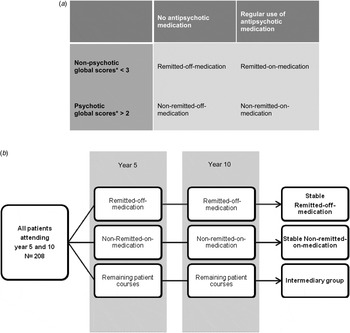
In this study the patients were divided into four groups based on their medication status and level of psychotic symptoms (Fig. 1 a) (Wils et al. Reference Wils, Gotfredsen, Hjorthøj, Austin, Albert, Secher, Thorup, Mors and Nordentoft2016). Criteria for being psychotic or non-psychotic were assessed using the SAPS interview covering symptoms 3 months prior to the interview (years 1, 2 and 5) or 6 months (year 10) (Cassidy et al. Reference Cassidy, Norman, Manchanda, Schmitz and Malla2010). When categorized as non-psychotic the global scores for hallucinations, delusions, bizarre behaviour or thought disorder should be lower than 3 (minimal to mild) (Andreasen et al. Reference Andreasen, Carpenter, Kane, Robert, Marder and Weinberger2005). Patients defined as using antipsychotics either took their medication daily or received it as depot. Regarding non-compliance, patients changed category if not taking their prescribed antipsychotic medication at all.
Categorization of outcome based on psychotic symptoms and antipsychotic medication at follow-up for patients with first-episode psychosis (Wils et al. Reference Wils, Gotfredsen, Hjorthøj, Austin, Albert, Secher, Thorup, Mors and Nordentoft2016). (a) Categorization of the participants into Remitted-off-medication, Remitted-on-medication, Non-remitted-off-medication and Non-remitted-on-medication. Global scores* = global scores on hallucination, delusion, bizarre behaviour or thought disorder (Scale of Assessment of Positive Symptoms interview). (b) Redistribution of the patients into the categories: Stable Remitted-off-medication, Stable Non-remitted-on-medication and Intermediary group. Patient courses from year 5 to year 10 included in the Intermediary group: Remitted-off-medication to Remitted-on-medication/Non-remitted-off-medication/Non-remitted-on-medication; Remitted-on-medication to Remitted-off-medication/Remitted-on-medication/Non-remitted-off-medication/Non-remitted-on-medication; Non-remitted-off-medication to Remitted-off-medication/Remitted-on-medication/Non-remitted-off-medication/Non-remitted-on-medication; Non-remitted-on-medication to Remitted-off-medication/Remitted-on-medication/Non-remitted-off-medication.

Patients were considered as Remitted-off-medication when rated non-psychotic and with no use of antipsychotic medication at the time of the follow-up, whereas Remitted-on-medication were rated non-psychotic and with a use of antipsychotic medication. Patients who were categorized as psychotic and not using antipsychotic medication at the time of the follow-up were referred to as Non-remitted-off-medication, while Non-remitted-on-medication were rated psychotic and on antipsychotic medication.
Defining patient courses
To examine the development in patient courses, we investigated patient outcome over time, i.e. if patients remained or changed group in consecutive follow-ups. We looked at the outcomes from years 1 to 2, 2 to 5 and 5 to 10. Since we grouped the patients into Remitted-off-medication, Remitted-on-medication, Non-remitted-off-medication and Non-remitted-on-medication, the development over two follow-ups resulted in 16 different courses.
In order to identify characteristics predicting a stable good or stable poor outcome, we divided the 16 courses into three larger groups ranking them as the best possible outcome (Stable Remitted-off-medication), the poorest possible outcome (Stable Non-remitted-on-medication) and an Intermediary group containing the rest of the patients (Fig. 1 b).
Statistical analysis
Statistical analyses were conducted using SPSS 20.0 (USA) and STATA/SE11.2 (USA). The univariable analyses were calculated applying ordinal logistic regression testing the significance (p < 0.05) of baseline predictors and 5-year predictors. We conducted sensitivity analyses using the same analytical approaches in multiply imputed (m = 100) data in order to assess how robust our results were to attrition. Regarding the analysis of DUP, the logarithm was applied since the distribution was skewed. To conduct the non-participant analysis, independent-samples t tests were used on scale variables, and the Pearson χ2 test was used on categorical variables. To assess differences in DUP between participants and non-participants a non-parametric test (Mann–Whitney U test) was applied since the distribution was skewed.
Ethical standards
All procedures contributing to this work comply with the ethical standards of the relevant national and institutional committees on human experimentation and with the Helsinki Declaration of 1975, as revised in 2008.
Results
Participants
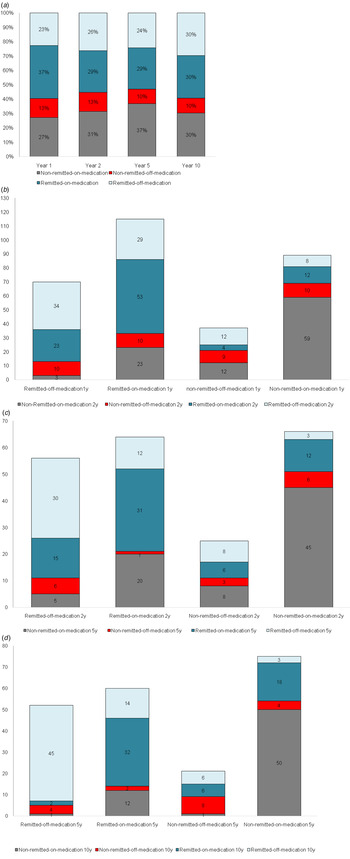
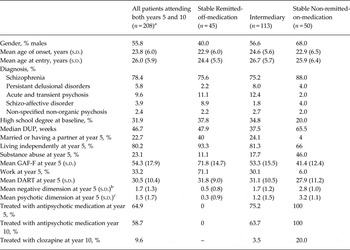
A total of 496 patients were included in the original OPUS trial. The follow-up rates ranged from 54% to 76% (Fig. 2a ). A complete description of the baseline cohort characteristics are described in previous studies (Petersen et al. Reference Petersen, Jeppesen, Thorup, Abel, Øhlenschlaeger, Christensen, Krarup, Jørgensen and Nordentoft2005; Bertelsen et al. Reference Bertelsen, Jeppesen, Petersen, Thorup, Øhlenschlaeger, le Quach, Christensen, Krarup, Jørgensen and Nordentoft2008). The population attending both years 5 and 10 had a mean age of 26.0 (s.d. = 5.9) years and 55.8% were male. Most patients (78.4%) were diagnosed with schizophrenia whereas the rest of the population was diagnosed with other psychotic disorders (Table 1).
Patient outcome at different follow-ups after first-episode psychosis. (a) Relative distribution of patients at all follow-ups. (b) Follow-up of patients with first-episode psychosis. Transition from year 1 (1y) to year 2 (2y) in absolute numbers. (c) Follow-up of patients with first-episode psychosis. Transition from year 2 to year 5 (5y) in absolute numbers. (d) Follow-up of patients with first-episode psychosis. Transition from year 5 to year 10 (10y) in absolute numbers. For (a), total number of patients: year 1: n = 379 (follow-up rate: 76%), year 2: n = 334 (follow-up rate: 67%), year 5: n = 266 (follow-up rate 54%), year 10: n = 303 (follow-up rate 68%). For (b–d), patient transition in absolute numbers. The bars represent the four groups: Remitted-off-medication, Remitted-on-medication, Non-remitted-off-medication, Non-remitted-on-medication and the patterns within each bar represent which of the groups the patients moved to at the consecutive follow-up. The participants had to attend the consecutive follow-ups to be included in the analysis (year 1–2: n = 311, 2–5: n = 211 and 5–10: n = 208). For a colour figure, see the online version of the paper.

Sociodemographic and clinical characteristics for Stable Remitted-off-medication, Intermediary and Stable Non-remitted-on-medication groups

s.d., Standard deviation; DUP, duration of untreated psychosis; GAF-F, Global Assessment of Functioning, function; DART, Danish Adult Reading Test; SANS, Scale of Assessment of Negative Symptoms; SAPS, Scale of Assessment of Positive Symptoms.
a There were slight variations in the total number of participants (especially for the variable DART, where n = 189).
b Negative dimension: mean value of the categories (alogia, affective flattening, anhedonia and avolition) from the SANS interview.
c Psychotic dimension: mean value of the categories (delusion and hallucination) from the SAPS interview.
Non-participants
Participants did not differ from non-participants (i.e. patients not participating at a given follow-up) regarding gender at any follow-up. At the 5- and 10-year follow-ups participants were significantly younger (at baseline) than non-participants; mean age difference at year 5 was 1.8 years (s.d. 0.58, p = 0.003) and at year 10 was 1.3 years (s.d. 0.59, p = 0.03). Baseline educational level (attending high school) was significantly higher amongst participants than non-participants at the 1- and 2-year follow-ups. Furthermore, participants had a higher baseline GAF-F score than non-participants at year 10 [mean difference in GAF = 3.6, 95% confidence interval (CI) 1.3–6.0, p = 0.02]. There was no significant difference in baseline diagnosis, pre-morbid social functioning, DUP, SANS score, SAPS score or substance abuse at baseline between participants and non-participants at any follow-up. Patients missing at year 5 or 10 followed the Intermediary group regarding days spent in psychiatric hospitals and supported housing (online Supplementary Fig. S1).
Patient outcome at years 1, 2, 5 and 10
We estimated the proportions of participants with different outcomes at years 1, 2, 5 and 10 using the full data observed for each assessment point, regardless of whether participants took part in other assessment points as well. The proportion of Remitted-off-medication increased in size by each follow-up, accounting for 30% of the patient population at year 10. The Remitted-on-medication comprised more than a third of the participants at all follow-ups, peaking at year 1 with 37%. The size of the Non-remitted-off-medication was stable at all follow-ups at approximately 10%. The Non-remitted-on-medication was also stable in size and accounted for around a third of the population at all follow-ups (Fig. 2a ).
Of the 33 patients who died during the follow-up period, nine had last belonged to the Remitted-on-medication group, two to the Non-remitted-off-medication and 14 to the Non-remitted-on-medication. The rest either died before the 1-year follow-up or never attended any follow-ups.
Long-term stability and patient courses
In the analysis of different patient courses, we found that patients in general displayed great continuity in outcome at each consecutive follow-up, most evident from year 5 to year 10 (Fig. 2b–d ).
This finding was most obvious in the Remitted-off-medication group from year 5 to year 10, illustrated by an 87% probability (95% CI 77–96%) for the Remitted-off-medication at year 5 for still being in this group at the 10-year follow-up.
The Remitted-on-medication group also displayed continuity in outcome, with 53% being in the same group from year 5 to year 10 and a further 23% being in the Remitted-off-medication group at year 10. Thus, good outcomes were maintained in 77% (95% CI 66–88%) of the Remitted-on-medication group between 5 and 10 years (Fig. 2). The group of Non-remitted-off-medication had no specific tendencies, which could be explained by the small group size.
At each follow-up a large proportion of Non-remitted-on-medication (30–37%) was found. Out of these patients, 67% (95% CI 56–78%) remained Non-remitted-on-medication at each consecutive follow-up (Fig. 2b–d ). However, within this group there was still a 24% (95% CI 14–34%) probability of being in the Remitted-on-medication group at the 10-year follow-up.
Predictors of stable outcome from year 5 to year 10
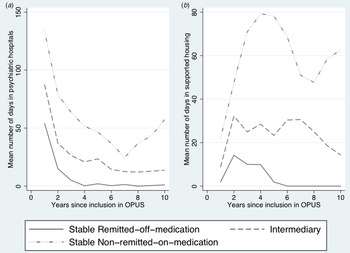
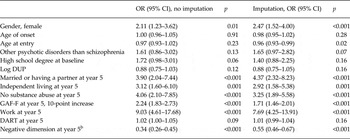
The most important predictors related to being in the Stable Remitted-off-medication group compared with the other two groups were female gender, higher GAF-F score, working, having a partner, living independently and the absence of substance abuse (all parameters at year 5). Yet, we found no significant association between a stable good outcome and the following baseline parameters: age, DUP, age of onset and educational level (high school degree) at baseline. A set of analyses with multiple imputations was conducted to address the risk of attrition bias and the same significant predictors of being in the Stable Remitted-off-medication group were found, except from the age variable (Table 2). Being diagnosed with schizophrenia was borderline significant in the multiple imputation analysis; we therefore conducted the analyses for the schizophrenia subgroup only. No major differences were found except for the variables high school, independent living and DART (online Supplementary Table S1). When looking at days spent in supported housing and psychiatric hospitals throughout the whole follow-up period, the Stable Remitted-off-medication had the lowest use in both categories whereas the Stable Non-remitted-on-medication had the highest (Fig. 3).
Number of days in psychiatric hospitals (a) and supported housing (b) during the 10-year follow-up period for patients with first-episode psychosis. (a) Mean number of days admitted in psychiatric hospitals in the three groups (n = 208) from official registers for years 1–10. Mean number of days accumulated from year 5 to year 10 for Stable Remitted-off-medication: 3.4 [96% confidence interval (CI) 0.83–7.72], Intermediary: 65.8 (95% CI 25.9–105.6) and Stable Non-remitted-on-medication: 199.1 (95% CI 112.4–285.7). (b) Mean number of days in supported housing in the three groups (n = 208) from official registers for years 1–10. Mean number of days accumulated from year 5 to year 10 for Stable Remitted-off-medication: 0 (95% CI –), Intermediary: 108.9 (95% CI 42.7–175.1) and Stable Non-remitted-on-medication: 301.8 (95% CI 137.7–465.9).

Univariable analyses of predictors for a good stable outcome from year 5 to year 10 a

Data are given as OR (95% CI) for a better outcome at the 10-year follow-up.
OR, Odds ratio; CI, confidence interval; DUP, duration of untreated psychosis; GAF-F, Global Assessment of Functioning, function; DART, Danish Adult Reading Test; SANS, Scale of Assessment of Negative Symptoms.
a The patient outcome is ranged as an ordinal variable with Stable Remitted-off-medication being the best possible outcome and Stable Non-remitted-on-medication being the worst outcome with the Intermediary group in between.
b Negative dimension: mean value of the categories (alogia, affective flattening, anhedonia and avolition) in the SANS interview.
Sensitivity analyses
Due to the amount of non-participation at the different assessment points, we estimated the proportions of participants falling into each of the four combinations of psychotic remission and medication in multiply imputed datasets. The proportions estimated in these analyses were almost identical to the ones estimated in the observed dataset (data not shown). We further also conducted analyses on predictors of stable outcome in these multiply imputed data, again with almost unchanged results (Table 2).
Discussion
Main findings
From this cohort of 496 patients with first-episode psychosis we investigated the use of antipsychotic medication in relation to psychotic symptoms at four follow-up points in a 10-year perspective. A main finding was the large proportion of patients in the Remitted-off-medication group, which increased in size by each follow-up, comprising 30% of the patient population at year 10. However, the most striking result was the large degree of stability regarding psychotic symptoms and antipsychotic medication, especially from year 5 to year 10, most prominent in the Remitted-off-medication group with an 87% probability of being in this same group both at years 5 and 10.
Remission and stability
Our results on the Stable Remitted-off-medication group suggest that a subgroup of patients had a relatively good and stable outcome on a long-term basis. This assumption is supported by a number of favourable characteristics (Tables 1 and 2). However, the assumption of stability could be challenged by the time gaps between the follow-ups where clinical status and use of antipsychotic medication remained unknown. Still, when taking the data on days spent in psychiatric hospitals and supported housing into consideration, it supports the idea of stability between the follow-ups (Fig. 3).
Our finding of a large group in remission of psychotic symptoms corresponds well with results from other cohort studies (Harrison et al. Reference Harrison, Hopper, Craig, Laska, Siegel, Wanderling, Dube, Ganev, Giel, an der Heiden, Holmberg, Janca, Lee, Leon, Malhotra, Marsella, Nakane, Sartorius, Shen, Skoda, Thara, Tsirkin, Varma, Walsh and Wiersma2001; Harrow et al. Reference Harrow, Jobe and Faull2012; Hegelstad et al. Reference Hegelstad, Larsen, Auestad, Evensen, Haahr, Joa, Johannesen, Langeveld, Melle, Opjordsmoen, Rossberg, Rund, Simonsen, Sundet, Vaglum, Friis and McGlashan2012; Moilanen et al. Reference Moilanen, Haapea, Miettunen, Jääskeläinen, Veijola, Isohanni and Koponen2013; Morgan et al. Reference Morgan, Lappin, Heslin, Donoghue, Lomas, Reininghaus, Onyejiaka, Croudace, Jones, Murray, Fearon, Doody and Dazzan2014). In a large multi-national cohort study containing 1633 subjects with psychotic illness, around half of the population achieved an outcome considered ‘favourable’ at both years 15 and 25 (Harrison et al. Reference Harrison, Hopper, Craig, Laska, Siegel, Wanderling, Dube, Ganev, Giel, an der Heiden, Holmberg, Janca, Lee, Leon, Malhotra, Marsella, Nakane, Sartorius, Shen, Skoda, Thara, Tsirkin, Varma, Walsh and Wiersma2001). Similar results were found in the Aetiology and Ethnicity in Schizophrenia and Other Psychoses 10-year follow-up (AESOP-10) study where 101 out of 228 patients with first-episode non-affective psychosis had had symptom recovery for at least 2 years at the 10-year follow-up; 56% in this subgroup were prescribed antipsychotic medication (Morgan et al. Reference Morgan, Lappin, Heslin, Donoghue, Lomas, Reininghaus, Onyejiaka, Croudace, Jones, Murray, Fearon, Doody and Dazzan2014). However, none of these studies investigated the patient courses with a systematic focus on continuity in psychotic symptoms and its relation to the use of antipsychotic medication.
Our results are different from numerous randomized trials where the effect of antipsychotics compared with discontinuation/placebo was investigated (Gitlin et al. Reference Gitlin, Nuechterlein, Subotnik, Ventura, Mintz, Fogelson, Bartzokis and Aravagiri2001; Chen et al. Reference Chen, Hui, Lam, Chiu, Law, Chung, Tso, Chan, Yao, Hung and Honer2010; Boonstra et al. Reference Boonstra, Burger, Grobbee and Kahn2011). The meta-analysis and reviews in this field clearly concluded that patients assigned to discontinuation of antipsychotic medication had much higher relapse rates than patients on medication (Leucht et al. Reference Leucht, Tardy, Komossa, Heres, Kissling, Salanti and Davis2012; Zipursky et al. Reference Zipursky, Menezes and Streiner2014). Thus, the results from a review comparing six studies on discontinuation estimated a total relapse rate at 77% following medication discontinuation v. 3% for maintenance treatment (Zipursky et al. Reference Zipursky, Menezes and Streiner2014).
One possible explanation for the differences in the Remitted-off-medication group in this study compared with the randomized clinical trials could be variations in study length. The study lengths in the randomized clinical trials were at maximum 3 years compared with much longer follow-up periods in the cohort-studies (i.e. 10–25 years). Results from both our study and other cohort studies suggest that long-term and short-term outcome may differ. The development over time in the Remitted-off-medication group might be an expression of a natural course of psychotic illness with a regressive disease pattern over time, at least for a selected subgroup of patients. This is also stated in an older cohort study investigating the course of life in patients with schizophrenia (Ciompi & Clemens, Reference Ciompi and Clemens1980).
Results from a discontinuation/dose reduction trial were distinguishable from the other randomized trials. At the 7-year follow-up patients in the discontinuation/dose reduction group had a higher recovery rate than those in the maintenance group. The authors considered the large degree of patient involvement a key element (Wunderink et al. Reference Wunderink, Nienhuis, Sytema, Slooff, Knegtering and Wiersma2007, Reference Wunderink, Nieboer, Wiersma, Sytema and Nienhuis2013). Our study was naturalistic in design and a potential discontinuation of medication could be based on patient initiative and as suggested this might play a role.
It must be kept in mind that the rather positive outcome of the Dutch study could be influenced by over half of the patients being diagnosed with other psychotic disorders than schizophrenia (Wunderink et al. Reference Wunderink, Nienhuis, Sytema, Slooff, Knegtering and Wiersma2007, Reference Wunderink, Nieboer, Wiersma, Sytema and Nienhuis2013). In our study, one may also suggest that the positive outcome in the Stable Remitted-off-medication group was driven by a larger proportion of non-schizophrenia patients. However, the majority was indeed diagnosed with schizophrenia and the analyses on this subgroup alone showed that the predictors remained nearly the same (online Supplementary Table S1).
The Stable Non-remitted-on-medication
The large Non-remitted-on-medication group was not unique for the OPUS cohort and this finding is consistent with the widely accepted notion that a substantial proportion of patients have a poor long-term outcome (Harrison et al. Reference Harrison, Hopper, Craig, Laska, Siegel, Wanderling, Dube, Ganev, Giel, an der Heiden, Holmberg, Janca, Lee, Leon, Malhotra, Marsella, Nakane, Sartorius, Shen, Skoda, Thara, Tsirkin, Varma, Walsh and Wiersma2001; Harrow & Jobe, Reference Harrow and Jobe2010).
The Stable Non-remitted-on-medication was primarily characterized by a low level of functioning, unemployment, substance abuse and male gender. These characteristics related to a poor outcome have been stated in other studies as well (Riecher-Rössler & Häfner, Reference Riecher-Rössler and Häfner2000; Køster et al. Reference Køster, Lajer, Lindhardt and Rosenbaum2008). The Stable Non-remitted-on-medication stood out when it came to symptomatology with a mean psychotic dimension of 3.2 and mean negative dimension of 2.8. These parameters indicate that the Stable Non-remitted-on-medication was a group with a serious disease course. However, it should also be pointed out that almost 30% of the group showed improved outcome from 5 years to 10 years, indicating that improvement is still possible late in illness course.
Study limitations
Like all other long-term follow-up studies this also faced the risk of attrition bias due to patients lost to follow-up. Although the OPUS cohort had a number of strengths including large sample size, long follow-up period and good external validity, the risk of attrition bias may lead to an overestimation of patients with a good outcome. This potential positive selection especially concerned analyses conducted on consecutive follow-ups, since the patients had to be present at both – also keeping in mind that the follow-up rate at year 5 was 54%. Yet, patients not attending year 5 or 10 showed the same tendencies for days spent in hospital or supported housing as the patients in the Intermediary group, implying that the non-participants did not entirely consist of patients with a poor outcome (online Supplementary Fig. S1). In order to further address the attrition bias, we conducted a dataset based on multiple imputations. This analysis revealed the same results, indicating that the regular dataset was representative of the cohort in general. Still, with multiple imputations there is always the risk that the non-participants are ‘missing not at random’. One alternative approach to reduce this potential attrition would have been to include earlier assessment points (i.e. years 1 and 2) in cases where year 5 data were missing. However, this would have meant using data from a period where the patients’ psychotic illness might not have stabilized yet, which could have given potentially misleading results. We consequently opted not to pursue this approach.
Another limitation is the well-known and common issue with compliance and adherence to medication. Since this was a cohort study with no systematic intervention on medication, it was not an option to perform pill count or blood samples. However, the compliance was measured by independent interviewers who were not involved in the treatment of the patients. They aimed to be non-judgmental and did not intervene on poor compliance. With this approach we assume that the patients provided reliable information.
The redistribution of the 16 groups into the Stable Remitted-off-medication, Stable Non-remitted-on-medication and Intermediary can also be considered a bit simplistic. Especially the Intermediary group contains very different patient outcomes including both psychotic and non-psychotic patients and does not allow for differentiation of these. However, the data support that the Intermediary group actually do lie between the two other outcomes, making an ordinal ranking of the three groups acceptable.
Clinical implications
The finding of the large group of Stable Non-remitted-on-medication calls for reflection on whether the existing treatment strategy is optimal. Medication algorithms for treatment-resistant schizophrenia recommend monotherapy with clozapine if regular antipsychotic medication fails to work (Dold & Leucht, Reference Dold and Leucht2014). Only 20% of the Stable Non-remitted-on-medication received clozapine at the 10-year follow-up, which might indicate that not all pharmacological treatment options were tried.
The results on Stable Remitted-off-medication challenge the idea that schizophrenia always is a chronic disorder with a poor prognosis. However, this study is naturalistic in its design and no systematic intervention on discontinuation was made. It is therefore not possible to elaborate on causality between symptomatology and use of antipsychotic medication. Still, the fact that some patients can obtain remission of psychotic symptoms on a long-term basis is an important message but further investigation examining the effect of professionally guided discontinuation with a degree of patient involvement is much needed; thereby allowing for more individualization in the long-term treatment of psychotic illness.
Supplementary material
The supplementary material for this article can be found at https://doi.org/10.1017/S0033291717000563
Acknowledgements
Additional non-author contributions were made by: Maj-Britt Abel, Pia Jeppesen, Lone Petersen, Johan Øhlenschlæger, Runa Munkner, Mette Bertelsen, Britt Morthorst, Marianne Melau, Heidi Jensen, Lasse Randers, Torben Christensen, Gertrud Krarup, Phoung Le Quack and Lars Morsaae. All contributed to the data collection.
Funding was received from the Danish Council for Independent Research (Medical Sciences; 9601612 and 9900734); Trygfonden; The Mental Health Services of the Capital Region of Denmark; the Danish Ministry of Health (96-0770-71); the Danish Ministry of Social Affairs; and the Psychiatry and Social Service Department in Central Denmark Region. None of the funding sources played a role in the planning of the study or in the data analysis and interpretation.
Declaration of Interest
None.