Iron deficiency is the most common paediatric nutritional deficiency in the United States, found in 7–15% of children, and is even more common in children with chronic diseases like chronic kidney disease, inflammatory bowel disease, and heart failure . Reference Powers and Mahoney1–Reference Baracco, Saadeh and Valentini5 Over 50% of children with heart failure are iron deficient, and iron deficiency is associated with increased hospitalisation burden and worse echocardiographic features in this population. Reference Puri, Price and Spinner6,Reference Higgins, Otero and Jefferis Kirk7 In both children and adults with heart failure, iron deficiency is also independently associated with higher risk of ventricular assist device implantation, heart transplant, or death Reference Puri, Price and Spinner6–Reference von Haehling, Ebner and Evertz8 , regardless of the presence of anaemia.
In adults with heart failure, oral iron replacement therapy is ineffective in replacing iron stores. In the Iron Repletion Effects on Oxygen Uptake in Heart Failure – IRONOUT-HF trial, oral iron therapy was efficacious in only 24% of participants. Oral iron therapy was also not effective in improving important patient-centred outcomes including the 6-minute walk test and health-related quality of life. Reference Lewis, Malhotra and Hernandez9 In contrast, intravenous iron replacement therapy is effective in replenishing iron stores, reducing hospitalisation, and improving exercise performance and quality of life in adult heart failure patients. Reference von Haehling, Ebner and Evertz8,Reference Ponikowski, van Veldhuisen and Comin-Colet10,Reference van Veldhuisen, Ponikowski and van der Meer11 In children with iron deficiency, oral iron replacement therapy remains the recommended first-line therapy. There are no specific recommendations for the treatment of iron deficiency in children with heart failure and no published reports on the efficacy of oral iron replacement therapy in children with systolic heart failure.
Methodology
We performed a single-centre retrospective review of all patients aged ≤21 years with systolic heart failure and iron deficiency who received treatment doses of oral iron replacement therapy (in the form of ferrous sulphate or gluconate) from 1 January 2013 to 30 April 2019. The study was approved by the Baylor College of Medicine Institutional Review Board. Systolic heart failure was defined as depressed systolic function on echocardiography (ejection fraction less than 50% if measured or qualitatively mildly depressed or worse systolic function). Iron deficiency was defined per our previously published criteria as the presence of ≥2 of the following four criteria on iron panel testing: serum iron <50 mcg/dL, serum ferritin <20 ng/mL, transferrin >300 ng/mL, transferrin saturation <15%. Reference Puri, Price and Spinner6,Reference Puri, Jeewa and Adachi12 Anaemia was defined per the sex- and age-based criteria issued by the World Health Organization . 13 Microcytosis was defined per the age-based criteria published by the World Health Organization. 14 Anaemia, microcytosis, and/or haemoglobin levels were not considered in the diagnosis of iron deficiency or the prescription of iron replacement therapy. Patients who received any intravenous iron replacement therapy before or during the oral iron course (that would reflect in follow-up testing) were excluded from the efficacy analysis. Per our institutional protocol, patients may be screened for iron deficiency multiple times over the course of their care; however, only the first occurrence of iron deficiency and iron replacement therapy were considered for this analysis. Patients on ventricular assist device support at time of oral iron therapy were excluded from this study.
The primary outcome was the efficacy of oral iron replacement therapy, defined as resolution of iron deficiency on follow-up serum iron testing. Resolution of iron deficiency was defined as normalisation of three or more of the four criteria for iron deficiency. Demographic features and clinical characteristics of the entire cohort were described to illustrate haematologic features of iron deficiency in paediatric heart failure as well as the prescribing practice of iron replacement therapy for the study cohort. Clinical features included aetiology of heart failure, cyanotic heart disease or cyanotic physiology at baseline, serum B-type natriuretic peptide level at time of diagnosis of iron deficiency, presence of cyanosis at time of diagnosis, chronic nature of heart failure, Ross Classification of Pediatric Heart Failure (Class I to IV), Reference Ross15 whether patient was chronically admitted for management of heart failure (as compared to being managed as an outpatient), need for inotropic support for management of heart failure (e.g. long-term milrinone therapy), and mechanical ventilation. Nutritional status was represented as completely enteral nutrition (compared to need for parenteral nutrition) and category of body mass index for age and height (underweight, normal weight, and overweight or obese per the growth chart of the Centers for Disease Control and Prevention). 16 The type of iron replacement therapy as well daily doing of elemental iron per unit body weight and duration of therapy were assessed. The volume of transfusion received after initial diagnosis of iron deficiency till follow-up testing or in the 3 months after initial diagnosis (whatever was later) was recorded in mL from the electronic blood product administration record. Haematologic parameters, including presence/absence of microcytosis or elevated red cell distribution width as well as burden of anaemia, were analysed prior to and after therapy, in addition to the serum iron studies, to assess haematologic response to iron replacement therapy. The baseline demographic, clinical, and haematologic parameters as well as serum iron studies were also compared between responders and non-responders to evaluate for possible predictors of successful response to oral iron therapy.
Statistical analysis
Statistical analysis was conducted using SPSS 22.0 (IBM Corporation, Armonk, NY), with descriptive statistics including frequencies and proportions or medians and interquartile ranges for categorical and continuous variables, respectively. Univariate analysis was performed using chi-square test or paired-samples Wilcoxon signed-rank test for categorical and continuous variables, respectively. We performed a secondary analysis to identify predictors of response to oral iron replacement therapy. Statistical significance was defined at p < 0.05.
Results
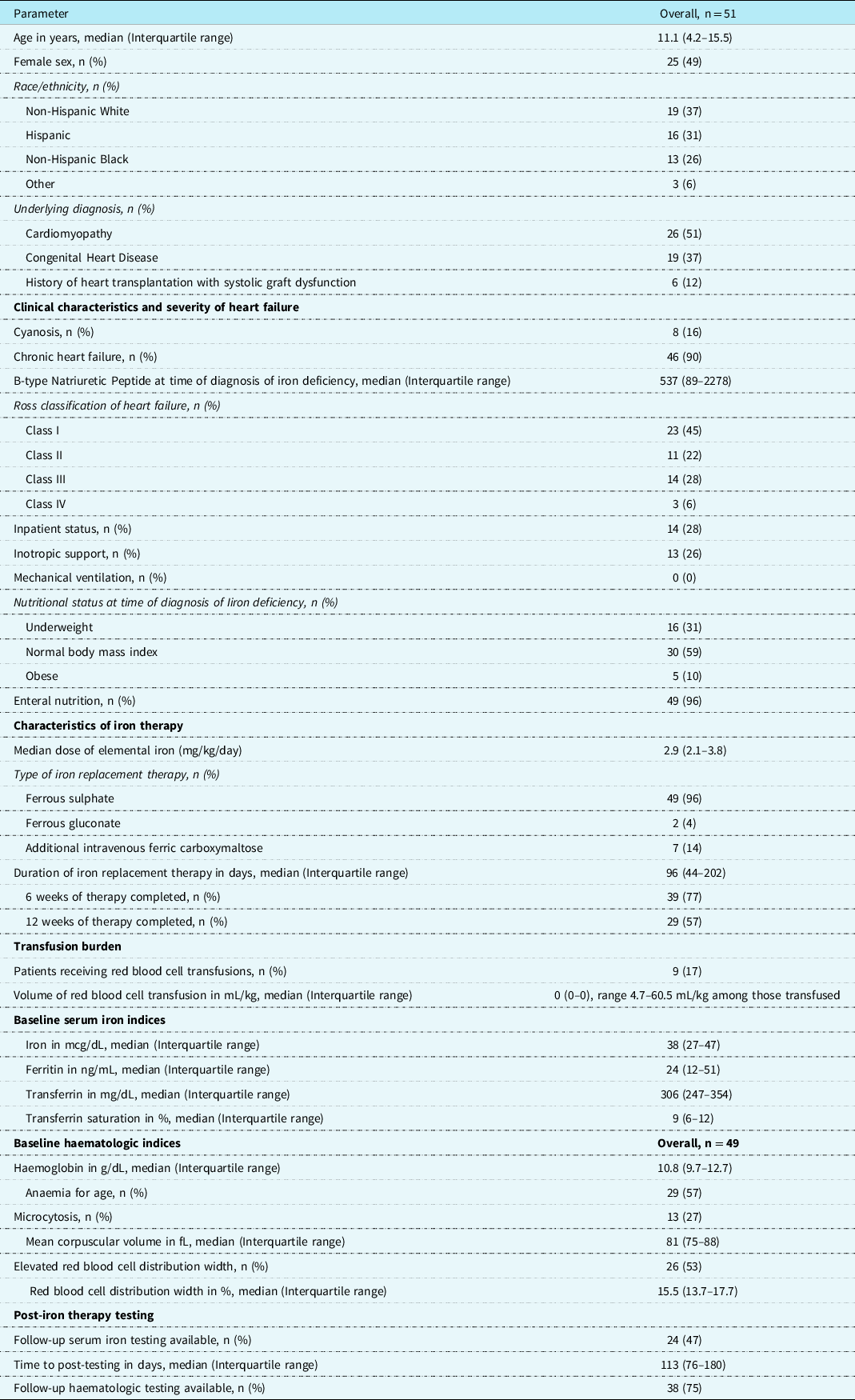
Fifty-one unique children with systolic heart failure and iron deficiency were treated with oral iron replacement therapy during the study period and met inclusion criteria for the analysis. Baseline clinical features as well as serum iron and haematologic parameters are shown in Table 1. The median age of the cohort was 11.1 years, 49% were female, and 37% were non-Hispanic White. A majority of the patients had cardiomyopathy as the underlying aetiology of their heart failure (51%), and 90% had chronic heart failure. A majority of the patients had Ross Classes I to III heart failure, with Class I comprising 45% of the cohort. Just over 1/4th of the cohort was inpatient or on inotropic support, and no patients were mechanically ventilated. About 1/3rd of the cohort was underweight. Only 16% of the patients had cyanosis at baseline.
Demographic and clinical characteristics of study cohort

The baseline haematologic characteristics are shown in Table 1. Only 57% of the patients were anaemic, only 13% had microcytosis, and 53% had elevated red cell distribution width. Nine patients received red blood cell transfusions (9/52, 17%) with volumes ranging from 4.7 mL/kg to 60.5 mL/kg. Table 1 also depicts the median baseline values of the iron studies and the characteristics of iron replacement therapy. Oral ferrous sulphate was the most commonly used formulation of oral iron replacement (96%). Median duration of oral iron replacement therapy was 96 days (Interquartile range 44–202 days) and median daily dose of elemental iron per kg was 2.9 mg/kg/day (interquartile range 2.1–3.8 mg/kg/day). Fifty-seven per cent of these courses were taken for a minimum of 90 days. Seven patients also got intravenous iron therapy with ferric carboxymaltose concomitant with the start of oral iron therapy and were excluded from the efficacy analysis.
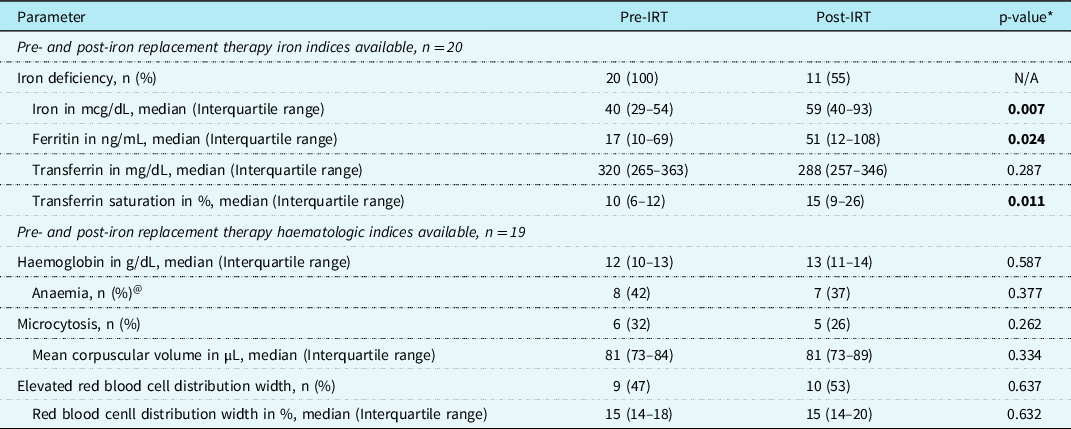
Twenty-four patients had follow-up serum iron testing available; however, 4 of those were after intravenous iron doses in addition to oral iron. The remaining 20 patients were included in the efficacy analysis. The range of duration of oral iron therapy prior to follow-up testing for the patients included in the efficacy analysis was 35 days to 562 days. The comparison of serum iron studies and haematologic parameters pre- and post-oral iron replacement therapy is shown in Table 2. Fifty-five per cent (12/22) of the patients remained iron deficient after iron replacement therapy. Increments in serum iron, serum ferritin, and transferrin saturation occurred, yet the change in transferrin saturation was not enough to overcome the threshold for iron deficiency. Transferrin levels did not improve significantly.
Comparison of serum iron studies and haematologic indices pre- and post-oral iron replacement therapy

* Paired-samples Wilcoxon test, boldface values indicate statistical significance with p-value <0.05.
@ Four of the eight patients anaemic pre-IRT remained anaemic; three new patients became anaemic despite being on IRT.
In terms of the haematologic features, there was no significant change in the haemoglobin or in the proportion of patients with anaemia pre- and post-oral iron replacement therapy. Four of the eight patients who were anaemic pre-therapy remained anaemic, and three new patients became anaemic despite being on iron replacement therapy. There was also no change in the mean corpuscular volume, proportion of patients with microcytosis, or red cell distribution width pre- and post-oral iron replacement therapy.
In a post hoc analysis using a modified definition of response to iron therapy, with response defined as an increase in haemoglobin by 1 g/dL, only seven of the patients in our cohort would have met the criteria for response with the majority (12/19, 63%) remaining non-responders. With regard to the efficacy of intravenous iron therapy, out of the seven recipients, four had follow-up iron testing, all of whom had successful treatment of iron deficiency.
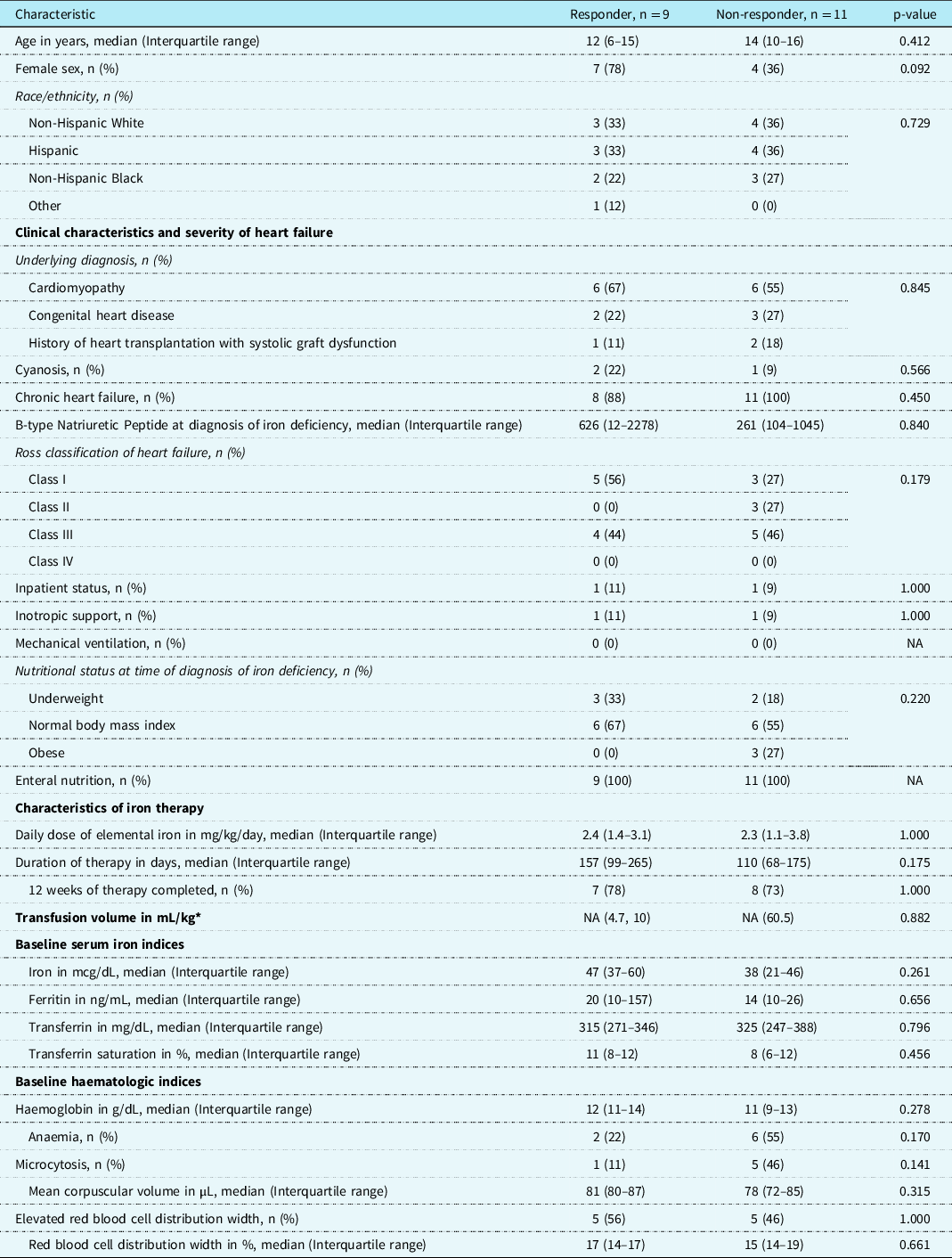
Table 3 shows the comparison of clinical characteristics between responders and non-responders to oral iron therapy. Among the 9 responders and 12 non-responders, there were no statistically significant demographic or clinical differences. There was no difference between the responders and non-responders in terms of the proportion of patients with chronic heart failure or higher Ross Class of heart failure, median baseline B-type natriuretic peptide, or proportion of patients receiving inotropic support or inpatient heart failure management. There was also no significant difference in the baseline nutritional status or enteral feeding abilities between the groups. There was no association between the median daily doses of the oral iron therapy or the duration of therapy with response to oral iron therapy. The serum iron parameters of the “non-responders” tended to be more deficient than the “responders” with median serum iron of 38 mcg/dL versus 47 mcg/dL; median serum ferritin of 14 ng/mL versus 20 ng/mL; median transferrin of 325 mg/dL versus 315 mg/dL; and median transferrin saturation of 8% versus 11%; however, none were statistically significant and all p > 0.2.
Comparison of demographic and clinical characteristics of responders and non-responders to oral iron replacement therapy

* Two patients transfused among the responders (4.7 mL/kg and 10 mL/kg) and one patient transfused among the non-responders (60.5 mL/kg).
Discussion
This is the first study to describe the efficacy of oral iron replacement therapy in children with systolic heart failure and iron deficiency. In a limited cohort, we found that oral iron replacement therapy was effective in less than half of the patients, with 55% of the patients remaining severely iron deficient. We also found that anaemia and microcytosis had poor sensitivity to detect iron deficiency, supporting the need to assess serum iron parameters to assess for iron deficiency in addition to a haemogram, particularly in this patient population.
In view of the established association of iron deficiency with worse clinical outcomes including exercise intolerance, hospitalisation burden, and mortality, as well as the positive impact of effective iron replacement therapy on these outcomes, treatment of iron deficiency is now standard of care for patients with systolic heart failure. Reference von Haehling, Ebner and Evertz8,Reference Ponikowski, van Veldhuisen and Comin-Colet10,Reference van Veldhuisen, Ponikowski and van der Meer11,Reference Klip, Comin-Colet and Voors17,Reference Anker, Kirwan and van Veldhuisen18 Oral iron replacement therapy, however, has demonstrated disappointing performance in studies including adults with heart failure. The largest trial of high-dose oral iron therapy in adults with iron deficiency and systolic heart failure, the IRONOUT-HF study, showed no significant improvement in functional outcomes or health-related quality of life. Further, similar to our study, the IRONOUT-HF study demonstrated a statistically significant yet clinically inadequate improvement in serum iron and transferrin saturation levels after 16 weeks of high-dose oral iron replacement therapy. Reference Lewis, Malhotra and Hernandez9 Our study findings showed a slight improvement in serum iron parameters over 6 weeks of therapy, but the patients remained overall iron deficient. It is possible that higher daily doses or longer courses of therapy may replenish iron stores in our patients. However, the IRONOUT-HF study demonstrated that high-dose oral iron therapy was not effective in treating iron deficiency. This indicated that longer and higher dose oral iron replacement therapy may not necessarily improve efficacy of oral iron therapy or address the tissue-level iron deficiency driving outcomes in heart failure patients. Reference Lewis, Malhotra and Hernandez9 Furthermore, high-dose oral iron therapy also has worse gastrointestinal side-effects and may limit compliance. Further, while the outcomes of a child with heart failure vary based on the cause of heart failure, the overall ICU mortality rate after an admission for acute decompensated heart failure is significant at nearly 15%. The 1-year transplant-free survival ranges from 50–75% in children with dilated cardiomyopathy. Reference Lasa, Gaies and Bush20,Reference Alvarez, Orav and Wilkinson21,Reference Singh, Canter and Shi22,Reference Alexander, Daubeney and Nugent23 Congenital heart disease is a growing cause of paediatric heart failure and is associated with worse hospital mortality in paediatric heart failure admissions. Reference Rossano, Kim and Decker24 Hence, when aiming to successfully treat iron deficiency in children with heart failure, there is less ability to trial prolonged treatment courses and await response due to the risk of the patient continuing to worsen and progress in the interim.
It is important to note that we defined iron deficiency as the presence of two or more abnormal serum iron indices among iron, ferritin, transferrin, and transferrin saturation. While there are no established criteria for children with heart failure, we followed the same criteria which we have previously utilised in studies on iron deficiency in this population from our group. Reference Puri, Price and Spinner6,Reference Puri, Jeewa and Adachi12 These criteria diagnosed iron deficiency in 56% of the children with systolic heart failure at our centre over a 5-year period, and iron deficiency diagnosed based on these criteria was associated with greater risk of ventricular assist device, heart transplant, or death. Reference Puri, Price and Spinner6 Prior studies in adults with heart failure have utilised less stringent criteria of serum ferritin <100 ng/mL (as heart failure is presumed to be an inflammatory state) or transferrin saturation <20% (in the presence of ferritin from 100 to 299 ng/mL). Reference von Haehling, Ebner and Evertz8–Reference van Veldhuisen, Ponikowski and van der Meer11,Reference Klip, Comin-Colet and Voors17,Reference Anker, Kirwan and van Veldhuisen18 These were also criteria that were used to diagnose iron deficiency which was found to be associated with worse clinical outcomes. For children with chronic kidney disease, iron deficiency is defined as ferritin <100 ng/mL or transferrin saturation <20%, and these are used as cut-offs for treatment. 19 Potentially, we may be underestimating the efficacy of oral iron therapy in more mild forms of iron deficiency. However, in the absence of recommendations for treatment of iron deficiency in children with heart failure, we chose to follow consistent criteria that we have previously demonstrated. Reference Puri, Price and Spinner6 These criteria were sufficiently sensitive to diagnose iron deficiency in over half of our cohort child with systolic heart failure, and these criteria were clinically relevant in that iron deficiency defined by these criteria predicted significantly worse outcomes. Reference Puri, Price and Spinner6
The underlying mechanism and impact of iron deficiency in heart failure patients is multifactorial and not limited to the haematopoietic role of iron. Reference von Haehling, Ebner and Evertz8,Reference Hoes, Grote Beverborg and Kijlstra25,Reference Charles-Edwards, Amaral and Sleigh26 Iron is a part of the iron-sulphur complexes in mitochondria and plays a critical role in normal cytochrome functioning. Hence iron deficiency, which manifests in the tissue prior to the onset of anaemia, leads to detrimental impacts on oxidative phosphorylation and aerobic metabolism in a vulnerable patient with pre-existing heart failure. In vitro studies in cardiac myocytes as well as in vivo studies in adults with heart failure have shown decreased contractility and lower ATP regeneration in iron-deficient state, which is improved to near-normal after effective iron replacement. Reference Hoes, Grote Beverborg and Kijlstra25,Reference Charles-Edwards, Amaral and Sleigh26
The poor performance of oral iron replacement therapy in adults with heart failure is in stark contrast to studies on intravenous iron replacement, which have shown improvements in clinical measures ranging from severity of heart failure based on the New York Heart Association classification, readmission burden, quality of life, and 6-minute walk test, starting as early as 4 weeks after commencing treatment. Reference Puri, Price and Spinner6,Reference Ponikowski, van Veldhuisen and Comin-Colet10,Reference van Veldhuisen, Ponikowski and van der Meer11,Reference Anker, Kirwan and van Veldhuisen18 Hence, the American College of Cardiology and the American Heart Association have a Class IIB recommendation for treatment of iron deficiency in adults with heart failure using intravenous iron formulations. Reference Yancy, Jessup and Bozkurt27 Currently, there are no such guidelines for children with heart failure. In the field of paediatrics, a 3-month course of oral iron replacement therapy is still the recommended first-line treatment for iron deficiency to completely replenish the body’s iron stores. Reference Powers and Mahoney1,Reference Powers28 However, our study demonstrates that children with systolic heart failure have a poor response to oral iron replacement, with >50% remaining severely iron deficient at the end of therapy. Since response to oral iron replacement is typically most rapid at the onset of therapy, therefore, when monitoring for response, we expect to see an improvement to less severe iron deficiency by the 4- to 6-week mark. Reference Powers and Mahoney1,Reference Powers28 The median duration of therapy was more than 90 days for both the responders and the non-responders, so we would expect to see an improvement by the end of therapy for these patients. In our patients, although some of the serum iron parameters improved, it was not enough to improve their iron deficiency adequately. The possible reasons for this may be multiple in children with heart failure. They may have gut mucosal oedema and dysfunction which may limit absorption. Additionally, these patients may have elevated levels of the iron regulatory hormone hepcidin (in the setting of chronic inflammatory state of heart failure) which may also limit absorption. Reference Ganz29 While we had follow-up testing in only four of the seven patients who received concomitant intravenous iron therapy, iron deficiency was effectively treated in all four of these patients. Greater efficacy of intravenous iron therapy would lend credence to the theory of poor absorption. These challenges limiting the efficacy of oral iron have also previously been demonstrated in children with chronic kidney disease and inflammatory bowel disease. Reference Goyal, Zheng and Albenberg4–Reference Baracco, Saadeh and Valentini5 Finally, due to the retrospective nature of this study, we did not have information about compliance to therapy in our study cohort. Due to the gastrointestinal side effect profile, oral iron therapy is unfortunately at risk for poor compliance, especially in children who are already on multiple medications due to their underlying chronic disease (heart failure, chronic kidney disease, or inflammatory bowel disease). Reference Powers, Nagel, Raphael, Mahoney, Buchanan and Thompson30,Reference Powers, Daniel, McCavit and Buchanan31 Hence, we do believe that our study reflects the “real-world” efficacy of oral iron therapy in children with heart failure and iron deficiency (in the patients for whom follow-up iron-testing was available).
Our current report adds to the body of literature supporting that haematologic features including anaemia, microcytosis, or elevated red cell distribution width are not sensitive indicators for iron deficiency in children with heart failure. Reference Puri, Price and Spinner6,Reference Puri, Jeewa and Adachi12 In fact, microcytosis had a sensitivity of only 27% to diagnose iron deficiency in our current study and was sensitive to detect iron deficiency in only 42% of patients in our previously published report. Reference Puri, Price and Spinner6 Waiting till these children manifest anaemia may lead to further worsening of iron deficiency and worse clinical outcomes.
Finally, our study also draws attention to the room for improvement in the practice of prescribing iron replacement therapy and monitoring its efficacy for children with heart failure, to maximise chances of success in the “responders” and ensure timely referral for intravenous iron treatment for “non-responders”. Increasing awareness about the recommended doses and duration of oral iron replacement therapy as well as the need for follow-up serum iron panel testing to assess for response or persistent iron deficiency will help improve our performance in these domains. For instance, as an institution, based on these data, we have formalised an iron deficiency screening and treatment protocol for children with systolic heart failure with ready dosing references and follow-up testing prompts.
Our study is limited by its retrospective, single-centre nature, and the small sample size. Further, follow-up iron testing was not available in a majority of patients. However, this also suggests a need to improve the practices of follow-up testing after initiation of iron replacement therapy and may be the target of quality improvement initiatives. There are no established cut-offs for treatment of iron deficiency in children with heart failure, hence we utilised criteria that we had previously demonstrated to be associated with worse clinical outcomes. However, future studies to establish diagnostic criteria and therapeutic guidelines in this population would be important. Additionally, patients with cyanosis have higher iron needs to support their compensatory polycythaemia and hence may need a lower threshold for iron deficiency treatment – however, defining this is beyond the scope of this study. We did not have 6-minute walk testing available at appropriate time-points (for older patients) to potentially study the functional improvement after oral iron replacement therapy. Larger prospective studies with uniform dosing and follow-up testing protocols and functional outcome assessments are needed to determine the optimal regimen of iron replacement therapy in children with systolic heart failure, as well as identify the “high-risk/non-responder” cohort that may benefit from early resort to intravenous iron replacement therapy.
Conclusion
We present the first data on efficacy of oral iron therapy in children with systolic heart failure. Over half of the patients with systolic heart failure and iron deficiency with available follow-up iron studies had an ineffective response to oral iron replacement therapy. Hence our study findings raise concern that oral iron may be ineffective in repletion of iron stores in child with heart failure. Due to the low sensitivity of haematologic parameters for diagnosing iron deficiency, serum iron testing at regular intervals may be needed to make the diagnosis as well as monitor for treatment efficacy. Routine follow-up testing may also help identify patients who need escalation to intravenous iron replacement therapy for successful treatment of iron deficiency.
Acknowledgements
We are grateful to the patients and families that we have the privilege to care for.
Financial support
This research received no specific grant from any funding agency, commercial or not-for-profit sectors.
Conflicts of interest
None.
Ethical standards
The authors assert that this research did not involve human or animal experimentation. This research study complies with ethical guidelines for retrospective cohort studies and has been approved by the institutional committees (Baylor College of Medicine Institutional Review Board).
Contributors’ statement
Dr Puri conceptualised and designed the study, collected data, carried out the initial analysis, and drafted and revised the manuscript.
Dr Spinner collected data, carried out the initial analysis, and critically reviewed the manuscript.
Drs Denfield, Dreyer, Choudhry, and Tunuguntla coordinated and supervised data collection, supervised analysis, and critically reviewed and revised the manuscript.
Drs Powers and Price conceptualised and designed the study, supervised data collection, and reviewed and revised the manuscript.
All authors approved the final manuscript as submitted and agree to be accountable for all aspects of the work.