I. TO COUNT OR NOT TO COUNT
Imagine that you know that a person is stranded on a small rock in the rising tide, and that he will surely die if you do not come to his rescue. You also know, however, that on a different rock, two other people face the same fate. Although you have a fast boat, there is no way you will be able to save all three.
Non-consequentialists disagree on how to resolve such situations.Footnote 1 It has proved surprisingly difficult to converge on a decision procedure that meets the most important non-consequentialist requirements. The main contenders include: (a) a fair coin toss regardless of the relative size of the conflicting groups,Footnote 2 (b) saving the larger groupFootnote 3 and (c) a proportional lottery, where each individual is given a 1/N chance of being saved.Footnote 4
Lotteries (in this particular context) come mainly in two types. The first type assumes that each imperiled person is due a proportional chance of being saved, and that individuals belonging to the same group are allowed to pool their chances.Footnote 5 The second type, which is the type I will examine here, also gives each imperiled person a proportional chance of being saved, but denies that chances can be pooled. The idea of pooling chances has been criticized,Footnote 6 and doing without it might count as a gain for a non-consequentialist theory. On the individualist lottery (IL) only one person wins the lottery, but anyone who happens to be stranded on the same rock as the winner will also be saved, because the rescuer no longer faces conflicting claims.Footnote 7 (This has been criticized as well.)Footnote 8
The purpose of my discussion is to show that the IL is less plausible than the coin toss as a non-consequentialist procedure for deciding which group to save in conflict situations,Footnote 9 even if the IL is the procedure which arguably is best equipped to meet the marginal difference criterion (MDC), according to which all individuals in conflict cases ought to have some bearing on the rescuer's decision-making.
In the next section I set out two accounts of the IL (defended by Jens Timmermann and Ben Saunders, respectively), and point to some important similarities between them. In section III I criticize the IL and argue that it should be rejected (and that we should toss a coin instead). In section IV I strengthen the conclusion of the preceding section by arguing that the fact that IL meets the MDC is not sufficient to redeem it. Section V concludes.
Before proceeding, it is worthwhile to consider briefly why numbers pose these kinds of challenges to non-consequentialists. Most people (I guess) would intuitively favor saving the larger group,Footnote 10 all else equal.Footnote 11 However, non-consequentialism is appealing in many other respects. The fact that this theory so far lacks a generally accepted justification for the widespread opinion that we should save more rather than fewer lives, when we can, is an important challenge. If this challenge could be met, the theory would increase its plausibility considerably.Footnote 12 This is why the numbers question has attracted so much attention, despite being, intuitively, a moral non-brainer.
Non-consequentialist moral theorists hold the view that one cannot always adjudicate between the competing claims of two (or more) groups of individuals simply by counting the number of people in each group. The reason is that individual claims cannot be added to one another, and then weighed against conflicting claims. Faced with the choice between saving one and two, the initial non-consequentialist analysis must be that there are three people with equally valid claims to assistance, and not that there are two ‘piles’ of claims, one of which is twice as large, or twice as heavy as the other. Any reasoning leading to the conclusion that we rescue the larger (or the smaller) group must be based on a concern with, and a decent treatment of, each single individual's claim. We could call this a requirement of non-aggregation. This requirement is closely linked to, and might even be an interpretation of, a broader requirement of fairness.Footnote 13
II. THE INDIVIDUALIST LOTTERY
Timmermann's procedure is ‘practically, but not philosophically’ equivalent to a proportional lottery.Footnote 14 He attempts to overcome the problems usually associated with the latter approach by conceptualizing the lottery as an individualist two-stage procedure. He argues first that the right thing to do in a standard conflict case (between one and two) is to give all three individuals an equal chance. ‘Each individual in need calls for our help; and we need to decide who ought to be saved.’Footnote 15 This implies, uncontroversially, that each claim must be given equal weight. Although there are many ways to achieve this, the only viable alternatives, or so I assume, are to give each person either a 50 per cent chance, or a 1/N chance of surviving, which in the case described above, amounts to 33.3 per cent. Timmermann wants to do the latter.
He then imagines a wheel of fortune divided into three equally large sectors. Each sector is assigned to one of the three imperiled persons. When the wheel is spun, each individual has an equal chance of winning the lottery. If the person who is alone on her island wins, then we save her. If one of the two on the other island wins, we save him. But, importantly, if we save him, we must of course also save the other person on that rock.Footnote 16 Although there is only one winner, we subsequently incur duties to save all non-winners who are stranded on the same rock as the winner. The initial conflict is solved, and the duty to save any ‘extras’ does not stand in opposition to any other duties. On this procedure, then, we neither ‘count, nor aggregate, nor quantify’.Footnote 17
Ben Saunders has recently defended a slightly different version of the IL. This version arises against the background of Hirose's two-pronged critique of proportional lotteries in general. According to Hirose's first criticism, pooling chances (as the original lottery allows) is indefensible, because this in effect gives the members of the larger group a higher chance (66.6 per cent) of survival. Therefore, each individual should only have a 33.3 per cent chance of survival, and if the winner happens to have a companion, the companion should be left to perish. But since this is wasteful, we should rather opt for giving each individual a highest equal chance (toss a coin).Footnote 18 The second criticism targets the IL more particularly, and starts from the observation that there is no principled reason why the lottery should be used to pick the winner rather than the loser. If the lottery is inverted, any companion of the loser loses as well. If A is alone and B and C are together, drawing B would mean the end of C as well. If so, A gets 66.6 per cent chance of survival while B and C only get 33.3 per cent. Since the IL cannot prefer the right type of lottery over the other, it should be rejected.Footnote 19
Saunders observes that these two criticisms rule each other out, since the ‘second criticism assumes what the first rejects, namely the pooling of baseline chances’.Footnote 20 He therefore proposes a version of IL that aims at picking out those not to save and that disallows pooling, thereby ducking both criticisms.Footnote 21
According to Saunders, if B is picked out not to be saved, we must still choose between A and C, since C's fate is not intertwined with B's, which would have been the case if the lottery allowed pooling of chances. If C loses, A is saved. If A loses, C is saved. The upshot is a lottery that picks out losers rather than winners but nonetheless gives each individual a 33.3 per cent chance of being saved.Footnote 22
The bad news is that in some situations, either B or C must be left to perish even if the rescuer lands on their rock to bring back their companion. Since this is hard to accept, Saunders argues (resonating Timmermann) that the rescuer, arriving to bring back C, when B (and A) has lost, no longer faces a conflict. It would then be permissible, after all, to take on board the pair of them, disregarding the fact that B actually lost the lottery. This surely sounds reasonable. ‘If A were to suddenly teleport to join B and C, we would not abandon her anyway.’Footnote 23 Saunders admits that we are pretty much back to the proportional lottery, which gives B and C a 66.6 per cent chance, and A a 33.3 per cent chance.Footnote 24
In my view, however, it looks more like we are back to the IL. Even though Saunder's proposal, like Timmermann's, is practically equivalent to the proportional lottery, it is relevantly different from it, precisely because it denies the pooling of chances, which seems to be the main difference between the IL and the proportional lottery. The equivalence obtains only because both Timmermann and Saunders agree that in the absence of conflict, we are allowed to bring along extras. The two proposals seem to mirror one another perfectly: both pick one winner, (directly or indirectly), both give each imperiled a 1/N chance of survival, and both allow the bringing along of extras, effectively raising the chances of those in the larger group. Saunders succeeds in showing that the IL can be turned on its head by picking losers instead of winners, without becoming inverse in Hirose's negative sense. Thus, his argument shows that the IL is not vulnerable to Hirose's second criticism.
The IL, as defended by Timmermann and Saunders, has two important advantages. First, it is consistent with treating people fairly, both in the sense of simply giving all an equal chance, but also in the sense of letting each individual have a marginal bearing on the rescuer's decision, thus respecting the MDC. The latter interpretation of fairness is stressed by Kamm and Scanlon,Footnote 25 because they find it implausible that the procedure should remain exactly the same regardless of how many people there are in the larger group.Footnote 26 It seems that lotteries, whether proportional or individualist, are well suited to meet this requirement. Second, it is also consistent (presumably) with the requirement of non-aggregation. Since all the persons involved are given an equal 1/N shot at the prize, there is only one winner, and the winner is selected without reference to the claim of others.
I will now argue that this is not sufficient to show that the IL is preferable to the coin toss. Note that in the following, I treat Saunder's and Timmermann's proposals as equivalent versions of IL. I refer to it in its positive version, in which winners, rather than losers, are chosen.Footnote 27 Note also that I will sometimes refer to IL as a two-stage lottery. At the first stage, the winner is chosen. At the second stage, extras (if any) are saved. (This might appear a bit confusing, but that is only because Saunders’ negative version has two stages in a different sense, since two draws are necessary in order to pick two losers (except in the refined version where one draw is sufficient if A loses). Thus, extras are saved at the third stage.)
III. WHY WE SHOULD REJECT THE INDIVIDUALIST LOTTERY
The IL appears to be quite promising. Nevertheless, it is not altogether clear why we should take the total probability of survival for all, chop it into equal parts and distribute it to the persons involved. Remember that this is a two-stage procedure. On the first level, the primary concern is to treat each person fairly and respectfully. As mentioned above, these aims could easily be achieved by giving each person a 50 per cent chance. Tossing a coin is a fair and non-aggregating way of treating competing claims. In addition, this procedure gives everyone involved not only an equal chance, but a highest equal chance. The question is why we should assign to all a 1/N chance, rather than a 1/2 chance. This is a vital choice, which stands in need of justification.
Defenders of IL have offered different reasons. While Timmermann relies on the idea that IL respects the separateness of persons, Saunders relies on the fact that IL allows each person to have a bearing on the decision.Footnote 28 For simplicity, I will assume that both Timmermann and Saunders rely on the MDC. This might constitute a simplification of the issue. However, Saunders explicitly refers to this criterion, and assumes that the IL gains credence in virtue of meeting it.Footnote 29 Moreover, there are persuasive reasons to think that IL (and the proportional lottery) is the procedure that best meets the MDC. In addition, the MDC can reasonably be interpreted as a way of both respecting the separateness of persons and giving each person a bearing on the decision. Further, the MDC is seen as a vital non-consequentialist constraint by several theorists, including Kamm and Scanlon.Footnote 30 Lastly, my argument against the IL is not strictly conditional on the falsity of the MDC, or any other criterion that might be invoked in favor of it.Footnote 31
As we saw above, Saunders succeeded in avoiding Hirose's second objection, by showing that IL can be turned on its head without malignant consequences. And since Hirose's first objection targets the notion of pooling chances, the IL stands vindicated. Nevertheless, I think there are reasons to reject the IL.
Assume for the time being simply that the IL is prima facie justified, for instance in virtue of respecting the MDC or some other non-consequentialist criteria. It is important to note, however, that this justification, whatever it is, pertains to the first stage of the lottery. The MDC, say, is certainly not what justifies the bringing along of extras. The latter is a side-effect that brings no independent justification to the procedure. Though the side-effect itself can certainly be justified, it does not in any way justify the procedure. Both Timmermann and Saunders explicitly defend the first step independently, and only then go on to argue that extras can legitimately be saved. The side-effect is, however, necessary for claiming extensional equivalence between IL and ordinary proportional lotteries. And ordinary proportional lotteries, as we know, imply that we save the many, most of the time. The problem is that the IL does not strictly imply that we save the many most of the time. Rather it happens to have this as a result. The following case illustrates this.
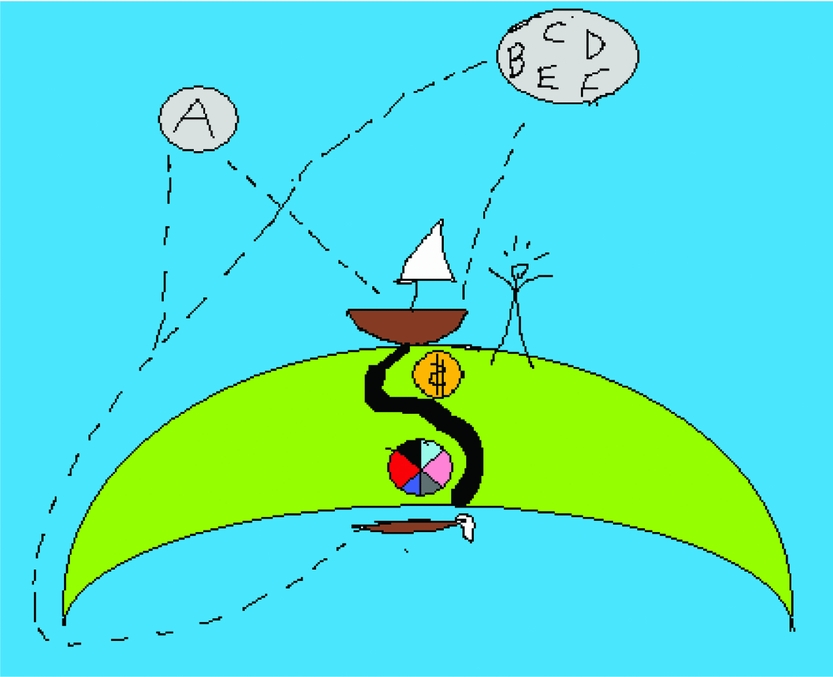
Jack is enjoying his holiday on beautiful Crescent Island. One day he spots a person desperately stuck on Little Rock in the dangerously rising tide. Just before hopping into his boat to embark on the rescue mission, Jack spots five other people in similar trouble on Big Rock. Jack considers what to do. Generally he is a fan of IL in these kinds of situations. The problem is that he left his handy six-sectioned lottery wheel on the south shore. There is no way he can run down there, spin the wheel and make it back in time. Luckily, Jack has another boat moored down south. This boat has a very powerful engine, and can easily round the island and make it to either rock before the tide reaches its height. The problem is that the fast boat is very small, and will simply sink if loaded with more than one passenger. The slow boat on the north shore, on the other hand, easily holds six. Jack has a coin in his pocket, so he can, if he so chooses, toss it and go to one of the rocks with the big boat. (Jack could, if he was tad cleverer, (which he is not) have simulated IL with the coin in his pocket.) However, Jack swiftly decides to run south, spin the wheel, and drive the fast boat out to fetch the winner. Call this the Crescent Island case (see figure 1).
Crescent Island case
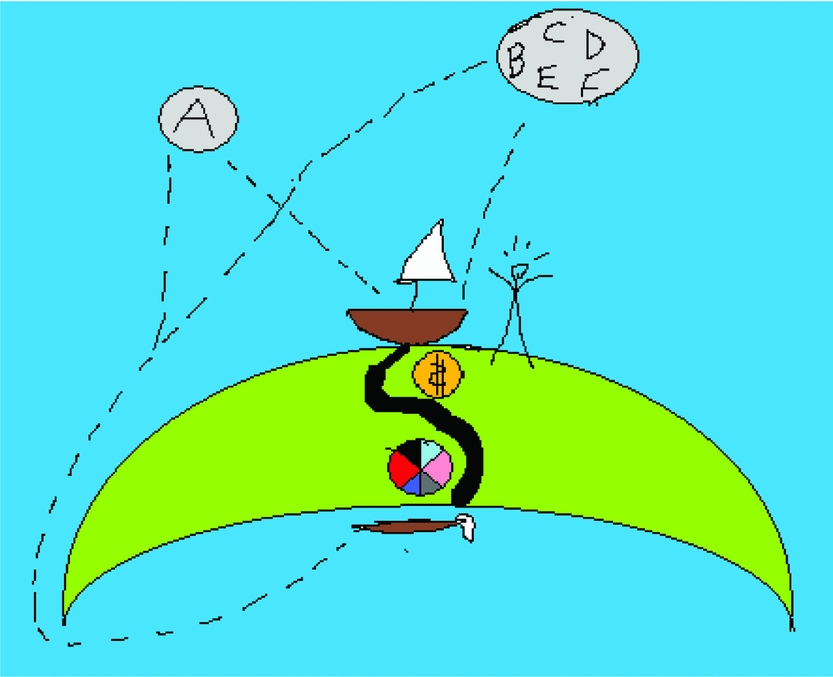
Many might react negatively to Jack's decision in the Crescent Island case. After all, he foregoes the benefits usually associated with IL, and ends up saving only one person, when he could have tossed a coin and saved one or six (three on average). But note that Jack did the right thing according to the procedure. The beneficial side-effect does not figure in its justification. This is not a pluralist approach combining consequentialist and non-consequentialist concerns. It is a straightforward non-consequentialist account which respects the MDC (or some other related criterion). The lottery wheel is required to let each person influence the way the decision is reached, and saving more people has got nothing to do with it. Therefore, I propose that when we evaluate the IL as a non-consequentialist solution to the numbers problem, we ought primarily to consider it in terms of Crescent Island type situations. (For simplicity, we can generalize the case by imagining (strictly for the sake of argument) that in some mysterious way, when the wheel is spun, the chances of non-winners simply disappear, and only the winner can be saved.) In that way we can focus directly on the merits of the IL versus an alternative approach, namely the coin toss.
The Crescent Island case, moreover, brings out the suspicion that some of the appeal of IL might be grounded in the mere fact that more people are, in practice, saved, if we follow this procedure than if we toss a coin. That is, the comparison of the two procedures might go along the following lines:

If one takes the parenthesized extension in (2) into account when comparing the alternatives, the comparison becomes flawed, because the IL can only justify the probabilities outside the parentheses. While its defenders can certainly hope that in most cases B, C, D, E and F will in effect have a 83.3 per cent chance of survival, they are committed, by their own justification, to hold that IL is preferable even in the generalized Crescent Island case. Now, this might count as a defect in and by itself, because many would think that this is extremely wasteful. Even if the waste is more theoretical than practical, it seems odd to stick to a principle that implies that it is better to save one individual in a conflict between a hundred and a hundred and one, than to toss a coin and save all individuals in one of the groups. However, this particular worry seems to be as motivated by consequentialist concerns as the original objection accuses the IL of being. We cannot reject the IL because it trades in consequentialism, on grounds of an argument that itself trades in consequentialism. (Or at least, non-consequentialists cannot.)
A different concern seems more convincing from a non-consequentialist standpoint. In the generalized Crescent Island case, the odds of each individual person decreases dramatically. In conflicts between one and five, everyone's chances are reduced from 50 per cent to 16.7 per cent. This seems highly counterintuitive.
It is plausible that even non-consequentialists accept the idea that we should give an individual a higher rather than a lower chance of survival, when this can be done without wronging others. Increasing chances of survival (for all), moreover, implies no form of objectionable aggregation of either lives or claims. Barring consequentialist reasoning, then, the IL is clearly less plausible than the coin toss. Therefore, non-consequentialists should toss a coin (at least when they cannot legitimately save the many).
IV. THE LIMITS OF THE MARGINAL DIFFERENCE CRITERION
As indicated, it might nevertheless be the case that the IL respects non-consequentialist constraints that the coin toss does not. Even if the coin toss is unambiguously fair,Footnote 32 and increases each individual's chances of survival relative to the IL, it could be the case that the IL has other things going for it. There could be several such considerations, and I cannot engage with all alternatives here. Instead I will discuss the most well-known non-consequentialist consideration that clearly speaks in favor of IL, and against the coin toss, namely the MDC.
The two persons in the larger group can complain that if the rescuer tosses a coin, he fails to acknowledge the importance of their claims, since their presence or absence makes no difference as to how the rescuer decides which group to save. Proportional lotteries, on the other hand, including IL, seem to meet the criterion quite smoothly. Each additional person will alter the chances of everyone. Therefore, one could conclude (though I would not) that the individualist lottery is preferable to the coin toss because it meets the MDC.
However, if the MDC is the main ground for choosing to give each person a 33.3 per cent chance of survival rather than 50 per cent, it would be worth examining this criterion more closely. First, assume that A and B are isolated and threatened by the rising tide on two separate rocks, R1 and R2 respectively, and the rescuer can only save one of them. The rescuer, in this case, should toss a coin. But then C drifts ashore on B's rock. Now, A, B and C all have legitimate claims to be treated fairly by the rescuer. Should the rescuer give everyone 50 per cent or 33.3 per cent chance of survival? By giving each 33.3 per cent, he would let C have a marginal bearing on his considerations. If he subsequently spun a wheel of fortune divided into three sectors, and then went on to save the winner, he would act according to the IL. But the question is why A, B and C would want to have their chances reduced from an optimal 50 per cent to 33.3 per cent. It seems counterintuitive to reduce everyone's equal chance by 16.7 per cent in an attempt to respect each person. Why not give all their highest equal chance?
Both the coin toss and the IL insist on giving all individuals an equal chance of survival. To that extent, both meet one fundamental fairness requirement. But they part in that they prioritize two further considerations differently: (1) give all involved the highest possible (but equal) chance of survival, and (2) let each individual make a marginal difference to the grounds on which the decision about what group to save is made. In many conflict cases, these two requirements cannot simultaneously be met, and one must choose. Taurek chooses (1) and Timmermann and Saunders choose (2).
My claim is that Taurek's choice is, on non-consequentialist grounds, the superior one. This judgement is based on the following idea. Even though it would be nice to let each individual make a difference to the grounds on which the decision is made (it cannot be required that all individuals make a difference to the actual decision or to the outcome of the decision), out of respect for that individual's legitimate claim, it would be irrational to do so solely by reducing everyone's chances of survival.
Consider this from the perspective of one of the persons in the majority group. Assume that she is a committed non-consequentialist, and that she (understandably) wants to be saved. Thus, the idea that she should be saved because she matters more than the others, or that she does not care how the others fare, or that the larger group should be saved because their continued lives will realize more welfare, has no place in her considerations (and would at any rate cut no ice with the non-consequentialist rescuer). All in all, she simply wants to be saved, and to be saved in the right way. Now, assume that she contemplates whether or not she would prefer to be assigned a 50 per cent versus a 33.3 per cent chance of survival. Clearly she would opt for the 50 per cent. She then learns (the tide is rising particularly slowly) that the rescuer wants to assign to her a 33.3 per cent chance of survival in order to respect her better as an individual. Giving her 50 per cent, he argues, would deny her a marginal bearing on the procedure. She could rightly reply that, under the circumstances, having a marginal bearing is low on her list of priorities. More generally, it seems that she would have reason to reject such a principle, with reference to how it would affect her prospects.
Of course, it is hard to resist the thought that by insisting on 50 per cent she in fact lowers her probability of being saved. But this is true only when her (separate) 33.3 per cent is added to the 33.3 per cent probability that her companion has of being saved. If this idea is what motivates her claim, then her considerations have little to do with non-consequentialism. If so, the appeal to the MDC is no more than a fig leaf covering straightforward aggregation. Reasonable as that might appear to some, a truly non-consequentialist procedure must avoid depending on reasons pertaining to the expected outcome in terms of the number of lives saved. (Though even a non-consequentialist must be allowed to increase her own chances of survival when this does not conflict with a similar goal on the part of others, or at least when it can be done without being unfair to others.) But then it is hard to see why she would have any interest in reducing her own probability with reference to the MDC.
Consider it also from the point of view of the single person on the other rock. She could reasonably complain (if she too were a non-consequentialist) that there is one available alternative that gives each their highest possible equal chance, 50 per cent, and that any deviation from this only serves either (on a non-consequentialist analysis) to diminish each and every one's probability of survival, or else (on a consequentialist analysis) to diminish her chances and increase the others' chances.
A further consideration is brought out if we assume that a fourth person capsizes in the vicinity of the two rocks, and that she is able to swim to either one. Which one ought she to choose? There seems to be no reason for her to swim to the single person's rock. For her, the choice is, in reality, a choice between 50 per cent and 75 per cent chance of survival. It seems implausible that a non-consequentialist procedure should give rise to such incentives. By letting the newcomer have a marginal bearing, the procedure creates incentives that seem harmful to the single individual's prospects of being saved. Or, if two people were already stranded on both rocks, and one of the four was a world-class swimmer, she would have reason to cross the distance between the rocks, leaving her former companion with half the probability of survival that she originally had. It seems that the MDC while allowing each additional person to make a difference, allows for the wrong kind of difference. The only conceivable function this criterion can have is to simulate aggregation, in some way or the other. Only the coin toss (and any defensible non-consequentialist procedure that secures that we always save the larger group) avoids this embarrassment (mostly).Footnote 33
Lastly, it should be noted that the MDC, while allowing each person to have a marginal bearing on the procedure, allows persons an unequal bearing. The later a newcomer arrives, the less of a difference she will make.Footnote 34 While this might not sound like a knock-down argument in itself, it is worth noting that the coin toss does not in this way discriminate on grounds of arrival time. The coin toss gives each person an equal bearing. True, equal bearing equals no bearing in this case, but since the coin toss increases everyone's chances relative to IL (barring consequentialist considerations) and allows everyone an equal bearing, this procedure seems preferable to a procedure that allows for unequal (if positive) bearing and decreased chances (still barring consequentialist concerns).
V. CONCLUSION
I have argued that the IL is less plausible than the coin toss, first, because the coin toss gives everyone a higher chance of survival than the IL, if we restrict attention to non-consequentialist reasons, and second, because the MDC does not seem to vindicate the IL when the first argument and considerations of equality are taken into consideration. This leaves room for the possibility that there might be other concerns, stemming from fairness or the separateness of persons, that might give the IL the edge. However, this seems unlikely as the coin toss is (a) intuitively fair, (b) gives everyone an equal bearing (none), (c) gives everyone a highest chance of survival that is compatible with an equal chance for all, and (d) that these chances, in contrast to IL, do not shrink in proportion to the number of endangered individuals.Footnote 35