1. INTRODUCTION
Over the second half of the twentieth century labour market structures underwent several major transformations. Aside from the mass incorporation of women into the labour force, the most notable change has been the progressive withdrawal from the workforce of ‘older’ workers; that is, those aged 60 years or over. This is particularly evident if participation rates in this age category are examined over the long run. Such withdrawal, or retirement, constitutes a relatively recent phenomenon and is linked to an increase in both life expectancy and incomes. The increase in the former caused the emergence of the ‘elderly’ as a separate age category, whereas the increase in the latter made it possible for individuals to withdraw fully from the labour market during the final years of their lives.Footnote 1 Individuals have had to learn to manage the complex web of economic, social and psychological factors now involved in ‘old age’. Industrialisation overturned the way work and the transition to retirement were conceived in many ways. In general, it may be said that the more arduous working conditions and more demanding practices involved in industrial work brought about changes which subsequently translated into greater economic and social difficulties for those approaching old age.
Historical studies of living conditions in old age tend to concentrate on the analysis of assistance networks,Footnote 2 institutions which, either formally or informally, provided for those individuals who had had to retire from work with insufficient resources to see them through the final years of their lives. For example, in the worst cases, when the physical limitations of old age made it impossible for an individual to work, he or she could apply for a place in an almshouse. One means of avoiding this outcome was membership in a mutual society. As members of such organisations, workers pooled their resources in order to provide insurance against adverse labour-related eventualities.Footnote 3 Protection in case of illness was, however, the main raison d’être of mutual societies; they seldom offered insurance against old age because of the long period of disbursement associated with retirement protection and the difficulties of maintaining an age-balanced membership in order to ensure that the society remained financially viable. In addition, only those workers who were relatively well off were able to regularly set aside the contributions due.Footnote 4 Furthermore, many mutual societies restricted affiliation to male workers and neglected the needs of women, who found themselves without financial protection in old age.Footnote 5 The protection offered by mutual societies was therefore relatively limited in scope.
When they found themselves in great need the elderly in Spain were most often cared for by their families.Footnote 6 Until the middle of the twentieth century, however, most elderly people did not ‘retire’, remaining in the labour market, often at considerable personal cost. Therefore, in order to obtain a comprehensive view of the living conditions and economics of old age, our analysis focuses on labour market participation within this age group.
The position of the elderly in the labour market changed dramatically during the course of the twentieth century as key changes in the framework of labour relations for older workers were introduced. First of all, the structure of production evolved substantially: although the physical demands of the workplace decreased, the demand for qualifications grew ever higher. Second, a system of national insurance was gradually introduced and consolidated.
In our research we set out to analyse the position of older workers in the labour market during the first two-thirds of the twentieth century in order to understand how and when the transitions took place which transformed the lives of people in this age group. We were particularly keen to assess the problems faced by older workers in the workplace which led to the introduction of a legal age of retirement and to understand how both the introduction of state pensions and the change in the occupational structure of the economy affected the lives of older workers. While there are several features which define older workers' problems in the workplace, in this article we will focus on the issues raised by the life-cycle deskilling hypothesis proposed by Paul Johnson.Footnote 7 This hypothesis suggests that as workers become older their choice of occupation becomes progressively more limited as a result of ‘dynamic disqualification’. According to the theory workers quit more productive and better-paid jobs as they age, to move downwards into less strenuous, but also less productive and thus less well-paid, occupations. The main source of data for our analysis was the tables of occupation by age taken from the reports published as a result of Spain's national population censuses, which allowed quantitative analyses similar to those published for certain other nations to be undertaken. The use of these tables is not without difficulties, the most notable of which is the lack of a reliable depiction of women's work. This and other issues will be discussed below.
Historical analyses of changes in the nature of both work at higher ages and retirement have been undertaken for a few developed countries.Footnote 8 Spain constitutes a rather unusual case because, compared with other countries, the introduction of its national system of social insurance was slow and uneven. With this in mind we will consider the period between the legal inception of state pensions in 1919–1921, when the Retiro Obrero Obligatorio (Compulsory Workers' Retirement Act) was approved,Footnote 9 and the passing of the Ley General de Seguridad Social (Social Security Act) in 1966, which finally allowed the majority of workers in Spain to exit the workforce as they approached old age. Perhaps even more important than the legislative changes was the fact that Spain's occupational structure remained heavily weighted towards agriculture until well into the middle of the twentieth century. This weighting had a significant effect on the pattern of retirement in the country, particularly as the nature of agricultural work was far from the paradigm of labour in the minds of the policy makers who put national insurance in place. The period being studied is therefore likely to offer only a partial view of the impact of the introduction of pensions as, even in the early 1960s, many older workers remained virtually unaffected by the legal provisions for retirement.
This article is organised as follows. First, values from the census will be presented and the presence of older men in the labour market estimated on the basis of the employment rates recorded, in order to provide insight into the scale and overall evolution of this variable over the time period under study. After comparing the Spanish values with those from other countries, it will be possible to judge whether employment amongst the elderly was comparatively more widespread in Spain. In Section 3, special attention will be devoted to two issues which are thought to have a significant influence on the long-term evolution of ‘retirement’ as a stage in the life-cycle. First, the evolution of Spain's pension policy during the first two-thirds of the twentieth century will be explored. The plight of older workers as they age and the diagnosis made by Spanish policy makers will be discussed, as well as the implementation of this diagnosis in the form of pension policy. We will start by considering the views of Spanish social reformers between the late nineteenth century and early decades of the twentieth century, as they played a key role in the first major attempts to provide state-funded protection for the elderly, before addressing the Francoist approach which, after the end of the Civil War in 1939, not only represented a major break with the previous period but also placed welfare in Spain at odds with international standards. It will be argued that the pension systems introduced by both the social reformers and the Francoists were insufficient to make retirement affordable for a large part of the Spanish population. In the second part of Section 3 an attempt will be made to quantify the role of structural change in the economy as a factor that made an increase in the uptake of retirement possible, an increase well beyond that which might be expected given levels of pension provision, which were too meagre and too narrowly spread to offer any incentive to workers to retire.
In Section 4, having considered the overall employment rate of older men in the previous section, the participation of older men in the workforce will be broken down by occupational sector to establish whether there were differences in such participation from sector to sector. In particular, in line with previous studies that analysed the situation in other countries, we will consider whether the ‘life-cycle deskilling hypothesis’ may have applied in Spain. In Section 5 we will then attempt to rule out alternative possible causes of the occupational patterns observed amongst older workers, in order to prove that the latter's concentration in some of the least favourable sectors of the labour force – in terms of pay, status or skill requirements – was due to unfavourable labour market dynamics. Finally, our conclusions are laid out in Section 6.
2. THE RECONSTRUCTION OF LABOUR FORCE PARTICIPATION RATES AMONGST OLDER MEN FROM THE SPANISH CENSUSES
Decennial population records collected by the census are an appropriate source for a long-run analysis of the changing age structure of the workforce and the different occupational classes. In 1900 age and occupation were cross-tabulated for the first time in the Spanish census, and from then onwards the census allows us to distinguish ‘working’ from ‘retired’ individuals across time.
However, the use of census records for this purpose has generally been subject to some criticism.Footnote 10 The greatest challenge posed by the census is its well-documented inconsistent treatment of women's participation in the labour force. This is related to the systematic under-enumeration of women's work, partly because of the part-time, or even casual, nature of some of the jobs women performed, but to a greater extent, because of the social norms regarding gender roles prevailing amongst the women themselves, their husbands and the enumerators, which are also believed to have led to the undercounting of more stable, regular and skilled work performed by women.Footnote 11 Due to the fundamental problems associated with the under-reporting of female employment, our analysis is restricted to the male working population of Spain. Of course the failure to capture adequately the economic reality of at least half of a study population is problematic for any researcher. Recent decades have witnessed significant progress in the way historical analysis can circumvent such difficulties using alternative data sources to provide more faithful pictures of women's activity. Therefore, we need to make it clear that our study has the important limitation that it reflects the cultural view of gender put forward by the twentieth-century Spanish censuses, which is far from a realistic depiction of the experiences of the country's women workers. This is important, as the work of women and, more generally, the work arrangements of all individuals within a household may have had a critical influence on the ability of elderly male workers to retire. Therefore, we acknowledge that by looking at male employment figures from the census without considering the wider dimensions of gender and family we are facing a key shortcoming of every census-based analysis of retirement patterns.Footnote 12
The records of the numbers of those in ‘employment’ and ‘retirement’ may not be entirely accurate, especially in the earlier censuses, as retired individuals may have been recorded, or counted, not as retired but according to their pre-retirement occupations.Footnote 13 Estimations of the number of older workers employed in the agricultural sector should also be treated with some caution, as the nature of this activity makes it hard to distinguish between those who really were ‘employed’ and receiving payment for their work, and those who were participating occasionally in the everyday tasks of a rural family. There are also important concerns over the accuracy with which the censuses captured the nature of employment amongst people living in predominantly agrarian communities, where the demand for agricultural labour was often lower than its supply. Workers in such communities may well have had second, alternative jobs, even though the census failed to capture that fact, preferring to enumerate them as working in agriculture only.Footnote 14
A further drawback of the Spanish censuses is the heterogeneity in the way they record statistics, including those on occupation and age. For example, the 1920 census is much poorer than the censuses of 1900 and 1910 in the way it records information: the classification of occupations is much less detailed and only three age groups are given.Footnote 15 The records from 1930 and 1940 are substantially better,Footnote 16 but unfortunately those from 1950 and 1960 are not. The occupation classification in the former is very general and the 1960 census report does not even include an occupation-by-age table.
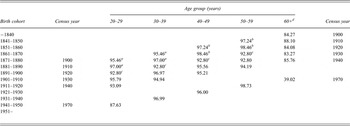
The varying definition of age intervals used in the censuses also presented some technical inaccuracies, which meant that a complete matrix of labour participation rates from 1900 to 1970 could not be reconstructed from the diverse age groups and cohorts reported in the various censuses. Age distortions of two kinds were found. In the 1950 census ages were classified into 10-year groups from the age of 25 years onward (25–34, 35–44 years, etc.). This meant that the data from that year could not be aggregated with the data from the other censuses, which used age groups beginning with a number including a ‘0’ (20–29, 30–39 years and so on). In addition, the age intervals in the 1920 census report were poorly defined, and the 1900 and 1910 census reports used 20-year, rather than 10-year, age intervals. Had the rates depicted in Table 1, the matrix of occupational participation rates by date and birth cohort, been drawn up requiring all the measurements to be homogeneous, the table would have been overly simplified. To avoid this the participation rates taken from the 1900 and 1910 censuses presented in the table (indicated by superscripts ‘a’ and ‘b’) are calculated for 20-year age groups, and then repeated over two columns of the table.Footnote 17 The rates derived from the 1920 census are calculated for the 20–59 years age group, and repeated across the four columns of the table representing those aged less than 60 years. Small discrepancies between censuses also affect the age at which age intervals start. Although these amount to no more than a year, this adds a certain inexactness to the cohorts for which the values in the matrix are derived. For example, the 1930 census presents values for the 21–30 years age group, so refers to the cohort born between 1900 and 1909 inclusive, rather than 1901–1910 inclusive. One of the notes to Table 1 mentions all the cells of the table in which such discrepancies are to be found.
Matrix of labour force participation rates amongst age groups and birth cohorts calculated from the Spanish population censuses, 1900–1970

The values given do not always refer to the age groups shown in the column headings. Superscripts indicate where other age groups are used: a 20–39 years; b 40–59 years; c 20–59 years. d Given that the age group ‘60+ years’ is open ended, it does not strictly correspond to the birth cohorts indicated.
The age groups for which workforce participation was reported differed from census to census. The dates of the censuses, age groups and birth cohorts used in the census reports were as follows: 1900 and 1910: 20–39, 40–59, 60 years and over; 1920: 21–60 years (birth cohort 1860–1899), over 60 years; 1930: 21–30 years (birth cohort 1900–1909), 31–40 years (birth cohort 1890–1899), 41–50 years (birth cohort 1880–1889), 51–60 years (birth cohort 1870–1879), over 60 years (birth cohort pre-1869); 1940: 20–29, 30–39, 40–49, 50–59, 60 years and over; 1970: 20–29, 30–39, 40–49, 50–59, 60 years and over.
Sources: Decennial census reports for Spain. 1900: Ministerio de Instrucción Pública y Bellas Artes. Dirección General del Instituto Geográfico y Estadístico, Censo de la población de España según el empadronamiento hecho en la Península e Islas Adyacentes en 31 de diciembre de 1900, Tomo IV (Madrid, 1907), 210–19; for population data, book III, 296–7 and 313. 1910: Ministerio de Instrucción Pública y Bellas Artes. Dirección General del Instituto Geográfico y Estadístico, Censo de la población de España según el empadronamiento hecho en la Península e Islas Adyacentes en 31 de diciembre de 1910, Tomo IV (Madrid, 1919), 2–7; for population data, book III, 402–3 and 419. 1920: Ministerio de Trabajo y Previsión. Servicio General de Estadística, Censo de la población de 1920. Tomo V. Resultado de la clasificación de los habitantes de España por su profesión (Madrid, 1929), 421–4. 1930: Dirección General de Estadística, ‘Clasificación de los habitantes inscritos en la población de hecho, por sexo, edad, estado civil y profesiones o industrias. Resumen de la nación, capitales y posesiones del norte y costa occidental de África’, in Censo de la población de 1930. Resúmenes generales de la nación. Clasificación de los habitantes inscritos en la población de hecho, por su edad, combinada con el sexo, estado civil e instrucción elemental (Madrid, year unknown), 2–31. 1940: Presidencia del Gobierno. Instituto Nacional de Estadística, Censo de la población de España según la inscripción de 31/12/1940. Resumen nacional de las clasificaciones por sexo, edad, instrucción elemental, fecundidad y profesión de la población presente (hecho), correspondientes a los totales de las provincias, de las capitales y de los municipios no capitales mayores de 20.000 habitantes, Tomo IV (Madrid, year unknown), 9–11; for population data, 3–6. 1950: Instituto Nacional de Estadística, Censo de la población de España el 31 de diciembre de 1950. Tomo III, clasificaciones de la población de hecho de la península e islas adyacentes, obtenidas mediante una muestra del 10 por 100, estado XXV (Madrid, year unknown), 624–31; for non-working population, estado XXII, 562–3. 1970: Ministerio de Planificación del Desarrollo. Instituto Nacional de Estadística, Censo de la población de España según la inscripción realizada el 31 de diciembre de 1970. Total Nacional. Tomo III, características de la población, estado 12.2 (Madrid, year unknown), 32–3; for non-working population, estado 22.1, 90; for population data, 8–9.
The way the Spanish censuses present data on older workers makes the analysis of their occupational patterns relatively simple, although the 1920 and 1930 censuses tabulate the ‘over-sixties’ rather than those aged ‘60 years and over’, which is the age group favoured by the other censuses in our study period, except for that of 1950 which begins its oldest group at the age of 65 years.Footnote 18 Working with a threshold of 60 years of age, rather than 65 years, which is the more familiar retirement age today, has the advantage that it allows us to include workers in our study who would normally still be in employment, and not just focus on those who stayed on after the legal retirement age. However, the younger threshold prevents us from drawing direct implications concerning the effects on employment amongst elderly workers of the various public old age insurance systems implemented between 1900 and 1970.
Table 1 shows the employment rates of the different age groups and birth cohorts contained in the various censuses from 1900 to 1970. The data in this table can be read in several ways. First, the cross-sectional data from each census can be followed by reading the values diagonally from lower left to upper right. Another way to look at the table is to follow the lifetime employment histories of specific birth cohorts. This can be made reading across rows, each of which is referring to the birth cohort noted in the column on the far left. Finally, the evolution across time of the participation rates for a particular age group may be followed across the relevant column.
According to Table 1, the rates of employment among men aged 60 years and over were very high throughout the period. If anything, in the values corresponding to the participation of men aged 60 years and over in the 1920 census, there is a slight decline. Participation rates rose again in 1930, but not amongst the 50–59 years age group, or more strictly speaking at this date, the 51–60 years age group. The other notable change in Table 1 is the fall in participation amongst those aged 20–29 years in the 1970 census. This corresponds, in all probability, to the increased levels of access to higher education in the later twentieth century.
If we now concentrate on the rates of labour force participation amongst the over-sixties, Table 1 indicates these were both high and stable throughout the period until 1970 when the rate fell sharply. Of course, Table 1 does not show values for 1950 and 1960, so there is a long gap between 1940 and 1970, long enough for the fall in the rates to be dramatic. Although we do not have a participation rate for the over-sixties in 1950, the rate amongst men aged 65 years or more was 66.06 per cent in that year.
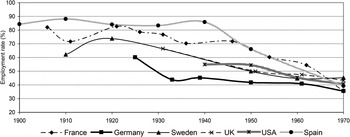
Compared with a sample of developed countries, the rates of participation in the labour force amongst older Spanish men were high, but not extraordinarily so, as shown in Figure 1.
Employment rates amongst men aged 60 years and over: selected countries, 1900–1970. Note that participation figures in years between censuses are estimated through interpolation. Sources: For Spain, Decennial census reports; see Table 1. For the other countries, Klaus Jacobs, Martin Kohli and Martin Rein, ‘The evolution of early exit: a comparative analysis of labor force participation patterns’, in Martin Kohli, Anne-Marie Guillemard and Herman Van Gunsteren eds., Time for retirement. Comparative studies of early exit from the labor force (Cambridge, 1991), 38–41. The French figures from 1921 to 1962 are for the 60–69 years age group only. Employment in each age group was weighted with population data from B. R. Mitchell, International historical statistics (New York, 2003).

The overall evolution of participation rates captured by the Spanish censuses masks some of the important transformations that occurred during the decades studied. Ideally, for instance, changes within the age structure of males over 60 years should have been taken into account so that the rates across years were strictly comparable. Unfortunately, it is not possible to correct this bias as, except in the census for 1970, more detailed age breakdowns of the workers aged 60 years or more were not given and participation rates weighted to allow for changes in the age structure of older men cannot be estimated. We must assume that the increase in life expectancy that occurred throughout the period covered in the analysis, along with the concomitant increase in the proportion of ‘elderly’ individuals within the 60 years and over age group, produced inflated participation rates in the earlier censuses, given that there is a declining propensity to work with age.
More significantly, changes in the participation rates ran parallel to two key transformations in Spanish society, both of which had a very marked effect on labour force participation. The first one of these was the rise of publicly funded insurance for old age: the Spanish state adopted a policy which meant that individuals were able to make the transition between ‘economic activity’ and ‘retirement’. Under this policy, state pensions substituted for income and on a much larger scale than any of the private alternatives that had previously been in place. The second transformation related to a structural change in the Spanish economy, which saw the share of the nation's workers employed in agriculture drop markedly, and subsequently translated into higher rates of retirement. The following section addresses both of these two transitions and discusses their impact on the rates of workforce participation amongst men aged 60 years or more.
3. THE RISE OF RETIREMENT IN THE TWENTIETH CENTURY: THE ROLE OF PUBLIC PENSIONS AND STRUCTURAL CHANGE
3.1. The slow introduction of old age pensions in Spain and its limited effect on retirement rates
The living conditions of older workers were not a priority in Spain until 1908, when the first state-promoted scheme of old age insurance was introduced.Footnote 19 That year the state became involved in the private network of savings banks which were already offering retirement products. In particular, the state added an extra contribution to the deposits paid into private savings institutions by workers aiming to secure resources for their old age. Such deposits were voluntary, however, and the small incentive offered was not enough to overcome the inability to save amongst the great majority of workers at whom the project was targeted: these initial, state-subsidised pension schemes therefore initially ended in failure.
The movement towards state-funded pensions gained momentum again when a discussion of compulsory old age insurance emerged in a context of strong labour unrest and led to its approval in 1919. However, when pensions were finally launched in 1921, after the publication of the rules of how they were to be applied, those aged above 65 years were totally excluded from the protection they offered. In addition, individuals aged over 45 years were also effectively excluded from receiving insurance benefits, as they would only expect to receive the accumulated sum of their capital on their retirement. Also, given the low rates of pension benefits paid and their irregular delivery, particularly in agriculture, even those fully affiliated to a scheme were not any better off.Footnote 20
It should be noted that workers were exempted from contributing, contrary to the arrangements for most contribution-based schemes elsewhere. Employers and the state both paid contributions. The arguments for the exclusion of workers from contribution mainly focused on the need to avoid taxing the workforce any further. However, the fact that the workers made no contribution to their pensions is key to understanding the fervent opposition to pensions once they had been approved, as many employers viewed their financial commitment as a forced contribution to charity, rather than a share in the participation towards the protection of their workers. To encourage employers to become involved in the scheme, the Social Catholics called on them not to abandon older workers as if they were ‘useless tools’.Footnote 21
In addition, old age insurance was also justified on the grounds that it benefitted production. From an openly utilitarian point of view it was argued that such insurance would not only offer individuals relief but would also stimulate productivity by favouring the withdrawal of older –and allegedly less productive– workers.Footnote 22 Accordingly, ‘productivist’ arguments abounded in the literature and propaganda which flourished in Spain during the first two decades of the twentieth century, seeing old age insurance as an instrument of reinvigoration of the labour force, boosting national production.Footnote 23
Francesc Moragas, manager of the Savings and Old Age Pensions Bank of Barcelona, a pioneering institution in the economic management of workers' old age, made the point clearly:
Economically speaking, human employment may be viewed as capital which produces income, and those who possess such capital can use the income to fulfil both their individual and family needs. However, human activity is a form of capital which, mirroring the life cycle, is first born, then grows, diminishes and disappears; and, while over a man's lifetime the strength of his abilities and the volume of capital they represent move in parallel, this trend is not matched by a similar relationship between his capital and his needs or those of his family. On the contrary, it is clear that most often the needs and the capital follow divergent paths, reaching a state of absolute separation in which the only common points are misery and ruin.Footnote 24
Other arguments put forward during the discussion and enactment of Spain's old age insurance provision reveal the perceptions held concerning older workers and their risk of destitution in the absence of alternative sources of income. Compulsory old age insurance was defended because it helped the ‘economically weak’ who, without a salary, savings or family support, would have to turn to poor relief. The elderly ‘were the victims of lack of foresight, in workhouses and hospitals, a situation that could only be remedied, inadequately and at great cost, by famine and emigration’.Footnote 25 According to this viewpoint, public insurance had the added benefit that it would relieve the state from the need to provide public assistance in the form of poor relief.
As shown in Table 1, however, the introduction of public pensions in 1919 and their launch in 1921 did not translate into widespread retirement among older workers. First of all this was because the pension, which was targeted at all workers who received a wage below a fixed limit, was very low; no more than roughly one-quarter of the average industrial salary. Second, it was because the system of capitalisation chosen required an investment period of at least 20 years before the first pensioners could claim the intended pension benefit. For these reasons, public pensions were unlikely to have an immediate and general effect on the patterns of retirement amongst workers. Furthermore, the requirement to provide continuous contribution payments to the pension schemes punished those who suffered spells of unemployment and added a gender bias to the insurance system, as it made it difficult to reach those individuals working in less regular types of job, such as women. In addition, servants were explicitly excluded from the protection offered by the insurance scheme, a decision which was justified by the difficulties of inspecting homes as working places and the short periods of time in which women were employed, generally restricted to the years prior to marriage and consequently insufficient to build full contribution records.
A third element that calls into question the effectiveness of Spain's first public old age insurance scheme was the low impact it had in agrarian regions. De facto resistance to the legislation by a majority of employers in the agrarian sector was a constant feature throughout the 1920s, which was exacerbated by the lack of state interest in challenging such resistance.Footnote 26 In fact, the dominant position of agriculture in the Spanish economy was sometimes used as an argument against the introduction of financial protection for old age. Intergenerational solidarity in rural areas was often idealised, especially by Social Catholics, with land transmission strategies and implicit agreements within families being seen as affording older family members a relatively comfortable retirement. Therefore, it would seem that the inclusion of agrarian workers within the pension legislation was more the result of an inclusive approach, rather than to a specific analysis of labour relations in this sector, where the seasonality of work and the reality of multiple employers did not fit into the industrial paradigm which underlay the insurance policies. Officials in the National Institute of Social Insurance realised that they would be unable to enforce pensions in the agricultural sector.Footnote 27 The situation improved significantly during the short-lived Second Republic (1931–1939) when stronger efforts towards enforcement were made, but once again the failure to ensure the uptake of pensions in the agrarian regions prevented the widespread withdrawal of older Spanish workers from the labour force.
The Spanish Civil War (1936–1939), and Franco's dictatorship (1939–1975) which followed, engendered a downward turn for social policies in Spain. Under Franco's long regime the progress of Spain's social protection policies diverged markedly from the gains made elsewhere in Europe, and as a result older Spanish people faced significantly lower standards of welfare. Under such conditions full withdrawal from the labour force was only possible for a small proportion of the population, as the persistence of high activity rates amongst those over the age of 60 years throughout the post-civil war period (shown in Table 1) clearly reflects. However, this state of affairs contrasted radically with the regime's ambitious discourse on social insurance.
In 1938, in the midst of the Civil War, Franco's supporters issued the so-called Fuero del Trabajo (Labour Charter), which included a very critical view of the existing forms of social insurance and announced that the welfare of workers was a priority. Much of the regime's criticism of pre-war social insurance policy stemmed from the dictator's need to acquire social legitimacy both during and after the war.Footnote 28 The deprivation brought about by the war and the post-war autarchy gave added prominence to the arguments concerning social protection in the Francoist discourse. Criticism of the past pension system focused on the low levels of benefits which had been disbursed, describing these as ‘miserable subsidies and pensions, insufficient to cover the most basic needs’Footnote 29 which had only been increased due to the war-driven rise in the cost of living. In this sense, the new regime, in the vague and euphemistic language so typical of Francoism, proclaimed itself as leading a generous revolution in social insurance and promised that: ‘[…] old age and invalidity benefits will be increased. The priority will be to endow older workers with sufficient provision for retirement.’Footnote 30 In the words of one contemporary:
This statement [the Labour Charter] was a condemnation of the past and gave relief to the elderly. Old age and invalidity benefits are now increased to 3 pesetas a day and thousands of workers now receive, with their pensions, the satisfaction of seeing that their efforts were not in vain. The Old Age Subsidy [the dictatorship's first amendment to existing old age pensions] has rescued from destitution those whose twilight years were ones of waning strength and uncaring employers. Producers have an inescapable duty to provide their workers with the means of life both during their working lives and at those periods of inactivity brought about by nature. Our oldest citizens deserve to retire!Footnote 31
Another aspect of Francoist criticism of the previous insurance system referred to its limited impact.Footnote 32 Before the Civil War, old age pensions had been designed as insurance for those wage earners who fell below a modest income threshold. All dependent family members, servants, self-employed workers and those pursuing more financially rewarding occupations had been excluded from the legislation. The regime therefore criticised the previous system for being targeted purely towards the working classes. According to this view, universal provision appeared to be the road to take. However, completely contradicting this goal, both the 1947 Old Age and Invalidity Insurance legislation and the general social insurance policy under Franco's dictatorship took quite a different course, ensuring that retirement was rare, as any funds available were economically insufficient to act as an adequate substitute for the income which could be earned from labour by the elderly.
Social insurance for old age became of secondary concern for the regime. As the Francoist policymakers would stress repeatedly, it was insurance against sickness that became the prime social goal of the dictatorship.Footnote 33 This change of priorities added to the difficulties involved in ensuring progress was made on the provision of old age insurance during the first decades of Franco's dictatorship. Contributions paid by those affiliated to the insurance schemes were very limited after the Civil War and only began to increase at the end of the 1940s, when the contributions to be paid were set as a percentage of their salaries after the Compulsory Old Age and Invalidity Insurance Act came into law in 1947. Indeed, the fact that pension funding continued to evolve was largely due to the workers' efforts, as the contributions from their wages had to compensate for the parsimony in the provision by the state.Footnote 34
More generally, the main problem for the advancement of pension provision under Franco's regime was that, at least until the Stabilisation Plans of the late 1950s, any redistribution of resources was away from labour towards capital.Footnote 35 In this context, it was highly unlikely that a progressive social policy would emerge and lead Spain to a social security system comparable with those found elsewhere in Europe as, indeed, the amount of social spending during the whole of the dictatorship was minimal. Instead, the Francoist regime opted to use extensive labour market regulations as a way of gaining workers' conformity with the regime.Footnote 36 Interventionist devices such as the paternalist guarantee of a ‘job for life’ or the adherence to officially sanctioned wage levels abounded, as labour unrest was seen as a potential challenge to the security of the dictatorship. The other side of the coin was mounting market inefficiencies and distortions.
As the Spanish state did not have a serious involvement in social insurance and spent very little on it during Franco's regime the two main features of the organisation of old age insurance throughout this period were the multiple number of public, sector-specific schemes put in place – particularly, in the agricultural sector – and the extent to which individuals had recourse to private insurance schemes.
With respect to the latter, the private network of social protection that developed from the 1940s eventually became a second tier of social insurance working in parallel with the public one. In this way, the mutualidades laborales, or workers' mutual societies, organised by economic sector or by firm, emerged as a private system of insurance that became compulsory for the nation's workers and employees to join.Footnote 37 The state supervised – and often interfered with – the functioning of the insurance system but each mutual society was able to decide on the contributions and benefits to be paid at its own discretion, guided by ‘(…) the economic potential of each industry and its specific needs’.Footnote 38 Eventually this gave rise to huge inequalities in the coverage and level of benefits provided within the insurance system, and this had a marked effect on the retirement patterns of workers in different sectors of the economy.Footnote 39 It must also be noted that a significant proportion of the working population of Spain remained in occupations which were not covered by the mutual societies, so that the issue of inequalities in access to insurance became as important an issue as the inequalities in the benefits received.
With its limited scale and the small proportion of state expenditure devoted to it, the inadequate design of the public pillar of social insurance became only too evident when the autarchic economic system of Franco's regime collapsed. At the same time the mutual societies also faced financial chaos, adding to an already gloomy picture, and social insurance in Spain found itself at a critical juncture. In 1959 Spain was facing an industrial crisis and the National Institute of Social Insurance was forced to discuss the financial problems confronting the insurance system. The economic downturn was forcing a growing number of workers to claim their retirement benefits early to help them to ease their exit from the labour force as unemployment rose.Footnote 40 This was sapping the already weak financial health of the mutual societies.
The collapse of the insurance system was averted by the 1966 Social Security Act, which constituted an important first step towards a modern welfare system in Spain, one that offered standards of social protection that were similar to, but not yet totally comparable with, those elsewhere in Europe. Prior to the introduction of social security, pensions can only be interpreted as a very basic safety net against destitution as they were, in every case, inadequate to finance a worker's full withdrawal from the workforce in Spain until well into the 1960s. After the Civil War, real wages continued to fall, making it impossible for older workers to retire, but also rendering it extremely difficult for families to survive under the strict ‘breadwinner’ model championed by the dictatorship. Even with the common recourse to overtime a breadwinner could scarcely bring home enough to maintain his family's wellbeing when the country was experiencing high rates of inflation.Footnote 41 The participation of women – and often young children – was needed to bring in extra resources to the household. For this reason, women frequently challenged post-war legal restrictions to their employment in the formal labour market and female participation rates in the workforce increased significantly from almost 9 per cent in the 1940 census to 15.1 per cent in 1960. There was also an increasing demand for women workers as the number of jobs in public administration, and elsewhere in the tertiary sector, grew. Despite the significance of these official figures, it is equally clear that many more women were occupied informally and consequently remained ‘off the record’.Footnote 42 Census figures are very often blind to household economies, but without considering this wider perspective, it is impossible to understand adequately the patterns of work and retirement behind the published figures.
3.2. Spain's economic structure as a key determinant of the participation of older men in the workforce
Although it marked a particular milestone in the development of social insurance in Spain, the slow introduction of limited pension benefits after 1919–1921 was insufficient to encourage workers to withdraw en masse from the labour force. Workers employed in agriculture faced the greatest difficulties in accessing benefits. Lack of legal enforcement to comply with the insurance before the Civil War was followed by the creation of a specific insurance scheme in the sector during the dictatorship which did little to improve the prospects of retirement for those working in agriculture. The very large proportion of the Spanish workforce employed in the sector meant that there was little progress towards mass retirement among the Spanish working population as a whole. It can be argued, therefore, that the decline in agriculture from the 1960s, by which time the sector employed no more than one-third of the total Spanish labour force, represented a powerful determinant of the fall in workforce participation among older workers.Footnote 43
Let us now turn to consider the diverse patterns of retirement in different occupational sectors. We will take an especially close look at agriculture, where retirement rates were traditionally lower,Footnote 44 in an attempt to estimate how much of the drop in workforce participation during the first two-thirds of the twentieth century was due to a change in the relative importance of the different economic sectors, rather than to an evolution in retirement behaviour. First of all the rates of agricultural and non-agricultural labour amongst males in 1970 (26.53 and 73.47 per cent, respectively) were applied to the total male working population registered in each of the other censuses. Having estimated the proportion of agricultural and non-agricultural workers at each census, the proportion of the male population under 60 years and the proportion over 60 years employed in each of the two sectors were extracted from each census and applied to the appropriate proportion of the workforce. In this manner, the rates of employment of older men in the two sectors in each census year were standardised against the agricultural/non agricultural distribution observed in 1970.
In order to examine all of the changes in the distribution of the workforce between occupational sectors in the Spanish economy brought about by the rise of service-related activities, the employment rates for each of 29 occupational groups identified in the 1970 census were applied to the working population reported in each of the earlier censuses.Footnote 45 By standardising the figures in this way, the influence of the changing employment structure was removed, thus allowing the impact of changing attitudes towards retirement to be assessed.
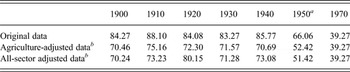
Table 2 confirms that the changing nature of the Spanish economy was a very powerful force behind the move towards retirement among older men. Given the very similar rates of participation derived from both the agriculture-adjusted (AA) and all-sector-adjusted (ASA) values in Table 2, the table suggests that the main impetus for increasing movement out of employment was the decline in the agricultural sector. The discrepancies between the AA and ASA values in 1940 and, especially, in 1920 suggest that in these years there were opportunities available to older workers in non-agricultural activities which made up for the decline of employment in agriculture. Table 3 shows the proportion of the decline in participation rates amongst older workers explained either by the shift from agricultural to non-agricultural occupations, or from a more complex redistribution of workers across all occupational sectors. According to these results, for instance, in 1900, 69.31 per cent of the drop in participation amongst older males between this year and 1970 is explained by the decline of the share of older men employed in agriculture between these two dates, and 68.82 per cent by changes in the composition of all sectors. The discrepancy between both percentages suggests that in 1900 agricultural activities offered slightly higher opportunities of employment for older men than non-agricultural activities. The values presented in the table confirm the major role that the redistribution of the workforce across occupational sectors played in the drop in participation rates amongst older workers.
Percentages of men aged 60 years and over recorded as employed by the census: Spain 1900–1970

a The values for 1950 are for men aged 65 years and older.
b For the definition of ‘agriculture-adjusted’ and ‘all-sector adjusted’ rates, see Section 3.2.
Sources: Decennial census reports for Spain; see Table 1.
Percentage change in workforce participation rates amongst men aged 60 years and over explained by changes in the size of the agricultural sector and all sectors between a given census date (t) and 1970: Spain 1900–1950

a Agricultural change is derived as follows: Agric%t = (AAt – AA1970)/(ODt –OD1970), where OD is original data (see row 1 in Table 2) and AA is agriculture-adjusted data (see row 2 in Table 2).
b The equivalent calculation for all-sector change was derived as: AS%t = (ASAt – ASA1970)/(ODt –OD1970), where ASA is all-sector adjusted data (see row 3 in Table 2).
Sources: Decennial census reports for Spain; see Table 1.
The evolution across time depicted by the values in Table 2 obviously reflects to some extent the parallel development of state-funded old age pensions, despite the fact that the data – for males aged 60 years or more rather than for those over the legal retirement age of 65 years – make a careful comparison of retirement and the progress of pensions. However, as mentioned above, the limited attraction of public pensions during the period covered in Table 2, coupled with the fact that legal retirement was less likely to be enforced in the agricultural sector, served to keep employment rates high in that sector. In addition, fewer workers in agriculture received a salary than in other sectors, and as this would have affected the number of workers who were entitled to social insurance, especially in the years after it was first introduced, this may have affected the result of high participation rates. The primary message to be extracted from the values shown is that the introduction of old age insurance did little to encourage Spanish workers to retire and what progress there was towards mass retirement during the first two-thirds of the twentieth century was largely driven by change within the economy, particularly the decline of the agricultural sector.
4. EMPLOYMENT AMONG OLDER MALES BY OCCUPATIONAL SECTOR
Having examined aggregate rates of employment among older men, let us now delve deeper into the census figures in order to detect specific problems working to the detriment of older workers. By doing this we will identify some of the more significant effects which made life-long employment undesirable and which, according to the arguments used by policy makers presented above, justified the introduction of public pensions in Spain and underscored the need to make retirement an affordable option for the country's workers. In this section we will consider the incidence of the life-cycle deskilling in Spain, and whether this confirms or refutes the downward occupational mobility hypothesis, by which workers see themselves pushed towards lower-status jobs as they get older.
Traditionally, increasing age has been linked to a decrease in employability. Historically, in the absence of state or company pensions, firms tended to deal with the older members of their workforce internally, transferring them to posts or areas of the firm where the physical demands placed upon them were lower but the pay rates were often lower too.Footnote 46 When such practices died out, however, ‘deskilling’ then began to involve moves across different sectors of the economy. This was an important change, as it carried a considerably greater risk for the worker due to the fact that his chances of re-employment diminished and declined faster as they grew older.Footnote 47
There were several reasons for the emerging pattern of segregation of older males into certain sectors of the labour market.Footnote 48 Both supply- and demand-side factors played a part in this phenomenon, sometimes in interrelated ways. On the demand side, a perception that the abilities of older workers declined as they aged may have translated into their displacement into jobs which were seen as requiring less skill or training and as involving less responsibility. Two factors played a fundamental role in this discrimination: on the one hand, educational achievement increased in successive cohorts over the period under study while, on the other, great technological change occurred, something to which all workers had to adapt but was especially onerous for those nearing the end of their careers.Footnote 49
It is, of course, possible that workers themselves may have preferred to shift to a lower-status occupation. For instance, if a worker in a physically demanding occupation perceived himself to be losing strength this might encourage him to move to an occupation where the physical demands were lower, or where he could work shorter days. Similarly, if teamwork or mechanised procedures were required to achieve high productivity levels, this may have been too inflexible for an older worker who may then have chosen to move to a more ‘forgiving’ occupation. In theory, a greater demand for low-skilled labour or the rise in service activities, which are assumed to have had more flexible work practices should, therefore, favour the work prospects of older workers.Footnote 50 An increase in self-employment at older ages would also suit the demands for more flexible employment amongst this age group.Footnote 51 Lastly, as workers passed their years of peak earning – taken to be between the ages of 40 and 50 years in high-productivity occupations – they may have felt encouraged to withdraw from more highly paid, but more demanding, roles as they saw the advantages of choosing to work in less demanding jobs with shorter hours and increased leisure time once their earnings began to fall.Footnote 52 Whether the reasons for the deskilling process are examined from the demand or supply side, the outcome of the deskilling resulted in poorer conditions for older workers in terms of pay, status or skill requirements.
To judge whether the life-cycle deskilling hypothesis holds in Spain, it is necessary to measure whether older workers were over-represented in particular occupations, compared with their presence in the labour force as a whole. To do this, the occupations represented in the census reports were grouped by economic sector. Despite the long time interval, the many changes in occupational definitions, and the variation in the degree to which they were broken down in the reports, homogeneity across time was maintained as far as possible. The classification scheme used was also designed to allow comparison of previous published case studies from other countries.Footnote 53
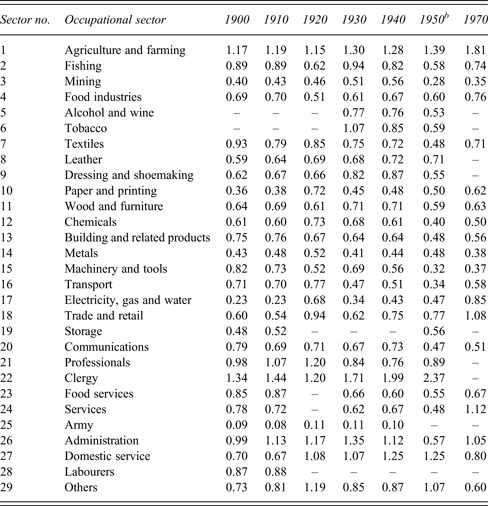
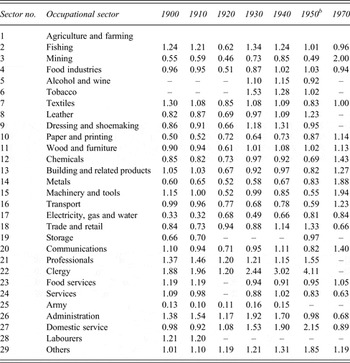
The occupations were assigned to 29 sectors of production, which are listed in Table 4. The age distribution of workers in each sector was then established so as to ascertain whether workers aged 60 years or over were over-represented or under-represented in a particular sector. An index of concentration was constructed by taking the percentage of the workforce aged 60 years and more working in a given sector as the numerator, and the percentage of the total workforce, irrespective of age, employed in the same sector as the denominator. A ratio of 1 was obtained when the percentage of older men employed in a sector and the percentage of the total workforce employed in the same sector were equal. An index above unity indicated an occupation where workers over 60 years were over-represented, and which was therefore of interest to the current study. Table 4 shows the concentration indexes calculated for each occupational sector at each census date.
Indexes of over- and under-representation of male workers aged 60 years and over, by occupational sector: Spain 1900–1970a
a Values greater than 1 in the table indicate sectors and dates where men over 60 years are over-represented; values less than 1 indicate where they are under-represented.
b The values for 1950 are for men aged 65 years and more.
Sources: Decennial census reports for Spain; see Table 1.
According to the values in Table 4, older workers were most over-represented in sector 1 (agriculture and farming). This supports the view that agricultural workers were more likely to remain in employment after reaching retirement age than workers in other sectors. We assume that the main reason for this lay in the sector's ability to adapt to specific features of an elderly workforce allowing them, for example, to work less intense and, in general, more flexible work days. Another sector with an over-concentration of older males, at least for the censuses between 1920 and 1950, was sector 27 (domestic service). Both of these occupational sectors conform to the pattern of life-cycle deskilling suggested in our initial hypothesis: they offered low wages, demanded minimal qualifications, and so on.Footnote 54 So far, the values in Table 4 are consistent with those of previous studies and with the views of the Spanish social reformers championing public pensions between the late nineteenth century and the 1920s.
The values also suggest, however, a pattern of the concentration of older workers in some ‘higher-status’ sectors requiring more qualifications, such as sector 21 (professionals) in 1910 and 1920, or in sector 26 (administration) between 1900 and 1940. In these sectors, the concentration of older workers may be attributed to the fact that individuals in these occupations can build up their abilities and skills through experience, and can continue to use these in older age. They may also have the advantage of tenure.Footnote 55 In addition to these reasons for remaining in the labour market, it must again be noted that state pensions had little impact amongst those in the better-paid sectors of the economy, as the pension schemes were very much targeted at members of the (non-agricultural) working classes. Men employed in the higher-status sectors would not have had the incentive of a pension to encourage them to withdraw from the labour market.
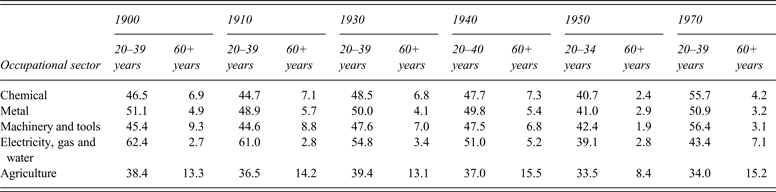
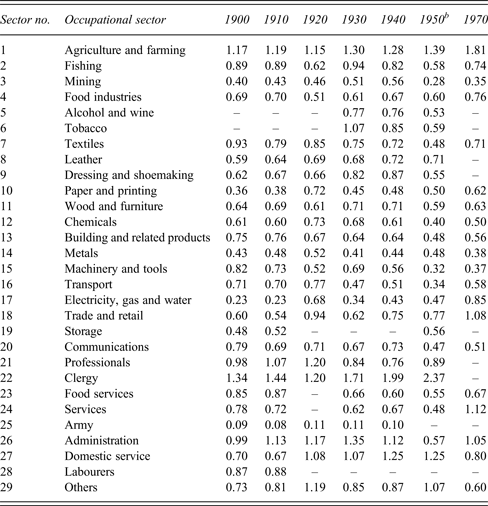
If we remove the agricultural sector, and agricultural workers, from our calculations, and recalculate the concentration indexes, as shown in Table 5, the pattern of the persistence of older workers in some of the more attractive, better-paid sectors of the economy, and the over-concentration of older workers in other occupations consistent with the life-cycle deskilling pattern is clearer, confirming both sides of our argument. In Table 5 sectors 7 (textiles), 6 (tobacco), 5 (alcohol and wine) and even 2 (fishing) all contain a marked over-concentration of older workers.
Indexes of over- and under-representation of male workers aged 60 years and over, by occupational sector when sector 1 (agriculture and farming) is excluded: Spain 1900–1970a

a Values greater than 1 in the table indicate sectors and dates where men over 60 years are over-represented; values less than 1 indicate where they are under-represented.
b The values for 1950 are for men aged 65 years and more.
Sources: Decennial census reports for Spain; see Table 1.
It is clear from Table 5 that older workers were under-represented in technology-driven sectors within the labour market. These sectors undoubtedly favoured younger age structures, as human capital would have depreciated rapidly given the significant technological change taking place during the period under study. Sectors 17 (electricity, gas and water) and 14 (metals) came into this category, as employers strove to renew their workforce by taking on younger workers.Footnote 56 Other occupational sectors may have had younger age structures because the jobs placed considerable physical strain on the workers; this is clearly illustrated by the indexes for sectors 3 (mining) and 19 (storage) in Table 5. In these occupations, the supply of workers would have dwindled as the men aged and their physical ability declined.
Given these results, the evidence supporting the life-cycle deskilling theory detected by Richard Ransom and Robert Sutch for the USA and by Johnson for England and Wales also seems to be found in Spain, although there is also considerable over-representation of older workers in some higher-status sectors. Our findings therefore support the idea of the emergence of a segmented labour market, in Spain and elsewhere, arising out of the new labour structures associated with increasing industrialisation. As part of this process certain occupational sectors reduced their qualification requirements, effectively curtailing their need for experienced workers, as opposed to their past dependence on experience-based knowledge and reliance on either implicit or explicit long-term contracts.Footnote 57
5. WAS LIFE-CYCLE DESKILLING REALLY THE RESULT OF GROWING OLD? RULING OUT ALTERNATIVE HYPOTHESES
Although, intuitively, the values presented in Tables 4 and 5 may appear to be the result of a life-cycle deskilling process, this need not in fact have been the case. The possibility that some other factors may have produced the patterns observed has to be explored before it can be unequivocally concluded that the concentration patterns displayed in the tables are indeed a response to the challenges posed for older workers by their working conditions.
The ageing of an industry's workforce may result from changes in the relative size of occupational sectors and the corresponding effects of this phenomenon may affect the mean age of the workers employed in that sector. An increasing mean age of the workforce in a particular sector may indicate that employment in those occupations was contracting. If it is assumed that the career profile of workers already employed in a given sector remained unchanged, then any decline in that particular sector would, ceteris paribus, reduce the number of young workers entering the sector which would, in turn, increase the index, indicating a concentration of older workers. To evaluate the extent to which this happened, the Spearman's rank-order correlation between the percentage growth in the workforce employed in each sector between each pair of censuses, on the one hand, and the index of concentration of older workers, on the other, was calculated. If a sufficiently negative correlation between the two measures was found then the null hypothesis (that there was no correlation between the measures) would have to be rejected and sectoral decline would have to be accepted as the reason for the increasing average age of the workforce in some occupations.Footnote 58
The Spearman's rank coefficients (results not shown) do not support the alternative hypothesis for the majority of inter-censal decades between 1900 and 1970 for which the exercise was undertaken.Footnote 59 Two exceptions were the decades between 1930 and 1940 and 1940 and 1950. In the former decade, the statistic –0.50 validates the alternative hypothesis as the critical Spearman's rho value at a significance level of 5 per cent where n = 26 is –0.392.Footnote 60 For 1940–1950, the equivalent statistic was –0.5733, which once again validated the alternative hypothesis. Both of these decades were periods where the data were affected by serious technical or structural contamination. It was, for example, questionable to apply the statistical tests to the 1940–1950 decade, because the figures for 1940 referred to workers aged 60 years or more, whereas the figures for 1950 were for workers aged 65 years and over. In this particular case the impression that the figures give that there was sectoral growth is probably misleading as the measurements suffer from the inconsistent age groups used and this probably affects the result of the Spearman's correlation. In contrast, the figures relating to the 1930–1940 decade were undoubtedly affected by the impact of the Spanish Civil War, which put a stop to the slow progress towards modernisation witnessed by the agricultural sector during the first third of the twentieth century. The first decade of Franco's regime saw interventionism and autarchy continue in the agrarian sector, preventing the modernisation and productivity gains needed to reduce the proportion of the Spanish workforce employed in agriculture. Instead the opposite effect was achieved.Footnote 61
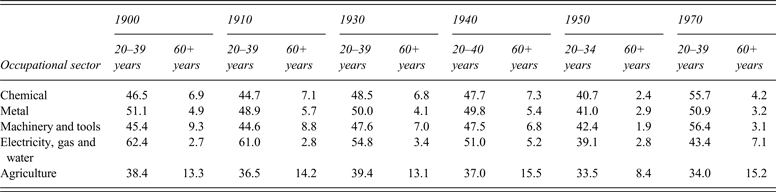
In addition to these findings, the stability in the relationship between the proportion of younger workers and the proportion of older workers employed in some sectors which relied heavily on technology, shown in Table 6, offers further support for the rejection of the hypothesis that proposes that ageing was related to reduced occupation opportunities in certain sectors of the economy.
Percentage of ‘young’ men and ‘older’ men employed in selected occupational sectors: Spain, 1900–1970a
Another alternative explanation for the pattern of concentration indexes seen in Tables 4 and 5 would be the existence of significant differences in mortality rates between men in different occupations: lower mortality in a particular sector might lead to a higher concentration of older workers in that sector. It is not easy to reject this hypothesis for the chronological framework under study. Obviously, a considerable mortality differential existed in the nineteenth and twentieth centuries between sectors such as mining and agriculture, but when the contrast in working conditions was less extreme the comparisons are not so straightforward. For instance, was mortality higher amongst agricultural labourers, for example, than it was among small tenant farmers? Unfortunately, it is very difficult to ascertain the truth when considering this point due to a lack of mortality rates by occupation for Spain. In his study of England, Johnson rejected the hypothesis that there was a consistent relationship between mortality levels and the concentration of older men in certain occupational sectors.Footnote 62 He based his conclusion on mortality data available in the Reports of the Registrar-General for England and Wales,Footnote 63 which summarised the data from the 1901, 1921 and 1931 population censuses for five social classes, rather than for occupations per se.
Traditionally, when occupational mortality rates are scarce, this is compensated for by taking differentials in mortality between town and country as proxy measures. If this is done for Great Britain, France and the USA the results point to clear mortality differentials in favour of the rural areas during the second half of the nineteenth century, but the same evidence also suggests that these differentials, otherwise known as the ‘urban penalty’, disappeared and in some cases actually reversed during the first decades of the twentieth century.Footnote 64
The data available for Spain appear to suggest that a similar sequence of events unfolded there too. Whereas mortality was higher in Spanish towns than in the countryside during the nineteenth century, the differential progressively narrowed until, after the Civil War, mortality rates in urban areas were below those in rural districts.Footnote 65 Even in the decades between 1900 and 1930 ‘the fall in mortality in the countryside was always higher than in the city’, as David Reher noted, ‘except for one age group: those aged 60–69’.Footnote 66 It would thus appear that the concentration of older workers in the agricultural sector was responding to more than just the hypothesised differentials in mortality between occupations.
It is possible that the occupational differentials in mortality may, in fact, be reflecting the existence of life-cycle deskilling across an individual's career. It would seem reasonable to believe that as the effects of prolonged exposure to the physical strain involved in a particular occupation gradually manifested themselves, workers would tend to seek less physically demanding jobs, either in the same sector or in another one.Footnote 67 In this situation, morbidity or, more exactly, a loss of physical ability, acted as a push factor in as much as the worker might have been at risk of an early death. Nevertheless, whether this dynamic is viewed from the perspective of labour supply or labour demand, it would appear to have been a practical expression of problems faced by older workers in the labour market that amounted to life-cycle deskilling.
Finally, the possibility that the pattern of occupational concentration amongst older workers reflected differential retirement rates between sectors of the economy should also be considered. Census data are, however, cross-sectional and hence inadequate to provide any safe conclusions on this point. Longitudinal records, following a given group of individuals over time, are needed for a complete assessment of this question. If stable differentials in rates of retirement could be identified then it might be possible to identify those sectors in which workers completed their careers with sufficient resources to face old age without employment. In this case the variations in retirement decisions observed could be linked to the different patterns of saving occurring in different occupational sectors. We have seen that there were lower rates of affiliation to pensions in agriculture and that savings schemes fragmented into sector- or firm-level schemes when the Francoist mutual societies were consolidated. It may be presumed that in sectors where labour supply was scarce, training expensive or the premium placed on skill higher, retirement provision was relatively generous and created opportunities for earlier withdrawal from the labour market. However, microdata analysis of such occupational schemes – which may not necessarily have applied to the occupations as they are defined in the census and may, in some cases, have also had a regional component too – lies outside the scope of this article. One further point that should be noted is the uneven incidence of self-employment between the sectors of the Spanish economy; it is presumed that higher levels of self-employment within an occupation resulted in lower levels of retirement.
To sum up, some of the findings detailed above mean that the concentration of older workers in certain occupations, as illustrated by the concentration indexes, cannot be conclusively and exclusively attributed to a process of life-cycle deskilling, or downward occupational mobility. Nevertheless, our results offer both robust and suggestive conclusions which support the view that there was a gradual flow of Spanish workers towards lower-status, less-attractive occupations as they grew older.
6. CONCLUSION
In this paper we have undertaken a quantitative analysis of the working patterns amongst older Spanish men over a considerable time period. Our main source of data was the national, decennial population census. Though not without its problems, this source has provided some important evidence. First, employment rates for men aged 60 years and over were found to have been very high until 1970, when they fell sharply after a modern social security system was introduced in the previous decade. Social insurance had already been in place in Spain since the 1920s, but the fact that rates of participation in the workforce remained high amongst men aged 60 years and over throughout the following decades demonstrates that the impact of early public pensions was very limited. The benefits paid prior to the Civil War were low and there were significant gaps in the coverage of the schemes that were in place. Francoist social policy exacerbated these deficiencies, diverged from international welfare standards and continued to make retirement unfeasible for the majority of Spanish workers.
Whereas self-reporting of employment status in the censuses probably distorts these results, the same system of data collection has been used in other countries. The corrections that have applied to participation rates in relation to structural changes in the Spanish economy suggest that men in more traditional occupational sectors, such as agriculture, were less likely to retire than men in other sectors. For this reason, the decline in the proportion of the male workforce who worked in agriculture contributed significantly to the drop in workforce participation amongst those aged 60 years or above throughout the first two-thirds of the twentieth century. This structural change played a greater role in the latter shift than changes in attitude towards retirement over the same period, which were inhibited by the unattractive pensions offered during that time.
It seems clear that, compared with today's figures, workers in Spain remained in employment for longer in every category of occupation in the first half of the twentieth century. The plight of older workers who found themselves removed from their traditional jobs with insufficient resources to guarantee a decent retirement was recognised by contemporary authors and, more particularly, by the policymakers who were responsible for designing the first measures to protect this vulnerable group within the population.
Early twentieth-century Spanish social reformers hypothesised that there was a redistribution of older workers across the occupational spectrum as they were expelled from the relatively good occupations they had held at younger ages. This downward occupational mobility, or life-cycle deskilling, has been observed in other countries and in this paper we set out to test whether it could, indeed, be observed in Spain. We were able to discount the idea that older workers remained in traditional sectors as the latter contracted and failed to attract young workers. Changes in mortality do appear to have affected the age distribution of some sectors of the workforce, but our analysis suggests that it was increasing morbidity and a need for occupations that were less physically demanding or had more flexible work practices which may explain the phenomenon of downward social mobility. In addition, there was an increased demand in certain sectors of the economy for workers with greater knowledge of technology and higher educational qualifications, qualities which few members of the older cohorts could supply. This increased the flow of older workers into lower-status, less-skilled occupations.
In conclusion, this article has highlighted the existence of problems faced specifically by older workers in the labour market, problems which were already perceived by those advocates of social insurance who, in the first decades of the twentieth century, pushed for public pensions to be introduced in Spain.
ACKNOWLEDGEMENTS
I am grateful to Giovanni Federico, Alfonso Herranz and Carles Sudrià, as well as participants in the seminar series of the Departament d'Història i Institucions Econòmiques of the University of Barcelona for their helpful guidance on earlier versions of this paper. I would also like to thank the anonymous referees and the editors of this journal for their valuable comments.