INTRODUCTION
Only five species of sharks have been recorded in the Southern Ocean (Cherel & Duhamel, Reference Cherel and Duhamel2004). One of these, the porbeagle Lamna nasus (Bonnaterre, 1788), is a large pelagic Lamnid shark found near many of the sub-Antarctic islands in the Indian and South-west Pacific Oceans (Francis et al., Reference Francis, Natanson, Campana, Camhi, Pikitch and Babcock2008). It also occurs in the cold temperate waters of the northern hemisphere and, due to the absence of porbeagles in tropical seas, it is presumed that two discrete breeding populations occur (Gon & Heemstra, Reference Gon and Heemstra1990; Francis et al., Reference Francis, Natanson, Campana, Camhi, Pikitch and Babcock2008). Porbeagles are relatively slow growing and late maturing, long-lived and bear only small numbers of young (Fowler et al., Reference Fowler, Raymakers and Grimm2004). Therefore, they have a low intrinsic rate of population increase exacerbated by a tendency for fisheries to capture large immature specimens long before they reach maturity (Fowler et al., Reference Fowler, Raymakers and Grimm2004). The species is currently classified as vulnerable on the International Union for Conservation (IUCN) Red List due to its vulnerability to over-exploitation (Scacco et al., Reference Scacco, Consalvo, Dimuccio and Tunesi2012).
Despite the lack of information on the status of porbeagle populations in the Southern Ocean, they have formed a high-value catch component in longline fisheries, and their highly valued meat and fins have entered international trade (Fowler et al., Reference Fowler, Raymakers and Grimm2004). Since the mid-1980s, porbeagles have been caught as a by-catch in both legal and illegal, unreported and unregulated (IUU) patagonian toothfish Dissostichus eleginoides fisheries in the sub-Antarctic waters off Îles Kerguelen, Îles Crozet and Macquarie Island (Gon & Heemstra, Reference Gon and Heemstra1990; Cherel & Duhamel, Reference Cherel and Duhamel2004; Fowler et al., Reference Fowler, Raymakers and Grimm2004; Pons & Domingo, Reference Pons and Domingo2010; Zhou & Fuller, Reference Zhou and Fuller2011). However, longline swordfish and tuna fleets have presumably taken the most significant bycatch of porbeagles in the Southern Ocean (Fowler et al., Reference Fowler, Raymakers and Grimm2004).
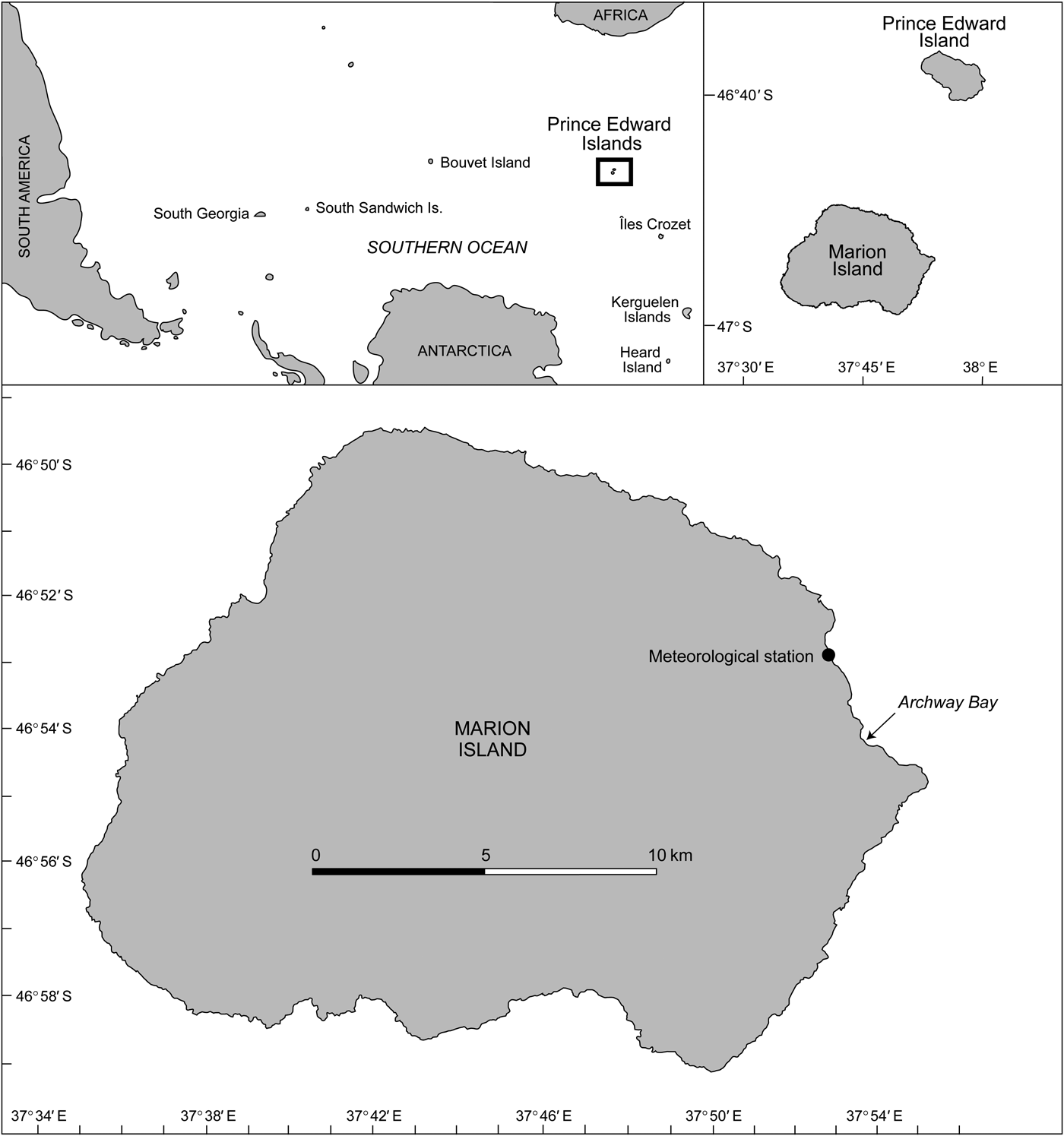
Although studies on porbeagles in the northern hemisphere are well documented, very little information is available on the biology of southern hemisphere stocks (Fowler et al., Reference Fowler, Raymakers and Grimm2004; Francis et al., Reference Francis, Natanson, Campana, Camhi, Pikitch and Babcock2008). A feeding study on porbeagles off the Îles Kerguelen indicate that they feed in the entire water column on intermediate to higher levels of the food chain, primarily on a diversity of fishes and squids (they do not feed on marine mammals) (Gon & Heemstra, Reference Gon and Heemstra1990; Cherel & Duhamel, Reference Cherel and Duhamel2004). Regards the Prince Edward Islands, almost nothing is known about the biology of chondrichthyes or cephalopods and no directed studies have yet focused on these important groups (Gurney, Reference Gurney2013). For cephalopods, only the species composition has been studied through the diet analysis of top predators such as seabirds (Berruti & Harcus, Reference Berruti and Harcus1978; Cooper et al., Reference Cooper, Brown, Gales, Hindell, Klages, Moors, Permberton, Ridoux, Van Heezik, Davis and Darby1990, Reference Cooper, Henley and Klages1992; Cooper & Klages, Reference Cooper and Klages1995) and Antarctic fur seals Arctocephalus gazella (Klages & Bester, Reference Klages and Bester1998; Makhado et al., Reference Makhado, Bester, Kirkman, Pistorius, Ferguson and Klages2008; Reisinger et al., Reference Reisinger, De Bruyn, Pistorius and Bester2010) breeding on the Prince Edward Islands (Figure 1). Other studies have focussed on the trophic ecology of the Patagonian toothfish (Pakhomov & Bushula, Reference Pakhomov and Bushula2003; Pakhomov et al., Reference Pakhomov, Bushula, Kaehler, Watkins and Leslie2006).
Illustration showing the location of Prince Edward and Marion Island in the southern ocean.

The incidental stranding of the porbeagle shark on Marion Island (Figure 1), therefore, provided a unique opportunity to investigate its stomach content.
MATERIALS AND METHODS
The taxonomic identification of the porbeagle shark was carried out according to the dichotomous keys and meristics provided by Compagno (Reference Compagno and Carpenter2002). The specimen was photographically recorded, pre-caudal length (PCL) measured to the nearest cm below and weighed to the nearest kg by means of tape measure and a 50 kg Salter scale, respectively. Sex was determined by the absence or presence of claspers.
The cephalopod beak removed from the squid specimen found in the stomach content were preserved in 70% ethanol until identification to species level from both the upper and lower beak (Clarke, Reference Clarke1986). Measurements were done with a vernier calliper, and the size and weight of the specimen were estimated from the species-specific allometric equations given in Clarke (Reference Clarke1986).
RESULTS AND DISCUSSION
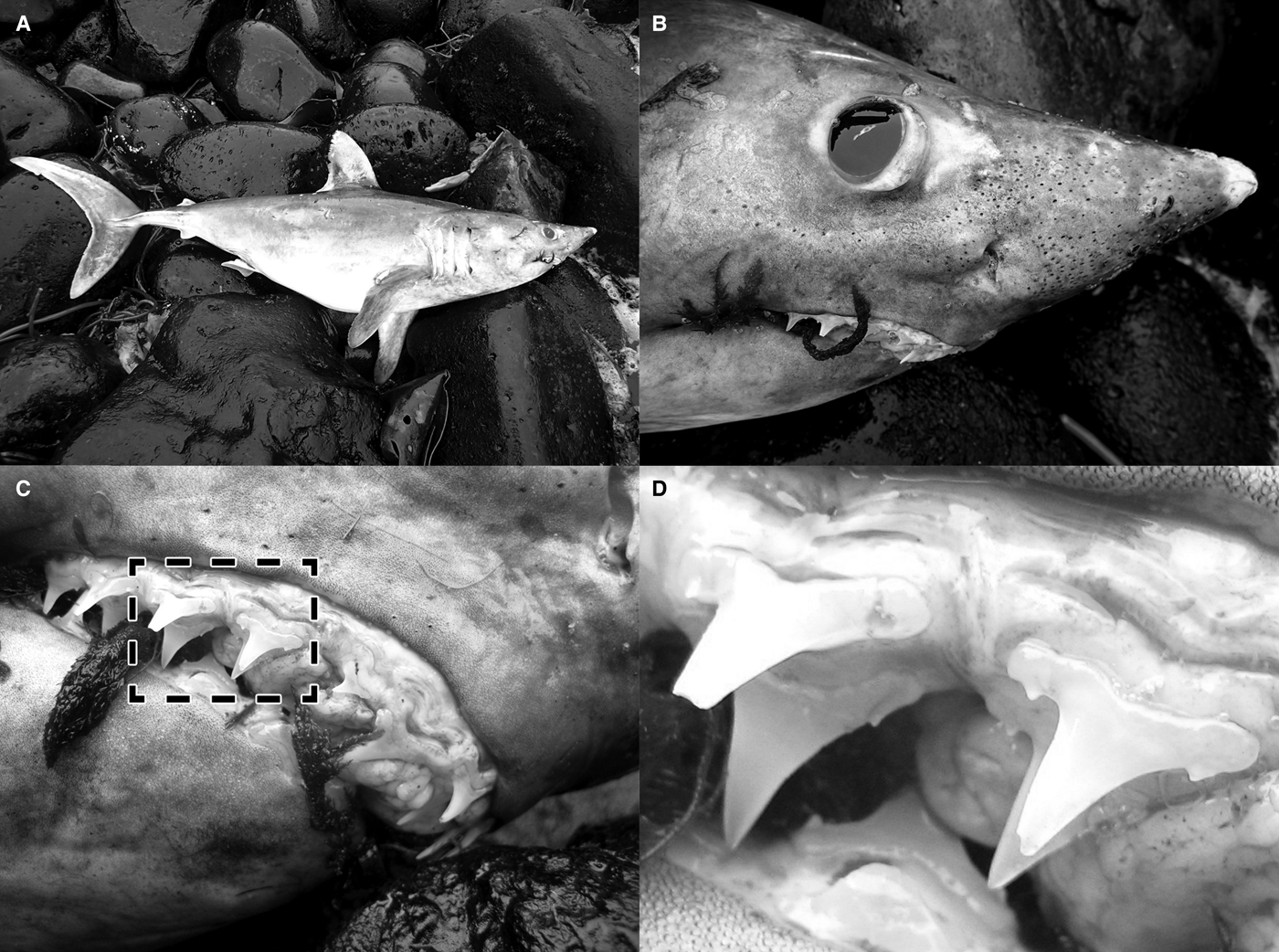
The 123 cm PCL porbeagle shark, weighing 46 kg, was sighted on 26 March 2014 during a normal census round of southern elephant seals Mirounga leonina (for details of the latter, see De Bruyn et al., Reference De Bruyn, Tosh, Oosthuizen, Phalanndwa and Bester2008) on Archway beach, situated on the eastern side of Marion Island (46°53′54.21″S 37°53′41.70″E) (Figure 2A–D). Based on the dichotomic key used, the shark was identified as Lamna nasus mainly because of the teeth shape consisting of two lateral cusps (Figure 2C and D), the free rear tip of first dorsal fin whitish in colour, the origin of the second dorsal fin above that of anal fin and the caudal fin with a secondary keel. In addition, only one species of Lamnidae is known to occur around sub-Antarctic islands (Gon & Heemstra, Reference Gon and Heemstra1990). The absence of claspers and the short body length (123 cm PCL) indicated that the specimen was a sub-adult female (Figure 2A). The specimen was found dead on the rocks at the water's edge. It appeared fairly fresh as scavenging bird species had not yet preyed on the carcass (e.g. De Bruyn et al., Reference De Bruyn, Cooper, Bester and Tosh2007). The jaws were opened and no fishing line or hooks were present in the mouth. Only a few minor skin afflictions were visible.
Images of a sub-adult female porbeagle shark Lamna nasus stranded on sub-Antarctic Marion Island, 26 March 2014: (A) dorsal view; (B) head view; (C) mouth; (D) tooth details. Dashed rectangle in picture (C) encloses the area magnified in picture (D).
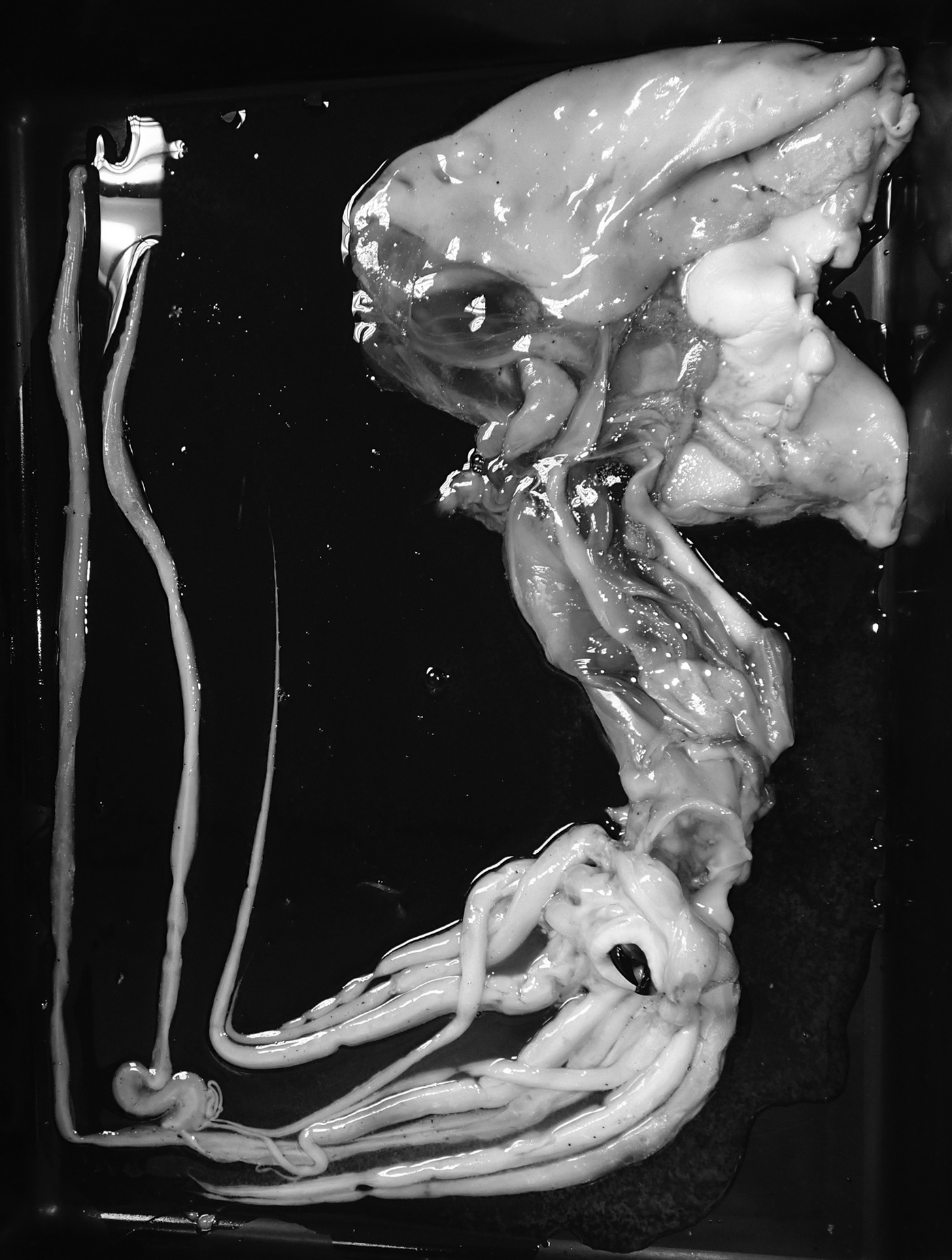
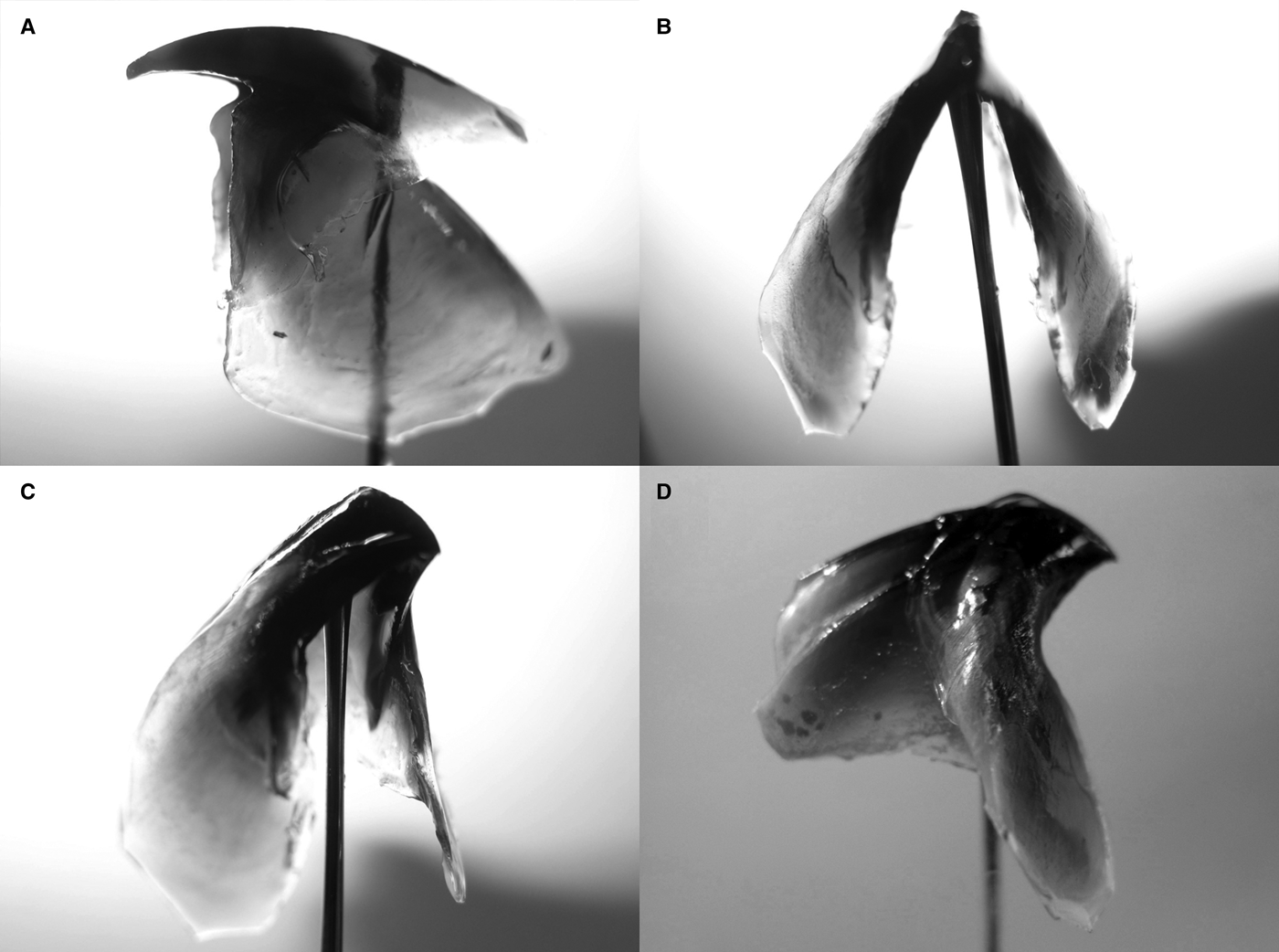
Examination of the stomach content revealed a partially digested greater clubhook squid Onykia ingens (family Onychoteuthidae) (Figure 3). Using measurements of the upper and lower beak of the specimen, it was estimated to have a mantle length (ML) of 36 cm and total weight 848 g (Figure 4). No fish remains were present in the stomach.
A partially digested clubhook squid Onykia ingens found in the stomach of a stranded porbeagle shark Lamna nasus on sub-Antarctic Marion Island, 26 March 2014.
Beak of the clubhook squid Onykia ingens removed from the stomach of a stranded porbeagle shark Lamna nasus on sub-Antarctic Marion Island, 26 March 2014: (A) upper beak; (B, C, D) lower beak.
No evidence of external damage caused by fishing gear was visible on the stranded porbeagle's body or in its mouth. There is also no evidence of a substantial porbeagle bycatch in the legal Patagonian toothfish fishery at the Prince Edward Islands Marine Protected Area (MPA) (Chris Heineckin, personal communication). Although porbeagle sharks are occasionally hooked, they are released alive (Chris Heineckin personal commonication) and there is only one record of a porbeagle shark being landed near the Prince Edward Islands in the last 14 years: a 200 kg individual caught at a depth of 807–1118 m on 8 October 2000 (CCAMLR, unpublished data). There are no restrictions or penalties for catching these sharks, so there is no incentive for fisherman to under report shark bycatch. In addition, the fishery has been subjected to 100% observer coverage since its inception.
There is little known about the natural predators of porbeagle sharks, but, according to Compagno (Reference Compagno2001), killer whales Orcinus orca might take this species. Killer whales associated to Marion Island do take Patagonian toothfish off the fishing lines, but no observational evidence or other records exists of them eating porbeagle sharks (Chris Heineckin, personal communication). Although no bite marks were visible on this specimen, such prey cannot be discounted from the diet of killer whales here (Reisinger et al., Reference Reisinger, De Bruyn, Tosh, Oosthuizen, Mufanadzo and Bester2011).
The beaks of the closely related species Filippovia knipovitchi are similar to those of Onykia ingens identified in the stomach content of the stranded porbeagle, and although the species occurs in the same region, its occurrence was much less probable due to its rarity. Cherel & Duhamel (Reference Cherel and Duhamel2004) found cephalopod prey of porbeagles off the Îles Kerguelen to consist mainly of small-sized histioteuthids (Histioteuthis atlantica and Histioteuthis eltaninae) and medium-sized juvenile ommastrephids of the genus Todarodes, all species known to be primarily pelagic when young and near-demersal when adult. Onykia ingens was also found in the stomach content of porbeagles caught off Îles Kerguelen, and although constituting a smaller percentage of their diet in this region, it is an abundant species in sub-Antarctic waters (Cherel & Duhamel, Reference Cherel and Duhamel2004; Jereb & Roper, Reference Jereb and Roper2010). It occurs on the Patagonian shelf, in southern Chile, Îles Crozet, Îles Kerguelen, southern New Zealand Islands, southern Australia, South African waters and the Prince Edward Islands (Jereb & Roper, Reference Jereb and Roper2010). Primarily a benthic/epibenthic species, it has been caught in demersal trawls from 300 to 1450 m in continental slope and bathyal waters (Jereb & Roper, Reference Jereb and Roper2010). The presence of Onykia ingens in the stomach content of the stranded porbeagle at Marion Island matches the classification of these sharks in the southern ocean region as pelagic and demersal predators. Onykia ingens is a major food item for the southern elephant seals, sperm and bottlenose whales, and also falls prey to king penguins Aptenodytes patagonicus, wandering albatross Doimedea exulans, lancetfishes, slender and yellowfin tunas and southern opah lampris immaculatus (Jereb & Roper, Reference Jereb and Roper2010).
The occurrence described here is the first documented record of a porbeagle shark stranding at Marion Island. The collection of stomach contents from these top predators is very rare in this region. The incidental stranding, therefore, provides a valuable addition to information on this shark's occurrence and one of its cephalopod prey species in the vicinity of the Prince Edward Islands MPA.
ACKNOWLEDGEMENT
This research received no specific grant from any funding agency, commercial or not-for-profit sectors.