Introduction
Allergic manifestations associated with the consumption of fish and shellfish have been reported consistently, these being two important elements among the group of eight main types of food responsible for allergic reactions (Sicherer, Reference Sicherer2002; Sicherer & Sampson, Reference Sicherer and Sampson2006). Studies have reported that allergies are often not related to the fish and seafood antigens themselves, but rather to accidental ingestion of Anisakidae parasite larvae (Nieuwenhuizen et al., Reference Nieuwenhuizen, Lopata, Jeebhay, Herbert, Robins and Brombacher2006). Among the several members of this family, larvae of the species of the genus Anisakis are most often associated with human problems, followed by those of the genus Pseudoterranova (Jofre et al., Reference Jofre, Neira, Noemi and Cerva2008; Na et al., Reference Na, Seo, Chai, Lee and Jeon2013). Diseases caused by species of the genus Contracaecum are less frequent (Shamsi & Butcher, Reference Shamsi and Butcher2011). Individuals parasitized by members of this family have been reported to have a high degree of cross-reactivity among themselves (Lozano et al., Reference Lozano, Martin, Diaz, Manas, Valero and Campos2004). This means that a person sensitized by larvae of one species may develop allergic reactions when consuming fish or seafood parasitized by larvae of other species of the same family. Since the morbidity of allergy has increased, epidemiological studies on the sensitization of anisakids have been directed, mainly, at the clinical forms resulting from the ingestion of live L3 (Del Pozo et al., Reference Del Pozo, Audicana, Diez, Munoz, Ansotegui, Fernandez, Garcia, Etxenagusia, Moneo and De Corres1997; Daschner et al., Reference Daschner, Alonso-Gomez, Cabañas, Suarez-de-Parga and Lopez-Serrano2000). Although this remains a controversial issue, live L3 infections appear to sensitize the host to allergic reactions (Del Pozo et al., Reference Del Pozo, Audicana, Diez, Munoz, Ansotegui, Fernandez, Garcia, Etxenagusia, Moneo and De Corres1997; Audicana et al., Reference Audicana, Ansotegui, De Corres and Kennedy2002; Alonso-Gomez et al., Reference Alonso-Gomez, Moreno-Ancillo, Lopez-Serrano, Suarez-de-Parga, Daschner, Caballero, Barranco and Cabanas2004). Analyses have demonstrated a similarity in the humoral and cellular immunological responses observed in mice against live and dead Anisakis sp. larvae, with those observed in humans, indicating the relevance of these study models (Iglesias et al., Reference Iglesias, Leiro, Ubeira, Santamarina and Sanmartin1993; Perteguer et al., Reference Perteguer, Rodero, Flores, Dorea and Cuellar2001).
Epidemiological data suggest that the application of peanut oil to inflamed skin may be an important route of sensitization (Lack et al., Reference Lack, Fox, Northstone and Golding2003). In this way, altered skin function may promote the sensitization of environmental antigens and increase the development of food allergies. In humans, approximately 80% of patients with atopic dermatitis (AD) have elevated serum levels of total IgE and IgE specific for environmental and/or food allergens (Leung, Reference Leung2000), and this emphasizes that epicutaneous exposure to protein antigens is one of the important pathways for development of AD (Santamaria Babi et al., Reference Santamaria Babi, Picker, Perez Soler, Drzimalla, Flohr, Blaser and Hauser1995; Teraki et al., Reference Teraki, Hotta and Shiohara2000). Therefore, other forms of sensitization to anisakid antigens should be considered as an important factor, especially in the assessment of the health of workers in markets, the fishing industry or those who deal directly with the handling of raw fish.
In animal models, epicutaneous sensitization with protein antigens has been shown to preferentially induce an immune response with Th2 profile and weak Th1 responses, leading to skin lesions similar to allergic dermatitis and to the development of asthma (Wang et al., Reference Wang, Lin, Hsieh and Lin1996; Spergel et al., Reference Spergel, Mizoguchi, Brewer, Martin, Bhan and Geha1998). Epicutaneous sensitization with protein antigen was reported to induce a modest Th17 response (He et al., Reference He, Oyoshi, Jin and Geha2007; Wang et al., Reference Wang, Chiu, Hsu, Liu, Hsueh and Miaw2009).
The immune response of mice to live and dead Anisakis spp. larvae has been reported, indicating considerable similarities with the human immune response, at both the cellular and humoral levels (Perteguer et al., Reference Perteguer, Rodero, Flores, Dorea and Cuellar2001; Vericimo et al., Reference Vericimo, Figueiredo, Teixeira and São Clemente2015). In this sense, the murine experimental model has aided in understanding the consequences generated by the production of high IgE concentrations and traced new strategies to modulate the consequences generated by this antibody class (Maizels & Yazdanbakhsh, Reference Maizels and Yazdanbakhsh2003; Baeza et al., Reference Baeza, Conejero, Higaki, Martin, Perez, Infante, Rubio and Zubeldia2005).
Experimental animal models support the clinical studies showing that epicutaneous immunization is one of the routes of immunization for atopic diseases, and thus contribute to knowledge about the immune response and the development of new strategies for the control of allergic reactions and parasitic infections (Cho et al., Reference Cho, Park, Kang, Caballero, Perez-Pinar, Rodriguez-Perez, Ock, Cha, Hong and Yu2014; Liu et al., Reference Liu, Navarro and Lopata2016). The skin is an organ that serves as an interface between the external environment and the immune system. Contact through the skin is a common mode of allergen action in our daily lives and may be one of the natural allergen sensitization pathways. In this sense, the present study aimed to analyse the allergenic potential of Contracaecum multipapillatum larvae, collected from Hoplias malabaricus, through sensitization to the crude extract by intraperitoneal and epicutaneous routes in a murine model.
Materials and methods
Collection of hosts for identification of nematode larvae and processing for crude extract
In March 2014, 15 specimens of H. malabaricus from Cuiabá River, municipality of Barão do Melgaço, state of Mato Grosso (MT), Brazil (16°12′59.70″S; 55°57′51.79″W) were collected by professional fishermen. The fish were transported to the Fish Laboratory of the Universidade Federal do Mato Grosso, municipality of Cuiabá, MT, in isothermal boxes with ice, and later eviscerated and filleted. The parasitic nematodes were found in the abdominal cavity and removed with needles and brushes. They were transferred to a Petri dish, stored in Ependorff tubes with 0.65% NaCl solution and placed in a freezer. These tubes were transported in a isothermal box with ice to the Universidade Federal Fluminense (UFF), municipality of Niterói, Rio de Janeiro, Brazil, where the nematodes were observed under an Olympus BX-41 (Tokyo, Japan) optical microscope and identified as C. multipapillatum based on the description of Moravec (Reference Moravec1998). For the purpose of disintegration, samples were processed in a Potter homogenizer (Thomas, Philadelphia, USA), after successive washes with 0.65% NaCl solution, and then phenylmethylsulphonyl fluoride (PMSF) was added. Subsequently, they were centrifuged at 10,000 rpm at 4°C for 20 min. Protein quantification of the extracts was performed by the method of Lowry et al. (Reference Lowry, Rosebrough, Farr and Randall1951), using bovine serum albumin (BSA) 1 mg/ml as the standard.
Analysis of animals
For the experiment, BALB/c mice aged 8–10 weeks were raised and kept in the local bioterium, in the Laboratory Animal Nucleus, UFF.
Immunization with crude extract of C. multipapillatum (CECM)
Three experimental groups consisted of five BALB/c mice each, receiving immunizations on the initial day of the experiment (day 0 or primary immunization) and on days 7, 14 and 48 by intraperitoneal (ip) injection: a group with 2 mg of aluminium hydroxide suspension (non-immunized control), another with 10 μg CECM, associated with 2 mg of the aluminium hydroxide solution, and the third with 50 μg of CECM associated with 2 mg of the aluminium hydroxide solution. Blood samples were collected from the retro-orbital plexus of the mice on days 0, 21, 28, 48, 55, 63 and 84 to determine the levels of specific antibodies in serum, using the enzyme-linked immunosorbent assay (ELISA).
Sensitization by the epicutaneous route
The animals were anaesthetized and depilated in the dorsal region on days 0, 13, 69 and 76, for the adhesion of a Finn-type camera (Finn Chambers®, Epitest Ltd Oy, Tuusula, Finland) sensitized with 100 μg chicken egg albumin (OVA) or with 100 μg CECM. There were four application steps. At each application the chambers remained adhered for 4 days and were then withdrawn. Blood samples were collected to obtain serum on days 0, 21, 69, 76 and 83, for determination of specific antibody levels by ELISA.
Determination of specific IgG and IgE antibody levels
The presence of IgG and IgE isotypes, anti-C. multipapillatum and anti-OVA in the sera of the mice was determined by ELISA, described by Vericimo et al. (Reference Vericimo, Figueiredo, Teixeira and São Clemente2015). Briefly, in Nunc MaxiSorp™ flat-bottom plates (Nunc, Roskilde, Denmark) 50 µl of CECM antigens or OVA (containing 20 μg protein/ml) were placed in 0.05 m carbonate/bicarbonate buffer, pH 9.6. The sera were serially diluted from 1 to 40 in PBS-G (phosphate-buffered saline gelatine, pH 7.2) at base 3 and incubated for 2 h at 37°C. The peroxidase-conjugated antibodies: anti-IgE (ε chain) (rat anti-mouse IgE, Invitrogen, Carlsbad, California, USA) and anti-total IgG (L and H) (1:10,000) (rabbit anti-mouse IgG, whole molecule, Sigma-Aldrich, St. Louis, Missouri, USA) were used. After washing the plates with PBS-T (phosphate-buffered saline-Tween), the reaction with the substrate and chromogen was performed by adding 50 μl/well of solution collected, 10 μl of 30% hydrogen peroxide diluted in 25 ml of 0.1 m citrate buffer with 10 mg of OPD (orthophenylenediamine). The enzymatic reaction was stopped with the addition of 4 n sulphuric acid. Optical density (OD) reading was performed on a microplate reader (Anthos 2010, Krefeld, Germany) at 492 nm wavelength. The analysis of the results was performed by comparing the sum of the OD of each serum. The results are reported as arbitrary units of ELISA corresponding to the value of the area under the dilution curve of each serum.
Evaluation of cellular immunity
On day 84 (end of the experiment) the groups of animals immunized by the intraperitoneal route received an intradermal injection of 20 μl of CECM in the left ear pavilion, and saline solution was injected in the right ear pavilion as a control. The ear pavilion thickness was measured before inoculation and at 24, 48 and 72 h after the injection, with a micrometer (no. 7301; Mitutoyo Sul Americana, Rio de Janeiro, Brazil).
Statistical analysis
Data were analysed by Tukey's post-hoc test, using the program GraphPadInStat-version 4.10 for windows XP (GraphPad Software, San Diego, California, USA; www.graphpad.com). In the statistical analysis of the experimental data, values were considered to be significant if P < 0.05.
Results
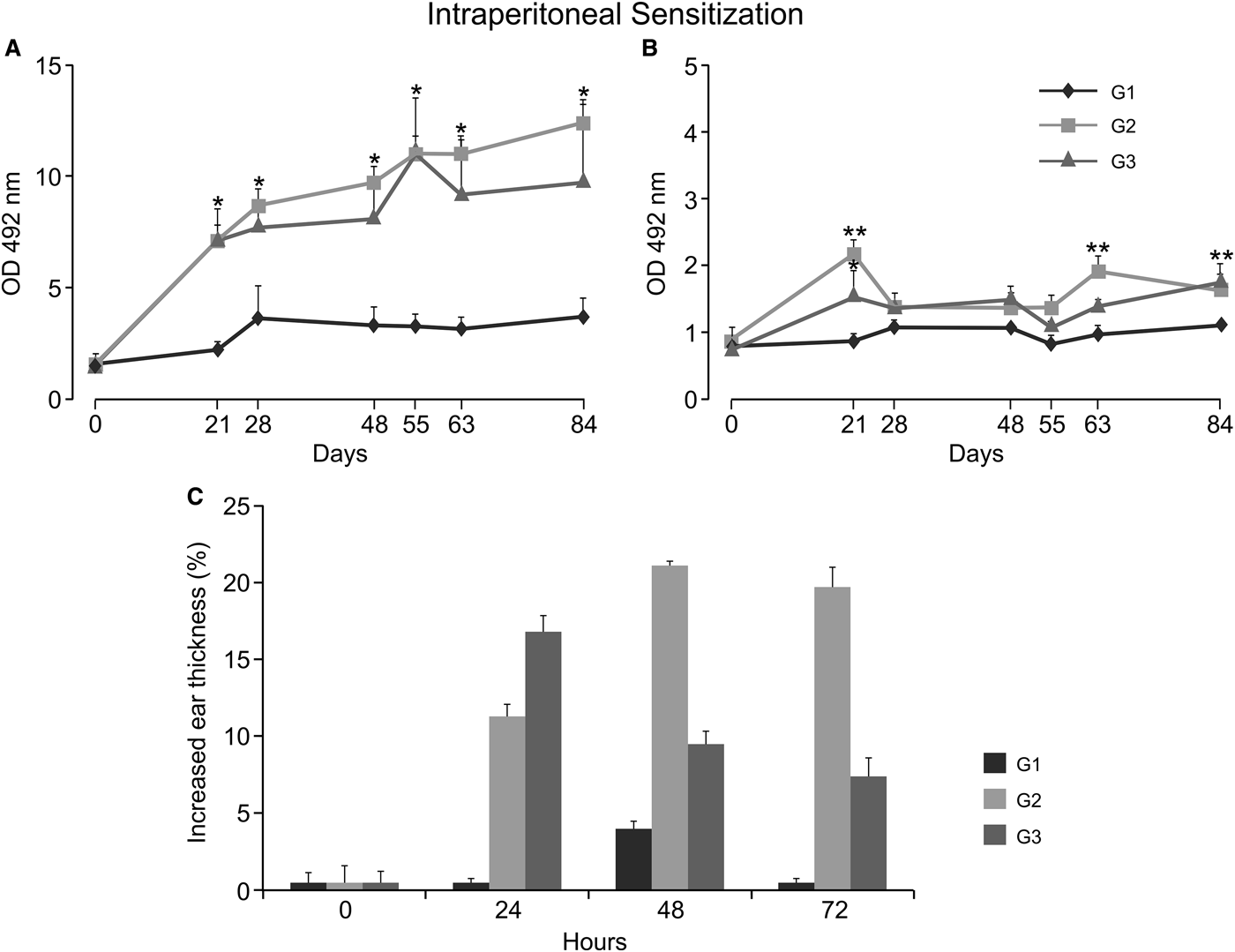
Initially, the intensity of the immunological response induced by intraperitoneal immunization with two concentrations of CECM was evaluated. Figure 1A shows levels of IgG against CECM, determined by the ELISA reaction. It was observed that after the primary immunization, both the group that was immunized with 10 μg of CECM and that immunized with 50 μg gradually responded with the production of specific IgG antibodies. The results were statistically significant in relation to blood samples collected before immunization (P < 0.01).
Intraperitonial sensitization. Immunogenicity of crude extract of C. multipapillatum (CECM). IgG and IgE levels and delayed hypersensitivity reaction. Groups of five mice received intraperitoneal injections on days 0, 7, 14 and 48 of 2 mg of Al(OH)3, control group (G1); 10 μg of CECM associated with 2 mg Al(OH)3, group 2 (G2); or 50 μg of CECM with 2 mg Al(OH)3, group 3 (G3). (A) Specific IgG kinetics; (B) specific IgE kinetics. The values indicate the averages of the sum of the optical densities (OD) ± the standard deviation (SD) of each group. (C) Cell hypersensitivity reaction after challenge with 20 μl CECM in the left ear pavilion. The result represents the percentage increase in the ear pavilion thickness and ± SD of each group. *P < 0.01 and **P < 0.001 compared to the serum sample taken prior to immunization.

No significant difference was observed between antibody levels in the groups immunized with 10 or 50 μg CECM.
IgE production (fig. 1B) showed a transitory elevation in the groups of immunized mice, reaching a maximum on day 21, which was statistically significant for those immunized with 10 and 50 μg (P < 0.001 and P < 0.01, respectively), and from then on there was a slight decrease. The animals immunized with 10 μg CECM had higher antibody levels than those immunized with 50 μg (P < 0.05). After the third immunization, day 48, a slight elevation of IgE levels was observed in both groups, reaching maximal levels on day 63 for the group immunized with 10 μg (P < 0.001) and on the 84th day for the group immunized with 50 μg (P < 0.001). Although the IgE levels of the group immunized with 10 μg were higher than those of the animals immunized with 50 μg, no statistically significant difference between these groups was observed.
The intradermal reaction is represented in fig. 1C. The groups immunized with 10 and 50 μg CECM showed a significant increase in ear pavilion thickness (P < 0.001) from the initial time until 24 h after injection. However, from 24 to 48 h a decrease was seen in the group immunized with 50 μg, unlike those animals that were immunized with 10 μg, which maintained the same level of inflammation.
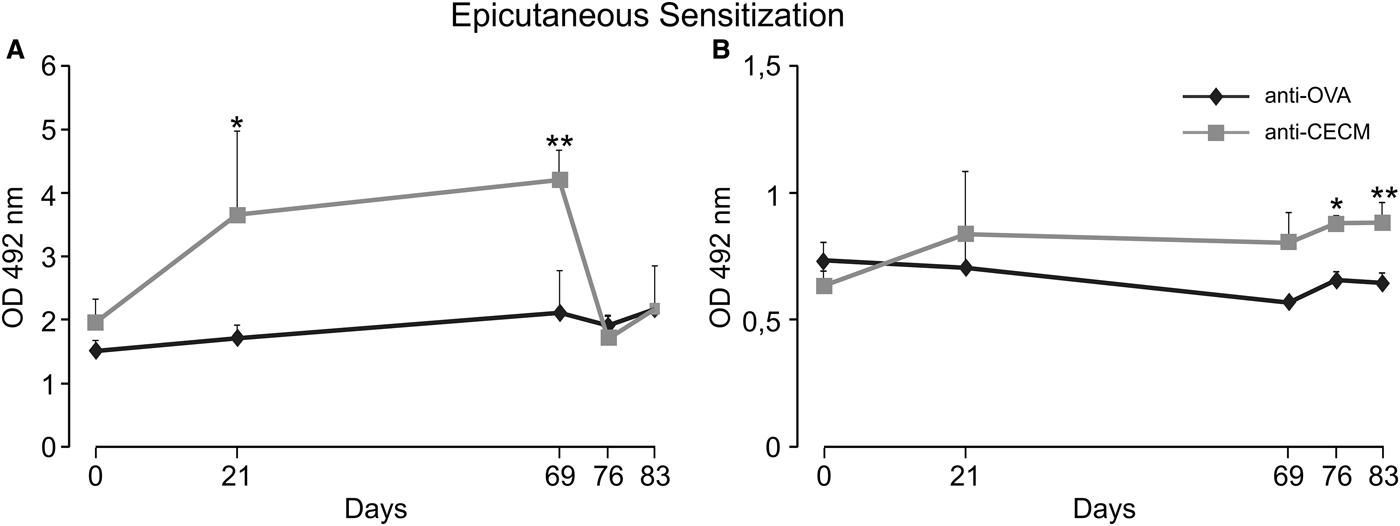
In the epicutaneous exposure to OVA or CECM, represented in fig. 2, only the animals exposed to the CECM responded with specific IgG levels, statistically significant on days 21 and 69 (P < 0.01 and P < 0.001, respectively). Specific IgG levels were observed after the second exposure step.
Epicutaneous sensitization. Specific IgG kinetics (A) and specific IgE (B) from groups of five mice sensitized with 100 μg chicken egg albumin (OVA) or 100 μg crude extract of C. multipapillatum (CECM) via the epicutaneous route on days 0, 13, 69 and 76. The values represent the mean optical density (OD) ± standard deviation of each group. *P < 0.01 and **P < 0.001 compared to the serum sample taken prior to immunization.

Figure 2B shows that the animals sensitized with CECM responded with specific IgE levels only after the third exposure step, on days 76 and 83 (P < 0.01 and P < 0.001, respectively).
Discussion
In general, parasitic nematodes stimulate an immune response with a very strong Th2-type lymphocytic profile characterized by the predominant production of cytokines, such as interleukin (IL)-4, IL-5 and IL-13, which promote secretion of high levels of circulating IgE and a strong eosinophilia. However, the close relationship between allergic diseases and parasitic diseases is not well understood (Koyasu et al., Reference Koyasu, Moro, Tanabe and Takeuchi2010; Spencer & Weller, Reference Spencer and Weller2010; Neill & McKenzie, Reference Neill and McKenzie2011). Therefore, the present study evaluated an experimental model of sensitization of mice with C. multipapillatum larval antigens and the apparent increased risk of inducing a type 1 hypersensitivity reaction, classically associated with an immune response that led to the production of high levels of IgE and IgG immunoglobulins.
Although the natural sensitization of CECM did not occur through parenteral administration, the results of the present study are in agreement with those of Mattos et al. (Reference Mattos, Vericimo, Lopes and São Clemente2015), who reported that in animals immunized with 10 and 50 μg, associated with aluminium hydroxide, high concentrations of specific IgG and IgE were induced, where no significant differences were observed in the kinetics of these antibodies at the concentrations used. However, in the present study the intensity of cellular immunity by the intradermal reaction demonstrated that animals immunized with 10 µg had a classical pattern of delayed hypersensitivity, tuberculin type, as observed by De Rossell et al. (Reference De Rossell, Bray and Alexander1987). On the other hand, in the present study, animals immunized with 50 μg showed a more intense response in 24 h, with a decrease of the reaction at 48 and 72 h, suggesting a large involvement of proinflammatory mediators, similar to the inflammatory response induced by 12-O-tetradecanoylphorbol acetate (TPA) as reported by Murakawa et al. (Reference Murakawa, Yamaoka, Tanaka and Fukuda2006).
Studies on the pathways of allergic sensitization in models are quite controversial. Hsieh et al. (Reference Hsieh, Tsai, Wu and Lin2003) reported that intraperitoneal immunization induced a predominantly Th1-type response, whereas epicutaneous sensitization was predominantly Th2. These authors suggested that ip sensitization might not be a sufficiently good model for allergic diseases, since it did not reflect the physiological pathway for Th2 induction, and concluded that exposure to crude extract (CE) of the protein antigen can promote food allergy, since mice pre-exposed to CE allergen developed systemic anaphylaxis after subsequent oral challenge. Baeza et al. (Reference Baeza, Conejero, Higaki, Martin, Perez, Infante, Rubio and Zubeldia2005) developed a murine model of A. simplex allergy, using the intraperitoneal route for immunization, where the mice presented a mixed pattern of Th2/Th2 response, similar to human anisakiasis, with the production of high levels of total and specific IgE. The epicutaneous exposure to protein antigens has been shown by some authors to be able to induce food allergy (Wang et al., Reference Wang, Lin, Hsieh and Lin1996; Dunkin et al., Reference Dunkin, Berin and Mayer2011), suggesting that epicutaneous exposure may be a role for allergic diseases such as atopic dermatitis and asthma. Thus, in the present study, it was possible to evaluate the involvement of CECM and OVA epicutaneous exposure in mice sensitization, where it was verified that only CECM was able to sensitize the specific production of IgG and IgE. In the present study, no sensitization was observed for OVA, unlike that observed by Hsieh et al. (Reference Hsieh, Tsai, Wu and Lin2003). In the present study, lack of OVA sensitization may have been due to a shorter exposure time (4 days) and the interval between exposures to referred antigen, taking into account that the protocol differed from that used by Hsieh et al. (Reference Hsieh, Tsai, Wu and Lin2003), who carried out three exposures, each lasting 7 days.
The results obtained in the present study suggest that contact of C. multipapillatum larval antigens with the skin can induce allergic sensitization in mice, where CECM was more efficient in sensitizing the animals than OVA. Thus, it is possible that under certain circumstances, the clinical association between these allergic diseases may be reflecting coexisting facets of a single disease, in response to the challenge of allergen by different natural roles. This idea of a single common role of sensitization for multiple allergic diseases finds support in Li et al. (Reference Li, Kleiner, Huang, Lee, Schofield, Soter and Sampson2001), who demonstrated that re-exposure to the allergen causes skin lesions, such as atopic dermatitis, in mice sensitized by the oral administration of allergens with mucosal adjuvant cholera toxin, which has been a mode of sensitization used in food allergy models, suggesting the presence of a common physiological sensitization pathway for AD and food allergy. Birmingham et al. (Reference Birmingham, Parvataneni, Hassan, Harkema, Samineni, Navuluri, Kelly and Gangur2007) and Gonipeta et al. (Reference Gonipeta, Parvataneni, Tempelman and Gangur2009) confirmed these results, but without the use of adjuvant at the moment of sensitization.
In the present study, it was demonstrated that the exposure to parasitic antigens by an epicutaneous route was able to induce a systemic sensitization in mice, with the production of specific IgG and IgE antibodies. This has direct implications for the possible induction of allergy in personnel involved in the preparation of fish for consumption, whether industrial worker, fishmonger or consumer.
Acknowledgements
The authors would like to thank Heloisa Nogueira (Serviço de Processamento de Imagens, IOC, Fiocruz) for processing the figures.
Financial support
The National Council for Scientific and Technological Development (CNPq) and the Coordination Office for Improvement of Higher-Education Personnel (CAPES) are thanked for partial financial support. This work was supported by one fellowship: CNPq grant number 308048/2013-0 (for S.C.S.C.).
Conflict of interest
None.
Ethical standards
This study was approved by the Animal Research Ethics Committee of the Universidade Federal Fluminense (UFF) Centre for Laboratory Animals (00137/2009).