





Excess Na intake, mostly consumed as salt, leads to high blood pressure and an increased risk of CVD and chronic kidney disease (CKD)(Reference He, Li and MacGregor1). As such, approximately 1·7 million deaths globally each year are associated with excess Na intake(2). Reducing Na intake has the potential to be one of the most cost-effective approaches to improving health and reducing the burden of non-communicable diseases(3,Reference Wang and Labarthe4) . As such, the WHO set a goal to reduce population Na intake by 30 % by 2025. The SHAKE technical package for population Na reduction was developed to support member states in reaching the goal(3,5) . Despite this, global mean Na intake is estimated to be 4310 mg/d, more than double the WHO recommendation(6). While the WHO goal has been extended to 2030, current modelling predicts that the target will not be met, with a 23 % global reduction projected(6). In addition, supplementing potassium intake can reduce blood pressure(Reference Filippini, Naska and Kasdagli7), but the global mean potassium intake (2·25 g/d) falls below the recommended 3·5 g/d(Reference Reddin, Ferguson and Murphy8).
In Australia, average daily Na intake is approximately 4000 mg in men and 2900 mg in women(Reference Land, Neal and Johnson9), and recent dietary intake data from 2023 suggest that these intakes have not changed in over a decade(10). Currently, one in three (34 %) Australian adults have high blood pressure, where excessive Na intake and inadequate potassium intake are key contributors(11). Switching regular salt to potassium-enriched salt, where a proportion of sodium chloride is replaced with potassium chloride, is a proven solution with clear health benefits in reducing blood pressure and the risk of stroke, CVD and premature mortality(Reference Neal, Wu and Feng12–Reference Yin, Rodgers and Perkovic14). With substantial evidence of health benefits for CVD, the WHO and several health organisations worldwide have published recommendations supporting the replacement of regular salt used for cooking or at the table with potassium-enriched salt(15–Reference Xu, Zeng and Jha17). Additionally, over the past 3 years, recommendations regarding potassium-enriched salt have been incorporated into multiple clinical hypertension guidelines(Reference Jones and Ferdinand18–Reference Mancia, Kreutz and Brunström21).
The challenge now is achieving population-level uptake of a switch to potassium-enriched salt in Australia, particularly among individuals with hypertension who are likely to benefit the most. Healthcare professionals are identified as key stakeholders in promoting and recommending the use of potassium-enriched salt, given their integral role and engagement with patients with hypertension. To better support healthcare professionals to recommend the switch to potassium-enriched salt, our study aimed to (1) assess Australian healthcare professional’s knowledge, attitudes and practices (KAP) related to regular and potassium-enriched salt, (2) understand the barriers and opportunities to recommendation of potassium-enriched salt for hypertension management in clinical practice and (3) explore strategies to increase recommendation of potassium-enriched salt in clinical practice. Specifically, our study focuses on potassium-enriched salt for use during cooking and at the table, as opposed to potassium-enriched salt used as an ingredient in the manufacture of foods by the food industry.
Methods
We used a convergent parallel mixed-methods approach(Reference Creswell and Plano Clark22), including surveys and semi-structured interviews, to explore the KAP of Australian healthcare professionals related to regular salt and potassium-enriched salt. A mixed-methods approach was used to provide a quantitative assessment of KAP across a sample of Australian healthcare professionals with in-depth qualitative exploration of the contextual factors influencing practice, that is, recommendation of potassium-enriched salt. Due to time and resource constraints, a convergent parallel design was used to capture both breadth and contextual depth at a single point in time. The survey took place between June and December 2024, and interviews took place between June and October 2024. This study was conducted according to the guidelines laid down in the Declaration of Helsinki and all procedures involving human participants were approved by the University of New South Wales Human Research Ethics Committee (iRECS6365). Written informed consent was obtained from all participants. Study reporting was guided by the Good Reporting of a Mixed Methods Study (GRAMMS)(Reference O’Cathain, Murphy and Nicholl23) and Composite Criteria for Reporting Qualitative Research (COREQ)(Reference Tong, Sainsbury and Craig24) guidelines.
Participants and recruitment
Participants were eligible to complete surveys and interviews if they were (1) a general practitioner (GP), nurse (nurse practitioner or general practice nurse), medical specialist or allied health professional working in clinical practice in Australia and involved in the care of individuals with hypertension, (2) English-speaking and (3) willing to provide consent to participate. For interviews, cardiologists and nephrologists were specifically targeted for medical specialist participants, and dietitians or pharmacists for allied health participants, as these professions were identified as the most relevant to nutrition and blood pressure management.
Convenience sampling methods were used to recruit survey participants by advertising through relevant healthcare professional associations (including the Australian and New Zealand Society of Nephrology, Nutrition Society of Australia and Australian Primary Health Care Nurses Association) and extended professional networks of research team members. After initial recruitment, a purposive maximum variation sampling method was used to obtain diverse perspectives from professions underrepresented in initial recruitment. This involved targeted advertising to networks of specific professions. Convenience and purposive sampling methods were used to recruit participants to the interview by distributing advertisements through healthcare professional networks (professional associations and networks as described for the survey) and inviting a stratified subset of survey participants, selected based on their professional role, to participate if they provided their contact details. While we encouraged interview participants to complete the survey if not completed prior, it was possible that not all completed the survey.
Data collection
The development of surveys and interview guides were informed by our previous systematic review(Reference Kissock, Ghammachi and Hoek25) and an additional search of the literature to identify data collection tools relevant to KAP towards regular salt and potassium-enriched salt and healthcare professionals.
A twenty-seven-item survey was developed to assess current KAP towards regular salt and potassium-enriched salt, particularly in hypertension management (Supplementary Material 1). The survey combined and adapted questions from published surveys on salt reduction and salt substitutes among healthcare professionals(Reference Algarni, Ayoub and Alkhadrawi26,Reference Fathima and Bhargava27) and Australian consumers(Reference Grimes, Kelley and Stanley28,Reference Trieu, Kissock and Hoek29) . Supplemental Table 1 outlines the derivation and adaptation of survey items. The survey was finalised based on expert consultation with the research team; however, it was not pilot-tested or validated. Surveys consisting of multiple-choice and open-ended questions were administered online via the Qualtrics platform. For knowledge, participants were asked about the relationship between salt and Na, daily salt intake recommendations and sources of salt in Australia, salt-related health outcomes, familiarity with potassium-enriched salt, indications and contraindications for the use of potassium-enriched salt, availability of potassium-enriched salt and the health benefits of potassium-enriched salt. Where applicable, correct answers were agreed a priori based on current available evidence and study team expertise. Questions on attitudes related to the importance of salt reduction for patients, accessibility of potassium-enriched salt and the safety of using potassium-enriched salt. Questions on practice related to the recommendation of salt/Na reduction and potassium-enriched salt. Participant demographics, including gender, age, education, professional history and location of practice, were also collected as part of the survey.
Semi-structured interviews were conducted to further explore KAP related to potassium-enriched salt in hypertension management and their influencing factors. As surveys were conducted concurrently, interview guides were developed prospectively by the lead author and researcher (KRK – female, PhD) adapting questions from published research that explored barriers and facilitators to implementing potassium-enriched salt amongst key stakeholders(Reference Crowther, Hoek and Trieu30,Reference Yin, Tian and Sun31) , followed by the research team providing expert review (see Supplementary Material 2). Interview guides were tailored for each healthcare professional group such that interview length varied depending on participant profession. Interviews consisted mostly of open-ended questions asking participants about their familiarity with potassium-enriched salt, barriers and opportunities to recommending it in clinical practice and strategies to increase its recommendation by healthcare professionals. Demographics were collected from all participants prior to the interview via email. All interviews, except for GP, were conducted by one interviewer (KRK or KT – female, PhD) with a second interviewer where possible. GP interviews were conducted in combination with another research project where one member from the research team (KRK or NG – female, MPH) was the lead interviewer for the section relevant to the current study. Other sections focused on experience with hypertension guidelines, single-pill combinations and prescription of blood pressure medications and were unlikely to influence responses around potassium-enriched salt. All interviewers for the current project were public health researchers with relevant training and previous experience in conducting qualitative interviews through previous research. Two interviewers (KRK and NG) were dietitians by training, with relevant background knowledge on nutrition, health and health practice. Two interviewers (KRK and KT) were global experts in potassium-enriched salt and Na reduction, leading research programmes supporting a switch to potassium-enriched salt. KT was director of the WHO Collaborating Centre on Population Salt Reduction. No other potential conflicts of interest were identified. Assumptions related to the benefits and implementation of potassium-enriched salt in clinical practice, derived from interviewer backgrounds, were managed by using the interview guide with pre-specified prompts to ensure consistency across interviews and encourage participants to share both supportive and critical perspectives. Interviewers employed open-ended questioning and avoided leading questions. Due to recruitment from extended networks of research team members, the lead researcher (KRK) had previous working relationships with a small number of participants; however, these relationships were historical, unrelated to the research topic, and efforts were made to maintain a neutral interviewing stance. The other interviewers (KT and NG) had no prior contact or relationship with the participants. Interviews were conducted online via Zoom or Microsoft Teams and lasted for 20–30 min, except for GP interviews which lasted up to 45 min but with only 10–15 min relevant to the current study. All sessions were audio-recorded and transcribed verbatim by an independent transcription company. Any identifiable information about the participant was removed from the transcript.
Data analysis
Survey data were analysed quantitatively in Microsoft Excel (version 2411) using basic descriptive statistics. All survey items were analysed individually. Some variables were grouped into categorical bands (age of participants and years working in the profession) or dichotomous variables (daily salt/Na intake recommendation identified correctly or incorrectly) for reporting purposes. Only surveys with complete responses were included in analysis, except where postcode data were missing. Since postcode for location of practice was used to determine socio-economic status(32) and remoteness(33), surveys with missing postcode data were retained for overall analysis but excluded from postcode-derived demographic variable analysis. Subgroup analyses by type of healthcare professional were conducted for questions related to daily salt intake recommendations, recommendation of salt/Na reduction and familiarity with potassium-enriched salt. Open-ended survey questions were coded by a single researcher (KRK) and frequencies of coded responses analysed quantitatively.
For interview data, a purposively selected 10 % subset of de-identified transcripts (n 4) was coded manually and independently by two researchers (KRK and NG) using inductive approaches to develop the coding framework, which was then refined through discussion with a third researcher (KT). We used reflexive discussions to manage any assumptions deriving from researcher backgrounds. Independent coding challenged individual interpretation and reduced the influence of pre-existing beliefs. The remaining transcripts were subsequently coded deductively to the framework by a single researcher (KRK or NG). Codes were analysed thematically using a deductive approach based on the Socio-Ecological Model(Reference McLeroy, Bibeau and Steckler34) to understand the level (individual, interpersonal, organisational/community or policy/environmental) at which influencing factors operated. Researchers actively considered whether apparent repetition reflected true saturation or potential confirmation of existing assumptions. All interview data analysis was completed using NVivo (release 1.7.2, QSR International Pty Ltd). All quotes were de-identified and labelled according to healthcare professional type (GP = general practitioner, DTN = dietitian, CRD = cardiologist, NEP = nephrologist, PH = pharmacist), interview number, gender (W = woman, M = man) and years working in the profession (L = Low ≤10 years in role, H = High >10 years in role) to create a descriptive identifier, for example, GP01WL.
Quantitative survey data and qualitative interview data were analysed and reported separately. Findings from both components were then integrated at the interpretation and reporting level to provide a comprehensive understanding of the contextual factors influencing the recommendation of potassium-enriched salt by Australian healthcare professionals(Reference Fetters, Curry and Creswell35). Integration involved matching quantitative findings on KAP related to potassium-enriched salt with qualitative interview data by a single researcher (KRK) with refinement through discussion with the research team. Integration results were presented as a side-by-side comparison. The relationship between findings were classified as either confirmative (findings reinforced the other), additive (qualitative findings enriched quantitative insights) or discordant (findings disagreed from the other). Both quantitative and qualitative components were given equal weighting.
Results
Participants
For recruitment, out of seven relevant healthcare professional associations in Australia that were contacted to advertise study participation to members, only three responded and agreed.
A total of 130 surveys were returned, of which ninety-nine were deemed eligible for analysis following exclusion of surveys that were incomplete (n 25) or where participants did not pass eligibility screening (n 6). Most participants were women (70 %), ≤45 years of age (64 %) with a Bachelor’s degree as the highest level of qualification (44 %) (Table 1). There was a spread across healthcare provider roles and years working in the profession with more responses from pharmacists, GP and dietitians and representation from early career (0–5 years) through to those with >20 years’ experience. Most participants practised in the state of New South Wales (63 %) and in major cities (65 %) with good representation across Socio-Economic Indexes for Areas (SEIFA) quintiles.
Participant demographics

Table 1. Long description
A table comparing demographics of survey and interview participants. The table has 12 rows and 3 columns. The two main data columns are labelled Survey (n 99) and Interview (n 36) with data presented by Percentage (%).. The rows are labeled with various demographic categories. Row 1: Gender, Woman, 70, 64. Row 2: Gender, Man, 28, 36. Row 3: Gender, Prefer not to answer, 2, 0. Row 4: Age, ≤45 years, 64, 64. Row 5: Age, >45 years, 36, 36. Row 6: Highest level of qualification, Bachelor’s degree, 44, -. Row 7: Highest level of qualification, Master’s degree, 27, -. Row 8: Highest level of qualification, PhD/doctoral degree, 28, -. Row 9: Profession, Pharmacist, 27, 14. Row 10: Profession, General practitioner (GP), 23, 56. Row 11: Profession, Dietitian, 23, 17. Row 12: Profession, Nephrologist, 10, 8. Additional rows and columns follow with similar demographic data.
SEIFA, Socio-Economic Indexes for Areas.
*Other professions included Paediatrician, Rheumatologist, Medical Specialist (not specified), ICU Physician, Neurologist, Obstetrician, Endocrinologist and Geriatrician.
†For surveys, postcode data was only available for eighty-five participants, which is used to determine SEIFA and remoteness of current practice.
‡Based on SEIFA 2021(32).
§Based on Australian Statistical Geography Standard (ASGS) Edition 3 2021(33).
There were thirty-six participants that completed an interview. Again, most participants were women (64 %), ≤45 years of age (64 %). Due to pre-specified target sample sizes for each healthcare profession, most participants were GPs (n 20), followed by dietitians (n 6), pharmacists (n 5), nephrologists (n 3) and cardiologists (n 2). There was representation across the different ranges of years working in the profession, and most participants practised in the state of New South Wales (67 %) and in major cities (78 %) (Table 1).
Survey results
Knowledge, attitudes and practices related to salt
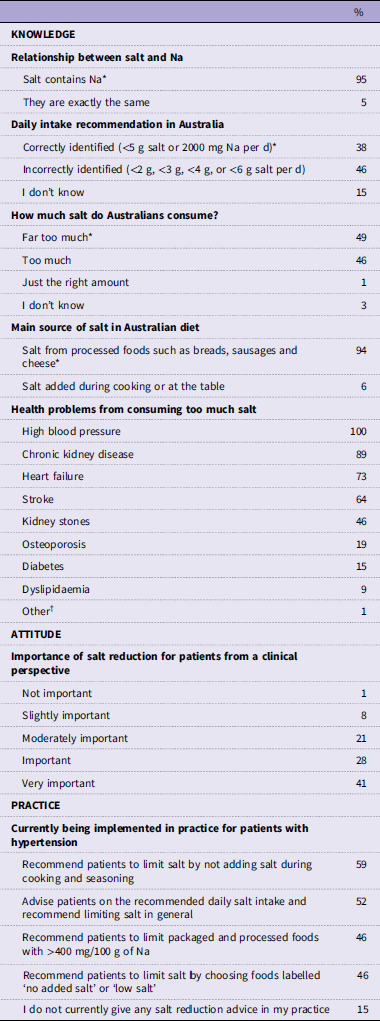
Of ninety-nine participants, ninety-four (95 %) were able to correctly identify that salt contains Na, ninety-five (96 %) that Australians consume too much salt, and ninety-three (94 %) that the main source of salt in the Australian diet is from processed foods (Table 2). Only thirty-eight (38 %) participants could correctly identify the recommended daily intake of salt for Australia as <5 g salt (or 2000 mg Na) per d. This was highest amongst dietitians (n 13 of 23, 57 %) followed by nephrologists (n 5 of 10, 50 %) (Supplemental Table 2). All participants identified that consuming too much salt leads to high blood pressure. The majority of participants also identified that consuming too much salt leads to CKD (89 %, n 88), followed by heart failure (73 %, n 72) and stroke (64 %, n 63). Most (91 %, n 90) participants identified that salt reduction was important for their patients, with 85 % (n 84) providing some form of salt-reduction recommendation to patients. The most common recommendation to promote Na reduction was to limit salt intake by not adding salt during cooking and seasoning (59 %, n 58), followed by advice on the daily salt intake recommendation and to limit salt in general (52 %, n 51). However, the most common recommendation provided differed by healthcare profession (Supplemental Table 2). All nephrologists (n 10 of 10) and 52 % (n 14 of 27) of pharmacists provided recommendations on the daily salt intake and recommended limiting salt in general. The most common recommendation for dietitians (91 %, n 21 of 23) and other health professions (63 %, n 5 of 8) was to limit packaged and processed foods based on Na content, while for GPs (61 %, n 14 of 23) it was to limit salt by not adding salt during cooking or seasoning. This was also a common recommendation by dietitians (83 %, n 19 of 23) and nephrologists (90 %, n 9 or 10). The most common intervention for cardiologists and nurses was mixed.
Knowledge, attitudes and practices of Australian healthcare professionals related to regular salt (n 99)

Table 2. Long description
A table with 11 rows and 2 columns. The first column lists various questions or statements related to salt consumption, and the second column shows the percentage of respondents who agreed or identified with each statement. Row 1: Relationship between salt and Na, Salt contains Na, 95 percent. Row 2: They are exactly the same, 5 percent. Row 3: Daily intake recommendation in Australia, Correctly identified (<=5 g salt or 2000 mg Na per d), 38 percent. Row 4: Incorrectly identified (<2 g, <3 g, <4 g, or <6 g salt per d), 46 percent. Row 5: I don’t know, 15 percent. Row 6: How much salt do Australians consume?, Far too much, 49 percent. Row 7: Too much, 46 percent. Row 8: Just the right amount, 1 percent. Row 9: I don’t know, 3 percent. Row 10: Main source of salt in Australian diet, Salt from processed foods such as breads, sausages and cheese, 94 percent. Row 11: Salt added during cooking or at the table, 6 percent. Data from the rows underneath this are missing or not acknowledged
*The correct answer.
†Other health problems listed include retinopathy and cardiomyopathy.
Knowledge, attitudes and practices related to potassium-enriched salt
General awareness of potassium-enriched salt by healthcare professionals was high with 94 % (n 93) of participants having heard of it and about half (49 %, n 49) reporting familiarity with it (Table 3). A large proportion of dietitians (74 %, n 17 of 23), nephrologists (60 %, n 6 of 10) and cardiologists (60 %, n 3 of 5) were familiar with potassium-enriched salt, while most pharmacists (63 %, n 17 of 27), GPs (43 %, n 10 of 23) and nurses (100 %, n 3 of 3) had only heard of it (Supplemental Table 2). Only two pharmacists (of 27, 7 %) and four GPs (of 23, 17 %) had never heard of potassium-enriched salt. Most participants (65 %, n 64) correctly identified that potassium-enriched salt could be purchased from major supermarkets in Australia. Attitudes related to the accessibility of potassium-enriched salt was mixed with most (48 %, n 48) participants unsure on the level of accessibility, while 28 % (n 28) and 23 % (n 23) of participants identified there was low and high accessibility, respectively (Table 3).
Knowledge and attitudes of Australian healthcare professionals related to potassium-enriched salt (n 99)

Table 3. Long description
The table presents data on the familiarity, accessibility, and purchasing locations of potassium-enriched salt among healthcare professionals. It has three sections: familiarity with potassium-enriched salt, accessibility of potassium-enriched salt, and where patients can buy potassium-enriched salt. The table has 11 rows and 2 columns. The first section includes rows for ’Never heard of it‘ with 6 percent, ’Heard of it but have limited knowledge of it’ with 44 percent, ‘Familiar with it but have not bought it’ with 37 percent, and ‘Familiar with it and have bought it’ with 12 percent. The second section includes rows for ‘Very low accessibility’ with 6 percent, ‘Low accessibility’ with 22 percent, ‘Unsure’ with 48 percent, ‘High accessibility’ with 20 percent, and ‘Very high accessibility’ with 3 percent. The third section includes rows for ‘Major supermarkets’ with 65 percent, ‘Online’ with 37 percent, ‘Chemists and other medical shops’ with 28 percent, and ‘Any retail shops’ with 7 percent.
*The correct answer.
Of the participants who were aware of potassium-enriched salt (n 93), only 13 % (n 12) identified Diet Rite Lite Salt and 8 % (n 7) identified Heart Salt as the two brands of products currently available in Australian supermarkets. Two-thirds (66 %, n 61) of participants who were aware of potassium-enriched salt were also aware of the associated health benefits, and 73 % (n 68) considered its use to be safe (Figure 1). Less than one-quarter (22 %, n 20) had patients mention potassium-enriched salt to them in their clinical practice, and only 14 % (n 13) had recommended potassium-enriched salt to patients in the previous 12 months. The main indications for use were identified as hypertension (81 %, n 75), followed by CVD (55 %, n 51) and hypokalaemia (51 %, n 47). The main contraindications for use were identified as taking potassium-sparing medications (71 %, n 66), followed by taking potassium supplements (68 %, n 63) and CKD (63 %, n 59) (Supplemental Table 3).
Knowledge, attitudes and practices of Australian healthcare professionals aware of potassium-enriched salt (n 93).

Interview results
Analysis of interview data identified six key themes and forty-one subthemes. Key themes included knowledge (n 5 subthemes), attitudes (n 2 subthemes) and practices (n 2 subthemes) related to potassium-enriched salt, barriers (n 17 subthemes) and opportunities (n 6 subthemes) to recommending potassium-enriched salt and strategies to support recommendation (n 9 subthemes). Subthemes for barriers, opportunities and strategies were mapped across levels of the Socio-Ecological Model. Across the interviews, substantial repetition of concepts was observed, and no major new themes emerged in the later interviews, suggesting thematic saturation had been achieved.
Knowledge related to potassium-enriched salt
Key subthemes included awareness and health benefits of potassium-enriched salt, as well as availability, affordability and accessibility. Among thirty-six participants, there was broad knowledge of potassium-enriched salt and its health benefits, but detailed and practical knowledge was lacking. Most participants had heard of potassium-enriched salt, but familiarity varied by healthcare profession. Medical specialists, including cardiologists and nephrologists, were familiar, often hearing about it from published clinical trials, while GPs and pharmacists were typically less familiar. Of those participants who were familiar with potassium-enriched salt, most identified that it was a ‘healthier’ alternative and had benefits in terms of managing blood pressure. However, it was clear that across professions, participants were unfamiliar with the availability of potassium-enriched salt products in Australia, where to purchase them and how much they cost. Some participants were not aware that it was available at major supermarkets in Australia, and many participants were unsure if it was more expensive than regular salt.
‘I have heard of it. Actually, there is a [NEJM] trial I think in China done a few years ago which [shows] a statistically significant improvement in MACE outcomes [and] stroke reduction’. – CRD01ML
‘In terms of the potassium salt substitutes – what the health benefits are – beyond management with hypertension, I’m not overly familiar with the other health benefits that it might have’. – DTN01WH
‘I don’t know about cost and availability of it and the ease of access’. – GP14WL
Attitudes related to potassium-enriched salt
Data related to attitudes were categorised as supportive or less supportive. Most participants across all professions were supportive and willing to recommend potassium-enriched salt for hypertension management as it was viewed as an easy, safe, affordable and accessible option with substantial health benefits (Table 4). For those not previously familiar with potassium-enriched salt, a summary was provided to gather initial thoughts. Of those who were supportive, some participants identified that they would only recommend potassium-enriched salt in specific populations, namely those not at risk of hyperkalaemia. Nephrologists supported the use of it amongst those with mild hypertension, glomerulonephritis and CKD stage 1–2 where blood tests were normal. They were not supportive for use amongst patients with CKD stage 3 and above. Similarly, renal dietitians would not recommend it to their patients who had advanced CKD. Among the few participants that were less supportive of recommending potassium-enriched salt (Table 4), some were concerned about hyperkalaemia while others preferred to have a focus on salt reduction in general as it was viewed as more effective.
Examples of reasons for support or lack of towards potassium-enriched salt recommendation

Table 4. Long description
A table with two columns labeled ‘More supportive’ and ‘Less supportive’, and multiple rows of text entries. The table compares reasons for support or lack of support towards recommending potassium-enriched salt. Each row presents a different perspective or concern. Row 1: More supportive: ‘I’m definitely in favour for it. For a non-pharmaceutical intervention to actually have, that’s so easy to do, that has significant benefits. I think it’ very powerful!.’ - CRD01ML. Less supportive: ‘I’m terrified. There’ so many people out there with potassium issues and it is a narrow window.’ - GP11WH. Row 2: More supportive: ‘Most people love salt. It’s really important in their diet. So, the fact that they could have something that replaces the sodium, which can decrease blood pressure, I think they‘ll be very appreciative.’ - GP06WH. Less supportive: ‘I think it’ a missed opportunity to reduce salt by exclusion because I think you can - I believe you’re far more likely to reduce salt by not having it in the preparation process than by having a slightly lower salt content because the tendency is to use a bit more.‘ - GP15MH. Row 3: More supportive: ’Using potassium salts, I’m sure it works. It makes sense physiologically and there’ that trial evidence that suggests so. If someone asked me - if I was a GP and I was seeing patients with hypertension and it was mild, I’d say, you can try this instead ... But I do think that once someone has kidney disease, particularly even stage 4 or stage 5, but even stage 3, I wouldn’t recommend it.’ - NEP01ML. Less supportive: ‘From that perspective, if it gives people pleasure in their cooking to be using expensive sea salt flakes - and, of course, the salt is not just about the flavour; there’s also the texture of the salt - I’m not going to take that away from them, especially if it helps with their behaviour around the joy and enjoyment of cooking.’ - GP07MH. Row 4: More supportive: ‘That’s why I think potassium salt sounds good, because it seems like an easy swap that people don’t really need to think about too much.’ - PH04WL. Less supportive: ‘I think it’s a band-aid approach that’s pushed by doctors because the dietary element of reducing sodium intake is far too hard and complicated.’ - DTN02WH.
Practices related to potassium-enriched salt
Two subthemes of recommending or not recommending potassium-enriched salt were identified. Interviews revealed that the recommendation of potassium-enriched salt by healthcare professionals was not common. Only three participants (a GP, a dietitian and a nephrologist) had recommended potassium-enriched salt to patients, with two of these only having done so once, and only when a patient brought it up during the consultation.
‘I said, you can buy this potassium-enriched [salt] - I never bring it up, but they brought it up to me’. – NEP01ML
Barriers and opportunities to recommending potassium-enriched salt
Twenty-seven subthemes of barriers and opportunities to recommending potassium-enriched salt in clinical practice are outlined and organised according to the Socio-Ecological Model (Figure 2).
Barriers and opportunities to recommend potassium-enriched salt by Australian healthcare professionals based on the Socio-Ecological Model*. *K-salt, potassium-enriched salt.

Individual-level barriers
The most commonly identified barrier for clinicians was a lack of knowledge on potassium-enriched salt (Table 5). Healthcare professionals suggested the need to be made aware of the availability, accessibility and affordability of potassium-enriched salt products to facilitate its recommendation, by enabling them to provide practical and affordable guidance. Information on how to use potassium-enriched salt, evidence of health benefits and indications/contraindications to use were also highlighted as areas requiring further knowledge.
Barriers that influence a recommendation to use potassium-enriched salt by Australian healthcare professionals

Table 5. Long description
A table with two main sections: barriers impacting clinicians at the individual level and barriers impacting patients at the interpersonal level. The table has two columns: Barrier and Examples. The first section lists barriers such as lack of clinician knowledge, safety, time, medication labels, and contradicting current dietary advice. The second section lists barriers like availability, accessibility and affordability, taste, artificial/unnatural perception, unfamiliarity, conflicting dietary information, consumer skepticism, and motivation and willingness. Each barrier is accompanied by examples provided by healthcare professionals.
A need to consider the safety of using potassium-enriched salt amongst certain populations, particularly those at risk of hyperkalaemia, was highlighted by participants across all professions. However, healthcare professionals currently lack understanding around this, leading to hesitancy that prevents recommendation.
Cardiologists, nephrologists and GPs also reported limited time during consultations and competing priorities due to complex presentations as barriers to recommendation.
Contradiction to existing practices was also identified by some participants as a barrier to recommendation. For pharmacists, there was hesitancy to recommend potassium-enriched salt as this would often contradict warning labels about potassium that are placed on medications. Similarly, some GPs identified that the recommendation to use potassium-enriched salt contradicts current advice to limit and reduce salt by instead introducing a new salt into the diet.
Interpersonal-level barriers
Participants also identified several patient-level barriers that they perceived to negatively impact the uptake of potassium-enriched salt recommendations which in turn may discourage healthcare professionals from recommending it (Table 5). Most commonly, participants identified that potassium-enriched salt needs to be available, accessible and affordable for patients to use; otherwise, its recommendation would not be helpful. They reported that these products are often on the lower shelf at supermarkets and not visible to patients. The cost to consumers was also a key factor in recommendation, with participants indicating that they would not recommend it if the product was too expensive.
Taste was another highly noted barrier where participants stated that they would recommend potassium-enriched salt to patients if it tasted the same as regular salt, but a perceived difference in taste for patients was considered a barrier to recommending it. Participants’ personal attitudes to taste would also influence whether they recommend it or not.
A small number of dietitian and GP participants also identified that some patients may be reluctant to use potassium-enriched salt as it might be seen as something artificial or unnatural. Similarly, participants thought patient unfamiliarity with the product and conflicting dietary information would make patients sceptical to take on board recommendations and make the change.
Finally, some participants identified that implementation of recommendations would ultimately depend on how motivated the patient is to make lifestyle and dietary changes. However, it was noted that patients are likely to have more motivation and compliance to a salt switch rather than removal of salt.
Opportunities across interpersonal and organisational/community levels
Multiple opportunities to increase potassium-enriched salt recommendations to patients were also identified, including incorporation into current resources, programmes and practices relevant to hypertension (Table 6). Several participants across professions identified incorporation into verbal education and written education materials, while some participants suggested incorporation during health assessments, care plan development and into various outpatient clinics and programmes. Recommendation was also identified by some participants to be particularly suitable for patients who find it difficult to achieve or initiate salt reduction, for those who prefer a non-pharmacotherapy strategy to reduce blood pressure and for specific patient populations including those with high blood pressure and normal kidney function.
Opportunities for Australian healthcare professionals to recommend potassium-enriched salt

Table 6. Long description
A table with three rows and only two columns. The columns are labeled Opportunity, Examples. The rows are as follows: Row 1: Opportunity, Incorporation into current resources, programmes and practices relevant to high blood pressure; Examples, The information that I would provide verbally to a patient, I could mention, if you were using table salt, you could consider using this salt substitute that has potassium in it and talk to them a bit about that. - DTN01WH. We do meds checks, so when we review people’s medications, absolutely. There would be opportunities there to do it. - PH05WL. I think, for me - I run a resistant hypertension clinic, so I think it would be something we could incorporate into that as part of our recommendations that we do for the clinic. - NEP03WH. Row 2: Opportunity, Suitable for specific patient populations; Examples, It’s not pharmacotherapy, I think that could be quite attractive to a lot of patients. - GP14WL. For those patients who find it difficult to initiate salt reduction or don’t see a way that they could, perhaps potassium-enriched salt would be an option for them. - GP18MH. Row 3: Opportunity, Multi-disciplinary approach; Examples, I think every single GP. Every cardiologist, of course, but also beyond, I guess - neurologists. There are many disciplines. All the disciplines that kind of are interested in the vascular tree. - DTN04WH. That’s why I think it needs to be a unified effort on all of these fronts. - CRD01ML.
All participants highlighted that a multi-disciplinary approach is required, and most suggested that a unified effort will strengthen messaging to patients. The role and advantages of different healthcare professionals in recommending potassium-enriched salt was identified. There was agreement that it was important to involve (1) dietitians as the key healthcare provider relevant to food and nutrition, (2) GPs as a frequent and first point of contact for patients with hypertension, (3) cardiologists as a specialist contact for hypertension who can advocate and raise awareness of potassium-enriched salt, (4) nephrologists to manage those with CKD and (5) pharmacists being one of the most accessible healthcare professions and due to concerns about medications raising blood potassium levels. Other professions that were identified included neurologists, clinic or support nurses, CKD educators, any profession involved in relevant outpatient clinics and occupational therapists and speech pathologists who discuss shopping, food preparation and kitchen assistance with patients.
Strategies to support the recommendation of using potassium-enriched salt
Nine subthemes of potential strategies to enable and support healthcare professionals to make recommendations on potassium-enriched salt were also identified and organised according to the Socio-Ecological model (Figure 3).
Strategies to enable and support recommendation of potassium-enriched salt by healthcare professionals based on the Socio-Ecological Model*. *K-salt, potassium-enriched salt.

Increased awareness of potassium-enriched salt amongst healthcare professionals, patients and the broader community would support healthcare professionals to recommend it. Participants commonly reported that educating healthcare professionals on potassium-enriched salt, its use, evidence, safety and aspects of accessibility, including cost and availability, would increase awareness and interest, leading to increased recommendation to patients. Some participants recognised the importance of incorporating education about potassium-enriched salt into course curricula for healthcare professionals in training and into other learning programmes post qualification.
‘Having easy, reliable, reputable information on hand, whether that be something that dietitians or any healthcare professional can get upskilled and educated on to then be able to share with their patient groups’. – DTN05WH
It was also identified by some participants that patients need an understanding of potassium-enriched salt alongside the recommendation for them to make a successful change in behaviour. Participants would like tools and resources that could be used to educate patients on and increase their awareness of potassium-enriched salt. Information on potassium-enriched salt could also be integrated into existing resources on salt reduction and blood pressure. Increasing broader awareness within the community and the Australian population was also noted.
‘Having information that patients can access, that I can either give them or say, here’s this QR code, go look at this video or this website…I think some physical things to be able to give patients. Actual pamphlets/information’. – NEP03WH
Participants across professions identified that having samples of potassium-enriched salt to provide to patients would support the recommendation. Some participants even expressed willingness to do taste tests with patients during consultations. It was also reported by pharmacists that stocking potassium-enriched products in pharmacies would promote recommendation as they could show patients the product and talk to them about it at the time.
‘Give small salt sachets, like as a sample, to be like, give this salt a go. Because then they know what the packet looks like, or the logo’. – PH05WL
‘What I would do is I’d actually buy some potassium salt and normal salt and then ask the patients to try it in my room, and see what they think’. – GP05WL
Support and endorsement from key organisations and associations, inclusion within guidelines, and recommendation amongst other clinicians in their network were commonly reported to provide healthcare professionals with the confidence to recommend potassium-enriched salt to patients. While most participants reported that incorporation into guidelines would make the recommendation more credible, some clinicians, particularly those that were more experienced, reported that they do not frequently read the guidelines as they are already integrated in their practice.
‘If it was in the guidelines, I think people would feel very comfortable recommending that product or a substance. I think if it’s not there, people may not be aware of how up to date the evidence is or may be more reluctant to recommend it’. – DTN01WH
‘I guess as a pharmacist, I’d also want guidance from our professional bodies as to how best to do that’. – PH01ML
Some participants reported wanting more evidence and research on potassium-enriched salt conducted in specific cohorts before recommending it, particularly studies amongst those with CKD, and studies conducted in the Australian population, as they want to understand how it translates in the Australian context. There was also interest in use amongst pregnant women with pre-eclampsia.
‘I think if there was a trial specifically targeting that cohort and it was seen to be safe, then I would do it. I would recommend it’. – NEP01ML
Integration of findings
A summary of the integration of quantitative and qualitative findings related to potassium-enriched salt are shown in Table 7. In general, qualitative findings were confirmative of the quantitative survey findings across key themes of KAP. However, the qualitative findings were also additive, highlighting that a lack of clinician knowledge, particularly around practical aspects and safety, may explain the low recommendation of potassium-enriched salt to patients. Other barriers relating to taste, time constraints, competing priorities and perceived consumer perceptions may also contribute. Increased recommendation by clinicians to patients could be achieved through patient education and integration into existing practice but should be supported by patient education resources with potassium-enriched salt information and key organisations and guidelines making the recommendation.
Integration of quantitative and qualitative findings related to potassium-enriched salt

Table 7. Long description
A table with four columns: Key theme, Subtheme, Quantitative findings, Qualitative findings, and Relationship and inference. The table has multiple rows grouped under different key themes: Knowledge, Availability, affordability and accessibility, Attitudes, and Practice. Each row provides detailed findings under these columns. For example, under the Knowledge theme, the table discusses awareness of potassium-enriched salt and health benefits, with both quantitative and qualitative findings. The Relationship and inference column confirms or adds to the quantitative findings with qualitative data. The table also includes specific percentages and insights related to clinician education and patient recommendations.
Discussion
Our study provides new insight into Australian healthcare professionals’ KAP regarding regular salt, potassium-enriched salt and its recommendation for the management of hypertension, as well as the barriers, opportunities and strategies that may support its recommendation in practice. General awareness of potassium-enriched salt was found to be high amongst a sample of Australian healthcare professionals, but familiarity and in-depth and practical knowledge were low, as reflected by the finding that only three interview participants had previously recommended potassium-enriched salt to patients. Although others were generally supportive and willing to recommend to patients for hypertension management, these positive attitudes may have been influenced by increased knowledge after providing a summary of potassium-enriched salt to participants who were unfamiliar. Increasing awareness of potassium-enriched salt amongst healthcare professionals, patients and the broader community, support and endorsement from key organisations and inclusion within guidelines were key strategies that would support healthcare professionals make the recommendation.
Our findings align with the KAP theory, in which knowledge shapes attitudes and, in turn, influences behaviour and practice(Reference Cabana, Rand and Powe36,Reference Liang, Wang and Liang37) . In this study, limited in-depth knowledge about potassium‑enriched salt appeared to contribute to cautious attitudes among healthcare professionals and a focus on perceived barriers, which adversely impacted recommendation. Other data describing the KAP of healthcare professionals towards potassium-enriched salt is limited, and our recent systematic review identified only five studies globally. One explored KAP among doctors in India, and four studies explored one aspect of knowledge among nurses in the USA(Reference Kissock, Ghammachi and Hoek25). Similar to our findings, there was high awareness of potassium-enriched salt among doctors in India (71 % of participants were aware), but in-depth knowledge and recommendation was low – 53 % reported it was used in hypertension, 44 % did not know the exact indication for use, 72 % did not know about contraindications to use and 19 % had made a recommendation to patients in clinical practice(Reference Fathima and Bhargava27). Findings of an additional recent study conducted amongst doctors in China also highlighted high general awareness of potassium-enriched salt (83 % of participants were aware) and a willingness to recommend (80 %), but also higher levels of knowledge and recommendation than the current study – 80 % knew about the health benefits and 55 % had made a recommendation to patients (unpublished results, under review). A large proportion of the evidence on potassium-enriched salt comes from studies conducted in China(Reference Yin, Rodgers and Perkovic14). In combination with extensive stakeholder engagement and promotion of Na reduction(Reference Xin, Xu and Li38), this may explain the higher rates of knowledge and recommendation compared with other countries.
In our study, it was clear that knowledge related to regular salt and its impacts on health by Australian healthcare professionals was generally high, demonstrating a strong understanding of the need to change salt intake practices, either through standard salt reduction or a switch to potassium-enriched salt. However, knowledge of Australia’s recommended daily salt/Na intake was low and differed by healthcare profession. Dietitians had the highest proportion of correct responses (57 %), likely reflecting their nutrition-focused training, although higher levels of knowledge would be expected in this group. This indicates that greater focus on educating healthcare professionals broadly on guidelines around Na and salt intake is warranted. While a switch to potassium-enriched salt was viewed as a simple and practical strategy for patients compared with cutting salt, some participants felt that a contradiction to decades of public health messaging to cut salt was a barrier to recommendation, highlighting an intellectual and behavioural tension between reducing and replacing salt. To successfully achieve a switch to potassium-enriched salt, we identified a need for increased knowledge of potassium-enriched salt amongst Australian healthcare professionals, their patients and the broader Australian community. This could increase interest and social acceptability of potassium-enriched salt and strengthen healthcare professionals’ confidence and willingness to recommend it(Reference Wiggins, Downie and Engel39). Current healthcare professional knowledge appears to be largely from the scientific literature, and practitioners had limited knowledge on the practical aspects of recommending potassium‑enriched salt, including its availability (where to purchase and the brands available), cost, taste and how to use. Increased understanding of these aspects through targeted resources, education and training would likely address many of the perceived barriers identified in our study and better support healthcare professionals to recommend potassium-enriched salt(Reference Xu, Land and James16). This is also evident among other sectors like the food industry where lack of knowledge on the practicalities of potassium-enriched salt use as an ingredient in foods is also a primary barrier to uptake(Reference Crowther, Hoek and Trieu30,Reference Crowther, Bullen and Balaguer-Mercado40) .
Healthcare professionals play critical roles across diverse care settings and are well positioned to promote potassium-enriched salt for hypertension management and CVD prevention. Barriers related to safety concerns could be addressed as they can manage patients to ensure safe and appropriate use of potassium-enriched salt, reducing the potential for hyperkalaemia(Reference Xu, Land and James16). Patient scepticism may also be reduced because healthcare professionals are a highly trusted source of health information(Reference Williams, Ames and Lawson41,Reference Asan, Yu and Crotty42) , and a recent survey showed Australian consumers would be willing to use potassium-enriched salt if it was recommended by a healthcare professional(Reference Trieu, Kissock and Hoek29). A combined and uniform effort from all disciplines would strengthen messaging leading to greater adoption.
This study identifies that a multi-faceted approach using multi-disciplinary strategies is needed to increase the recommendation of potassium-enriched salt by Australian healthcare professionals. Integration of potassium-enriched salt into clinical guidelines was identified as key to getting healthcare professionals to make the recommendation. A review of thirty-two hypertension guidelines worldwide found that only four mentioned potassium-enriched salt specifically and only two recommended its use for hypertension management(Reference Xu, Zeng and Jha17). More recently, the European Society of Cardiology (2024)(Reference McEvoy, McCarthy and Bruno19) and the American College of Cardiology/American Heart Association (2025)(Reference Jones and Ferdinand18) now recommend potassium-enriched salt within their hypertension guidelines. The hypertension guidelines in Australia are currently being updated(43), and there is strong support to include potassium-enriched salt to align with the most recent evidence(Reference Xu, Land and James16). Developing and implementing a roadmap of strategies to integrate potassium-enriched salt into Australian healthcare practice would help prioritise and guide efforts moving forward. While some high-level strategies have been identified in the current study, further research is needed to expand strategies and determine applicability across professions. In addition, future research should assess the change in KAP overtime to quantify the successes and failures of implementation.
This study is the first to comprehensively explore KAP related to potassium-enriched salt among Australian healthcare professionals. Strengths relate to the convergent mixed-methods approach and the inclusion of diverse healthcare professions and perspectives from varying clinical, geographical and socio-economic backgrounds. However, representation from some states/territories were not captured, and there was limited representation from outer regional and remote areas. In addition, survey participants were not recruited through stratified sampling methods, meaning responses may not be generalisable to all healthcare professionals in Australia. While nurses can also play an important role in potassium-enriched salt recommendation(Reference Xu, Neal and Davidson44), their perspectives were not captured in the interviews. Other limitations were also noted. In both surveys and interviews, the use of convenience sampling methods increases the likelihood that those who responded may have had a greater interest in potassium-enriched salt compared with non-respondents, which may over-estimate knowledge and positive attitudes towards potassium-enriched salt. Due to time and resource constraints, the survey and interview guides were not pilot-tested; however they were finalised following expert discussion. Finally, while deductive coding to the Socio-Ecological Model facilitated identification of barriers, opportunities and strategies at different levels of influence, it may have oversimplified the interconnection between these aspects. Both the Socio-Ecological Model and KAP framework are primarily descriptive and do not explicitly address the mechanisms underlying behaviour change. This alone is unable to sufficiently drive implementation of strategies but does offer a comprehensive starting point to guide future exploration.
Conclusion
While a sample of Australian healthcare professionals were generally aware of potassium-enriched salt and supportive of its use, detailed knowledge and routine recommendation remain limited. Improving recommendation by healthcare professionals requires targeted education on potassium-enriched salt delivered through professional training programmes, continuing professional development and tertiary education, with a particular focus on practical aspects and appropriate use. Integration of potassium-enriched salt into hypertension management pathways, clinical guidelines and decision support tools and existing patient education resources would help normalise and support recommendation in practice. Clear guidance and information around safety would also increase clinician confidence and support recommendation. However, strategies to increase awareness and knowledge of potassium-enriched salt should be considered across all levels, from individual to policy and environment. Future work should develop and evaluate a multi-level implementation roadmap to integrate potassium-enriched salt into Australian healthcare practice and monitor changes in healthcare professionals’ KAP over time.
Supplementary material
For supplementary material/s referred to in this article, please visit https://doi.org/10.1017/S000711452610854X
Data availability statement
The data that support the findings of this study are available on request from the corresponding author. The data are not publicly available due to privacy or ethical restrictions.
Acknowledgements
The authors would like to thank all the healthcare professionals who took the time to participate in surveys and interviews in this study.
This work was supported by NSW Health (A.E.S, grant number H23/27205-2), the National Heart Foundation Australia (K.R.K, grant number 108112; K.T, grant number 108501; K.T, grant number 108808) and Ian Potter Foundation. The funders had no role in the design, analysis or writing of this article.
Katrina R Kissock: Conceptualization-Lead, Data curation-Lead, Formal analysis-Lead, Funding acquisition-Lead, Methodology-Lead, Project administration-Lead, Writing - original draft-Lead, Writing - review & editing-Lead; Nadine Ghammachi: Data curation-Supporting, Formal analysis-Equal, Writing - review & editing-Supporting; Aletta E Schutte: Funding acquisition-Equal, Writing - review & editing-Supporting; Xiaoyue Xu: Writing - review & editing-Supporting; Juliette Crowther: Writing - review & editing-Supporting; Maoyi Tian: Writing - review & editing-Supporting; Yuze Xin: Writing - review & editing-Supporting; Shuangjie Peng: Writing - review & editing-Supporting; Hannah Greenwood: Writing - review & editing-Supporting; Loai Albarqouni: Writing - review & editing-Supporting; Lauren Ball: Writing - review & editing-Supporting; Bruce Neal: Conceptualization-Supporting, Methodology-Supporting, Writing - review & editing-Supporting; Kathy Trieu: Conceptualization-Supporting, Data curation-Supporting, Formal analysis-Supporting, Funding acquisition-Equal, Methodology-Supporting, Writing - original draft-Supporting, Writing - review & editing-Supporting.
A.E.S. has received speaker honoraria from Servier, AstraZeneca, Medtronic, Omron and Novo Nordisk and serves on scientific advisory boards for Medtronic, Roche/Alnylam, AstraZeneca, Servier, SiSU Health, Biozen and Sky Labs. K.T. is the director of the WHO Collaborating Centre on Population Salt Reduction. All other authors have no conflicts of interest to declare.
This study was conducted according to the guidelines laid down in the Declaration of Helsinki, and all procedures involving research study participants were approved by the University of New South Wales Human Research Ethics Committee (iRECS6365). Written informed consent was obtained from all participants.



 Open access

