Introduction
Caregiver burden (CB) is the extent to which caregivers perceive that their engagement in caregiving has an adverse effect on their psychological, physiological, social, financial, and spiritual well-being (Farahani et al., Reference Farahani, Ghane and Sydfatemi2016; Wang et al., Reference Wang, Zhong and Ji2016; Liu et al., Reference Liu, Li and Shi2017). Research on caregivers of cancer patients indicate that caregiving of cancer patients is particularly onerous with cancer caregivers spending a significant proportion of their time involved in addressing the needs of patients that they are caring for (Shaffer et al., Reference Shaffer, Chow and Cohn2018a). Shaffer et al. (Reference Shaffer, Chow and Cohn2018a) note that caregivers of patients with cancer suffer a “unique caregiving trajectory” with significant caregiving responsibilities, more specifically, those pertaining to assisting patients with activities of daily living, such as “dressing, toileting, and mobility” (National Alliance for Caregiving and AARP, 2015, 206, cited in Shaffer et al., Reference Shaffer, Chow and Cohn2018a, p. 276), an overseeing of patient's day-to-day errands and chores, assisting patients with transportation to and from health care appointments, and acting as an “emotional bedrock for the patient and his or her extended social networks” (Shaffer et al., Reference Shaffer, Chow and Cohn2018a, p. 276). The enormity of this responsibility for cancer caregivers and its concomitant burden are associated with a wide range of health impairments for caregivers (Shaffer et al., Reference Shaffer, Chow and Cohn2018a). In this regard, it is noted that the CB of cancer patients is associated with depression and feelings such as grief, fear, loneliness, and helplessness (Wang et al., Reference Wang, Zhong and Ji2016). In addition, CB is associated with significant sleep disturbances with such sleep loss contributing to greater anxiety and depression, and an impaired quality of life for caregivers (Shaffer et al., Reference Shaffer, Chow and Cohn2018a). Applebaum et al. (Reference Applebaum, Kulikowski and Breitbart2015) note that the CB of those caring for cancer patients may even cause “existential distress,” which includes feelings of hopelessness, demoralization, loss of personal meaning, guilt, and powerlessness, and decreased will to continue living (Henery, Reference Henery2003; Chochinov et al., Reference Chochinov, Krisjanson and Hack2006; Henoch and Danielson, Reference Henoch and Danielson2009, cited in Applebaum et al., Reference Applebaum, Kulikowski and Breitbart2015).
Caregivers of children with cancer also face significant challenges to their psychological well-being with research, indicating that caregivers of children with cancer are at far greater risk of psychological distress than caregivers of healthy children or caregivers of children with other forms of illness (Salvador et al., Reference Salvador, Crespo and Martins2015). For example, Boman et al. (Reference Boman, Viksten and Kogner2004) found that parents of children with cancer experienced greater uncertainty along with a greater and constant fear of losing their child as compared to parents of children with pediatric diabetes.
For parents of children with cancer, while both parents may be involved in caregiving, the role tends to fall predominantly on the mother (Palma et al., Reference Palma, Deatrick and Hobbie2015). Traditionally, women are expected to provide care, nurturing, and help with the role of caregiver falling predominantly to mothers within developing countries (Santo et al., Reference Santo, Gaíva and Espinosa2011; Adelman et al., Reference Adelman, Tmanova and Delgado2014; Sulkers et al., Reference Sulkers, Tissing and Brinksma2015). Consequently, mothers may be more vulnerable to CB. Knowing the factors affecting the CB is essential to provide appropriate strategies to reduce it.
The literature suggests that several factors affect the degree of CB. Social support (SS) is one resource that can affect CB (Burnette et al., Reference Burnette, Duci and Dhembo2017; Wang et al., Reference Wang, Shen and Zhang2017). Feeling supported enhances caregivers' sense of self-efficacy in dealing with the patient and, in general, can reduce caregivers' emotional burden (Zhang et al., Reference Zhang, Edwards and Yates2014; Shiba et al., Reference Shiba, Kondo and Kondo2016).
However, there are cultural implications of support seeking within different cultural groups. The meaning of SS varies within different cultures. In different societies, people may perceive and access SS in different ways (Morling et al., Reference Morling, Uchida and Frentrup2015). Cultural norms can influence the “amount” of SS that a person receives when he or she is ill or cares for a patient. For example, research has shown that the stigma associated with cancer affects the extent to which one may receive SS (Phelan et al., Reference Phelan, Griffin and Jackson2013; Hamann et al., Reference Hamann, Ostroff and Marks2014; Chambers et al., Reference Chambers, Baade and Youl2015). This is especially true in subcultures in the Middle East and Asia and in less developed countries (Chambers et al., Reference Chambers, Baade and Youl2015). In some societies, illness and especially cancer are interpreted as the result of a person's or a family's actions, and it can, therefore, affect the amount of SS that it is believed that the individual “deserves” (Hasan Shiri et al., Reference Hasan Shiri, Mohtashami and Nasiri2018). More specifically, within Iran, cancer is associated with fears of contagion and may often be attributed to family genetic defects, misfortune, fate, wrongdoing, and even being cursed (Mohabbat-bahar et al., Reference Mohabbat-bahar, Bigdeli and Mashhadi2017). Thus, Iranian patients and their families tend to hide their diagnosis from others. Fear of the beliefs that others have about cancer, that is, that it is that the sufferer and his or her family are at fault and that the patient is contagious, leads to non-disclosure of illness. In Iran, this notion of cancer being caused by a family's actions is relatively prevalent and may, therefore, impact upon the extent to which SS is available to the family. More specifically, the “amount” of SS can be reduced in cultures where such beliefs prevail. Indeed, in Iranian culture, an individual may be less likely to seek out SS (Mohabbat-bahar et al., Reference Mohabbat-bahar, Bigdeli and Mashhadi2017). Patients and their family are less likely to engage in help-seeking, as it is deemed that the cancer is a result of the individual's or his or her family's past actions, and they are, therefore, less deserving of being given support (Ehsani et al., Reference Ehsani, Taleghani and Hematti2016; Mohabbat-bahar et al., Reference Mohabbat-bahar, Bigdeli and Mashhadi2017). Within Iran, patients and their families tend to hide their diagnosis from others. Fear of the beliefs that others have about cancer, that is, that it is the patient and his or her family at fault and that the patient is contagious, leads to non-disclosure of their illness, with such non-disclosure limiting interaction with others outside of the immediate family. This limited interaction, thus, serves to isolate the patient and his/her family from wider networks and sources of SS. In addition, as the topic of cancer is to great extent taboo within Iran, doctors often do not provide full disclosure to families of children diagnosed with the disease (Montazeri et al., Reference Montazeri, Tavoli and Mohagheghi2009; Valizadeh et al., Reference Valizadeh, Zamanzadeh and Rahmani2012; Rahmani et al., Reference Rahmani, Ferguson and Jabarzadeh2014).
Consequently, within Iran, the support of health care providers is considered a vital source of support to mothers of children with cancer. However, severe shortages of hospital personnel and a lack of adequate training to provide support to the patients and family of patients also contribute to low support from the medical fraternity (Ehsani et al., Reference Ehsani, Taleghani and Hematti2016). As a result, the burden of taking care of the patient falls almost exclusively upon the mother. Thus, although the mother may require SS as an assistive resource, cultural beliefs within these countries attract more stigma to the family experiencing such a crisis and mothers may, therefore, feel reluctant in calling upon potential SS networks. Within these cultures, there is great reluctance to seek SS outside of the context of the immediate family (Mohabbat-bahar et al., Reference Mohabbat-bahar, Bigdeli and Mashhadi2017). When a family member is sick, while relatives may come to the aid of the family, the mother is still precluded from seeking SS outside of the family from, for example, friends and colleagues. For this reason, the size of the mother's SS network is limited.
Therefore, while the literature has shown that increased SS is associated with lower levels of experienced caregiver's burden, the role of culture in limiting SS cannot be precluded. In addition, the role of demographics and contextual variables on SS and CB cannot be ignored (Santo et al., Reference Santo, Gaíva and Espinosa2011; Granek et al., Reference Granek, Nathan and Rosenberg-Yunger2012; Rauschenbach et al., Reference Rauschenbach, Krumm and Thielgen2011; Adelman et al., Reference Adelman, Tmanova and Delgado2014; Gardner et al., Reference Gardner, Mrug and Schwebel2017). Demographics pertain to the marital status, age of the mother, educational level, and employment status of the mother, and contextual factors pertain to the duration of treatment; with research indicating that these demographics along with treatment duration are associated with varying degrees of SS and CB. Thus, the aim of the present study was to (1) determine the extent to which SS predicted CB of mothers with children, ages 3–18 years, undergoing chemotherapy. In addition, (2) the study aimed to determine the extent to which various demographic and contextual variables, such as marital status, age of the mother, educational level, employment status, and duration of treatment, contributed to the differences in SS availability, SS satisfaction, and CB.
Methods
Study design
The current study was a cross-sectional, descriptive-correlative study utilizing self-report surveys for the data collection. Data were gathered from September 2017 to December 2017. Participants were recruited from a convenience sample of mothers of children undergoing chemotherapy in a public hospital who met the inclusion criteria. The inclusion criteria were mothers of a child whose age was 3–18 years, newly diagnosed with ALL, and at the induction and consolidation phases of chemotherapy. The induction phase is short and intensive, and it usually lasts about a month. The consolidation phase is also intensive, and it typically lasts for a few months. In addition, mothers could not be suffering from any significant mental disorder which required treatment. Children did not receive any other treatment other than chemotherapy. All mothers who had a child in the chemotherapy phase and who met the inclusion criteria were invited to participate in the study by the first author approaching the clinic for access.
Measures
The Norbeck Social Support Scale was utilized to measure SS. It is a 27-item self-report questionnaire designed to measure perceptions of SS and satisfaction with SS. Each item is a question that requires a two-part answer: Part 1 asks participants to list all the people that are included in the participant's social support network (SSQN) and in Part 2 asks participants to indicate how generally satisfied they are with the support received from each of these people (SSQS). Items within Part 2 (overall satisfaction with support from people within the SS network) were assessed using a five-point Likert-type scale response format, with answers ranging from 0 (not at all) to 4 (a great deal). Higher scores indicated higher significant support, while lower scores indicated less support. Nasseh et al. (Reference Nasseh, Ghazinour and Joghataei2011) translated the questionnaire to Persian, and they found that Cronbach's alpha for both scales was high (SSQN = 0.95 and SSQS = 0.96). The internal consistency for the whole scale within the present study was 0.89.
The Caregiver Burden Scale (Elmståhl et al., Reference Elmståhl, Malmberg and Annerstedt1996) was utilized to measure CB. The scale consists of 22 items that determine the impact of caregiving on the individual's life. Scores for each item range from 1 to 4 with a minimum of 22 to a maximum of 88 across all items. Higher scores indicate a higher level of CB. The scale was translated to Persian using the WHO process of translation and adaptation of instruments. This is a four-step process, including forward translation, expert panel back-translation, pre-testing, and cognitive interviewing to obtain the final version (World Health Organization, 2016). The face validity of the instruments was confirmed utilizing the opinions of an expert. The translated scale was provided to 10 people (four nursing instructors, two chemotherapy specialists, and four nurses) in the department. In addition, the opinion of eight mothers from the research community was asked about questionnaires. (Cronbach's alpha of 0.79 was reported.)
Ethical considerations
The study protocol was approved by the Ethics Committees of the Kerman University of Medical Sciences (IR.KMU.1393.23567). Confidentiality was maintained throughout the study.
Data analysis
The data were entered into SPSS Version 16. The Shapiro–Wilk test was used to test for normality (p > 0.05). Data were analyzed using Pearson's correlations, t-tests, and ANOVA and Linear regressions with the enter method. The missing data were filled in by utilizing mean substitutions within the interval variables.
Results
During the sampling period, 164 children were undergoing treatment. Eighteen mothers did not meet the inclusion criteria. Twenty-nine mothers did not wish to participate in the completion of the survey. The sample consisted of 117 mothers whose children were undergoing treatment at the time of the study and thus an 80.13% response rate. The mean ± SD of the age of mothers was 33.50 ± 7.28 years. Children with cancer had a mean age of 7.48, with a standard deviation of ±4.36 years. The mean and standard deviation of the treatment period was from diagnosis to the point at which mothers completed the questionnaire. At this point in time, children treatment period mean was 24.36, with a standard deviation of ±22.31 days (range between 11 and 120 days).
The mean ± SD of SS availability and satisfaction was 2.73 ± 1.43 and 3.83 ± 1.40, respectively. The range of CB scores was 24–83 with a mean ± SD of 49.53 ± 12.99.
Demographics of the sample according to the level of education, marital status, age of mothers, and employment status
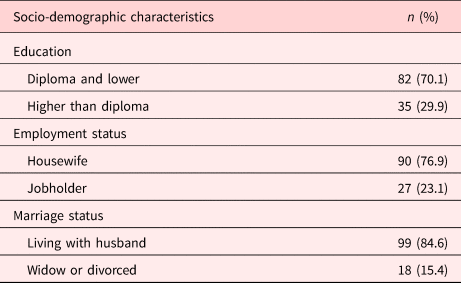
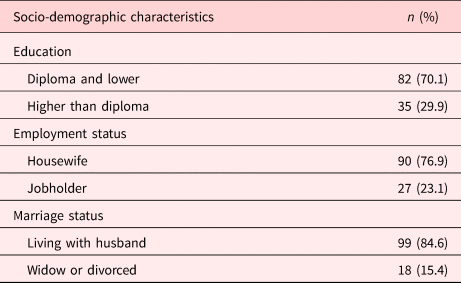
Table 1 shows the frequencies of the socio-demographic variables. Most of the study participants did not have a college education and were housewives who lived with their husbands. Table 1 indicates that the present sample was predominantly made up of those with a diploma or lower, thus being less educated. Within the sample, there was also a preponderance of housewives, and those who were married, as compared to those that that were employed, and those that were divorced or widowed.
Socio-demographic characteristics of study participants
Correlations between demographic variables, SS availability, SS satisfaction and age of the child, duration of treatment, and CB
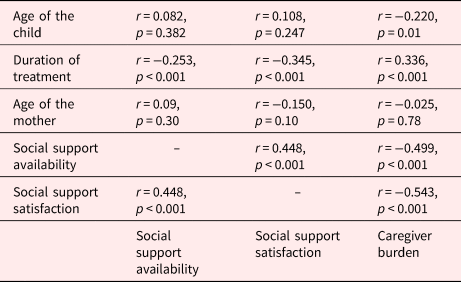
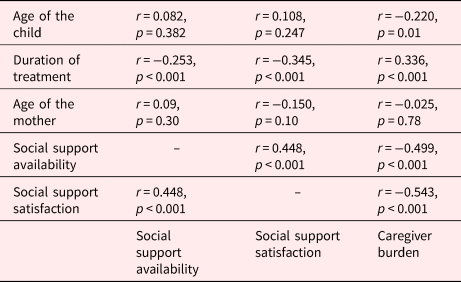
Table 2 shows the correlations between SS availability, SS satisfaction and age of the child, duration of treatment, and CB. With regard to the correlations as represented in Table 2: small to moderate correlations inverse correlations between the age of the child and CB were demonstrated. That is, the younger the child, the greater the CB. Further, small to moderate inverse correlations between the age of the mother and CB were demonstrated. That is, the younger the mother, the greater the CB. In addition, small to moderate positive correlations were also reported and between the duration of treatment and CB. That is, the longer the duration of treatment, the greater the CB. Strong inverse correlations between SS availability and satisfaction and CB were also demonstrated, suggesting that higher SS availability and satisfaction is associated with lower CB.
Pearson's correlations
Group comparisons: t-tests for the level of education, marital status and SS and CB
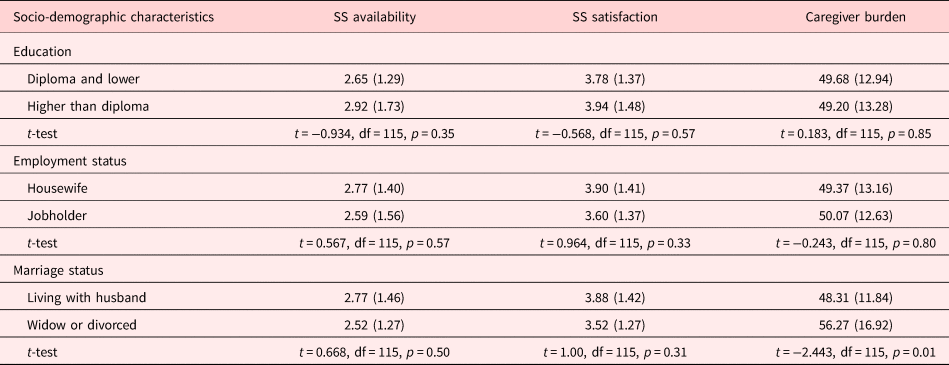
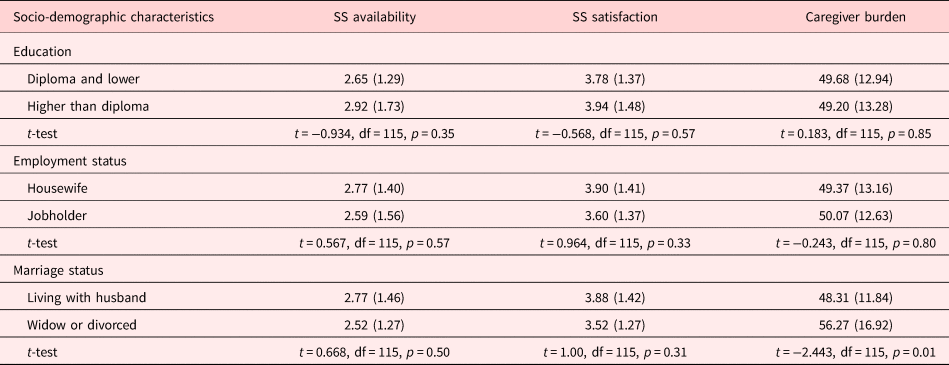
Table 3 shows the results of the t-tests of the level of education, marital status, and employment status on SS availability, SS satisfaction, and CB. With regard to group comparisons as represented in Table 3: There were no significant differences between those with higher and lower education levels and CB, and no significant differences between those that were employed and those that were housewives and CB. There was, however, a significant difference between those that were married and those that were widowed or divorced and CB. In addition, there were significant differences in education and employment status in relation to SS availability and satisfaction, respectively.
t-tests and the mean (SD) of SS availability and satisfaction and CB, and comparison based on education, job, and marriage status
Linear regression — predictors of CB
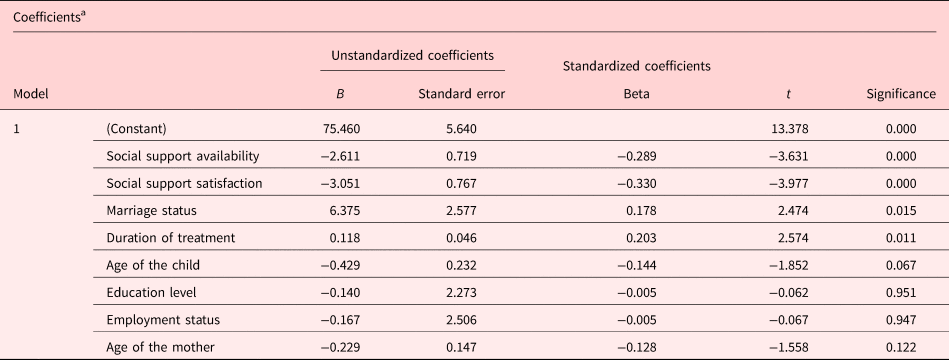
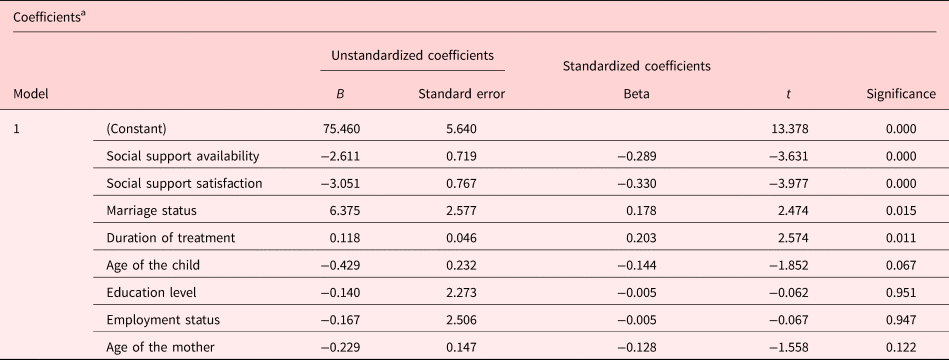
The result of multiple linear regressions that indicate which variables predicted CB is presented in Table 4. With regard to the linear regression as represented in Table 4: only SS availability and SS satisfaction along with marital status and the duration of treatment predicted CB in the multivariate linear regression. Age of the child, educational level, employment status, and age of the mother were not significant predictors. As mentioned, within the univariate analysis, the correlations between the age of the child and age of the mother, in association with CB, were small to moderate. Thus, it is important to note that although age of the child and age of mother were associated with CB within this analysis; within the multivariate, they were not significant predictors of CB. This suggests that there are other factors of greater import that predict the variance in CB, namely marital status, duration of treatment, and SS availability and satisfaction.
Multivariate linear regression of factors related to CB
a Dependent variable: caregiver burden.
Discussion
The findings of the present study provided support for the relationship between SS availability and SS satisfaction and CB. Strong correlations were reported between SS availability and satisfaction and CB and SS availability and satisfaction predicted a large proportion of the variance in CB. These findings are aligned to the literature that suggests that SS is indeed an important resource for those that are engaged in caregiving roles, serving to reduce levels of CB (Hsiao, Reference Hsiao2010; Kate et al., Reference Kate, Grover and Kulhara2013; Rodakowski et al., Reference Rodakowski, Skidmore and Rogers2013; Li et al., Reference Li, Yang and Liu2016; Shiba et al., Reference Shiba, Kondo and Kondo2016; Burnette et al., Reference Burnette, Duci and Dhembo2017).
Findings of the study also support the relationship between marital status and the duration of treatment and the extent of CB. Both of these variables, that is, marital status and duration of treatment, were significantly related to CB. With regard to marital status: those that were married as compared to those that were divorced or widowed; reported greater SS availability and satisfaction and lower CB. This finding aligns to the SS literature, which indicates that those who are married or have a partner/significant other, have available to them an additional and possibly rich source of SS. Married individuals as opposed to those that are single, divorced or widowed, by having someone with whom the caregiving burden could be shared, tend to report lower CB. In addition, having a partner may alleviate financial burdens (Granek et al., Reference Granek, Nathan and Rosenberg-Yunger2012). A partner who is working provides an additional source of income. This financial contribution made by one's partner, who may also assist with caregiving, can well serve to reduce one's overall feelings of distress, manifesting in lower CB.
The present study's findings also align with the literature, indicating that the age of the child, age of the mother, and the duration of treatment have negative implications for CB. Although the degree of relationship within the present study between the age of the child and the duration of treatment with CB was small to moderate (−0.22, 0.336, and −0.025, respectively); these findings are consistent with the previous literature. With regard to the age of the child: the literature indicates that younger the child, the higher the experience of distress may be. Younger children tend to experience greater separation anxiety, are far less self-sufficient than older children, and therefore can add to a caregiver's burden (Wolfe-Christensen et al., Reference Wolfe-Christensen, Mullins and Fedele2010; Williams et al., Reference Williams, Williams and Williams2014; Wang et al., Reference Wang, Zhong and Ji2016). The caregiver has to deal with the both the child's fear and anxiety and engage in far more care as the younger the child, the less able they are to engage in self-help chores (such as feeding, bathing, and dressing themselves). With regard to the age of the mother: those that are younger and have less life experience tend to fare more poorly on coping with stress as compared to those that are older and have greater life experience (Rauschenbach et al., Reference Rauschenbach, Krumm and Thielgen2011). With regard to the duration of treatment: the longer the duration, the more likely it is that the stressor moves from one that could be acute to one that is chronic. The longer the stressor has to be borne, the more hospitalizations that are entailed, the higher the experience of long-term chronic stress (Wolfe-Christensen et al., Reference Wolfe-Christensen, Mullins and Fedele2010; Gardner et al., Reference Gardner, Mrug and Schwebel2017). Thus, the findings for younger child and mother's age and longer treatment duration and their association with increased CB within this study are supported by previous research.
The current study also reported significant inverse correlations between SS availability and satisfaction and the duration of treatment, that is, the longer the duration of treatment, the lower the availability (r = −0.253) and satisfaction (r = −0.345). This suggests that over time SS resources could “erode.” This finding aligns with the conservation of resources (COR) theory proposed by Hobfoll (Reference Hobfoll1989), which notes that individuals have “reservoirs of resources” which they draw on in times of stress. These reservoirs are limited, and if the stressor is protracted, these resource levels may diminish. Consequently, over time, as the duration of the treatment progresses, SS resources may deplete, with both the duration of treatment and SS depletion further contributing to greater CB as SS providers may withdraw. As the study was not longitudinal, this process of erosion was not tested and remains a limitation and a proposal for future researchers to the study.
Findings within the study also indicated that there were differences with regard to the level of education and employment in relation to SS. Within this study, those with higher education experienced greater SS availability, while those that were employed experienced lower support satisfaction. This is aligned to the literature which, in this regard, suggests that educational level and employment status can affect levels of SS availability and satisfaction. For example, Folkman (Reference Folkman, Gellman and Turner2013) indicates that those that are more educated are likely to perceive greater SS availability and greater satisfaction with support than those that are less educated. The higher educational level appears to foster better stress management with those that are more educated seem to have a higher cognitive complexity that facilitates realistic stress perception and greater problem-solving ability. Those that are more educated also have a greater sense of mastery over their lives, a higher sense of perceived control over stressful events, a greater sense of self-efficacy and a greater ability to establish supportive networks and access SS effectively. The literature also suggests that those who work, more especially women, are subjected to the compounded burdens of coping with work and home demands (McDonough and Walters, Reference McDonough and Walters2001), and this can serve to reduce their ability to harness and utilize SS effectively as compared to those who do not work. Furthermore, the age of mothers is also a factor that can affect stress perception with literature, indicating that those that are younger and possibly less experienced in dealing with life crises may experience greater CB than those that are older and have developed a greater coping capacity (Rauschenbach et al., Reference Rauschenbach, Krumm and Thielgen2011). However, it is important to note that only SS availability and SS satisfaction along with marital status and duration of treatment predicted CB in the multivariate linear regression; while age of the child, age of the mother, educational level, and employment status were not significant predictors. Nevertheless, attention still needs to be paid to all these factors when seeking to alleviate CB.
Limitations
There were limitations to this study. The study was conducted in one single public hospital in an urban center, and the findings may, therefore, not necessarily be generalizable to other urban hospitals and to more rural areas. Furthermore, the sample consisted of those willing to participate. Reasons for those not willing to participate were not established. Reasons may have been linked to stigmatization and cultural taboos; however, this was not established with certainty.
Recommendations
Based on the above limitations and findings within the present study, the following recommendations can be made. Further investigation on cultural taboos and stigmatization within Iranian culture needs to be undertaken. The need to examine the unique Iranian cultural aspects of seeking SS requires that more research, particularly, qualitative research needs to be undertaken to enable the exploration of prohibitions of seeking SS outside of the family and the implications thereof. Ehsani et al. (Reference Ehsani, Taleghani and Hematti2016) note that within Iranian society, there needs to be some form of exploration and intervention to understand and mitigate the conservative attitude of concealment and non-disclosure of those diagnosed with cancer. They note that priority must be given to providing training to nurses so that they are better able to advise and support those diagnosed with cancer. In addition, they note that the mass media can be utilized to dispel negative misinformation that the general populace has about cancer, thus de-stigmatizing the disease to some extent. Ehsani et al. (Reference Ehsani, Taleghani and Hematti2016) go so far as to say the tenets of Islam could also be used to reduce people's fears about cancer and the taboo of the disease. In this regard, Islam has a viewpoint that the disease is considered a means to erase the sins of the patient and improve his/her ranks in the sight of Allah. Fallahi et al. (Reference Fallahi, Rassouli and Mojen2017) note “Iranian mysticism which is the origin of teachings in Islam see pain and suffering as an atonement for …sins and (a) clearing agent for (the patient) and the community” “Bearing such pain stoically will be followed by God's mercy and grace”. If such a viewpoint is more widely propagated in the religious community, it may assist individuals in seeing the disease in a less negative light. Thus, a de-stigmatizing of the disease more broadly in the eyes of the public through public information and mass media information campaigns and support offered by the religious community could assist patients in obtaining more support in general and may further reduce the extent of experienced CB (Fallahi et al., Reference Fallahi, Rassouli and Mojen2017).
In addition, although we examined the CB of mothers, as the mother is primarily the person upon whom this burden falls, in a large number of families, other members may be involved (albeit to a lesser degree) in caring for a child with cancer, especially fathers and older children. The involvement of other family members produces a “ripple effect” of CB within the family. Consequently, we recommend examining the CB of other family members in future studies in order to not only determine how they predict the burden of mothers but also to determine the impact that caregiving has upon the family as a whole.
Given the negative impacts of CB, it becomes imperative to identify resources and interventions that can alleviate that burden experienced by mothers of children with cancer. The urgency of establishing interventions is twofold. Not only does one need to alleviate the experience of CB for the mother because of its impact upon maternal health, but one also has to alleviate this burden as impaired maternal health can, in turn, have a negative psychological and physical impact upon the ill child (Wolfe-Christensen, et al., Reference Wolfe-Christensen, Mullins and Fedele2010; Wang, et al., Reference Wang, Zhong and Ji2016). In this regard, it is noted that parents who cope well have children who cope well, with parental adjustment, thus having implications for the adjustment of the child (Wolfe-Christensen et al., Reference Wolfe-Christensen, Mullins and Fedele2010). Interventions can be directed toward nursing staff who need to be aware of the possible depletion of SS resources that may occur within the family over time, and how they can offset this by maintaining a high level of support to mothers throughout the duration of treatment. The role of fathers in future studies and the impact on other children within the family should also be explored in future research. The need to enrich family sources of support and the skills of medical personnel in providing support are of particular importance for Iranian mothers whose SS networks may be limited by cultural factors. While within many developed countries, SS can be accessed through online resources and through engaging with psychologists and psychiatrists (Shaffer et al., Reference Shaffer, Garland and Mao2018b), in developing countries, including Iran, these resources are not readily accessible. Psychological or psychiatric services are costly in Iran, and insurance companies do not pay for such services. Consequently, nurses have a more critical role in providing such services. Nurses are the front line of providing health care. They are present at all phases of diagnosis, treatment, and recovery, and thus have a precious opportunity to assess caregivers, especially mothers. Interventions, therefore, need to be more closely directed to enhancing nurses' ability to offer help and support to mothers and families (Bahrami et al., Reference Bahrami, Etemadifar and Shahriari2014). Cognitive behavioral intervention programs could also be used to assist mothers in coping. For example, the “Bright Ideas Problem Solving Skills Training” has reported success in alleviating CB amongst mothers of children with cancer (Sahler et al., Reference Sahler, Varni and Fairclough2002).
Further, while the present study highlighted how SS predicts CB, there is a need to examine this relationship longitudinally in order to observe the unfolding process of this interrelationship over time. As mentioned, the duration of treatment can erode support, and interventions aimed at assisting those with limited or depleted networks need to be put into place. In this regard, nurses within pediatric cancer departments must be sensitized to supporting caregivers, especially mothers that are single, widowed or divorced. Nursing staff need to be aware of the possible depletion of SS resources that may occur within the family over time, and how they can offset this by maintaining a high level of support to mothers throughout the duration of treatment. The role of fathers and the impact on other children within the family should also be explored in future research. The need to enrich family sources of support and the skills of medical personnel in providing support are, thus, of particular importance for Iranian mothers whose SS networks may be limited by cultural factors.
Conclusion
Based on our results, there was a significant relationship between SS and CB. Lack of SS can significantly increase the intensity of the burden and vice versa. The relationship between CB and SS satisfaction was stronger than its relationship with SS availability. This indicates that SS availability is not sufficient precondition as a resource unless the quality of the support (as indicated by satisfaction) is perceived at a high level. Availability without quality and thereby satisfaction may render the support to be ineffective. The age of the child with cancer and the duration of treatment were also significantly related to CB, indicating that parents of young children with longer treatment duration require interventions that enhance the availability of long-term quality SS. While mothers as primary caregivers bear the most significant burden the fact that this is exacerbated for single, widowed, or divorced mothers indicates the significant role that fathers can play in the caring of children.
Within the discussion, it was also noted that interventions must aim to reduce stigmatization associated with cultural taboos, which may facilitate the mother's access to wider networks of support. In addition, it was suggested that religious communities and the media should provide more information and support and that there should be greater support from medical personnel. Finally, the possible introduction of psychological cognitive behavioral interventions has been suggested as a further intervention of import.