Why Is a Clear Picture of the Ministry of Clergy Married to Clergy Important?
Clergy marrying each other before, during or after training may encounter considerable challenges of finding two appropriate posts in one locality. They may also experience others (congregation members, colleagues and diocesan leaders) expecting to be more involved in their lives than other clergy. Decisions made freely by the couple, or prescribed by others, have far-reaching consequences for them. Clergy married to clergy (henceforth CMC) stand at a point of confluence of various critical issues affecting ministry in general, often in a particularly focused form. In practice, choosing ministry together can mean sharing remuneration and future pension rights, while seeking different geographically specific ministries (e.g. parishes) combined with family responsibilities may constrain deployability, ministry development and preferment, making this group particularly vulnerable.Footnote 2 Today's growth in flexible working arrangements, working from home and both spouses needing to earn, suggests that insights from this group of clergy may be valuable for others sharing characteristics with them in diverse settings and churches.
In the quarter century since the ordination of women as deacons (1987) and then priests (1994) the Church of England has included CMC, and growing numbers of ordained women bring more such couples, but how many are there, and what do they do?Footnote 3
Numbers of clergy married to other clergy in the Church of England are not readily available as official figures but may be gleaned from official and other publications from 1991. Data sources and methodologies are generally not overt and the forms of ministry represented often uncertain. Thus existing work has not provided clear empirical data on this group, so policies are developed and decisions made regarding selection, training, deployment, management and support on the basis of assumptions and guesswork. A base of data is also needed for more detailed analysis and comparative longitudinal study. This paper therefore seeks to establish the importance of an empirical basis for decision-making regarding CMC in the Church of England, and to describe the shape of this form of ministry in early 2013.
While the impact of the dyadic factor on marriage and ministry may be minimized by some and embraced by others, the extent and pattern of the ministry of CMC has not been researched to any substantial degree. The existence of the dyad could be a factor in decisions of clergy married to clergy and their managers in three ways: positively, negatively or de facto. Positive decisions include couples with theological or practical reasons for choosing to work in particular forms of ministry based on the fact that they are CMC. A couple may seek to affirm their gender equality, for example, by the female taking a senior role. Alternatively if the couple espouse a hierarchical theological position it may be important to them that the male partner is senior. Similarly, bishops convinced of the opportunities of the ministries of CMC, within legal constraints, might actively support and facilitate them. Negative decisions are those where individual clergy seek to negate the impact of the dyad by choosing to present as separate professionals, or where senior clergy develop or sustain policies that are disadvantageous to CMC. In de facto decisions, couples, regardless of other principles, need to take each other's ministries into account when making decisions about deployment, considering geographical location or child-care/educational needs, or where implications of CMC have an impact on management decisions such as deployment or remuneration, even where the individuals themselves prefer not to consider the dyad as an important factor. Similarly, CMC may make ministry decisions fully understanding their implications, but other implications may not be fully anticipated, such as the impact of halved/reduced pension entitlements through the sharing of stipends.
With Church of England ministry particularly dependent on the structures and constructs of the institution, CMC experience particular vulnerability where both partners rely on the same organization for work and remuneration opportunities, and for their family home.Footnote 4 Even those working beyond parochial structures normally need permission or a licence from the diocesan bishop to carry out ministerial functions. Practices and policies detrimental to the ministry of CMC will adversely affect the life of the Church locally and nationally. So a clear picture of this phenomenon would help facilitate well-informed decision-making about ministry by CMC, their managers and those in their ministry contexts, based on a good understanding of the reality of the situation to enable the growth of fruitful and healthy ministry and mission.
Why an Empirical Study?
There is little research on CMC in the Church of England, with the majority of existing work being qualitative. Most, such as Rallings and Pratto, and Peyton and Gattrell, have been based on semi-structured interviews, with others, including Walrond-Skinner, using combined methods.Footnote 5 Much focuses on psychological and relational aspects rather than ministry, often drawing on relatively small samples from specific periods and geographical locations, giving limited scope to use these sources to assess the nature of this ministry and its development in the Church of England. Nevertheless, previous research provides valuable observations and insights of some depth to complement and enrich quantitative research, as we shall see later.
The early North American study of Rallings and Pratto explored Two-Clergy Marriages within the wider development of dual-career families, and affirmed the ‘role homiphily theory’, finding their sample of protestant clergy in south-eastern USA exhibiting high levels of mutuality, marital commitment, marital satisfaction and family satisfaction.Footnote 6 The researchers noted practical and financial challenges for CMC and concluded that competition was a pertinent issue, in spite of individuals themselves appearing less concerned about it.
In their two influential papers, Kieren and Munro considered ‘Handling Greedy Clergy Roles’ and ‘The Support Gap for Dual Clergy Couples’.Footnote 7 Like Rallings and Pratto, the authors drew on Rapaport and Rapaport, particularly in the area of handling boundaries. CMC experienced high levels of absorptiveness, with their ministerial work becoming all-encompassing, while boundary enmeshment arose from difficulties in separating ministry and family/marital life.Footnote 8 Normal support networks of family and friends were found to be difficult to sustain because of these issues, as well as geographical distance.
Walrond-Skinner researched Church of England CMC from a psychological and therapeutic angle.Footnote 9 Building on Rallings and Pratto, indicators of successful marriages were correlated with personality traits and whether individuals were more traditional or modern in their marriage roles.Footnote 10 The impact of the ordination of women to the priesthood on their marriages was addressed in the longitudinal element of Walrond-Skinner's work, as was a comparison between the relationships of CMC with clergy married to a non-ordained spouse. CMC tended to exhibit strong positive indicators of androgyny and similarity in their marriages.
In Managing Clergy Lives, Peyton and Gatrell studied clergy well established in parochial ministry, a number of whom were married to other clergy, thus earning attention within the wider study.Footnote 11 As an experienced minister and a business studies researcher respectively, the authors provide a distinctive perspective. Some ambiguity was identified, questioning whether, in their choices of ministerial contexts and sectors, CMC make decisions ‘for domestic work-home convenience, or are forced into accepting what the Church is prepared to offer. Two-clergy couples [sic] can find it difficult to find two full-time posts in the same or close by parishes’.Footnote 12 Little evidence was found of many wanting, or having the opportunity, of a parish job-share style of ministry, although it was seen as a stimulating option for some periods of their lives. The authors point to future research imperatives in ‘exploring gendered and professional aspects of the ordained careers’ of CMC. More broadly they concluded that the marriages and family lives of CMC were vulnerable, and ministry in the Church ‘appears to undermine domestic intimacy … [that their] behaviours remain strongly gendered with patriarchy in the ascendancy’ with CMC representing a ‘two-way amplification’ of the experience of other clergy.Footnote 13
Osmer, himself CMC rooted in church ministry, aims to develop and enrich good practice by applying analytical tools.Footnote 14 His four elements of ‘descriptive-empirical, interpretive, normative and pragmatic tasks’ provide a process method of research, analysis, reflection and action. With its attention on the numerical extent and spread of CMC, the current study forms part of the descriptive-empirical aspect of the process of researching the phenomenon.
The empirical study can be an important element in triangulating a variety of methodologies as suggested, for example, by Swinton and Mowat's Critical Realism, enabling the ‘crystallization’ of data of different types on a ministry subject and thus a fuller, richer research approach.Footnote 15 Anecdotal evidence and personal experience can both be valuable to the reflexive researcher in the affirmation of the voice of individuals and their seriousness as living human documents following the work of Boisen and others.Footnote 16 Yet a broad empirical investigation of a phenomenon has the potential to provide insights that may be missed at the level of the individual experience by revealing patterns evident on a macro scale. While care must be taken in attributing causation to such patterns without justification, correlations may prove to illuminate aspects of the research subject, and point to possible areas of fruitful future quantitative and qualitative research.Footnote 17 Thus, while past qualitative research has provided some insight to aspects of the lives of CMC, it is only with the benefit of a contemporary, empirically based understanding of their ministry in the Church of England that these insights may be fully appropriated and applied for the benefit of the ministry and mission of the individuals and the Church as a whole, and priorities for further future research identified.
Limitations of the Existing Available Data
Both previous researchers and official Church of England publications have referred to the number of CMC as part of a description of the situation at the time of writing, yet figures relied upon have often been uncertain in their provenance or somewhat limited in scope. An understanding of the extent of the phenomenon has provided an important factor in decisions made by those in Church leadership and management, and in policy development and implementation.
Publications and reports between 1984 and 2009 mention the number of CMC. Some sources state that their figures derive from official data or are extrapolated from research questionnaire results, but their exact provenance and methodological bases tend not to be explicit, making both confidence in their comprehensiveness and direct comparisons between sets of information problematic. Chronologically, these plot a steady increase over time (Table 1), apart from a high estimate cited in Walrond-Skinner.Footnote 18
Published numbers of Church of England clergy married to clergy 1991–2009

A Church of England working party in 1984 was shy of asserting numbers of CMC in spite of research having been conducted to determine the figure.Footnote 19 Emphasis was rather in the future reach of the phenomenon and its positive potential impact, leading to an impression that there were limited numbers at that time.
Six years later, the Deacons Now report claimed the existence of 159 couples, or 318 individual clergy, constituting 16 per cent of ordained women.Footnote 20 At the landmark ‘Double Vision’ conference in 1992 when women were deacons but not yet priests, organizers estimated the existence of over 200 couples (400 clergy) representing 20–25 per cent of ordained women.Footnote 21 This organization continued to provide a database of couples used by subsequent researchers, although it is unclear how this was constituted and maintained, and therefore how complete it was.
Walrond-Skinner's major study covered the period around women's ordination as priests, asserting that information from the National Association of Deans and Advisors in Women's Ministry (NADAWM) indicated 306 couples (612 individuals), and referred to a Double Vision contact list of 240 couples (480 individuals).Footnote 22 Walrond-Skinner drew on these contacts for her questionnaires to research the correlation of personality type and patterns of CMC marriage relationships. Her conclusion further mentions a figure of 400 couples in England, and this estimate is also included in the report of the consultation in 1988, Marital Bliss and Ministerial Enigma.Footnote 23 This may be either an over-estimate or a more accurate figure than the subsequent lower numbers. In either case the difference demonstrates the problem of a lack of consistency in published figures.
Information from Deployment, Remuneration and Conditions of Service Committee (DRACSC) and Deans and Advisors in Women's Ministry (DAWMs) and Diocesan Secretaries was the basis for Lesley Bentley's chapter ‘Two-Clergy Couples’.Footnote 24 The exact methodology of the survey is not explained fully, but with the focus of DRASCS being full- and part-time licensed clergy paid by the Church Commissioners, and the research relying on individuals responding to a survey request, this study is unlikely to have provided a complete picture of CMC. Chaplains paid through other organizations, such as National Health Service Trusts, educational establishments and the Forces may be under-represented, as will CMC where one (or both) hold Permission to Officiate (PTO) without being licensed to a particular ministry. It is postulated that one way for CMC to negotiate the particular personal, family and ministerial issues that they encounter may be through diversifying ministry beyond parish work or by stepping back from licensed ministry for a time, in which case these omissions may prove significant.
Bentley identified 333 couples where one or both were ordained/accredited ministers, including 364 full-time clergy (4 per cent of stipendiary clergy).Footnote 25 Notably the survey focuses on ministry and conditions, with responses revealing valuable insights into ministry context and conditions of service and highlights that both partners receive full stipends in only 83 cases, and that 42 respondents were non-stipendiary due to factors other than their own choice. This pattern results in less pension entitlement accruing and limited funding for Continuing Ministerial Development. Gender bias in appointments was noted, with anecdotal evidence indicating dioceses being more likely to find stipendiary posts for husbands than wives. Concern was also raised about some dioceses’ policies of paying only one stipend per couple even when both were in full-time posts.
A key document is the guidance provided by the Church of England itself, most recently in Clergy Couple Guidance, whose foreword provides the most recently published number of 900 for CMC in the Church of England, but the provenance of this figure is unstated.Footnote 26 It is therefore unclear if it is from an empirical measurement, and if so, what is the basis of calculation. It may alternatively comprise an estimated projection of a previous figure. Its status is therefore contestable. Nevertheless, the number carries the weight of its authorship and in the absence of other data, others such as Peyton and Gatrell, have relied on it without question.
Church Statistics is published annually by the Church of England, facilitating longitudinal comparison of data relating to clergy and other licensed ministers as well as church income and attendance figures. This data has been utilized in the present study for comparison and contextualization.Footnote 27
Perhaps surprisingly, data on CMC is not collected systematically by the Church of England, making it impossible accurately to establish the extent and nature of their ministries nationally or to track developments. Much of the organization of the Church of England is historically at the level of the diocese with great variance in policies and practice arising from Bishops ordering their dioceses with considerable independence. While Common Tenure is the latest development serving to standardize working arrangements for clergy, residual variations in policy, culture and practice can affect CMC.Footnote 28 Dioceses hold information on their ‘own’ clergy, and some monitor and support CMC in an intentional fashion. Others do not keep such records, nor have specific awareness of CMC, particularly if one spouse lives or ministers in a different diocese or organization. Thus information from dioceses may be very good on a local level, but is neither reliable nor published in such a way that provides an adequate national picture of these ministries. However, a directory of Church of England clergy is maintained online and published annually in book form. Crockford's Directory contains details of clergy's dates of birth and ordination, educational history, posts held and contact information, providing a rich resource for the empirical researcher.Footnote 29
Thus while data on the ministry of some clergy is collected nationally and locally, this does not include a national database of CMC, and the present survey of available data seeks to provide a picture of the situation of their ministry at the beginning of 2013.
Purpose
This study aims to establish an accurate picture of the nature and extent of the ministry of CMC in the Church of England to further research and praxis. Providing a basis for further empirical analysis and longitudinal comparison as well as indicating the direction of further in-depth qualitative research, this work may also serve to assist individual clergy, their colleagues and those in their ministry contexts to understand the complexities of the phenomenon better and facilitate greater fruitfulness in ministry.
Understanding Clergy Patterns of Service in 2010 raised concerns and issues that give some indication of ways in which the current research could be of use by dioceses and in decision-making in the Church of England centrally.Footnote 30 The twin intents of that study, ‘to monitor the changing deployment patterns among clergy’ and ‘to explore the prevalent issues that currently affect career choices among mid-career parochial clergy’ were pursued first by analysis of Crockford's data, and secondly by telephone interviews with clergy to listen to their experiences and concerns.Footnote 31 Finally, in-depth discussions in groups of chaplains, self-supporting clergy and women clergy provided a further layer of input. A number of CMC were found within the sample. Regardless of national patterns, similar numbers of each gender were interviewed and proportionately more female than male chaplains and self-supporting ministers in order to ‘secure a viable representation at group discussions’, such that within the sample female clergy were found to be almost twice as likely to be married to other clergy (20 per cent) than male clergy (10.6 per cent).Footnote 32 The research thus has limitations as quantitative research to extrapolate patterns to the wider population of Church of England CMC, but produced valuable insights in the qualitative study.
Issues identified included the need for effective support to develop vocation during the working life of clergy, the impact of time management pressures and role boundaries on deployment, women's deployment issues, the need to foster and support (younger) stipendiary vocations and ministry, the need to support and enable movement between different categories of ministry, the need to continue to provide long-term, personal-ministerial development within Continuing Ministerial Education (CME), the need to utilize more fully experienced ministry pre-retirement and the need to improve administrative and support links with licensed ministers and clergy taking ‘career breaks’.Footnote 33
As already noted, because both partners are involved in the ministry of the Church, CMC are likely to experience such issues as these in a particularly focused form, and may be especially vulnerable to systemic and managerial biases within the institution, making a clear picture of the phenomenon all the more important. In its turn, this picture may reveal patterns for ministry of broader interest, and so contribute to good practice for the ministry of the Church of England and its greater well-being and fruitfulness.
Method
Informed by previous qualitative and quantitative material, this research's primary aim is to provide a trustworthy empirical set of data describing the phenomenon of CMC in the Church of England by gathering foundational data from existing sources.
The primary source of data was the publicly available Crockford's Clerical Directory 2012–13 and its companion subscription website for more frequently updated information.Footnote 34 The data was analysed first to establish a marital connection between individual clergy, and secondly to investigate the nature of the ministry of each individual to provide a set of base data for further analysis.
Women were identified initially (as the smaller population) and then cross-checked for marital connections. Different categories of CMC dyads were found. Those sharing surnames giving the same address were the most straightforward to identify (including composite, double-barrelled names), of which less commonly occurring surnames were the easiest. CMC harder to identify included those giving different contact/work addresses from each other, and CMC not sharing surnames for ministry purposes, especially if giving different addresses. This second group may include some reluctant to self-identify as a couple. In each case, shared history could indicate (but not prove) a current marital connection.
Where connections between entries were uncertain, further information was sought through online research, occasionally supplemented with individual contacts and diocesan directories. Where connections were found to be currently unsubstantiated, for example if a common address was identified in the paper version of Crockford's Directory, but not in the more recently updated online version, the couple was noted as ‘uncertain’, and not included in the final definite numbers of CMC. To minimize errors further, contacts were made where possible to DAWMS as local gatekeepers to check data for accuracy.
From the total number of CMC, analysis was made of the list to establish the proportion in active ministry. Those licensed to a particular ministry or parish, or holding Permission to Officiate in a diocese were included.
Using Church Statistics, patterns observed among CMC were compared with national patterns to identify similarities and differences.Footnote 35 As Church Statistics showed the situation as at 31 December 2011, and Crockford's online data was retrieved in January and February 2013, the level of inherent inaccuracy in this comparison has to be weighed against the greater usefulness of understanding the ministries of CMC within the national context.
The list of CMC was next analysed to identify the number of chaplains, dignitaries and those licensed to the same ministry context. The type of chaplaincy in which each was engaged was noted, as was the relative seniority of members of couples in joint ministry settings and also those in senior posts. An initial analysis of senior clergy included Cathedral Deans, Bishops and Archdeacons, but other Cathedral clergy were added to this grouping of ‘dignitaries’ to match the categorization in Church Statistics, enabling more meaningful comparison.Footnote 36
Findings
The Extent of CMC in the Church of England
The most significant new finding of this study was the high number of CMC identified compared to previously published figures. Indeed the number of 1160 clergy represents a 26.4 per cent increase on the most recent published number from the Church of England of 900.Footnote 37 Of these 1160, 994 were seen to be active in ministry, equating to 5.2 per cent of the 19,108 active Church of England clergy.Footnote 38
It is possible that the aforementioned 2009 figure is based on active clergy rather than all Church of England clergy. Even if this is the case then the 994 ministerially active CMC in 2013 represents a substantial increase of 9.5 per cent, and a figure much higher than previously thought. While an increase in the number of CMC in the intervening period is likely, the high percentage upward change may also be explained by a more thorough calculation of the figures.
The need for the present study is axiomatic with the basis of this comparison being difficult to establish with exactitude. The Church of England does not collect the number of all CMC centrally as a matter of course and the exact methodological provenance of the 2009 figure remains uncertain, in spite of researchers and others having to rely on it in the absence of other calculations.
CMC identified from Crockford's Directory numbered 1160, of whom 32 represented uncertain connections. In some cases this is because while there were shared names and previous ministry contexts, there was no current shared address listed. Some individuals listed as active in sector ministry (e.g. armed forces or prison chaplaincy) give only a professional contact address and therefore could not be definitely connected to a spouse. In some such cases the marriage connection was confirmed by DAWMs or local/online research. In the remaining 32 cases the connection remained uncertain and the individuals were not included in further calculations.
DAWMs enumerated a further five couples without identifying them fully, and efforts were made to ensure that no individual was counted more than once by inviting the DAWMs to check an existing list and confirm whether or not the additional individuals were already included. Thus an additional 10 CMC were added to the total number, albeit without the additional data from Crockford's Directory from which to analyse patterns of ministry further.
Clergy Active in Ministry
Clergy active in ministry were taken to be those who hold a licence in the Church of England for parochial or non-parochial ministry, or who have Permission to Officiate (PTO). A decrease in full-time stipendiary clergy and the means to support them financially means that the Church of England increasingly relies less on full-time stipendiary clergy and more on retired and other Self-Supporting Ministers for the effective work of ministry and mission.Footnote 39 Self-Supporting Ministers may be those with financial support from other employment of their own, a pension, or from members of their family, and choose to give their time to the work of the Church without stipend. It may be thought that in order to focus on clergy active in ministry, only those who are licensed in some way should be included. However, those with PTO may be clergy who have previously been full- or part-time stipendiary or Self-Supporting Ministers, including those who have retired from such ministry, or those taking a less full-time role for a while. Some with PTO will be very active in ministry on a regular basis, and others only rarely.
Some recent studies of clergy have sought to focus on clergy active in ministry by limiting their samples to those under 71 years old, to include those continuing in active ministry for a few years beyond normal retirement age.Footnote 40 In the present analysis of CMC, 148 were over the age of 71, and 144 held neither a licence nor PTO. The similarity of these numbers might support an age-specific focus; however, further investigation reveals that those over 71 and those not active in ministry are not coterminous groups. Some younger CMC become inactive in ministry, retiring through ill-health or caring for family members, or choosing not to continue official ministry on retirement, meanwhile some over 71 continue active for some years.
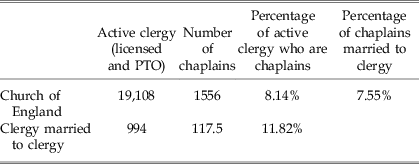
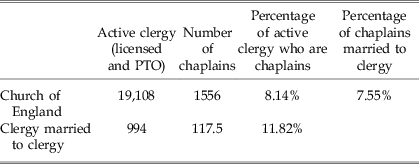
Thus ‘active’ clergy was taken to include licensed ministers and those with PTO, with the total number of CMC active in ministry calculated as 994, or 87.4 per cent of the total. Comparing with Church Statistics it was found that of 19,108 active clergy nationally, CMC constituted 5.2 per cent (Table 2).Footnote 41
CMC active in ministry

Patterns of Ministry of CMC
Non-parochial ministry
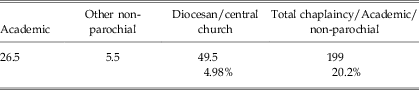
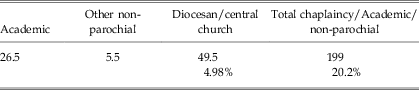
Of the active CMC, 11.8 per cent were identified as chaplains, which is higher than the national figure of 8.1 per cent of all clergy. However, where other non-parochial roles are included (e.g. academic/theological college staff and diocesan/central church employees), this percentage rises to the substantial figure of 20.2 per cent of CMC (Table 3).
Chaplains as a percentage of clergy
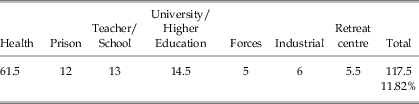
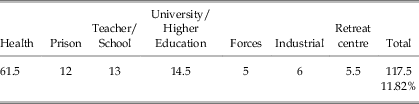
Chaplaincies of every variety are represented in the sample, with some being part-time or combining this with another role (leading to non-whole numbers). Of the total number of CMC chaplains of 117.5, most were in healthcare (61.5), followed by university chaplains (14.5), prison chaplains (12), and school chaplains/teachers (13) (Table 4). Six were industrial chaplains and a further five were armed forces chaplains. As previously mentioned, methodological complexities mean that some chaplains, especially forces and prison chaplains, may be among the most difficult groups to identify accurately as CMC, and this figure may prove to be under-counted. Further cooperative work with chaplaincy departments would be needed to ascertain more exact numbers.
Chaplains among clergy married to clergy
The range and diversity of chaplaincies and other non-parochial posts engaged in by CMC is notable, and the substantial proportion of this group choosing to engage in non-parochial ministry of over 20 per cent is highly significant (Table 5). While further in-depth qualitative research would be required to discover the reasons for this pattern, the strong indications from previous research suggest a range of likely possibilities such as financial factors and the need to manage absorptiveness and boundary enmeshment.
Non-parochial posts of clergy married to clergy
The greater number of CMC being employed as full- or part-time healthcare chaplains (totalling 61.5) may indicate the range of opportunities for healthcare chaplaincy, its relative familiarity to many clergy and the geographical spread of chaplaincy posts, suggesting that this may be seen as a good option for CMC as an alternative to parochial roles.
Gender Differences and Seniority
Nearly 20 years from women first being ordained as priests in the Church of England in 1994, and 26 years since they were ordained deacons in 1987, considerable gender parity may be expected in patterns of ministry of non-episcopal clergy. The effect of diverse marital dynamics on relative seniority in ministry roles of male and female partners would be harder to anticipate. At an empirical level, however, observations can be made, which could form the basis for fruitful further qualitative research.
Most CMC (79.8 per cent) have their primary ministry focus in local church life, or are dignitaries holding more senior responsibilities in their dioceses or the national Church. Assessment of the comparative seniority of male and female partners is most straightforward in this ‘track’ of ordained ministry. This study considered CMCs sharing a ministerial context, and where one (or both) are dignitaries.
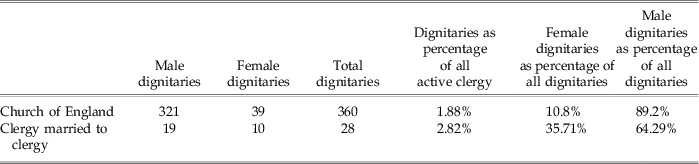
Church Statistics defines ‘dignitaries’ in the Church of England as the 360 Residential Canons of Cathedrals, Cathedral Deans, Archdeacons, and Bishops, comprising 1.9 per cent of all active clergy (Table 6), while across CMC 2.8 per cent are dignitaries.Footnote 42 An analysis of dignitaries revealed that CMC make up 7.8 per cent of this group (Table 7) compared with 5.6 per cent of all active clergy (Table 2). Thus not only are dignitaries more likely to be married to clergy than among clergy generally, but also CMC are more likely to be dignitaries than are others. These figures indicate some advantage in preferment for CMC, although it is not possible to draw particular causal conclusions about this pattern.
Dignitaries in the Church of England
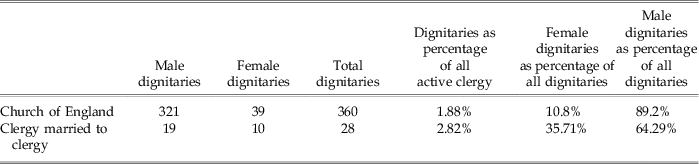
Gender of dignitaries married to clergy

When analysis of dignitaries was made along gender lines (Tables 6 and 7) 10.8 per cent were female. Within CMC dignitaries, however, the significantly higher percentage of 35.7 per cent are female, indicating greater gender parity among dignitaries married to clergy than among other dignitaries. Nevertheless, gender parity remains elusive, not least because at the time of this study women were not eligible for suffragan or diocesan bishoprics (up to 110 posts). Even leaving aside this systemic issue by considering only non-episcopal dignitaries, women clergy make up an increased percentage of 15.6 per cent of the remaining 250 dignitaries, with 4 per cent of these being married to clergy, still representing substantial inequalities that belie the years of experience gathered by female clergy over the past quarter century.
Further analysis shows that 25.6 per cent of female dignitaries are married to clergy, as are 5.6 per cent of male dignitaries. It is difficult to find adequate comparators for all active female clergy, as published figures presented by gender do not include those with PTO. If such figures could be identified it would be interesting to calculate the percentage of male and female CMC who are dignitaries compared to the percentages in the populations of active male and female clergy as a whole.
No cases were identified in the current study where both wife and husband were dignitaries, although in at least one case a female dignitary was married to a retired dignitary. This highlights a potentially problem in an organization where most senior and other posts are geographically specific (e.g. in particular cathedrals, dioceses, archdeaconries and parishes) and where senior posts are relatively few. Thus we can imagine the scarcity of two senior posts being available within close enough proximity to be realistically achievable for both spouses, and at a time when both are available and appropriately experienced. As in some other ministerial settings, there may also be overt or covert expectations on the partners of dignitaries to be available actively to support the ministry of their spouse. Internal expectations by the couple may further limit their willingness both to seek preferment. It is to be supposed that as women clergy continue to grow in experience this issue will continue to pertain for competent and gifted CMC. Other patterns of CMC may provide positive models for a dignitary to be married to another dignitary, such as the 20 couples where a parish incumbent is married to the incumbent of a different parish.
Gender Difference in Shared Ministry Contexts
Eighteen per cent of CMC were seen to be sharing a ministry context. As parish clergy and dignitaries in the Church of England are Office Holders, each post may be held by only one person at a time, thus obviating the possibility of clergy, including CMC, of being officially Joint-Vicars or Curates or indeed Joint- Canons, Deans, Archdeacons or Bishops. Nevertheless, anecdotal and online research shows that a few couples are styled locally as ‘joint vicars’.Footnote 43 Research in non-English contexts suggests the importance for each partner to establish her/his ministry independently before considering becoming co-pastors.Footnote 44
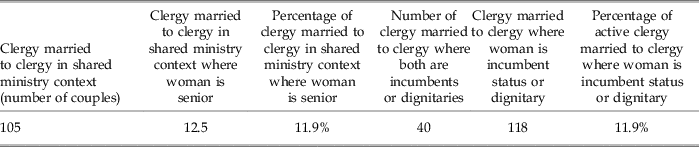
The lack of gender parity already identified is particularly stark in shared ministerial contexts, for in only 11.9 per cent of cases does the woman hold a senior position to the man (Table 8), and even in many cases where husband and wife are known as Joint-Vicars it is the man who is officially senior.
Clergy married to clergy in shared ministry context

Need for Further Research
A rich seam of future investigation is to be found in developing the areas where data has been least forthcoming with further quantitative work on numbers of forces and other chaplains married to clergy, and on sourcing appropriate data for further gender-based comparisons of ministerially active clergy. Mapping diocesan policies onto local patterns of the ministry of CMC would inform whether correlative and/or causal relationships are revealed.
Qualitative research could explore factors behind patterns noticed in this study, such as semi-structured interviewing and wider questionnaire-based research to consider motivations of CMC in making decisions, such as whether non-parochial ministry is chosen for reasons of vocation, the absorptive nature of parochial ministry, financial needs, family support or other factors. Further work would also be needed to explore whether vulnerabilities and dynamics in the lives and ministry of CMC may contribute to marital pressures and breakdown or to leaving the ministry temporarily or permanently.
Conclusions
Previously, researchers and others have relied on published numbers of CMC, most recently indicating 900 involved.Footnote 45 However, even given the inherent potential for under-counting, the present study reveals the much higher figure of 1160 in early 2013, showing an increase of 26.4 per cent, with 994 of these in active ministry. This difference emphasizes the importance of good numerical information as a basis for decisions, policy-making and the development of good practice, and emphasizes the importance of this group of clergy in the life and ministry of the Church of England.
Patterns of the ministry of CMC show markedly a higher proportion in chaplaincy roles than among clergy generally: 11.8 per cent of ministerially active CMC hold such posts, compared to 8.1 per cent of all active clergy nationally. This proportion is even greater when diocesan, central church, academic and other non-parochial roles are included (20.2 per cent), a pattern not only indicating that CMC may prioritize geographical location in seeking ministry roles, but also suggesting that non-parochial roles may enable them to negotiate absorptive demands and boundary enmeshment in parish ministry.Footnote 46 Further, spreading ministerial contexts beyond the parochial system would also serve to reduce a family's vulnerability to a single system, particularly if there are found to be financial advantages of not sharing a stipend, but rather accruing salary/stipend and pension entitlements beyond dioceses which may be systemically restrictive to CMC. Title curacies remain entirely in the gift of the dioceses, however, pointing to particular vulnerability at the outset of ordained ministry. Further research on the breakdown of the marriages of this group of clergy may reveal substantial further vulnerabilities with serious challenges in handling marital crisis in the public context of both partners in ministry, alongside far-reaching effects for career development, and personal and financial well-being into retirement.
Gender parity is very weak among clergy in the Church of England, and where CMC share a ministry context; in only 11.9 per cent of cases does the woman hold a more senior position, even where they are known locally as Joint Vicars. However, among CMC, a higher percentage of dignitaries are women than is seen in clergy generally, perhaps reflecting the higher than average levels of androgyny and intra-couple similarity found in the marriages of CMC.Footnote 47
The challenge to the Church of England and her bishops is positively to value and affirm the level of commitment represented by CMC, the immersion of whose personal and family lives can reach far beyond the already substantial levels in clergy generally. Upholding the principle of individual responsibility for CMC decisions encouraged by the Church's own guidelinesFootnote 48 will give diocesan staff greater awareness and understanding of particular issues for CMC, including handling the tension of taking seriously their own duty of care for clergy by informing and explaining the implications of different patterns of ministry, while non-judgmentally respecting preferences and decisions made by such a variety of individuals and families. Meanwhile the challenge to CMC is to be well-informed, realistic and wise when making decisions about their ministries and families to fulfil their responsibilities before God and enable greatest flourishing for themselves and those with whom they live and work.