Bidirectional cavopulmonary anastomosis involving anastomosis between the superior caval vein and the pulmonary artery is a useful part of the staged strategy before Fontan completion for patients with functional single-ventricle physiology. In many centres, bidirectional cavopulmonary anastomosis in early infancy – at 3–6 months of age – is thought to be advantageous for preserving ventricular performance and to avoid excess volume load, especially in patients with hypoplastic left heart syndrome.Reference Cleuziou, Schreiber, Cornelsen, Hörer, Eicken and Lange 1 – Reference Jaquiss, Ghanayem and Hoffman 4 However, early unloading of the functional univentricular heart via bidirectional cavopulmonary anastomosis may result in a small pulmonary artery. Therefore, the optimal timing of bidirectional cavopulmonary anastomosis remains unclear. The purpose of this study was to assess the impact of patient age at the time of bidirectional cavopulmonary anastomosis on post-operative pulmonary artery size, haemodynamics, and post-operative course after extracardiac total cavopulmonary connection without fenestration.
Materials and methods
This study was approved by the Institutional Review Board of Fukuoka Children’s Hospital, and the need for individual informed consent was waived. Retrospective review of medical records, including in-hospital and outpatient medical charts, laboratory data, cardiac catheterisation, echocardiography, and other non-invasive test results, was undertaken for patients who underwent total cavopulmonary connection at Fukuoka Children’s Hospital between January 2010 and March 2014. All patients had previously undergone bidirectional cavopulmonary anastomosis before total cavopulmonary connection in a staged manner. Patient characteristics are summarised in Table 1.
Patient characteristics.

AVSD=atrioventricular septal defect; BCPA=bidirectional cavopulmonary anastomosis; DORV=double-outlet right ventricle; DIV=double-inlet ventricle; HLHS=hypoplastic left heart syndrome; hypo LV: hypoplastic left ventricle; IQR=interquartile range; MA=mitral atresia; MS=mitral stenosis; PAB=pulmonary artery banding; PA/IVS=pulmonary atresia with intact ventricular septum; PBF=pulmonary blood flow; RV=right ventricle; TA=tricuspid atresia; TS=tricuspid stenosis; UVH=univentricular heart.
Study group
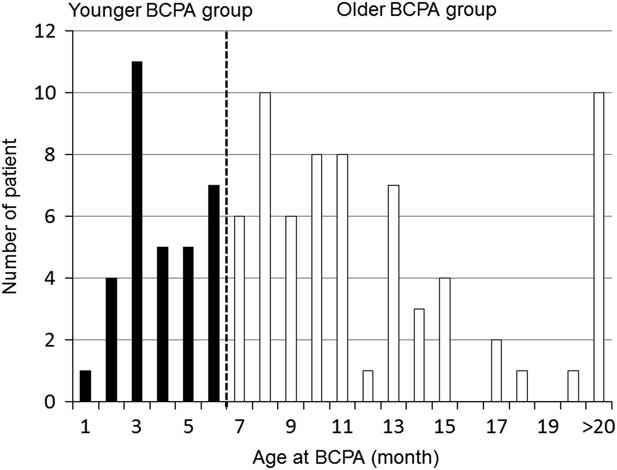
A total of 100 consecutive patients underwent bidirectional cavopulmonary anastomosis followed by total cavopulmonary connection at Fukuoka Children’s Hospital during the study period. Patient’s age at the time of bidirectional cavopulmonary anastomosis ranged from 2 months to 15 years (median, 9 months), and patient’s age at total cavopulmonary connection ranged from 16 months to 15 years (median, 36 months). Follow-up period was 5.0±1.2 years, and follow-up completion rate was 100%. The timing of bidirectional cavopulmonary anastomosis was decided according to the patient’s clinical status, ventricular function, presence of atrioventricular valve regurgitation, oxygen saturation, and body weight. In particular, in patients with hypoplastic left heart syndrome, bidirectional cavopulmonary anastomosis was performed basically at <6 months of age. Patients were classified into two groups as follows: younger group, if patient’s age at bidirectional cavopulmonary anastomosis is 6 months or less (n=33), and older group, if patient’s age at bidirectional cavopulmonary anastomosis is older than 6 months (n=67) (Fig 1).
Distribution of the timing of the BCPA and definition of younger BCPA group and older BCPA group. BCPA=bidirectional cavopulmonary anastomosis.

Bidirectional cavopulmonary anastomosis
Bidirectional cavopulmonary anastomosis was performed via median sternotomy and under standard cardiopulmonary bypass with mild hypothermia. Myocardial protection was achieved only when intracardiac procedure was needed. Bidirectional cavopulmonary anastomosis was carried out in an end-to-side manner between the superior caval vein and the pulmonary artery. If bilateral superior caval veins were present, both caval veins were anastomosed individually in the same manner. At the time of bidirectional cavopulmonary anastomosis, 26 patients required pulmonary artery plasty: 10 in the younger group and 16 in the older group (p=0.628). Additional pulmonary flow was placed in 21 patients: eight in the younger group and 13 in the older group (p=0.608). Inter-stage operation between bidirectional cavopulmonary anastomosis and total cavopulmonary connection was required in two patients in the older group: atrioventricular valve plasty in one patient and pulmonary artery plasty in one patient (p=0.447). A total of seven patients – three from the younger group and four from the older group – underwent catheter intervention for pulmonary artery before total cavopulmonary connection.
Extra-cardiac total cavopulmonary connection
Total cavopulmonary connection was performed via a median sternotomy approach and under standard cardiopulmonary bypass with mild hypothermia. Cardiac arrest was obtained if needed with cold crystalloid cardioplegic solution. An expanded polytetrafluoroethylene conduit (Gore-Tex vascular graft, W.L. Gore & Associates, Inc., Flagstaff, AZ, USA) was used as the extracardiac conduit for the inferior caval venous route, mainly an 18-mm conduit, but a16-mm conduit was used in 14 patients: eight patients from the younger group and six patients from the older group (p=0.063). No fenestration was placed during this study period.
Haemodynamic evaluation
All patients underwent cardiac catheterisation before and 6 months after total cavopulmonary connection to assess haemodynamic variables. The mean pulmonary artery pressure, the mean arterial pressure, the mean ventricular end-diastolic pressure measured in the dominant ventricle, the oxygen saturation at systemic artery, the ratio of pulmonary and systemic blood flow, the pulmonary artery resistance, the cardiac index, the normalised ventricular end-diastolic volume, and the Nakata index (pulmonary artery index=[{π×[(diameter of right pulmonary artery)2+(diameter of left pulmonary artery)2]/4}/body surface area]mm2/m2) were measured at the cardiac catheterisation.
Statistical analysis
Data are expressed as mean±standard deviation for normally distributed continuous variables or as median for skewed continuous variables, according to the Shapiro–Wilk test. Testing for differences in demographic and clinical data was accomplished using the unpaired Student’s t-test, Mann–Whitney U-test, or Kruskal–Wallis test for continuous variables, Fisher’s exact test for categorical variables, and analysis of variance as appropriate. Statistical significance was defined as p<0.05. The independent risk factors for prolonged use of chest tube – more than 14 days – were assessed using multi-variate regression by estimating hazard ratio and 95% confidential intervals. Statistical analysis was performed using SPSS statistical software, version 16.0 (SPSS, Inc., Chicago, IL, USA).
Results
Patients
Median age at bidirectional cavopulmonary anastomosis was 9 months, with an interquartile range of 5–13 months, in all study patients. Age at bidirectional cavopulmonary anastomosis was 3.9±1.5 months in the younger group and 17.0±23.5 months in the older group (p<0.001). The most common primary diagnosis in the younger group was hypoplastic left heart syndrome, and the incidence of hypoplastic left heart syndrome was higher in the younger group than in the older group (48 versus 4%; p<0.001). Of the 16 patients with hypoplastic left heart syndrome in the younger group, the source of the pulmonary blood flow at Norwood operation was systemic to pulmonary shunt in eight patients and cavopulmonary anastomosis in eight. Of these 16 patients, six patients had undergone pulmonary artery plasty. In the older group, unbalanced atrioventricular septal defect was the most common primary diagnosis (28%) (Table 1; Fig 1). Coil embolisation for aorto-pulmonary collateral arteries was performed before total cavopulmonary connection in 15 patients the: 8 patients from the younger group and 7 patients from the older group, p=0.081.
Haemodynamic data before total cavopulmonary connection
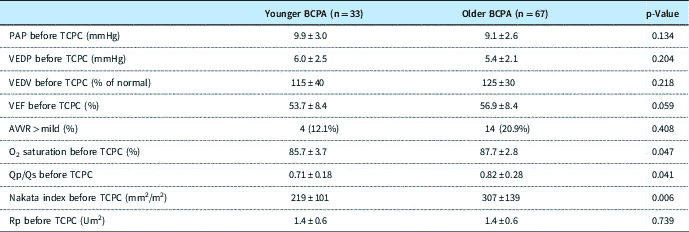
On cardiac catheterisation before total cavopulmonary connection, the Nakata index was smaller (280±101 versus 307±139 mm2/m2; p=0.006) and systemic to pulmonary blood flow ratio was lower (0.71±0.18 versus 0.82±0.27; p=0.041) in the younger group than in the older group. Oxygen saturation level before total cavopulmonary connection was lower (85.7±3.7 versus 87.2±2.8%; p=0.047) in the younger group than in the older group. Pulmonary artery pressure, ventricular end-diastolic volume, end-diastolic pressure, ventricular ejection fraction, and pulmonary artery resistance were not significantly different when comparing the two groups (Table 2).
Haemodynamic data before TCPC.

AVVR=atrioventricular regurgitation; BCPA=bidirectional cavopulmonary anastomosis; PAP=pulmonary artery pressure; Qp=pulmonary blood flow; Qs=systemic blood flow; Rp=pulmonary artery resistance; TCPC=total cavopulmonary connection; VEDP=ventricular end-diastolic pressure; VEDV=ventricular end-diastolic volume; VEF=ventricular ejection fraction.
Post-operative data and haemodynamic data after total cavopulmonary connection
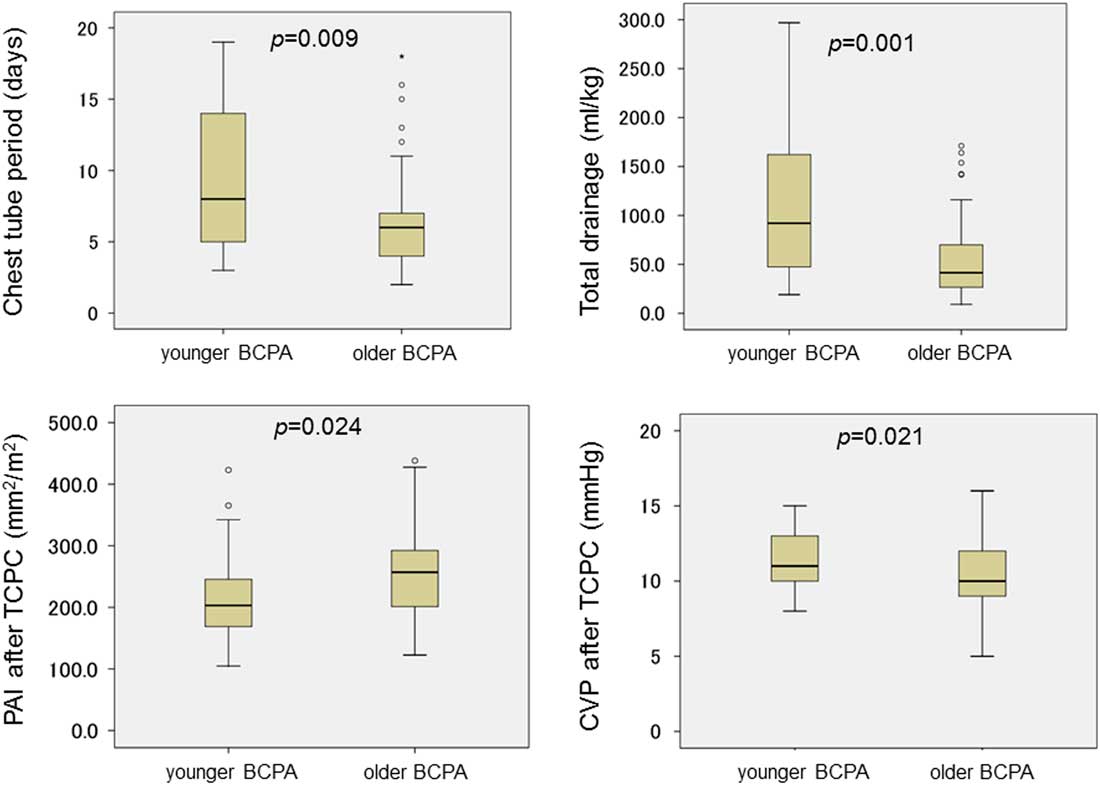
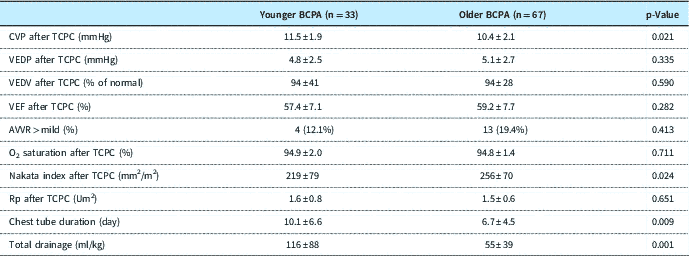
The median age at total cavopulmonary connection was 36 months (16–189 months). From the older group, one patient died at 1 year after total cavopulmonary connection because of peritonitis due to perforation of the intestine. After total cavopulmonary connection, the chest tube period was longer in the younger group than in the older group (10.1±6.6 versus 6.7±4.5 days; p=0.009), and total amount of drainage was larger in the younger group than in the other group (115±88 versus 55±39 ml/kg; p=0.001). Cardiac catheterisation at 6 months after total cavopulmonary connection revealed that central venous pressure was higher in the younger group than in the older group (11.5±1.9 versus 10.4±2.1 mmHg; p=0.017) and that the Nakata index was lower in the younger group (219±79 versus 256±70 mm2/m2; p=0.024). No differences in ventricular ejection fraction, end-diastolic volume, and cardiac index were found when comparing the two groups (Table 3; Fig 2).
Comparison of the chest tube period, total drainage, PAI after TCPC, and central venous pressure after TCPC between younger BCPA group and older BCPA group. BCPA=bidirectional cavopulmonary anastomosis; CVP=central venous pressure; PAI=pulmonary artery index; TCPC=total cavopulmonary connection.

Haemodynamic data after TCPC.

AVVR=atrioventricular regurgitation; BCPA=bidirectional cavopulmonary anastomosis; CVP=central venous pressure; Qp=pulmonary blood flow; Qs=systemic blood flow; Rp=pulmonary artery resistance; TCPC=total cavopulmonary connection; VEDP=ventricular end-diastolic pressure; VEDV=ventricular end-diastolic volume; VEF=ventricular ejection fraction.
Comparison of hypoplastic left heart syndrome and non-hypoplastic left heart syndrome patients in the younger group
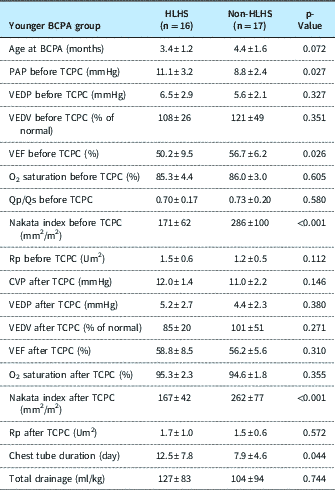
In patients who had undergone bidirectional cavopulmonary anastomosis at the age of 6 months or less, 16 patients had hypoplastic left heart syndrome and 17 patients had non-hypoplastic left heart syndrome. Before total cavopulmonary connection, pulmonary artery pressure was higher (11.1±3.2 versus 8.8±2.4 mmHg; p=0.027), ventricular ejection fraction was lower (50.2±9.5 versus 56.7±6.2%; p=0.026), and Nakata index was smaller (171±62 versus 286±100 m2/mm2; p<0.001) in hypoplastic left heart syndrome patients. After total cavopulmonary connection, Nakata index was smaller (167±42 versus 262±77 m2/mm2; p<0.001) in hypoplastic left heart syndrome patients, whereas other haemodynamic parameters were not significantly different, when comparing hypoplastic left heart syndrome patients and non-hypoplastic left heart syndrome patients. Chest tube period after total cavopulmonary connection was significantly longer (12.5±7.8 versus 7.9±4.6 days; p=0.044) in hypoplastic left heart syndrome patients than in non-hypoplastic left heart syndrome patients (Table 4).
Haemodynamic data before and after TCPC: comparison of HLHS and non-HLHS.

BCPA=bidirectional cavopulmonary anastomosis; CVP=central venous pressure; HLHS=hypoplastic left heart syndrome; PAP=pulmonary artery pressure; Qp=pulmonary blood flow; Qs=systemic blood flow; Rp=pulmonary artery resistance; TCPC=total cavopulmonary connection; VEDP=ventricular end-diastolic pressure; VEDV=ventricular end-diastolic volume; VEF=ventricular ejection fraction.
Comparison of age at bidirectional cavopulmonary anastomosis in non-hypoplastic left heart syndrome patients
There were 81 non-hypoplastic left heart syndrome patients in the study cohort. Of these, 16 patients had undergone bidirectional cavopulmonary anastomosis before 6 months of age, and the remaining 65 patients had undergone bidirectional cavopulmonary anastomosis after 6 months of age. There was no statistical difference in haemodynamic data before and after total cavopulmonary connection between these two groups, but younger patients had a larger volume of chest tube drainage after total cavopulmonary connection than that of older patients (109±95 versus 55±40 ml/kg; p=0.044) (Table 5).
Haemodynamic data before and after TCPC: comparison of patient age at the time of BCPA (non-HLHS).

BCPA=bidirectional cavopulmonary anastomosis; CVP=central venous pressure; HLHS=hypoplastic left heart syndrome; PAP=pulmonary artery pressure; Qp=pulmonary blood flow; Qs=systemic blood flow; Rp=pulmonary artery resistance; TCPC=total cavopulmonary connection; VEDP=ventricular end-diastolic pressure; VEDV=ventricular end-diastolic volume; VEF=ventricular ejection fraction.
Pulmonary artery size before and after total cavopulmonary connection
The Nakata index significantly decreased after total cavopulmonary connection (284±131 versus 243±75 mm2/m2; p=0.001). In the younger group, Nakata index was not significantly changed after total cavopulmonary connection (237±98 versus 220± 79 mm2/m2; p=0.330). However, in the older group, Nakata index was significantly decreased after total cavopulmonary connection (307±139 versus 254±70 mm2/m2; p=0.001).
Risk factors for prolonged use of chest tube
Table 6 shows the risk factors that were recognised as statistically significantly associated with prolonged duration of chest drain insertion – more than 14 days. In the multi-variate analysis, age at bidirectional cavopulmonary anastomosis <6 months (p=0.025) and central venous pressure at the time of intensive care unit (p=0.045) were risk factors.
Risk factors for prolonged length of more than 14 days of chest tube.

AVVR=atrioventricular regurgitation; BCPA=bidirectional cavopulmonary anastomosis; CPB=cardiopulmonary bypass; CVP=central venous pressure; ECC=extracardiac conduit; EDV=end-diastolic volume; EF=ejection fraction; HLHS=hypoplastic left heart syndrome; OR=odds ratio; PAP=pulmonary artery pressure; Qp=pulmonary blood flow; Qs= systemic blood flow; OP=operation; Rp=pulmonary artery resistance; TCPC=total cavopulmonary connection; VEDP=ventricular end-diastolic pressure; VEDV=ventricular end-diastolic volume; VEF=ventricular ejection fraction.
Discussion
This study demonstrated that bidirectional cavopulmonary anastomosis at the age of 6 months or younger provided excellent outcome of total cavopulmonary connection. However, a longer chest tube period, smaller pulmonary artery size, and higher central venous pressure after total cavopulmonary connection were recognised in younger bidirectional cavopulmonary anastomosis patients, particularly hypoplastic left heart syndrome patients. Before total cavopulmonary connection, pulmonary artery was smaller and oxygen saturation level was lower in the younger group than in the older group. In non-hypoplastic left heart syndrome patients, there was no significant difference in haemodynamics when comparing before and after total cavopulmonary connection, but chest tube drainage was larger in the younger group than in the older group.
Bidirectional cavopulmonary anastomosis is an intermediate step to the Fontan completion in patients with single-ventricle physiology as a staged strategy. After the introduction of the bidirectional cavopulmonary anastomosis for staged Fontan completion, surgical outcomes of single-ventricle patients have improved. However, the optimal timing of bidirectional cavopulmonary anastomosis remains unclear. Early-age (3–6 months) bidirectional cavopulmonary anastomosis had been widely adopted in many centres, especially for hypoplastic left heart syndrome patients, in order to preserve ventricular function and atrioventricular valve function.Reference Cleuziou, Schreiber, Cornelsen, Hörer, Eicken and Lange 1 , Reference Jacobs, Rychik and Rome 2 , Reference Jaquiss, Ghanayem and Hoffman 4 Furthermore, early-age bidirectional cavopulmonary anastomosis shortens the period between Norwood stage-1 palliation and stage-2 bidirectional cavopulmonary anastomosis, thereby reducing inter-stage mortality.Reference Ghanayem, Tweddell, Hoffman, Mussatto and Jaquiss 5 Several reports demonstrated that early bidirectional cavopulmonary anastomosis could be performed safely with excellent results.Reference Jaquiss, Siehr and Ghanayem 3 Therefore, bidirectional cavopulmonary anastomosis has been performed at 3–6 months of age in many centres. However, there are no previous studies that have investigated the impact of early-age bidirectional cavopulmonary anastomosis on outcomes and post-operative course after total cavopulmonary connection.
Although many studies have reported excellent outcomes of the bidirectional cavopulmonary anastomosis at early infancy, there are some concerns with regard to early bidirectional cavopulmonary anastomosis.Reference Slavik, Lamb and Webber 6 , Reference Reddy, McElhinney, Moore, Haas and Hanley 7 For example, some investigators found a higher incidence of the pulmonary artery thrombosis in early-age bidirectional cavopulmonary anastomosis patients. In addition, growth of the pulmonary artery after the bidirectional cavopulmonary anastomosis is thought to be smaller than normal because of the lack of non-pulsatile blood flow in the pulmonary artery.Reference Gérelli, Boulitrop and Van Steenberghe 8 , Reference Chen, Tulloh, Caputo, Stoica, Kia and Parry 9 This means that early bidirectional cavopulmonary anastomosis shortens the duration of pulsatile blood flow in the pulmonary artery, leading to non-growth of the pulmonary artery bed after bidirectional cavopulmonary anastomosis. Therefore, it is suggested that the pulmonary artery size in patients who have undergone bidirectional cavopulmonary anastomosis at early infancy remains small, both before and after total cavopulmonary connection. In fact, the Nakata index of the early-age bidirectional cavopulmonary anastomosis patients both before and after total cavopulmonary connection was smaller than that of patients in the older bidirectional cavopulmonary anastomosis group in the present study.
Previous reports demonstrated that the size of the pulmonary artery does not influence the operative outcome of bidirectional cavopulmonary anastomosis and total cavopulmonary connection, and investigators also suggested that pulmonary artery resistance is more important than pulmonary artery size. Adachi et alReference Adachi, Yagihara and Kagisaki 10 reported that a small pulmonary artery had no influence on post-operative outcomes, but demonstrated a pulmonary artery size reduction during the follow-up period after total cavopulmonary connection. Reddy et alReference Reddy, McElhinney, Moore, Petrossian and Hanley 11 demonstrated that pulmonary artery size did not change after bidirectional cavopulmonary anastomosis and did not affect the early mortality after total cavopulmonary connection. In contrast, other studies suggest that a small pulmonary arterial bed is a risk factor for Fontan circulation. Ovroutski et alReference Ovroutski, Ewert and Alexi-Meskishvili 12 argued that if the pulsatility of the pulmonary artery was eliminated at an earlier period, especially in children with a small pulmonary artery, non-growth pulmonary artery would affect the long-term Fontan circulation owing to elevated pulmonary artery pressure. The present study revealed that early bidirectional cavopulmonary anastomosis patients had higher central venous pressure, smaller pulmonary artery size, and a longer chest tube period after total cavopulmonary connection. Furthermore, they also had a smaller pulmonary artery and lower oxygen saturation before total cavopulmonary connection. These findings suggest that a small pulmonary artery persisted after total cavopulmonary connection, thus leading to higher pulmonary artery pressure and a longer chest tube period in the early bidirectional cavopulmonary anastomosis group.
Contribution of the primary diagnosis should be also considered for the results of this study. The timing of bidirectional cavopulmonary anastomosis in patients with hypoplastic left heart syndrome was earlier than that in patients with non-hypoplastic left heart syndrome in our centre. Thus, the proportion of the hypoplastic left heart syndrome patients in younger bidirectional cavopulmonary anastomosis patients was much higher than that of the older bidirectional cavopulmonary anastomosis group. The patients with hypoplastic left heart syndrome had higher pulmonary artery pressure, a longer chest tube period, and a larger amount of pleural drainage; these findings were also similarly seen in the younger bidirectional cavopulmonary anastomosis group. These findings may be a result of the fact that the pulmonary artery was smaller in hypoplastic left heart syndrome patients than in non-hypoplastic left heart syndrome patients. Lyengar et alReference Iyengar, Winlaw and Galati 13 reported that hypoplastic left heart syndrome patients are at high risk of prolonged effusion and adverse events after total cavopulmonary connection. In contrast, in patients with non-hypoplastic left heart syndrome, there was no difference in post-operative haemodynamics after total cavopulmonary connection when comparing two groups. Therefore, the diagnosis of hypoplastic left heart syndrome itself, rather than age at bidirectional cavopulmonary anastomosis, might have influence on the post-operative haemodynamics after total cavopulmonary connection. In our institute, fenestration was not routinely placed even in patients with hypoplastic left heart syndrome. Therefore, results of hypoplastic left heart syndrome patients may differ when the non-fenestrated population of this study is compared with previous reports.Reference Feinstein, Benson and Dubin 14 In a recent publication, Meza et alReference Meza, Hickey and McCrindle 15 reported that high-risk patients who had undergone bidirectional cavopulmonary anastomosis at <6 months of age had the highest mortality after Norwood operation. Although this report included only post-Norwood patients and did not investigate post-operative haemodynamics, their finding seems to support our hypothesis that early transition to cavopulmonary shunt affects haemodynamics and outcome after total cavopulmonary connection in specific patients. Furthermore, they finally concluded that such high-risk patients should be considered as candidates for heart transplantation.
Fontan circulation is affected by many factors, including ventricular performance, pulmonary artery size and resistance, dominant ventricular type, cardiac rhythm, systemic to pulmonary collaterals, and Fontan operation type. Therefore, optimal timing of bidirectional cavopulmonary anastomosis and total cavopulmonary connection should be comprehensively determined on the basis of the above-mentioned factors. In hypoplastic left heart syndrome patients, early bidirectional cavopulmonary anastomosis is exceedingly beneficial, because preservation of the right ventricular performance and tricuspid valve function in early infancy is essential. In contrast, in patients with non-hypoplastic left heart syndrome patients, such as tricuspid atresia, pulmonary artery growth might be given priority over the ventricular function, because the ventricle and atrioventricular valve function can tolerate the volume load relatively better than those of hypoplastic left heart syndrome patients. Therefore, older-age (>6 months of age) bidirectional cavopulmonary anastomosis may be beneficial in terms of ideal Fontan circulation with well-grown pulmonary artery trees and preserved ventricular function in patients with non-hypoplastic left heart syndrome.
Study limitations
The retrospective nature of the study is a limitation. The study group was small, and adverse events were rare; therefore, the results of statistical analysis should be interpreted with caution, as bias may have been introduced. The proportion of hypoplastic left heart syndrome patients predominantly existed in younger bidirectional cavopulmonary anastomosis patients, and this disproportion affected the findings of this study. The timing of bidirectional cavopulmonary anastomosis was decided at the physician’s discretion, and a difference was noted in the primary diagnosis when comparing younger and older bidirectional cavopulmonary anastomosis groups, and these conditions may influence the post-operative course and haemodynamics after total cavopulmonary connection.
Conclusions
The patients who had undergone bidirectional cavopulmonary anastomosis at <6 months of age provided favourable haemodynamics and did not affect the outcome of total cavopulmonary connection. Longer chest tube period, smaller pulmonary artery size, and higher pulmonary artery pressure after total cavopulmonary connection were recognised in early bidirectional cavopulmonary anastomosis patients, especially in hypoplastic left heart syndrome patients.
Financial Support
This research received no specific grant from any funding agency or from commercial or not-for-profit sectors.
Conflicts of Interest
None.
Acknowledgements
None.