Introduction
Dementia care reviews on psychosocial interventions are consistent in concluding that these interventions should be person-centered. Person-centered interventions seem to be more effective than standardized interventions, especially when they are intensive and aimed at needs of the person with dementia and the caregiver (Brodaty et al., Reference Brodaty, Green and Koschera2003; Livingston et al., Reference Livingston, Johnston, Katona and Lyketsos2005; Ayalon et al., Reference Ayalon, Gum, Feliciano and Arean2006; Spijker et al., Reference Spijker2008; O'Connor et al., Reference O'Connor, Ames, Gardner and King2009). Person-centered psychosocial interventions have the broadly overlapping goal of improving quality of life and maximizing function in the context of existing deficits (APA, Rabins et al., Reference Rabins2007). They can more efficiently address personal needs and better use the remaining capacities of the person in need for care than standardized interventions. Person-centered care is usually related to the person with dementia and/or the family caregiver. They are both approached as individuals with their own problems and needs for care. The New York University Caregiver Intervention (NYUCI) expands the intervention to all participating family members and focuses on the family context (Mittelman et al., Reference Mittelman1995).
Despite this high consistency of evidence in favor of person-centered care, little information is available on how person-centered and family-centered interventions are actually provided and on barriers and facilitators in the provision of this type of care. Few intervention studies provide a process analysis in which the actual provision of care has been described (Lewin et al., Reference Lewin, Glenton and Oxman2009). Information on process analysis is not required in the criteria of the Cochrane Library for randomized controlled trials. Moreover, if a process analysis has been published, it usually provides information on the extent to which the intervention has been carried out according to plan and not about challenges met in using the intervention in daily clinical care (Lewin et al., Reference Lewin, Glenton and Oxman2009).
Thus, the details of the actual provision of clinical interventions in daily practice are hidden in a “black box” and are not on the research agenda. However, knowledge about what actually happens in the provision of psychosocial interventions should not be hidden but be shared. This knowledge might be very helpful to explain success and failure of interventions and it might enhance future implementation (Hulscher et al., Reference Hulscher, Laurant and Grol2003).
We thought it would be worthwhile to fill this knowledge gap by getting in-depth information from providers (counselors) on the actual provision of an intervention and their perceived challenges and successes. We chose the family counseling component of the NYUCI as an example to get more insight into the actual provision of person centered care, especially because we are currently investigating the effects of this component of the NYUCI in the Netherlands (Joling et al., Reference Joling2008).
The NYUCI has achieved a substantial evidence base as a best practice. A longitudinal randomized controlled trial conducted over more than 20 years at the NYU Alzheimer's Disease Center with funding from NIMH and NIA (AG14634 and MH42216) has demonstrated important psychosocial and long-term care utilization outcomes. The results show that this intervention can alleviate some of the deleterious effects of caregiving on mental health (Mittelman et al., Reference Mittelman1995; Reference Mittelman, Roth, Coon and Haley2004a; Reference Mittelman, Roth, Haley and Zarit2004b) and physical health (Mittelman et al., Reference Mittelman, Roth, Clay and Haley2007) and enable spouse caregivers to postpone or prevent nursing home placement of the patients (Mittelman et al. Reference Mittelman, Ferris, Shulman, Steinberg and Levin1996; Reference Mittelman, Haley, Clay and Roth2006). The NYUCI is unique in its emphasis on enhancing support from family and friends. While the number of support network members does not change, the number to whom the caregiver feels close does increase, as do satisfaction with assistance and emotional support (Roth et al., Reference Roth, Mittelman, Clay, Madan and Haley2005). In more detailed analyses of social support information collected from 200 of the spouse-caregivers, it was found that higher levels of emotional support, more visits, and having more network members to whom they felt close were all individually predictive of longitudinal changes in social support network satisfaction (Drentea et al., Reference Drentea, Clay, Roth and Mittelman2006).
The intervention includes six sessions of individual and family counseling, support group participation, and additional counseling by telephone when requested by the primary caregiver or family members following the formal counseling sessions. Details of the intervention were published in a handbook for healthcare professionals (Mittelman et al., Reference Mittelman, Epstein and Pierzchala2003).
The unifying theme of the NYUCI is that improving social support and minimizing family conflict will improve the ability of the caregiver to withstand the difficulties of caregiving and obviate or defer the need for institutionalization of the patient. The focus is on diminishing the negative aspects of family involvement with caregiving, while enhancing the positive support (Mittelman et al., Reference Mittelman, Epstein and Pierzchala2003). The family counseling component of the intervention is instrumental to achieving the goals of the intervention.
Family counseling sessions aim to reduce conflict and improve support of family members for the primary caregiver. It can be said that these sessions build or strengthen bridges from the spouse caregiver to other family members. The first family session has several components: introduction, exploration of family members’ understanding of the impact of AD on the primary caregiver and themselves, identification of issues, tentative solutions and task allocation, summary and agenda for next sessions. The subsequent family sessions include feedback on the previous session and commitments, identification of difficulties, making plans for continued efforts and addressing new problems. A variety of therapeutic techniques was used, including active listening, cognitive reframing, and role playing (Mittelman et al., Reference Mittelman, Epstein and Pierzchala2003).
We asked three of the counselors who had been providing the NYUCI for a long period of time to provide information about their experiences with family counseling. Our aim was to gain insight into the actual provision of effective family counseling in the context of caring for a relative with Alzheimer's disease, in order to enhance its implementation in future replications.
Methods
Qualitative methods are often used to provide information and gain insight into unknown fields such as the actual provision of person or family centered care. They allow in-depth information and offer a broad picture of problems, approaches and of the construction of meaning, reflecting the perspectives of the participants and the significance attached to the (caregiving) situation (Black and Rabins, Reference Black and Rabins2007).
Setting and participants
The setting of the interviews was the New York University Aging and Dementia Research Center. Qualitative research requires purposive sampling, in this case of counselors providing NYUCI. A total of eight counselors worked on the project from 1987 to 2006, one only for a short period. There were never more than four at a time. The first author interviewed all the counselors working at the NYU Center in 2007 who had provided counseling to families in the study of the NYUCI. Two of them were instrumental in developing the intervention and participated for the entire length of the study. The other two original counselors had been replaced by two new counselors, of whom one was also interviewed by the first author (the other was not available). All the counselors were female, two with advanced degrees in social work and one with an MA in gerontology, whose experience with the intervention ranged from 4 to 20 years. Their ages at the time of the interview ranged from mid-60s to 95 years. Two of them were still involved in counseling at the center at the time of the interview, one had stopped counseling several years earlier. At the time of the interview there were no longer any study participants who were receiving the family counseling sessions. However, counseling is now routinely provided to all caregivers who come to the center.
Data collection
Two series of interviews were undertaken. One series of individual interviews was carried out by the first author to derive information for the Dutch study on family counseling. All three counselors connected to the original NYUCI were interviewed, of whom one was in her sixties, one in her eighties and one in her nineties at the time of interview, which was more than 20 years after the start of the study in 1987. Two counselors were interviewed twice. MVD also interviewed one of the researchers (MM) connected to the project and one counselor involved in the routine counseling provided in the center. Each interview took approximately one hour. Notes were taken during these interviews. The richness of information was so impressive that the first author decided to use a more rigorous approach. The first author adapted the interview guide, based on the results of the personal interviews, to include the following questions:
• Which are the most prevalent problems?
• What approaches were effective?
• What are the barriers and rewards in applying the family counseling program?
• Which are the do's and don'ts?
In the group interview, each of the counselors reported on their own experiences in conducting the intervention. Another counselor, who had not participated in the NYUCI, and the fourth author were present, but did not participate. This group interview was videotaped and transcribed.
Data analysis
The first step in the analysis was data reduction by coding the data from the transcript. Coding is the interpretive process by which qualitative data are broken down and given conceptual labels (Corbin and Strauss, Reference Corbin and Strauss1990). First, codes were assigned that are closely related to the text fragments. This coding process was done by three authors independently (MVD, KJ, HvH), then discussed until final agreement was reached. The discussions led to a more extensive study of the data, as disagreements stimulated an iterative procedure and re-reading provided new concepts. Codes referring to the same phenomenon were grouped into categories. The consensus process of independently making categories, followed by discussion, was repeated. Finally, categories were grouped into themes, again using the same consensus procedure. In this way, the analysis gradually built up from the raw text to higher levels of abstraction. The results were checked by feeding them back to the counselors. Finally, a hypothesis was derived from the data.
Results
Six themes were identified: (1) family problems; (2) ways of dealing with these problems; (3) barriers encountered by counselors (4) ways of dealing with these barriers; (5) facilitators or rewards of being a counselor; and (6) the perceived effectiveness of the family counseling. Quotes are either indicated between brackets or in Tables 1 and 2.
Family problems

Ways to deal with problems

Family problems
It should be emphasized that participants who enrolled in the study did not apply for help with family problems. At the time they enrolled in the study, some caregivers told the counselors that their family relationships were fine, while others made it clear that they needed a lot of help or that they didn't need or want their families to be involved in caregiving. In the course of implementing the family counseling component of the intervention, a number of themes that impinged upon the family's ability to support the primary spouse caregiver was identified. The needs of the different families ranged over a spectrum from basically only needing referrals for resources to requiring major readjustments in their relationships to enable them to be mutually supportive.
Family problems mentioned in the interview were placed in the following three categories: conflicts within families, the influence of past experiences and personality, and daily living with dementia.
Conflicts within the family
Family members are confronted with a disease that gradually makes their relative with dementia dependent and unable to fulfill previous roles and tasks. This is a big challenge for the family system.
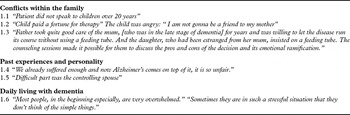
Many families have no history of past conflicts, while other families might have had problematic relationships or lingering conflicts based on issues from the past. These conflicts were sometimes quite serious and, in a few cases, contact between adult children and their parents had been broken off for a long time (Table 1.1). Being with their parents again may have challenged the separation they had fought, with great emotional effort, to achieve (Table 1.2). However, adult children who had struggled in their relationships with their parents were sometimes able to use the counseling sessions, which focused on the present and the illness of the parent as an opportunity to reconnect.
Current conflict might involve complicated issues about appropriate care for the person with dementia (e.g. care at home or in a nursing home, hiring paid help or not). A difference of opinion about current treatment can have far reaching consequences (Table 1.3).
Previous and current conflicts hamper family collaboration in dementia care, but in the majority of these cases the family members were able to use the opportunity of family counseling meetings to rebuild a bridge to the family.
Influence of past experiences and personality
Families with traumatic experiences in their past had more trouble accepting the disease and accepting help from each other than other families (Table 1.4). The personalities of the family members also play a crucial role (Table 1.5). A controlling spouse may be more challenged by the unpredictability of the illness and by the need to accept input and help from other family members.
Daily living with dementia
Dementia profoundly influences daily life. A diagnosis of dementia has an enormous impact on the patient and the family (Table 1.6). The period immediately following the diagnosis often causes turmoil, and can evoke all kinds of worries:
“They just don't know where to go, what to do, what to handle first, how to cope with all the things that happen to them.”
Living with dementia changes during the course of the disease, but some problems were mentioned regardless of the stage of dementia. One problem that was brought up constantly during family counseling sessions was the “empty day syndrome”:
“He sits around all day and doesn't do anything.”
People don't know how to deal with it and find it hard to witness this “emptiness” and apathy.
Ways of dealing with family problems
It requires a lot of skill and experience to respond to the diversity of problems associated with caring for a relative with dementia. It is very hard for the counselor to predict how the family is going to react:
“People have there own agendas. You never know the whole story about what's really motivating people, their prior experience.”
In general, it is very important to be aware of the problems within the family system and to maintain a neutral position rather than taking sides. This is an important skill in family counseling.
The ways of dealing with family problems were divided into the following four categories: dealing with conflicts and misunderstandings, dealing with the past, dealing with daily living with dementia, and “don'ts”.
Dealing with conflicts and misunderstandings
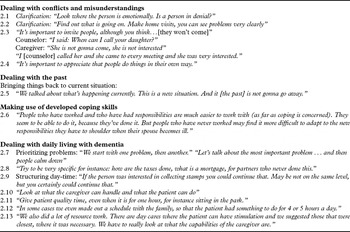
Clarification of the perspectives of those involved in the problem is a key concept in dealing with conflicts and misunderstandings (Table 2.1). Profound knowledge of the family situation is a firm basis for counseling.
As a counselor, sometimes you can affect family dynamics by taking the initiative with the permission of the spouse caregiver (Table 2.2).
An active approach is not always necessary or desirable. In some cases counselors felt it would be more helpful to follow the family's lead (Table 2.4). Sometimes this was because the family felt they were doing well, in other cases because interfering might have been even more harmful for the family system (Table 1.3).
Dealing with the past
The counselors tried to avoid discussion of problems from the past and focus on the current situation (Table 2.5). Where possible, however, counselors encouraged discussion of knowledge and skills gained from past experiences that could facilitate current care. Competencies learned in the past were very useful in adapting to caring responsibilities (Table 2.6).
Even when problems in the past remain unsolved, family members might want to contribute to care of their parents. If they sensed there was a willingness to help, the counselors supported it by making it clear that:
“You don't even have to love each other, you still might want to help the person who is ill. And there are ways of doing that.”
This might seem a bold suggestion, but it can help family members to contribute to parental care.
Dealing with daily living with dementia
The counselors were very keen to help families deal with day-to-day problems. Many problems have a practical dimension which is amenable to “treatment”. For instance, when people are overwhelmed and don't know what to do, counselors can help families to prioritize problems and break them down into manageable pieces (see Table 2.7 and 2.8).
The empty day syndrome was recognized as a serious problem. Activities are very important in daily life. They structure the day. Counselors tried to address the empty day syndrome by helping the families think about activities persons with dementia used to be involved in that could be modified to suit the limitations imposed by the illness (see table 2.9; 2.10; 2.11; 2.12).
Moreover, the counselors helped the caregivers and family members to find resources for practical support (table 2.13). Through experience, they were able to estimate how much and which resources are required and appropriate to the specific needs of the caregiver and the person with dementia.
Don'ts
The counselors gave some “don't suggestions” for other counselors.
“Don't get angry, even when provoked.”
Another piece of advice which might be surprising was:
“Don't say: ‘Take care of yourself’.”
This seems to contradict the fact that it is important for the caregiver to pay attention to his or her own needs. However, the counselors noted that this was a cliché and “taking care of yourself” became another requirement that the caregiver was often unable to fulfill.
Barriers encountered by counselors and ways to deal with these barriers
There are barriers to creating effective family counseling sessions. Some barriers, such as geographical distance, are difficult to overcome by counseling. Grown children often live at great distance from their parents.
The barriers dealt with in counseling were divided into the following four categories: difficulty making a connection with the family, feeling like an unwanted intruder, denial and reluctance to be helped and dealing with denial, and reluctance to be helped.
Difficulty making a connection with the family
Families with traumatic experiences in the past are more difficult for counselors to work with (see Table 1.4).
“They are suspicious of help, not open, difficult to make a connection with.”
They often have more trouble accepting the disease than other families and they also have more trouble accepting help.
Feeling like an unwanted intruder
Sometimes counselors felt rejected by the family members’ extreme reactions to what they perceived as intrusions into their family system.
“He [the caregiver] got very angry at me and said: ‘Who are you? How do you know? What are you – God? And you're making decisions for us?’”
The counselors were aware that it was better to help families make their own decisions, rather than telling them how to behave. Nevertheless, they admitted that sometimes they became frustrated in not being able to make a connection or affect change. Their impatience often tempted them to tell people what to do, rather than waiting for them to come to their own conclusions.
Denial and reluctance to be helped
Many families are willing to accept help. However, others are unwilling to accept help, even when they are obviously struggling to cope. It is not always easy to find out the real meaning behind a refusal to accept help from other family members, paid help or other resources. Caregivers often give a reason for their refusal which hides the real reason.
They may say:
“He [the patient] won't accept any help,” rather than: “I [caregiver] don't want it.”
Hiding behind the patient might be easier for the caregiver than explaining why the help is not welcome. Another reason for not accepting help is the fear of having too much free time. Caregivers, especially older spouses, can become so absorbed by the situation that they have trouble imagining that they can do anything else with their time.
“Having space in the day that is not filled with tasks can be is very difficult. And also helping the caregivers think about dealing with what to do when they get the free time . . . to work with the space that opens for them.”
Dealing with denial and reluctance to be helped
Counselors were very creative in addressing these barriers and offering help in an acceptable way. Their basic principle was:
“Make a bond [without taking sides] and consider that reluctance to be helped is often related to the wish to maintain autonomy and the need for control over one's situation. This should be respected.”
One way they did so was by inviting people to experiment with accepting help.
“Try and see what happens. . .”
They suggested accepting help for a short period, giving the caregiver an opportunity to make a choice about whether to accept or decline help after having had the of experience. Encountering these barriers was not always a pleasant experience, but the counselors generally were able to view them as a challenge.
Facilitators or rewards of being a counselor
The rewards and obvious benefits to the families far outweighed the barriers perceived in counseling. Families generally expressed the fact that they highly valued the counseling sessions.
“People said this [family counseling] was the best thing that ever happened.”
One of the experiences of counselors was that even when they try to do the utmost to help a family, they sometimes have to realize that what they are doing is wrong or not working for the family's benefit. The counselors learned to be flexible, and to try different approaches and to deal with apparent failure. They learned that they were not perfect and that making mistakes is part of the process.
“It is not terrible to make a mistake”
This seems an obvious remark, but it is hard in practice. The importance of forgiving your own mistakes was emphasized by one counselor:
“When you can forgive yourself instead of defending yourself, you open up new avenues.”
This learning experience contributed to their own growth, which was also stimulated by the frequent exchange of experiences and reflections on their own contributions to the group process in weekly staff meetings. The following comments indicate that job satisfaction was generally high:
“It makes you feel good”;“It bolsters your ego to help people”;“It was a privilege to be a counselor.”
Perceived effectiveness of family counseling meetings
The effectiveness of interventions is measured by quantitative outcome measures. However, we thought there might be other observed effects which are not reflected in these outcome measures. Therefore the counselors were asked which were the most important effects they observed.
“Not so much anger” and “New, more options”
These are changes in the perceptions of caregivers that are especially amenable to the person-centered approach.
The counselors were also asked what contributed most to the effectiveness of the family counseling sessions.
“The counseling sessions created a ‘level playing field’. You can say anything you want, nobody gets angry. At least for the moment, there is just total acceptance.”
This comment reflects a key element of family counseling – providing a safe environment in which the interactions are guided by an experienced objective counselor.
Discussion
Opening the “black box” of the family counseling component of the NYU Caregiver Intervention led to our identifying six themes: family problems, ways of dealing with these problems, barriers encountered by counselors, ways of dealing with these barriers, facilitators or rewards of being a counselor and perceived effectiveness of the family counseling. Dementia has challenged families to deal with current problems within the context of a longstanding relationship. Counseling was perceived to be challenging when counselors were confronted with reluctance to be helped and with provocations to get involved in family conflicts. However, it was also perceived to be very rewarding. As well as the well-known effects of the NYU Caregiver Intervention in improving social support from family and friends which lead to delayed institutionalization and a reduction in symptoms of depression, less severe reactions to problem behaviors caused by the disease and improved self-reported physical health (Mittelman et al., Reference Mittelman1995; Reference Mittelman, Ferris, Shulman, Steinberg and Levin1996; Reference Mittelman, Epstein and Pierzchala2003; Reference Mittelman, Haley, Clay and Roth2006; Reference Mittelman, Roth, Clay and Haley2007), the counselors considered the reduction of anger and seeing more and new options as effects of the family counseling program.
This study provides insights that have received little prior attention: the context of family caregiving, including the efforts to care for the person with dementia despite past conflicts; the influence of caregivers’ past experiences, including the use of skills gained in other situations; the impact on daily life of witnessing the “empty day” syndrome; barriers such as dealing with reluctance to be helped and rewards of being a counselor such as their joy of helping in this context and the opportunity for personal growth in helping others.
One underlying theme of family counseling might be summarized as offering the opportunity to see more and new options, which we hypothesize is a direct effect of this person-centered counseling. This might be an important outcome to be measured in future studies.
The counselors dealt with family problems by using principles outlined in the theoretical family crisis and support models of Bengtson and Kuypers (Bengtson and Kuypers, Reference Bengtson, Kuypers, Munnichs, Olbrich and Mussen1985; Zarit and Zarit, Reference Zarit and Zarit1986; Vernooij-Dassen et al., Reference Vernooij-Dassen, Lamers, Bor, Felling and Grol2000). These models have been based on the social breakdown syndrome, originally applied to the etiology of mental illness (Gruenberg, Reference Gruenberg1967)..This includes problem clarification from the perspectives of the persons involved, prevention of getting lured into family dynamics and bringing back attention to the current situation. The complexity of family dynamics means that family counseling programs should be carried out by social workers or other social service providers with skills in system approaches and family therapy.
The skillfulness of the counselors is demonstrated by their observation that many caregivers find it hard to admit their reluctance to be helped and prefer to hide behind the patient. Caregivers consider themselves to be supporters rather than persons in need of care. Brodaty found that one third of caregivers obviously in need of help, refused to be helped (Brodaty et al., Reference Brodaty, Thomson, Thompson and Fine2005). Bolger and Amarel (Reference Bolger and Amarel2007) indicated that being helped can threaten self-esteem, creating a sense that the recipient feels unable to solve problems. Observations of the counselors in our study similarly suggested that accepting help threatened caregivers’ sense of being in control.
The counselors’ approach to dealing with the “empty day” syndrome – helping to find activities preferred by the person with dementia and adapted to his or her capacities – is in accordance with the principles behind the effective occupational therapy program (Graff et al., Reference Graff, Vernooij-Dassen, Thijssen, Dekker, Hoefnagels and Rikkert2006; Reference Graff, Vernooij-Dassen, Thijssen, Dekker, Hoefnagels and Olderikkert2007; Reference Graff2008).
Limitations of this study are related to the requirements of qualitative research. For example, we may not have covered the full range of prevailing family problems, as we interviewed three of the counselors after the counseling sessions within NYUCI took place. The results of this study were based on recording counselors’ responses to questions rather than observing the family sessions or interviewing participants. Yet the discussion revealed common themes within a wide variety of family problems. Future research should also include mechanisms for obtaining more information on the perceptions of participants in counseling and observations of counselors at the time of the sessions, rather than retrospectively.
Conclusion
Person-centered care, in contrast to disease centered care, emphasizes “normality”: acknowledgement of family conflicts and yet finding a way to provide care in the present situation, structuring daily life and enabling caregivers to accept help. The principle of person-centered care shaped by knowledge of the caregiving context, acknowledgement of problems and limitations and recognition of strengths, made it possible to help caregiving families to perceive new and more options.
The goals of the NYUCI were to maintain the well-being of the primary caregiver and reduce premature or unwanted nursing home placement of the person with dementia. The study results suggest that these goals were achieved through improving social support from family and friends. Focusing on measuring outcomes closely related to the way in which the intervention seemed to achieve its aims – by reducing family conflict and helping caregivers and their family members to consider more and new options to help each other and to deal with caregiving – might help to better explain the effectiveness of this and other psychosocial interventions. In addition, in future studies of family counseling, it would be valuable to maintain notes of the sessions so that a more thorough analysis can be made of the problems discussed and the facilitators of improvement perceived in the provision of counseling. This would create a knowledge base to make it possible for future interventionists to tailor counseling more closely to the needs of families and enable caregivers to derive even greater benefit from what the evidence from the NYU Caregiver Intervention study suggests is a powerful treatment modality.
Conflict of interest
None.
Description of authors’ roles
Myrra Vernooij-Dassen designed the study, carried out the interviews, analyzed the data and wrote the paper. Karlijn Joling and Hein van Hout analyzed the data and assisted with writing the paper. Mary Sherman Mittelman directed the original NYU Caregiver Intervention, checked the data and contributed extensively to the paper.
Acknowledgment
We thank all the counselors who reported on their own experiences in conducting the intervention.