After first appearing in the United KingdomReference Uttley, Collins, Naidoo and George 1 and FranceReference Leclercq, Derlot, Duval and Courvalin 2 in 1986, vancomycin-resistant enterococci (VRE) have spread worldwide.Reference Werner, Coque and Hammerum 3 – Reference Molton, Tambyah, Ang, Ling and Fisher 6 Dramatic increases in VRE isolation (0% to 25.9%) have been reported over a 10-year period, from 1989 to 1999, in the Unites States, and this trend is continuing.Reference Deshpande, Fritsche, Moet, Biedenbach and Jones 4 According to the National Healthcare Safety Network, one-third of enterococci strains were vancomycin-resistant in 2006–2007.Reference Hidron, Edwards and Patel 7 The European Antimicrobial Resistance Surveillance System has highlighted wide variability between European countries,Reference Orsi and Ciorba 8 with VRE proportions ranging from less than 2% (Finland, the Netherlands) to more than 20% (Ireland, Greece, Portugal). Mortality caused by bloodstream VRE infections is at least twice that occurring with susceptible strains.Reference Orsi and Ciorba 8 Moreover, the risk of horizontal vanA gene transfer from vancomycin-resistant Enterococcus faecalis to methicillin-resistant Staphylococcus aureus can lead to dissemination of vancomycin-resistant S. aureus.Reference Friães, Resina, Manuel, Lito, Ramirez and Melo-Cristino 9 – Reference Moravvej, Estaji, Askari, Solhjou, Naderi Nasab and Saadat 11
To manage and control VRE outbreaks, several measures are usually taken simultaneously, including contact precautions, cohorting, contact screening, active surveillance, or ward closure. The cost of such measures is significant—US $193,469—with $68,301 for infection control measures and $125,168 for loss of income from spare isolation beds.Reference Escaut, Bouam and Frank-Soltysiak 12 One of the first steps in hospital outbreak investigations is to identify the magnitude of infection spread. Because VRE outbreaks often result in digestive carriage without clinical infection, the definition of at-risk populations and screening policies during investigation of outbreaks is crucial for better control. To our knowledge, no review has analyzed different screening policies during VRE outbreaks in hospital settings.
Basic reproductive rate or R 0, defined as the average number of secondary cases generated by 1 primary case, is a key concept in infectious disease dynamics.Reference Austin, Bonten, Weinstein, Slaughter and Anderson 13 An epidemic can occur if R 0 is greater than 1. Few estimates of VRE R 0 have been reported, and no one has ascertained the pooled R 0 of VRE outbreaks in hospital settings.Reference Austin, Bonten, Weinstein, Slaughter and Anderson 13 , Reference Lowden, Miller Neilan and Yahdi 14
We undertook a systematic review of VRE outbreaks worldwide. Our primary goal was to describe VRE outbreaks with particular emphasis on definition of contact patients. Our secondary objective was to estimate the pooled R 0 of VRE in hospital settings on the basis of investigation reports.
METHODS
Data Acquisition
We conducted our searches according to the Preferred Reporting Items for Systematic Reviews and Meta-Analyses Statement.Reference Moher, Liberati, Tetzlaff and Altman 15 Published outbreak investigations were identified through the English-language Medline database. The keywords were “vancomycin-resistant enterococcus” and “outbreak.” Inclusion criteria were the following: (1) publication between January 1, 2004, and March 31, 2014; (2) studies reporting details of VRE outbreaks including number of cases, contacts, and screening policies; (3) studies involving only 1 center; (4) epidemic duration estimated; (4) total duration of the outbreak less than 6 months; and (5) only adult populations included. Studies that did not fulfill all these criteria were excluded. We considered that outbreaks lasting more than 6 months might be related to endemic situations or surveillance studies, not only to outbreaks. Then, we excluded studies with longer duration that are exposed to unpredictable confounders, loss of follow-up, and lower quality of data.
Descriptive Data
Descriptive analysis included number of index cases and secondary cases, definition of contact patients, and infection control measures. An index case was a patient, infected or colonized by confirmed positive culture of VRE, identified at time of initiation of outbreak investigation. Secondary cases were VRE-positive patients, infected or colonized, identified during the course of the outbreak. Screened cases were all patients who had at least 1 screening test to detect VRE carriage during the total duration of the outbreak. VRE prevalence was calculated for the whole outbreak on the basis of results of active screening cultures. Summary statistics were described as number and proportions of qualitative variables, with mean (SD) or median (interquartile range) of quantitative variables. Pooled VRE prevalence was estimated by the inverse variance method with Metaprop in Stata, version 10.0 (StataCorp), and heterogeneity was quantified by I2 measurement. I2 test permits the quantification of the heterogeneity between studies in meta-analysis. I2 describes the percentage of total variation across studies caused by heterogeneity rather than chance. A value of 0% indicates no observed heterogeneity, and larger values indicate increasing heterogeneity.
R0 Calculation
The pooled R 0 of VRE was ascertained according to the method developed by Anderson et al.Reference Anderson, Fraser and Ghani 16 Outbreaks lasting less than 6 months were selectively included in this analysis; indeed, longer studies might be related to endemic situations, not to outbreaks. R 0 can be estimated by fitting an exponential growth equation because the chain of transmission events within an epidemic is expanding if each index case, on average, generates more than 1 secondary case. In epidemics of a directly transmitted respiratory or gastrointestinal pathogen, during early growth in a totally susceptible population, doubling time (t d) is related to R 0 magnitude by the simple equation t d=(ln2) D/ (R 0 –1), where D is the average duration of latency plus infectious periods in days.Reference Anderson, Fraser and Ghani 16 D, also known as the generation time or serial interval, denotes the average time taken for a secondary case to be infected by a primary case.
For each VRE outbreak included, we calculated t d with epidemic duration and number of index and secondary cases. D was figured through a literature search. It was 5 days during the investigation of an outbreak in Cook County Hospital in the United States in 1995.Reference Bonten, Hayden and Nathan 17 We calculated R 0 in each study according to the mathematical formula R 0=(ln2) D/t d+1, and we estimated pooled R 0 by applying it to the estimation of weighting by population proportions in every outbreak. Each R 0 estimation for a particular study was weighted according to its size, and pooled R 0 was the sum of the different R 0 weighted according to study size.
RESULTS
Review
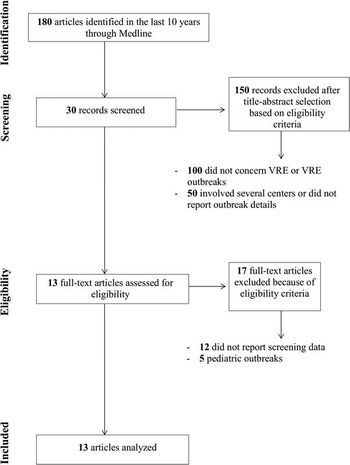
The initial Medline search identified 180 articles (Figure 1); 150 were excluded because they did not concern VRE or VRE outbreaks, involved several centers, or did not report details of outbreaks in the title and/or abstract. Another 17 articles were excluded because they did not contain screening data or entailed pediatric outbreaks. Finally, 13 VRE outbreaks were retained for descriptive analysis. Among them, 10 studies were included for R 0 calculation (epidemic duration <6 months).Reference Escaut, Bouam and Frank-Soltysiak 12 , Reference Marcadé, Micol and Jacquier 18 – Reference Naas, Fortineau, Snanoudj, Spicq, Durrbach and Nordmann 26
Flow chart of studies reporting vancomycin-resistant enterococci outbreaks.

Epidemiological Features of Outbreaks
In our search, we found 8 descriptive studies, 3 case-control studies, 1 descriptive study with economic impacts, and 1 outbreak investigation with prospective surveillance. Among the 13 studies, 8 took place in Europe (5 in France, 1 in Belgium, 1 in the Netherlands, 1 in Italy), 3 in Asia (2 in China and 1 in Singapore), and 2 in the Americas (1 in Canada and 1 in Brazil).
Contact precautions (isolation room and hand hygiene with gown and glove use) were implemented in 12 studies (92%), wards were closed or transfers and admissions restricted in 7 (54%), cases and contacts (dedicated medical and nursing staff) were cohorted in 6 (46%), environmental samples were taken in 4 (31%), antimicrobial policies were applied in 3 (23%), and readmission entailed an automatic alert in 1 (8%).
Two studies (15%) reported outbreak costs. Infection control costs plus loss of income from spare isolation beds were calculated: they ranged from US $222,244 to $268,343 per outbreak, with a mean of $17,096 to $29,816 per infected or colonized patient.
Description of Contact Patients
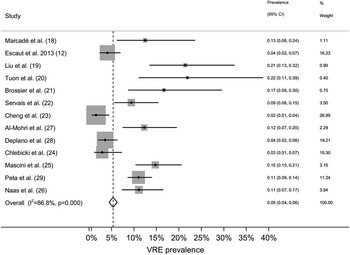
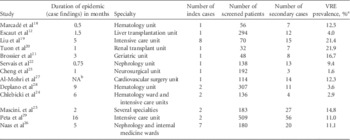
The number of screened patients ranged from 32 to 509, with a mean (SD) of 174 (134). The number of secondary cases ranged from 3 to 56, according to the number of index cases (Table 1), with a mean (SD) of 15 (14) per outbreak. The prevalence of digestive VRE carriage in contact patients ranged from 1.6% to 21.9% (Figure 2). Pooled VRE prevalence was 5.4% (95% CI, 4.5%–6.3%), with significant heterogeneity between outbreaks (I2=86.8%). Table 1 describes the characteristics of each VRE outbreak.
Pooled reporting of vancomycin-resistant enterococci prevalence: 13 studies, N=2,259 patients. The numeral after an author’s name is the reference.

Characteristics of 13 Studies Reporting Vancomycin-Resistant Enterococci (VRE) Outbreaks

a Number of secondary cases/number of screened patients.
b Not available.
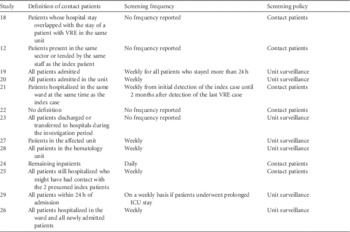
Two major screening policies were implemented: (1) a surveillance program in the unit or hospital (7 studies [54%]) and (2) screening of selected contact patients (6 studies [46%]) (Table 2). Contact patient policies may entail patient hospitalization (in the same sector or care by the same staff) at the same time as index patientsReference Escaut, Bouam and Frank-Soltysiak 12 , Reference Brossier, Lefrançois and Paute 21 , Reference Cheng, Chan and Tai 23 – Reference Mascini, Troelstra and Beitsma 25 or secondary cases.Reference Marcadé, Micol and Jacquier 18 Screening could even continue after index patient discharge.Reference Brossier, Lefrançois and Paute 21 Surveillance programs generally consist of rectal swab samples from all patients during or 24 h after admission in the unit, then weekly.Reference Liu, Cao, Gu, Liu and Feng 19 , Reference Tuon, Penteado-Filho, Camilotti, van der Heijden and Costa 20 , Reference Cheng, Chan and Tai 23 , Reference Naas, Fortineau, Snanoudj, Spicq, Durrbach and Nordmann 26 – Reference Peta, Carretto and Barbarini 29
Definitions of Contact Patients in Reported Vancomycin-Resistant Enterococci (VRE) Outbreaks in 13 Studies

NOTE. ICU, intensive care unit.
R0 Estimation
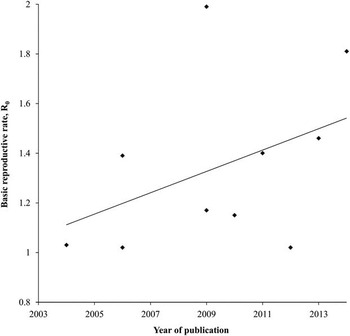
In the studies selected, we observed t d of 3.5 to 180 days with a median (interquartile range) of 14.5 (7.8–84.4). The average duration of latency plus infectious periods (D) was considered as median time to VRE acquisition after admission, on the basis of observational data in outbreak setting,Reference Bonten, Hayden and Nathan 17 that applied the duration of 5 days for R 0 calculation. R 0 ranged from 1.02 to 1.99 in the studies selected,Reference Escaut, Bouam and Frank-Soltysiak 12 , Reference Marcadé, Micol and Jacquier 18 – Reference Naas, Fortineau, Snanoudj, Spicq, Durrbach and Nordmann 26 and the pooled R 0, found after weighting by population proportions in every outbreak, was 1.32 (interquartile range, 1.03–1.46) (Figure 3). R 0 tended to increase with time (Spearman rank order correlation: R=0.46, P=.11). Pooled R 0 was 1.27 (interquartile range, 1.02–1.46) in the studies that implemented surveillance; it was 1.41 (range, 1.02–2.0) in studies where selected contact patients were screened.
Basic reproductive rates of vancomycin-resistant outbreaks over time. N=13 studies. R0 was calculated according to the following formula: R 0=(ln2) D/t d + 1, where t d is the doubling time and D is the average duration of latency plus infectious periods in days. The linear trend is shown (Spearman rank order correlation: R=0.46, P=.11).

DISCUSSION
Our objectives were to review reports of VRE outbreaks, with particular emphasis on the definition of contact patients, and estimate the pooled R 0 in hospital settings. We discerned wide heterogeneity in the definition of contact patients, with screening based on several definitions of hospital-wide programs. The pooled R 0 of VRE outbreaks was 1.32 (interquartile range, 1.03–1.46).
To estimate the spread of outbreaks and the implementation of control measures, it is important to identify, as soon as possible, how many patients are contacts and potentially colonized secondarily. The cost of such screening programs, with repeated rectal swabs and completed with other control measures, is not negligible. Therefore, it seems appropriate to maximize detection capacity by focusing on selected patient groups. However, no standard definitions of exposed/contact patients were proposed in the reported articles, which led to considerable heterogeneity in VRE screening policies worldwide and did not facilitate comparisons.
In 2013, in France, the High Council of Public Health published a report on preventing the spread of highly resistant bacteria where a clear screening policy was defined. 30 Contact patients were those who were attended to by the same staff at the same time as VRE patients. In the United States, screening policies are different. The Hospital Infection Control Practices Advisory Committee recommends obtaining stool cultures or rectal swab samples from roommates of patients newly found to be infected or colonized by VRE and additional screening of patients on the ward at the discretion of infection control staff. 31 The optimal timing and extent of screening procedures in Canadian guidelines remain unclear. 31
Significant heterogeneity of VRE prevalence was observed in contact patients with a pooled rate of 5.4% (95% CI, 4.5%–6.3%) in screened individuals. This heterogeneity may be partially explained by screening policies, by different baseline prevalences of VRE carriage in endemic or nonendemic countries, and by the implementation of infection control measures.
Pooled R 0 was higher than 1, confirming the epidemic nature of VRE. Austin et alReference Austin, Bonten, Weinstein, Slaughter and Anderson 13 found that the estimated R 0 of VRE, during a study at Cook County Hospital in Chicago, was approximately 3 to 4 without infection control but only 0.7 when infection control measures were included. Our estimate was lower than the R 0 of VRE without infection control measures, meaning pooled R 0 was an mean estimate of the reproductive number during the entire outbreak course. Lowden et alReference Lowden, Miller Neilan and Yahdi 14 tested a new model showing that the estimate of R 0=0.751, in the baseline scenario, could be reduced by 28.6% by implementing a hospital policy that simultaneously allocates maximum resources to both preventive care of VRE colonization and treatment of VRE infections. Interestingly, we have seen an increased R 0 trend in recent reports, which could be related to detection bias or to greater difficulties in controlling outbreaks in recent times.
Main limitations include possible publication bias of large VRE outbreaks with insufficient information on latency period because of the asymptomatic nature of VRE carriage that was based on a single studyReference Bonten, Hayden and Nathan 17 ; however, we did not discern a more precise and reliable description of this parameter in the literature. Moreover, because the number of articles was limited, we were unable to quantify which factors were associated with better outbreak control. Thus, R 0 was calculated for the entire outbreak period, which included time before and after the implementation of control measures. Indeed, estimates of the reproductive rates are dependent on the ability to detect all secondary cases. For colonization or infection with multiresistant organisms, screening procedures are crucial because they are the only chance to detect secondary cases in nearly all instances. Thus, the choice of the population to be screened directly influences the sensitivity of the detection of secondary cases and consequently the estimates of the reproductive R 0 .
In conclusion, VRE outbreaks frequently occur in hospital settings. Large heterogeneity in the definition of contact precautions can be problematic because it can evoke delays in identifying the magnitude of VRE cross-transmission. Future study might assess the impact of different infection control measures on the reproductive rate of VRE.
ACKNOWLEDGMENTS
Financial support. None reported.
Potential conflicts of interest. All authors report no conflicts of interest relevant to this article.