





1. Introduction
Commercial generative artificial intelligence (GenAI) music platforms promise ultimate artistic democratisation; anyone can create music. Companies such as Suno, Udio and ElevenLabs echo this rhetoric throughout their marketing (Schulman Reference Schulman2024), promising unprecedented creative access using only natural language. However, a more nuanced reality underlies this emancipatory claim; these platforms trained their models on vast catalogues of existing music and now compete directly with the musicians whose work enabled them. This article analyses commercial GenAI music platforms as a technological disruption, focusing on venture-backed services rather than AI techniques in research or artistic practice. We use ‘disruption’ for technologies that alter not only musical production’s material conditions but also its social relations and economic structure. This extends Marx and Engels’ (Reference Marx and Engels2002: 7) observation that transformations in the instruments of production reshape both relations of production and the overall social order.
Previous technological disruptions in music – from the fortepiano, to recording and sampling – concerned instrumentation, reproduction, distribution or manipulation of existing musical works. Recordings captured and distributed performances; synthesisers provided new instruments; and sampling allowed artists to incorporate existing recordings into new compositions. These changes historically sparked concerns ranging from job displacement to copyright battles (Stravinsky Reference Stravinsky1930; Pinch and Trocco Reference Pinch and Trocco1998; Chanan Reference Chanan1995; Suisman Reference Suisman2009; Warfield Reference Warfield2009). Commercial GenAI music platforms, as the following section demonstrates, operate through a different paradigm. Rather than reproduction, they fragment millions of musical artefacts into computational tokens, and then reconstruct new outputs from learned statistical patterns.
To analyse the sociocultural and socioeconomic implications of this paradigm, we engage with complementary theoretical frameworks across two tracks. For the sociocultural dimensions –political critique, relational meaning, anticipating social transformations – we draw on Walter Benjamin’s analysis of mechanical reproduction (Reference Benjamin2010), Christopher Small’s concept of musicking (Reference Small1998) and Jacques Attali’s notion of music’s prophetic role (Reference Attali1977). For the socioeconomic dimensions – how value is extracted, labour is displaced and platform power is consolidated – we mainly draw on Kate Crawford’s analysis of extraction (Reference Crawford2021), Yannis Varoufakis’s concept of technofeudalism (Reference Varoufakis2024) and Marx’s surplus population (Reference Marx1867).
Drawing on these frameworks, our argument unfolds through four lines of analysis. First, we trace a brief history of AI in music and how current commercial systems operate through what we term fragmentation and reconstruction (Section 2). Second, we examine how GenAI impacts Benjamin’s politicisation/aestheticisation distinction, Small’s concept of musicking and Attali’s understanding of music’s prophetic capacity, while disrupting the traceable connection between musical works and human labour (Section 3). Third, we contextualise commercial GenAI platforms within music’s political economy, revealing how fragmentation enables new forms of extraction that intensify existing patterns of platformisation (Section 4). Finally, we explore the implications for music’s politicisation function and possibilities for artistic intervention (Section 5). As GenAI increasingly mediates cultural production across many domains, understanding how fragmentation and reconstruction transform art’s social function becomes vital for preserving democratic participation in culture. Examining this transformation begins with the technology itself.
2. GenAI in music: history and operations
Recent advances in machine learning and computational resources have driven a surge in text-to-audio research (Dhariwal et al. Reference Dhariwal, Jun, Payne, Kim, Radford and Sutskever2020; Agostinelli et al. Reference Agostinelli, Denk, Borsos, Engel, Verzetti and Caillon2023; Copet et al. Reference Copet, Kreuk, Gat, Remez, Kant and Synnaeve2024; Evans et al. Reference Evans, Carr, Taylor, Hawley and Pons2024a). Commercial GenAI platforms are now capable of generating music from a wide range of genres, although various AI tools are used to automate tasks such as mixing and mastering (Sturm et al. 2019; Miranda Reference Miranda2021). Yet the field’s history extends considerably further. Over several decades, researchers developed statistical modelling, Markov chains and machine-learning approaches for musical tasks, from François Pachet’s Continuator (Pachet Reference Pachet2003) or IRCAM’s OMax (Assayag et al. Reference Assayag, Bloch and Chemillier2006) to neural network approaches such as FolkRNN for folk melodies (Sturm et al. Reference Sturm, Santos, Ben-Tal and Korshunova2016) and DeepBach for chorale harmonisation (Hadjeres et al. Reference Hadjeres, Pachet and Nielsen2017).
Despite their sophistication, these systems remained mainly confined to research, requiring expertise and producing outputs that fell short of commercial, production-ready music. This changed, among other developments, with the introduction of transformer architectures (Vaswani et al. Reference Vaswani, Shazeer, Parmar, Uszkoreit, Jones and Gomez2017), which enabled the capture of long-range structure beyond the limits of sequential processing. This revolutionised not only natural language processing – which led to today’s large language models (LLMs) – but also AI music generation. Backed by large-scale computation and capital, systems such as MuseNet and Jukebox (Dhariwal et al. Reference Dhariwal, Jun, Payne, Kim, Radford and Sutskever2020) showcased high levels of coherence, MusicLM (Agostinelli et al. Reference Agostinelli, Denk, Borsos, Engel, Verzetti and Caillon2023) achieved text-to-music generation and AIVA provided early commercialised AI composition. Open-source options emerged with diffusion models such as MusicGen (Copet et al. Reference Copet, Kreuk, Gat, Remez, Kant and Synnaeve2024) and Stable Audio Open (Evans et al. Reference Evans, Parker, Carr, Zukowski, Taylor and Pons2024b). By 2024, platforms such as Suno and Udio pushed beyond instrumental music to offer highly realistic outputs including vocals, designed to let ‘anyone make music’ (Schulman Reference Schulman2024: 3), a democratisation claim we examine further in Section 3.
These platforms mark a leap from experimental tools to commercial, large-scale music generation, advancing beyond earlier algorithmic ventures like Melomics that failed to progress (Sturm et al. Reference Sturm, Déguernel, Huang, Kaila, Jääskeläinen and Kanhov2024). Yet their capabilities remain limited by their training data. They excel within mainstream commercial genres but struggle with traditions requiring specific performance practices or conventions underrepresented in digital corpora. Our prompts to generate Iranian traditional musicFootnote 1 , for instance, produced only stereotypical Iranian pop and epistemic hallucinations, including incorrect or unidentifiable instruments and scales. To understand what enables and constrains such outputs, we examine how these systems reconstruct music from learned patterns.
2.1. Fragmentation and reconstruction
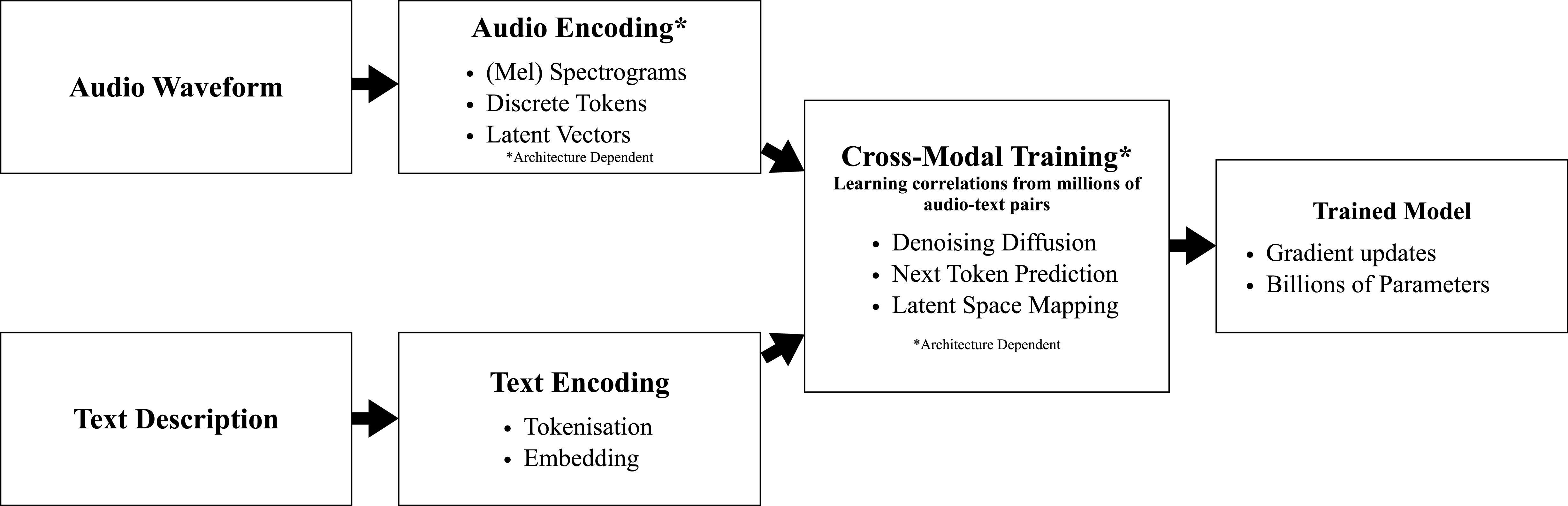
GenAI music platforms learn by analysing vast datasets of recordings, identifying statistical patterns amongst segments and then using these patterns to generate new audio from text prompts. Although these models vary in architecture – commercial platforms typically employ diffusion models, autoregressive transformers, variational autoencoders (VAEs) or combinations thereof – they share a common operational pipeline (Figure 1). Audio waveforms are transformed into spectrograms, quantised into discrete tokens or compressed into latent vectors depending on the model’s architecture. If text-conditioned, text descriptions are separately tokenised and embedded, then aligned with audio representations as models learn correlations across millions of audio–text pairs. Each recording segment is turned into gradient updates across billions of parameters through training objectives such as denoising, autoregressive token prediction or contrastive learning.
The fragmentation pipeline transforming the temporal nature of music for text-to-audio training.

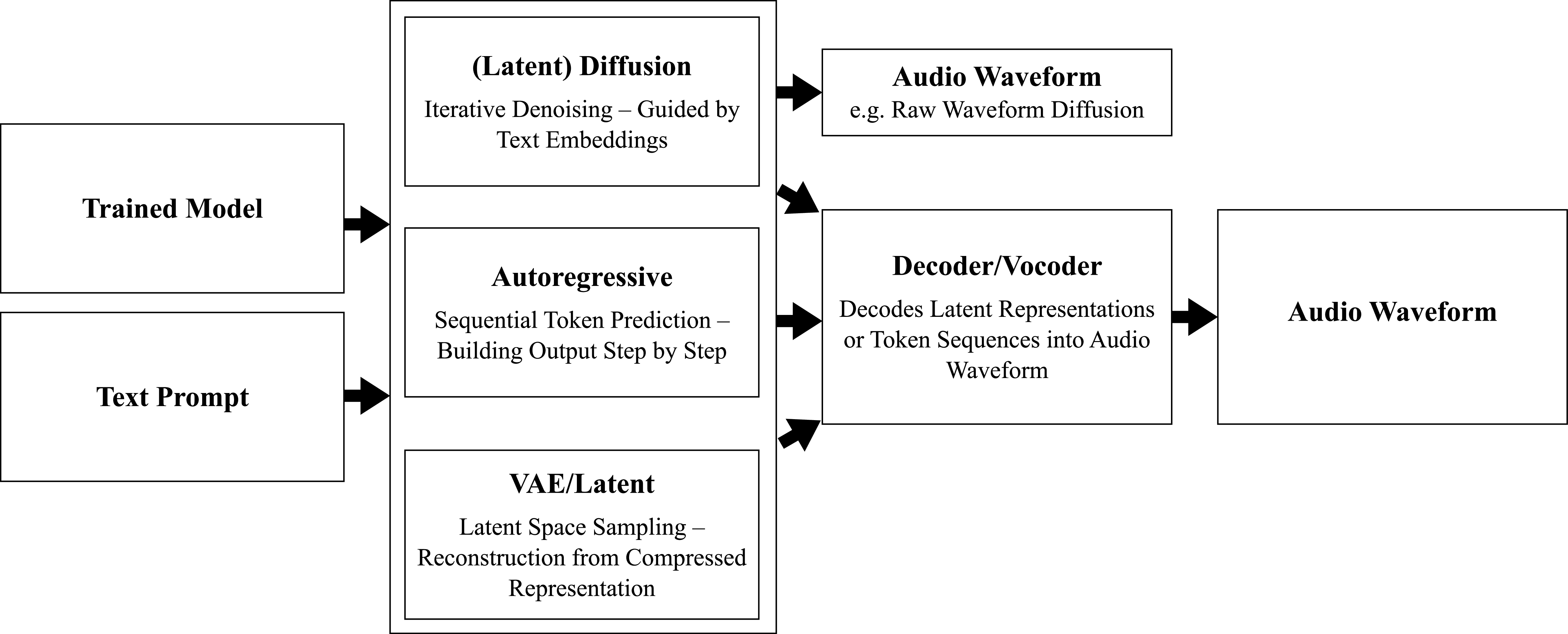
From these learned distributions, models generate new audio (Figure 2). Diffusion models iteratively denoise Gaussian noise guided by text embeddings; autoregressive models predict subsequent audio tokens sequentially; and VAEs encode inputs as probability distributions in latent space, sampling from these during generation. Regardless of mechanism, these systems transform latent representations or token sequences back into audio waveforms. As Steyerl observed in images, such outputs represent ‘statistical renderings’ rather than ‘actual objects’ (Steyerl Reference Steyerl2023: 82).
Reconstruction embodies how GenAI models generate music from learnt statistical correlations.

We refer to the operations described above as fragmentation and reconstruction. FragmentationFootnote 2 describes the pipeline of data preparation, embedding and training that turns musical artefacts into statistical distributions. Reconstruction describes the generative inference that produces new audio from these distributions. We use these terms not only to describe encoding and decoding, but also, as critical terminology, to reveal sociocultural implications beyond the technical and to distinguish the process from Benjaminian reproduction.
Existing practices such as concatenative synthesis have long relied on fragmenting and recombining recorded sound, and GenAI may be seen as an extension into latent space. However, although concatenative synthesis ‘finds the sequence of units that match best’ a target from a segmented database (Schwarz Reference Schwarz2006: 3), GenAI interpolates between learned patterns and samples from a continuous statistical model. Commercial GenAI platforms further differ in scale and commercial logic; where concatenative products monetise an algorithmic tool, platforms monetise music data through subscription access to reconstruction; training on millions of songs, serving large user bases (Robinson Reference Robinson2025) and reconstructing high-fidelity outputs already competing on streaming platforms (Berger Reference Berger2025). On the surface, fragmentation and reconstruction might seem simply another method of mediated music production. At commercial scale, however, their economic and extractive underpinnings make it worth examining how such processes reshape the social, aesthetic and political conditions under which music operates.
3. From reproduction to reconstruction
Having established how commercial GenAI platforms operate through fragmentation and reconstruction, we now turn to the sociocultural implications of these processes. To do so, we engage with three frameworks – Benjamin’s analysis of mechanical reproduction, Small’s concept of musicking and Attali’s theory of music’s prophetic function – as each illuminates a different dimension of what these processes reconfigure. Together, they reveal how commercial GenAI platforms reshape the conditions under which music operates as a social and political practice.
3.1. The work of art in the age of mechanical reproduction
In 1936, grappling with the disruptive technologies of photography, film and mechanical reproduction, Benjamin traced the implications of the artwork’s withering ‘aura’ – its unique presence in time and space grounding its authenticity – towards a transformation from ‘cult value’ to a more accessible ‘exhibition value’ (Benjamin Reference Benjamin2010: 16–18). He identified an emancipatory dimension in this withering, arguing it freed art from its ‘parasitic subservience’ (parasitären Dasein) to ritual (Benjamin Reference Benjamin2010: 24). Art had come full circle; just as it began helping humans navigate an incomprehensible world through magic and religion, it now helped the masses navigate the technological apparatus of their age. For Benjamin, this shift caused art’s ‘politicisation’: the capacity of cultural forms to render material social conditions visible and open to participation, enabling collective critique rather than individual experience. This mode of reception stands in opposition to fascism’s ‘aestheticisation’ (Ästhetisierung), which grants the masses’ expression (Ausdruck) while denying them agency or rights (Recht). In the Epilogue, Benjamin writes: ‘The masses have a right to changed property relations; fascism seeks to give them expression in keeping these relations unchanged’ (Benjamin Reference Benjamin2010: 73–74). We write during a crisis not unlike Benjamin’s: rising authoritarianism, inequality, climate collapse and war – all alongside another technological disruption.
For Benjamin, film carried political force. Workers saw their struggles with industrial machinery reflected on screen, becoming ‘quasi-experts’ (Benjamin Reference Benjamin2010: 47–48) who discussed films with new critical authority, developing collective consciousness through shared cultural experience. In music, parallels appear in audiences’ engagement with genres rooted in social movements. Blues, punk, techno and hip-hop carried critiques of the conditions from which they emerged, enabling critical consciousness through music linked to identifiable social contexts. However, whether contemporary film under capitalist production has fulfilled this potential, or more often reinforced existing economic structures, remains contested (Feshami Reference Feshami, Mazierska and Kristensen2017: 66). The same can be asked about genres such as punk, hip-hop and jazz that, despite emancipatory origins, have been heavily commodified and coopted.
As established, GenAI operates differently from reproduction; where reproduction captured and distributed, GenAI fragments recordings into statistical distributions and reconstructs new outputs from learned patterns. Therefore, art created through GenAI’s operations demands extending Benjamin’s framework. Park (Reference Park2025) offers one valuable extension, arguing that GenAI transforms rather than abolishes aura, simultaneously liberating and subordinating artists while democratising creative production. Our analysis, however, focuses on Benjamin’s final and most politically charged passages: the opposition between politicisation and aestheticisation, and the conditions under which art serves collective critical engagement or power. Here the question becomes how fragmentation and reconstruction transform the politicising potential mechanical reproduction enabled.
3.2. The work of art in the age of fragmentation and reconstruction
Instead of capturing and reproducing, GenAI systems fragment cultural artefacts into mathematical tokens, learning from them while adjusting weights and biases; reconstruction then creates new music from these learned distributions. In large commercial models trained on vast datasets across genres, a jazz piano voicing is not stored as a sample but exists as weighted connections between thousands of parameters, activated alongside patterns learned from classical, pop and other sources. The results resemble specific genres with high fidelity. However, a crucial distinction emerges between stylistic resemblance and identifiable origin. A Suno-generated blues song may sound like blues, even like a specific artist, without being a trace of any specific performance or performer. In GenAI, the relationship to source recordings is distributed across millions of works and statistically mediated: what is reproduced is not a specific artefact, as in Benjamin’s framing, but the distributional patterns amongst many artefacts. We return to the implications of this for music’s legal and economic infrastructure at the end of this section.
Alongside these connections, mechanical reproduction created conditions for politicisation through mass accessibility and collective reception. At first glance, commercial GenAI platforms appear to extend this; anyone with internet access can generate music, videos and images. AI-generated content is already deployed for explicitly political purposes – MAGA-aligned imageryFootnote 3 , satirical songs and political animations roam across platforms, demonstrating GenAI’s political efficacy. Yet such political deployments are almost at odds with politicisation in Benjamin’s sense. AI-generated MAGA imagery may be politically effective, but it mobilises feeling without rendering the material relations – of property, labour or political economy – that structure its audience’s lives open to analysis or intervention. It thus grants expression while conserving the very relations politicisation would transform, exactly the configuration Benjamin diagnosed in aestheticisation (Benjamin Reference Benjamin2010: 73–74). Meanwhile, democratisation is one of these platforms’ central claims.
As Harkins and Prior observe, the term ‘democracy’ has become ‘a rather baggy and idealised aspiration toward a vague levelling of hierarchies’ (Reference Harkins and Prior2022: 84). Claims of democratisation have accompanied nearly every music technology innovation from cassette tapes to recording gear to user-friendly digital audio workstations (Goodwin Reference Goodwin1992; Chanan Reference Chanan1995; Harkins and Prior Reference Harkins and Prior2022). Still, making tools easier to use does not automatically increase meaningful access, and accessibility rhetoric often serves ‘massively scalable business models’ (Sturm et al. Reference Sturm, Déguernel, Huang, Kaila, Jääskeläinen and Kanhov2024: 8). Recent research confirms that for commercial GenAI music platforms, democratisation functions primarily as marketable rhetoric rather than a guiding principle, with Suno, Udio, AIVA and Stable Audio sharing an ‘individualist, globalist, techno-liberal, and ethically evasive’ ideology (Pram and Morreale Reference Pram and Morreale2025: 1). In Benjaminian terms, current GenAI platforms grant expression without rights or agency. The technologies are proprietary; accessibility serves scalable business models rather than genuine participation in the means of production. Democratisation is best evaluated not by who can produce outputs, but by the economic structures governing production and the social relationships it sustains. Therefore, as presently constructed and despite democratisation claims, commercial platforms tend strongly towards aestheticisation: consumed rather than contested; experienced rather than participated in. This raises a further question: if GenAI platforms reconfigure conditions for politicisation, what happens to the social relationships through which music gained meaning as practice? Christopher Small’s concept of musicking provides a framework for examining this relational dimension.
3.3. Musicking reconfigured
Christopher Small argues that ‘the fundamental nature and meaning of music lie not in objects, not in musical works at all, but in action’ and that music’s ‘primary meanings are not individual at all but social’ (Small Reference Small1998: 8) – what he calls ‘musicking’. Following Small’s deliberately expansive framework, a person prompting Suno for a Mother’s Day song is engaged in musicking no less socially embedded than traditional music-making. The intention and social relationship are real; the musical result mediates a genuine human connection. Similarly, Discord Communities where users share, discuss and build identity around AI-generated music, and the millions of streams for GenAI bands like Velvet Sundown, suggest genuine forms of musical and social participation.
However, what changes is not whether musicking occurs, but the relationships it creates, and for Small those relationships are fundamental. Composing, practicing, performing and listening are ‘all aspects of the one great human activity that is called musicking’ (Small Reference Small1998: 11). Even mediated forms maintain relationships to performers and composers whose acts are part of the event’s totality. With AI-generated music, however, the musicians whose labour trained the models are excluded from the musicking the platform enables. They are not absent participants but transformed into raw material. Their contributions persist as spectral remnants within the model, what Privato and Magnusson, following Derrida (Reference Derrida2006), call ‘hauntological traces’ (Reference Privato and Magnusson2024) – and haunting is not the same as participating. Although platforms like Suno have introduced features such as StudioFootnote 4 to enable musician participation, these do not address the foundational extraction. Extracting musical data without creators’ participation reconfigures musicking itself, initially writing musicians out of the act, which is not a judgement about the quality of GenAI musicking but an observation about relational structure. This exclusion has consequences not only for present social relations but also for music’s temporal relationship to social change – what Attali (Reference Attali1977) described as music’s prophetic function.
3.4. Repetition, composition and the prophetic deficit
For Attali, music does not merely reflect social order but heralds it. ‘Music is prophecy’, he claimed, ‘Its styles and economic organization are ahead of the rest of society because it explores, much faster than material reality can, the entire range of possibilities in a given code’ (Attali Reference Attali1977: 11). This prophetic capacity operates across all Attali’s historical stages – sacrifice, representation, repetition, composition – as each stage’s music anticipates the social formations that follow. The first three stages each serve power differently: ritual sacrifice makes people forget violence; representation makes them believe in order and harmony; and repetition silences them through normalised reproduction. Yet in each case, music ‘heralds the subversion of both the existing code and the power in the making, well before the latter is in place’ (Attali Reference Attali1977: 20). We identify two related mechanisms in Attali’s analysis; music exhausts the possibilities of a given code faster than material reality can, and ‘noise’ – disruptions that ‘carry new information’ – is the source of ‘mutations in the structuring codes’ (Attali Reference Attali1977: 33). Crucially, Attali distinguished between repetition and composition not as musical techniques but as historical modes of production. Repetition ‘does nothing but replicate a recorded representation, imperfectly and without creating anything new’ (Attali Reference Attali1977: 33), operating through stockpiling and commercial circulation. Composition, by contrast, is contingent upon the destruction of earlier codes. Music’s break with tonality is exemplary: ‘music forced a break with tonality before economic accumulation forced a break with the laws of the economy of representation’ (Attali Reference Attali1977: 83). Rupture occurs when existing codes can no longer contain the noises that attack them. Schoenberg’s emancipation of dissonance exemplifies this (Attali Reference Attali1977: 81): a new organising grammar that could not have been derived from late-Romantic chromaticism, however thoroughly one explored the tonal system’s combinatorial possibilities.
The commercial pop music industry has long operated within repetition, using formulaic production and song structures or algorithmic playlists. However, it can be argued that commercial GenAI platforms intensify repetition in Attali’s precise sense at unprecedented scale. Training on existing music and sampling from learned probability distributions, they can only reconstruct from existing code, not rupture it. Regardless of training objective – maximum likelihood estimation, denoising or variational inference – these models are optimised to approximate their training data’s distribution, not to transcend it. Even when outputs sound novel, they emerge from reconstruction within learned codes rather than breaks with them. Additionally, commercial platforms generating an entire streaming catalogue’s worth of music every two weeks (Robinson Reference Robinson2025) are accelerating what Attali calls a crisis of proliferation; ‘production will proliferate without being able to find an outlet’ (Attali Reference Attali1977: 130) because the apparatus that produces demand cannot keep pace with repetitive supply. This failure in itself could be prophetic; when repetition cannot find an outlet, it reveals the limits of its own code and has historically pointed towards composition (Attali Reference Attali1977: 130–136). Yet, the transition from repetition to composition ‘can only emerge from the destruction of the preceding codes’ (Attali Reference Attali1977: 136) – and the social conditions for that destruction, as we have examined through Small and Benjamin, are themselves being reconfigured by commercial GenAI. These platforms’ structural dependency on existing musical data further constrains this transition; they are optimised to recirculate existing codes, not destroy them. One might argue that humans could deliberately steer models to force novelty, yet this again shifts the creative act entirely to human intervention. Commercial GenAI platforms may therefore be prophetic of a crisis they cannot resolve: intensifying repetition while foreclosing the composition that would transcend it. This crisis has another dimension; it not only intensifies repetition but also severs the traceable connection between musical works and the identifiable acts of creation that ground attribution and compensation.
3.5. Beyond traceable origins
The preceding analyses reveal a shared consequence; fragmentation severs the traceable relation between generated musical works and identifiable acts of creation – something mechanical reproduction maintained but Benjamin did not explicitly theorise. In music, just as in the material processes of film and photography, earlier technologies of reproduction operated through what Jonathan Sterne calls ‘transduction’ (Reference Sterne2003: 31): the material conversion of audible vibrations from one form to another while preserving traceable relationships to their source. Piano rolls encoded specific performances as holes (Suisman Reference Suisman2009) and magnetic tape maintained physical correspondence to sound waves (Millard Reference Millard2005). Even in the controversial case of sampling – which as Rodgers explains, ‘encompasses selecting, recording, editing and processing sound pieces to be incorporated into a larger musical work’ (Rodgers Reference Rodgers2003: 313) – a chain of origination remained intact.
Building on these, however imperfect, the legal and economic infrastructure of music – ownership, attribution, compensation – has been premised on works originating in identifiable human authorship (Woodmansee Reference Woodmansee1984; Jaszi Reference Jaszi1991). Maintaining this infrastructure has always been socially constructed work rather than a given (Gunning Reference Gunning, Beckman and Ma2008), as lawsuits over sampling and debates about authenticity demonstrate (Jaszi Reference Jaszi1991; Sanjek Reference Sanjek, Woodmansee and Jaszi1994). Although alternative authorship systems exist, including practices without individual attribution, our focus reflects the institutional framework within which most working musicians are compensated under capitalism, necessary for the next section’s economic analysis. Commercial GenAI reconfigures this existing framework. The emergence of infrastructures attempting to reconstruct traceability – certification schemes like Fairly TrainedFootnote 5 , platforms like Have I Been TrainedFootnote 6 and defensive technologies such as Glaze (Shan et al. Reference Shan, Cryan, Wenger, Zheng, Hanocka and Zhao2023) and Nightshade (Shan et al. Reference Shan, Ding, Passananti, Wu, Zheng and Zhao2024) – testifies to this rupture. These tools exist precisely because GenAI severs the connections reproduction maintained. This alters not only how musical value is created and compensated, but also the conditions under which music can fulfil the politicising function Benjamin envisioned – making the political economy of this technology essential to examine.
4. The political economy of commercial GenAI
Among all artistic disciplines, music has historically demonstrated remarkable openness to technological advancement (Deltorn and Macrez Reference Deltorn, Macrez and O’Connor2018). Yet each introduction has triggered disputes over authorship, copyright and displacement of musical labour. Early twentieth-century figures like John Philip Sousa feared that recordings would eradicate amateur music-making (Warfield Reference Warfield2009); the 1920s sound revolution in cinema – alongside factors like the Great Depression – devastated thousands of musicians’ employment (Suisman Reference Suisman2009). The rise of synthesisers like the Moog sparked concerns about replacement by machines, and sampling in the 1980s ignited fierce legal battles prefiguring today’s GenAI disputes (Brown Reference Brown1992). Even everyday technologies like the radio or the audiocassette were initially met with industry alarm over their disruptive economic potential. This pattern reveals a cycle of technological introduction, dispute and sometimes adaptation – some fears proved unfounded, although others permanently altered the musical landscape (Schuster et al. Reference Schuster, Mitchell and Brown2019).
One could argue that GenAI only accelerates disruptions; after all, previous technologies also disrupted the economics of distribution (mp3, streaming), instrumentation (synthesisers) or repurposed recordings (sampling). However, commercial GenAI platforms’ business models, alongside the severed traceable relationships established in Section 3, represent more than acceleration – these platforms disrupt creation and authorship itself. Crucially, our concern is not individual creative practice or GenAI as a technology in general, but how commercial platforms distribute value. These platforms enable reconstruction with composer and performer roles redistributed across prompters, platforms and algorithms. A 2024 report commissioned by the German and French collective management and performance rights organisations (GEMA and SACEM) projected GenAI could lead to revenue losses of up to 27 per cent by 2028 for musicians in France and Germany alone (Goldmedia 2024). This is particularly significant given that composing for advertisement, television, films and video games became crucial revenue streams as recorded music revenues declined (DiCola Reference DiCola2013) – precisely the streams targeted by GenAI platforms (Lin Reference Lin2025). By targeting creation itself, GenAI platforms potentially reduce demand for human musical labour before traditional compensation mechanisms apply. This is enabled by extraction at a massive scale.
4.1. Extraction
The process of fragmentation as defined earlier facilitates what Kate Crawford (Reference Crawford2021) characterises as an extractive process: ‘enclosing different fields of human knowing, feeling, and action – every type of available data – all caught in an expansionist logic of never-ending collection’ (Crawford Reference Crawford2021: 120–121). In music, this operates at massive scale; platforms fragment millions of recordings to build models that reconstruct infinite outputs. Training data derived from generations of musical recordings enable algorithmic systems to reconstruct musical patterns without preserving the cultural contexts, historical struggles or community practices that produced them. This extraction is particularly insidious because the labour that created the original music becomes invisible. As Simon Schaffer observed of early computing machines, ‘to make machines look intelligent it was necessary that the sources of their power, the labour force which surrounded and ran them, be rendered invisible’ (Schaffer Reference Schaffer1994: 204).
All capitalist production involves commodity fetishism that obscures labour relations, rendering what Marx (Reference Marx1867) called ‘dead labour’ – past effort congealed in the means of production – invisible to the consumer. Commercial GenAI’s extraction, however, operates at unprecedented scale with a distinct form of algorithmic lock-in. Although dead labour has always been locked into the means of production, commercial GenAI is distinctive in that the congealed labour – creative and cultural expression – is mobilised to generate outputs that directly compete with the living labour of the same workers whose effort was absorbed. Of course, the earlier mentioned ‘hauntological traces’ remain to critical inquiry rather than fully extinguished by fragmentation. Nonetheless, these traces do not prevent what we might call locked labour; musicians currently cannot withdraw their works, transparently trace their influence or collectively organise around their incorporated knowledge. This is not an inherent property of dead labour, but a consequence of the severed traceability established earlier in this section. Courts – at least for now – cannot easily determine infringement sources and as mentioned earlier, this also locks musicians out of the musicking relationship built on their musical works. This extraction operates within broader economic structures that determine how cultural knowledge becomes profitable. Understanding how platforms monetise extracted knowledge requires examining the infrastructure that enables it.
4.2. Technofeudalism and continuation of platformisation
In his 2024 publication Yannis Varoufakis argued that traditional capitalism’s value extraction through labour exploitation in production has given its place to technofeudalism, where value is extracted through control of digital infrastructure (Varoufakis Reference Varoufakis2024). Platform owners become ‘cloud lords’ extracting rent from every interaction of ‘cloud serfs’ within their domains. His framework remains highly contested (Gane Reference Gane2024; Morozov Reference Morozov2022). Critics question whether it represents genuine analytical novelty or functions primarily as rhetorical device, potentially obscuring continuities with established capitalist processes. However, even without claiming conceptual novelty, Varoufakis’s framework offers a relevant lens for examining GenAI infrastructure in music, given its dependence on cloud infrastructure, computational resources controlled by major tech companies and the capacity for large-scale cultural extraction.
Companies like Suno raised considerable capital from Silicon Valley venture capitalists (Schulman Reference Schulman2024, Reference Schulman2025) to access vast infrastructures for processing musical data – resources accessible only to well-capitalised firms. They charge users monthly fees – rent – for reconstruction capabilities, while admitting to large-scale copying of copyrighted recordings during training (Suno Inc. 2024: 8–9). Value is extracted not from traditional production but through fragmentation of musical works, monopolisation of musical processing and training capabilities, without working musicians in the loop. Value also accrues from venture capital betting on speculative growth and disruption, yet the revenue model – charging rent for infrastructure access rather than selling products – aligns with technofeudal dynamics. This concentration is reinforced by infrastructure dependencies; even independent GenAI startups must rent computing power from Amazon Web Services, Google Cloud or Microsoft Azure (Luitse Reference Luitse2024), which controlled 63 per cent of the global cloud infrastructure market as of Q4 2024 (Richter Reference Richter2025). The technical requirements for competitive models – massive datasets, specialised hardware and extensive engineering expertise – create natural monopolies, concentrating capabilities within few companies. GenAI platforms do not operate in isolation but integrate into existing industry structures. Poell et al. (Reference Poell, Nieborg and Dijck2019: 4) describe this integration as ‘platformisation’: the process by which digital platforms penetrate and reorganise established industries to capture value.
Although commercial GenAI reconstruction at this scale is novel, the underlying infrastructures extend existing music industry patterns while intensifying their effects. Streaming platforms like Spotify, despite maintaining traceable origins, demonstrated how intermediaries could capture value while paying artists minimal compensation – UK parliamentary inquiries found artists receive as little as 13 per cent of income generated (UK Parliament 2021). In addition, the industry’s traditional royalty systems have long concentrated revenue among major labels and platforms rather than individual creators (Jensen Reference Jensen2024). The ‘long tail’ problem – where a small number of musicians achieve widespread popularity, whereas the vast majority occupy the long tail of the distribution (Celma Reference Celma2010: 88) – was supposed to be solved by streaming’s democratised distribution but worsened as platforms increased competition for attention (Morreale Reference Morreale2021). Paradoxically, this ‘common-pool resource’ of shared musical knowledge now becomes valuable as free GenAI training data (Drott Reference Drott2021: 193). Even following 2024 Recording Industry Association of America (RIAA) lawsuits (Connelly Reference Connelly2024), GenAI platforms have only negotiated licensing deals with major labels (Hinkle Reference Hinkle2025; Warner Music Group 2025a, 2025b) while treating most training data as free inputs.
Although full effects on music’s economic value remain speculative, emerging indicators suggest significant displacement. ElevenLabs reports AI-generated music costs ‘a fraction’ of traditional composition fees (Lin Reference Lin2025: 12), whereas the GEMA and SACEM study projects €2.7 billion in cumulative potential damage for creators in Germany and France alone. These signals suggest substantial value transfer from musical workers to GenAI platform operators, particularly in background music, stock libraries and commercial soundtracks where cost considerations outweigh artistic uniqueness. These economic disruptions reveal a deeper transformation in the nature of musical labour itself. GenAI creates new forms of exploitation that exceed both traditional labour exploitation and platform extraction, requiring analysis of how these processes relate to, and diverge from, fundamental categories of capitalist production that have long governed musical labour.
4.3. Musical labour and commercial GenAI’s surplus population
Marx’s concept of surplus population described workers both necessary for capitalism’s reproduction and kept precarious to maintain downward pressure on wages. Pasquinelli defines AI’s core project as the attempt to ‘capture the knowledge expressed through individual and collective behaviours and encode it into algorithmic models to automate the most diverse tasks’ (Pasquinelli Reference Pasquinelli2023: 2). Taken together, these frameworks reveal a distinctive dynamic in GenAI music. Musicians become a new form of surplus population; unlike traditional surplus populations who cycle between employment and unemployment, musicians continuously produce value for GenAI systems while being systematically excluded from the economic benefits of their collective creative output. Commercial GenAI’s qualitative difference lies in the scale and form of its exploitation. Where previous technologies displaced specific roles while maintaining the need for musical knowledge, GenAI systems extract creative output from millions of artists to train systems competing directly with their labour, without ongoing compensation. Rather than extracting surplus value from workers’ labour time, commercial GenAI platforms commodify the accumulated cultural knowledge of entire musical communities, fragmenting it to reconstruct competing products that undermine original creators’ economic value.
This goes beyond individual livelihoods sustained through the infrastructure examined in Section 3. Musical ecosystems rely on apprenticeship, local scenes and informal knowledge transfer that sustained stylistic evolution and cultural continuity across generations – everything needed for Benjamin’s vision of art’s politicising function. GenAI potentially disrupts these ecosystems by extracting their accumulated knowledge while reconfiguring the social relationships that created it. Musicians who might have mentored others, built scenes or developed new styles now compete with systems trained on the collective output of these very cultural processes – a contradiction where GenAI undermines the very infrastructure that produced its training data. This parallels broader patterns of institutional decay under AI; as Hartzog and Silbey (Reference Hartzog and Silbey2026) argue, AI’s affordances erode the expertise, hierarchies and human relationships through which civic institutions sustain and adapt themselves. This transformation brings us full circle to a central question we proposed in the beginning: how participatory and interventionist approaches can repoliticise music alongside, against and despite the conditions commercial GenAI platforms have created?
5. Repoliticising music: from reconstruction back to artistic agency
We have argued that commercial GenAI music platforms, as presently constructed, reconfigure the conditions under which music operates as a politicising art form. They sever traceable connections to human creators – the base for existing infrastructures of attribution and compensation – while reconfiguring musicking relationships and intensifying repetition at the expense of compositional rupture. These reconfigurations operate within extractive economic structures that lock musicians out of the value that their labour generates. Yet none of these is inevitably baked into the technology of GenAI itself, but into current mass-scale commercial practices that can be challenged. Although fundamental refusal is certainly a valid response, it is not one we advocate; non-participation risks asking those most exposed to platform extraction to absorb its costs. Instead, we observe two constructive pathways within recent critical practice – amongst many others. The first is what Fisher (Reference Fisher2020) calls parasitical resistance: a complicit tactic to redirect dominant systems from within, particularly where hegemonic powers are immunised to frontal critique. Adjacent strategies related to GenAI include creative misuse of GenAI interfaces (Salvaggio et al. Reference Salvaggio, Sinders and Swanson2025) and scraping for artistic and critical ends (Lavigne Reference Lavigne2023). The second is McQuillan’s (Reference McQuillan2022: 139) positive refusal: a rejection of current AI paired with the construction of an alternative apparatus that supports social autonomy. Although McQuillan’s apparatus is fundamentally collective in scope, analogous principles can be pursued at the smaller scale of individual artistic practice. As the following section surveys the wider field of interventions, Section 5.2 situates our own practice-based work drawing on principles from the two mentioned paths.
5.1. Participation as democratic intervention
Following Andrew Feenberg’s (Reference Feenberg1991) argument that intervention in the trajectory of technology’s development represents a democratising act, researchers, legislative bodies, artists and technologists can intervene by developing AI music systems that prioritise transparency and agency over extraction (e.g., Bryan-Kinns et al. Reference Bryan-Kinns, Zheng and Castro2025). Just as circuit-bending (Ghazala Reference Ghazala, Hopkin and Tewari2021) enabled musicians to repurpose proprietary devices for creative ends, these initiatives seek to reclaim AI’s creative potential from platform monopolies. Preserving music’s capacity for political engagement requires coordinated action across regulatory, technical and organisational domains – much as workers’ movements shaped industrial technology’s deployment. Emerging responses reflect this imperative; legal challenges like the RIAA’s lawsuits against Suno and Udio (Connelly Reference Connelly2024) contest AI training as fair use, whereas regulatory frameworks like the European Union’s AI Act (The European Union 2024) attempt to preserve opt-out provisions (see Recital 105). Australia recently rejected a similar fair use exemption for training on copyrighted works (Rowland Reference Rowland2025).
On the technical front, open-source initiatives like IRCAM’s Realtime Audio Variational autoEncoder (RAVE) (Caillon and Esling Reference Caillon and Esling2021) or Stable Audio Open (Evans et al. Reference Evans, Parker, Carr, Zukowski, Taylor and Pons2024b) explore models that aim to preserve agency while enabling broader AI development. Training competitive foundation models, however, faces structural constraints requiring massive investment in hardware, energy, cloud rental and staffing (Cottier et al. Reference Cottier, Rahman, Fattorini, Maslej, Besiroglu and Owen2025). On-device inference time also varies considerably depending on available hardware, further limiting access (Azimi and Zareei Reference Azimi and Zareei2025). In addition, a 2024 Epoch.ai report on LLMs (Cottier et al. Reference Cottier, You, Martemianova and Owen2024) indicated open models lag commercial systems by 5–24 months in capability.
Distinct from open-source efforts, artist-led and community-oriented approaches offer alternative interventions. The Intelligent Instruments Lab, for example, alongside individualised RAVE model creation, develops AI-embedded instruments exploring human–AI collaboration (Magnusson Reference Magnusson2024). Vigliensoni and Fiebrink (Reference Vigliensoni and Fiebrink2024) advocate data- and interaction-driven approaches – including small-data methods (Vigliensoni et al. Reference Vigliensoni, Perry and Fiebrink2022) – as alternatives to large foundation models. Musicians such as SKYGGE, Taryn Southern and YACHT demonstrate varied ways AI integrates into creative workflows (Vengathattil Reference Vengathattil2025). A survey of 337 AI music artworks confirms this pattern, finding artists predominantly use AI for co-composition and sound design rather than full AI-composition, retaining creative agency over generative systems (Pons et al. Reference Pons, Zukowski, Parker, Carr, Taylor and Evans2025). Live performance offers a particularly rich site, with a substantial lineage: from George Lewis’s ‘Voyager’ and David Rokeby’s ‘Very Nervous System’ to contemporary work by Marije Baalman (e.g., The Machine Is Learning) or Jonathan Reus (e.g., Bla Blavatar vs Jaap Blonk), performers have incorporated AI systems as improvisational partners, creating hybrid performances where human intentionality guides algorithmic generation.
These interventions suggest that even as standardised commercial production becomes dominated by corporate GenAI, experimental and critical music practices can embrace technological intervention as creative methodology. These approaches aim to maintain human agency while leveraging GenAI’s capacity to process vast musical information, if done ethically. Practice-based research offers concrete strategies here, moving beyond theoretical critique to develop methodologies artists can deploy immediately. The following section examines one such initiative, demonstrating how interventionist principles can be applied to AI music systems.
5.2. A practice-based approach to circuit-bending AI
The first author’s PhD research investigates how experimental composers can reclaim agency within text-to-music AI systems through practice-based methodologies, borrowing circuit-bending’s (Ghazala Reference Ghazala2013) ethos of creative subversion and McQuillan’s (Reference McQuillan2022) call for the construction of an alternative apparatus to current AI. Other recent work has explored interventionist approaches at various levels of generative architectures: Network Bending (Broad et al. Reference Broad, Leymarie, Grierson, Romero, Martins and Rodríguez-Fernández2021) manipulates internal layers of deep generative models to produce expressive outcomes, IRCAM’s torchbend library enables real-time manipulation of neural network parameters (ACIDS 2026), and Tungnaá (Shepardson et al. Reference Shepardson, Reus and Magnusson2024) opens neural voice synthesis to real-time performer intervention. These approaches intervene at the code and architecture level or through interface-mediated access to architectural parameters. As Abuzuraiq and Pasquier (Reference Abuzuraiq and Pasquier2024) observe, artistic engagement with generative models encompasses broader strategies, from crafting and adapting models to navigating their outputs. The work presented here operates mainly at the pipeline level: curating training data, providing interfaces, steering generation, embedding in performance and composing with outputs, while also providing access to some hyperparameters at the interface level. Rather than only modifying internal network weights, this approach conditions the entire generative process through what the first author has termed conditioned stochasticity (Azimi and Zareei Reference Azimi and Zareei2026): artist-controlled intervention at the stages of training, prompting and assembly. The following artefacts illustrate how such strategies address the theoretical challenges diagnosed in previous sections.
5.2.1. Fragmenta: open-source diffusion fine-tuning pipeline
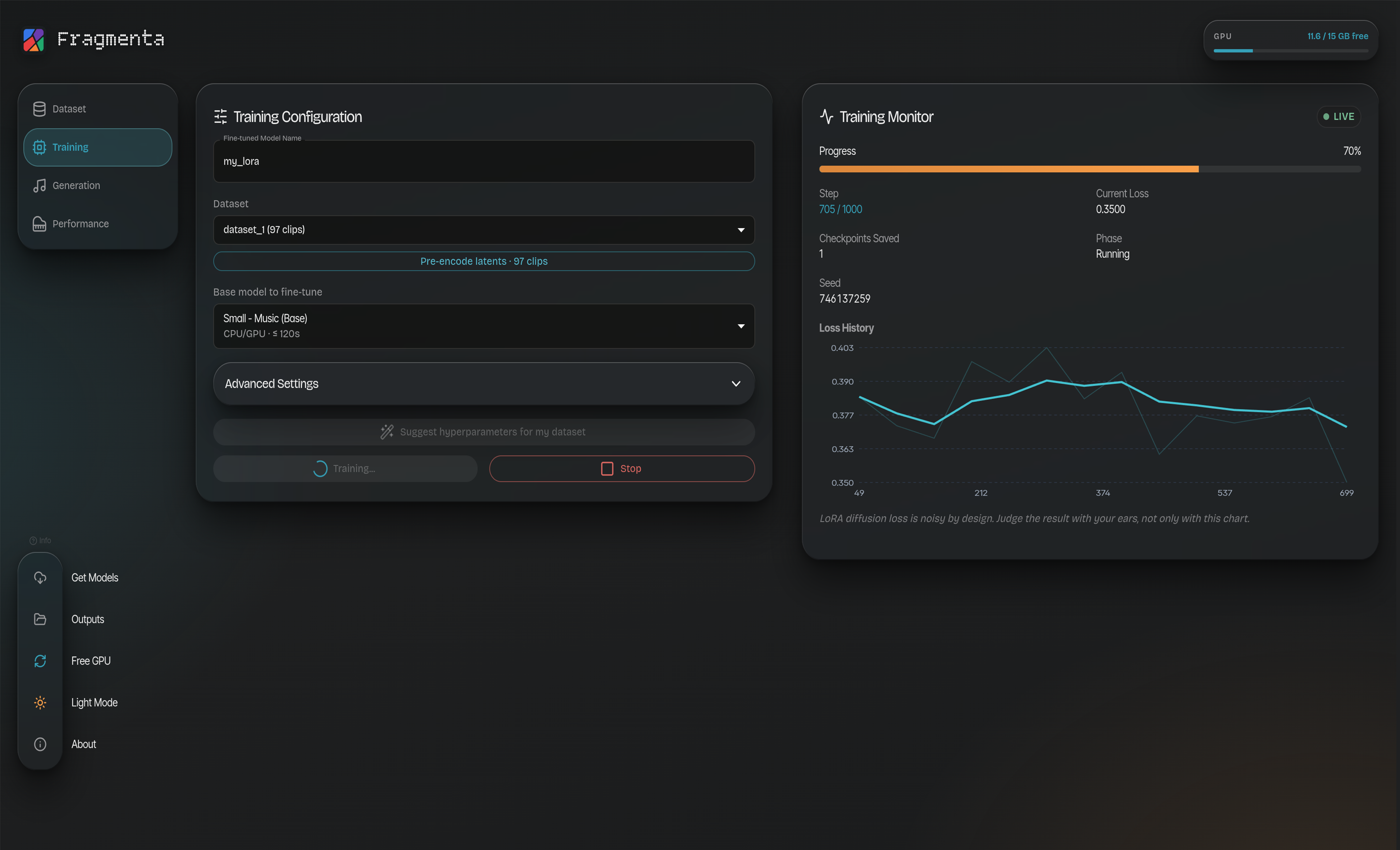
Section 4 outlined how commercial platforms concentrate generative capacity through cloud infrastructure, proprietary training pipelines and rent-extracting subscriptions, locking musicians out of the value their labour generates. FragmentaFootnote 7 borrows the technologies and interface conventions of commercial systems to prototype their alternative: an end-to-end pipeline (Figure 3) through which experimental composers can train, fine-tune and perform with diffusion models using their own data. The approach is partly parasitical in Fisher’s (Reference Fisher2020) sense – the host’s tools are turned against the economy that produced them – but Fragmenta runs parallel to commercial systems rather than within them. It requires no programming knowledge and operates entirely offline. Each of these decisions is political before it is technical: offline operation withdraws the generative act from the cloud-capital economy; data sovereignty refuses extraction; and the interface provides access to the means of production, not only its outputs – but also attributes removed by commercial platforms as discussed in Section 3. The scale is modest, but Fragmenta demonstrates that ownership, pipeline transparency and data traceability can be built into text-to-audio systems rather than stripped from them.
Fragmenta allows composers to fine-tune a diffusion model on their own compositions without coding.

Figure 3. Long description
The interface displays a training configuration panel and a training monitor. The training configuration panel includes fields for the fine-tuned model name, dataset selection, and base model selection. The dataset selected contains 23 clips, and the base model chosen is Small - Music (Base). Advanced settings are available but not expanded. The training monitor shows the progress as 78 percent complete, with the current loss at 0.4160. The step is 784 out of 1000, and one checkpoint has been saved. The loss history is displayed as a line graph with the x-axis representing steps and the y-axis representing loss values. The graph shows a general downward trend in loss over time.
5.2.2. Conditioned stochasticity: maintaining compositional agency
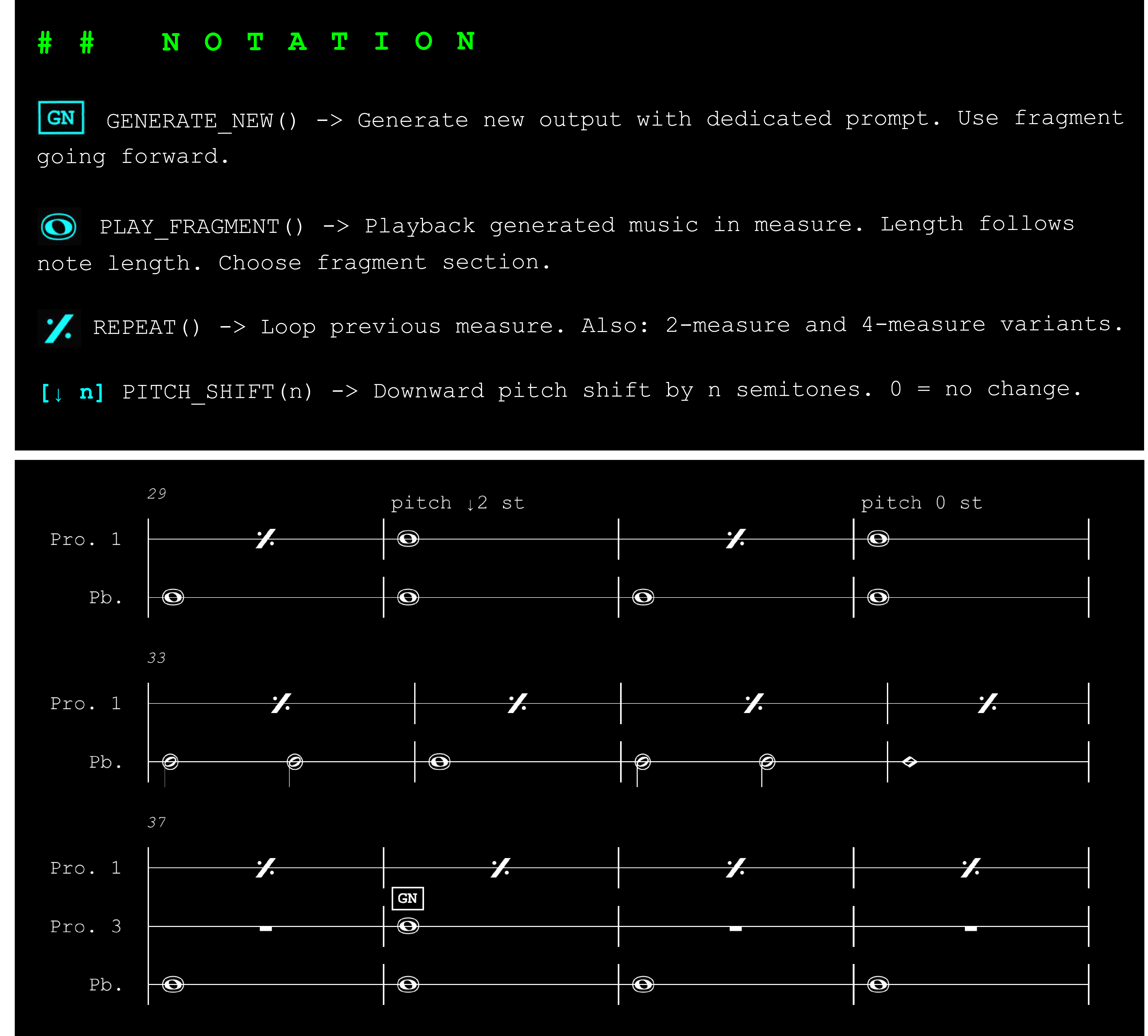
Built on Fragmenta-trained models, Collective Consciousness 1.0 (Azimi Reference Azimi2026) explores how co-composing with text-to-audio through conditioned stochasticity unfolds within this apparatus. Where Fragmenta builds the alternative infrastructure, this work develops compositional practice within it. Rather than framing GenAI as a novel autonomous creative agent, conditioned stochasticity situates text-to-audio generation within experimental music’s long engagement with indeterminacy and algorithmic procedures – from Cage’s chance operations and Xenakis’s stochastic distributions to constraint-based composition (Nierhaus Reference Nierhaus2009). Throughout these traditions, artists maintained compositional agency by designing the conditions under which musical creation occurred; conditioned stochasticity extends this principle to GenAI. At the training stage, fine-tuning on over 32 hours of the author’s own compositions conditions the model’s generative vocabulary to a specific aesthetic space – creating a musical other capable of generating novel variations within a bounded compositional language. At the prompting stage, text prompts derived from an original poem steer generation, functioning similarly to graphic notation’s open instructions (Bröndum Reference Bröndum2018). At the assembly stage, a 130-measure score specifies when generations occur, how they combine with synthesiser parts and what transformations apply (Figure 4), restoring compositional control over the generative material.
Using the proposed notation system (top), the score (bottom) indicates temporal integration and sonic manipulation of the generated fragments within the composition.

5.2.3. Live improvisation integration
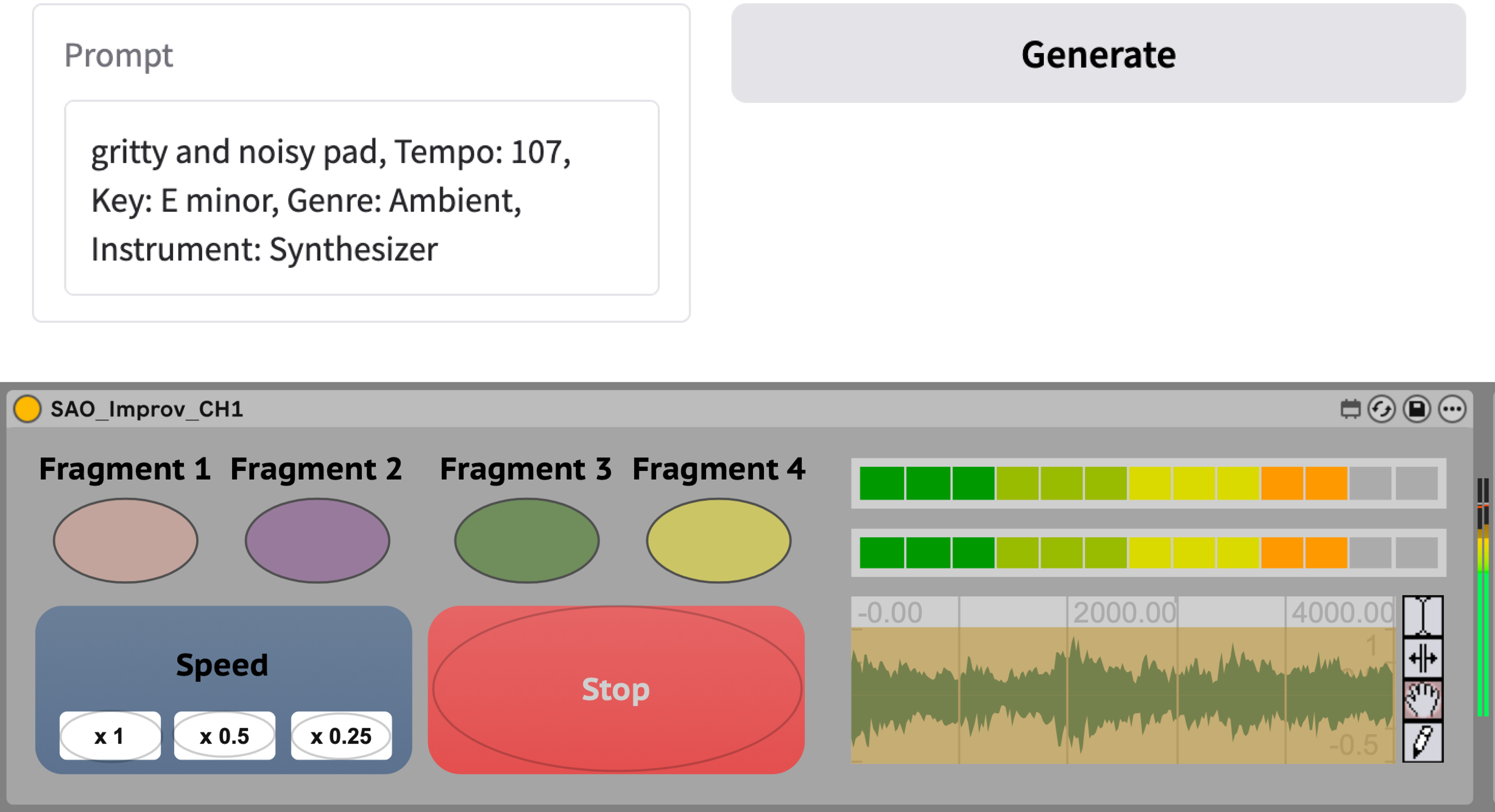
(un)Stable (dis)Connection (Azimi Reference Azimi2025) extends conditioned stochasticity into live improvisation in real time. The system generates fragments that are immediately integrated into the live performance (Azimi and Zareei Reference Azimi and Zareei2025) via a custom Max for Live patch (Figure 5). Each performance creates a feedback loop between prompt, AI output and live manipulation within the Musical Metacreation framework (Pasquier et al. Reference Pasquier, Eigenfeldt, Bown and Dubnov2017). The performer’s embodied decisions guide generation, restoring a participatory dimension that commercial platforms obscure. Beyond this, by portraying reconstruction as visible labour, the performance puts the audience in the critical position Benjamin attributed to the film viewer – that of the ‘quasi-expert’. Instead of consuming a seamless product, they witness, and potentially contest, the conditions of its production.
In (un)Stable (dis)Connection the performer generates musical fragments using a simple UI and can utilise these inside Ableton using a custom MAX for Live patch.

These pipeline-level interventions counter extractive practices – a shift from homogenised reconstruction to artistic agency within infrastructural limits. By engaging with AI critically rather than consuming its outputs, musicians can restore connections between human intention and creative expression, transforming technologies of extraction into instruments of critique and politicisation. These practices embody Benjamin’s call for the author as producer: positioning artists not as consumers of technological apparatus, but as active shapers of its politicising potential. The current trajectory towards cultural homogenisation need not be our final destination.
6. Conclusion
This article examined how commercial GenAI platforms transform music production through fragmentation and reconstruction, contrasting these with Benjamin’s analysis of mechanical reproduction. We argued that this paradigm, at commercial scale, reconfigures the conditions under which music operates as a social and political practice. Through three complementary frameworks, we traced these reconfigurations. Drawing on Benjamin, we demonstrated that commercial GenAI platforms tend towards aestheticisation rather than politicisation – granting expression without agency and serving capital accumulation rather than collective critical engagement. Through Small, we investigated how these platforms reconfigure musicking itself, extracting musicians’ labour as raw material while excluding them from the relationships their data enables. Through Attali, we argued that commercial GenAI intensifies repetition – generating within learned codes rather than breaking with them – while constraining the compositional rupture through which music has historically anticipated new social formations. These transformations are sustained by extractive economic structures: extraction, technofeudalism, intensified platformisation and locked labour conditions that concentrate value while bypassing the social relationships through which music has gained meaning.
Yet these effects are contested rather than determined. Interventionist approaches now operate across multiple levels of generative systems, from architecture-level manipulations to pipeline-level strategies. These include small dataset approaches, ethical fine-tuning, data sovereignty and frameworks such as the first author’s proposed conditioned stochasticity that situate GenAI within experimental music’s long engagement with indeterminacy. Through examples of practice-based research, we demonstrated how such interventions can counter extraction, restore musicking relationships and create conditions for composition rather than intensified repetition. As commercial GenAI depoliticises music, the task is to repoliticise it. The implications extend beyond music to how algorithmic systems reshape the relationship between human creativity, cultural production and democratic participation.
Acknowledgements
The authors declare no conflict of interest. This research has received no external funding. The authors used GenAI tools in limited ways during manuscript preparation. Qwen3 (locally hosted, accessed May 2026) and Claude Sonnet 4.7 (accessed May 2026) were employed solely to support language adherence. These tools were not used to generate substantive text, research ideas or arguments. All intellectual content, interpretations and conclusions remain the sole responsibility of the authors. Our thanks to Dr Tim Corballis for his invaluable input and insightful feedback.

 Open access

