There is growing and immediate interest in composites of inorganic particles and organic semiconducting materials for thermoelectric applications.[Reference Wang, Cai and Yao1–Reference Zhang, Sun, Katz, Fang and Opila4] Such composites combine solution processing, mechanical flexibility, and potentially low thermal conductivity with useful power factors for energy capture from waste heat and local component cooling, potentially contributing to high values of the figure of merit ZT = S 2σT/κ, where S is the Seebeck coefficient, σ is the electronic conductivity, T is the Kelvin temperature, and κ is the thermal conductivity.[Reference Zebarjadi, Esfarjani, Dresselhaus, Ren and Chen5–Reference Poehler and Katz7] Elemental tellurium (Te) is worthy of consideration for these purposes because of its well-defined composition, high charge carrier mobility, and submetallic charge carrier density.[Reference Luo, Liang, Huang, Yan, Hu, Yu, Wu, Wang, Zhu, Li and Jie8–Reference Zaiour, Zahraman, Roumie, Charara, Fawaz, Lmai and Hage-Ali10]
The readiness with which Te forms nanostructures is favorable for homogeneous microscale mixing and possible reduction in thermal conductivity that is the main origin of inefficiencies in thermoelectric energy conversions. Recently, a collaboration at Lawrence Berkeley Laboratories demonstrated the dispersion of Te nanostructures in an aqueous solution of the conducting thiophene polymer poly(3,4-ethylenedioxythiophene) (PEDOT), and cast films of the combined materials to form composites with ZT of about 0.1.[Reference See, Feser, Chen, Majumdar, Urban and Segalman11] The use of Te nanostructures in thermoelectrics was suggested earlier,[Reference Bodiul, Bondarchuk, Huber, Konopko, Nikolaeva and Botnari12] and the fundamental thermoelectric properties of elemental Te have appeared in the literature extending decades back.[Reference Cartwright13–Reference Sharma16]
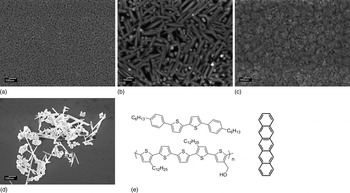
In this communication we report that two thiophene-based semiconductors, one a vapor-deposited molecular solid and the other an amorphous polymer (structures in Fig. 1), each show potential in enhancing the thermoelectric properties of Te nanowires, vapor deposited or mixed in, respectively. While neither organic is an optimized member of its compound class, they are prototypical materials from which further development can occur. Pentacene was also checked as an example of the classic high performing small molecule. On the other hand, the polymer was designed for compatibility with polar solvents and additives, while having similar orbital energies to the commonly used PQT12.[Reference Lee, Jung, Kim, Kim, Lee, Park, Chung, Park, Koo, Jin and Lee17–Reference Ong, Wu, Liu and Gardner20]
(a) (Top left): Vapor-deposited Te on glass. (b) (Top middle): Vapor-deposited Te on 6PTTP6.(c) (Top right): Vapor-deposited Te on pentacene. (d) (Bottom left): Te synthesized by oxide reduction in solution. (e) (Bottom right): Structure of thiophene semiconductors and pentacene.

Both vapor and solution preparation of Te resulted in nanowire morphologies. Figure 1(a) shows scanning electron micrographs of Te vapor deposited on glass. Figures 1(b) and 1(c) show Te vapor deposited on an existing layer of vapor-deposited 5,5′-bis(4-hexylphenyl)-2,2′bithiophene (6PTTP6)[Reference Mushrush, Facchetti, Lefenfeld, Katz and Marks21] and pentacene, which are both reliable hole transporters under ambient conditions. Figure 1(d) shows Te nanowires synthesized as reported in the literature from reduction of TeO2 in the presence of hydrazine hydrate.[Reference Ma, Liu, Wu and Zheng22] While vapor deposition gave nanowires nearly exclusively, the solution synthesis yielded platelets as well. Field effect properties of related Te-organic bilayers were recently reported.[Reference Ireland, Zhang, Gopalan and Katz23]
Te vapor-deposited as a nominal 10 nm film onto unheated Corning glass showed a positive Seebeck coefficient of 400 ± 10 µV/K. Te deposited on 6PTTP6 acted with the same polarity and improved Seebeck, 457 ± 6 µV/K. Possible reasons for this are introduction of new hole energy levels at the 6PTTP6 interface that were not present in Te-on-glass, or increased surface area of crossing Te nanowires, with which additional energy states could be associated. Although the nanocrystalline network on glass showed conductivity of 227 ± 21 S/m, and the hybrid bilayer shows conductivity of 216 ± 16 S/m (accounting for the thickness of Te only, about 10 nm, measured by quartz crystal microbalance during deposition), the resulting power factor (S 2σ) was enhanced from 36 ± 3 to 45 ± 4 W/mK2. Pure 6PTTP6 has essentially no conductivity (less than 0.01 S/m), so we conclude that changes in power factor are due to charge transport being affected in Te. In this case, the bilayer provides an enhancement in Seebeck without compromising conductivity drastically. Pentacene bilayers resulted in similar Seebeck to 6PTTP6 bilayers (468 ± 9 µV/K), but with more conductivity (266 ± 36 S/m), producing higher power factors (58 ± 6 W/mK2). With optimization, these values compare favorably to other hybrid systems.[Reference Wang, Cai and Yao1, Reference Poehler and Katz7] Typical data are shown in Fig. S1. Contact resistance was negligible, as shown in Fig. S2.
X-ray diffraction confirms that Te films are polycrystalline on both glass and organic semiconductor substrates (Fig. S3). Te has the hexagonal unit cell and orients itself at various angles with each substrate upon crystallization. Organic substrates generally result in less crystallinity due to increased roughness and lower surface-energy compared with glass substrates.[Reference Ireland, Zhang, Gopalan and Katz23] Also, the interlayer potential created over each 2D interface (Fig. S4) plays a significant role in charge transport, accumulation, and trapping. For instance, the pentacene HOMO level is more positive than the work function of Te, which implies that it accepts holes from Te more readily than 6PTTP6, having a HOMO level more negative than the Te work function.[Reference Ireland, Dawidczyk, Cottingham, McQueen, Johns, Markovic, Zhang, Gopalan and Katz24] Consequently, scattering of electronic charges at the Te–pentacene interface may be reduced compared with Te–6PTTP6 and Te–glass interfaces.
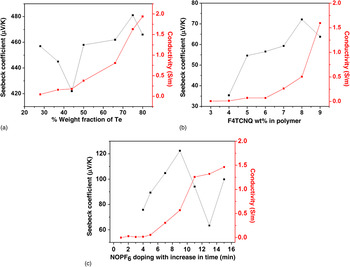
For Te–polymer composites, the Te product from chemical synthesis was first treated with hydrazine hydrate and then washed with ethanol, and dried under vacuum in order to reduce oxide formation on the surface. An alternating copolymer containing 3,3'-didodecylquaterthiophene and thiophen-3-ylmethyl acetate were polymerized via direct acrylation in the presence of Pd(OAc)2 as the catalyst with pivalic acid and K2CO3 in dimethylacetamide, which was then treated with HCl resulting in –OH functional polymer.[Reference Sinha, Lee, Kong, Swift and Katz25] The dried Te was weighed to varied amounts (0.4–4 mg) and added to 1 mg of the polymer in CHCl3. The solution was drop cast and the film dried over 24 h at room temperature. Figure 2 shows plots of S and σ versus Te content and dopant concentrations.
Plots of S and conductivity for P1 blended with different weight ratios of Te, F4TCNQ, and NOPF6, the latter added from the solution by dipping for different times after the film was cast.

The Seebeck coefficient was relatively constant, and within experimental error of the vapor-deposited Te value, for the entire range of compositions. The conductivity, on the other hand, increased continuously with Te concentration in the polymer. Interestingly, solution-deposited Te (≤1 mg) without polymer showed no conductivity or Seebeck because Te particles were not in contact with each other, but the solution-deposited Te mixed with polymer showed conductivity and Seebeck (even with 0.4 mg of Te in the polymeric matrix), which implies synergistic effects between Te nanoparticles and the polymer.
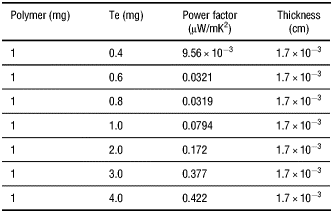
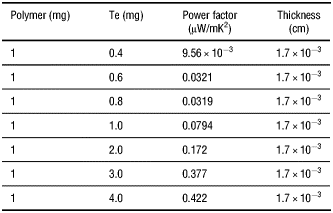
When the pure polymer not containing Te was mixed with standard hole dopants tetrafluorotetracyanoquinodimethane (F4TCNQ) or NOPF6, the conductivities were increased in a similar range as with the Te nanowire addition, but the Seebeck coefficients were 5–10 times lower, indicating that when Te was present, it dominated the Seebeck effect. The power factors of various samples are listed in Table I. The power factors increase with Te addition, but do not approach high values reported for other polymer composites because hole mobility of the neat polymer is on the order of 10−5 cm2/Vs (Fig. S5), due to disorder introduced by the OH groups.[Reference Sinha, Lee, Kong, Swift and Katz25] A similar functional group attachment on a higher-mobility backbone using an even-numbered ring repeat unit would lead to higher conductivities and power factors. Still, this experiment demonstrates the value of organic semiconductor co-deposition in enabling any macroscopic power factor to be obtained from a Te nanowire network where the network alone would not have sufficient connectivity.
Thermoelectric power factors of Te-polymer samples.
Supplementary materials
For supplementary material for this article, please visit http://dx.doi.org/10.1557/mrc.2013.14
Acknowledgment
We thank the Department of Energy Office of Basic Energy Sciences, Grant Number DE-FG02-07ER46465 for support of this work.