Introduction
Cognitive impairment is a primary feature of schizophrenia (Bleuler, Reference Bleuler1943; Heaton et al. Reference Heaton, Paulsen, McAdams, Kuck, Zisook, Braff, Harris and Jeste1994; Heinrichs, Reference Heinrichs2005) related to multiple functional disabilities, including social skills impairment (Reeder et al. Reference Reeder, Newton, Frangou and Wykes2004). Although greater severity of psychiatric symptoms, particularly negative symptoms (Harvey et al. Reference Harvey, Sukhodolsky, Parrella, White and Davidson1997), has also been associated with poor social functioning, cognitive impairment appears to account for more variability in social functioning than does symptom severity (Patterson et al. Reference Patterson, Klapow, Eastham, Heaton, Evans, Koch and Jeste1998, Reference Patterson, Goldman, McKibbin, Hughs and Jeste2001, Reference Patterson, Lacro, McKibbin, Moscona, Hughs and Jeste2002). In a comprehensive review of the literature, Green et al. (Reference Green, Kern, Braff and Mintz2000) found that vigilance, working memory, verbal memory and executive functioning were the neuro-psychological domains most frequently associated with social functioning. The increasing awareness of the associations between cognition, social functioning and community integration in psychosis (Bellack et al. Reference Bellack, Sayers, Mueser and Bennett1994; Twamley et al. Reference Twamley, Doshi, Nayak, Palmer, Golshan, Heaton, Patterson and Jeste2002) has resulted in growing interest in treatments to improve cognition (Marder & Fenton, Reference Marder and Fenton2004). At the same time, schizophrenia researchers have increasingly prioritized the measurement of functional outcomes, including social functioning. For example, the Measurement and Treatment Research to Improve Cognition in Schizophrenia (MATRICS) consensus battery (Marder & Fenton, Reference Marder and Fenton2004) includes measures of social competence, social functioning and social adjustment.
As the population in general ages, the number of older people with schizophrenia will increase as well. These older individuals may experience additional barriers to social functioning that are less prominent among younger adults with schizophrenia, such as age-related cognitive decline, reduced mobility, and friends passing away. However, most research on social functioning among people with schizophrenia has been completed with younger adults (Bellack et al. Reference Bellack, Sayers, Mueser and Bennett1994; Addington et al. Reference Addington, McCleary and Munroe-Blum1998; Pinkham & Penn, Reference Pinkham and Penn2006) and suggests that people with schizophrenia have worse social skills than the general population (Mueser et al. Reference Mueser, Bellack, Douglas and Morrison1991).
There are several strategies for measuring social functioning. Many studies of social functioning in schizophrenia, including most of those reviewed by Green et al. (Reference Green, Kern, Braff and Mintz2000), have used self-reports or informant ratings of social performance (e.g. Harvey et al. Reference Harvey, Sukhodolsky, Parrella, White and Davidson1997; van Beilen et al. Reference van Beilen, Kiers, Bou, van Zomeren, Withaar, Arends and van den Bosch2003; Miura et al. Reference Miura, Mizuno, Yamashita, Watanabe, Murakami and Kashima2004). These approaches have economic advantages over other strategies and describe typical styles of interaction regardless of how socially skilled someone is capable of acting. However, such measures may be hampered by the biases inherent in the reporting method, such as social desirability, poor insight due to disease processes, retrospective memory effects, or minimal informant exposure to the behaviors under investigation. These biases can be reduced through the use of performance-based measures that allow trained raters to directly observe social skills in laboratory settings. Performance-based measures such as the Maryland Assessment of Social Competence (Bellack et al. Reference Bellack, Sayers, Mueser and Bennett1994) and the Conversation Probe Role-Play Test (Penn et al. Reference Penn, Hope, Spaulding and Kucera1994) use role-play scenarios to elicit specific social behaviors while maintaining control over extraneous factors. They also have advantages over naturalistic observation strategies, such as standardized administration, control over environmental and situational confounds, time limitedness, and greater focus and efficiency. These performance-based measures are not measures of typical interaction styles, but are measures of the capacity to engage in social activity. Therefore, there may be a discrepancy between a person's capacity for social interaction in the laboratory and the level of social skill demonstrated during everyday social interactions.
Associations between cognitive impairment and performance-based measures of social skills have been observed among younger adults with schizophrenia. Specific areas of cognitive functioning that have been associated with social skills performance include attention, verbal memory and cognitive flexibility/executive functioning (Bellack et al. Reference Bellack, Sayers, Mueser and Bennett1994; Addington et al. Reference Addington, McCleary and Munroe-Blum1998; Addington & Addington, Reference Addington and Addington2000; Pinkham & Penn, Reference Pinkham and Penn2006). Although Addington & Addington (Reference Addington and Addington2000) found associations between cognitive abilities and social skills performance, they were unable to find relationships with self- and informant-reports of social functioning, possibly because of the aforementioned limitations of this reporting strategy. It is also unclear whether the relationships between cognition and social skills performance exist among older adults with schizophrenia.
Our group previously reported on the development and validation of a performance-based measure of social skills, the Social Skills Performance Assessment (SSPA; Patterson et al. Reference Patterson, Goldman, McKibbin, Hughs and Jeste2001). The SSPA was designed for use with individuals with schizophrenia and adapted from the Role Play Task of the Social Problem Solving Battery (Bellack et al. Reference Bellack, Morrison, Wixted and Mueser1990). A study of 83 schizophrenia out-patients and 52 normal comparison subjects suggested that the SSPA had high test–retest reliability (r=0.92) and was highly correlated with other performance-based measures of general functional status, such as the Direct Assessment of Functional Status (DAFS; Loewenstein et al. Reference Loewenstein, Amigo, Duara, Guterman, Hurwitz, Berkowitz, Wilkie, Weinberg, Black and Gittelman1989; r=0.70, p<0.001) (Patterson et al. Reference Patterson, Goldman, McKibbin, Hughs and Jeste2001). Poor performance on the SSPA was found to be associated with greater overall cognitive impairment and worse negative symptoms (Patterson et al. Reference Patterson, Goldman, McKibbin, Hughs and Jeste2001).
The goals of the current study were to replicate and expand the findings of Patterson et al. (Reference Patterson, Goldman, McKibbin, Hughs and Jeste2001) and identify specific domains of cognitive functioning associated with social skills performance using a larger sample of middle-aged and older individuals with schizophrenia. We hypothesized that (1) patients would demonstrate impaired social skills performance compared to healthy subjects, (2) such impairment would be related to impairments in attention, memory and executive functioning, (3) cognitive abilities and negative symptoms would predict social skills performance after controlling for demographic and clinical factors, and (4) better social skills performance would be related to better social functioning as measured by self-reported frequency of social interactions. Additionally, we sought to examine, in an exploratory manner, the relationships between specific cognitive abilities and individual domains of social skills.
Method
Participants
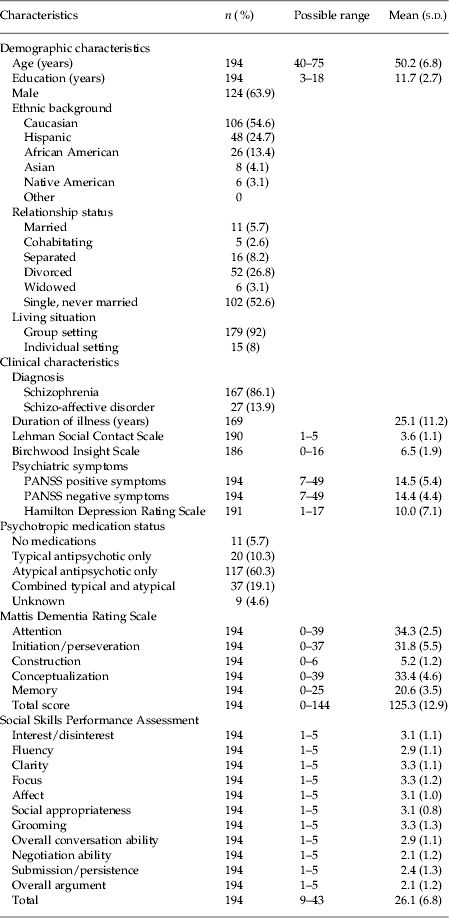
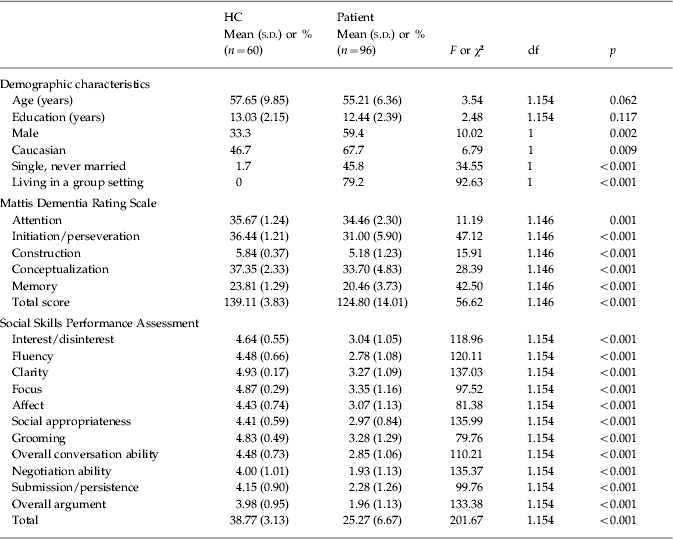
The patient sample consisted of 194 out-patients with DSM-IV-based (APA, 1994) chart diagnoses of schizophrenia (n=167) or schizo-affective disorder (n=27), between the ages of 40 and 75 years (97% were under age 65), who completed baseline assessments for a trial of an intervention to improve everyday functioning (see Table 1). A patient's chart diagnosis was the diagnosis of record provided by the treating psychiatrist. A subset (n=96) of the out-patients was compared to 60 age- and education-matched healthy comparison subjects (age range=40–76 years, mean=58; education range=6–18, mean=13) to evaluate differences in social skills performance (see Table 2). The majority of the healthy comparison subjects were community members who had participated in previous research on the SSPA (Patterson et al. Reference Patterson, Goldman, McKibbin, Hughs and Jeste2001) at our center, but the present sample of patients was not included in any previous reports on the SSPA. All of the participants were psychiatrically, physically and psychopharmacologically stable. Participants were excluded if they had a history of seizure disorder or head injury with >30 minutes loss of consciousness, a current diagnosis of dementia, or a current diagnosis of substance abuse or dependence.
Demographic, clinical and cognitive characteristics of schizophrenia out-patients

PANSS, Positive and Negative Syndrome Scale; s.d., standard deviation.
Demographic, clinical and cognitive characteristics of the healthy comparison (HC) subjects and an age- and education-matched subset of schizophrenia out-patients

s.d., Standard deviation; df, degrees of freedom.
Procedure
The University of California, San Diego Institutional Review Board approved this study and all subjects provided written informed consent to participate. Out-patients were recruited from board-and-care facilities and day treatment centers in San Diego County by trained recruiters who have established relationships with facility managers and residents. Recruitment focused on larger board-and-care facilities, each housing at least 20 middle-aged and older residents (⩾40 years of age) with long-standing psychotic disorders. Therefore, the majority of the patients (92%) resided in group living situations. Comparison subjects were recruited from the general San Diego community by local advertising. All measures were administered by psychometricians trained to a high level of inter-rater reliability (e.g. SSPA intraclass correlation coefficient=0.91). All measures were administered by the same examiner during a single evaluation period.
Measures
The SSPA uses two 3-minute role-play tasks to evaluate subjects' ability to participate in everyday social interactions (Patterson et al. Reference Patterson, Goldman, McKibbin, Hughs and Jeste2001). Scenario 1 involves a neutral social situation (introducing oneself to a new neighbor), whereas Scenario 2 involves a potentially conflictual social situation (convincing a landlord to fix a leak that has not been repaired after a previous complaint). Each role-play is enacted between the participant and the examiner, and is audio-taped for subsequent scoring. Items requiring visual observation (e.g. body posture, facial expression, grooming) are rated directly following the interaction, rather than by audio-tape. A total overall score is calculated by summing ratings [on a scale of 1 (low) to 5 (high)] across scenario-specific domains. For a fuller description of the SSPA, refer to Patterson et al. (Reference Patterson, Goldman, McKibbin, Hughs and Jeste2001).
The Lehman Social Contact Scale, a subscale from the Quality of Life Interview (Lehman, Reference Lehman1996), measures frequency of interactions with friends outside the household, and was included as a secondary measure of social functioning. Subjects report, on a five-point scale (1=not at all, 5=daily), the frequency with which they engage in specific social behaviors, such as spending time with a friend. Previous versions of the Social Contact Scale have demonstrated adequate internal consistency (median α=0.68) and 1-week test–retest reliability (median α=0.65; Lehman, Reference Lehman1996).
Measures of psychiatric symptom severity included the Positive and Negative Syndrome Scale (PANSS; Kay et al. Reference Kay, Opler and Fiszbein1987) and the 17-item Hamilton Depression Rating Scale (HAMD; Hamilton, Reference Hamilton1960). Higher scores on both measures reflect greater severity of illness.
The Birchwood Insight Scale (IS; Birchwood et al. Reference Birchwood, Smith, Drury, Healy, Macmillan and Slade1994) is a Likert-type scale measuring awareness of illness, need for treatment, and symptom attributions. Higher scores reflect greater insight. The IS has adequate internal consistency (α=0.75) and good 1-week test–retest reliability (r=0.90).
Cognitive performance was evaluated with the Mattis Dementia Rating Scale (DRS; Mattis, Reference Mattis1973), a 20-minute screening tool with five subscales including Attention, Initiation/Perseveration (e.g. verbal fluency), Construction (visuospatial ability; e.g. figure copying), Conceptualization (verbal and visual abstraction ability), and Memory. Total scores range from 0 to 144, with higher scores reflecting better cognitive performance. Although the DRS does not measure executive functioning broadly, as conceptualized by Green et al. (Reference Green, Kern, Braff and Mintz2000), the Conceptualization subscale is the best proxy for executive functioning available from the DRS.
Analyses
All data were examined for normality of distribution. A reflected logarithmic transformation was used to normalize the negatively skewed, leptokurtic distribution of the DRS Attention subscale scores. Categorical variables with more than two levels (ethnic background and relationship status) were recoded into dichotomous variables for correlational and regression analyses (Caucasian versus non-Caucasian and single/never married versus history of marriage or cohabitation respectively). Two separate analyses of variance (ANOVAs) were used to compare schizophrenia to schizo-affective patients and patients to normal comparison subjects on demographic, clinical and social skills performance variables, with the exceptions of gender, ethnic background and relationship status, which were compared using χ2 tests. Pearson correlation coefficients were calculated to identify relationships between social skills performance and demographic, clinical, social contact and cognitive measures. A hierarchical multiple regression analysis was used to identify the strongest demographic, clinical and cognitive predictors of total social skills performance. Only predictors that were significantly correlated with social skills were included in the regression analysis. Because no demographic variables were correlated with social skills, predictors were entered into the model in two steps: (1) clinical characteristics (positive symptoms, negative symptoms, insight and social contact); and (2) cognitive performance (DRS Attention, Initiation/Perseveration, Construction, Conceptualization and Memory subscale scores).
Results
Patients with schizophrenia and schizo-affective disorder were similar on measures of all demographic, clinical and cognitive characteristics, with the exceptions of depressive symptoms being more severe for schizo-affective patients [means were 9.01 and 15.85 respectively; F(1, 90)=10.82, p=0.001] and attention being higher in schizophrenia patients [means were 34.65 and 33.31 respectively; F(1, 89)=4.53, p=0.036]. We therefore combined the patients from these two groups for all further analyses.
Clinical, cognitive and social skills characteristics of the patients are presented in Table 1. Patients with schizophrenia reported relatively low levels of positive, negative and depressive symptoms, and their overall cognitive ability fell within the mildly to moderately impaired range, with greater impairment in the domains of Initiation/Perseveration, Conceptualization and Memory than in Attention and Construction. Compared with the patient group, the healthy comparison subjects were significantly older and more educated, and were disproportionately female and married. We therefore used a subset of 96 patients, matched on age and education with the comparison subjects, for comparisons between these two groups (see Table 2).
Comparisons between healthy comparison subjects and a subset of age- and education-matched schizophrenia patients are presented in Table 2. Consistent with our first hypothesis, the patients demonstrated significantly worse social skills than did the normal comparison group [F(1, 154)=201.67, p<0.001].
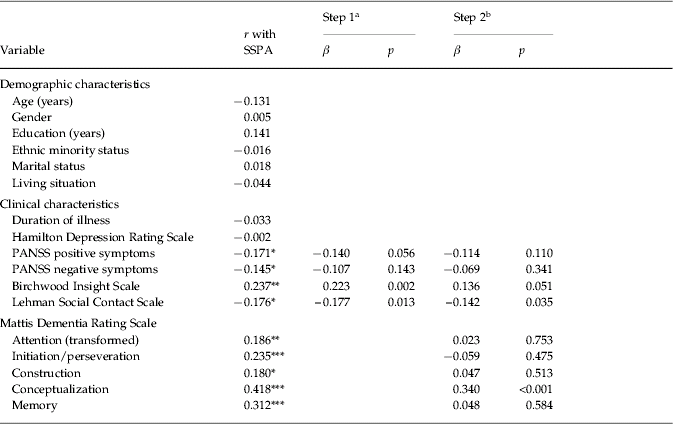
Correlations for schizophrenia patients between performance on the SSPA and demographic, clinical and cognitive variables are presented in Table 3. Although our second hypothesis was that social skills performance would be associated with the cognitive domains of attention, memory and executive functioning, we found that all of the DRS subscales were significantly correlated with SSPA total scores, with measures of executive functioning (conceptualization ability and initiation and lack of perseveration) and memory being most highly correlated.
Pearson correlations and regression coefficients of demographic, clinical and cognitive ability scores on the Social Skills Performance Assessment (SSPA) in patients with schizophrenia (n=194)

PANSS, Positive and Negative Syndrome Scale.
a R 2=0.123, R 2 change=0.123, F change=6.262, df=4, 178, p<0.001.
b R 2=0.249, R 2 change=0.126, F change=5.790, df=5, 173, p<0.001.
* p⩽0.05, ** p⩽0.01, *** p⩽0.001.
The results from the regression analysis (Table 3) showed that the overall model explained approximately 25% of the variance in SSPA scores. Clinical predictors explained 12% of the variance and cognitive abilities explained another 13% of the variance in SSPA performance. Consistent with our third hypothesis, cognitive ability was one of the two predictors of social skills. Specifically, patients' ability to abstract verbal and visual information (Conceptualization) independently predicted 6.5% of the variability in social skills. Contrary to our hypothesis, negative symptom severity did not predict social skills performance. Instead, frequency of social contact was the only other independent predictor of social skills performance. However, the direction of this relationship was counterintuitive and ran contrary to our fourth hypothesis; better social skills performance was associated with having fewer social contacts.
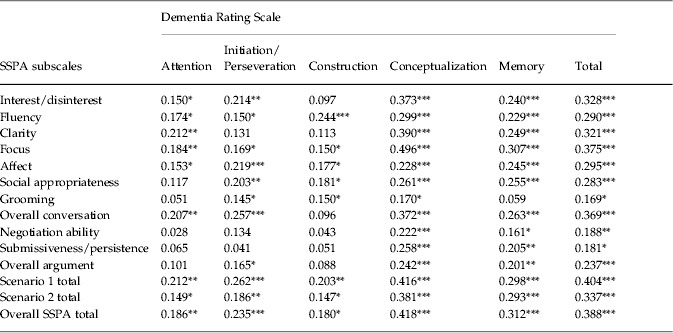
To further explore the relationships between cognitive abilities and specific components of social skills performance among schizophrenia patients, we computed correlations between the DRS subscale scores and all SSPA domain scores (see Table 4). All SSPA domains were significantly correlated with overall cognitive ability. Ability to focus on the conversation was most related to overall cognitive ability, whereas grooming was least related. Most specific domains of cognitive functioning were significantly related to most domains of social ability. Abstraction ability (Conceptualization), which was most highly correlated with overall SSPA score, was most related to ability to focus on the conversation.
Pearson's correlations between domains of cognitive and social functioning in patients with schizophrenia (n=194)

SSPA, Social Skills Performance Assessment.
* p⩽0.05, ** p⩽0.01, *** p⩽0.001.
Discussion
The current study identified relationships between social skills performance and demographic and clinical characteristics as well as cognitive abilities in middle-aged and older out-patients with schizophrenia. As expected, patients demonstrated worse social skills performance than did normal comparison subjects. For patients, better overall social skill performance was correlated with higher scores on all measured domains of cognitive functioning, including attention, initiation/freedom from perseveration, visuospatial ability, abstraction ability, and memory. Lower positive and negative symptom severity, greater insight, and less frequent social contact were also associated with better SSPA performance. The negative association between social skills performance and self-reported frequency of social contact was unexpected and may be representative of the discordance between assessing ability to demonstrate social skills, and typical styles of social interaction. Additionally, those with better social skills may be more aware of their lack of social contact and therefore more likely to report lower levels of contact; whereas people with poor social skills may be less attuned to their social interactions and therefore worse self-reporters. It may also be that people who are more impaired and cannot live independently are living in group settings (e.g. board-and-care, skilled nursing facility), where they may have more opportunities for social interaction. Our relatively small cohort of patients who were not living in group settings made it difficult to test this hypothesis.
When clinical and cognitive variables were included in a multivariate model, abstraction ability was the only significant cognitive predictor of social skills performance. The DRS Conceptualization subscale measures abstraction ability, concept formation and pattern recognition. The ability to identify a concept or topic and provide responses related to that topic may be important in maintaining social interactions. It is important to note the high degree of intercorrelation between the cognitive domains, which could have limited our ability to identify individual contributions of each cognitive domain.
Contrary to our hypotheses, and previous research, negative symptom severity was not predictive of SSPA performance after controlling for other factors. It may be that although there is a bivariate relationship between negative symptom severity and social skills performance, the relationship is attenuated in the presence of other predictors.
The relationships between cognitive abilities and specific domains of social skills performance were also examined. Overall cognitive ability was related to all measured domains of social skills. The ability to conceptualize information and think abstractly was related to more domains of social skills functioning than was any other cognitive ability. These results suggest that poor cognitive ability can have a broad effect on social performance, and that executive functioning may play a key role in appropriate social interactions.
Previous research has also identified relationships between social skills and attention (vigilance) and memory (Green et al. Reference Green, Kern, Braff and Mintz2000). Although measures of attention and memory were correlated with SSPA scores in the present study, these measures were not uniquely predictive of performance on the SSPA in the presence of additional predictor variables. This may be due to lower sensitivity of the DRS attention and memory subscales compared with other neuropsychological measures, or, alternatively, to the conceptualization subscale accounting for a greater share of the variance, consistent with other reports of frontal executive measures being associated with social skills (Hatashita-Wong et al. Reference Hatashita-Wong, Smith, Silverstein, Hull and Willson2002; Yamashita et al. Reference Yamashita, Mizuno, Nemoto and Kashima2005; Zanello et al. Reference Zanello2006). Additionally, we used a performance-based measure of social skills rather than self- or informant-reports (cf. Chino et al. Reference Chino, Mizuno, Nemoto, Yamashita and Kashima2006), and an out-patient sample (cf. Cohen et al. Reference Cohen, Forbes, Mann and Blanchard2006), which may account for some of the differences in findings.
The current study has several limitations. The SSPA is a proxy for social ability, and does not measure social skills in real-world settings. Although the DRS evaluates cognitive abilities in multiple domains of functioning, it is a screening tool that does not measure all of the neuropsychological domains of interest (e.g. sustained attention, planning and strategizing). However, the degree of impairment in this population was severe enough to be detected by the DRS, as was variability of impairment in multiple domains of functioning. Although we included a measure of frequency of social contact, we did not include a self- or informant-report of social skills. Therefore, we were unable to evaluate the relationship between self- or informant-reported social skills and SSPA performance. In addition, our schizophrenia sample consisted entirely of psychiatrically stable, middle-aged and older out-patients, limiting the generalizability of our findings.
The cross-sectional nature of the current study precludes definitive causal inferences regarding the relationship between cognitive abilities, symptom presentation and social skills performance. Longitudinal studies have demonstrated that cognitive deficits often precede the development of psychotic symptoms (Erlenmeyer-Kimling et al. Reference Erlenmeyer-Kimling, Rock, Roberts, Janal, Kestenbaum, Cornblatt, Adamo and Gottesman2000; Cannon et al. Reference Cannon, Caspi, Moffitt, Harrington, Taylor, Murray and Poulton2002). Both retrospective and prospective studies of early predictors of schizophrenia suggest that poor social functioning also precedes the onset of psychotic symptoms (Bearden et al. Reference Bearden, Rosso, Hollister, Sanchez, Hadley and Cannon2000; Niemi et al. Reference Niemi, Suvisaari, Tuulio-Henriksson and Lönnqvist2003). However, little is known about the temporal relationship between cognitive deficits and social impairment in prodromal schizophrenia.
Our findings for a middle-aged and older adult population were consistent with previous research suggesting that cognitive abilities play an important role in social functioning among younger adults with schizophrenia. Psychosocial interventions that target cognitive deficits, such as cognitive training, have demonstrated some efficacy for the improvement of cognitive and daily functioning among primarily younger adults with schizophrenia (Twamley et al. Reference Twamley, Jeste and Bellack2003). These same strategies may be useful for middle-aged and older adults as well, given the consistency of association between cognitive and social functioning across age groups.
Acknowledgments
This work was supported, in part, by the National Institute of Mental Health grants P30MH066248-03 and T32MH019934-11 and by the Department of Veterans Affairs.
Declaration of Interest
None.