The study of sign languages provides a unique window into universal properties of natural human languages at all levels of analysis, from linguistics to neuroscience. It is important to study sign languages not only for their striking similarity to spoken languages, but also for the potential divergence that is instigated by disparate physical language modalities (see Sandler & Lillo-Martin, Reference Sandler and Lillo-Martin2006 for a review). Such divergent characteristics allow us to make better predictions on how languages are acquired and how the brain may adapt to various linguistic sensory input. Given the aforementioned motiving factors in addition to the large number of students who enroll in sign language courses each year (Rosen, Reference Rosen2015; Welles, Reference Welles2004), it is important to understand which cognitive-linguistic factors underlie second language acquisition (SLA). A growing field of research within SLA has started to address a unique type of SLA: second modality (M2) second language (L2) acquisition (Chen Pichler & Koulidobrova, Reference Chen Pichler, Koulidobrova, Marschark and Spencer2015). Most research studies have focused on learners whose first and second languages are spoken. However, sign language researchers have started to investigate the similarities and differences between M2L2 learners and typical unimodal learners. As such, the present study aimed to investigate which cognitive-linguistic skills predict acquisition outcomes during initial stages of M2L2 learning of American Sign Language (ASL). Drawing from unimodal (M1) L2 literature, L1 cognitive-linguistic predictors were examined to determine which predict M2L2 sign language acquisition outcomes.
LITERATURE OVERVIEW
Traditional studies within the field of SLA have attempted to address this type of question—what cognitive and linguistic factors will best help a learner in acquiring their new language? Often, predictors such as working memory and lexical knowledge have been investigated (e.g., Linck, Osthus, Koeth, & Bunting, Reference Linck, Osthus, Koeth and Bunting2014; Sparks, Patton, Ganschow, & Humbach, Reference Sparks, Patton, Ganschow and Humbach2009; Ye & Zhou, Reference Ye and Zhou2009). Working memory has been found to robustly predict L2 processing and proficiency outcomes (Linck et al., Reference Linck, Osthus, Koeth and Bunting2014 for review; Michael & Gollan, Reference Michael, Gollan, Kroll and De Groot2005; Miyake & Friedman, Reference Miyake, Friedman, Healy and Bourne1998). Linck and colleagues (2014) reported a large-scale meta-analysis, which examined 3,707 L2 learners across 79 studies. The results indicated that there is a robust contribution of working memory to L2 acquisition, where verbal and executive control measures of working memory highly predict L2 proficiency outcomes. The contribution of working memory is highlighted by the fact that low-proficiency L2 learners with relatively higher working memory capacities than other low-proficiency learners do better on processing tasks (Linck, Hoshino, & Kroll, Reference Linck, Hoshino and Kroll2008). In other words, individual differences among learners in working memory capacity help identify those who might have better long-term L2 outcomes. It should be noted, however, the studies included in Linck et al.’s meta-analysis did not include sign language as a second language.
The relationship between individual differences in working memory ability and SLA is not only restricted to the oral modality. Short-term memory capacity has also been able to predict sign language interpreter competency ratings (Christoffels & De Groot, Reference Christoffels and De Groot2004; Hodàkovà, Reference Hodáková2009; López Gómez, Bajo Molina, Padilla Benítez, & Santiago de Torres, Reference López Gómez, Bajo Molina, Padilla Benítez and Santiago de Torres2007; Tzou, Eslami, Chen, & Vaid, Reference Tzou, Eslami, Chen and Vaid2011). On average sign language interpreters tend to have greater working memory capabilities than advanced L2 signers (e.g., hearing sign language teachers and learners) (Stavrakaki, Megari, Kosmidis, Apostolidou, & Takou, Reference Stavrakaki, Megari, Kosmidis, Apostolidou and Takou2012). Working memory enhancements for interpreters might be a result of a self-selecting bias where only interpreters with large working memory capacities continue on in the field. Regardless, interpreters are vastly different from typical sign language students. For noninterpreting M2L2 learners, it has been hypothesized that verbal working memory may not be a robust predictor of M2L2 acquisition (at least in the early stages) because of an indexing bias (Hirshorn, Fernandez, & Bavelier, Reference Hirshorn, Fernandez and Bavelier2012; Williams, Darcy, & Newman, Reference Williams, Darcy and Newman2015a). Hirshorn and colleagues argued that sign language proficiency is largely predicated on visuospatial memory skills; however early M2L2 learners incorrectly index visuospatial information into their verbal working memory, which slows and impedes M2L2 acquisition. In light of contradictory evidence, this study attempts to investigate whether baseline crossmodal L1 verbal working memory skills can predict M2L2 proficiency after one semester of study.
Cognitive factors, like working memory, are not the only possible contributing factors to L2 proficiency outcomes. A common linguistic factor that has been used to predict L2 proficiency outcomes is L1 vocabulary knowledge. According to Cummins (Reference Cummins1979), both first and second languages are connected on various levels; the skills and metalinguistic knowledge acquired during L1 acquisition can be bootstrapped and used during L2 acquisition. Sign-spoken language bilingualism is no exception (Davis, Reference Davis and Lucas1990). Therefore, larger vocabulary sizes, which may be dependent on other linguistic skills like phonological knowledge, can predict greater L2 proficiency outcomes. Specifically, L2 learners with larger L1 vocabularies have higher rates of L2 aptitude achievement (Sparks, Patton, Ganschow, & Humbach, Reference Sparks, Patton, Ganschow and Humbach2009). Large L1 vocabulary knowledge also predicts L2 reading acquisition and metalinguistic skills (Lervåg & Aukrust, Reference Lervåg and Aukrust2010; McBride-Chang, Cheung, Chow, Chow, & Choi, Reference McBride-Chang, Cheung, Chow, Chow and Choi2006; Proctor, August, Carlo, & Snow, Reference Proctor, August, Carlo and Snow2006). Large L1 vocabulary size even predicts grammatical acquisition (Blom, Paradis, & Duncan, Reference Blom, Paradis and Duncan2012). In some studies, oral L2 proficiency is also predicted by larger L1 vocabulary size (Geva & Ryan, Reference Geva and Ryan1993). Again, all of these studies include comparisons of L1 and L2 that are both spoken. Relatively few studies have investigated the relationship between vocabulary sizes in spoken language and sign languages. Some studies have shown that native deaf signers who have larger vocabularies in their sign language will acquire their L2 spoken language to a greater degree of proficiency (Daniels, Reference Daniels1993; Singleton, Morgan, DiGello, Wiles, & Rivers, Reference Singleton, Morgan, DiGello, Wiles and Rivers2004). However, it is unclear how the opposite situation (i.e., spoken to sign) affects second language outcomes. Here, a measure of L1 English vocabulary (i.e., Peabody Picture Vocabulary Test) was used in order to quantify how L1 vocabulary knowledge may predict growth in M2L2 lexical sign knowledge, regardless of the differences in modalities.
Mounting evidence points to enhanced audiovisual processing as a unique ability that arises from the divergence between language modalities. Sign languages use mouth movements, or mouthing, for various linguistic purposes, including homophonic disambiguation and inflectional morphology (Bickford & Fraychineaud, Reference Bickford and Fraychineaud2006; Boyes-Braem, Sutton-Spence, & Leiden, Reference Boyes-Braem, Sutton-Spence and Leiden2001). Not only does the use of the mouth for linguistic purposes draw attention to the mouth, but many signers, hearing and deaf, also simultaneously silently mouth or overtly articulate English lexical items during the coproduction of signs (e.g., code blending, Capek, Campbell, & Woll, Reference Capek, Campbell and Woll2008; Davis, Reference Davis and Lucas1990; Emmorey, Borinstein, Thompson, & Gollan, Reference Emmorey, Borinstein, Thompson and Gollan2008). In fact, it has been shown that novice learners of sign languages often look at the mouth of the signing interlocutor during sign communication (Emmorey, Thompson, & Colvin, Reference Emmorey, Thompson and Colvin2009). As such, it has been argued that hearing M2L2 learners of sign language may have enhanced audiovisual processing relative to monolinguals (Williams, Darcy, & Newman, Reference Williams, Darcy and Newman2016a). In Williams et al. (Reference Williams, Darcy and Newman2016a) M2L2 learners and nonsigners classified English words based on place of articulation (i.e., bilabial vs. velar). Williams and colleagues showed that M2L2 learners have better audiovisual English phonetic categorization than hearing nonsigners and their abilities may be tied to the amount of lip-reading that they engage in during sign perception (especially with other M2L2 learners). The ability to segment and process spatially dependent phonetic features may also predict M2L2 sign acquisition. Moreover, a recent study demonstrated that the same cortical areas are activated during phonetic processing of spoken and sign languages, which suggests a common neurocognitive substrate regardless of language modality (Williams, Darcy, & Newman, Reference Williams, Darcy and Newman2015b). As such, an English phonetic categorization task was included in the present study in order to determine whether English audiovisual phonetic skill can predict lexical acquisition of sign language.
So far, we have used vague terms like “M2L2 acquisition,” “L2 outcomes,” or “L2 success.” This is somewhat intentional because it is difficult to determine how to exactly quantify L2 proficiency (cf. controversy of the operationalization of “nativelike” in L2 attainment studies). In the present study, we use the term “L2 outcomes” or “L2 acquisition” as an umbrella term for two different dependent measures of L2 proficiency. First, we use an objective vocabulary size measure as a reflection of general proficiency (Miralpeix, Reference Miralpeix2012). Given the absence of standardized proficiency tests of sign language at the conception of this study, an ASL vocabulary knowledge measure was selected to best represent initial L2 competence. A subjective self-rated proficiency measure was also used. Self-rated proficiency measures have been shown to correlate well with more objective measures of proficiency and with length of study (Bachman & Palmer, Reference Bachman and Palmer1989; MacIntyre, Noels, & Clément, Reference MacIntyre, Noels and Clément1997; Williams & Newman, Reference Williams and Newman2016a).
Taken together, this study aimed to answer three research questions. First, given that verbal working memory abilities often predict within-modality (M1) L2 acquisition, does verbal working memory also predict M2L2 outcomes? Second, given evidence that lexical knowledge in the L1 supports L2 vocabulary acquisition when both languages are spoken, we were interested in whether the same predictive relationships holds in languages with two different physical modalities. Third, given the mounting evidence that supports enhanced audiovisual skills for M2L2 learners, we were interested in seeing whether audiovisual skills (i.e., audiovisual phoneme categorization) could predict sign language acquisition. It is possible that sign language proficiency, especially when indexed by L2 lexico-semantic vocabulary knowledge, is best predicted by ability to derive sign meaning from mouthing. Two dependent variables (vocabulary and self-rated proficiency) were analyzed using a multiple linear regression analysis in order to determine which of the aforementioned cognitive-linguistic variables would best predict M2L2 success at the end of one semester of instruction. We predicted that all of these cognitive-linguistic skills would predict M2L2 acquisition to some extent. However, given the interdependence between first and second languages and emerging evidence that supramodal phonetic skills are important to M2L2 acquisition, we predicted that English phonetic categorization skills and lexical knowledge would predict L2 ASL lexical sign acquisition to a greater extent than verbal working memory.
METHOD
The following data were collected as part of a longitudinal study of M2L2 sign language acquisition. The longitudinal study was both a behavioral and neuroimaging study. Data from the neuroimaging study has been published elsewhere (Williams, Darcy, & Newman, Reference Williams, Darcy and Newman2016b). The larger longitudinal study consisted of two cohorts of learners staggered by a semester. After data collection of both cohorts, the first time point (T0) included a total of 33 M2L2 ASL learners (Williams et al., Reference Williams, Darcy and Newman2015b). Seventeen learners returned after one semester in the first cohort (T1) and eight learners after the second, for a total of 25 learners at T1. Twelve learners from these cohorts returned after two semesters (from the date of the baseline scan) for both waves (T2; Williams et al., Reference Williams, Darcy and Newman2016b). Therefore, there were a total of 33 learners at the beginning of the study, with 12 of those students remaining after two semesters. Here, only the behavioral data from T0 and T1 (n = 25) were included due to the high attrition rate at T2.
PARTICIPANTS
The 25 M2L2 learners from both cohorts of the larger longitudinal study are included herein. These are the learners that attended both baseline (T0) and first semester (T1) testing sessions. The average age of this cohort was 20.52 (2.71). There were seven males and 18 females. All participants were right-handed according to the Edinburgh Handedness Inventory (M = 86.1, SD = 20.0). English was the native language of all of the participants. They were enrolled in a course for ASL at Indiana University and had not taken any other foreign languages at the university level. Footnote 1 All data were collected according to Indiana University’s Institutional Review Board regulations and each participant provided written consent for their participation.
PREDICTORS
There was a total of four predictors selected for this study. These predictors covered a variety of L1 cognitive and linguistic skills that were tested during the behavioral sessions of the longitudinal study. Two predictors tested verbal short-term and working memory and two predictors measured lexical and phonetic knowledge of L1 English. Each of the predictors will be described in turn.
Memory Predictors (Digit Span)
A simple digit span task was implemented in order to capture short-term and working memory capacities. Learners listened to an auditory presentation of numbers one through nine presented in English. Digits were randomly selected and presented in increasing lengths from two to nine digits. All learners heard the same sequences of digits across trials and sets. Two trials at a given length were presented. In one set (i.e., forward recall), learners were asked to repeat the numbers aloud in the correct order in which they heard them. For example, if the sequence was 1–5–2, then the learner should respond 1–5–2. In another set (i.e., backward recall), learners were asked to repeat the numbers aloud in the reverse order in which they heard them. For example, the learner should respond 2–5–1 for the same sequence previously mentioned. The forward digit span provides a measure of short-term memory, whereas the backward digit span measures working memory (Baddeley & Hitch, Reference Baddeley and Hitch1974). The learner’s digit span was considered the length at which they could recall all of the items within a sequence correctly for that given order, but could not do so in the next longer length. As such, the learner would need to correctly recall at least one entire sequence out of the two sequences presented at a given length, but none (i.e., 0 out of 2) from the next longer length. There was one predictor for each forward recall (DS-F_Eng) and backward recall (DS-B_Eng).
English Vocabulary Test
English vocabulary knowledge was measured using a computerized version of the Peabody Picture Vocabulary Test (PPVT-IV; Dunn & Dunn, Reference Dunn and Dunn1997). Learners were presented with the standard four-choice picture display on the computer, with each picture labeled one through four. The vocabulary word was displayed below the picture display. Learners were instructed to pick which picture best matched the definition of the written word. PPVT sets are ordered from 1 to 17 and increase with difficulty. Given that the learners are college-aged, it was assumed that they had at least vocabulary knowledge in the set that covered the 17–adult age range. Thus, the learners started with Set 13 and continued until the end of Set 17 (Dunn & Dunn, Reference Dunn and Dunn1997, p. 15). Raw scores were used in the regression. The maximum possible score was 204 (PPVT).
English Phonetic Categorization Test
Learners viewed a native English speaker saying various words. The speaker’s full face and torso were shown in front of a blue-gray backdrop. All stimuli were high frequency monomorphemic words from various word classes (i.e., nouns, verbs, and adjectives). All stimuli were constrained to four phones in length. Half of the stimuli began with labial sounds (i.e., bilabial and labio-dental; e.g., /m/, /p/, /b/, /f/, /v/); the other half started with nonlabial sounds (i.e., alveolar, velar, and liquid; e.g., /k/, /g/, /s/, /t/, /l/). Additionally, the second set of stimuli did not contain bilabials in the word. Learners had to categorize words based on their initial phoneme by pressing buttons on a button box. If the initial phonemes were visible on the lips (i.e., labial and labio-dental sounds), then they would press their right index finger. Conversely, if the initial phonemes were not visible on the lips (i.e., alveolar, velar, or liquid), then they would respond with their left index finger. They were able to hear the words auditorily through headphones. The accuracy of categorization was used as a predictor variable (T0_Eng_PhonCat). This task was used in three recently published studies (Williams et al., Reference Williams, Darcy and Newman2015b, Reference Williams, Darcy and Newman2016a, Reference Williams, Darcy and Newman2016b).
DEPENDENT VARIABLES
Two dependent variables that were thought to represent various aspects of L2 outcomes were selected. The primary measure of L2 success was vocabulary knowledge, as it was an objective measure. One subjective measure, self-rated proficiency, was also included. Although self-rated proficiency measures are not necessarily commonplace measures of L2 aptitude, we argue that they likely capture various aspects of L2 aptitude, including phonetic, lexical, grammatical, and pragmatic competence. Experiences with other M2L2 learners provides comparative feedback on their own performance and well as communication with native signers. Furthermore, learners likely have some awareness of their abilities that go beyond a simple measure of vocabulary knowledge. Unlike all of the predictors that were taken at preexposure baseline (T0), the dependent measures were recorded after one semester of ASL instruction (T1).
Vocabulary Knowledge
A vocabulary test from Reference Williams and NewmanWilliams and Newman (in press) was used to capture growth in ASL lexical knowledge. This variable was obtained by administering an ASL vocabulary test twice, once before ASL instruction (T0) and again after one semester of instruction (T1). The vocabulary test was given in a new randomized order after one semester of learning to measure lexical gain. The ASL vocabulary test was constructed by taking the signs from the current ASL textbooks in the learners’ curricula. These textbooks were taken from all four semesters of ASL (Smith, Lentz, & Mikos, Reference Smith, Lentz and Mikos1988a, Reference Smith, Lentz and Mikos1988b, Reference Smith, Lentz and Mikos2008). During the vocabulary-translation task, participants viewed video clips of the signed words produced by a native signer. Participants were required to type in the English translation. The computer scored their translations for correct answers, including any synonyms (e.g., bathroom or restroom would be accepted for bathroom). A total score correct out of 142 was calculated for each time point. The independent variable was the amount of change in their vocabulary knowledge after one semester (T1 − T0). By creating a vocabulary growth measure, we can account for baseline vocabulary knowledge and random sampling error across the semesters.
T1 Self-Rated Proficiency
The participants rated their proficiency in ASL on a scale from 1 to 7 (1 = “Almost None,” 2 = “Very Poor,” 3 = “Fair,” 4 = “Functional,” 5 = “Good,” 6 = “Very Good,” 7 = “Like Native”) for their understanding and fluency abilities. This measure has been used in a number of studies and has been shown to correlate with various types of objective proficiency measures as well as length of study (e.g., Williams & Newman, Reference Williams and Newman2016a).
STUDY DESIGN
All of the behavioral tasks were pseudorandomly presented to all subjects. The implementation of each task could vary randomly across participants; however, the memory tasks were always given in a forward-backward order. Therefore, digit span may have appeared randomly throughout the sequence in relation to other tasks, but the forward recall version always preceded backward recall in each memory task. The tasks were implemented using PsychoPy (Peirce, Reference Peirce2007). The English categorization was given in the fMRI scanner as part of the larger longitudinal study (see Williams et al., Reference Williams, Darcy and Newman2015a, Reference Williams, Darcy and Newman2015b for details). The remaining tasks were all administered individually in a quiet testing room equipped with a computer and headphones.
Learners were all enrolled in the course Beginning ASL I at Indiana University, and were tested at the beginning of their first semester, before any significant exposure to sign language (T0). The average number of hours in the classroom at the first testing session was 0.75 (SD = 0.95). There were four sections of ASL I. Two different instructors had two sections each. Both instructors followed the same curriculum across all sections. According to course instructors, the instruction in the first week of classes included introduction to the course, the target language, and culture, but little linguistic instruction. Furthermore, most to all instruction was conducted in English during the first week (see Williams et al., Reference Williams, Darcy and Newman2015b for classification as “effective monolinguals”). Learners were tested again at the end of their first semester, with an average of 43.98 (SD = 1.12) hours of instruction. Their average course performance as measured by subjective grade reports from the students were high (M = 91.13, SD = 4.8%). The order in which learners were tested was randomized across a two-week time window.
RESULTS
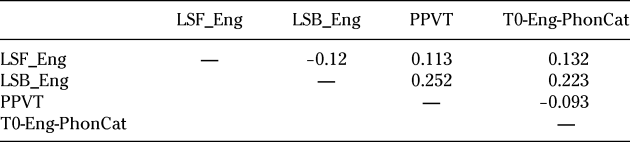
Two separate multiple linear regression analyses were implemented with four independent predictor variables and two dependent variables (see following text). The independent variables that were included were forward digit span for English (DS-F_Eng), backward digit span for English (DS-B_Eng), English Vocabulary (PPVT), and English Phonetic Categorization (T0_Eng_PhonCat). Independent variables were analyzed for intercorrelations (see Table 1) to reduce multicollinerarity. A bivariate correlation analysis revealed no significant intercorrelations.
Correlation of predictor variables

Note. None of the correlations were significant, p > 0.2.
Two multiple linear regression models were run (using SPSS; http://www.ibm.com/analytics/us/en/technology/spss/). The model with vocabulary growth score as a dependent variable was run, followed by the model with self-rated proficiency as a dependent variable. An enter method was chosen because there was an a priori hypothesis that L1 cognitive-linguistic skills would predict L2 linguistic acquisition.
DESCRIPTIVE STATISTICS
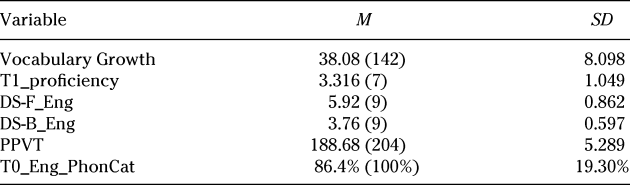
Descriptive statistics for the dependent and independent variables are shown in Table 2. Learners’ proficiency after one semester of ASL instruction was low to moderate. Learners self-rated their proficiency at a 3.3 (out of 7) and had a vocabulary score of 45.5 (out of 142). Learners also did not begin with a large vocabulary (M = 7.4 signs). On average, learners acquired 38.08 (SD = 8.098) signs of those in vocabulary test after one semester. All memory scores (forward: M = 5.92, SD = 0.862; backward: M = 3.76, SD = 0.597) were within normal limits and followed the typical pattern wherein backward recall capacity is less than forward recall capacity. English phoneme categorization ability was also within normal limits with approximately 86% accuracy; however, there was high variability across learners in the ability to classify speech sounds. Overall, these data fit the predicted profile of beginner M2L2 students.
Descriptive statistics of predictors and independent variables

Note. Numbers in parentheses are the highest possible value for that variable.
Model 1: Predictors of Vocabulary Growth
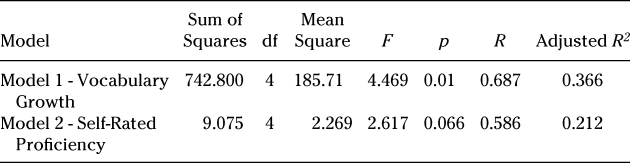
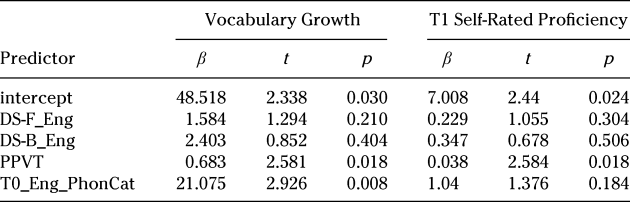
Results of the multiple linear regression analysis for Model 1 (Table 3) demonstrated that change in vocabulary knowledge is a linear function of the learners’ baseline English memory capabilities, English vocabulary knowledge, and English phonetic (or audiovisual) processing ability. This model significantly predicted change in L2 ASL vocabulary knowledge and captured 36.6% variance (R = 0.687, adjusted R 2 = 0.366). The overall F for the four-variable model was 4.469, df = 4, 24, p < .01. Standardized beta weights (Table 4) showed that L1 vocabulary knowledge (PPVT) and English phoneme categorization skills (T0_Eng_PhonCat) significantly contributed to the model. Neither of the memory variables significantly predicted change in L2 ASL vocabulary knowledge.
Regression model summaries

Regression model coefficients

Model 2: Predictors of T1 Self-Rated Proficiency
Results for Model 2 (Table 3) demonstrated that the four predictor variables moderately accounted for T1 self-rated proficiency (p = 0.066). There was a significant contribution of extant English vocabulary knowledge (PPVT; p < 0.05). The other predictors were not significant (p > 0.1).
GENERAL DISCUSSION
In the present study, cognitive and linguistic baseline skills were tested to identify predictors of initial M2L2 sign language acquisition during the first semester of ASL. A longitudinal study was implemented that followed 25 beginning M2L2 ASL learners. The learners were tested at the beginning of their first semester (0.75 hours of instruction; T0) and again at the end of that same semester (43.98 hours of instruction; T1). Two dependent variables were tested separately as proxies for L2 proficiency: L2 vocabulary knowledge and self-rated proficiency. Four predictors were used to predict L2 success that covered cognitive (e.g., L1 short-term and working memory capacity) and linguistic (e.g., lexical knowledge and phonetic processing) domains. Results from two multiple linear regression models indicated that English vocabulary knowledge predicted both ASL vocabulary knowledge and self-rated proficiency at the end of the first semester. English phonetic categorization skills significantly predicted ASL vocabulary knowledge and showed a trending significance to predict self-rated proficiency. Measures of L1 memory capacity did not significantly predict either of the independent measures of proficiency. Taken together, it seems that L1 English lexical and phonetic processing ability best predict L2 ASL learning, despite modality differences.
ASL lexical acquisition was measured by a vocabulary translation task developed from the learners’ ASL curricula. Three broad categories of predictors were used: memory, lexical, and phonetic processing. It was hypothesized that all of these skills would predict sign language vocabulary acquisition to some degree; however, specifically it was hypothesized that English phonetic categorization skill and vocabulary knowledge would be the best predictors, as these two skills are the foundation for general lexical knowledge, which can be transferred to the L2, regardless of modality.
Self-rated proficiency was collected because it was thought to represent a gross measure of M2L2 proficiency, which included lexical knowledge but also other areas such as grammatical competence. The assumption that self-rated proficiency might cover other linguistic domains provided an avenue to examine what other predictors may be important to M2L2 success. English vocabulary knowledge was the most significant contributor to self-rated proficiency, followed by English phonetic categorization skills. Despite the nonsignificant correlation between ASL vocabulary knowledge and self-rated proficiency after one semester of instruction, similar cognitive-linguistic skills significantly predicted L2 outcomes.
Previous studies have shown that L1 vocabulary knowledge predicts L2 vocabulary knowledge and reading competence when both languages are spoken (Lervåg & Aukrust, Reference Lervåg and Aukrust2010; McBride-Chang et al., Reference McBride-Chang, Cheung, Chow, Chow and Choi2006; Proctor et al., Reference Proctor, August, Carlo and Snow2006). The predictive power of L1 vocabulary knowledge on L2 proficiency acquisition is thought to arise out of an interdependence between the two languages (Cummins, Reference Cummins1979). The present study was able to demonstrate such an interdependence between a spoken language (e.g., English) and a sign language (e.g., ASL). This study extends previous studies that have shown positive effects of proficient sign language knowledge on the acquisition of written English (e.g., Mayberry, Del Giudice, & Lieberman, Reference Mayberry, Del Giudice and Lieberman2011). Additionally, the present results show an interdependence of two language modalities at the lexical level, which has been hypothesized previously by researchers studying the bimodal bilingual lexicon (Giezen & Emmorey, Reference Giezen and Emmorey2016; Shook & Marian, Reference Shook and Marian2012; Williams & Newman, Reference Williams and Newman2016a, Reference Williams and Newmanin press).
English phonetic categorization skills significantly predicted both vocabulary knowledge and self-rated proficiency. English phonetic skills in many ways represent audiovisual processing. Learners often attend to the mouth when acquiring sign language (Emmorey et al., Reference Emmorey, Thompson and Colvin2009). Fixation on the mouth likely provides English-based support for lexical acquisition for hearing nonnative signers. For example, other nonnative learners may whisper or mouth English while signing, which supports L2 processing and vocabulary acquisition. Therefore, learners who have better audiovisual phonetic processing may also have better lip-reading skills. A recent study demonstrated that L2 ASL learners who used more lip-reading showed greater phonological processing (i.e., activation in the superior marginal gyrus) in response to ASL signs, which would require greater lexical sign knowledge (Williams et al., Reference Williams, Darcy and Newman2016b).
Data from a previous longitudinal study demonstrated that both English and ASL phonetic categorization skills were correlated in this group of learners (r = 0.875, p < 0.001). It might be possible that general (i.e., modality-independent) phonetic processing skills underlie L2 acquisition. In other words, given that English and ASL phonetic categorization skills are correlated and English phonetic categorization skills are linearly related to ASL vocabulary knowledge after one semester of learning, then it is likely the case the ASL phonetic categorization skills would also predict these dependent measures if the English predictor variable was eliminated from the model. It has been shown that the neural substrates that underlie phonetic segmentation and processing are the same across spoken and sign languages (Corina et al., Reference Corina, Chiu, Knapp, Greenwald, San Jose-Robertson and Braun2007; Emmorey, Xu, Gannon, Goldin-Meadow, & Braun, Reference Emmorey, Xu, Gannon, Goldin-Meadow and Braun2010; Williams et al., Reference Williams, Darcy and Newman2015b). Therefore, it may be the case that a learner’s ability to segment linguistic information underlies the ability to acquire new lexical items.
Measures of memory abilities did not significantly predict vocabulary growth or self-rated proficiency. One explanation for this null result is that the digit span measure is not fine-grained enough to capture the variability among these learners and more complex measures of memory skill may be needed. Another possibility is that sign language acquisition relies on visuospatial memory more so than verbal phonological memory, especially with learners in transition between using one language modality and learning another. A recent study (Williams et al., Reference Williams, Darcy and Newman2015a) showed that a simple span task (i.e., digit span) correlated with self-rated L2 proficiency in Spanish but not ASL. It has been hypothesized that perhaps simple verbal working memory measures do not predict M2L2 sign language acquisition because (a) learners have an indexing bias that prevents them from being able to relegate visual linguistic information to the visuospatial sketchpad; and (b) spatial working memory measures may be more appropriate to predict L2 sign language outcomes instead of verbal recall tasks (Hirshorn et al., Reference Hirshorn, Fernandez and Bavelier2012; Williams et al., Reference Williams, Darcy and Newman2015a).
CONCLUSION
Despite spoken and sign languages using separate modalities, cognitive and linguistic skills that underlie spoken language processing predict sign language acquisition. First language vocabulary knowledge and phonetic processing ability determine lexical sign acquisition and a learner’s perception of their signing ability. These findings are important because they provide insights into how two languages interact to aid in acquisition, even when they require two different modalities. Thus, phonetic and lexical knowledge may be bootstrapped supramodally to aid in language L2 acquisition. Given the sample size in the current study, these findings may not generalize to a larger population of learners. However, this is a significant first step to identifying salient acquisition predictors. Beyond theoretical implications, the present study may also have translational value. Given that English (and possibly ASL) phonetic processing skills are key to sign language vocabulary acquisition in initial stages of learning, sign language programs may want to include training in phonetic processing. The study of M2L2 sign language pedagogy is quite sparse and lacking. It is unknown whether this type of training may be important. However, beginning learners (or nonsigners) learn new lexical signs more accurately when target signs maximize the perceptibility (i.e., movement sonority or handshape markedness) of phonetic features (Geer, Reference Geer2016; Williams & Newman, Reference Williams and Newman2016b). Further studies are needed to tease apart why these specific skills predict lexical outcomes, whether these same skills predict other areas of linguistic competence (e.g., grammar), and whether there is generalizability with a larger sample of learners.