INTRODUCTION
Common dolphins (Delphinus spp.) occur globally in tropical to temperate oceans. In the eastern North Pacific they are found from 36°N to the equator and offshore to about 142°W (Perrin et al., Reference Perrin, Scott, Walter and Cass1985; Leatherwood et al., Reference Leatherwood, Reeves, Perrin and Evans1988). After analysing morphometric and meristic data from more than 270 specimens from southern California, Heyning & Perrin (Reference Heyning and Perrin1994) concluded that there are two species of common dolphins in the eastern Pacific: a smaller, short-beaked species (D. delphis), distributed in three apparently separated populations (one north of 32°N off southern California, one between 28° and 30°N off Baja California, Mexico, and one south of 15°N), and a larger, long-beaked species (D. capensis), occurring inside the 100-fathom curve north of 20°N.
Both species of Delphinus occur in the Gulf of California, Mexico, where the short-beaked species is rare and the long-beaked is very common (Vidal et al., Reference Vidal, Findley and Leatherwood1993; Heyning & Perrin, Reference Heyning and Perrin1994). The latter is in fact the most common and abundant cetacean in the Gulf of California, with sightings in all seasons and throughout the Gulf where they are incidentally killed in gillnet fisheries as well as purse-seine fisheries targeting tunas and sardines (Perrin et al., Reference Perrin, Scott, Walter and Cass1985; Vidal et al., Reference Vidal, Findley and Leatherwood1993, Reference Vidal, Van Waerebeek and Findley1994; Silber et al., Reference Silber, Newcomer, Silber, Pérez-Cortés and Ellis1994; Niño-Tórres et al., Reference Niño-Tórres, Urbán-Ramírez and Vidal2011).
Between early January and mid-February 1995, at least 366 dolphins, eight baleen whales (Balaenoptera spp.), 51 California sea lions (Zalophus californianus) and 200 sea birds of four species died in the upper Gulf of California (Vidal & Gallo-Reynoso, Reference Vidal and Gallo-Reynoso1996). The causes of these die-offs remain unknown but were probably the result of the presence of a toxic substance in the water (Vidal & Gallo-Reynoso, Reference Vidal and Gallo-Reynoso1996). We were able to closely examine 160 of the 366 dolphins: 154 were long-beaked common dolphins and six were common bottlenose dolphins (Tursiops truncatus). Most of the remaining 206 dolphins, which were counted with 8× binoculars from a small aeroplane at altitudes of less than 150 m, were almost certainly long-beaked common dolphins. In this paper we document the composition by sex and size of 105 of the 154 long-beaked common dolphins which we were able to measure and which were not badly decomposed, and compare these data with those from the literature.
MATERIALS AND METHODS
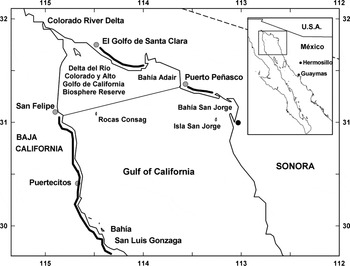
Sixty-seven of these dolphins were examined on the beach near El Golfo de Santa Clara (31°41′12″N 114°29′59″W), Sonora, and 38 between San Felipe (31°01′39″N 114°50′07″W) and Bahía San Luis Gonzaga (29°46′36″N 114°20′24″W), Baja California (Norte) (Figure 1). Determination of sexes and all measurements were taken by one of us (O.V.) following standards set by Norris (Reference Norris1961).
Locations of carcasses of long-beaked common dolphins (indicated by the black bars parallel to the coast); the line connecting San Felipe and Puerto Peñasco represents the southern limits of the Upper Gulf of California and Colorado River Delta Biosphere Reserve (modified from Vidal & Gallo-Reynoso, Reference Vidal and Gallo-Reynoso1996).

RESULTS
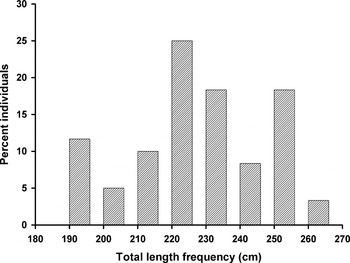
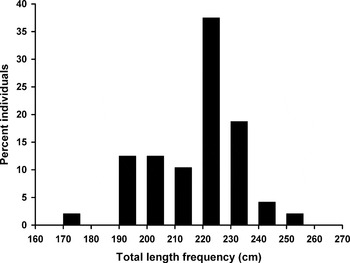
Total length (TL) of 57 males ranged from 191.2 to 264.7 cm (standard deviation (SD) = 20.6) and those of 48 females ranged from 170.0–252.4 cm (SD = 16.7) (Figures 2 & 3). In addition, two female near-term aborted foetuses measured 80.3 and 83.5 cm TL. To our knowledge, this is the first time biologists have had the opportunity to examine, and measure, such a large number of Delphinus which died because of causes other than by-catch.
Total length–frequency (cm) of 57 male Delphinus capensis from a die-off in the Gulf of California, Mexico.

Total length–frequency (cm) of 48 female Delphinus capensis from a die-off in the Gulf of California, Mexico.

DISCUSSION
Evans (Reference Evans, Ridgway and Harrison1994) mentioned that although the recorded maximum TL for Delphinus spp. (then known only as D. delphis) is 260 cm TL (presumably making reference to a 254-cm male from South Africa reported by Ross, Reference Ross and Gess1984; also mentioned by Best, Reference Best2007), the majority of adult specimens examined by Evans (Reference Evans, Ridgway and Harrison1994) and reported in the literature were less than 230 cm TL. Evans (Reference Evans, Ridgway and Harrison1994) also reported that mean TL of 33 adult male and 47 female common dolphins from southern California and off Baja California, Mexico (his ‘northern stock’) were 187.5 and 178.3 cm, respectively; and that mean TL of 40 adult males and 48 females from the eastern tropical Pacific (his ‘Baja neritic’ form) were 208 cm and 196 cm, respectively. Total lengths of 15 mature males and 10 mature female long-beaked common dolphins from southern California ranged from 202–235 cm and from 193–224 cm, respectively (Heyning & Perrin, Reference Heyning and Perrin1994).
The analysis of TL of adult specimens reported by Evans (Reference Evans, Ridgway and Harrison1994), Heyning & Perrin (Reference Heyning and Perrin1994) and those reported herein shows that 18 (30%) males and 24 (62%) females from our sample are longer than those reported by Heyning & Perrin (Reference Heyning and Perrin1994). The longest male and female in our sample are 30 and 28 cm, respectively, longer than the ones reported by Heyning & Perrin (Reference Heyning and Perrin1994). And mean total lengths of our specimens are larger than those reported by Heyning & Perrin (Reference Heyning and Perrin1994) (11 cm larger for males, 13 cm for females), and than those reported by Evans (Reference Evans, Ridgway and Harrison1994) (22 cm larger for males, 25 cm for females). Mean and maximum TL will vary between populations and ocean basins, for example, in the eastern North Atlantic, Kuiken et al. (Reference Kuiken, Simpson, Allchin, Bennett, Codd, Harris, Howes, Kennedy, Kirkwood, Law, Merrett and Phillips1994) reported the longest TL of male and female D. delphis were 244 cm and 213 cm, respectively.
It is noteworthy that in the 105 specimens we examined there were none with TL in the range of newborns to juveniles, ~85 to 170 cm. This suggests that: (i) newborns and juveniles were not affected by the die-off; or (ii) dolphin schools affected by the die-off did not contain younger dolphins. The latter case seems to be the most likely as any toxin is unlikely to be age-class specific.
Data presented here suggest that: (1) long-beaked common dolphins from the Gulf of California are larger than those inhabiting California waters and, in fact, larger than any Delphinus taxon reported to date anywhere in the world (see Evans, Reference Evans, Ridgway and Harrison1994; Kuiken et al., Reference Kuiken, Simpson, Allchin, Bennett, Codd, Harris, Howes, Kennedy, Kirkwood, Law, Merrett and Phillips1994; Jefferson & Van Waerebeek, Reference Jefferson and Van Waerebeek2002; Murphy et al., Reference Murphy, Herman, Pierce, Rogan and Kitchener2006; Van Bressem et al., Reference Van Bressem, Van Waerebeek, Montes, Kennedy, Reyes, García-Godos, Onton-Silva and Alfaro-Shigueto2006; Best, Reference Best2007); or (2) due to small sample sizes, total lengths of long-beaked common dolphins from California, Baja California, Mexico and other parts of the eastern tropical Pacific may be biased. We think it noteworthy that the majority of specimens examined by Evans (Reference Evans, Ridgway and Harrison1994) and Heyning & Perrin (Reference Heyning and Perrin1994) came from incidental catches in the tuna purse-seine fishery. As several authors have pointed out (e.g. Perrin & Reilly, Reference Perrin and Reilly1984), the vulnerability of dolphins to die in fishing gears is influenced by their age, sex and reproductive condition. Nevertheless, the differences in size between the long-beaked common dolphins from the Gulf of California and those from the eastern tropical Pacific may well be real and thus represent the possibility of a different population of D. capensis in the Gulf of California.
As described by Vidal & Gallo-Reynoso (Reference Vidal and Gallo-Reynoso1996), D. capensis specimens were the main species recorded in the mass mortality of cetaceans, sea lions and seabirds in the upper Gulf of California during January and February 1995. It is important to note this case was a die-off and not a mass stranding which are much more common.
ACKNOWLEDGEMENTS
We thank the Government of Sonora, the then Mexican Secretariat of the Environment, Natural Resources and Fisheries (SEMARNAP, Sonora office), Mexico's Federal Office for Environmental Protection (PROFEPA, Sonora office), the Mexican Navy (Guaymas contingent), the then Conservation International Gulf of California Program, and Televisa television channel for logistical support. We also thank J. Torre, F. Melo, L. Varela and J.M. Sámano for assistance in the field. R.L. Brownell, Jr, L.T. Findley, W.F. Perrin and an anonymous referee offered useful suggestions for improving the manuscript.