Introduction
‘(…) we are still without an explanation of the essential nature of delusion. The same may be said for the attempt to derive delusion from preceding affects (…).’ Jaspers (Reference Jaspers, Hoenig and Hamilton1963). We have come some way since this sobering evaluation by Jaspers in the 1960s. A number of theoretical models on the emergence of positive symptoms have been proposed synthesizing evidence on cognitive, social, and emotional processes from epidemiological, cross-sectional, experimental, and intervention studies (e.g. Garety et al. Reference Garety, Kuipers, Fowler, Freeman and Bebbington2001; Beck & Rector, Reference Beck and Rector2003; Kesting & Lincoln, Reference Kesting and Lincoln2013; Bentall et al. Reference Bentall, de Sousa, Varese, Wickham, Sitko, Haarmans and Read2014; Howes & Murray, Reference Howes and Murray2014). Although these models differ in emphasis, they cohere in stressing the importance of negative affect and extreme negative beliefs about the self [negative-self-schemas (NSS)] in explaining the exacerbation of psychosis.
In one of the first and most widely cited of these models, positive symptoms are postulated to be both exacerbated and maintained by NSS, resulting from external stressors and social adversity (Garety et al. Reference Garety, Kuipers, Fowler, Freeman and Bebbington2001). Specifically, the model postulates a unidirectional pathway from NSS to symptoms, which is mediated by negative affect. This model has been cited more than 500 times according to Web of Science since its publication in 2001. It has been immensely important to inform CBTp (cognitive behavioral therapy for psychosis) that lays an emphasis on changing dysfunctional beliefs about the self and now is recommended as a first-line treatment for psychosis (National Institute for Health & Clinical Excellence, 2009). In a recent model, Howes & Murray (Reference Howes and Murray2014) integrate the perspective originally proposed in cognitive models of psychosis, e.g. (Garety et al. Reference Garety, Kuipers, Fowler, Freeman and Bebbington2001, Reference Garety, Bebbington, Fowler, Freeman and Kuipers2007; Morrison, Reference Morrison2001; Beck & Rector, Reference Beck and Rector2002, Reference Beck and Rector2003) with socio-developmental (van Os et al. Reference van Os, Kenis and Rutten2010; Bentall et al. Reference Bentall, de Sousa, Varese, Wickham, Sitko, Haarmans and Read2014), and neural (Kapur et al. Reference Kapur, Mizrahi and Li2005) explanations of psychosis. They postulate that childhood adversity both sensitizes the dopamine system, resulting in excessive dopamine synthesis and aberrant assignment of salience to stimuli, and biases the cognitive schema that the individual uses to interpret experiences in a way that renders paranoid interpretations more likely.
The central postulates related to the cognitive processes in these models are that: (1) social stressors result in NSS, (2) that NSS precede and cause symptoms via affective states. Whereas the first postulate has been backed up by evidence in a rigorous 30-year longitudinal study (Fergusson et al. Reference Fergusson, McLeod and Horwood2013), the second has found some support but lacks evidence from compelling longitudinal studies. Specifically, the postulate that NSS play an important role in the emergence of symptoms has been supported by the finding that decreases in self-esteem precede paranoid symptoms within brief intervals in daily life (Thewissen et al. Reference Thewissen, Bentall, Oorschot, à Campo, van Lierop, van Os and Myin-Germeys2011) and in experimental studies (e.g. Kesting et al. Reference Kesting, Bredenpohl, Klenke, Westermann and Lincoln2013) and over the course of months in a longitudinal study (Fowler et al. Reference Fowler, Hodgekins, Garety, Freeman, Kuipers, Dunn, Smith and Bebbington2012). Similarly, experience sampling studies show that negative affect precedes the emergence of paranoia in daily life (Ben-Zeev et al. Reference Ben-Zeev, Ellington, Swendsen and Granholm2011; Thewissen et al. Reference Thewissen, Bentall, Oorschot, à Campo, van Lierop, van Os and Myin-Germeys2011; Kramer et al. Reference Kramer, Simons, Wigman, Collip, Jacobs, Derom, Thiery, van Os, Myin-Germeys and Wichers2013) and two longitudinal studies found anxiety and depression to predict paranoia over the course of several months (Fowler et al. Reference Fowler, Hodgekins, Garety, Freeman, Kuipers, Dunn, Smith and Bebbington2012; Oliver et al. Reference Oliver, O'Connor, Jose, McLachlan and Peters2012). However, the only study that investigated the role of negative affect as a mediator of the longitudinal association between NSS and positive symptoms (Oliver et al. Reference Oliver, O'Connor, Jose, McLachlan and Peters2012) used a design with only two assessment points (T1, T2). They found a unidirectional association between NSS (T1) and delusional ideation (T2) in university students from the UK and New Zealand, which was fully mediated by anxiety (T2), but not by depression. Although the findings are promising, it needs noting that the design was not ideally suited to establish whether changes in negative affect follow NSS and precede increases in symptoms, as a rigorous test of this assumption requires at least three assessment points.
Furthermore, most of the accumulated evidence on the association between NSS and positive symptoms is based on narrow single subpopulations of people from white, educated, industrialized, rich, democratic countries, which may not be generalizable to other subpopulations (Henrich et al. Reference Henrich, Heine and Norenzayan2010). Because culture is likely to play a role in the way psychotic experiences are appraised and maintained (e.g. Luhrmann et al. Reference Luhrmann, Padmavati, Tharoor and Osei2015), investigating the antecedents of symptoms in culturally broader samples is necessary to arrive at generalizable findings.
In the face of the existing state of research, we agree with Howes & Murray (Reference Howes and Murray2014) who concede that further evidence to support the proposal that schemas are biased before the onset of psychosis is needed. Clarifying whether NSS and negative affect are predictors of positive symptoms or consequences makes a large difference to the way we understand and treat positive symptoms of psychosis. If the postulated causal pathway from NSS to symptoms via affect is confirmed, this implies that a therapeutic focus on self-schema and affect in the pre-morbid phase could be an effective way to prevent the development of the full clinical disorder. In contrast, if negative affect and NSS temporally follow the experience of positive symptoms, then the more plausible approach would be to continue to focus on reducing symptoms and enhancing patients’ coping abilities.
The present study thus tested the following hypotheses using auto-regressive cross-lagged path analysis with four evenly spaced assessment points across 12 months in large community samples from Germany, Indonesia, and the USA: (1) NSS longitudinally predict positive symptoms and (2) the association between NSS and symptoms is longitudinally mediated by negative affect.
Method
Participants and procedure
Participants from Germany, Indonesia, and the USA were recruited through Crowdflower, a crowdsourcing website, and other websites (e.g. internet forums and social networking websites) to complete an anonymous 30-min online survey. Only participants who agreed with the consent statements and reported to be above 18 years of age were included. After completing the baseline survey (T0), participants were invited via email to complete a follow-up survey after 4 (T1), 8 (T2), and 12 months (T3). Participants who completed the baseline survey received an invitation to the follow-up surveys. Participants recruited from Crowdflower received 0.50 US$ for completing the baseline survey (T0) following the median hourly wage typical of online recruitment platforms (Buhrmester et al. Reference Buhrmester, Kwang and Gosling2011). To motivate participation in follow-ups, the compensation was increased subsequently (T1, 0.60 US$; T2, 0.80 US$; T3, 1.00 US$). Participants recruited from other websites could not be given compensation for reasons of data protection. The study received ethical approval from the German Psychological Society.
There were 2501 completed baseline survey entries of which 151 were excluded due to duplicate entries [n = 98), longstring (i.e. providing the same answer consecutively for 50 items, n = 46, see Johnson (Reference Johnson2005)], and inconsistent answers (n = 7). The baseline (T0) sample consisted of 2350 participants of whom 720 participants completed the English, 786 the German and 844 the Indonesian version of the survey, 1447 of these participants responded at T1 (response rate = 61.6%), 1244 at T2 (response rate = 52.9%), and 943 at T3 (response rate = 40.1%). The participants who responded to the invitation were then subjected to the same inclusion criteria (i.e. complete entry, no longstring, consistent answers). Based on these criteria, there were 682 participants at T1, 409 at T2, and 366 at T3, of which 135 participants completed all follow-up assessments. A detailed participant flowchart following the STROBE (STrengthening the Reporting of OBservational studies in Epidemiology) guideline (Vandenbroucke et al. Reference Vandenbroucke, Elm, Altman, Gøtzsche, Mulrow, Pocock, Poole, Schlesselman and Egger2007) is available in the Supplementary (Fig. S1). For the current analysis, we included participants who participated in at least one follow-up survey (n = 962) of whom 302 participants completed the English, 312 the German and 348 the Indonesian version of the survey.Footnote †Footnote 1
Measures
Back-translation procedure and cultural adaption of measures were conducted by native Germans, British and Indonesians according to a guideline (Schmitt & Eid, Reference Schmitt and Eid2007). A complete description of the scale and scoring procedure is available from the corresponding author.
NSS were measured with the negative-self subscale from the Brief Core Schema Scale (BCSS, Fowler et al. Reference Fowler, Freeman, Smith, Kuipers, Bebbington, Bashforth, Coker, Hodgekins, Gracie, Dunn and Garety2006). The subscale comprised six items (e.g. ‘I am unloved’) rated on a 5-point Likert scale from ‘no, do not believe it’ to ‘yes, believe it totally’. Good validity and reliability of the scale have been reported (Fowler et al. Reference Fowler, Freeman, Smith, Kuipers, Bebbington, Bashforth, Coker, Hodgekins, Gracie, Dunn and Garety2006). The negative-other subscale was not included in the main analysis because the focus was on self-related schema and the items of the negative-other (e.g. ‘Other people are devious’, ‘Other people are hostile’) resemble some of the items assessing paranoid thoughts in the Community Assessment of Psychic Experiences (CAPE, Stefanis et al. Reference Stefanis, Hanssen, Smirnis, Avramopoulos, Evdokimidis, Stefanis, Verdoux and van Os2002), which impedes on the interpretability of associations found. However, the results of the analysis for negative-other schemas can be found in the Supplementary Tables (S8–S12) and are discussed in the Supplementary Text (S3).
Anxiety was measured with the seven-item Generalized Anxiety Disorder-7 scale (GAD-7, Spitzer et al. Reference Spitzer, Kroenke, Williams and Löwe2006) that includes items such as ‘Feeling nervous, anxious or on edge’. Depression was measured with the nine-item Patient Health Questionnaire-9 (PHQ-9) that is based on the DSM-IV criteria for depression (Kroenke et al. Reference Kroenke, Spitzer and Williams2001) with items such as ‘Feeling down, depressed, or hopeless’. For both scales the instruction was as follows: ‘Over the last 4 weeks, how often have you been bothered by any of the following problems?’ on a 4-point Likert scale from ‘not at all’ to ‘nearly every day’. Both scales have been shown to have good reliability and validity in large representative population samples (Martin et al. Reference Martin, Rief, Klaiberg and Braehler2006; Löwe et al. Reference Löwe, Decker, Müller, Brähler, Schellberg, Herzog and Herzberg2008). Negative affect was defined as the combined sum-score of the PHQ-9 and GAD-7.
Positive symptoms were measured with the 20-item positive symptom subscale from the CAPE (Stefanis et al. Reference Stefanis, Hanssen, Smirnis, Avramopoulos, Evdokimidis, Stefanis, Verdoux and van Os2002), which assesses a range of symptoms, such as paranoia (e.g. ‘Have you ever felt that you were being persecuted in any way?’) and hallucinations (e.g. ‘Do you ever hear voices when you are alone?’). The items were answered on a 4-point Likert scale from ‘never’ to ‘nearly always’ to measure the frequency of the occurrence of symptoms and from ‘not distressed’ to ‘very distressed’ to measure the appraisal of symptoms. The frequency and distress scales were combined into a weighted score reflecting the severity of each symptom, specifically by multiplying an item´s frequency score with its associated distress score. For example, if an individual reported that they ‘sometimes’ heard voices (frequency score of 2) and were ‘quite distressed’ by this experience (distress score of 3), they would receive a severity score of 6. The final score was the sum of severity scores. The German and English versions of the CAPE demonstrate good validity and reliability (Brenner et al. Reference Brenner, Schmitz, Pawliuk, Fathalli, Joober, Ciampi and King2007; Schlier et al. Reference Schlier, Jaya, Moritz and Lincoln2015).
Analyses
We examined the temporal relationships between NSS, negative affect and positive symptoms using cross-lagged panel models. Cross-lagged panel models are ideal for examining temporal associations between two variables, because they take various sources of error, such as the stability of the variables, cross-sectional associations, and prior associations into account.
Before computing the cross-lagged panel models, we tested two preconditions: (1) a saturated model that assumes all variables are significantly inter-correlated cross-sectionally and across all assessment points; (2) a within-construct longitudinal model to estimate the extent to which past scores on a variable predict temporally following scores on that variable (e.g. NSS at T0 predict NSS at T1).
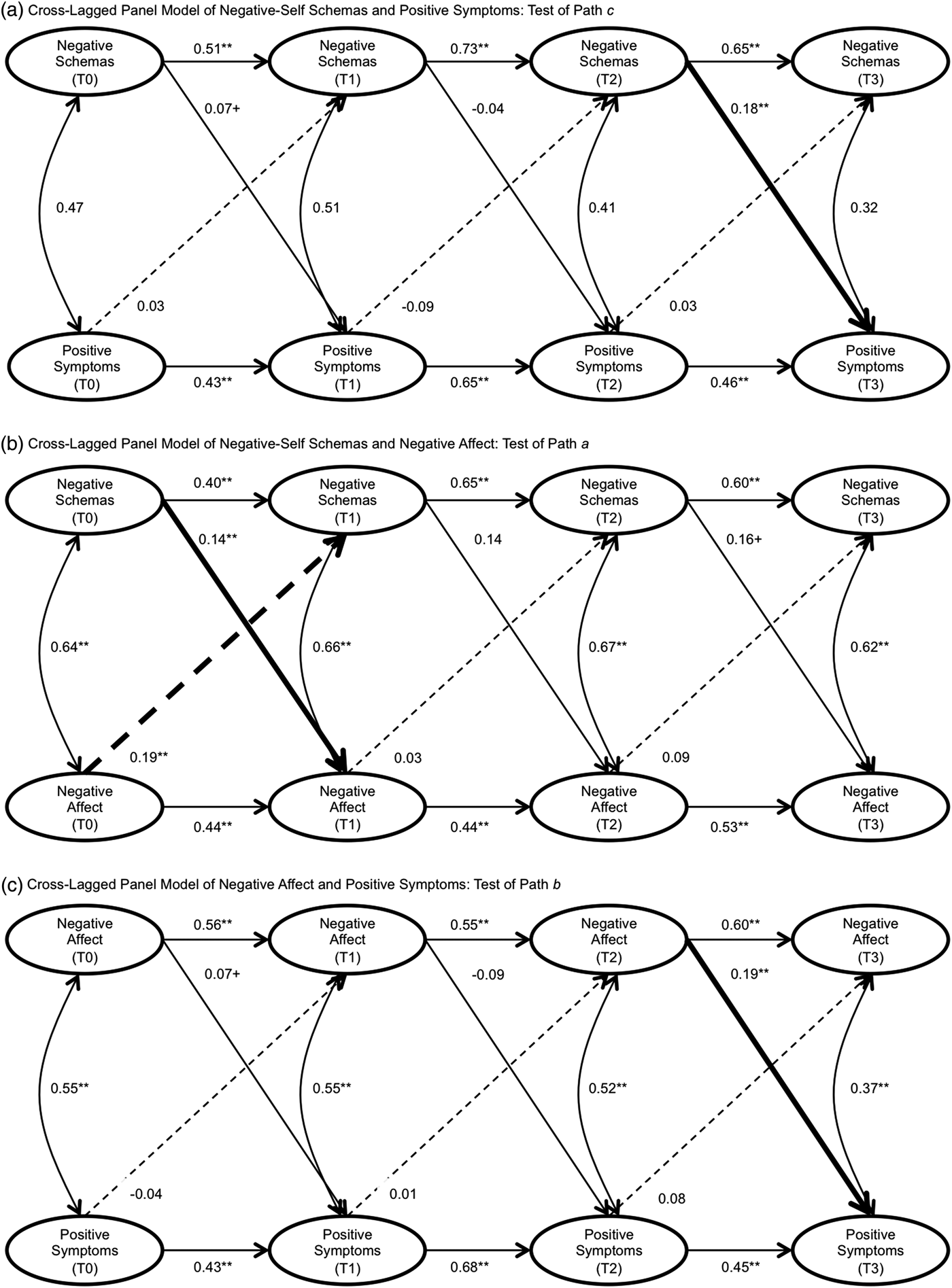
Before computing the longitudinal mediation model, three preconditions for mediation derived from Baron & Kenny's (Reference Baron and Kenny1986) causal steps approach were established, using cross-lagged panel models: (1) NSS longitudinally predict positive symptoms (path c, see Fig. 1a); (2) NSS longitudinally predict negative affect (path a, see Fig. 1b); (3) negative affect longitudinally predicts positive symptoms (path b, see Fig. 1c). In each step, we also tested for the possibility of reverse pathways.
Prospective associations of negative-self-schemas, negative affect, and positive symptoms. Note. Dotted arrows indicate reverse pathways. Non-dotted arrows indicate hypothesized pathways. Bolded arrows indicate significant cross-lagged pathways. Bi-directional arrows indicate association. Uni-directional arrows indicate prediction. Path coefficients are completely standardized. Negative schemas = Negative-self-schemas; T0, baseline; T1, month 4; T2, month 8; T3, month 12. (a) Model fit = χ2 (12) = 88, p < 0.01, Comparative fit index (CFI) = 0.951, Root-mean-square error of approximation (RMSEA) = 0.081 [90% CI 0.066–0.097], Standardized root-mean-square residual (SRMR) = 0.060, Akaike information criterion (AIC) = 13 130. (b) Model fit = χ2 (12) = 50, p < 0.01, CFI = 0.984, RMSEA = 0.057 [90% CI 0.041–0.074], SRMR = 0.052, AIC = 13 130. (c) Model fit = χ2 (12) = 91, p < 0.01, CFI = 0.953, RMSEA = 0.083 [90% CI 0.067–0.099], SRMR = 0.069, AIC = 11 171. + p < 0.10, * p < 0.05, ** p < 0.01.

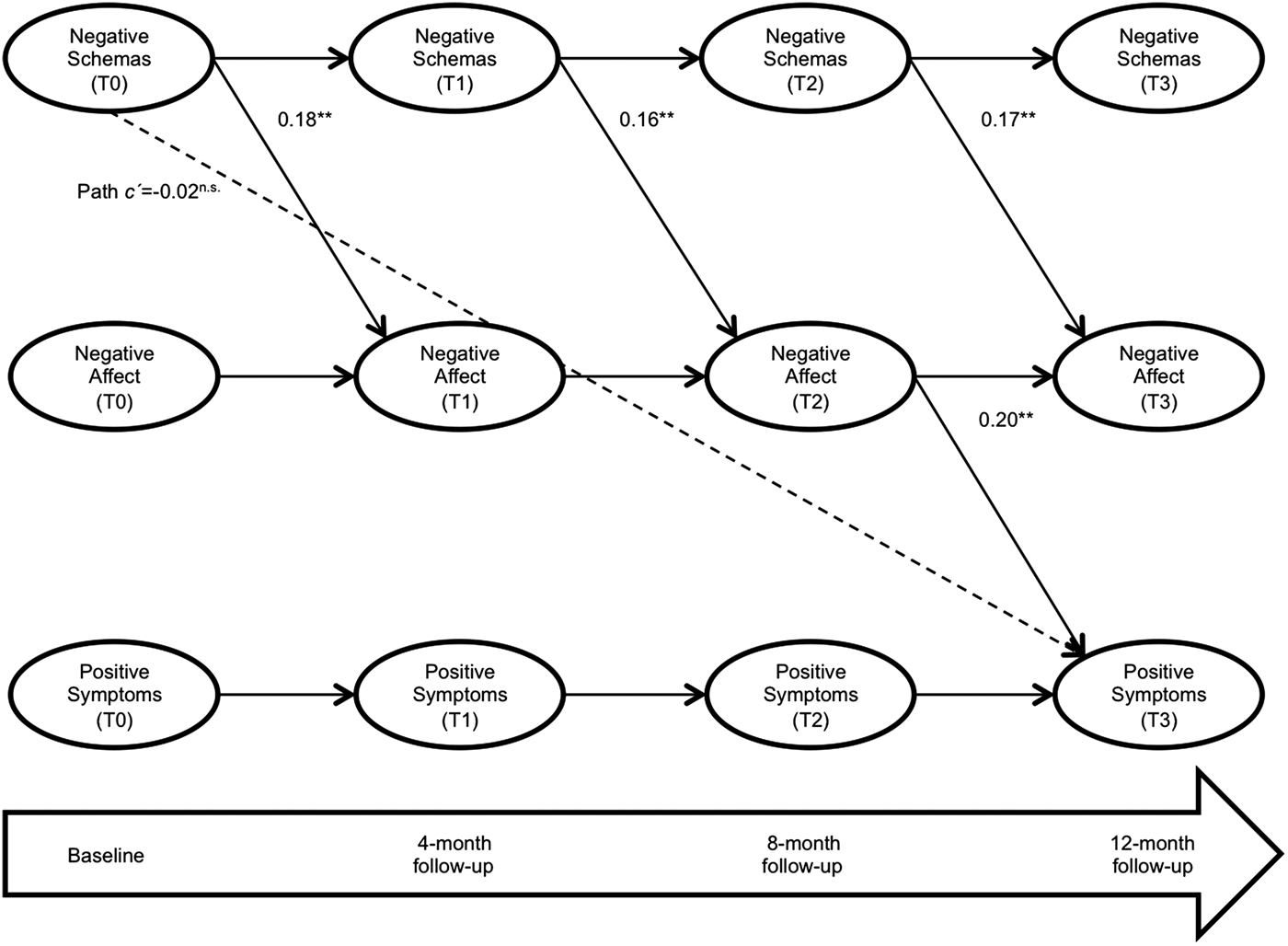
The longitudinal mediation analysis followed the suggestions by Preacher (Reference Preacher2015) in constructing the appropriate cross-lagged panel models (see Fig. 2, for the full statistical model, see Supplementary Fig. S2). Moreover, following Mayer et al. (Reference Mayer, Thoemmes, Rose, Steyer and West2014) we used indirect effect size estimates to confirm whether a variable is a mediator. Because we did not have time-specific hypotheses regarding the temporal mediation pathways (e.g., that the mediation via negative affect only occurs within the first 8 months), we computed and reported all possible indirect pathways and their respective effect size coefficients. The indirect effect coefficients were considered significant if the bias-corrected bootstrap 95% confidence interval (BCa CI) did not include zero (Cheung & Lau, Reference Cheung and Lau2008).
Longitudinal mediation analysis of negative-self-schemas, negative affect, and positive symptoms. Note. All cross-sectional associations are statistically significant at p < 0.05, only significant cross-lagged paths coefficients are reported. Dotted arrows indicate non-significant paths. Path coefficients are completely standardized. Negative schemas = Negative-self-schemas. T0, baseline; T1, month 4; T2, month 8; T3, month 12. Model fit = χ2 (38) = 170, p < 0.01, Comparative fit index (CFI) = 0.965, Root-mean-square error of approximation (RMSEA) = 0.060 [90% CI 0.051– 0.069], Standardized root-mean-square residual (SRMR) = 0.075, Akaike information criterion (AIC) = 15 661. n.s. = not significant. ** p < 0.01.

All of the analyses were conducted with structural equation modeling (SEM) using the lavaan package ver. 0.5–22 (Rosseel, Reference Rosseel2012) in R version 3.2.3. Reported path coefficients (γ and β) are completely standardized. Reported overall total effect, overall direct effect, and overall indirect effect coefficients are unstandardized. The following fit indices along with the proposed cut-off criteria were used to assess the fit between hypothesized models and the data: CFI > 0.95, RMSEA < 0.06, and SRMR < 0.08 (Hu & Bentler, Reference Hu and Bentler1999). The χ2 is reported but not used as a fit criterion because it tends to reject models that are based on large sample sizes (Bentler & Bonett, Reference Bentler and Bonett1980). All analyses were estimated using maximum-likelihood procedure with standard errors based on the first-order derivatives.
Little's missing completely at random (MCAR) test indicated that NSS, negative affect, and positive symptoms across measurement time points were MCAR [χ2 (45) = 54.18, p = 0.16]. However, the MCAR assumption was not supported when we looked at the correlations of various variables of interest with missing status. Furthermore, we found that individuals who did not complete any follow-up assessment in comparison to those who did were significantly younger and more likely to be male, as well as to have lower socio-economic status and more pronounced positive symptoms. However, they did not significantly differ in regard to NSS negative affect presence of diagnosis of any lifetime mental disorder, or presence of a diagnosis of schizophrenia or other psychotic disorders (see Supplementary Text S2 for details, and Supplementary Table S1 in correlation format). Consequently, the more conservative full information maximum likelihood (FIML) with missing at random (MAR) assumption was used.
Results
Participant characteristics
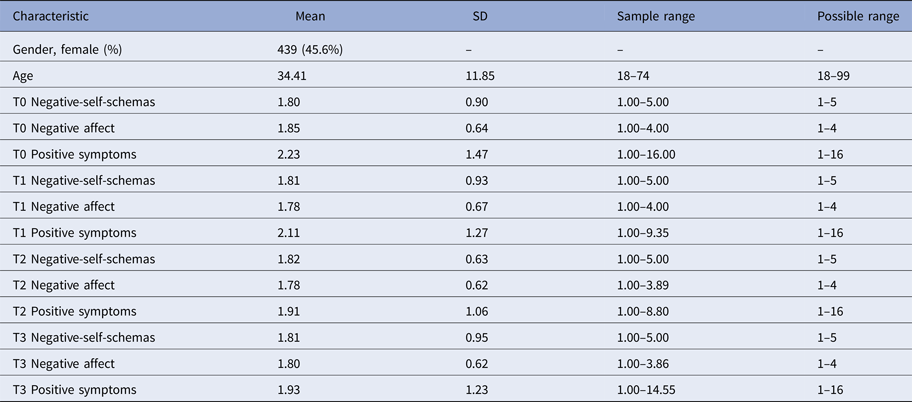
The participants were 34.4 years old on average and 45.6% were female. Generally, the participants tended to have a somewhat higher education, but a lower income in comparison with their national averages (see Supplementary Text S1). The employment status was diverse with 31.8% workers, 23.1% office employees, 14.9% university students, 6.9% self-employed, 6.0% helping family members (e.g. housewife), 5.4% freelancers, 7.6% were unemployed, and 4.3% other. Moreover, 31.2% of the participants reported a lifetime mental diagnosis, and 3.3% participants reported to have a current diagnosis of a psychotic disorder. Detailed participant characteristics are provided in Table 1.
Participant characteristics (N = 962)

Note. T0 n = 962, T1 n = 682, T2 n = 409, T3 n = 366.
Preconditions for cross-lagged panel models
First, saturated models showed that NSS, negative affect, and positive symptoms were significantly correlated with each other within and across time points (see Supplementary Table S2). Second, within-construct longitudinal models showed that previous measures significantly predicted subsequent measures for all variables of interest (see Supplementary Table S3) indicating that these constructs are stable over time to a certain extent. In addition, all fit indices of the cross-lagged panel models tested below (sections ‘Preconditions for longitudinal mediation analysis’ and ‘Longitudinal mediation’) met at least two out of three goodness of fit criteria (see notes of Figs 1 and 2), indicating that all parameter estimates can be interpreted.
Preconditions for longitudinal mediation analysis
First, NSS significantly predicted positive symptoms at the following time-points. In contrast, there were no significant reverse pathways from positive symptoms to NSS (for details see Fig. 1a and Supplementary Table S4). Second, NSS significantly predicted negative affect at the following time-points. One of the four possible reverse paths from negative affect to NSS was also significant indicating reverse causation (for details see Fig. 1b and Supplementary Table S5). Third, we found that negative affect significantly predicted positive symptoms at the following time-points. There were no significant reverse pathways from positive symptoms to negative affect (for details see Fig. 1c and Supplementary Table S6).
Longitudinal mediation
The longitudinal mediation model is shown in Fig. 2 (more details are available in Supplementary Table S7). As apparent in Fig. 2, there are three possible indirect pathways from NSS at T0 via negative affect to positive symptoms at T3, of which one was significant, one was trend-level significant and one was non-significant. First, the indirect effect consisting of the pathway from NSS at T0 to negative affect at T1, then from negative affect at T1 to negative affect at T2, and finally from negative affect at T2 to positive symptoms at T3 was significant (0.020, p < 0.05, 95% BCa CI, 0.004, 0.035). Second, the indirect effect consisting of pathways from NSS at T0 to NSS at T1, then from NSS at T1 to negative affect at T2, and finally from negative affect at T2 to positive symptoms at T3 was trend-level significant (0.021, p = 0.06, 95% BCa CI −0.001 to 0.042). Third, the indirect effect consisting of pathways from NSS at T0 to negative affect at T1, then from negative affect at T1 to positive symptoms at T2, and finally from positive symptoms at T2 to positive symptoms at T3 was not significant (−0.001, p = 0.15, 95% BCa CI −0.022 to 0.003). Furthermore, the pattern of results remained the same if we modeled the covariates (age, sex, and socioeconomic status) to be correlated (bivariate, and the direction of the relationship was not assumed) with NSS, negative affect and positive symptoms at all time points, but not to be correlated with each other.
Discussion
Informed by cognitive models of psychosis (particularly Garety et al. Reference Garety, Kuipers, Fowler, Freeman and Bebbington2001) this study set out to investigate the postulate that NSS precede symptoms and that negative affect mediates this association over the course of 1 year in a large multi-national sample. As hypothesized, we found a unidirectional, longitudinal pathway from NSS to positive symptoms. Together with previous work that provides support for a unidirectional pathway from NSS to paranoia (Fowler et al. Reference Fowler, Hodgekins, Garety, Freeman, Kuipers, Dunn, Smith and Bebbington2012; Oliver et al. Reference Oliver, O'Connor, Jose, McLachlan and Peters2012), we now have an increasing body of evidence pointing to a temporal precedence of NSS in the formation and maintenance of positive symptoms as postulated by the cognitive models (e.g. Garety et al. Reference Garety, Kuipers, Fowler, Freeman and Bebbington2001). Moreover, we could ascertain that this link is uni directional as we found no significant reverse pathways from positive symptoms to NSS. Finally, we confirmed one of the cognitive models’ core assumptions, namely that negative affect longitudinally mediates the path from NSS to positive symptoms.
Interestingly, the bidirectional pathways in the independent cross-lagged panel models suggest that NSS and negative affect enhance each other over time, although further research with larger samples is required to confirm this assumption. Our findings indicate that it takes a certain amount of time (about 8 months in our study) before this build-up of negative affect and NSS leads on to psychotic symptoms. This observation is in line with the clinical observation that patients with psychosis often present with problems related to anxiety or depression first, before developing psychotic disorders at a later time-point (Häfner et al. Reference Häfner, Maurer and an der Heiden2013). For example, in the Dutch Early Detection and Intervention Evaluation (EDIE-NL) trial more than 50% of the identified prodromal schizophrenia patients had a diagnosis of an anxiety disorder, depressive disorder, or both (van der Gaag et al. Reference van der Gaag, Nieman, Rietdijk, Dragt, Ising, Klaassen, Koeter, Cuijpers, Wunderink and Linszen2012a). Furthermore, the majority of individuals with an at-risk mental state have been found to have anxiety and/or depressive disorders (Fusar-Poli et al. Reference Fusar-Poli, Nelson, Valmaggia, Yung and McGuire2014). However, it is important to note that these disorder statuses were not found to increase the risk of transition to psychosis (Fusar-Poli et al. Reference Fusar-Poli, Rutigliano, Stahl, Davies, Bonoldi, Reilly and McGuire2017).
Moreover, our findings suggest that NSS and negative affect precede positive symptoms rather than vice versa. This indicates that they are likely to play a causal role in symptom formation, although we acknowledge that further criteria are required to ascertain causality with more clarity (Reininghaus et al. Reference Reininghaus, Depp and Myin-Germeys2016). Previous cognitive models have often postulated a vicious cycle relationship between NSS, negative affect and positive symptoms by claiming that the same factors that precede symptoms are responsible for maintaining them (e.g. Garety et al. Reference Garety, Bebbington, Fowler, Freeman and Kuipers2007; Kesting & Lincoln, Reference Kesting and Lincoln2013). However, neither our study nor other studies (Fowler et al. Reference Fowler, Hodgekins, Garety, Freeman, Kuipers, Dunn, Smith and Bebbington2012; Oliver et al. Reference Oliver, O'Connor, Jose, McLachlan and Peters2012) support the notion that positive symptoms are followed by increased NSS or more negative affect. Thus, it appears that NSS make people vulnerable to having positive symptoms, but that positive symptoms do not necessarily cause people to feel worse or to see themselves in a more negative way. This does not exclude the possibility that longer-term consequences of positive symptoms (e.g. being hospitalized, stigmatized, medicated, socially excluded, etc.) will have a detrimental effect on affect and self-schemas, but this would require studies looking at even longer time-periods and selecting a sample that scores on the more severe end of the psychosis continuum. This type of research could also be combined with a PET methodology to investigate the maintenance mechanism as postulated by Howes & Murray (Reference Howes and Murray2014), namely that paranoia and hallucinations cause further stress, leading to the repeated dopamine dysregulation which hardwires the psychotic beliefs. Moreover, future studies are needed to clarify the role of social factors in the postulated cognitive and affective pathway to psychosis. A specific question is whether social disadvantage impacts directly on psychosis by being linked to other social adversity (Morgan et al. Reference Morgan, Charalambides, Hutchinson and Murray2010; Reference Morgan, Reininghaus, Fearon, Hutchinson, Morgan, Dazzan, Boydell, Kirkbride, Doody, Jones, Murray and Craig2014), or more indirectly via emotion (Gevonden et al. Reference Gevonden, Myin-Germeys, van den Brink, van Os, Selten and Booij2015; Lincoln et al. Reference Lincoln, Marin and Jaya2017), schemas (Jaya et al. Reference Jaya, Ascone and Lincoln2016) or a combination of several mediators.
In this context, we would also like to use our findings to spark a discussion on the consideration of time in cognitive models of psychosis. Psychological theories in general have been criticized to lack consideration of time (Cole & Maxwell, Reference Cole and Maxwell2003), and this shortcoming has only been recently addressed in the context of psychosis. Putative psychological mechanisms of psychosis may take place at a distal macrolevel and/or at a more proximal microlevel (Reininghaus et al. Reference Reininghaus, Depp and Myin-Germeys2016). For example, brief setbacks in self-esteem have been shown to trigger an immediate increase in paranoid beliefs at a micro level in experimental (Kesting et al. Reference Kesting, Bredenpohl, Klenke, Westermann and Lincoln2013) and in experience sampling studies (Thewissen et al. Reference Thewissen, Bentall, Oorschot, à Campo, van Lierop, van Os and Myin-Germeys2011). Similarly, negative emotional states have been shown to play an important role in the development of psychosis at the microlevel, in the sense that increases in negative emotions tend to be followed by proximal increases on state symptom measures (Lincoln et al. Reference Lincoln, Lange, Burau, Exner and Moritz2009; Kramer et al. Reference Kramer, Simons, Wigman, Collip, Jacobs, Derom, Thiery, van Os, Myin-Germeys and Wichers2013). However, these studies do not investigate how NSS and negative affect influence symptoms over longer time-periods. Our findings, in contrast, focus on the macrolevel and indicate NSS and negative affective states to build up over a period of months before they have a meaningful impact on positive symptoms. Thus, it seems that in the case of negative affect and NSS both macro- and microlevel mechanisms could be involved and it would be interesting to further pursue this question in future studies.
Strengths and limitations
A strength of the study is that the participants covered different regions and cultures. Moreover, they covered the whole psychosis continuum including the severe end as indicated by a relatively high prevalence of individuals with a diagnosis of a psychotic disorder (3.3%). Looking at associations across the continuum is advantageous when it comes to investigating putative mechanisms, because the findings can be interpreted free of issues that often influence studies comparing clinical to non-clinical populations, such as selective small samples, stigma, and medication. Another strength is the careful consideration of the temporal aspect of measurement and assessment points. The specific and uniform reference to the past four weeks in all measurements and assessment points along with the evenly spaced assessment points allowed us to investigate temporal pathways between NSS, negative affect and psychotic symptoms repeatedly under uniform conditions.
A limitation is that the recruiting method limited participants to those with access to the internet. Furthermore, although we oversampled participants with schizophrenia spectrum disorders to have sufficient variation in symptoms, the rate of overall psychopathology in our sample was comparable to typical samples reported in epidemiological studies. For example, 29% of the participants in the study reported a life-time mental disorder diagnosis, which is similar to the rates presented in representative population samples (Kessler et al. Reference Kessler, Demler, Frank, Olfson, Pincus, Walters, Wang, Wells and Zaslavsky2005). Notably, subgroup analyses of samples that differ in their position along the continuum are needed to test whether the temporal mechanisms are comparable between the ‘lower’ and the ‘higher’ end of the continuum, the latter likely being faced with additional problems that impact on affect (e.g. medication) and self-schemas (e.g. stigma). A reverse causality mechanism may be particularly likely for people at the ‘higher’ end of the continuum.
Another aspect worthy of discussion is that cross-lagged panel analysis has been noted to overestimate the stability coefficients of constructs and to underestimate the cross-lagged paths (Cole & Maxwell, Reference Cole and Maxwell2003). This means that the coefficients of the main results (e.g. from negative affect to positive symptoms) presented are conservative and might be underestimated. This could also be the reason why not all of the possible mediation paths were significant. Moreover, our analysis of the missing data pattern showed a tendency of participants with severe symptoms to drop out at follow-up. We attempted to correct for this by estimating the missing data using FIML procedure, but can nevertheless not rule out an underestimation of all lagged pathways due to a reduction of follow-up data variability.
Finally, while the current study has participants from different regions and cultures, it was not designed to investigate differences in strengths of associations and mediation hypotheses between the different countries, which would have required larger sample sizes.
Conclusion
Our study design allows us to conclude that NSS precede symptoms and that this link is mediated by negative affect. This finding confirms a core assumption of cognitive models of psychosis and refines them further by showing that the mechanism applies uni-directionally and in the time-period of months. Our results suggest that interventions that target NSS and negative affect could have a buffering effect, reducing and preventing positive symptoms.
The value of intervening at the mediating mechanism, negative affect, as a strategy to reduce positive symptoms has been demonstrated in a couple of pioneering trials that target depression and anxiety in patients with psychotic disorders. The most convincingly designed among these studies compared a brief intervention targeting worry to standard care in a sample of 150 patients with persecutory delusions and was able to demonstrate that focusing solely on worry was successful in reducing paranoid ideation (Freeman et al. Reference Freeman, Dunn, Startup, Pugh, Cordwell, Mander, Černis, Wingham, Shirvell and Kingdon2015). In fact, the results of the mediation analysis in Freeman's study showed that 66% of the intervention's effect on delusions was explicable by reductions in worry. Studies focusing on depression (van der Gaag et al. Reference van der Gaag, van Oosterhout, Daalman, Sommer and Korrelboom2012b; Moritz et al. Reference Moritz, Schröder, Klein, Lincoln, Andreou, Fischer and Arlt2016) have provided more mixed findings, showing improvements in mood but not in psychotic symptoms. However, this might be due to a lack of study power (i.e. van der Gaag et al. Reference van der Gaag, van Oosterhout, Daalman, Sommer and Korrelboom2012b) or the fact that the intervention was delivered online (i.e. Moritz et al. Reference Moritz, Schröder, Klein, Lincoln, Andreou, Fischer and Arlt2016). Further adequately designed research is thus required in order to test which affective processes should be targeted and how to have a sustainable effect on positive symptoms. Another important therapeutic implication could be to target NSS in order to prevent or reduce positive symptoms. Again, there is a pioneering work by Freeman et al. (Reference Freeman, Pugh, Dunn, Evans, Sheaves, Waite, Černis, Lister and Fowler2014) investigating the impact of an intervention aimed to improve self-related beliefs in patients with persecutory delusions. However, they did not find a significant effect of the intervention, neither on NSS or paranoia at a 1 month follow-up assessment, which the authors discussed as being due to the brevity of the intervention (six sessions in 8 weeks). Thus, developing interventions that are successful to improve self-schemas and testing their impact on positive symptoms remains a challenge for future research, which is not only clinically relevant but also an important piece of evidence in asserting causality (Reininghaus et al. Reference Reininghaus, Depp and Myin-Germeys2016).
Given that we found the associations of NSS, affect and symptoms across the entire continuum, focusing on NSS and negative affect as a strategy to prevent symptom formation before the development of a full psychotic disorder could be particularly promising. This could be done by screening for risk-indicators at the level of schools, universities or other institutions and offering low-threshold interventions that focus on improving self-schemas and reducing anxiety and depression in those who show elevated levels of negative affect or NSS. This type of primary prevention might help to prevent progression to an at risk status or from the psychosis prodrome to the full disorder.
Supplementary material
The supplementary material for this article can be found at https://doi.org/10.1017/S003329171700277X.
Acknowledgements
We are grateful to David A. Cole for his assistance in the longitudinal mediation analysis. ESJ received a research grant from the German Academic Exchange Service (DAAD, 91540971).
Declaration of Interest
None.