Wilcox etal.’s (Reference Wilcox, Damarin and McDonald2022) focal paper brings to fore important practical questions, such as whether or not organizations should cybervet job applicants’ social media profiles or what the risks and benefits associated with cybervetting can be for employers. The authors also provide a relevant overview of work done by psychology and management researchers to better understand the psychometric properties (e.g., validity, reliability) of social media assessments, potential group differences, legal or ethical issues, risk of adverse impact associated with such practices, and applicant reactions (e.g., whether such practices are perceived as fair or as an invasion of privacy). Overall, we fully agree with Wilcox etal. that all these elements must be carefully considered, more research is needed, and clearer standards must be established before encouraging or discouraging organizations to cybervet.
In this commentary, we argue that the existing empirical evidence associated with the elements listed above, standards to be created, or guidelines to be provided to practitioners largely differ depending on the social media platform used. Although Wilcox etal. (Reference Wilcox, Damarin and McDonald2022) reviewed a large body of work examining both personal (e.g., Facebook, Twitter, Instagram) and professional (e.g., LinkedIn) social media, we believe that their conclusions to generally avoid cybervetting are largely based on empirical evidence from personal social media. However, we argue that different conclusions could be reached if one specifically considers professional social media platforms like LinkedIn. In addition, focusing on such platforms would actually help align with several suggestions made by Wilcox etal. about cybervetting in general, such as assessing person–job fit and applicants’ knowledge, skills, and abilities.
A reexamination of cybervetting via Facebook
Wilcox etal. (Reference Wilcox, Damarin and McDonald2022) have effectively summarized the largely disappointing evidence from Facebook-based cybervetting research. Indeed, although initial work suggested that Facebook could be a promising source of information for assessing personality (Kluemper etal., Reference Kluemper, Rosen and Mossholder2012), subsequent research painted a more depressing picture: Facebook-based assessments were associated with poor criterion-related validity, legally protected information being highly visible, high risk of adverse impact based on race or gender, a tendency for hiring managers to look mostly for negative information on applicants’ profiles, and negative applicant reactions (Hartwell & Campion, Reference Hartwell and Campion2020; Stoughton etal., Reference Stoughton, Thompson and Meade2015; Van Iddekinge etal., Reference Van Iddekinge, Lanivich, Roth and Junco2016; Zhang etal., Reference Zhang, Van Iddekinge, Arnold, Roth, Lievens, Lanivich and Jordan2020). These findings can be seen as surprising considering the research showing how behavioral traces contained on personal social media can predict personality (Azucar etal., Reference Azucar, Marengo and Settanni2018) and that personality predicts job outcomes such as job performance, organizational citizenship behaviors, or counterproductive work behaviors (Sackett & Walmsley, Reference Sackett and Walmsley2014).
Although this might be disappointing for organizations hoping to find valid behavioral traces of individuals’ knowledge, skills, abilities, and other characteristics on personal social media, such platforms were not designed to deliver information for personnel decisions. It is also well established that people behave differently across situations and contexts (Mischel etal., Reference Mischel, Shoda and Mendoza-Denton2002). For instance, someone may be very extraverted with friends but more reserved in a work context. Moreover, there is evidence that self-reported personality measures predict workplace outcomes better when items are framed in a work context (vs. noncontextualized; Shaffer & Postlethwaite, Reference Shaffer and Postlethwaite2012). Overall, people act differently across contexts, and only information pertaining to work behaviors should be useful for predicting work outcomes, thus making Facebook a suboptimal source of information for organizations. In addition, people (especially younger users) are starting to move away from Facebook to join other platforms, like TikTok (Anderson, Reference Anderson2022). Only 27% of adolescents have a Facebook account today, compared with 94% in 2012 (Press-Reynoldd, Reference Press-Reynoldd2021). Thus, we largely concur with the arguments provided by Wilcox etal. (Reference Wilcox, Damarin and McDonald2022), suggesting cybervetting through personal social media like Facebook constitutes a dead end for hiring managers, organizations, and researchers.
Each social media platform is a technology in itself
Landers and Marin (Reference Landers and Marin2021) recently introduced a framework explaining how to best integrate technology in industrial-organizational psychology research. In short, they argued that researchers should apply a technology-as-designed paradigm, which considers technologies in terms of their unique design characteristics and intended users. Applying that perspective to cybervetting, one must thus consider different social media platforms (i.e., technologies) separately. Indeed, personal social media platforms like Facebook and professional ones like LinkedIn were designed with different goals and users in mind: The former was meant to facilitate connections and interactions between friends or family members, whereas the latter was designed with professional networking and career-related goals in mind (Davis etal., Reference Davis, Wolff, Forret and Sullivan2020). Moreover, LinkedIn profiles function like an extended and regularly updated online resume and include more work-related information (e.g., detailed descriptions of work experiences, list of skills, endorsements by colleagues and supervisors), and the platform itself is designed to foster interactions with professional connections (coworkers, clients, and potential employers), thus offering much less personal or legally protected information than Facebook (Zide etal., Reference Zide, Elman and Shahani-Denning2014). We thus argue that cybervetting research should clearly distinguish platforms, and recommendations provided to practitioners should be platform specific.
Cybervetting via LinkedIn: Empirical evidence
In contrast to Facebook, LinkedIn continues to attract an increasing number of users, with over 690 million in 2020 and 810 million according to the most recent estimates provided by the platform. Job seekers report more favorable attitudes toward cybervetting done via LinkedIn than via Facebook, Instagram, or Twitter, perceiving LinkedIn as being fairer, less invasive, and more face-valid (Cook etal., Reference Cook, Jones-Chick, Roulin and O’Rourke2020). LinkedIn is also viewed as a beneficial platform by job seekers to obtain information about employers and career opportunities and to find employment (Davis etal., Reference Davis, Wolff, Forret and Sullivan2020; Utz, Reference Utz2016). Therefore, Wilcox etal.’s (Reference Wilcox, Damarin and McDonald2022) conclusion that cybervetting leads to negative reactions by job seekers might not apply to LinkedIn.
Wilcox etal. (Reference Wilcox, Damarin and McDonald2022) rightly ask whether social media assessments can be used as a valid, relevant, and justifiable hiring criterion. Although the evidence is certainly lacking for Facebook, recent empirical findings suggest that LinkedIn could be a more useful (i.e., reliable and valid) cybervetting tool. For instance, van de Ven etal. (Reference van de Ven, Bogaert, Serlie, Brandt Mark and Denissen Jaap2017) reported adequate interrater reliability between independent assessors for personality-based ratings from LinkedIn profiles. Roulin and Levashina (Reference Roulin and Levashina2019) also reported satisfactory interrater reliability for some personality traits (e.g., agreeableness, extraversion), cognitive ability, and some skills (e.g., communication and information seeking). There is also evidence of convergent validity of LinkedIn-based ratings performed by untrained assessors with self-reports of extraversion, visible skills (leadership, planning, communication), and cognitive ability test scores (Roulin & Levashina, Reference Roulin and Levashina2019; van de Ven etal., Reference van de Ven, Bogaert, Serlie, Brandt Mark and Denissen Jaap2017). Importantly, LinkedIn-based ratings show limited adverse impact (Roulin & Levashina, Reference Roulin and Levashina2019).
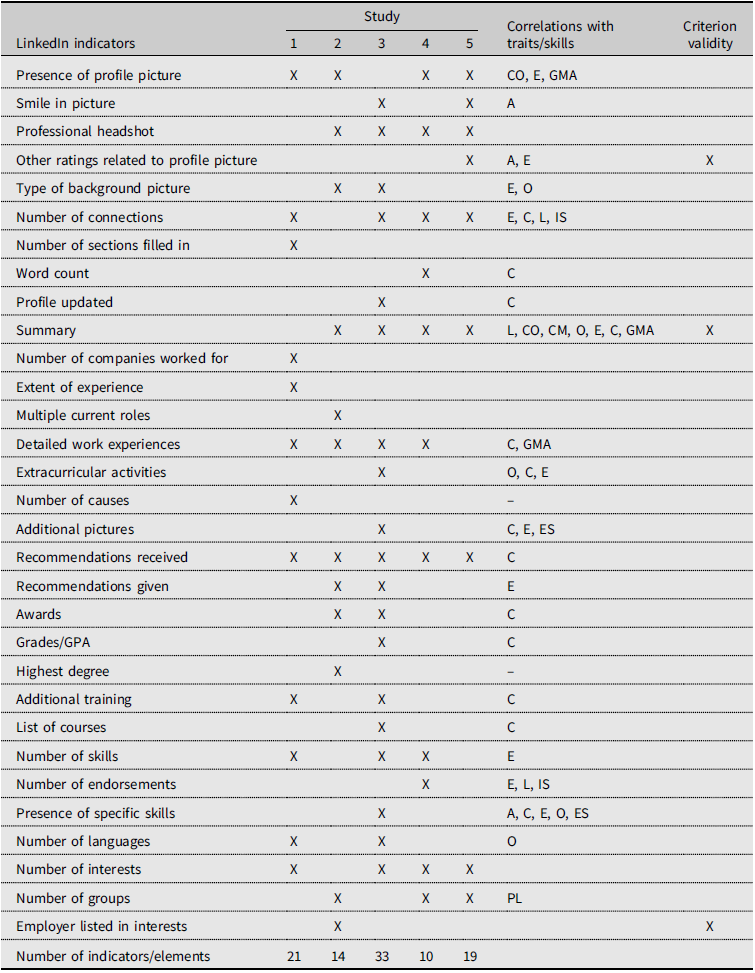
Studies also showed that specific LinkedIn profile elements can be associated with psychological constructs. For instance, Roulin and Levashina (Reference Roulin and Levashina2019) observed that the presence of a summary indicated communication, leadership, and cognitive ability, whereas the number of connections a person has on LinkedIn was related to leadership, communication, planning, and extraversion. Fernandez etal. (Reference Fernandez, Stöcklin, Terrier and Kim2021) demonstrated that LinkedIn profiles contain indicators of extraversion (e.g., number of connections), conscientiousness (e.g., reported academic grades), agreeableness (e.g., teamwork listed as a skill), and openness to experience (e.g., creativity listed as a skill). Table 1 summarizes LinkedIn indicators and associated psychological constructs.
LinkedIn indicators examined in past studies

Note. Study 1 = Aguado etal. (Reference Aguado, Andrés, García Izquierdo and Rodríguez2019); Study 2 = Cubrich etal. (Reference Cubrich, King, Mracek, Strong, Hassenkamp, Vaughn and Dudley2021); Study 3 = Fernandez etal. (Reference Fernandez, Stöcklin, Terrier and Kim2021); Study 4 = Roulin & Levashina (Reference Roulin and Levashina2019); Study 5 = van de Ven etal. (Reference van de Ven, Bogaert, Serlie, Brandt Mark and Denissen Jaap2017). E= Extraversion; A= Agreeableness; C= Conscientiousness; O= Openness to experience; ES = Emotional Stability; GMA = General Mental Ability; L= Leadership; CO = Communication; CM = Conflict Management; IS = Information Seeking; PL = Planning
There is also some preliminary evidence for the criterion-related validity of LinkedIn-based cybervetting. For instance, hiring recommendations based on LinkedIn profiles are positively associated with the obtention of a job in line with one’s degree or obtaining a promotion (Roulin & Levashina, Reference Roulin and Levashina2019). LinkedIn profiles suggesting that a worker possesses higher “social capital” (e.g., recommendations) are associated with higher productivity and lower absenteeism (Aguado etal., Reference Aguado, Andrés, García Izquierdo and Rodríguez2019). Finally, a recent study showed that sales employees who have their company logo as their background picture and a summary section in their profile performed better on two different sales metrics (expending current business, bringing new business; Cubrich etal., Reference Cubrich, King, Mracek, Strong, Hassenkamp, Vaughn and Dudley2021). Overall, although more research is needed, initial evidence that LinkedIn can predict workplace outcomes is promising.
What should future LinkedIn cybervetting research focus on?
Future LinkedIn-based cybervetting research could more fully examine how to best use information contained on LinkedIn profiles. For instance, although research on personal social media has shown the potential to automatically assess personality based on profile content and posts (Tay etal., Reference Tay, Woo, Hickman and Saef2020), no research has examined this with professional platforms. Yet, the language used in LinkedIn profile summaries or to describe work experiences might uncover insights about users’ personalities. Alternatively, the content that individuals post, like, share, or comment on might provide useful information about LinkedIn users.
Future research examining the convergent validity of LinkedIn-based assessments should rely on self-report measures contextualized in the workplace (vs. general measures), whereas studies examining criterion-related validity should focus on specific psychological constructs, profile elements, and outcomes based on a job analysis. For instance, Cubrich etal. (Reference Cubrich, King, Mracek, Strong, Hassenkamp, Vaughn and Dudley2021) explored whether LinkedIn profile elements could predict sales performance, but they did not identify specific elements that should theoretically be related to performance in this occupation. For example, extraversion is related to both sales performance (Vinchur etal., Reference Vinchur, Schippmann and Switzer1998) and LinkedIn content (e.g., number of connections; Fernandez etal., Reference Fernandez, Stöcklin, Terrier and Kim2021). Thus, future studies could explore whether content like the number of connections predicts sales performance. Research could also explore whether information from LinkedIn profiles predicts other outcomes, such as counterproductive work behaviors and organizational citizenship behaviors, or adds incremental validity beyond traditional predictors (see Van Iddekinge etal., Reference Van Iddekinge, Lanivich, Roth and Junco2016 for an example using Facebook).
Finally, research should explore how hiring managers can more effectively use LinkedIn-based cybervetting. Existing studies have relied on untrained assessors (primarily students) evaluating personality traits without guidance or a structured assessment process (Roulin & Levashina, Reference Roulin and Levashina2019; van de Ven etal., Reference van de Ven, Bogaert, Serlie, Brandt Mark and Denissen Jaap2017). We agree with suggestions by Wilcox etal. (Reference Wilcox, Damarin and McDonald2022) and other researchers (e.g., Roth etal., Reference Roth, Bobko, Van Iddekinge and Thatcher2016; Schroeder etal., Reference Schroeder, Odd and Whitaker2020) that training programs and formal policies might be beneficial. Research could thus examine whether a brief training intervention and/or the use of a structured LinkedIn assessment approach could help raters evaluate job seekers’ personality, skills, or cognitive ability more accurately. For instance, training interventions could guide raters about which profile elements to focus on versus ignore or how to assess LinkedIn profiles when users provide incomplete information about themselves.
In conclusion: Should practitioners use LinkedIn to cybervet?
In the focal article, Wilcox etal. (Reference Wilcox, Damarin and McDonald2022) caution organizations against cybervetting because such practices lack validity, can be perceived as invading applicants’ privacy, and can lead to negative reactions or lower organizational attractiveness, as well as adverse impact. Although we agree with them for personal social media, we believe that there is more potential when considering LinkedIn-based cybervetting. As noted above, LinkedIn-based cybervetting is more accepted by job seekers who create LinkedIn profiles for career-related reasons. LinkedIn profiles function like an extended and updated resume that can contain information that is useful for hiring decisions. There is evidence for accurate and somewhat-valid LinkedIn-based assessments of skills, personality traits, and cognitive ability, and such assessments are associated with less adverse impact than when using Facebook.
However, as Wilcox etal. (Reference Wilcox, Damarin and McDonald2022) mentioned, hiring managers who screen candidates’ LinkedIn profiles still have access to information such as age, gender, and race. They should thus be instructed to disregard this information and instead focus on job-relevant information such as skills, experiences, or LinkedIn profile elements related to pertinent traits (e.g., extraversion or conscientiousness). We concur with Wilcox etal. that specific assessment policies and training programs should be developed to enhance cybervetting practices. For instance, just like training can help hiring managers better assess personality in job interviews (Powell & Bourdage, Reference Powell and Bourdage2016), assessors could be trained to more accurately infer specific and observable personality traits (e.g., extraversion) based on valid and relevant LinkedIn profile content (e.g., summary, number of connections). Although such training could be useful for hiring professionals, it could be especially essential for line managers who are less familiar with legal issues in employee assessment and selection (Roth etal., Reference Roth, Bobko, Van Iddekinge and Thatcher2016).