


How do authoritarian successor parties (ASPs) interact with their supporters after democratic transitions? Post-transition, do ASP supporters frequently organize political protests for their parties? ASPs are former authoritarian ruling parties that survived democratic transitions (Loxton Reference Loxton2015; Loxton and Mainwaring Reference Loxton and Mainwaring2018; Slater and Wong Reference Slater and Wong2013; Hicken and Kuhonta Reference Hicken and Kuhonta2011). After democratization, whether they stay as authoritarian actors (or not) is an essential question for democratic consolidation. ASP supporters’ post-democratization protesting behavior can be a useful indicator to evaluate ASP supporters’ connections with the authoritarian past. Nevertheless, the literature on political parties and protest almost exclusively focuses on opposition parties and their supporters during democratic transitions. Recent studies suggest that opposition parties organize political protests to confront authoritarian incumbents when elections are rigged (Kalandadze and Orenstein Reference Kalandadze and Orenstein2009; Beaulieu Reference Beaulieu2014; Knutsen, Nygård, and Wig Reference Knutsen, Nygård and Wig2017; Tucker Reference Tucker2007; Sato and Wahman Reference Sato and Wahman2019), when the economy is not good (Brancati Reference Brancati2014, Reference Brancati2016), or when they are endowed with strong civil society networks (Boulding Reference Boulding2014; Moseley Reference Moseley2015, Reference Moseley2018). However, studies on how former autocrats and their supporters organize protests in the post-democratization setting are limited.
This study fills this gap by examining ASP supporters’ mass mobilization patterns after a democratic transition. Analyzing former autocrat supporters’ mobilization behavior helps understand who these supporters are, what their relationship with former autocrats is, and whether their parties become democratic actors after democratization. Although former autocrats may survive democratization as an ASP, post-democratization, their political power is limited by democratic institutions. Under this situation, whether they adjust to democratic procedures will influence the likelihood of democratic resilience. In a context where ASPs frequently organize protests to break political deadlocks and attain their political goals, their actions can be detrimental to the emergence of a healthy democracy (Huntington Reference Huntington2006).
I argue that ASP supporters are less likely to participate in protests because they are poorly endowed with protest tactics and networks. As democratization does not ensure a complete disconnection from the authoritarian past in political institutions (Mobrand Reference Mobrand2019; Loxton Reference Loxton2015), the post-democratization mobilization environment can also be based on the pre-democratization mobilization foundation. Pre-democratization, protests were organized and implemented in conjunction with democracy movements (Bellinger and Arce Reference Bellinger and Arce2011; Brancati Reference Brancati2014, Reference Brancati2016). Because the most immediate protest target is dictators, popular mobilizations will likely emerge as democracy movements or cooperate with them. Brancati (Reference Brancati2016), for example, shows how economic grievances can translate into democracy protests.
Accordingly, protest tactics, organizations, and networks will be accumulated around the democracy movement. Post-democratization, although the immediate target disappears, the mobilization resources are still alive and operate. The key is who can get access to the accumulated networks and tactics. ASP supporters are less likely to access those resources as ASPs emerge from the authoritarian past and thus their supporters are more likely to value authoritarian legacies. Pre-democratization, ASP supporters were not likely to protest dictators or be affiliated with the democracy movement organizations that had abundant protest mobilization experiences and resources. Post-transition, this lack of experiences will limit their ability to access mobilization resources. Moreover, as former autocrats, ASPs have limited ability to provide protest resources to their supporters.
However, not all ASPs remain the same after democratization (Grzymala-Busse Reference Grzymala-Busse2020). Some actively move away from the authoritarian past and try to attract new supporters. To account for this possibility, I also argue that ASP supporters’ negative association with mobilization is mitigated by the ASP's characteristics and individuals’ age. If an ASP is ideologically constant from the authoritarian past, the consistency serves as a robust mobilizing factor and aids mobilizing protesters. On the contrary, if an ASP does not have a constant ideological foundation, its mobilizing power will be limited. Furthermore, when ideologies are considered, older supporters are more likely to participate in protests than younger supporters, implying that older supporters are more likely to support the ASP for their good memories of the past and thus tend to have a stronger attachment to the party and its original ideology.Footnote 1
To assess these claims, I examine four Asian democracies that have produced substantive ASPs: Taiwan, South Korea, Mongolia, and Indonesia. I conduct both single-level and multilevel analyses using the four waves of the Asian Barometer Survey Data. I find evidence that ASP supporters are, in general, less likely to participate in protests. I find limited evidence for the argument on party ideology and supporter age. Finally, I compare two South Korean mass mobilizations: the Taegeukgi rallies (pro-ASP protest) and the Candlelight movement (anti-ASP protest) to unpack the links between ASP supporters, protest resources, and mobilization.
Problems of mass mobilization
The literature on mass mobilization and protest examines how protests are organized and assesses mobilizing structures. The primary problem of mass mobilization was portrayed by Olson (Reference Olson1965, Reference Olson2009). Known as the collective action problem, he shows why common grievances and interests cannot provide a sufficient condition for mass mobilization (Lichbach Reference Lichbach1998). Participating in protests is costly, and everyone in a group will share the gains made through protests. In this situation, individuals will attempt to free-ride rather than putting their time and effort into protesting.
Resources can lower the cost of protesting and thus help mitigate the collective action problem. Organizing protests requires resources. Carrying out protests requires not only tangible resources such as money but also non-material resources such as networks and expertise. These various resources serve as the essentials for making protests possible. Also, consistent access to these resources is important for sustained mobilization. Based on Boulding (Reference Boulding2014), I list three types of resources that are essential for mobilization.
Material resources
For a movement to be organized, material resources are needed. Organizers make and circulate protest materials such as banners, pamphlets, and flyers. Organizers make temporary stages to lead protesters. Sometimes, mobilization requires commercial advertisement. All these involve material resources.
Mobilization know-how and expertise
Apart from material resources, mobilization also depends on knowledge and expertise. Mobilization is not an easy task. Efficient mobilization requires both rational and emotional framing of issues, efficient delivery of protest agendas, appropriate use of images, catch-phrases, and slogans that can resonate with people, proper designing of protest programs, and so on. All this process entails the mobilization know-how and expertise. Experienced mobilizers can speed up the mobilization process and mobilize a large number of crowds with limited material resources, since they know how to touch people's hearts and minds and how to deliver their messages efficiently. On the contrary, inept mobilizers struggle with using the right framing and messages.
Mobilization network
The final element of the mobilization resource is the network. To expedite mobilization, a close network between different organizations will be useful. Through the network, organizers can collaborate and coordinate the protest events. This will help create a single line of organizing and thus prevent multiple, scattered protest events.
In summary, material resources are not the only aspect of mobilizing resources. Mobilizers cannot mobilize protesters efficiently if mobilization expertise is lacking. Also, without mobilizing networks, mobilizers cannot organize a large-scale movement.
Democratization and mobilization resources
Under authoritarian rule, mobilizations will be divided into top-down authoritarian mobilizations and bottom-up anti-authoritarian mobilizations.
Autocrats consistently mobilize people with incumbent advantage and/or strong authoritarian discipline/institutions. For example, during the Mao era, the Chinese Communist Party mobilized people with campaigns such as the Great Leap Forward and the Cultural Revolution (Bachman and Bachman Reference Bachman and Bachman2006; Lovell Reference Lovell2020; Chan Reference Chan2001; Dickson Reference Dickson2014). Through those mass mobilizations, authoritarian incumbents could strengthen their power (Hellmeier and Weidmann Reference Hellmeier and Weidmann2020). Although there are many different types of authoritarian mobilizations, the basic nature of an authoritarian mobilization is top-down and relying on authoritarian institutions and/or incumbent advantage (Hellmeier and Weidmann Reference Hellmeier and Weidmann2020). With the top-down command line and institutional and incumbent advantage, mobilizations were less likely to depend on coordination between organizations and organizers were less likely to accumulate mobilization expertise. Post-democratization, autocrats’ access to democratic institutions is limited, restricting their mobilization capability.
On the other hand, anti-regime forces organized protests pre-democratization. Facing state repression, they carefully designed and implemented mobilization, and collaborations between different organizations were required. With abundant protest organizing experiences and inter-organization collaborations, pro-democracy organizations will accumulate abundant protest resources—mobilization expertise and network. The know-how and networks are hard to eliminate after democratization, and they will continue to help mobilize protesters.
In summary, resources related to authoritarian mobilization are less likely to survive democratization than resources associated with non-authoritarian mobilization. If a group has abundant mobilization resources, those resources will increase the mobilization ability of the group (Dahlum and Wig Reference Dahlum and Wig2021; Boulding Reference Boulding2014; LeBas Reference LeBas2011; Fu Reference Fu2017; Putnam Reference Putnam1994, Reference Putnam2000; Davis et al. Reference Davis, McAdam, Richard Scott and Zald2005). Because of the ASPs’ lack of mobilization resources, the group of ASP supporters are less likely to access mobilizing resources—especially protest expertise and networks. This will lower ASP supporters’ mobilization ability.
This article aims to study ASP supporters’ protest patterns to understand who these ASP supporters are and what their relationship with their parties is. Why study ASP supporters’ protesting behavior? Voting patterns do not provide much information about ASP supporters; as their definition shows, they are highly likely to vote for ASPs. However, protesting behavior can deliver more information about them. First, protest behavior shows how strong ASP supporters’ attachment to their party is. Because protest is costly, if ASP supporters protest for their parties, that can imply that ASP supporters have a stronger attachment to their parties. Second, examining whether ASP supporters can access the accumulated protest resources will provide hints about their connections with the authoritarian past. If their ties with their parties come from the authoritarian past, their ability to access the resources will be limited. Moreover, by accounting for ASP qualities—how much they distance themselves from the authoritarian past—and ASP supporters’ age group, this study will further disclose whether old age-cohort supporters are loyal, longstanding supports emerging from an authoritarian past.
Theory and hypotheses
Why do supporters of some parties constantly organize protests when they have to break the political deadlock or promote specific political agendas, while supporters of other parties do not? Based on resource mobilization theory (McCarthy and Zald Reference McCarthy and Zald1977), I argue that if a party cannot provide mobilizing resources, the party supporters are less likely to organize protests. The mobilization of resources has material components, such as funds and staff, and non-material components such as networks and expertise (Boulding Reference Boulding2014). Among them, non-material components are less studied. Lack of mobilization expertise will limit groups’ mobilization ability (Jenkins Reference Jenkins1983; Jenkins and Klandermans Reference Jenkins and Klandermans1995; McCarthy and Zald Reference McCarthy and Zald1977). Also, networks and coordination experiences between different organizations will facilitate and smooth mobilization. These nonmaterial components are accumulated through previous protest experiences (Pierskalla Reference Pierskalla2010; Bell and Murdie Reference Bell and Murdie2018; Siegel Reference Siegel2011). Because ASPs have limited protest-organizing experience as former autocrats, they are less likely to provide enough protest expertise and networks. This will limit ASP supporters’ mobilization ability.
H1: In general, ASP supporters are less likely to participate in protests compared to other party supporters.
Although mobilization resources can be the primary factor in overcoming the collective action problem, it is puzzling that in some cases mobilization is sustained without substantive mobilizing resources. Particularly when people have higher morale, resource scarcity can be compensated for. So, what helps people have higher morale? I argue that ideology can boost people's morale and thus compensate for resource scarcity. Historically, ideology motivated people to engage in costly activities such as revolution (Vladisavljević Reference Vladisavljević2019).
ASPs do not remain the same after democratization (Grzymala-Busse Reference Grzymala-Busse2020). Some ASPs deviate from their authoritarian past and reinvent themselves. If an ASP reinvents itself, it will likely lose its old supporters who have a deeper attachment to the party and thus have a greater willingness to bear the costs of protesting. I argue that if an ASP maintains its original ideology, the ideology will mobilize its supporters better than a reinvented ASP. During their rule, ASPs developed a set of political ideas and ideologies and promoted them during their incumbency. These ideas served as the foundation for legitimizing their power and helped them remain in power before democratization (March Reference March2002, Reference March2003; Lorch and Bunk Reference Lorch and Bunk2017; Dukalskis and Gerschewski Reference Dukalskis and Gerschewski2017). After democratization, these former autocrats will face challenges related to their past actions. ASPs benefit from their authoritarian resources but are also hindered by their past wrongdoings (Loxton Reference Loxton, Loxton and Mainwaring2018). This creates a dilemma for an ASP; how much does it distance itself from its authoritarian past? If it attempts to distance itself from the past, it will likely lose its original supporters, but it can attract new supporters who do not endorse its authoritarian rule.
ASPs may change their original political ideology and be assimilated into other parties to attract more voters. This may be beneficial for electoral outcomes. However, it may not be a good strategy for protest mobilization (Kim-Leffingwell Reference Kim-Leffingwell2022). Suppose an ASP abandons its original political ideology, changes its political stance on core issues considered important by its original supporters, and promotes new practical policies. It can lose its most loyal, oldest support group with the strongest attachment to the party. Parties should provide higher incentives when mobilizing protesters because protesting is more costly than voting. This is where ideology comes in (Jenkins and Klandermans Reference Jenkins and Klandermans1995). Ideology can motivate people to join in expensive political activities like revolutions and protests (Vladisavljević Reference Vladisavljević2019). Ideology can appeal to people's emotions and galvanize people to act. Also, even in the middle of protests, these ideas will effectively boost people's morale and strengthen their resolve. Therefore, ASP supporters who support an ASP that maintains its original ideology will have higher morale to fight for their party on the street than supporters of ASPs with fluctuating ideologies. This leads to the following hypothesis.
H2: ASPs that have not changed their political ideology are better able to mobilize their supporters than ASPs that have changed their political ideology after democratic transitions.
I also expect that consistent ideology will mobilize ASPs’ old and loyal supporters better. Old supporters have stronger attachments to their party's political ideology than its new supporters because they were vested before the democratic transition. This means that old supporters are more likely to participate actively when their party organizes protests using its old political ideology as a rallying point. Even though new supporters can also be attached to their party's ideology, their attachment will not be as strong as its old supporters. Therefore, I expect that the effect of political ideology is less robust for new supporters. In distinguishing old and new supporters, I take age into account. Once established, party identification is long-lasting (Green and Palmquist Reference Green and Palmquist1994; Barnes, McDonough, and Pina Reference Barnes, McDonough and Pina1985; Brader and Tucker Reference Brader and Tucker2001), meaning senior supporters are more likely to emerge from the authoritarian past and are among the old support group. From this, I draw the following hypothesis.
H3: Older ASP supporters are more likely to participate in protests than younger supporters when their party has not changed its core political ideology.
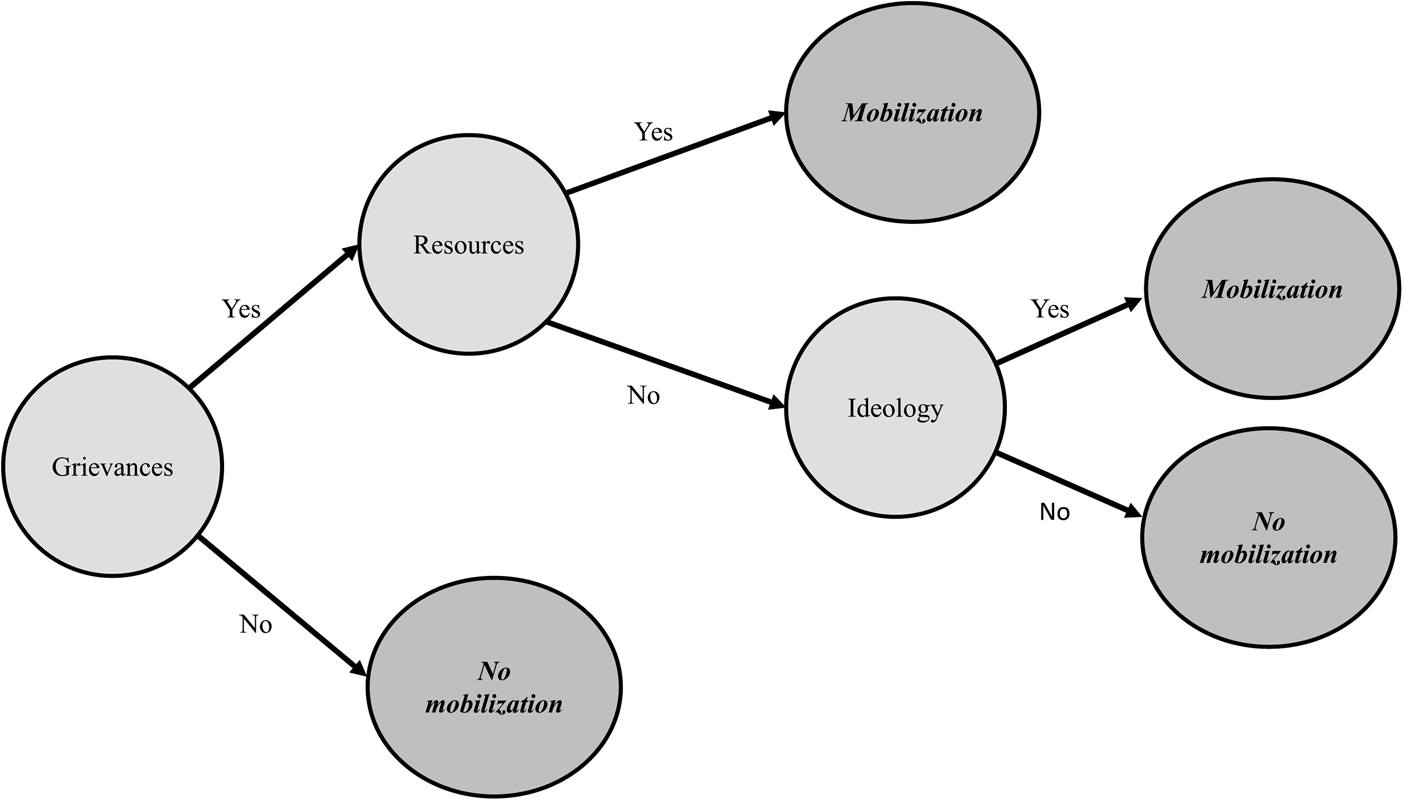
Figure 1 summarizes the theoretical expectations. Grievances are the necessary condition for mobilization. However, without mobilizing resources—knowledge and network—mobilizations are less likely. Nevertheless, if potential protesters have a higher resolution, those individuals can be less affected by the collective action problem and mobilize. I expect that mobilizing resources is the primary factor over ideology. Resources make immediate impacts on mobilization whereas ideology make gradual impacts. At the initial stage, mobilization inevitably suffers without resources. Ideology can only solve the collective action problem in a gradual manner because unlike resources it will take more time to motivate people with ideology.
Theoretical expectations of the resource mobilization thesis

ASPs in Taiwan, South Korea, Mongolia, and Indonesia
To assess my hypotheses, I examine four ASPs from four Asian countries: the Kuomintang (KMT) in Taiwan, the Grand National Party (GNP)/Saenuri Party in South Korea, the Mongolian People's Party (MPP) in Mongolia, and the Golkar in Indonesia. I select these ASPs because they are politically active after democratization in Asia. I classify these four ASPs into staying cases and changing cases. If an ASP maintains its core ideology, it is classified as a staying case; if it has changed its ideology, it is a changing case.
Two ASPs are classified as staying cases. The Grand National Party/Saenuri Party in South Korea (Lee and Glasure Reference Lee and Glasure1995; Heo and Yun Reference Heo and Yun2018) and the Golkar in Indonesia (King and Rasjid Reference King and Ryaas Rasjid1988; Mujani, Liddle, and Ambardi Reference Mujani, William Liddle and Ambardi2018) were anti-communist right-wing parties during the authoritarian era. These parties relied heavily on anti-communism to claim legitimacy. After democratization, they maintain their anti-communist, right-wing origins. I expect that their solid and consistent anti-communist ideology will help their supporters to participate in protests after democratic transitions.
Two ASPs are classified as changing cases. The MPP in Mongolia was a far-left communist party during the authoritarian period. After democratization, they modified their ideology and became left-leaning, but not too far from the center (Dierkes Reference Dierkes2017). Their movement toward the center of the ideological spectrum can be helpful for electoral mobilizations. The party won presidential elections in 1997, 2001, 2005, and 2021, after the democratic transition. Nevertheless, the movement will limit the party's protest mobilization. Its core ideological focus was diluted by its movement, and the party could lose its old, loyal support group. The circumstances surrounding the Kuomintang (KMT) in Taiwan are complicated. The party has its origin in anti-communist, right-wing ideology. At the same time, the party claims Chinese nationalism as its slogan and pursues policies that are more pro-integration/pro-unification after Taiwan's democratic transition, which dilutes anti-communist ideology (Yu Reference Yu2020; Moody Reference Moody1992). Although this is not particularly harmful to the party's electoral success, it weakens its ability to mobilize protests.
Empirical strategy
I employ the four waves of the Asian Barometer datasets.Footnote 2 The dependent variable is each respondent's protest participation experience in the past. This binary variable is coded as 1 if they have at least one prior experience and 0 otherwise. The primary independent variable is whether a respondent is an ASP supporter. This binary variable is coded as 1 if a person is an ASP supporter and 0 otherwise. ASP supporters are identified based on their party identification.
My empirical strategy is three-fold. First, I estimate single-level logistic regression models for each country and each wave. In these models, I control for the demographic characteristics of respondents—gender, age, education, and income. I also control for Christians, both Protestant and Catholic, and Muslims due to religious organizations’ potential mobilization power (Chang Reference Chang2015). Also, I control for the level of political interest. Supposedly, people who are strongly interested in politics are more likely to participate in protests. Finally, when ASPs are the ruling party, I control for nonpartisans who do not self-identify with one political party over another. When ASPs are not the ruling party, I control for both incumbent party supporters and nonpartisans. Therefore, non-ASP, non-incumbent party supporters become the reference category.Footnote 3
Second, I employ propensity score matching models. It is likely that ASP supporters are relatively older (or younger) than non-ASP supporters because of ASPs’ connections with the authoritarian past. This can create a systematic difference in the reasons people (dis)approve the ASP. With the t-test, I find that ASP supporters tend to be older, although the difference is not statistically significant. If ASP supporters tend to be older, simply controlling for the age cannot capture the systematic age effect on the dependent variable. Propensity score matching (PSM) helps resolve this issue (Rosenbaum and Rubin Reference Rosenbaum and Rubin1984, Reference Rosenbaum and Rubin1985; Rubin Reference Rubin1974). First, I define the treatment group and the control group. The treatment group consists of ASP supporters, whereas the control group consists of non-ASP supporters. Then, I calculate propensity scores with a logit model estimating the predicted probability of being an ASP supporter by age. Based on the propensity scores, I match each observation from the treatment group to the control group. Finally, I estimate the probabilities of participating in protests with the matched set of observations.Footnote 4 In the PSM models, I control for the same variables with single-level models.
Lastly, I estimate Bayesian multilevel logistic regression models for cross-national comparisons (Gill Reference Gill2004; Gelman and Hill Reference Gelman and Hill2007; Stegmueller Reference Stegmueller2013). The unit of analysis for level 1 is individual survey respondents and for level 2 is the country-year of each wave in the Asian Barometer dataset. I also allow the intercepts and the slopes to vary based on the function of level 2 indicators, which will create the cross-level interaction effects. Multilevel models allow me to compare the relationship between ASP supporters and protests by country-year. Also, I can account for level 2 indicators such as the economic conditions, levels of repression, and whether an ASP is in office in a specific year.Footnote 5 In single-level models, I cannot control for these country-year level indicators because these indicators will remain the same across all observations as the survey responses are collected in a same country in a same time frame. Moreover, Bayesian models produce less biased estimates with fewer level 2 observations. In level 2, I only have 14 observations.Footnote 6 This small sample can cause biased estimates with a frequentist approach that makes inferences based on asymptotic assumptions. The Bayesian approach does not make asymptotic assumptions. Bayes theorem permits researchers to make inferences that are conditional on their data. Therefore, the small sample inferences are not significantly different from larger sample inferences. Stegmueller (Reference Stegmueller2013) conducts Monte Carlo experiments to compare frequentist multilevel models with Bayesian models. From 5 observations to 30 observations in level 2, Bayesian models produce less biased estimates than frequentist models.
In addition to the same control variables with single-level models,Footnote 7 I control for an age cohort group. The age cohort group is defined by whether a respondent became a voting-eligible age before or after the democratic transition in their country. If a respondent became voting-eligible after the transition, the cohort variable is coded as 1 and 0 otherwise. I also interact this age cohort variable with the ASP supporter variable to account for if there is a difference in protest behavior between old and new ASP supporters.
In level 2, I control for whether an ASP is in office in any given year. I also control for the economic conditions with the lagged GDP growth from the World Bank. Then, I control for the level of repression using the Political Terror Scale State Department measure (Gibney et al. Reference Gibney, Cornett, Wood, Haschke, Arnon, Pisanò, Barrett and Park2021). I employ non-informative independent normal priors for the regression coefficients with the mean set at zero and the variance set a 100. I allow the intercept and the slope to vary based on the function of level 2 indicators. This means that the coefficient of the ASP variable interacts with the level 2 indicators. Mathematically, the following equations explain the varying intercept/slope model.
 $$\Pr ( {Y_i = Protest} ) = logit^{{-}1}( {\alpha_{\,j[ i ] } + ASP_{\,j[ i ] }\beta_1 + {\boldsymbol X}_i\beta + \varepsilon_i} ) , \;\;for\;i = 1, \;2, \;3, \;\;\ldots \;., \;n$$
 $$\alpha _j = \gamma _{1j} + ASP\;in\;office_j\gamma _2 + Economy_j\gamma _3 + Repression_j\gamma _4 + \varepsilon _j, \;\;for\;j = 1, \;\;\ldots \;., \;14$$
 $$ASP_j = \gamma _{1j} + ASP\;in\;office_j\gamma _2 + Economy_j\gamma _3 + Repression_j\gamma _4 + \varepsilon _j, \;\;for\;j = 1, \;\;\ldots \;., \;14$$
Where i represents individual respondents, j represents country-year, α j is the varying intercept, and ASP j is the varying slope. I use Markov Chain Monte Carlo (MCMC) methods to calculate joint posterior distributions for model parameters. MCMC estimation is conducted using JAGS and R package rjags (Plummer Reference Plummer2003, Reference Plummer2013). I conduct convergence diagnostics and do not find the absence of convergence.
Results
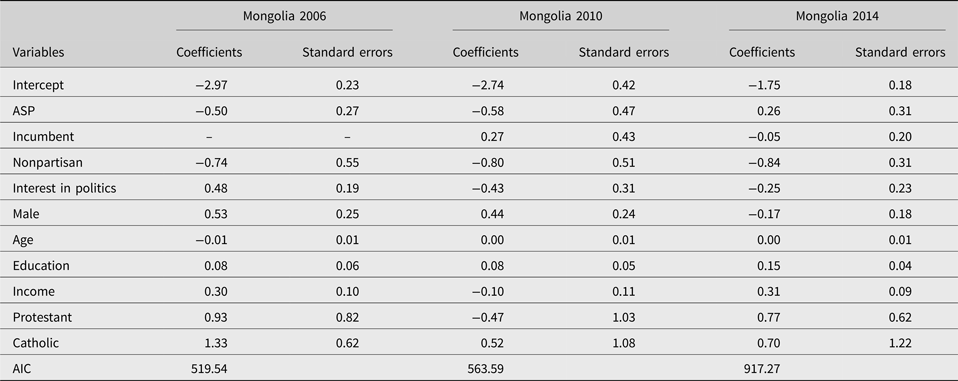
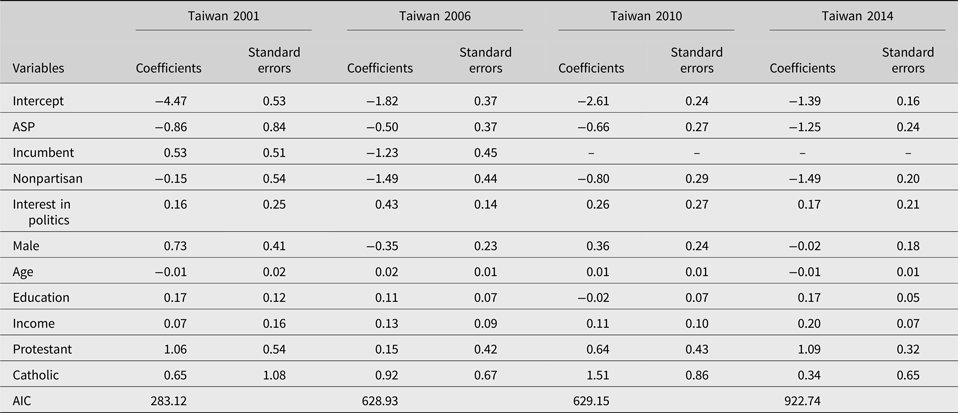
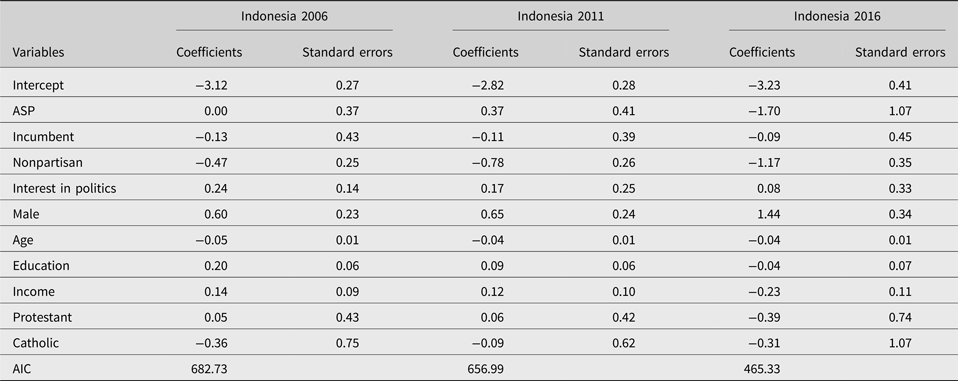
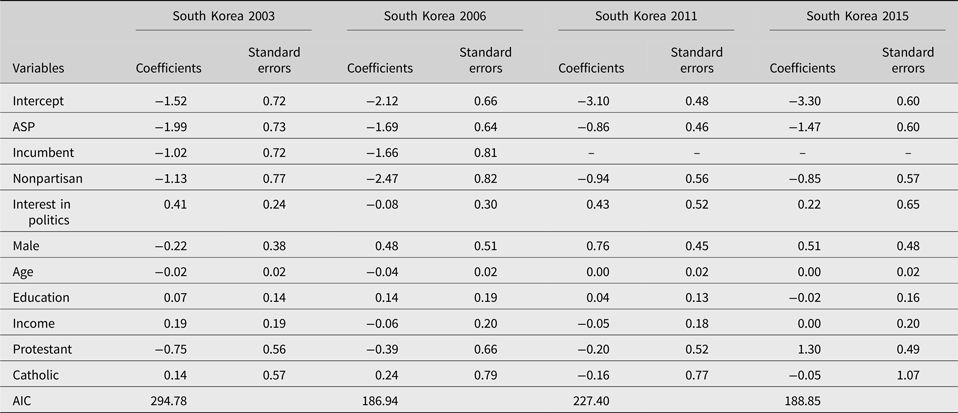
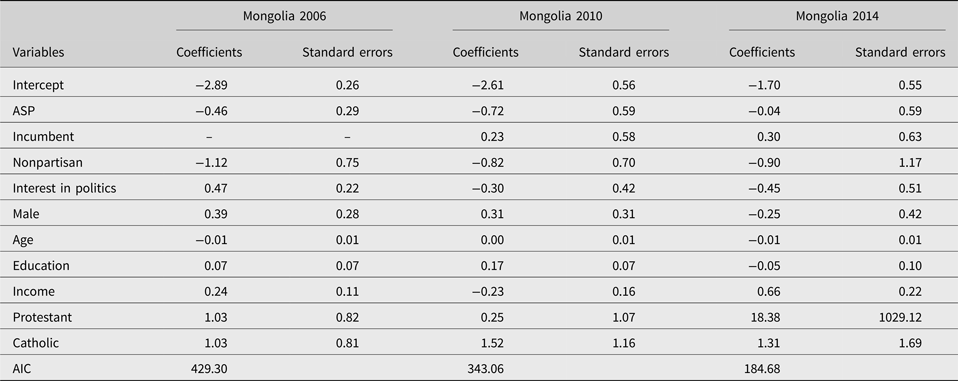
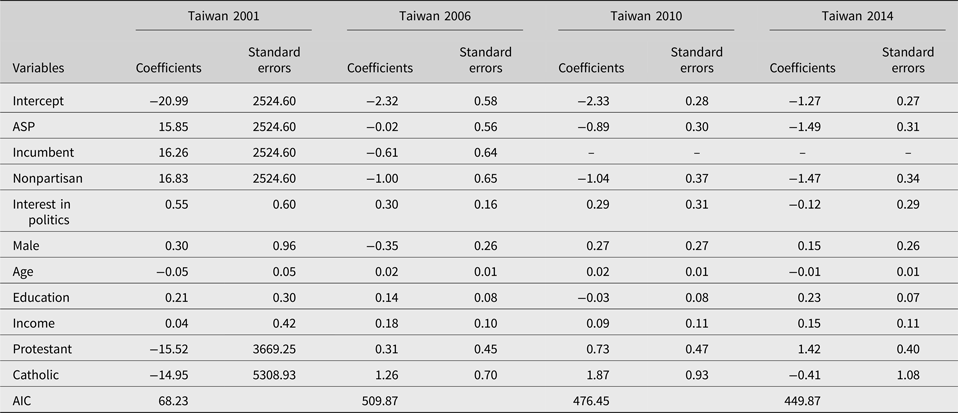
Figure 2 shows the summary of single-level models.Footnote 8 Each figure reflects the ASP supporters’ protest participation propensity compared to other non-incumbent party supporters’ using 90 percent confidence intervals. In South Korea, the coefficients are all negative, and the CIs do not include zeros. ASP supporters in South Korea are less likely to protest compared to other non-incumbent party supporters. In Mongolia, the coefficients for ASP supporters are negative in 2006 and 2010, and positive in 2014. The 90 percent CIs do not include zero in 2006, whereas they include zeros in 2010 and 2014. ASP supporters are less likely to protest when the Mongolian ASP, the MPP, is the incumbent party. In contrast, when the ASP is not in office, its supporters are more likely to participate in protests. In Taiwan, ASP supporters tend to be less likely to protest as the signs of coefficients are all negative. However, this effect is more significant when the ASP is in office. In Indonesia, the coefficients for ASP supporters are positive in 2011 and 2016, meaning ASP supporters are more likely to participate in protests. Also, there was almost no ASP effect in 2006.
Summary of single-level models

In summary, from these single-level models, I find three patterns. First, ASP supporters are less likely to participate in protests in South Korea, Mongolia, and Taiwan. Second, the ASP effect is statistically significant when ASPs are in office in those three countries. When ASPs are not in office, ASP supporters in Mongolia and Taiwan tend to protest more.Footnote 9 Third, Indonesian ASP supporters protest more.
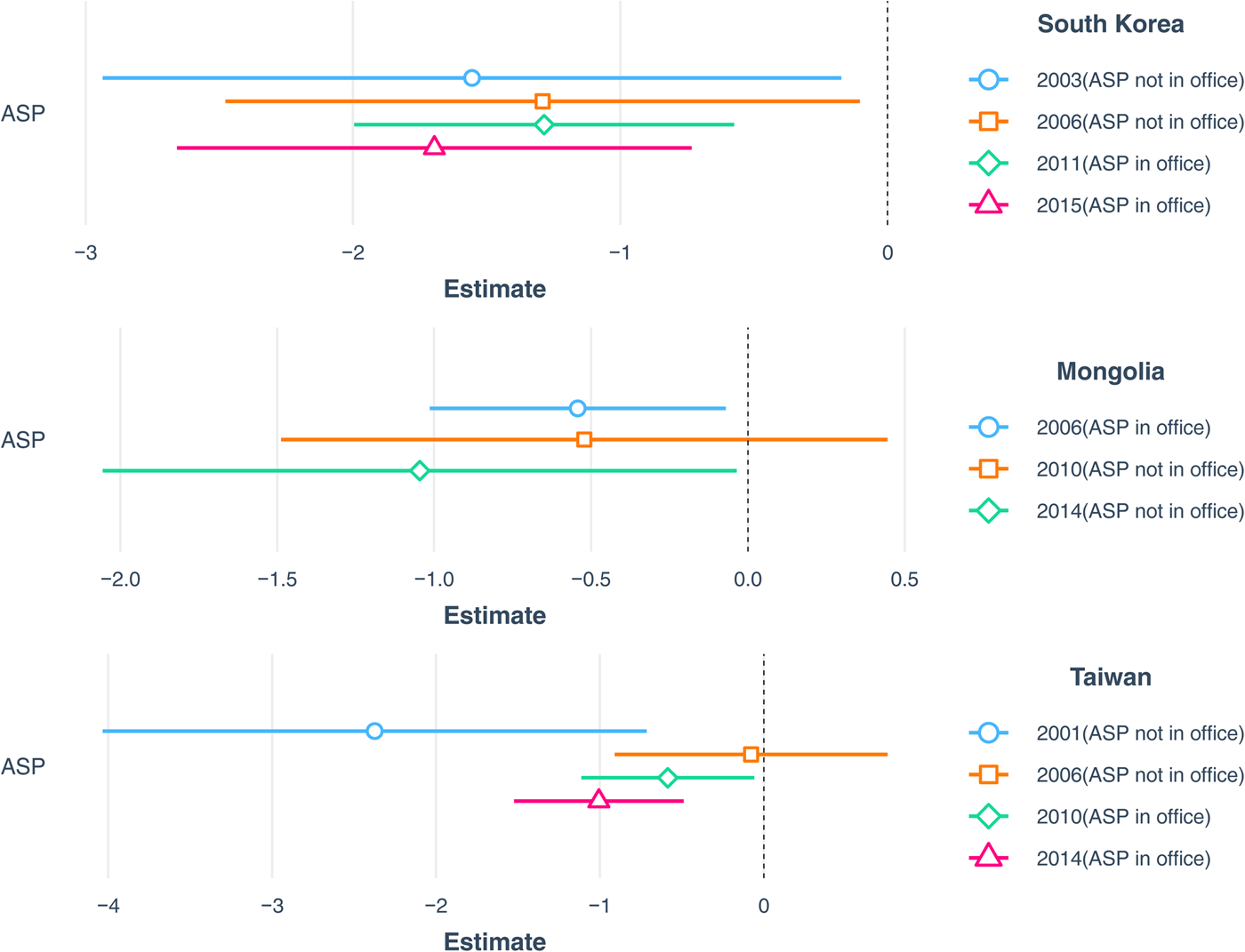
Figure 3 summarizes propensity score (PSM) models.Footnote 10 I exclude Indonesia because the smaller number of ASP supporters causes larger standard errors, making matching difficult.Footnote 11 Observations in the treatment group (ASP supporters) and observations in the control group (non-ASP supporters) are matched with age. In South Korea, Mongolia, and Taiwan, the coefficients for each year are all negative, confirming that ASP supporters are less likely to protest than other non-incumbent party supporters. Moreover, except for Mongolia in 2010 and Taiwan in 2006, the negative effects are statistically significant.
Summary of PSM models

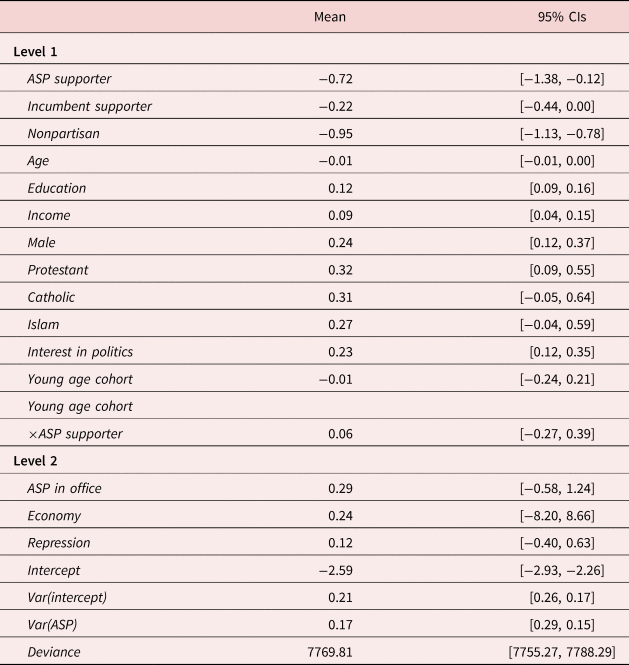
Table 1 exhibits the results of the Bayesian multilevel model. The mean of ASP supporters is negative in sign, and the 95 percent credible intervals do not contain zero. Because I controlled for the young age group, this means that, on average, ASP supporters in the old age group are less likely to participate in protests than other non-incumbent party supporters.Footnote 12 The interaction term, Young age cohort x ASP supporter, is positive, indicating that this negative effect will be alleviated among young ASP supporters.Footnote 13 Also, incumbent party supporters are less likely to protest than non-incumbent party supporters as the mean of incumbent supporters shows a negative value. On average, as people get older, they are less likely to protest. People in the younger cohort—people who became voting-eligible after democratization—tend to protest less, but the effect is not statistically meaningful. The mean of the interaction term of ASP supporters and young age cohort exhibits a positive sign, but it is not statistically meaningful as the CIs contain zero. For other demographic variables, I can infer that people who have a higher level of education, higher-income earners, and men are more likely to protest than people with a lower level of education, lower-income earners, and women. For level 2 indicators, none of the three variables display statistically meaningful effects on protest.
Bayesian multilevel model summary

The dependent variable is each respondent's protest participation
To explore the substantive effects of these models, I create two hypothetical average figures living in a country with an average level of GDP growth and an average level of repression: the first person is from the old age cohort and the second person is from the young age cohort.
The first person is a male with an average level of education and an average income; he is not an incumbent party supporter and is not nonpartisan. He is also not a church attendee or a Muslim, and he lives in a country where an ASP is not in office. I calculate his predicted probability of protest participation when he is an ASP supporter. I also calculate his predicted probability of protest participation when he is not an ASP supporter. Finally, I calculate the first difference between these two predicted probabilities.
Figure 4a shows the results of these assessments. Two patterns can be gleaned from these results. First, generally, the medians of the posterior distributions are negative, meaning ASP supporters are less likely to protest than other non-incumbent party supporters. Second, one can find no significant difference in protest behavior between ASP supporters and other non-incumbent party supporters in South Korea in 2011, Taiwan in 2001, and Indonesia in 2006 and 2011.
First difference of ASP supporter effects

I also examine the second person living in a country with an average level of GDP growth and an average level of repression. He has the same demographic characteristics as the first average person except for age. As with the first person, I calculate the predicted probabilities of his protest participation when he is an ASP supporter and not an ASP supporter.
Figure 4b displays the results of these estimates. Here, I find three patterns. First, in general, ASP supporters are less likely to protest. Second, in the cases of Taiwan in 2006 and 2010 and South Korea in 2003 and 2011, the ASP effect is not statistically meaningful as the credible intervals contain zeros. Third, in Indonesia, younger ASP supporters are less likely to participate in protests. This finding is noticeable because older ASP supporters in the country tend to protest more.Footnote 14
How much the incumbency status of ASPs can influence ASP supporters’ protest patterns? Because my model allows intercepts and slopes to vary based on ASP's incumbency status, I can calculate the first difference of ASP supporters’ protest propensity between when the ASP is in office and when it is not. The results show that ASP supporters tend to protest more when their party is not in office, although there are many cases where the differences are not statistically meaningful as 95 percent of CIs contain zeros.Footnote 15 The result indicates that ASP supporter's dissatisfaction or grievances—that they will feel when their parties are not in office—can mobilize individuals. However, dissatisfaction alone can only marginally mobilize protesters. Mobilizing resources amplify aggrieved people's mobilization efforts.
In summary, these empirical findings support H1: ASP supporters are less likely to protest in general. However, they do not support H2 or H3. To prove my ideology hypothesis (H2), I should find a stronger protest propensity of ASP supporters in South Korea and Indonesia than in Mongolia and Taiwan. Moreover, in those two cases, I should find that old supporters are more likely to protest than young supporters. Yet, there is no strong evidence for these. This limited statistical evidence calls for further research. Unlike resources, ideology can have a long-term effect on mobilization. It can gradually mobilize protesters; resource-poor, ideology-driven protests can go small at first, but it can sustain longer and gradually attract more and more protesters. To account for the gradual mobilizational effect of ideology, I conduct a process-tracing case study in the following section.
The Candlelight movement and the Taegeukgi rallies in South Korea
To unpack the relationship between ASPs, resources, and mobilization, I compare two South Korean movements. Among the four cases, I choose South Korea for theoretical and practical reasons. Theoretically, through the case study, I attempt to examine not only the relationship between resources and mobilization but also the effects of ideology and age on mobilization. This limits my cases to South Korea and Indonesia. Empirically, South Korea recently experienced both pro-ASP and anti-ASP movements, providing an interesting analytical environment for comparison. For this reason I choose South Korea over Indonesia.
The Candlelight movement in 2016–17 was an anti-ASP movement where participants demanded the impeachment of President Park Geun-hye. The Taegeukgi rallies were a pro-ASP movement between 2016 and 2019. The former was very quickly organized as a coherent movement and attracted a large number of protesters. Multiple organizers cooperated closely and provided vibrant, coherent protest programs from the beginning. The latter, however, struggled to mobilize people and provide coherent protest programs, resulting in a small number of participants and several scattered rallies at different sites. After the impeachment of Park Geun-hye, the Taegeukgi rallies had grown and eventually became a coherent movement, attracting more than 460,000 people in 2019.Footnote 16 However, it took more than two years to be a consistent movement. What drives these different outcomes? South Korean ASP has a lot of supporters and has been successful electorally. So why did the supporters not participate in the pro-ASP movement? Based on the resource mobilization theory, I will show how crucial the non-material resources are in mobilization.
Material resources
Organizations associated with both movements were reasonably well-resourced materially. Organizations that led the Candlelight movement include the Korean Confederation of Trade Unions (KCTU, Minjunoch'ong), an umbrella organization of trade unions, and the People's Solidarity for Participatory Democracy (PSPD, Ch'amyŏyŏndae), an NGO to protect and further democratic values.Footnote 17 These are biggest organizations in South Korea endowed with lots of physical resources—for example, the KCTU has 16 regional headquarters; the PSPD claims 15,000 members on its website.Footnote 18
Various conservative, far-right organizations are associated with the Taegeukgi rallies. The Korean Veterans Association (Taehanmin'gukchaehyangguninhoe) and Korean Disabled Veteran's Association by Agent-Orange in Vietnam War allegedly mobilized their members for the rallies.Footnote 19 These far-right organizations were financially supported under the two conservative administrations of Lee Myung-bak and Park Geun-hye.Footnote 20
Mobilization tactics
Organizations in the Candlelight movement set up a websiteFootnote 21 and a Facebook pageFootnote 22 immediately to mobilize people. They also developed coherent slogans and clear demands from the beginning (Lee Reference Lee2022). One famous slogan is “Is this even a state?” (ige naranya?), which captures people's frustrations about the government's inability. Organizers also provided various protest programs, including music concerts and interesting cultural events, creating a festive and exciting atmosphere. This shows these organizations’ sophisticated mobilizing techniques. These techniques have been accumulated through their previous mobilization experiences from the authoritarian period. On December 8, 2016, in an interview on the CBS radio program, An Chinkŏl—the co-Secretary-General of the PSPD and a member of the Standing Steering Committee of the Candlelight movement—and panelists recalled their memories of participating in the democracy movement in the 1980s: how they mobilized people without cell phones, how they made flyers in a clandestine basement to avoid police crackdown, etc. In the discussion, they highlighted the legacy of the democracy movement within the Candlelight movement. The Secretary-General explained that the organizations that led the Candlelight Movement were the ones that had led the Korean democracy movement.
[The Candlelight movement is led by organizations such as] the Korean Federation for Environmental Movement (KFEM, Hwan'gyŏngundongyŏnhap), the Korea Alliance for Progressive Movement (KAPM, Han'gukchinboyŏndae) … You know? Organizations that led the South Korean democratization movement or civil society movements that represent people of the lower classes.Footnote 23
On the contrary, organizations associated with the Taegeukgi rallies were mostly relying—especially in the early stage—on rallying and chanting, and they failed to provide interesting protest programs. Not a single movement website can be found. They had not come up with coherent slogans and demands at the beginning. This shows their lack of mobilization expertise. In 2019, they finally developed coherent slogans, such as “the Republic of Korea is completely ruined” (taehanmin'gugi manghaetta), and a clear framing (e.g., “7 reasons why President Moon Jae-in must resign”). But it took two years to develop these.
Networks
More importantly, organizations in the Taegeukgi rallies failed to cooperate and create a single movement committee. At first, pro-Park Geun-hye and right-wing organizations created the Headquarters of the Citizen Resistance Movement to Nullify the Impeachment (Taet'ongnyŏng t'anhaengmuhyo kungminjŏhangch'onggwŏlgi undongbonbu). However, divisions between organizations occurred, and the Headquarters failed to remain centralized. This led to the movement being scattered and multiple organizers holding rallies at different sites.Footnote 24 In 2019, scattered rallies converged into a movement led by Chŏn Kwanghun, a protestant church pastor who started to provide coherent protest agendas, demands, and slogans. The initial failure of the cooperation is mainly due to their lack of cooperation experiences. From time to time, right-wing organizations had organized small-scale rallies. However, there had not been a large-scale joint rally encompassing all conservative organizations. Organizations have not created daily or urgent communication lines for close cooperation.
This was not the case for the Candlelight movement. According to An Chinkŏl, about 1,600 civil society organizations participated in the movement. Among them, about 100 organizations formed the Steering Committee.Footnote 25 The Steering committee was set up very quickly. With interviews with these CSO staff, Lee (Reference Lee2022) finds that these organizations can coordinate a movement jointly with the established communication lines within a week. This close network was established through the democracy movement and was further developed through post-democratization joint mobilization efforts.
ASP Ideology
Although divided, the Taegeukgi rallies persisted for more than two years and eventually became one coherent movement. Despite the lack of organizational resources, the movement was compensated with participants’ exceptionally high morale. Yang (Reference Yang2020) shows that the rally participants share a strong anti-communism, and the shared ideology became the driving force behind the mobilization. I conducted in-depth interviews with 25 rally participants over the age of 60.Footnote 26 I find that the rally participants harbor a deep-seated concern about communism. One participant explains the rationale behind his participation stating, “[the new progressive administration] keeps attempting to make changes [to this perfect country], communizing the country and I can't stand it anymore” (P22). They participated in the pro-ASP movement since it is the party that maintains an anti-communist ideology. Also, the movement was dominated by old people. A report shows that more than 70 percent of participants are older than 60.Footnote 27 This shows how the party's consistent ideology mobilized old age supporters.
Summary
The qualitative evidence of South Korea suggests that (1) non-material resources—mobilization expertise and networks between organizations—are essential for mobilizing a large number of protesters, (2) these non-material mobilizing resources are accumulated from previous mobilization experiences, particularly from the democracy movement, (3) therefore, ASP supporters have limited access to these resources, which limits their mobilizing capabilities, and (4) if an ASP maintains its original ideology, supporters’ attachment to the ideology can compensate for the lack of mobilizing resources.
Conclusion
This study examines ASP supporters’ ability to mobilize in the context of Asian democracies. The findings of this study are as follows. First, in general, ASP supporters are less likely to participate in protests. That is, ASP supporters are not endowed with non-material mobilization resources due to the ASPs’ connections with the authoritarian past. Second, I expect to find that ASPs with a stable ideology can mobilize their supporters better than ASPs that have changed their ideology after democratic transitions, meaning compared to the ASP supporters in Taiwan and Mongolia, the ASP supporters in South Korea and Indonesia are more likely to participate in protests on behalf of their parties. The consistent anti-communist ideology in South Korea and Indonesia helps mobilize their supporters—particularly older supporters. Because Indonesian ASP supporters are in small numbers, the results regarding the ideology and age hypotheses can only provide limited evidence. Moreover, studies show left-wing voters are more likely to protest than right-wing (Gutting Reference Gutting2020). This conventional ideological dimension of protest propensity is not fully examined in this study due to its limited scope.
The case study of two South Korean movements reveals that post-democratization mobilizing resources—mobilizing knowledge and networks—were accumulated from pre-democratization mobilizations. Therefore, ASP supporters lack mobilizing resources due to their party's connections with the authoritarian past. The comparison between the two movements displays how important mobilizing knowledge and networks are in the process of protest mobilization. Also, it supports my hypotheses regarding ideology and age, showing how South Korean ASP mobilized its old supporters.
The limited statistical evidence and the case study evidence that supports my hypotheses on ideology and age call for further research. The scope of this study is limited to four Asian democracies. The small number of countries can inevitably generate limitations in finding statistically patterns. Large-N analyses and cross-national comparative studies can further disclose the relationship between ASP supporters, resources, ASP ideology, supporters age, and mobilization.
This study contributes to the literature on democratic transition and consolidation by providing hints about post-democratization actors (ASP supporters) and mobilization structures and how much actors and structures depend on pre-democratization settings. The main implication of this study is two-fold. First, ASP supporters—particularly elderly supporters—are highly likely to have strong emotional connections with past authoritarian ruling parties since the results imply that the authoritarian political ideology still has a powerful emotional mobilizing effect on older ASP supporters. Whether these citizens are truly democratic when they are still under the influence of the authoritarian past is an important future research topic for understanding democratic breakdown/decay/consolidation. Second, the presence of ASPs may not be generally detrimental to democracy since ASPs do not remain the same. While some ASPs maintain stronger authoritarian legacies, others have changed from the past.
Funding
Although this project is not funded by the Korea Foundation, Myunghee Lee's appointment at the University of Copenhagen is funded by the Korea Foundation.
Conflicts of Interest
The author declares none
Supplementary Material
The supplementary material for this article can be found at https://doi.org/10.1017/jea.2022.34
Myunghee Lee is a Korea Foundation postdoctoral fellow at the Nordic Institute of Asian Studies, Department of Political Science at the University of Copenhagen.
Appendix
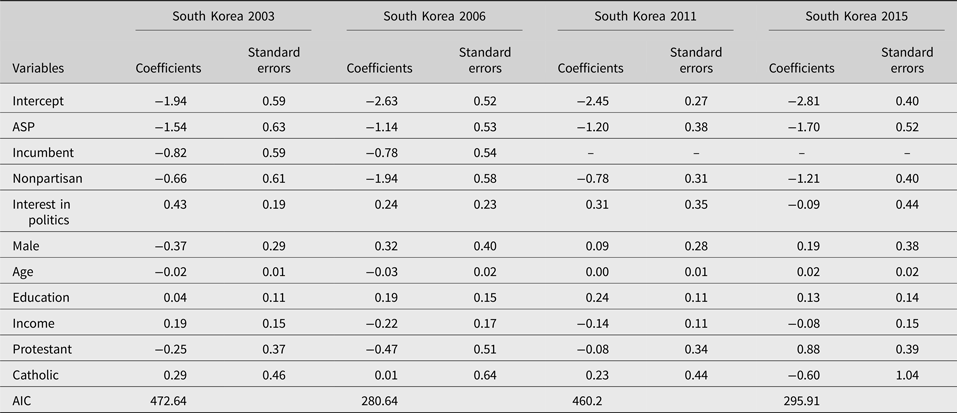
Single level logit models for South Korea

Single level logit models for Mongolia

Single level logit models for Taiwan

Single level logit models for Indonesia

PSM models for South Korea

PSM models for Mongolia

PSM models for Taiwan