


1 Introduction
Positional spellings, that is to say graphemes originally regulated in frequency by character position in a word, have an interesting history of development in Early Modern English (EModE).Footnote 1 The spellings <u> and <v>, for example, have their origins in the single Latin letter v, and were used as positional variants in early EModE without any clear phonemic distinction, with <v> usually appearing at the beginning of words, as in vntil, and <u> elsewhere, e.g. in loue (Horobin Reference Horobin2013: 121). Likewise, <j> was traditionally merely a variant of <i>, and was originally used at the end of Latin-derived numeric forms, e.g. in iiij for ‘4’, while <i> occurred in all positions, including word-initially, like in iudge (Salmon Reference Salmon and Lass1999: 39). In the first half of the seventeenth century, <v> signified increasingly more frequently /v/, and <u> generally began to indicate /ju:/, /ʌ/ and /ʊ/, e.g. in due, cut and bull. Correspondingly, <j> was gradually used more consistently as /dʒ/, and <i> mainly as /ɪ/ and /eɪ/, e.g. in ship and time (see Salmon Reference Salmon and Lass1999: 39; Nevalainen Reference Nevalainen2006: 121, 123–5; Rutkowska Reference Rutkowska2013: 118, 130).Footnote 2 Overall, the alternations between <u> and <v>, and <i> and <j> are among the most commented-upon instances of spellings affected by a process of standardisation in EModE (see e.g. Scragg Reference Scragg1974: 14, 81; Brengelman Reference Brengelman1980: 350; Görlach Reference Görlach1991: 45, 48; Reference Görlach2001: 79; Salmon Reference Salmon and Lass1999: 28, 39; Upward & Davidson Reference Upward and Davidson2011: 184–5, 189–90; Horobin Reference Horobin2013: 120–1; Rutkowska Reference Rutkowska2013: 117–21, 130; Reference Rutkowska and Russi2016: 168–9; Basu Reference Basu, Estill, Ullyot and Jackaki2016: 180–2). The present article focuses on standardisation in printed material, which occurred some fifty years earlier than in handwriting (see Osselton Reference Osselton, Blake and Jones1984 [1998]: 123–37; Görlach Reference Görlach2001: 79).
In general, some details about the redistribution of the positional variants are more or less clear from statements made by previous scholars. Brengelman (Reference Brengelman1980: 350), for example, indicates that ‘[t]he letters i and j were not distinguished consistently until the 1640's’. According to Salmon (Reference Salmon and Lass1999: 28, 39), printers made no progress in establishing the use of <u>/<i> to represent vowels and <v>/<j> to represent consonants during most of the EModE period, at least until the 1630s. Görlach (Reference Görlach1991: 45, 48; Reference Görlach2001: 79), instead, suggests that the redistribution in <u>/<v> and <i>/<j> became regularised between 1630 and 1640, though the distinction was not observed in alphabetisation for a long time (e.g. in Johnson Reference Johnson1755). For Upward & Davidson (Reference Upward and Davidson2011: 184–5), the modern distinction between vocalic <i> and consonantal <j> also began around 1630–40, but the use of the two graphemes as fully separate letters of the alphabet took some time to become consolidated. Rutkowska (Reference Rutkowska2013: 118, 130; Reference Rutkowska and Russi2016: 168–9) notices that the new system, with <u>/<i> corresponding to vowels and <v>/<j> indicating consonants, appears inconsistently in a number of books printed in the 1630s, but that the distinction does not seem to be fully established until approximately 1640. Rutkowska's indications partly contradict statements from the Oxford English Dictionary (s.v. ‘U, n.1’), which suggest that the modern distinction between <u> and <v> in printed books was established by about 1630; the alternants <i> and <j>, on the other hand, allegedly standardised soon after 1630 (OED, s.v. ‘J, n.’). Overall, however, it remains unclear whether the change was gradual or abrupt from a large-scale point of view, and whether there are any parallel diachronic developments between the standardisation of <u>/<v> and that of <i>/<j>.
The motivation behind this article largely stems from a desire to address the tentative indications offered to date about the chronology of the two alternant pairs, and to trace more objectively and for the first time large-scale patterns of development over the full EModE era. A more precise understanding of the chronology of redistribution in <u>/<v> and <i>/<j> affords more confident attempts to correlate diachronic trends with possible factors underlying the standardisation of the positional variants. The two variant pairs, I argue, are closely related to one another, because they were affected by the same pragmatic forces in the early modern era. Thus, large-scale standardisation developments in <u>/<v> and <i>/<j>, especially in word-initial position, were not so much animated by intellectual debates on the English language, but rather they were dependent on professional and historical dynamics that affected the printing industry. In the discussion, the main forces underlying the changes will be argued to be those of typography, cost/error reduction and, most importantly, the end of religiously driven censorship, which favoured more conservative type and spelling practices. Recent explorations of spelling variation in EModE (see Rutkowska Reference Rutkowska2013; Condorelli Reference Condorelli2020a) provide evidence to support the conceptual and empirical validity of a focus on graphemes, as a basis to discuss potential factors underlying spelling standardisation. Previous empirical work has also argued that graphemes form the basic units for the process of standardisation in EModE, and that each graphemic shift occurs autonomously and within its own time frame (Basu Reference Basu, Estill, Ullyot and Jackaki2016: 183–4). A focus on graphemes is therefore paramount in order to trace some of the major influences on the standardisation of English spelling. In order to contribute to a better understanding of the graphemes in question, I conducted a systematic analysis of the alternations in <u>/<v> and <i>/<j> in their most iconic word-initial position between 1500 and 1700, the years most frequently used to delimit the EModE era (see Görlach Reference Görlach1991: 9; Blake Reference Blake, Avila, Pantaleo and Pezzini1992: 18, 26, 28; Barber Reference Barber1997: 1; Nevalainen Reference Nevalainen2006: 1; Nurmi Reference Nurmi, Bergs and Brinton2012: 48).
Chronological patterns of development were analysed in the southern variety of English used by the printing community, largely based in London, as available in a corpus created from Early English Books Online, Text Creation Partnership (EEBO TCP 2015–ongoing). The texts contained in my collection were sampled at regular publication intervals from all transcribed material available to date. The corpus attempts to represent a diversified range of genres and text types, with an average of fifteen different texts per decade, for a total of 312, mostly book-length items. Texts pertaining to topics broadly related to religion are relatively more frequent in the sampled corpus, and comprise almost half of the overall material. The religious texts are evenly distributed in the corpus but they are slightly more frequent in the sixteenth century, reflecting what seems to be a large-scale, general trend in EEBO TCP and in publications from the EModE period as a whole. Over the course of the sixteenth century, about 40–50 per cent of publishing was religious, and included bibles, prayerbooks, sermons, devotional works and more erudite theological writings (see Bennett Reference Bennett1989, II: 269; Bland Reference Bland and Kastan1999: 458; Raymond Reference Raymond and Raymond2011: 62). As well as working as a more generalised collection of a variety of texts, therefore, my corpus reflects the dynamic role that religion had as a component of the printing industry in early modern England. The religious component of my corpus will be pivotal for developing some of the ideas advanced in my discussion. The following section summarises the methodology followed in order to analyse the corpus sampled from EEBO TCP.
2 Methodology
Over the last decade, quantitative methods based on the use of normalisation tools (see Baron & Rayson Reference Baron, Rayson, Mahlberg, González-Díaz and Smith2009; Baron et al. Reference Baron, Rayson and Archer2011a; Reference Baron, Rayson and Archer2011b; Archer et al. Reference Archer, Kytö, Baron and Rayson2015) have pioneered the analysis of relatively large datasets, with the purpose of exploring spelling standardisation in EModE. Preliminary, quantitative insights into spelling variation in EModE as a whole have described a reasonably consistent process of standardisation, which appears to have begun at the onset of the EModE era, and to have continued gradually and lineally to the nineteenth century (see Archer et al. Reference Archer, Kytö, Baron and Rayson2015: 9). As I have recently argued (Condorelli Reference Condorelli and Condorelli2020b; see also Basu Reference Basu, Estill, Ullyot and Jackaki2016: 173–4), however, the trends detected from these preliminary investigations may require some reconsideration, because historical standardisation in normalisation mechanisms tends to be conflated with modernisation (the latter being intended as ‘translation’ into present-day English). Spelling rarely morphed consistently and lineally from one historical stage to a final, ‘standardised’ form, but rather it followed a complex framework of internal regularities. This development shaped words through different standards before reaching the forms that one would expect by the end of the EModE period, and in fact forms like giue, loue, iest and iolly had a dominant, standard-like status in the early seventeenth century over their respective present-day versions (see Basu Reference Basu, Estill, Ullyot and Jackaki2016: 180–1). The process of standardisation by internal regularities should be accounted for in more objective approaches to studying spelling quantitatively, in order to avoid overestimating the degree of internal variation in chronological spelling developments, and to glean a new understanding of the history of standardisation that does not proceed from ‘chaos to order, but from coherence to coherence’ (Basu Reference Basu, Estill, Ullyot and Jackaki2016: 184).
My solution for achieving a more accurate understanding of spellings stems from the 2015 publication of EEBO TCP, which encompasses more than 60,000 transcribed files to date, mostly books printed in the south-east of England.Footnote 3 Private conversations with Paul Schaffner, manager of the Text Creation Partnership, followed by sample comparisons between facsimile and transcribed copies at regular intervals of publication, have informed the fact that the texts available in EEBO TCP are faithfully transcribed from the originals. EEBO TCP is hand-tagged rather than being OCR-ed, which means that all transcriptions inevitably entail some loss of faithfulness potentially caused not so much by electronic recognition processes, but only by human error. The transcribers, however, were most careful to make sure that no reprints or later editions were included in the corpus, and the final product reflects the transcribers’ intent to present the originals in as unbiased and unaltered a way as possible, without prejudice to the type of use to which the texts would be destined. EEBO TCP's transcription policy makes the texts suitable for a historical study of spelling, and the material can be confidently used as a core vocabulary dataset for quantitative investigations of EModE spelling developments (see also Shute Reference Shute2017a: 62‒5). For the present investigation, the vocabulary available in EEBO TCP was extracted in order to build the EModE Vocabulary Database, a resource used to interrogate my corpus about the alternations in word-initial <u>/<v> and <i>/<j>. While my corpus contains texts published from 1500 to 1700, word material from texts produced between c. 1473 and 1700 from EEBO TCP was all included in the vocabulary database, in light of the fact that there are fewer texts surviving from the more distant past.Footnote 4 The EEBO TCP word material was then integrated with vocabulary within the same date range from the Corpus of English Dialogues (Culpeper & Kytö Reference Culpeper and Kytö2006), the Early Modern English Medical Texts (Taavitsainen et al. Reference Taavitsainen, Pahta, Hiltunen, Mäkinen, Marttila, Ratia, Suhr and Tyrkkö2010), the Lampeter Corpus (Schmied et al. Reference Schmied, Claridge and Siemund1994), the Newsbooks Corpus (McEnery & Hardie Reference McEnery and Hardie2007) and Shakespeare's First Folio. All of these corpora contain texts with reliable EModE spelling, with only rare exceptions which were addressed systematically. For example, a subset of texts in the Corpus of English Dialogues containing normalised spelling (see Kytö & Walker Reference Kytö and Walker2006: 28) was excluded as a source of reliable vocabulary.
The process of extraction of the vocabulary from the said corpora entailed a systematic effort to preserve historical spellings by eliminating mark-up material, i.e. easily identifiable tagging elements introduced by the transcribers to signpost page breaks and similar metadata.Footnote 5 The final version of the vocabulary database thus contains more than four million individual lemmas and more than one billion word tokens in total.Footnote 6 The database covers the entire EModE period and represents the greatest majority of the historically reliable material transcribed to date (see also Condorelli Reference Condorelli and Condorelli2020b).Footnote 7 The vocabulary database was tied to a search mechanism in a piece of software that aims to detect variation in spelling purely within and across historical texts.Footnote 8 The search mechanism aims to compare words in a given corpus with words existing in the vocabulary database, to identify and count graphemic variants. Thus, given the word unfaithful, for example, the search system will look for vnfaithful in the vocabulary database, in order to validate the word as a variant if instructed to search for <u>/<v>. The system will then include unfaithful in the validated counts for <u> and the relative year of publication if an instance of vnfaithful exists in the vocabulary database. The variation between <u> and <v> in unfaithfull, unfaythful, unfeythfvll, vnfaithfull, vnfaythful and vnfeythfvll will be identified when looking at <u>/<v> if each of the lemmas above has a variant with each <u> and <v> in the vocabulary database. Identifying different word spellings as separate items does not affect the final diachronic projections in any way, as these are the result of the analysis of all variant vocabulary as a whole for each grapheme. Tracking one position per variation across the whole EModE vocabulary affords the analysis of gradual changes diachronically, to include internal regularities. If there are multiple relevant variant characters in a word, every character position within the word will be counted independently, in order to allow for a focus on individual graphemes, rather than entire word variants.
The variant analysis search mechanism draws on the vocabulary database for judgement about whether a word in a corpus, following a variant search, can be included in the counts as a valid variant. The vocabulary database thus represents a constant against which to detect patterns of standardisation. If a word is never attested in the vocabulary database to show spelling alternation for a specific variant pair, the large dataset used for validation suggests the likelihood that any variation affecting a specific non-variant word involves a more complex graphemic alternation than previously envisaged, or that the word in question may be idiosyncratic. While variant validation could be somewhat regulated by word frequency, searches provide exhaustive information about the greatest majority of individual lemmas, given the proportions between my corpus and the vocabulary database. The identification of variant material following the system described above allows us to analyse spelling developments in word material where we know that two variants for each relevant lemma could have competed to become a standard at some point in EModE, and to count proportions of development diachronically. The following section describes the steps followed for data collection according to the rationale explained above.
3 Data collection
Within the remits of this investigation, the main search found words in my corpus containing variant 1 and variant 2 for <u>/<v> and <i>/<j>, and retained storage of variant and non-variant material in separate levels of internal analysis. Counts for the variant words were extracted distributing the material over different tables, according to the character position where the graphemes occurred. Results were then aggregated by decade of publication, i.e., for example, 1500–9, with the exception of the closing decade of 1690–1700. The purpose of the steps above was to allow a more focused, granular analysis of diachronic changes occurring in first-character position, which alone comprise more than half of the overall relevant material where alternation is attested to occur for <u>/<v> and <i>/<j>. The search was instructed with internal parameters with the aim to afford a permissive, yet systematic identification of individual words in the corpus with those in the vocabulary database, while always retaining the original spellings. In other words, a compromise was made between spelling, intended as indicating the basic character units of EModE words, and orthography, indicating the character units as well as any additional layers of information, including accents, diacritics, punctuation and capitalisation (Rutkowska Reference Rutkowska, Bergs and Brinton2012; Rutkowska & Rössler Reference Rutkowska, Rössler, Hernández-Campoy and Conde Silvestre2012). In practical terms, the compromise between spelling and orthography resulted in the counting of words differing only in orthographic details, e.g. the use of capitals, under the same lemma within results for <u>, <v>, <i> and <j>. The decision above was reinforced by the absence of any meaningful variation from the main trends in results from exploratory searches conducted on orthographic subgroups (for capitalisation, my findings reflect the information available in the OED, s.v. ‘J, n.’, s.v. ‘U, n.1’). Preparatory explorations of sample variant pairs, including <u>/<v> and <i>/<j>, have shown that the number of validations where compromises are made is always proportionally low, i.e. c. 10 per cent of the overall lemmas. However, permissive validation affords an informed exploration of as much relevant EModE vocabulary as possible, in accordance with the limitations in the quantity of material transcribed to date and the constraints of the present article.
EEBO TCP does not contain any duplicate texts, and the editions used in the other smaller corpora are, in all samples compared, different from those of any of the same texts transcribed to date in EEBO TCP. However, for a conceptually rigorous search and as comprehensive an analysis as possible, a one-item minimum frequency threshold was applied for systematic validation. Thus, one variant pair for each <u>/<v> and <i>/<j> in the vocabulary database was sufficient to validate relevant words in the corpus as variants of either of the two pairs. A subsequent step of analysis was carried out to check validations to ensure that idiosyncrasies resulting only from any regional-dependent variations (especially in validations from one text) or orthographic peculiarities (e.g. only uppercase vocabulary to validate lowercase material) would not affect results significantly.Footnote 9 The analysis was aimed especially at lemmas with at least 10 tokens in my corpus, and was conducted by checking word material in the original sentence context. In order to undertake this task, a concordancing tool was used (AntConc, Anthony Reference Anthony2019) for searches on the corpus under analysis, as well as on EEBO TCP and the other individual corpora. The lemma v for ‘5’ (169 tokens in total in my corpus), for instance, was identified as an irregular validation, as only one quote in EEBO TCP features u for ‘5’ (i.e. M.U.C.LUI, in Lauder Reference Lauder1556).
The results were also analysed so that validations would not be affected by issues related to ambiguity caused by homographs, homophones or foreign language material, according to the framework of analysis spelled out elsewhere (Condorelli Reference Condorelli and Condorelli2020b), as a guideline for achieving high standards of precision. The analysis was aimed at ensuring that words like just, which could indicate an adverb or an adjective, would be validated correctly according to both lexical categories and their relative meanings using the vocabulary database, as both categories were represented in my corpus. Additionally, EModE words like vulgar, as available in my corpus, were checked to determine whether they would be validated in the vocabulary database with EModE material, rather than only with any sporadic Latin vocabulary. Overall, the focus of my analysis was not so much on the specific sound values of the alternant graphemes in question, but rather on the overall frequency of development for each grapheme. While a focus on the quantitative developments in the two graphemes represents a standard approach in previous work that focuses purely on orthographic developments in EModE (as discussed in the introduction), there is a more specific reason behind the methodological choice made in this present article. A background overview of the spellings of individual phonemic categories did not reveal anything that was deemed important for a more nuanced picture of developments, and has led me to pursue a direction that promised to provide more fertile ground for a discussion about the factors involved in the chronological development of the positional variants. The following section discusses relative proportions of results based on the overall word counts per decade in my corpus.
4 Analysis
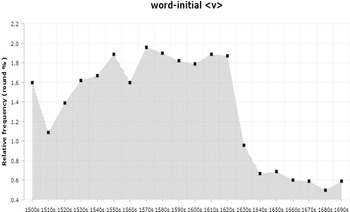
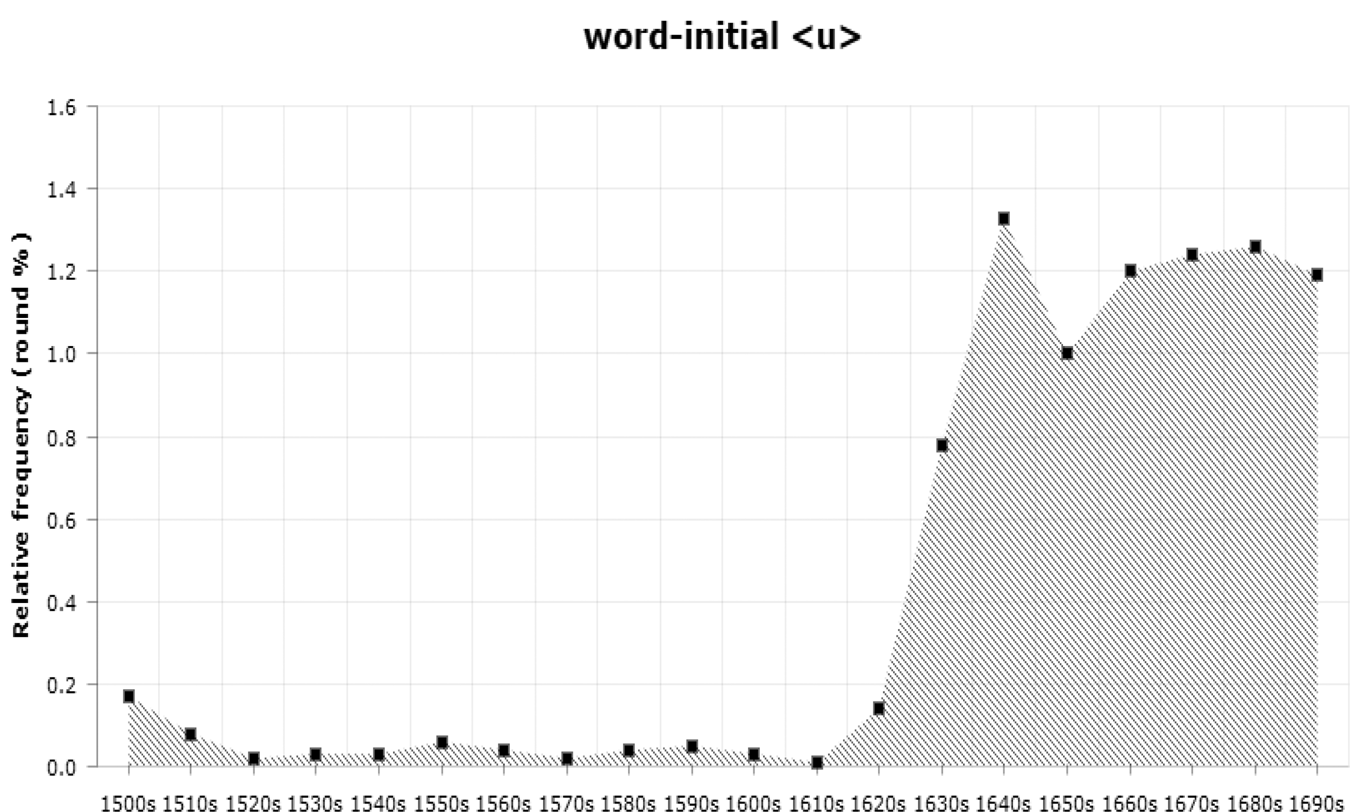
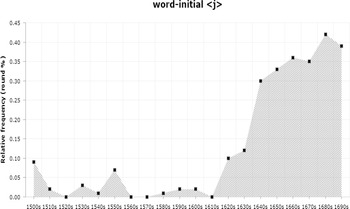
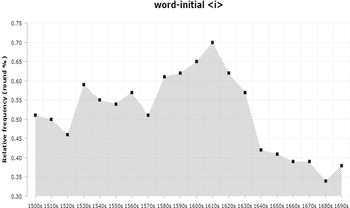
My quantitative results for the diachronic developments of word-initial <u>/<v> and <i>/<j> have revealed some visually compelling chronological patterns. The diachronic projections for the four variant graphemes in first-character position reflect a rather abrupt change in frequency between the 1620s and the 1640s. For word-initial <v> (figure 1), there appears to be a sharp frequency drop of 1.20 per cent between the 1620s and the 1640s. For word-initial <u> (figure 2), trends appear to be inversely proportional to those established for word-initial <v>, and show a rise in frequency of 1.19 per cent between the 1620s and the 1640s. For word-initial <j> (figure 3), trends describe a rise of 0.20 per cent occurring between the 1620s and the 1640s. For word-initial <i> (figure 4), patterns describe a decline of 0.31 per cent between the 1620s and the 1640s, which corresponds chronologically with the spike detected for word-initial <j>. The findings above already inform previous statements about the two alternant pairs, as they describe a process of modern redistribution which mainly occurred within the same generation of printers. The patterns establish some clear dates for the onset of change and a period of regularisation that are common to both word-initial <u>/<v> and <i>/<j>. While the years of redistribution largely match those from previous statements, my data reject the hypothesis that either of the two alternants may have found a complete resolution as early as the 1630s (see e.g. OED, s.v. ‘U, n.1’).
<v> as an alternant of <u>, word-initial position

<u> as an alternant of <v>, word-initial position

<j> as an alternant of <i>, word-initial position

<i> as an alternant of <j>, word-initial position

A closer examination of diachronic projections for each individual alternant character reveals additional, illuminating details about the word-initial variants. For word-initial <v>, there is a slow increase in frequency, amidst small fluctuations, between the 1500s and the 1620s (i.e. 1.60% > 1.87%). Examples of word material contributing to these patterns are vnworthy, which features 31 tokens between the 1500s and the 1620s, and only 2 items after the 1620s; and verily, which occurs 31 times in and before the 1620s, and 12 after the 1620s. Furthermore, the 1620s appear to show proportions that are more similar to those of the sixteenth century than the seventeenth century, compare 1.89 per cent in the 1610s with 1.87 per cent in the 1620s. The process of modern standardisation, however, follows a pronounced trough between the 1620s and the 1630s (i.e. 1.87% > 0.96%). The frequency then drops to 0.67 per cent in the 1640s and finds a relatively permanent resolution at an average of 0.61 per cent between the 1640s and the end of the diachronic spectrum. Examples from individual variant words suggest that the change spread out less naturally than one would expect, which would normally be from high-frequency to low-frequency words (see Nevalainen & Raumolin-Brunberg Reference Nevalainen and Raumolin-Brunberg2003: 53–5). Some of the core, high-frequency words between the 1500s and the 1640s, namely vnder, vnlesse, vnto, vp, vpon, vs and vse, provide evidence to suggest that the change generally occurs in positions that correspond to a vowel sound. All of these items undergo a sudden change in absolute frequencies by the 1640s, with a drop as dramatic as that from 71 tokens for vnto in the 1630s to 3 tokens in the 1640s; or, for vpon, from 108 tokens in the 1620s to 18 in the 1640s. Less frequent words follow a very similar pattern, for example vndoe and vnkind feature 3 and 6 tokens in total, all occurring in or immediately before the 1640s.
The chronological patterns detected for word-initial <u> (figure 2) are largely complementary to those identified for word-initial <v>. Word-initial <u> occurs at an average of 0.05 per cent between the 1500s and the 1610s, with an incipient change to 0.14 per cent in the 1620s. The relative frequency then rises to 0.78 per cent in the 1630s and to 1.33 per cent in the 1640s, and finds a relatively permanent resolution at an average of 1.20 per cent between the 1640s and the end of the century. The redistribution in word-initial <u> describes exactly the opposite lexical dynamics to those identified for word-initial <v>, as relevant characters indicating a vowel this time increase in absolute frequencies. The diachronic projection also forms a sharp s-shaped curve, which describes the speed at which change spread out across the words with a vowel in word-initial position. Core vocabulary items like under, unlesse, unto, up, upon, us and use begin to appear in the 1620s, and seem to replace the <v>-variants almost immediately upon their appearance. The word unto, for example, appears 4 times in the 1620s, and then 75 times in the 1630s and 190 times in the 1640s; upon appears 16 times in the 1620s, 95 times in the 1630s and 250 times in the 1640s. Less frequent vocabulary items also follow similar trends in the same years, for example undoe and unkind replace the <v>-forms discussed above with 3 and 6 tokens in total, appearing in or immediately after the 1640s.
Patterns in word-initial <j> (figure 3) follow similar frequency trajectories to those detected for word-initial <u>, but also describe a more immediate, yet less sustained onset of redistribution, relatively to the proportions in <j>. In particular, the relative frequency of occurrence rises from 0 per cent in the 1610s to 0.10 per cent in the 1620s, and then follows a slightly more conservative development, reaching 0.12 per cent in the 1630s. From the 1640s onwards, however, the relative frequency rises more sharply to 0.30 per cent, and then gradually increases until the end of the century to a peak of 0.42 per cent in the 1680s. High-frequency alternant vocabulary identified for word-initial <j> corresponds exclusively to words expected to begin with /dʒ/ and increases in the number of tokens rather abruptly from around the 1640s. Examples include the core word just, which appears 151 times in and after the 1640s, and only 30 times before the turning point of the 1640s; but also other vocabulary like Jesus, which occurs only 23 times before the 1640s and 116 times in and after the same decade.
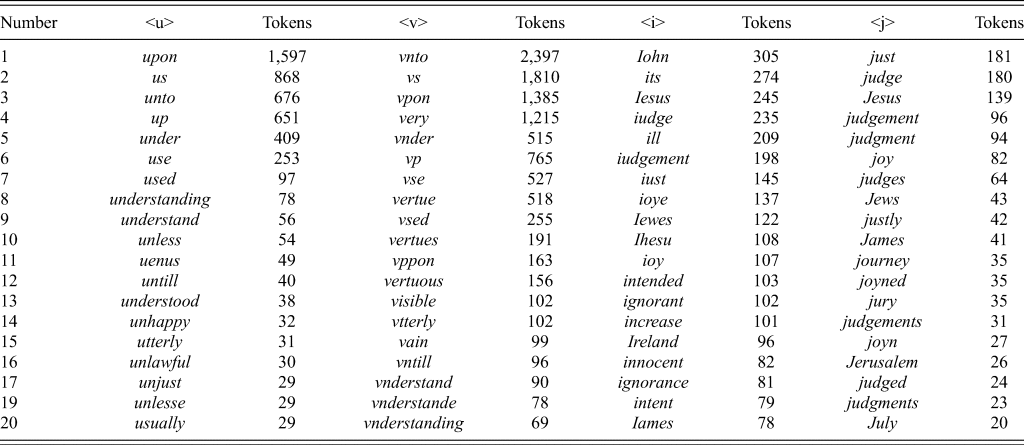
In word-initial <i>, the relative frequency rises from 0.51 per cent in the 1500s to 0.70 per cent in the 1610s, among small fluctuations in between. These patterns are interrupted by a decline from the 1620s, which reaches 0.57 per cent in the 1630s and 0.42 per cent in the 1640s, and then slowly continues to descend afterwards, reaching as low a point as 0.34 per cent in the 1680s. Word-initial <i> also features a more immediate onset of redistribution, with a drop from 0.70 per cent in the 1610s to 0.62 per cent in the 1620s. High-frequency alternant vocabulary sporadically indicates a vowel, for example in words like Ireland, which features 96 tokens spread out across the full diachronic spectrum. The sound /dʒ/, instead, appears to become more frequent over the course of the sixteenth century and the early seventeenth century, for example Iesus features 209 items before the 1620s and 36 tokens in or after the same decade. Most of the lemmas then decrease in the sheer number of tokens from the 1620s, for instance the alternant word iust appears 120 times before the 1620s and 25 times in and after the 1620s. Other lemmas remain in use a little longer beyond the 1640s, for example iudges features 19 tokens between the 1640s and the 1680s. The following section discusses the points developed in this analysis, with a view to identifying factors responsible for the patterns detected. Overall, the word item examples provided in this analysis are only a small sampling of the lexemes collected among the relevant items, and giving a more panoramic view of the data would require an effort that goes beyond the remits of one research article. As shown in the Appendix, however, many of the items chosen as illustrative examples of high-frequency items are indeed some of most frequent forms found in my data, and are reasonably informative of my dataset as a whole. Table A1 in the Appendix lists the top twenty lexical items that alternate between <u>/<v> and <i>/<j>, which provides a more objective, comparative overview of the type of material that was found across my datasets for the four positional variant graphemes.
While there are other graphemic alternants (e.g. <w> and <y>) competing for initial position in the relevant lexemes included in the Appendix and beyond, the overall occurrences of these other graphemes can be considered idiosyncratic, and therefore statistically irrelevant within the remits of this piece of research. Last but not least, the data discussed in this analysis section should be contextualised within the remits of the technical limitations currently existing in corpus-based work. Relevant issues which could become further instructive about general standardisation tendencies behind the positional variant graphemes are, for example, the frequency of the different font-types, as well as the number and regional provenance of the printers in the material studied. While the construction of the corpus might not allow a direct retrieval of this information for every token, the original EEBO-TCP metadata for the texts could give an overall picture, if more systematic ways to aggregate different types of information are developed as part of the corpus transcription project.
5 Discussion
The standardisation of English spelling is assumed to have been a process involving more parties, including authors, readers, the printing press and linguistic commentators of the time (Nevalainen Reference Nevalainen, Baddeley and Voeste2012: 156). The introduction of print, in particular, has been described as a key ‘external event’ that accelerated the process of standardisation and encouraged a debate around spelling reform (Smith Reference Smith and Mugglestone2012: 174). The changes in the distribution of word-initial <u>/<v> and <i>/<j> in my corpus could initially be viewed as the product of a growing, increasingly more firm encouragement to standardisation coming from a longstanding debate on spelling reform. Among the commentators, Hart encouraged a distinction between <u> and <v> and between <i> and <j> in an unpublished pamphlet written in 1551 ([Reference Hart and Danielsson1955]; Dobson Reference Dobson1957, I: 69) and then, more officially, in 1569 (33r–v). The patterns detected in my own diachronic projections for <u>/<v> and <i>/<j>, however, suggest that Hart's indication did not influence contemporary printers’ practices. Even Hart's own works, Orthographie (Reference Hart1569) and Methode (Reference Hart1570), were printed without following a rigorous distinction in the distribution of <u> and <v>, and without using word-initial <j> at all (Rutkowska Reference Rutkowska and Russi2016: 170–1).
The phonemic distinction between <u>/<i> and <v>/<j> was then acknowledged by Hume (Reference Hume1617 [1865]: 12), who indicated that <v> and <j> sounded ‘other wayes then it seemes the romanes did’. The rule for the distribution of <u>/<i> corresponding to vowels and <v>/<j> corresponding to consonants was later endorsed by Greaves (Reference Gr[eaves]1594), Hayward (c. Reference Hayward1625) and Butler (Reference Butler1633). The distribution rule appears to be observed more rigorously in the same text where Butler formulated his statement (‘such are j and v consonants, for which i and u vowels, under the same name, are made to serve’, 1633: iv). The changes advocated by early seventeenth-century commentators may in principle have had somewhat of an effect on the processes of redistribution in word-initial <u>/<v> and <i>/<j>, as the years when the theoreticians were active roughly correspond with the chronological window of redistribution detected. However, the correspondence between the input of the theoreticians and the chronology of the redistribution in word-initial <u>/<v> and <i>/<j> may not be as linear and as immediate as one might be tempted to postulate, due to intricacies that are the product of EModE printing.
For one thing, the EModE book market was markedly different from the largely predictable set-up of our present time, and books rarely had the disposable properties that they often have today. The long life of books meant that some of the material printed in the sixteenth century was certainly still in circulation and in use during the seventeenth century. In academic and religious circles especially, the demand for learned texts was constant, and books had a significant resale value, which in turn encouraged the multiplication of libraries from the mid sixteenth century (Leedham-Green & McKitterick Reference Leedham-Green, McKitterick, Barnard and McKenzie2002: 323–4). As a result of the growing number of libraries, both private and public, readers and writers of the second half of the EModE era were certainly accustomed to earlier spellings. Older texts inevitably influenced seventeenth-century authors, especially when the writing was intended to imitate an archaic or solemn style, like that of some religious material. This would most likely have been the case even when the steady growth in book production recorded from the introduction of printing in England was interrupted by a sharp and sustained increase from the 1640s (see Barnard & Bell Reference Barnard, Bell, Barnard and McKenzie2002: 783‒93; Knights Reference Knights2005: 16; Raymond Reference Raymond and Raymond2011: 60). Brand new books were certainly ideal territory for spelling manipulation, as writers were free from the burden of any standard imposed by previous publications. The concomitant rise of the author as a professional figure meant that a large portion of first editions were created during the second half of the EModE era, but this was in concurrence with a continuous, if not reinvigorated production of old classics and ‘steady sellers’ (see Raymond Reference Raymond and Raymond2011: 62).
Another problem with the hypothesis of a linear correspondence between the changes advocated by the theoreticians and the abrupt spelling redevelopments detected lies in the variety of material contained in the collection surveyed. The texts in my corpus, including those between the 1620s and the 1640s, are linked only very loosely together by shared religious discourse communities. The religious titles coexist with material that has no religious connotations at all, and where the relative communities of authors and readers varied considerably. These texts fall across a number of differing categories, like science, literary prose and official documents, and are each shaped by communicative function, audience, format and even price in the original market (see Gants Reference Gants2002: 189‒93; Bellingradt & Salman Reference Bellingradt, Salman, Bellingradt, Nelles and Salman2017: 2). Each of these variables had an immediate effect on the conventions which readers expected and to which authors strived to conform, which in turn most likely had an impact on the process of linguistic codification of individual categories of texts (Taavitsainen Reference Taavitsainen2001: 140). The linguistic codification of individual texts would probably have driven spelling patterns to follow more independent, or at least less synchronised practices than my own data suggest. In light of this argument, some of the differences across individual groups of texts may be responsible for the smaller fluctuations detected in the four graphemes across the full diachronic spectrum. Additionally, differences in the average redistribution frequencies across the four graphemes may be regulated by the phonemic values of each character in the EModE vocabulary and their distribution in the texts included in my corpus. The eye-catching, abrupt changes occurring between the 1620s and the 1640s, however, require some more careful thinking about this window of time than just the explanations above.
The fact that most of the printers, including small, family-run businesses, produced a variety of books concurrently to maximise profit (McKenzie Reference McKenzie1969: 15) decreases the likelihood that the one-generational change in frequencies for word-initial <u>/<v> and <i>/<j> was due to the sole impetus of the theoreticians. Different categories of texts would probably have shown varying chronologies of receptivity to the intellectual suggestions from the theoreticians, according to the variables outlined in the previous paragraph. Based on the evidence collected from examples of lexical diffusion in the variant graphemes, then, it seems more reasonable to suggest that the abrupt redistribution would have been driven mostly not by a purely linguistic motivation, but rather a pragmatic one. In particular, diachronic patterns of development were probably largely regulated by typographic practices in the production of the book common to all texts included in the corpus. Even when taking the route of typography, however, matters are nothing less than complicated. For example, one might endorse Salmon's idea (Reference Salmon and Lass1999: 39) that the delay in the redistribution of <u>/<v> and <i>/<j> may be caused by ‘the strong influence of Latin orthography’, presumably in the process of concurrent book production. While <v> was found word-initially in Latin and English, however, <j>, unlike English, was also frequently used word-initially in the sixteenth century (see e.g. veterator, vtinam and juris in Anon 1586). This fact challenges the idea that Latin was fully responsible for the delays in the redistribution of the word-initial variant pairs. If anything, the influence of Latin may have been involved in the fact that typesetters, at least at the onset of the redevelopments in the 1620s, were more prepared to use word-initial <j> than to dismiss word-initial <v>.
Another hypothesis based on typography lies in the increased awareness of the text as a platform for technical improvement. Between the end of the sixteenth century and the beginning of the seventeenth century, changes occurred in the layout of the page as a result of developments in compositional practices, which led to a wider, large-scale shift from an understanding of the page as a solid block of text to a more flexible organisation of typographic elements (Bland Reference Bland1998: 94). In particular, space gradually took a pivotal role for a revolutionary approach to ordering the text with more precision and rigour, to replace the unpredictability of older texts, which were often squeezed together (see Shute Reference Shute2017b). The increased awareness of space as an element of printing most likely also enabled compositors to rethink spelling consistencies. Typesetters began to take the habit of using spaces of different widths according to the characters that they separated between words. For example, the type f in word-final position normally required one of the wider spaces due to its stretching shape, but not if the following word featured a j in word-initial position, as the hooked tail of the type would take some of the room usually filled in by the space. On the other hand, spaces were narrow in the vicinity of round types like v and u, and there was a finer difference between word-initial v and u depending on the character in the preceding word, as u sometimes required an even narrower space than v due to its rounder shape (see Mosley Reference Mosley, Suarez and Turner2009: 177 for parallel instances other than my own examples). From an overarching point of view, however, linking changes in handling page composition with the spelling redistribution detected appears to be a challenging task, due to the following potentially counterintuitive issue.
Making use of the modern distinction between <u>/<i> and <v>/<j> would most likely have afforded compositors a more flexible, dynamic way to attain justification. The solution would probably have given typesetters a less uneven distribution of words beginning with each of the four characters on an average page. This achievement would in turn have helped compositors to make a more dynamic use of the types and the spaces of different widths available during composition, by manipulating the text from a lexical or syntactic point of view. A more flexible spelling resolution would thus have lowered the cost related to ordering imperfections, namely additional types and spaces which were sometimes necessary whenever the typographic material ordered from the type founder became unexpectedly insufficient (as defined by Mosley Reference Mosley, Suarez and Turner2009: 173). It is not yet clear, therefore, why compositors would have waited decades to begin taking steps towards a more economical and flexible approach to using types, if this could have been to the advantage of printers from the beginning of the seventeenth century. Admittedly, cheap print may have somewhat encouraged a more predictable rearrangement of the spellings: with the ever-increasing production of pamphlets from the 1620s (see Nelson & Seccombe Reference Nelson, Seccombe, Barnard and McKenzie2002: 535), thick, mid and thin spaces – sometimes even hair spaces – became critical for readability. A pamphlet was produced as anything smaller than a folio, i.e. quarto, octavo and duodecimo, and the space devoted to the text was even smaller than the page itself (Peacey Reference Peacey and Raymond2011: 454). Once again, however, the book market of the time encompassed more than only pamphlets, and so does my own corpus. Thus, economy would probably not have been the only catalyst for the word-initial redevelopments.
With reference to other possible typographic solutions potentially related to the redistribution in word-initial <u>/<v> and <i>/<j>, then, typefaces appear to provide even more interesting material for discussion. Quite recently, Rutkowska has identified a correlation between the use of <u>/<i> and black-letter, as well as between <v>/<j> and roman, and has briefly indicated that a change in typefaces probably underlies the redistribution of these variants (Rutkowska Reference Rutkowska2013: 119–20, 130; Reference Rutkowska and Russi2016: 168–9). The hypothesis advanced by Rutkowska is certainly alluring, but a more precise, large-scale understanding of the chronology of the redistribution in word-initial <u>/<v> and <i>/<j> inevitably calls for a more thorough evaluation of the extent to which changes in typefaces are compatible with the spelling redevelopments detected. Black-letter was the predominant typeface in English language texts until a rise in economic prosperity changed the typography of publications in favour of roman between the sixteenth and seventeenth centuries (Bland Reference Bland1998: 94).Footnote 10
While roman became increasingly more popular at the turn of the century, the delay in the redistribution of the word-initial variants may stem from technicalities involved in the composition of the two typefaces. For compositors, sixteenth-century black-letter was fairly easy to learn, and the types were fewer than roman. For example, <j> was never used word-initially (see Rutkowska Reference Rutkowska2013: 130), which must have contributed to creating very little well-established ambivalence between vocalic and consonantal values in word-initial <i> and <j>, as reflected in my own data. Another characteristic of sixteenth-century black-letter was that there was only one capital form for <u>/<v> and one for <i>/<j>, generally equivalent to the letters V and I respectively, and the text-hand did not have any capitals at all (see Carter Reference Carter1969: 27; Görlach Reference Görlach1991: 48). What is more, the type  , usually indicating the grapheme <v>, frequently appeared word-initially regardless of its phonemic value (e.g. in
 , vnder), a principle which may have contributed to the rising high-frequency patterns detected for word-initial <v> before the modern redistribution. The type
 was visually distinct from
 , normally indicating <u> in other positions (e.g. in
 , vniuersal).Footnote 11 From other examples in printed material (see Rutkowska Reference Rutkowska2013: 118–20), it seems that a departure from the convention above was also possible in black-letter, but the shape of the types was distinct enough for the compositors to reduce incoherencies in any case, when working under pressure.
If black-letter provided a more fine-grained graphic resolution, roman was more reader-friendly and sold well, but probably challenged compositional practices. Even though early seventeenth-century roman often imitated word-initial conventions from black-letter, typesetters appear to have experienced more difficulty in distinguishing between the types  and
 in roman. Compositional issues occurred especially whenever the traditional rules were not followed, perhaps as early attempts to adopt a more dynamic approach to using types and spaces (see e.g.
 for uery, compare
 for not).Footnote 12 The difficulties may have been caused by the larger number of characters available in roman, which would have required a rearrangement of the compositor's type case set-up, or even the boxes within each case where types were held (see Raymond Reference Raymond2003: 75; Mosley Reference Mosley, Suarez and Turner2009: 174–6). A more systematic use of the type
 , and therefore of the grapheme <v> for a consonant, and a more predictable use of
 , and therefore <u> for a vowel, may have worked as an urgent attempt, admittedly not always successful, to diminish errors in the use of
 and
 in roman, by association between pronunciation and type box position. The urgency of this resolution could have played a role in word-initial <u> and <v>, which changed abruptly in frequencies in the 1630s following some initial hesitation, and underwent a relatively permanent resolution after the 1640s. These patterns are not entirely comparable with trends in the other variant pair, probably because
 , even upside-down, was clearly less ambiguous due to its dotted, elongated body and its curved tail. However, the solution proposed still does not appear to be sufficient, when taken alone, to explain the abrupt changes occurring in word-initial <u>/<v> and <i>/<j> overall between the 1620s and the 1640s.
With reference to chronology, the shift from black-letter to roman was not an immediate one but rather it occurred in a phased and intermittent way. In London, most printers acquired new pica roman type from 1587, year of the opening of the Rose Theatre, responding to an increasing demand for new fashion that came from the Continent (Bland Reference Bland1998: 106). The use of roman as a more predominant typeface other than for contrastive purposes coincided with the rise of the public theatre and an unexpected expansion in the book market (Rappaport Reference Rappaport1989: 149–50). The prospering situation of the book market, however, changed abruptly with the outbreak of the plague in 1593. Between 1593 and 1594, only three printers appear to have purchased new type (i.e. Thomas Creede, John Legate and Valentine Simmes), and no new type was acquired again until the beginning of the seventeenth century (Bland Reference Bland1998: 107). In the seventeenth century, then, black-letter continued to be used in jest books, romances, ballads, some religious material, as well as legal texts and proclamations, long after it had disappeared in verse, plays and elsewhere (Raymond Reference Raymond2003: 74). On the other hand, roman dates back as early as 1509 in a Latin book printed in England, and the earliest extant use of roman in an English publication dates from 1555 (Bland Reference Bland1998: 93).Footnote 13
If the change from black-letter to roman was rather phased, then, it may become difficult to explain the abrupt frequency changes in the word-initial variants from a large-scale point of view as mainly related to typefaces. A possible solution to this dilemma, however, may be found in the correlation between typefaces and confessional ideology. In particular, the dynamics between black-letter and roman may be linked to traditional religious connotations relative to the two respective typefaces, particularly in religious material. Roman had a very obvious Italianate correlation and was probably traditionally associated with Catholic ideologies; on the other hand, there would probably have been a longstanding, close link between black-letter, a typically ‘English’ typeface, and Protestantism (see Bland Reference Bland1998: 94; Hellinga & Trapp Reference Hellinga, Trapp and Hellinga1999: 24–5). The semiotics of the two typefaces were made explicit by association with key publications of the time: among the most authoritative books, the first edition of the Protestant King James Bible (1611), printed in black-letter, and the Catholic Douay–Rheims Bible (Martin Reference Martin1582, Reference Martin1609–10), printed in roman, were probably the most grandiose expression of a long-standing, implicit framework of meaning and identity in typefaces.
Scrutinising the fingerprint of types and typefaces, together with decorative material, was the main way in which the monarchy, through inquisitions, identified printers of unlawful material during most of the early modern era (Loades Reference Loades1991: 114; Bland Reference Bland1996: 159; Pettegree Reference Pettegree2011: 206). The influence of censorship was so strong that typesetters appear to have been responsible for apparently counterintuitive standardisation patterns like those in Iesus, which appears increasingly more frequently up to the early seventeenth century. Religious censorship was so pervasive that all writing from the period was ‘encoded’, and ‘the prevailing codes of communication, the implicit social contract between authors and authorities [were] intelligible to all parties at the time, as being a fully deliberate and conscious arrangement’ (Patterson Reference Patterson1984: 17). The licensing of manuscripts and the supervision of the press according to these unsaid codes were generally delegated to the chaplains in the bishop of London's household (Bland Reference Bland1996: 169). The decision as to whether a book deserved royal sanction, therefore, was made by readers who were very familiar with religious works and were highly motivated to defend Protestantism. This is not to say that Catholic material was censored a priori, of course, as authors occasionally reprinted Catholic works in their confutations to criticise Catholicism, nor was the roman typeface banned as a general principle if used in unsuspicious works. The process of discrimination, however, worked through a wide range of complicated prescriptions and was often arbitrary and inconsistent (Shuger Reference Shuger2006: 6).
Given the unpredictability of the censorship system, the typeface of Protestant religious material may have set a model for a tacit, censorship-friendly typographic desideratum in England for a long time. With the increasing popularisation of roman, some of the features inherited from black-letter, like the positional spellings, would still have worked as a compromise for general typographic conventions. The implicit, typographically based obligation to express loyalty to the government inevitably stilted the mainstream market, and played to the advantage of foreign or unlicensed printers in attracting customers with fancy layouts and prohibited topics, causing resentment among the authorised professionals (see Bland Reference Bland1996: 179; Collison et al. Reference Collison, Hunt, Walsham, Barnard and McKenzie2002: 45–6; Pettegree Reference Pettegree2011: 207). From the evidence available in authoritative Catholic material like the Old Testament printed abroad (Martin Reference Martin1609–10), it seems that a phonemically regularised distribution of <u>/<v> and <i>/<j> was not a distinguishing mark of foreign alternative printing up to the early seventeenth century. Additionally, the covert way in which unlicensed printers operated in England would most likely not have solicited anything like an identity-defining spelling innovation on a large-scale basis. Thus, the systematic standardisation of <u>/<v> and <i>/<j> prescribed by the theoreticians, especially in its emphatic word-initial position, may have been seen by the mainstream printers as a new, authoritative means to reinforce a detachment from alternative printers and to embrace innovation. The printers’ intention to make the mainstream, domestic market more competitive, together with the need to reduce printing costs using types and spaces more dynamically, are in fact likely to have been the main motivations behind the large-scale redistribution in the word-initial spellings. The rapidity of the change and the rather close correlation between the chronological developments affecting both sets of positional variants discussed imply that some specific conscious decision could have also been involved, possibly on the part of the Stationers’ Company.
The scenario laid out here represents a suitable point of departure for a more confident conclusion about the spelling redevelopments that took place between the 1620s and the 1640s, and their relationship with typefaces and the historical context of the time. The window of time where the redistribution for word-initial <u>/<v> and <i>/<j> occurred corresponds chronologically with the Thirty Years’ War (1618–48) and the outbreak of the English Civil War (1642–51). Both of these historical events had a direct impact on the manner of English printing and, consequentially, it is likely that they mutually reinforced changes in large-scale practices in typography. With regards to the Thirty Years’ War, recent research has placed emphasis on the fact that the Stuart monarchs engaged actively with the conflicts between Catholic and Protestant states on the Continent, sending Englishmen to fight together with the armies of the Dutch Republic, Denmark and Sweden (Marks Reference Marks2012). The war thus prompted a demand for European news, and encouraged such an overwhelming quantity of pamphlets and other printed material, that the licensing system used to control publication had begun to become less effective from the 1620s (see Rostenberg Reference Rostenberg1971: 81). The crumbling of the censorship system may have encouraged established printers to take advantage of the situation, a decision which would in turn have been reinforced by the growing number of new printing businesses devoted to printing pamphlets in the most economic way (Nelson & Seccombe Reference Nelson, Seccombe, Barnard and McKenzie2002: 538).
The years leading to the Civil War, then, consolidated an even more disorderly printing activity, and probably changed the popular perception of black-letter. In 1637, Archbishop Laud tried to impose a new prayer book on the Scottish church, and asked for the commanding folio book to be printed in black-letter, as most folio books of English Common Prayer had been printed. Laud's typographic decision, however, caused resentment in the Protestant Scottish church, which in turn contributed to sparking a riot in Edinburgh (see Morrill Reference Morrill, Cust and Hughes1997: 159–81). With the ascent to the English throne of King Charles I, a former High-Anglican turned Catholic, black-letter had begun to signify not only the authority of English state proclamations, but also the monarch's Catholic orientation (see Lesser Reference Lesser and Straznicky2006: 107). In 1639, King Charles sent an army to enforce Archbishop Laud's prayer book in Scotland, essentially declaring war on his Protestant subjects. In 1641, then, in an attempt to suppress royalist propaganda, Parliament abolished the licensing system that had been set up under the Tudors, effectively leaving the press unregulated for the following two decades (Shuger Reference Shuger2006: 12). The breakdown of censorship and the shift in the perception of black-letter allayed most of the pressures that were being placed on the English printing industry. It was these changes that, I believe, gave a stronger impetus for printers to implement redistribution in word-initial <u>/<v> and <i>/<j>.
6 Conclusion
The empirical focus of this article has been on the diachronic development of the redistribution in word-initial <u>/<v> and <i>/<j> between 1500 and 1700. The results have shown that the change occurred abruptly and in a synchronised way between the 1620s and the 1640s. The discussion has argued for professional and historical dynamics in the first half of the seventeenth century as key to encouraging changes in practices among the community of printers. Thus, the belated redistribution of <u>/<i> to represent vowels and <v>/<j> to represent consonants may not have been the result of a failure of printers to establish a regular correspondence between sounds and spellings during most of the EModE period, as indicated by Salmon (Reference Salmon and Lass1999: 28). Instead, the delay was the product of a conscious effort by the printers’ community to comply diligently with the government's requirements for a long time.
This conclusion seeks to resolve the enigma of whether early modern theoreticians or the printing press were responsible for the positional spelling redistribution (see Rutkowska Reference Rutkowska and Russi2016: 187). This new perspective also calls for a re-evaluation of the role of the community of printers and their historical context in shaping English spelling as we know it today. Any future explorations of parallel changes in other character positions should further validate some of the arguments advanced in this artcle. While the discussion provided in the present article mainly revolves around British culture and history, it seems that the same phonographic pattern for <u>/<v> and <i>/<j> was also emerging at roughly the same time in printed texts from the continent (see e.g. Baddeley Reference Baddeley, Baddeley and Voeste2012: 97). Investigating patterns in other languages, of Course, exceeds the scope of the case study in question, but the possibility of influence from the broader context for printing in Europe should be considered in future research. Printing practices were not limited to the geographical and linguistic bounds of one nation or another, so it is very likely that the continental practices would have been noticed in Britain and vice versa. The coincidence in time frame suggests that there was either mutual influence or a similar underlying cause affecting all the relevant traditions, perhaps related to the history of the book as a herald of European culture.
Appendix: lexical overview (top twenty word items)
Table A1 contains the overall token counts for the top twenty items that alternate between <u>/<v> and <i>/<j> in my study corpus. For the purposes of illustration, capitalisation was fixed in the entries below, where applicable, regardless of any existing internal variation. The absolute token results are based on the following overall variant token population for each different graphemic category (relevant positional values only): <u>: 6,641; <v>: 18,760; <i>: 7,931; <j>: 2,043. The overall size of the study corpus is of 1,428,864 tokens.
Overall token counts for the top twenty items that alternate between <u>/<v> and <i>/<j>