Background
Although interpersonal violence is recognized as an important public health problem, relatively little is known about the etiology of violent behavior. Familial clustering of interpersonal violence can be assumed from most theories of its development, be they sociological, biological or psychological. Given the sometimes conflicting nature of these theories, the family would seem a natural arena to empirically test them against each other. Perhaps surprisingly, this has rarely been done in a systematic fashion. In fact, even the magnitude of the familial aggregation of violence remains largely unknown.
Intergenerational transmission, that is a correlation between parent and offspring behavior, has been reported for criminal convictions (Bijleveld & Wijkman, Reference Bijleveld and Wijkman2009), serious violent offending (Putkonen et al. Reference Putkonen, Ryynanen, Eronen and Tiihonen2007), criminal ‘careers’ (van de Rakt et al. Reference van de Rakt, Nieuwbeerta and de Graaf2008), partner violence (Ehrensaft et al. Reference Ehrensaft, Cohen, Brown, Smailes, Chen and Johnson2003), aggressive behavior (Conger et al. Reference Conger, Neppl, Kim and Scaramella2003; Dubow et al. Reference Dubow, Huesmann and Boxer2003), inconsistent (Thornberry et al. Reference Thornberry, Freeman-Gallant, Lizotte, Krohn and Smith2003) or hostile (Conger et al. Reference Conger, Neppl, Kim and Scaramella2003) parenting, child abuse (Pears & Capaldi, Reference Pears and Capaldi2001), and substance use (Bailey et al. Reference Bailey, Hill, Oesterle and Hawkins2006). Of these studies, all but one (van de Rakt et al. Reference van de Rakt, Nieuwbeerta and de Graaf2008) used small or unrepresentative samples, making estimates of familial risk unreliable. By only focusing on associations between parents and their offspring, they were also limited in their ability to separate between competing theories of how antisocial behavior is passed on from one generation to the next. Although there are exceptions (Hicks et al. Reference Hicks, Krueger, Iacono, McGue and Patrick2004; D'Onofrio et al. Reference D'Onofrio, Slutske, Turkheimer, Emery, Harden, Heath, Madden and Martin2007), many studies of intergenerational transmission assume transmission due to social learning or other environmental mechanisms without controlling for possible genetic confounding. This is problematic because a meta-analysis of 51 twin and adoption studies concluded that genes explain some 40% of the variance in antisocial behavior (Rhee & Waldman, Reference Rhee and Waldman2002), although the assumptions underlying the classical twin model have been criticized (Joseph, Reference Joseph2002). This illustrates the need for well-designed family studies in criminology, so that genetic, social and individual (biological or environmental) risk factors can be teased apart systematically. This approach is common in genetic and medical epidemiology, where familial risk has been studied for many somatic disorders [e.g. pre-eclampsia (Cnattingius et al. Reference Cnattingius, Reilly, Pawitan and Lichtenstein2004), melanoma (Lindstrom et al. Reference Lindstrom, Yip, Lichtenstein, Pawitan and Czene2007) and endocrine diseases (Hemminki et al. Reference Hemminki, Shu, Li, Ji, Sundquist and Sundquist2008)] and psychiatric illnesses [e.g. schizophrenia (Lichtenstein et al. Reference Lichtenstein, Bjork, Hultman, Scolnick, Sklar and Sullivan2006), autism (Daniels et al. Reference Daniels, Forssen, Hultman, Cnattingius, Savitz, Feychting and Sparen2008) and attention deficit/hyperactivity disorder (Rasmussen et al. Reference Rasmussen, Neuman, Heath, Levy, Hay and Todd2004)].
Some previous research tried to quantify the familial risks of criminal offending (Farrington et al. Reference Farrington, Jolliffe, Loeber, Stouthamer-Loeber and Kalb2001; Putkonen et al. Reference Putkonen, Ryynanen, Eronen and Tiihonen2002). However, we expand on this by specifically addressing interpersonal violence using a data set more than one thousand times larger than in the largest previous study (van de Rakt et al. Reference van de Rakt, Nieuwbeerta and de Graaf2008). Furthermore, we use longitudinal register data instead of relying on index individuals' self-reports of their relatives' life-time violent crime, and by reporting familial risks for violence across different levels of relatedness, socio-economic position, age at first conviction, and different types of violent crime.
Method
Data set and variables
We linked several Swedish total population registers using the unique personal identification number as key. From the Crime Register (held by the National Council of Crime Prevention), we obtained records of all convictions in Swedish general courts between 1 January 1973 and 31 December 2004. The Multi-Generation Register (Statistics Sweden) identifies biological and adoptive parents of everyone living in Sweden at any time since 1961 and born in 1932 or later (7 968 603 index persons yielded, through this linkage, a total n=12 563 581). This information made it possible to construct full family pedigrees and analyze familial aggregation at many levels of genetic and family environmental distance. The Total Population Register (Statistics Sweden) provided information on individuals' sex, birth year and country of birth. The Cause of Death Register and the Migration Registers (both at Statistics Sweden) provided information on when individuals were alive and living in Sweden. Finally, the national censuses of 1960, 1970, 1980 and 1990 supplied information regarding childhood socio-economic position.
We defined violent crime as: homicide, assault, robbery, threats and violence against an officer, gross violation of a person's/woman's integrity, unlawful coercion, unlawful threats, kidnapping, illegal confinement, arson, and intimidation. Attempted and aggravated forms of these offences were also included. For a brief description of the crimes, see the Data Supplement (available online). We did not incorporate sexual offences (e.g. rape and child molestation) because they might differ etiologically from non-sexual violent offending (Hanson et al. Reference Hanson, Scott and Steffy1995; Lussier, Reference Lussier2005). Plea bargaining is not allowed in the Swedish judicial system and all crimes are registered regardless of possible insanity at the time of perpetration. Furthermore, conviction data include all persons who received custodial or non-custodial sentences and cases where the prosecutor decided to caution or fine. Finally, Sweden does not differ considerably from other members of the European Union (EU) regarding rates of violent crime and their resolution (Westfelt, Reference Westfelt and Ekström2008).
The age of criminal responsibility in Sweden is 15 years; hence, no offences committed before this age are recorded in the Crime Register. Country of birth was aggregated across regions; Statistics Sweden does not provide more detailed information for research. Categories were: Sweden; Scandinavia excluding Sweden; the European Union excluding Scandinavia and former eastern European countries; former eastern European countries in the EU excluding Romania and Bulgaria; the rest of Europe; Africa; USA and Canada; the rest of North America; South America; Asia excluding the former USSR; the former USSR; Australia and New Zealand; and finally, the rest of Oceania.
Childhood household socio-economic position was rated on a three-point scale, based on Statistics Sweden's Socio-Economic Index (SEI; Statistics Sweden, 1995). The household SEI is constructed from both parents' occupation, divided into categories reflecting the education needed for the job, associated status and payment. The coding of the SEI has changed somewhat over time; hence, we collapsed the coding into categories Low (skilled and unskilled workers across all fields), Medium (low- and intermediate-position white collar workers) and High (high-position white collar workers and self-employed professionals and entrepreneurs). The latter includes all owners of private enterprises (except agriculture), regardless of size. Household SEI was assessed in the national censuses of 1960, 1970, 1980 and 1990. Each individual's childhood household SEI was defined as the household SEI at the census when the person was between 5 and 15 years of age. Consequently, we were unable to obtain childhood SEI for individuals born before 1945, this gave us 4 405 841 index persons with SEI information. For those born 1985–1989 we used the 1990 Census although they were aged <5 years at the time of the census.
Analytical procedure
For each degree of relatedness, we created a dataset containing all such relatives of each person in the Multi-Generation Register; that is, one entry per index person–relative pair rather than one entry per individual. We then performed a nested case–control study with multiple matching variables. Hence, when an index person was convicted of a violent crime, he or she was considered a case and five controls were chosen randomly among people who were alive, living in Sweden and not convicted of a violent crime at the time of the case's conviction. Controls were matched to cases on sex, birth year, country of birth, and having a corresponding relative (e.g. sibling, parent or child respectively) of the same age and sex. If such a relative had ever been convicted of a violent crime, the index person was considered ‘exposed’. The difference in exposure between cases and controls was analyzed using conditional logistic regression with a robust sandwich estimator, yielding odds ratios (ORs) and 95% confidence intervals (CIs). The robust sandwich estimator aggregated over families (e.g. among sibling pairs, all pairs having the same parents) to adjust for the correlated nature of familial data. This analysis was performed for index persons' full, half and adoptive siblings, biological and adoptive parents, grandparents, aunts and uncles, cousins, and mating partners (defined as a person with whom the index person had sired one or more children). All calculations were performed using proc phreg in SAS version 9.2 (SAS Institute Inc., USA).
As a complementary measure of familial risk, tetrachoric correlations were calculated from the matched data. Note, however, that this metric does not take into account that our data have a matched structure of one case per five controls. Neither does it take into account the correlation between dyads in the same family.
To test whether familial risks were modified by socio-economic position, we also modeled interactions between childhood SEI and family history of violent crime. We further analyzed the effect of age at the first violent criminal conviction on familial aggregation by redefining exposure to be the relative's history of first violent conviction within a 5-year age interval (15–19, 20–24, etc). To eliminate potential period effects, this analysis was performed only for pairs where both index person and relative were born 1958 to 1968, the decade for which we had the longest follow-up and where both index person and relative were at least 15 years when the Crime Register began (index persons n=1 321 755).
Finally, in recognition that our definition of violent crime contained several, perhaps etiologically disparate, subtypes, we also analyzed all subtypes of violent crime separately against themselves and any violent crime respectively. The study was approved by the Regional Ethics Committee in Stockholm.
Results
Sample characteristics
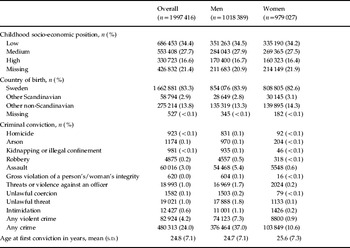
Descriptive statistics are presented in Table 1. As in other countries, crime rates and the demographic composition of the population in Sweden has changed over time. This dynamic nature of our cohort makes population characteristics difficult to summarize in a few figures. Hence, the prevalences presented in Table 1 are based on a restricted cohort, those who were alive, living in Sweden and 30–45 years old in 2004. These individuals were at least 15 years old at the start-up of the register of criminal convictions, and have passed the peak age of first criminal conviction (about 15–25 years of age). Of these, 83.3% were born in Sweden and 16.7% were first-generation immigrants. It was quite common to have been convicted of any crime: 24.0% had been convicted at least once (men: 37.0%, women: 10.6%). Convictions for interpersonal violence were considerably rarer, and the gender difference even more pronounced: 4.2% had been convicted overall, 7.2% among men and 0.9% among women.
Sociodemographic characteristics for all individuals who, in 2004, were alive, aged 30–45 and living in Sweden

s.d., Standard deviation.
Childhood socio-economic position was based on parents' highest occupation when the index person was aged 5–15 years and coded as Low (skilled and unskilled workers in all fields), Medium (low- and intermediate-position white collar professionals) or High (high-position white collar professionals and self-employed entrepreneurs). Age at first conviction refers to violent crime.
Familial risk of interpersonal violence
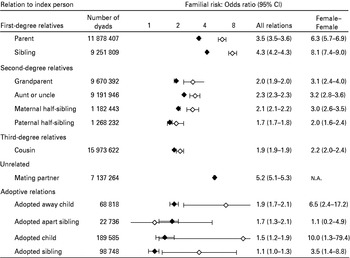
We found strong evidence of familial aggregation of interpersonal violent behavior leading to criminal convictions, significant (p<0.05) for all relationship types except biologically unrelated adoptive siblings (p=0.16). Overall, close genetic relatives living in the same family, that is full siblings and children/parents, had the highest familial risk [Fig. 1 and Table S1 (online)]. For instance, the OR for non-sexual violent offending was 4.3 (95% CI 4.2–4.3) among full siblings of violent individuals and 1.9 (95% CI 1.9–1.9) among cousins. Although high familiality could theoretically be caused by aggregation of either genetic or environmental risk factors alone, the pattern of familial risks in Fig. 1 suggests the importance of both. As children continue to live predominantly with their mothers upon parental separation (Statistics Sweden, 1994), and are hence exposed to similar degrees of shared environment as full siblings, genetic etiology was supported by the risk for full-siblings (OR 4.3, 95% CI 4.2–4.3) being higher than for maternal half-siblings (OR 2.1, 95% CI 2.1–2.2). The risk was also higher for parent-biological offspring (OR 3.5, 95% CI 3.5–3.6) than parent-adopted offspring (OR 1.5, 95% CI 1.2–1.9), and there was a statistically significant risk increase for full siblings adopted apart (OR 1.7, 95% CI 1.3–2.1). This strong effect of genes on violent offending is congruent with previous studies indicating that genes explain some 40% of the variance in antisocial behavior (Rhee & Waldman, Reference Rhee and Waldman2002). Effects of the shared family environment were also suggested; unrelated adopted offspring of violent offenders had an increased risk of being convicted themselves (OR 1.5, 95% CI 1.2–1.9), although there was no such risk increase for biologically unrelated adopted siblings of violent offenders (OR 1.1, 95% CI 1.0–1.3). Again, because children are considerably more likely to stay with the mother's new family when parents separate, supporting evidence of shared family environment effects also came from the risk difference between maternal and paternal half-siblings, the former having significantly higher familial effects than paternal half-siblings (ORmaternal 2.1, 95% CI 2.1–2.2; ORpaternal 1.7, 95% CI 1.7–1.8).
Relative risk for violent crime among relatives of violent index persons in the Swedish total population 1973–2004, compared to matched controls. Graph shows odds ratios (ORs) and 95% confidence intervals (CIs) for all dyads (◆) and female–female dyads (◊). Each individual in the population may appear multiple times in different categories (e.g. parent, sibling and cousin, etc.) depending on family pedigree.

Finally, there was a remarkable degree of ‘assortative mating’; a man or woman convicted for a violent offence was substantially more likely to have children with a violent partner (OR 5.2, 95% CI 5.1–5.3).
Familial effects by gender
Interesting gender effects were suggested; interpersonal violence among female probands was specifically associated with higher risk among female relatives [ORsis–sis 8.1 (95% CI 7.4–9.0) compared to ORbro–bro 4.2 (95% CI 4.1–4.3), ORsis–bro 4.4 (95% CI 4.2–4.6), and ORbro–sis 4.0 (95% CI 3.8–4.2)]. This effect was strongest in sisters followed by mother–daughter pairs, but was found across all female–female relations: grandmothers–granddaughters, aunts–nieces, and female cousins (Fig. 1). The only female–female risk increase that failed to reach significance was that for adopted apart sisters, but there were few such dyads (n=5500) and the statistical power hence poor. The OR is a relative measure of risk, and given the low prevalence of violent crime among women, it might not be surprising that the sister–sister OR is higher than the brother–brother OR. However, female–female relations also have an increased association on the tetrachoric correlation scale [sister–sister correlation: 0.48, brother–brother: 0.41, see Table S2 (online) for all tetrachoric correlations].
Familial effects by socio-economic position
We found higher familial risk in higher socio-economic strata: ORsibling in families with low socio-economic position was 3.6 (95% CI 3.5–3.7), in families with medium socio-economic position 4.8 (95% CI 4.6–5.0), and in families with high socio-economic position 5.8 (95% CI 5.5–6.1). This interaction between familial risk and childhood socio-economic position was highly significant [likelihood ratio (LR) test: χ2=40 316.1, df=5, p<0.0001] and the pattern was consistent across all other relations [Table S3 (online)].
Familial effects by age at violent crime
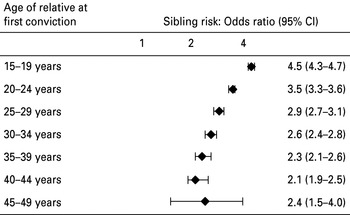
Younger age at first conviction was associated with higher violence risk in siblings (Fig. 2). This pattern was consistent across all relations analyzed, although the effect seemed weaker for spouses [Table S4 (online)]. Note that parents and grandparents could not be included in this analysis.
Relative risk for violent crime among siblings of violent index persons in the Swedish total population born 1958–1968, divided by age of sibling at first violent conviction. Graph shows odds ratios (ORs) and 95% confidence intervals (CIs) for all dyads.

Familial effects by subtype of violent crime
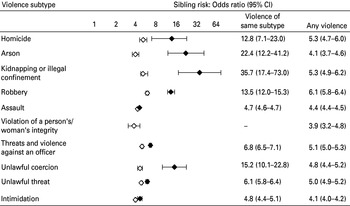
Our definition of violent crime included several different offences against persons. As these subtypes might represent different behavioral traits with different etiology, we analyzed sibling risks separately for each subtype (Fig. 3). The increased risk for any violent crime varied slightly across violent crime subtypes exhibited by the sibling [ORviolence ranged from 3.9 (95% CI 3.2–4.8) for violation of a person's/woman's integrity to 6.1 (95% CI 5.8–6.4) for robbery]. However, the strong specificity suggested for some violent offences is more striking. A person's conviction for arson was specifically associated with increased risk for arson in his/her sibling (ORarson 22.4, 95% CI 12.2–41.2), far beyond the association of arson to any violent crime (ORviolence 4.1, 95% CI 3.7–4.6). Similar specificity was found for unlawful coercion, robbery, lethal violence, and kidnapping and illegal confinement.
Relative risk for crime among siblings of violent index persons in the Swedish total population 1973–2004, divided by subtype of violent crime. Graph shows odds ratios (ORs) and 95% confidence intervals (CIs) for siblings' conviction for crime of the same subtype (◆) and any violent crime (◊).

Discussion
In summary, we find strong familial risks for violent crime. The pattern of risks suggests the importance of both genetic and environmental elements in this familiality. We also find that the familial risk is modified by gender, socio-economic position, age at first criminal conviction and subtype of violent crime.
Although high female–female risks would be in line with theories of a higher genetic threshold for female antisocial behavior (Cloninger et al. Reference Cloninger, Christiansen, Reich and Gottesman1978), the effect was not seen in sister–brother pairs to the extent that would have been expected following a generally increased genetic liability (for a discussion of this, see the online Data Supplement). There is some prior evidence that the heritability of antisocial behavior is higher in women than in men (Eley et al. Reference Eley, Lichtenstein and Stevenson1999), but this was difficult to verify by comparing familial risks in the present study. Judging from adoptive data, the female-specific effect seemed both genetic and environmental. This suggests the presence of both female-specific genetic variation and female-specific environmental effects. Although speculative, the latter might include role modeling, where a woman's interpersonal violence risk might be particularly enhanced by the violent behavior of her mother or another female relative, or specific interpersonal interactions.
Finding weaker familial risk in lower socio-economic strata was expected. The crime rate is higher in lower socio-economic groups, generally regarded as reflecting higher levels of structural and individual criminogenic factors; hence, less familial loading would be needed to make someone violent. In higher socio-economic groups, the lower prevalence of interpersonal violence renders factors within the family more important for violent behavior. Of interest, previous research with representative Swedish population data suggests that genetic factors account for more variance in antisocial behavior in higher as compared to lower socio-economic groups (Tuvblad et al. Reference Tuvblad, Grann and Lichtenstein2006). Though not tested in the present study, this could indicate that the increased familiality found in upper SEI strata is due largely to an increased importance of genes rather than familial microenvironments.
The increased familial risk with lower age at first conviction could be interpreted in two ways. First, this could mean that those who are convicted at an early age represent those with more severe antisocial behavior, due to many alleles (gene variations) or particularly stressful environments conferring increased risk. Naturally, such factors would partly be shared by relatives and explain the increased familial risk. Second, later-onset violent offenders might constitute another, qualitatively different, group of offenders on a dissimilar developmental trajectory for violent crime. These older offenders would then have followed a developmental path where familial factors are less important. Future studies could investigate how this age effect is connected to theories of typologies of developmental trajectories of antisocial behavior, such as Moffitt's (Reference Moffitt1993) division of adolescent-limited and life-course-persistent offenders.
The pattern of high familial risks among specific offences suggests etiological diversity within the wider category of violent crime; one general familial factor could influence all violent crime and others, more specifically, only one or a few behaviors (for a lengthier discussion, see the online Data Supplement). Such general factors could include negative affect, aggression proneness, impulsivity, and substance use disorders, all of which are at least moderately familial (Lake et al. Reference Lake, Eaves, Maes, Heath and Martin2000; Conger et al. Reference Conger, Neppl, Kim and Scaramella2003; Rasmussen et al. Reference Rasmussen, Neuman, Heath, Levy, Hay and Todd2004; Bailey et al. Reference Bailey, Hill, Oesterle and Hawkins2006).
Our finding that a person convicted for a violent offence had five times the odds to have children with a violent partner has important implications for attempts at separating the influence of genes and environmental factors on antisocial behavior. If not specifically adjusted for, such ‘assortative mating’ would cause some behavior genetic models (such as the classical twin model) to underestimate genetic and overestimate shared family environmental effects (Krueger et al. Reference Krueger, Moffitt, Caspi, Bleske and Silva1998). It also implies that studies focusing on the impact of antisocial traits in one of the parents, usually the father, might have been confounded by antisociality in the other biological parent.
The use of nationwide registers is a considerable strength of the present study. Hereby, we could study the entire Swedish population for a period of 32 years, and reduce the risk of misclassification by eliminating the risk of recall and other reporting biases associated with interview data. Nevertheless, registers also have limitations. First, mothers might report someone other than the true biological father as the father of their child. Although paternal discrepancy is not known specifically for the Swedish Multi-Generation Register, a review suggested a median of 3.7% across prior international studies (Bellis et al. Reference Bellis, Hughes, Hughes and Ashton2005). Note that the true paternity of a child is generally not known, so our estimates are clinically relevant even though they might underestimate genetically transmitted risk. Second, the Crime Register only contains data on convictions in general courts, and not on potential changes in higher court upon appeal. According to official reports from the Swedish National Courts Administration (1987, 1995), the appeal rate has increased for criminal code violations (7% in 1975, 10% in 1993). However, the rate of substantial changes in higher court decreased during the same time (19% in 1975, 8% in 1993). Thus, the rate of misclassification in our data due to changes in conviction status after appeal should be fairly constant at about 1%.
We only had access to data on actual criminal convictions, and a majority of all crimes committed are either not reported to the police at all (current reporting rates 21–42% for illegal threats, assault and robbery; Swedish National Council for Crime Prevention, 2008) or, if they are, do not result in a conviction. If, for any reason, the risk were different across families for ‘true’ violent offenders to be reported, prosecuted or convicted and hence end up in the Crime Register, this could inflate estimates of familial risk. This could, for example, be caused by racism or discrimination in the judicial process. We attempted to handle this potential source of bias by matching on country of birth, and by presenting familial risks for different socio-economic strata.
There are also some technical issues with register data. In general, left truncation due to register start-ups and right censoring due to the end of follow-up will lead to random misclassification of outcome, which will bias familial risks towards the null (Leu et al. Reference Leu, Czene and Reilly2007). We reduced this misclassification by matching case and control index persons and relatives on birth year to yield equal time at risk to enter the Crime Register. However, because familial risk changes with age at first violent crime (Fig. 2), left truncation and right censoring might still bias familial risk estimates. For siblings, the ORs in Fig. 1 could be considered an overall estimate of familial risk across different ages at first conviction and socio-economic strata. Cross-generational dyads present a greater problem because both individuals have to be convicted during a 30-year period. The familial risk of grandparents is based only on combinations of young offenders (the index persons) and older offenders, with an unknown age at their first true conviction. To get an unbiased estimate of grandparental risks, a much longer follow-up time is needed.
Genetic contributions to interpersonal violence are no longer novel findings in behavior genetics (Rhee & Waldman, Reference Rhee and Waldman2002). By contrast, the precise estimates of the size of familial aggregation of interpersonal violence reported here are completely new. Specifically, an ORsibling of 4.3 (95% CI 4.2–4.3) might be considered fairly large, knowing that the prevalence of violent criminal convictions is about 4.2% in the general Swedish population. To illustrate, the crude OR for the association between low versus high socio-economic position and violent crime was 2.1 (95% CI 2.1–2.1), and the corresponding OR for being born outside Scandinavia versus being born in Sweden was 2.1 (95% CI 2.0–2.1). In comparison, familial history of interpersonal violence is a potent marker of individual risk. This supports addressing familial history of interpersonal violence when assessing an individual's risk for violent behavior (e.g. Fazel et al. Reference Fazel, Grann, Carlstrom, Lichtenstein and Langstrom2009). Furthermore, although we acknowledge the potential controversy regarding equality before the law in legal proceedings, the usefulness of family history for violence risk assessment seemed to be more pronounced for females, in higher socio-economic strata, and for early-onset violence.
These results also support prevention and intervention efforts that involve the families of violent individuals. Not only could this prevent index offender recidivism but also possibly prevent offences otherwise committed by other members of the identified offender's family.
The family is a natural focal point for many theories concerning the development of antisocial behavior. Despite this, criminology has mostly overlooked family-based studies. Individuals constituting a family often share socio-economic factors, ethnicity, neighborhood, etc. Hence, familial aggregation of interpersonal violence has usually been interpreted as an environmental effect. However, family members also share known amounts of DNA. In comparing individuals with their relatives and not only with unrelated, albeit matched, controls, it should be possible to disentangle factors causally related to the development of antisocial traits and behaviors. By providing reliable estimates of substantial familial risks of interpersonal violence, we hope to inspire further family-based research on the development of criminal behavior.
Note
Supplementary material accompanies this paper on the Journal's website (http://journals.cambridge.org/psm).
Acknowledgments
The research was funded by the Swedish Prison and Probation Service R&D. N.L. is supported by the Swedish Research Council – Medicine. The funding bodies were not involved in the design and conduct of the study, collection, management, analysis, and interpretation of the data, or preparation, review or approval of the manuscript.
Declaration of Interest
None.