I. Introduction
The study of legal change is a prominent aspect of law and courts research. Much of the research has tended to focus on court-centric aspects of ideology (Segal and Spaeth Reference Segal and Spaeth2002), strategic interactions (Epstein and Knight Reference Epstein1998), or the influence of political elites in shaping the courts (Gillman Reference Gillman2002, Reference Gillman2006; Whittington Reference Whittington2005, Reference Whittington2007). While all important, I argue that we need to also give more attention to the legal interactions between courts and lawyers in legal development. Courts, under whatever influences, do not drive legal development alone because common law courts are inherently passive and must wait for claims to come before them to act. Courts are not, however, completely passive because they can send signals about the kinds of legal arguments they wish to hear. Courts act on the legal claims developed by lawyers, and lawyers respond to legal signals sent by courts. Thus, it is fair to say that courts need lawyers and lawyers need law. This article offers an initial exploration of how lawyers respond to legal signals in the particular context of judicial federalism because this area emerged fairly recently and provide lawyers with a complex set of signals about legal meaning from multiple courts at both levels of government. At a narrow level, then, this article says something interesting about why the practice of judicial federalism has varied across states. At a broader level it reaches further and presents one way of exploring the legal dynamics that courts and lawyers go through over time.
While judicial federalism—the use of state constitutional rights provisions to expand protections beyond federal doctrine—has led to some significant victories in areas such as school finance, abortion regulations, and LGBT rights (Andersen Reference Andersen2005; Wharton Reference Wharton2009; Paris Reference Paris2010), numerous studies demonstrate that rights claims are dominated by federal law (Fino Reference Fino1987a, Reference Fino1987b; Emmert and Traut Reference Emmert1992; Esler Reference Esler1994; Cauthen Reference Cauthen2000). James Gardner’s critique of judicial federalism concluded that state constitutional discourse “is a vast wasteland of confusing, conflicting, and essentially unintelligible pronouncements” and that what does exist is “often borrowed wholesale from federal constitutional discourse, as though the language of federal constitutional law were some sort of lingua franca of constitutional argument generally” (Gardner Reference Gardner1992, 763, 766).Footnote 1 Explanations for the limited development of state constitutional law have tended to center on court-centric influences such as judicial ideology, the institutional structure of state courts, and the political environments in which state courts operate (see Fino Reference Fino1987b; Tarr and Porter Reference Tarr1988; Latzer Reference Latzer1991; Emmert and Traut Reference Emmert1992; Esler Reference Esler1994; Beavers and Walz Reference Beavers and Walz1998; Brace, Hall, and Langer Reference Brace1999; Beavers and Emmert Reference Beavers and Emmert2000; Swenson Reference Swenson2000). Unfortunately, what attitudinal and strategic accounts ignore is the role of law and lawyers in the development of legal change.
In this article, I argue that the interaction between courts and lawyers in legal development is an important element in the study of judicial federalism. I argue that lawyers respond to two basic legal signals in the judicial federalism context: external signals from federal retrenchment and internal signals from state court guidance or encouragement. Most existing research focuses on the actions of state courts rather than lawyers under the first, external signal. Here, I focus on legal responses to internal encouragement; in other words, how lawyers respond to their state high court’s doctrinal shifts in judicial federalism cases. The goal is to present an initial empirical exploration of the role of internal signals that can be built on in later work. Through a study of the Washington Supreme Court, I argue that the adoption of the criteria test shifted the legal analysis and reasoning offered by lawyers in constitutional rights cases. This change in internal signals shifted the content of legal arguments both in comparison to earlier constitutional claims in Washington, as well as comparatively across states.
I first survey the literature showing the importance of interactions between lawyers and courts in legal change more broadly. I then explain how these studies can be understood specifically in the judicial federalism context. After establishing this theoretical background, I turn to discussion of why Washington was chosen for study. For reasons explained there, the criteria approach was quite strongly established in Washington and thus serves as a most likely case. In other words, if Washington’s adoption of the criteria test showed negligible shifts in lawyer behavior, then we would not expect internal signals, in this form at least, to have an effect in other states. Finally, I turn to discussion and analysis of the constitutional claims and concluding remarks about what this evidence suggests for the study of judicial federalism and the broader concept of legal interactions.
II. Lawyers and Courts, Support and Signaling
This focus on lawyers is largely drawn from support structure arguments. Charles Epp examined rights revolutions, the “sustained, developmental process that produced or expanded the new civil rights and liberties” (Epp Reference Epp1998, 7), in Canada, India, the United Kingdom, and the United States. Traditionally studies of rights revolutions emphasize the importance of formal bills of rights with activist judges willing to enforce these rights and Epp acknowledged the importance of these two factors as necessary to rights revolutions but insufficient alone. He demonstrated that “rights revolutions depend on widespread and sustained litigation in support of civil rights and liberties” (Epp Reference Epp1998, 18). While judges do occasionally take the initiative in crafting legal changes without the push from lawyers, the support structure is still necessary to build on and enforce such changes (Epp Reference Epp1998, 21). His comparative study found that in the two broadest rights revolutions, Canada and the United States, a broad support structure for the rights claims preceded and supported the work of activist courts. Even in the United Kingdom, where no formal bill of rights exists, a limited rights revolution developed through the concerted effort of reform litigators. Finally, India never saw a sustained rights revolution despite the support of the high court because of the limited ability of rights litigators to mobilize and support this judicial interest. The findings of Epp and others demonstrate the importance in understanding how lawyers are participating in a movement for legal change.Footnote 2 Epp focused on support in the form of legal organizations being able to marshal sufficient funds and support to litigate the case. Other scholars similarly frame support as primarily a resource mobilization issue. For example, in his examination of conservative rights groups Steven Teles (Reference Teles2008, 12) detailed how legal mobilization is necessary to capitalize on shifts in other institutions: “Where the composition of the judiciary is reshuffled without a corresponding shift in the support structure, legal change may fail to occur or, at the least, be substantially limited and poorly coordinated or implemented.” Similarly, expansion of federal funds for legal support services for the poor led to significant alteration in legal rules affecting the poor by ensuring a sufficient degree of support in bringing the issues to court (Lawrence Reference Lawrence1990).
While mobilization in the form of sufficient funding and support is certainly a necessary component, lawyers still must marshal support in the law through their arguments and legal claims. We might view this as an ideational form of support that builds on the simple mobilization of financial resources to bring cases to court. Courts are required to provide legal justifications for their decisions and “opinions themselves, not who won or lost, are the crucial form of political behavior by the appellate courts, since it is the opinions which provide the constraining directions to the public and private decision makers” (Shapiro Reference Shapiro1968, 39). Legal arguments frame the options available to courts even if the final decision “is the product of those litigant claims, legal bases, and judicial sympathies that the temper of the times create and join together” (Lawrence Reference Lawrence1990, 122). In her study of the development of civil rights litigation in the 1940s, Risa Goluboff (Reference Goluboff2007) demonstrated that lawyers were faced with an open field of legal possibilities and that their choices and interactions with courts throughout the decade shaped the options ultimately available to the Supreme Court in the 1950s. In their study of death penalty and abortion litigation before the Supreme Court, Lee Epstein and Joseph Kobylka (Reference Epstein and Kobylka1992, 8; emphasis in original) concluded that while traditional explanations of judicial ideology, political environment, and interest group pressure were all important to the Supreme Court’s doctrinal shifts, “it is the law and legal arguments as framed by legal actors, that most clearly influence the content and direction of legal change.” A study comparing the texts of legal briefs and Supreme Court opinions found that 10% of the language in Supreme Court opinions was drawn directly from the briefs (Corley Reference Corley2008). From these studies we see suggestions of the importance of ideational support in addition to material support. In turn, then, we look to the primary source of law for constitutional litigations: the actions of courts.
Where support structure arguments focus on the ways lawyers develop cases and legal arguments for courts to act on, court signaling theory highlights the ability of courts to trigger cases and arguments that they are interested in hearing (Baird Reference Baird2007; Baird and Jacobi Reference Baird and Jacobi2009a, Reference Baird and Jacobi2009b). Vanessa Baird (Reference Baird2007, 4) argued “that the incentive to support litigation in particular policy areas varies over time in accordance with litigants’ changing perceptions of Supreme Court justices’ policy priorities.” Through their opinions and other actions, justices send signals that they are interested in particular kinds of claims and legal arguments and “policy-minded litigants base their strategies of selecting cases, issues, and legal arguments on information from the Supreme Court” (Baird Reference Baird2007, 31). For example, in an immigrant rights case the litigants preferred to rely on an equal protection argument, but negative signals from the Supreme Court suggested such arguments would fail. Instead, the litigants shifted to a federalism argument after an increasing trend of signals about the revival of federalism (Baird Reference Baird2007, 73–82; see also Baird and Jacobi Reference Baird and Jacobi2009a). In a related vein, the Supreme Court’s earliest decision on university affirmative action pushed universities and litigants on both sides of the issue to reframe their approaches and challenges to the policy in the Court’s terms (Keck Reference Keck2006).Footnote 3 Through the favoring of some claims over another, courts provide guidance on particular legal claims that in turn shapes how litigants develop subsequent arguments.
III. Support, Signaling, and Judicial Federalism
Each of these arguments is important for the study of judicial federalism. The lack of a legal support structure for state constitutional activism would be a significant barrier to the development of judicial federalism. If lawyers are rarely offering state constitutional claims, or only offering discarded federal law as state arguments, then the weak development of state constitutional law is unsurprising. Unfortunately, failure to raise state constitutional claims has rarely been examined, though it has frequently been asserted (see Collins, Galie, and Kincaid Reference Collins and Galie1986; Williams Reference Williams1991; Esler Reference Esler1994). Donald Farole (Reference Farole1998) is one of the few exceptions. In his study of obscenity and takings cases, Farole (Reference Farole1998, 20) examined interest group litigation in state and federal courts and found that “all else being equal, interest groups typically prefer to locate policy conflicts in national rather than state courts” because federal decisions have a broader impact.Footnote 4 But this study of interest groups is limited because such groups are necessarily policy activists with a national focus, whereas most lawyers serve individual clients and practice law in single states and thus may have different interests. In particular, duty to their client is of foremost importance, and the failure to raise state claims may have disastrous consequences for these clients. A former judge of the New York Court of Appeals noted that in a series of recent cases his court had adopted broader state protection but warned, “obviously, if defense counsel had not argued state constitutional law their clients, instead of being exonerated, would have gone to jail” (Hancock 1993, 276–77). Connecticut Justice Robert Berdon (1994, 197) discussed a case where a mentally ill man lost his federal claim and opines that a state claim, if made, would most likely have resulted in his removal to a mental institution rather than prison.
There is reason to believe that the support for state constitutional law is generally weak. Since the Warren Court’s movement to nationalize constitutional law, the tendency of law schools has been to follow suit and treat it as a unitary concept. Law schools may give significant attention to state level variations in common law subjects such as property or torts but they tend to neglect this possibility for constitutional law (Esler Reference Esler1994; Sutton Reference Sutton2009; Williams Reference Williams1991). Even if law school is primarily understood as implanting a particular worldview along with certain research tools (Mertz Reference Mertz2007), this lack of any background training surely limits the imagination of lawyers approaching constitutional issues. This limitation is likely further entrenched by the fact that courts tend to give limited attention to state constitutional law. This depends on the law offered to lawyers, however.
Two kinds of legal signals are important to explaining why lawyers develop state constitutional claims in some areas but not others. I refer to these as the external and internal signals. The external refers to instances where the US Supreme Court has retrenched away from previous rights protection or refused to recognize rights claimed from precedent. A lawyer seeks primarily to win her case and where federal law has soured on her, state constitutional provisions provide a last-ditch effort. This move to state law is limited, however, by the fact that there is usually no state constitutional law to rely on. In such a situation, lawyers are likely to provide arguments that are still primarily concerned with the now-discarded federal doctrine because that is all the law they have to work with. Thus, the state arguments are most likely to be invitations for evasion of federal retrenchment, for the state court to continue applying the prior federal rule under the window dressing of state law.
State courts, however, may take a stronger interest in state constitutional activism and seek to provide guidance to their bars. This is the internal signal where courts seek to provide instruction and guidance by providing standards and independent law to lawyers. State courts may pursue this doctrinally in terms of particular kinds of rights claims or more broadly through instructions on how constitutional claims are to be litigated generally. With the state court encouraging the development of, and providing the seeds for, distinct state constitutional doctrines, the content of litigants’ state claims should shift. The arguments should become increasingly divorced from simple invitations for evasion of a retrenching federal court because litigants are provided with a more coherent set of law or guidelines and, in turn, provide the state courts with more opportunities to build that law.
IV. Question
While the above stresses how legal change can be understood through interactions between lawyers and courts, this study is admittedly focused on only one part of this interaction. My inquiry is limited to examining whether the strong signals sent by the Washington Supreme Court altered litigant behavior in the form of the constitutional claims they offer. I do not make any claims about the impact this change in litigant behavior may have on court decisions. The goal is to illustrate internal signaling through an initial empirical examination of one state. At a narrow level, the findings implicate the development of state constitutional law and suggest one way in which the practice of such law may be improved. At a broader level, this article illustrates the importance of considering legal interactions between lawyers and courts over time and across issues.
V. Why Washington?
Washington serves as a most likely case. Its relatively early adoption and forceful briefing rule is unusual and should provide evidence of shifting arguments in response if my argument is credible. In other words, it is unlikely that internal signals, at least in the criteria form, affect legal arguments if no change is observed. Finding no effect would call into question my claim that studying legal interactions between courts and lawyers is an important aspect of studying legal change. A finding that lawyers did alter their behavior to accommodate the court’s change in signals, even if compliance is imperfect, is suggestive that attention to court signaling and interaction between lawyers and courts in legal development is worth further study.
Like most state high courts, state constitutional issues became increasingly important to the Washington Supreme Court in the 1970s and 1980s. Unlike most other courts, however, it responded by expressing a clear state constitutional theory to guide how lawyers were expected to argue such claims. Under the influence of Justice Robert Utter,Footnote 5 who published widely on state constitutional theory generally and its specific application in Washington (Utter Reference Utter1984, Reference Utter1985, Reference Utter1988, Reference Utter1992; Utter and Pitler Reference Utter and Pitler1987; Utter and Larson Reference Utter and Larson1988; Utter and Spitzer Reference Utter and Spitzer2002), the Court adopted a strong preference for hearing state constitutional claims only when properly presented.
The first attempt at clarity came in State v. Coe (1984, 101 Wash.2d 364), where Justice Utter wrote for the Court declaring that the constitutional challenge to a judicial order forbidding broadcasting of trial evidence should first be examined under the state constitution. Utter argued that the very nature of the federal system and differences between the constitutions along with the histories of both “clearly demonstrate that the protection of the fundamental rights of Washington citizens was intended to be and remains a separate and important function of our state constitution and courts that is closely associated with our sovereignty.” Moreover, regular engagement with the state constitution allows the Court to “develop a body of independent jurisprudence that will assist this court and the bar of our state in understanding how that constitution will be applied.” This body of law will be more legitimate because it “will not appear to have been constructed to meet the whim of the moment.” Finally, it is simply illogical to apply federal law where narrower state law, whether common, statutory, or constitutional, would have been sufficient (Coe, 101 Wash.2d at 373–74). Despite this preference for state constitutional resolution, the Court maintained it should also resolve the federal issues even after it found the prior restraint to violate the absolute state right to publish and broadcast legally obtained information. Utter (1985) justified this approach as maintaining participation in the national constitutional debate.
Two years later, in State v. Gunwall (1986, 106 Wash.2d 54), the Court revisited this issue by specifying a clear preference for the criteria approach to state constitutional law in a case about whether a warrant is required to obtain phone records or to attach a pen register to a phone line. The Court expressed concern with the legitimacy of judicial federalism noting that
Many of the courts now resorting to state constitutions rather than to analogous provisions of the United States Constitution simply announce that their decision is based on the state constitution but do not further explain it. The difficulty with such decisions is that they establish no principled basis for repudiating federal precedent and thus furnish little or no rational basis for counsel to predict the future course of state decisional law. (Gunwall, 106 Wash.2d at 60)
Gunwall established six “nonexclusive neutral criteria” that are necessary for demonstrating whether “the Washington State Constitution should be considered as extending broader rights to its citizens than the United States Constitution: (1) the textual language; (2) differences in the texts; (3) constitutional history; (4) preexisting state law; (5) structural differences; and (6) matters of particular state or local concern” (106 Wash.2d at 58). These criteria were specifically aimed at guiding counsel in arguing state constitutional issues as well as ensuring that any expansive state constitutional holding is based on “well founded legal reasons and not by merely substituting our notion of justice for that of duly elected legislative bodies or the United States Supreme Court” (106 Wash.2d at 62–63).
After Gunwall’s guidance proved less than effective, as discussed below, the Court strengthened the test. In State v. Wethered (1988, 110 Wash.2d 466), the Court declared that the Gunwall factors were required and that “by failing to discuss at a minimum the six criteria mentioned in Gunwall, [claimant] requests us to develop without benefit of argument or citation of authority the ‘adequate and independent state grounds’ to support his assertions. We decline to do so consistent with our policy not to consider matters neither timely nor sufficiently argued by the parties.” While other courts may have decided to expand Miranda-type protections, “we will not consider that question until the issue is adequately presented and argued to us” (Wethered, 110 Wash.2d at 472, 473 [internal citations omitted]). Subsequent cases consistently reiterated this requirement of full Gunwall briefing before the Court would consider state constitutional issues. Hugh Spitzer (1998, 1197) examined the 108 instances where the Court discussed Gunwall through 1997, finding that in nearly 60% of cases it refused to consider the issue solely because of inadequate briefing. Later decisions also encouraged early complete briefing, refusing to consider issues where Gunwall analysis was made only in late reply or supplemental briefs.Footnote 6 As the cases accumulated and developed a body of law, the Court became less strict holding that “no Gunwall analysis is necessary in this case because we apply established principles of state constitutional jurisprudence” but warning that “Gunwall analysis is nevertheless required in cases where the legal principles are not firmly established” (State v. White, 135 Wash.2d 761, 769 n. 7 [1998]). Though in actual practice probably only search cases had developed sufficient precedent to be included in this exception for my time frame.
Some have criticized the criteria test for treating state constitutional meaning as presumptively limited to federal doctrine because state courts have a duty to interpret state constitutions in all cases regardless of federal meaning (Tarr Reference Tarr1998b, 182–83; Williams Reference Williams1997). In this view, the criteria approach is an illegitimate gatekeeping measure. I certainly agree that the approach is a gatekeeping measure (Spitzer Reference Spitzer1998) but stake no ground as to the normative question of legitimacy. I assume that the Court intended the criteria to serve as a means of making state constitutional law easier and more efficient by making the lawyers do the heavy lifting and not as a means of dodging the Court’s obligation to interpret state law. As Sptizer (Reference Spitzer2006) argued, the criteria encompass accepted forms of constitutional arguments and the Court has been open to hearing state claims so long as the arguments fit the form so there is no reason to assume that the Washington Court adopted this approach to shirk its duty to interpret state law.
VI. Case Selection and Coding
This study draws on constitutional rights arguments presented to the Washington Supreme Court from 1970 to 2000. This date range is meant to allow for tracking of changes in constitutional arguments from the early days of interest in judicial federalism through periods of more active engagement. I collected briefs only from even years. Data collection on briefs that are not electronically available is time consuming and expensive, and thus I used even years as a reasonable compromise between a wide date range and completeness within each year. I used the year the case was decided, though obviously briefs were sometimes presented before that year. Cases were identified through Westlaw searches for any mention of constitution or its variations for each year; the syllabus and head notes were examined to limit cases to constitutional rights claims that have parallels in both constitutions. With a few minor exceptions, I included all rights areas parallel to the federal Bill of Rights—except for the unincorporated provisions guaranteeing grand juries and civil jury trials—and the due process and equal protection clauses of the Fourteenth Amendment. I excluded only issues concerning speedy trials, challenges to public employment hearings, and vague police powers arguments. The first two are excluded because they tend to involve interrelated issues of constitutional and statutory provisions. Further, the second and third are likely to be only vaguely presented as constitutional claims with the argument being primarily an attack on the facts underlying the hearing or regulation.
Unfortunately, the collections I used were incomplete for some years. For 1970–86, the University of Washington Law Library had only paper copies of the briefs that were incomplete. For 1970–82, the Seattle University Law Library had some limited coverage in a set of in-house microfiche. I obtained copies of all the briefs available from these two sources, but this fell short of my ideal sample. For 1972–82 and 1986 my samples ranged from 40% to 48% of the identified universe and only 1970 was reasonably complete with 70% of the briefs available. However, coverage of 1984 was woefully underrepresented with only 14% of the briefs located. Thus, the data for these years should be read with this limitation in mind. After 1986, the William S. Hein Company collected briefs in microfiche; also some briefs were available on Westlaw from 1992 to 2000. I obtained copies of all briefs included in those sets with the samples for these years ranged from 77% to 94% of the identified universe.
The Washington appeals process causes a further oddity. While there is a normal appellate process through a petition of review from an appellate court, only a minority of cases reach the high court through this process. Most cases get to the Court through direct review either from direct appeal from the trial court or, commonly, by transfer from one of the courts of appeals. Appellate courts are allowed to transfer the case to the high court, which it can refuse to accept, and the Supreme Court can also transfer a case on its own motion to reduce appellate caseloads (Wiggins Reference Wiggins1986). The briefs collected then are occasionally from the Court of Appeals filing, about a third of my sample for most years. While some cases showed later briefing solely to the Supreme Court, these were usually styled as supplemental and like supplemental briefs generally were aimed at expanding or clarifying the first brief; many cases had only these appellate briefs.Footnote 7 Because the Washington Supreme Court relied on these briefs, I treated them as the initial brief like any other case.
Only the initial brief for the rights claimant was included because rights claimants typically frame claims; this framing should be primarily accomplished in the initial brief though I acknowledge that supplemental claims may be made later. I do not consider amicus briefs or those from opposing parties because my interest is in how rights claimants frame issues. The unit of analysis is the individual arguments offered in each brief. Issues are coded as either federal or state according to the following rules. First, where the point heading or point clearly identifies the argument as either federal- or state-based alone, then it is coded accordingly. This holds true even in arguments that are presented as solely state constitutional issues but rely heavily on federal cases and doctrines. Where the point cites both federal and state constitutional provisions I follow Farole’s (Reference Farole1998, 33) standard with the state citation treated as filler where it is simply presented as part of a string cite without any independent development or rationale. Finally, where the point fails to cite any provision—for example, simply pointing to a “right to counsel”—and the precedent cited is federal, I code the argument as federal. Where the primary precedent points to state cases only, I examine those decisions, and if the precedent(s) clearly rested on independent analysis of the state constitution, I code the argument as state (see Esler Reference Esler1994). Thus, the coding of unclear arguments tends in favor of state arguments whenever possible.
Beyond simple frequency of state claims, I examine the constitutional discourses of each argument and trace how arguments in different areas shift over time guided by the various theories of state constitutional interpretation. To provide a quick content measure, I code the absence or presence of nine different factors identified by state constitutional theorists or state courts as potentially relevant. Textual difference arguments are coded as present where the brief notes some difference in state language versus the federal but not where the state language is simply cited. State constitutional history refers to mentions of the drafting process or the preceding state constitutional experience. Preexisting state law is coded for any discussion of home state constitutional decisions on the legal issue being argued or references to statutory or common law related to that point; references to home state examples of judicial federalism in other legal areas are coded as previous judicial federalism decision. Other state law is coded similarly as either on point with the legal issue being argued or as examples of judicial federalism in other areas. Structural differences note some internal aspect of the state institutional environment. Matters of particular state or local concern include any claim about the facts in state justifying a rule that the US Supreme Court is unable or unwilling to apply nationally. Finally, public attitude is coded as present where the argument notes some indicia that the state’s citizens desire a different rule or result than federal law. All of these are coded as either present or absent; no attempt to weight them is made. Totaling the number of factors referenced in an argument is used as a rough idea of the complexity of the legal claim. However, I make no claim that a certain number of these factors makes a “good” argument or that all are strictly “legal” but only as a measure of the nonpolicy claims used by lawyers in state constitutional arguments.
Given the importance of the Gunwall criteria test, I coded an argument as Gunwall compliant where it utilized all five factors (textual difference, state constitutional history, prior state law, structure, and state and local interests)Footnote 8 required by that case. I also coded an argument as compliant where it did not make an argument but noted the factor and gave a reason for not arguing it. Usually, this occurred in text arguments with the claimant noting that the provisions are identical or noting that no debate of the provision occurred at the constitutional convention. Additionally, a brief was considered compliant where it argued that full Gunwall briefing was unnecessary because of some particular precedent.
VII. Discussion and Analysis
Aggregate Trends
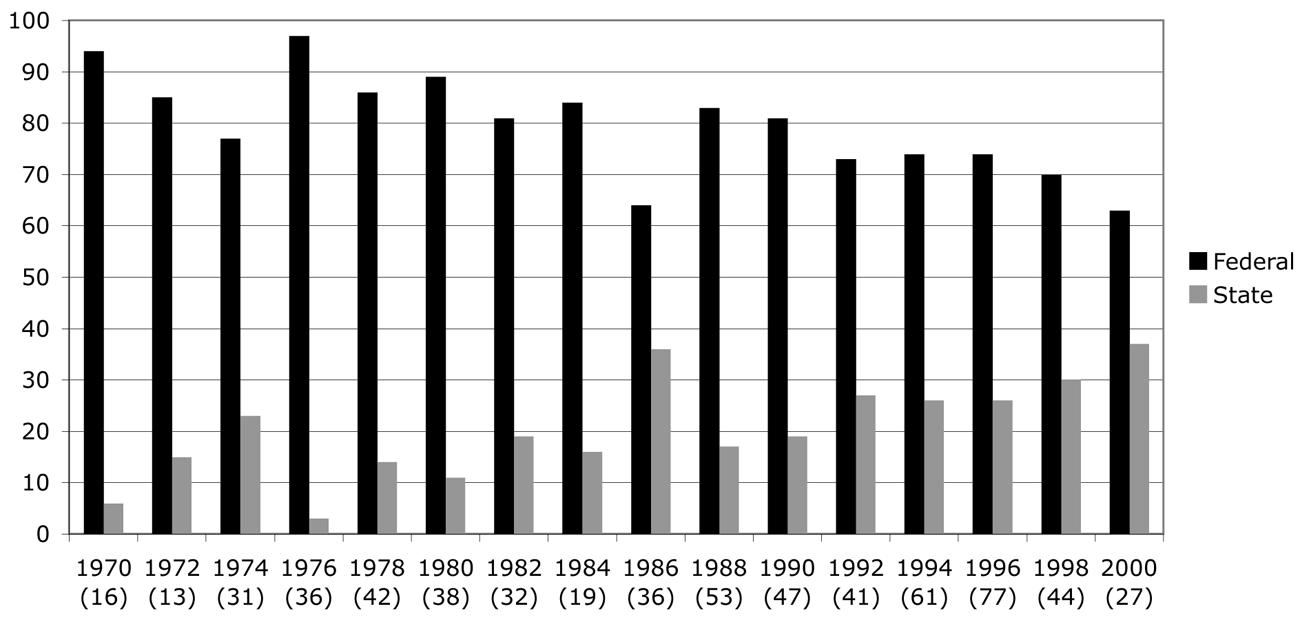
I examined a total of 339 briefs encompassing 613 constitutional rights arguments in Washington, finding that 79% (482) were federally based and 21% (131) were based on state constitutional law. Figure 1 tracks the percentages of each argument over time. The trends show a generally increasing degree of state constitutional arguments, though with early spikes in 1974 and 1986, and there is no indication of a drop-off in attention in the 1990s. This trend is at least suggestive that lawyers became increasingly attentive to the Court’s guidance and its continued reliance on and reiteration of state constitutional law.
Percentage of arguments by year (n = 613)
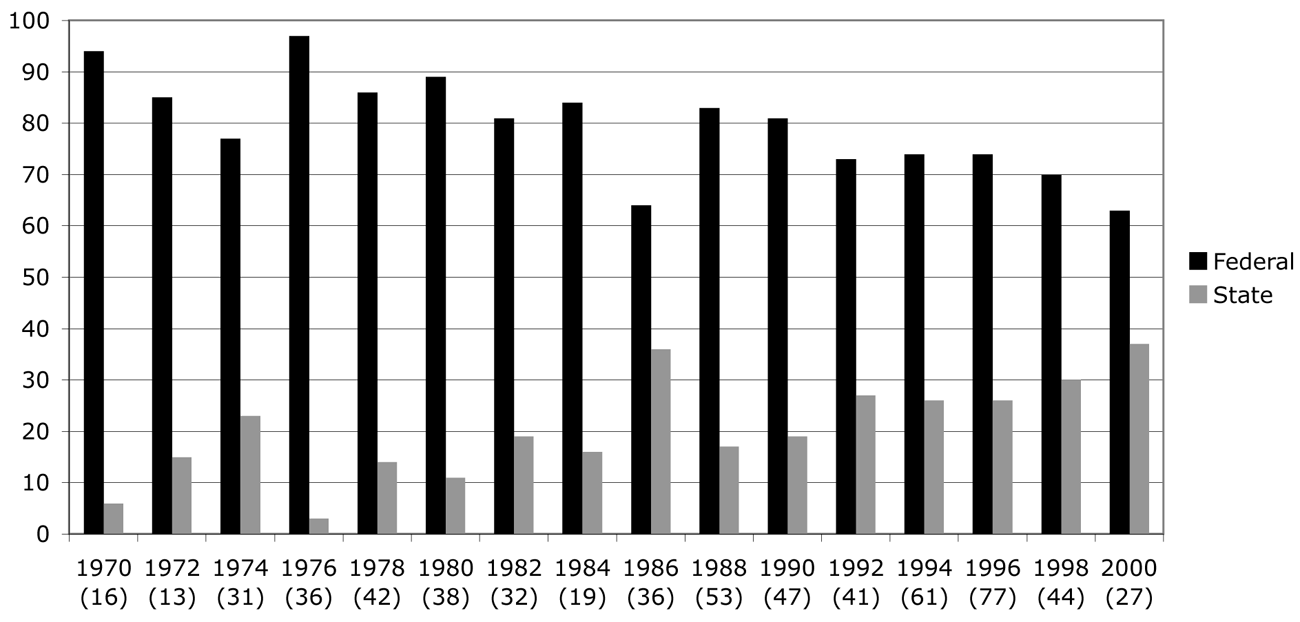
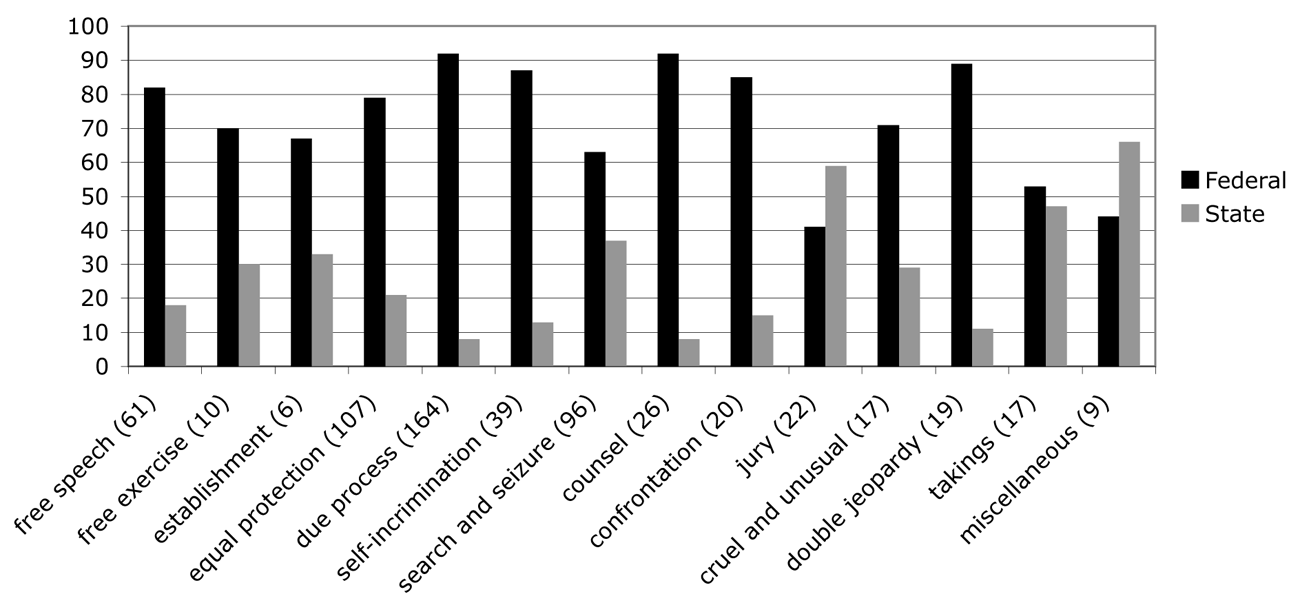
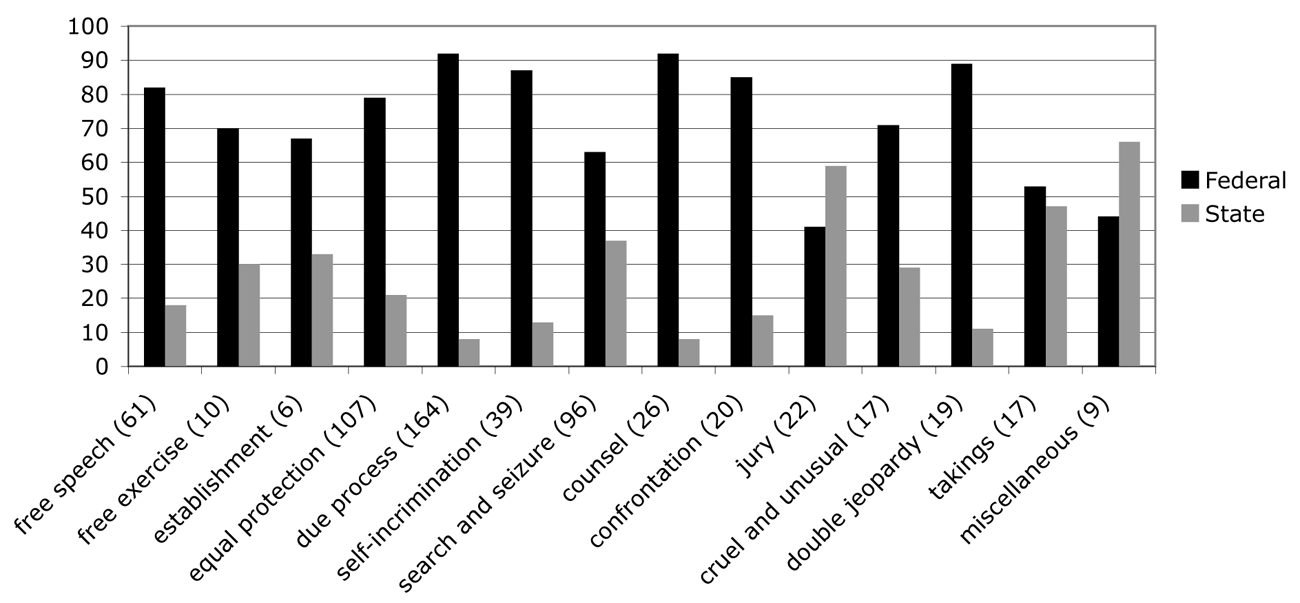
Figure 2 illustrates the percentage of rights arguments by various issue areas. Search and seizure cases represent the single largest number of state arguments, an unsurprising fact given the US Supreme Court’s retrenchment and that Gunwall was a search case. The finding that 21% of equal protection claims were state-based is unexpected given the generally limited attention that equal protection receives in other states (Fino Reference Fino1987a; Williams Reference Williams2009, 209) but is partly explained by the state’s equal rights amendment and potentially by Gunwall as discussed below. Only jury issues showed a greater proportion of state than federal arguments and is due in part to major changes to the state’s trial procedure but also reflects a trend in many states where jury rights saw some independent interpretation despite limited federal retrenchment (Cauthen Reference Cauthen2000). The nearly equal split in takings issues is more surprising giving the fact that the US Supreme Court was expanding the reach of federal law during much of this time.
Percentage of arguments by issue area (n = 613)
Before Gunwall
Prior to the clear constitutional theory adopted in Gunwall and reinforced in Wethered, state arguments largely appeared in reaction to federal retrenchment and expressed the limited reasoning criticized so heavily by the Washington Court in later years. However, there was also some degree of internal doctrinal encouragement prior to Gunwall.
An interesting example of federal retrenchment came in the common area of school funding. Following the US Supreme Court’s rejection of school funding suits in 1973 (San Antonio Independent School District v. Rodriguez, 411 U.S. 1 [1973]), claimants in Northside School District No. 417 v. Kinnear (1974, 84 Wash.2d 685) attacked the state’s policy under the state constitution on both education clause and equality grounds, though I only consider the equality issue due to the lack of a parallel federal education guarantee. Interestingly, instead of rejecting the US Supreme Court’s decision, the claimants sought to apply its test because the state’s education clause demonstrated that “there can be no doubt … under the principles of Rodriguez, that education is a fundamental interest under the Washington Constitution” (Northside School, 84 Wash.2d 685, Plaintiff-Petitioners brief at 31 [emphasis in original]). As a fundamental interest, strict scrutiny applies to the state’s system and even the US Supreme Court’s decision admitted that the challenged funding schemes could not survive strict scrutiny.Footnote 9 The claimants thus imported federal law wholesale into their state constitutional claim.
Gunwall represents another example of response to retrenchment. The primary arguments revolved around warrantless access to telephone records and attachment of a pen register to record the numbers called from a home.Footnote 10 The US Supreme Court had upheld the warrantless use of pen registers, and the logic left little room for protecting telephone records (Smith v. Maryland, 442 U.S. 735 [1979]). In Gunwall, the claimant noted that the text of the state provision was dramatically different: “No person shall be disturbed in his private affairs, or his home invaded, without authority of law” (Wash. Const. Art. I, § 7). She also noted additional examples where the Court rejected federal search law changes. But the strongest reliance was placed on attacking the policy underlying the US Supreme Court’s decision. Specifically, the claimant noted that three state high courts had rejected this specific decision, stressing that “each of the courts which has dealt with the question of the reasonableness of the expectation of privacy in a person’s financial or telephone records has noted the tremendous potential for abuse” under federal law. Quoting to the dominant treatise on search and seizure law, the decision is “a mockery of the Fourth Amendment” that opened intimate private details to indiscriminate police rummaging (Gunwall, 106 Wash.2d 54, Appellant’s brief at 12 [quoting LaFave 1984 edition]). The claimant closed with an invitation for evasion: “This Court should reject the narrow and outmoded interpretation of a reasonable expectation in phone records … [and follow the other state courts] which place the judiciary in its proper [role] as the guardian of privacy interests against unwarranted invasions by the police” (Gunwall, 106 Wash.2d 54, Appellant’s brief at 13).
In a number of other instances attempts were made to distinguish negative federal law with state arguments used as a last ditch effort. In Federated Publications, Inc v. Kurtz (1980, 94 Wash.2d 51, Petitioner’s reply brief), newspapers challenged an order barring the public from a pretrial hearing. While the US Supreme Court had recently rejected a nearly identical argument, the claimant noted that the deciding vote only rejected the claim under the Sixth Amendment but reserved any First Amendment consideration. The claimant argued that the state constitution also provided for a right to public trial but also that a separate provision specifically guaranteed “Justice in all cases shall be administered openly” (Wash. Const. Art. I, § 10) and that other state courts had relied on similar provisions to limit courtroom closures. In State v. Hehman (1978), the claimant argued that an arrest for a minor traffic offense was unconstitutional in the face of two recent US Supreme Court decisions to the contrary relying on factual distinctions.Footnote 11 The argument then turned to a state issue discussing how two state courts had invalidated arrests in similar situations but placed great reliance on a lengthy quote from a critical law review showing that the federal decisions were “not well received in all quarters” (Hehman, 90 Wash.2d 45, Respondent’s brief at 9). A similar dynamic is shown in State v. Basson (1986) involving successive confessions where incriminating statements were repeated after Miranda warnings. The bulk of the argument sought to demonstrate that this case still fit into the weaker federal protections,Footnote 12 but it closed with an invitation for bald evasion of this federal retrenchment: “Under the state constitution, prior [federal] case law may be used as a guidance to determine that there is a bright line presumption” that subsequent warnings do not cure the initial constitutional defect (Basson, 105 Wash.2d 314, Respondent’s brief at 45). These examples show a common trend of treating state provisions as a means of maintaining a prior federal standard.
In contrast, jury trial arguments for petty offenses relied exclusively on state law because the US Supreme Court rejected protections early in the rights revolution (Cheff v. Schanackenberg, 384 U.S. 373 [1966]). Prior to 1980 this decision had no real effect in Washington because petty offenders had an absolute right of appeal to the Superior Court where a jury trial could be held de novo. In 1980, the legislature altered these rules to significantly limit the ability to seek a trial de novo and this law faced immediate court challenges; in fact, four of the twelve state jury arguments, and three in 1982 alone,Footnote 13 involved this statute. The claimants focused on the state language providing that the “right of trial by jury shall remain inviolate” (Wash. Const. Art. I, § 21). These words were clear and unambiguous “and provide for no restriction or limitation” (Mace, 98 Wash.2d 87, Petitioner’s brief at 10). Two of the three 1982 claimants focused a great deal of attention on the constitutional history of juries as well as case law showing the paramount role juries play. Interestingly, none of the three arguments cited the federal provision or any federal case law. The US Supreme Court refused this claim early in the rights revolution; thus, there was no history of favorable federal law to rely on, and the claimants were forced to develop their arguments without this reference.
Turning to internal signals, the expression of interest in state constitutional law in Coe had some influence; a small number of claimants’ briefs included vague statements that the state constitutions may be a basis for decision but failing to make clear state arguments beyond simply noting the existence of the state option.Footnote 14 In a speech challenge to restrictions on abortion protests, the claimant’s state claim became somewhat more distinct. After a lengthy federal argument, the claimant noted both Coe and a case about speech on private property (Alderwood Associates v. Washington Environmental Council, 96 Wash.2d 230 [1981]) to show that speech rights under the Washington Constitution should prevail in any balancing test against other rights (Bering v. SHARE, 106 Wash.2d 212 [1986], Appellants brief at 19). In Kitsap County v. Kev, Inc. (1986, 106 Wash.2d 135, Appellant’s brief), the state speech argument became increasingly distinct in large part because the case fit into the result of Coe more clearly. The claimant challenged a permanent injunction declaring an “erotic dance studio” to be a public nuisance relying on the text of the state provision and the logic of Coe as creating a per se rule against prior restraints arguing that the county could only punish the studio for abuses after they occurred. Federal law was not particularly hostile in either of these cases, but they at least began to suggest state arguments to supplement the primary federal claims. However, the arguments were hardly well developed and likely contributed to the frustration expressed in Gunwall.
Gender equality provides a strong example of a clear state-based doctrine. In 1972, Washington voters approved an Equal Rights Amendment (ERA) to the state constitution, and the Court applied this provision strictly. In Darrin v. Gould (1975), the Court interpreted the ERA to forbid gender discrimination even if it might have satisfied the strict scrutiny test.Footnote 15 Six gender discrimination arguments are present in my sample for all years—this helps explain the relatively large number of state equal protection arguments—and two prior to Gunwall. In Marchioro v. Chaney (1978, 90 Wash.2d 298, Respondents’ brief) the claimant attacked a statute requiring gender diversity in representatives to party conventions as violating this absolute bar against gender classifications. In Seattle v. Buchanan (1978, 90 Wash.2d 584, Appellants’ brief), the claimant challenged a city ordinance defining exposure of female breasts as lewd conduct. The claimant argued that such a law “develops from a tradition that seems to indicate that there is something wrong, abnormal, or incorrect about having been born as a woman” but that under the ERA, “our courts and legislatures may no longer consider femaleness to be an aberration of maleness, subject to unique restrictions, disabilities, or preferences” (Buchanan, 90 Wash.2d 584, Appellants’ brief at 14, 15). Neither brief bothered with a discussion of federal law, despite the increasing protection against gender discrimination under federal law, instead relying solely on the state equality argument as expressed in Darrin.
This image of state constitutional arguments largely tracks with broader experience. Lawyers offer state constitutional arguments primarily where federal law either lacks support for their claim or is increasingly unsure. These arguments were the kind complained of in Gunwall: they presented fairly vague assertions and tended to simply invite evasion of recent federal changes in favor of older federal law. In a smaller set of cases, we do see some limited influence of Coe, but even in those arguments the state claim was weakly developed and primarily served as an addendum to a federal argument. Only in the gender equality cases was there a clear and definite internal signal. The Court apparently intended to correct this problem by providing guidance about how state arguments should be briefed. I now turn to how successful this guidance has been.
After Gunwall
There was no immediate response to Gunwall. Of the nine state arguments offered in 1988, none complied by briefing the criteria. The greatest number of the Gunwall criteria cited was three by two claimants. Three arguments involved search and seizure issues, two of which cited Gunwall but none of them complied with or even showed interest in the criteria established there; instead, Gunwall was cited only for the substantive expansion of state search law. The most egregious example was in Wethered where the claimant simply cited to a single state constitutional precedent and then asserted that the claimant was coerced into consenting to a search under the state constitution. It is understandable that the Washington Supreme Court utilized this case to clarify that the Gunwall criteria were mandatory.
Despite the failure to comply with Gunwall strictly, two 1988 search cases suggest that Gunwall and other search cases were having some effect; in both, federal law was still uncertain, and yet state arguments were either dominant or at least on par with the federal claims. In a random drug testing case, the claimant began with a state challenge that cited to recent expansive search cases, as well as the textual differences but rested most of the state argument on Washington cases applying federal law, arguing in essence that these strong declarations requiring individualized suspicion under the Fourth Amendment should be carried over. The brief then proceeded to argue a Fourth Amendment claim specifically as a secondary issue providing lesser protection (Alverado v. Washington Public Power Supply System, 111 Wash.2d 424 (1988), Appellants’ brief at 11). A similar dynamic is illustrated in Seattle v. Messiani (1988). The claimant attacked the constitutionality of sobriety checkpoints and did so nearly exclusively based on state grounds despite the fact that the US Supreme Court had already struck down some uses of checkpoints and only conclusively upheld sobriety checks in 1990.Footnote 16 The claimant noted textual differences, state constitutional history, and recent state search precedent, in particular a case expressing discomfort with the federal automobile exception (State v. Ringer, 100 Wash.2d 686 [1983]) but primarily stressed cases from other states rejecting sobriety checkpoints. The claimant admitted that most were based on federal law but used the logic of those decisions to support the state argument. Interestingly, the federal claim is relegated to a bare assertion, reversing the trend observed in many other state constitutional arguments. The claimant simply cited to one supportive federal precedent and concluded that sobriety checkpoints “are clearly in violation of [the state provision] and many states find these roadblocks violate the Fourth Amendment as well” (Messiani, 110 Wash.2d 454, Respondents’ brief at 39). While neither claimant complied fully with Gunwall despite clearly being aware of it, the fact that they rested primarily on state claims in areas where federal law was potentially supportive suggests that the repeated interest in the state search provision was having an effect on the Washington bar.
Given the failure to comply with the criteria test, it is unsurprising that the Court reiterated and strengthened it in Weathered by requiring criteria briefing before the Court would consider the issue. Of the 79 state constitutional arguments offered from 1990 to 2000, 28 (35%) complied completely with Gunwall.Footnote 17 Given Spitzer’s (1998) findings that the Washington Supreme Court regularly dismissed state claims for Gunwall failures, this is not surprising. Though none of the years had a majority of briefs complying fully, there was an increasing trend from the early 1990s at about 20% compliant to more than 40% in 1994, 1996, and 2000 with 30% in 1998. It is also possible that the relatively low degree of compliance is an artifact of my coding rules where ambiguous arguments are coded at times as state-based; in other words, it is possible that the claimants did not intend to provide a state argument. Additionally, it is possible that some claimants thought the criteria were unnecessary because the Court had already expanded protections in the contested area. I coded such arguments as compliant only if the claimants explicitly stated that they were making this assumption. An initial question is whether Gunwall may have induced a significant number of state constitutional arguments that we might not have expected otherwise.
Search and seizure argument made up more than a third (28) of the 79 state constitutional arguments. Eleven of these arguments presented complete Gunwall briefing. A large proportion of these arguments sought to build on the earlier state precedents such as the Court’s rejection of the totality of the circumstances test for informant reliability. Many other cases sought to extend the result in Gunwall to different areas of electronic or high tech privacy. A few pressed the boundaries further. For example, State v. Young (1994, 123 Wash.2d 173, Appellant’s opening brief) argued that warrantless use of thermal imaging devices violated the private affairs of the suspects well before the US Supreme Court accepted the same argument (Kyllo v. United States, 533 U.S. 27 [2001]). Others had a more mixed influence as the US Supreme Court retrenched in specific issue areas. For example, in State v. Boland (1990) the claimant argued that Washingtonians have a legitimate expectation of privacy in their garbage after the US Supreme Court rejected the same argument.Footnote 18 Similarly, another claimant attacked the Hodari D. standard that a person who flees from a show of police authority is not seized under the Fourth Amendment.Footnote 19 In this area, given both federal retrenchment as well as the Washington Court’s history of engagement with the state provision in recent years, it is not surprising to see a high frequency of state search arguments.
Speech cases demonstrate a similar dynamic, offering state arguments largely centered on Coe; none of the five speech arguments offered complete Gunwall briefing. One of these did come in an area where we might not otherwise expect: commercial speech. Commercial speech saw a general expansion of federal protection since the 1970s and while the primary reliance was on this law, one claimant did assert a state claim. However, it was little more than an afterthought without more development than to simply note that Coe and other cases have recognized greater speech protections.Footnote 20 The expansion of federal protection had an interesting effect in Soundgarden v. Eikenberry (1994 123 Wash.2d 750). The case involved a statute limiting the availability of sexually explicit music to minors. The claimant began with a federal argument centered on the recent expansion of federal speech law in R.A.V. v. St. Paul (505 U.S. 377 [1992] [state must maintain content neutral distinctions even within classes of “unprotected speech”]). When the claimants turned to the state argument, they sought to use R.A.V. to correct an aspect of Coe where the Court suggested that the ban on prior restraints did not apply to unprotected speech such as obscenity.Footnote 21 The claimant stressed the underlying federal legal rule assumed in Coe: “Coe’s statement rested on the premise that the First Amendment affords no protection to obscenity and, therefore, neither does Article I, Section 5. This premise is invalid in light of R.A.V.” and should be discarded so that the strict prior restraint rule should apply (Soundgarden, 123 Wash.2d 750, Respondents/Cross-Appellants brief at 25–26, n. 15). Even though federal law had expanded somewhat, the claimants still offered state arguments seeking to utilize the strict rule from Coe even if ignoring the Gunwall criteria.
While my entire sample includes only ten free exercise claims, all three post-Gunwall arguments included state constitutional arguments due to significant federal retrenchment in 1990 (Employment Division v. Smith, 494 U.S. 872). In Barnett v. Hicks (1990, 114 Wash.2d 879, Appellant’s brief), argued before the federal case was resolved, the claimant relied on the absolute nature of the state provision as well as a recent law review emphasizing the strong history of religious protection in Washington.Footnote 22 The Washington Supreme Court would later accept this argument and reject the newly weakened federal test (First Covenant Church of Seattle v. Seattle, 120 Wash.2d 203 [1992]). In the two subsequent casesFootnote 23 claimants relied on this rejection to argue a state claim, and none of the three presented full Gunwall briefing. The federal legal change led to an increase in state constitutional activity. A similar dynamic is also present in two confrontation arguments where full Gunwall arguments were made in cases where federal law was fairly negative.Footnote 24 While the above areas do not show any clear evidence that embracing the criteria approach led to state arguments than might not have been made otherwise, in two areas the post-Gunwall arguments show unexpected state constitutional activism: equal protection and takings.
State courts typically lockstep with federal equal protection doctrine, despite at times quite different language and history (Fino 1987a; Williams 2009, 209). While the text of the Washington provision is quite distinct from the Fourteenth Amendment,Footnote 25 the Washington Supreme Court generally treated the provision as substantially identical to federal law, though at times it did suggest that a separate analysis may be possible (Bindas et al. 2011).Footnote 26 Thirteen state equal protection arguments were offered post-Gunwall. Three of these were ERA cases relying on the law discussed above, a few others were vague assertions, but some presented well-developed state arguments with full Gunwall briefing. In Ford Motor Co. v. Barrett (1990, 115 Wash.2d 556.) the claimant attacked the state’s lemon law statute that placed conditions on the right of auto dealers to appeal but not on the rights of the owner. The claimant stressed Justice Utter’s (1984) guidance on the importance of state constitutional law, as well as the prior examples of judicial federalism in Washington. Turning to the state’s history, the claimant discussed how the Washington convention failed to even consider the federal language in favor of Oregon’s provision, and the earliest state case law did not consider the federal doctrine as binding but that through “force of inertia” the two became conflated despite the fact that the Court “has never articulated a basis for adopting such a position” of uniform treatment (Barrett, 115 Wash.2d 556, Petitioner/Appellant’s brief at 31). The claimant proceeded to invoke the historical connection to Oregon and its test (Schuman 1988), arguing that the lemon law could not survive this test even if it passed the federal rational basis review. While the Court did not give this claim serious attention, the next year Justice Utter adopted substantially similar arguments (State v. Smith, 117 Wash.2d 263, 282 [1991] [Utter, J. concurring]). Claimaints relied on Utter’s arguments in challenges to heightened punishments for first-time drug offenders and state inheritance laws limiting the ability of illegitimate children to reopen settled estates.Footnote 27 Gunwall may have triggered some interest in an area where state arguments are uncommon, and this interest was buoyed by Utter’s strong support even though it received little attention from the rest of the Court.
Takings law, similarly, saw relatively little support from judicial federalism as well, largely because federal law was slowly expanding protection. Despite this fact, five of the post-Gunwall state arguments involved takings of property, though only one presented a full Gunwall analysis. Two of these arguments were public use cases where the US Supreme Court gave broad deference to legislative determination of public use.Footnote 28 Both argumentsFootnote 29 invoked the explicit state language, shared by only three other states, making the determination of public use a judicial question with no weight to any legislative determination.Footnote 30 While the remaining three arguments all involved state regulatory takings issues, only one offered complete Gunwall briefing noting a prior refusal to consider the same issue because of Gunwall failure (Gulmont v. Clarke, 121 Wash.2d 586, 604 [1993]). In Manufactured Housing Communities v. State (2000, 142 Wash.2d 347 [2000], Appellant’s brief) the claimant placed strong reliance on the state provision’s language specifically prohibiting property from being “taken or damaged” (Wash. Const. Art. 1, § 16) to attack a statute limiting the ability to sell property. This was in addition to a federal argument relying on the increasing protection offered in recent decisions.
It appears that Gunwall did little to influence state constitutional claims in areas we would not otherwise expect. Generally, claims were still focused in areas of federal retrenchment or areas where the Washington Court had already expanded protections. While equal protection and takings cases may show some influence, it is unlikely that federal law would have been supportive to any of the claims pushed and in the equal protection context Utter offered some encouragement even if his court was disinterested in the claims. This finding is understandable because the Washington Court never issued a requirement that lawyers brief state issues in all cases, only that briefing was necessary for the Court to consider a state constitutional issue.
The Substantive Nature of Gunwall Criteria
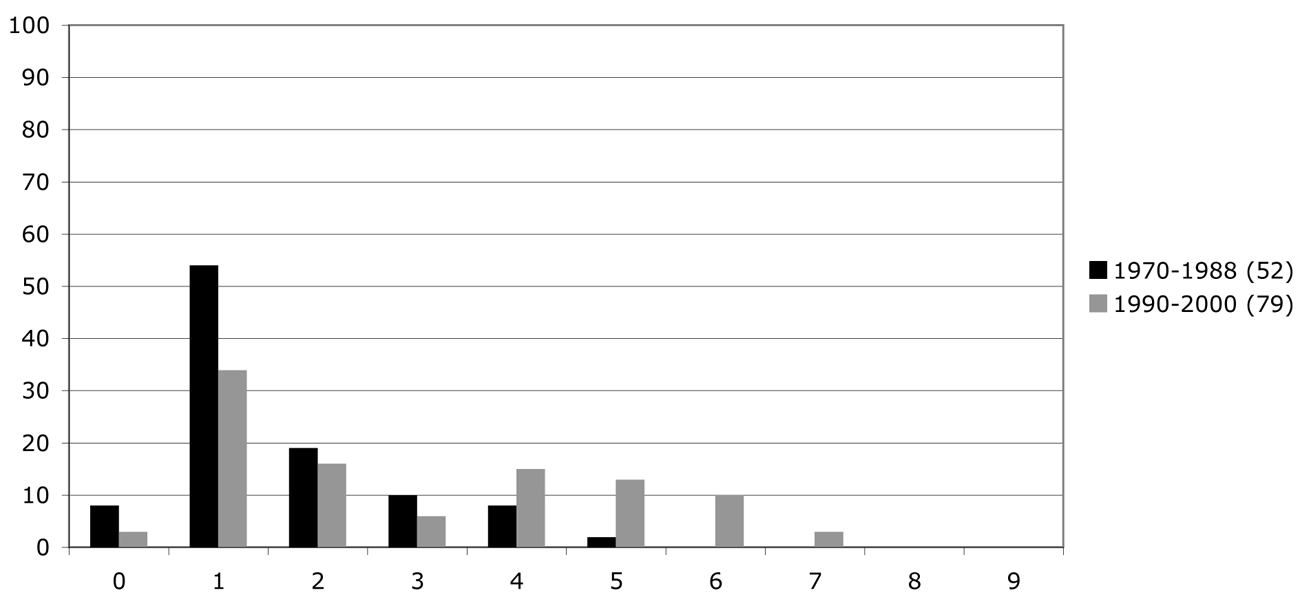
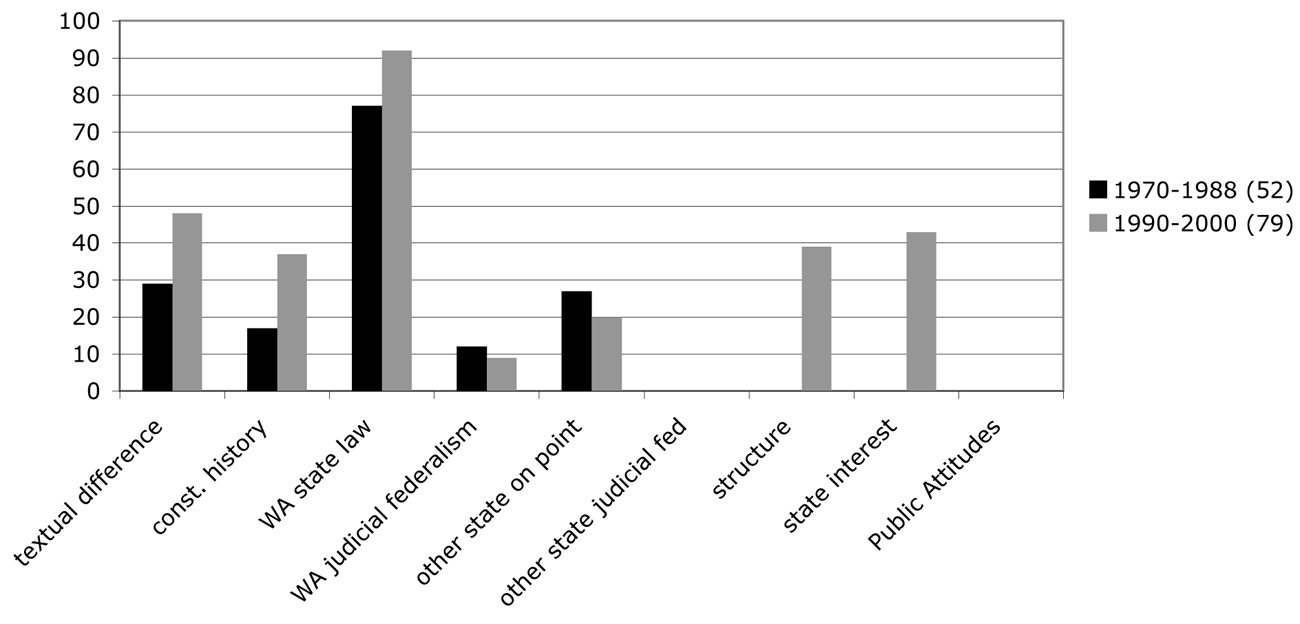
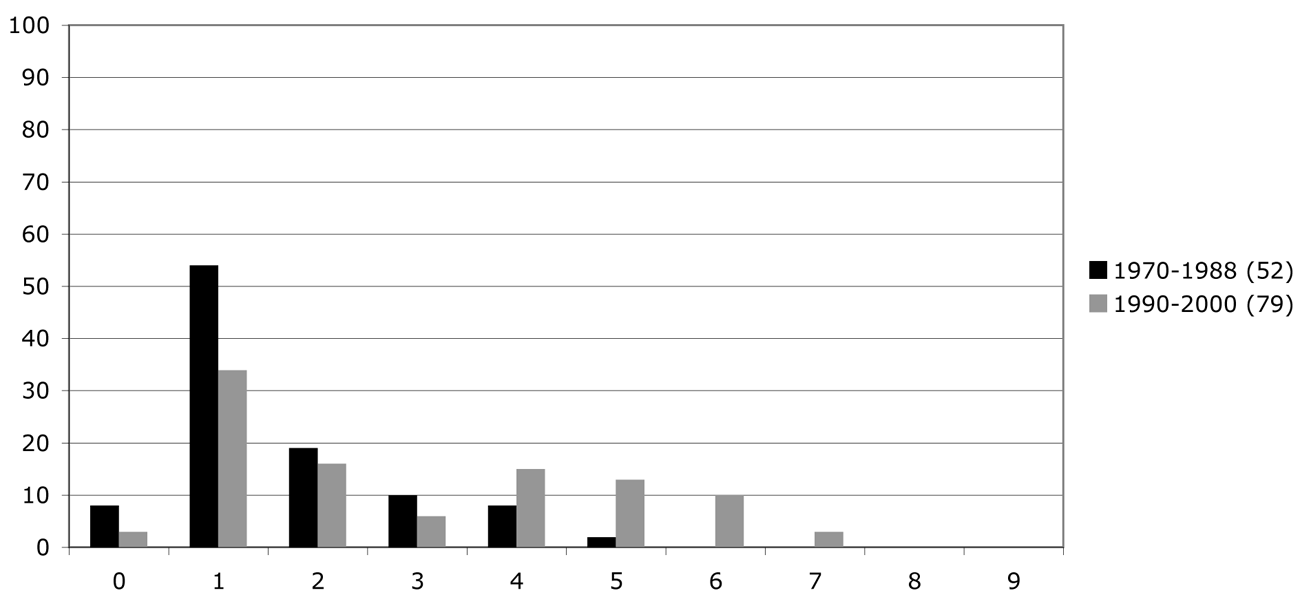
Figures 3 and 4 illustrate the effect of Gunwall on the content of state constitutional arguments. Each shows significant changes in these content issues. For all five of the Gunwall criteria (text, constitutional history, Washington state law, structure, and state interests) there is a sizable increase in the percentage of arguments discussing each factor. Figure 3 shows how the rough complexity, measured by totaling the number of factors discussed in each brief, increased after Gunwall. Prior to Gunwall, 81% of state arguments noted two or fewer of these factors; after Gunwall, this dropped to 53%. There was a sizable move toward more complex arguments with 41% noting four or more factors. This finding suggests that Gunwall had at least part of its intended effect, even though full compliance was not achieved. As discussed below, these criteria were not always substantively compelling, but the strong preference for the criteria test nearly eliminated state arguments that were nothing more than policy attacks on the US Supreme Court’s decisions.
Percentage of total factors, pre- and post-Gunwall (n = 131)
Percentage of state arguments citing each legal factor, pre- and post-Gunwall (n = 131).
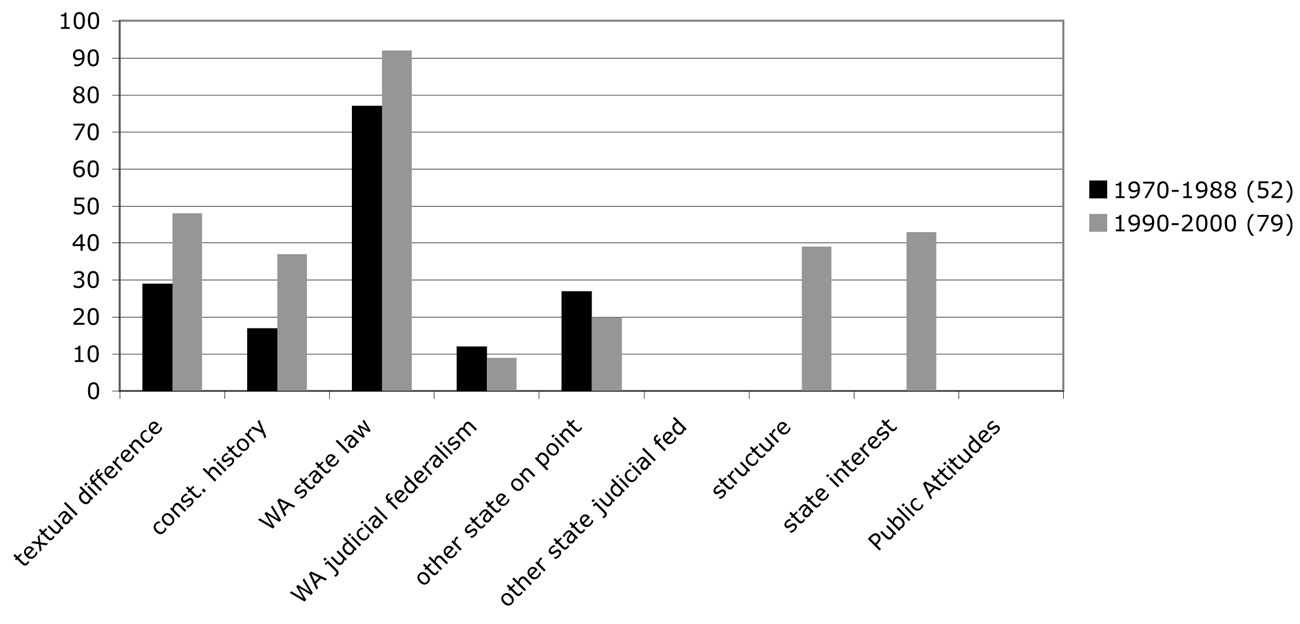
While present in about 40% of the post-Gunwall arguments, structural and local interest arguments tended to be a bare quotation or paraphrasing from the Gunwall opinion itself. This is most clear in the context of structural arguments where nearly every argument to employ it quoted the direct language from Gunwall (106 Wash.2d at 66–67). The Court itself eventually acknowledged that the structural factor “favors an independent state interpretation in every Gunwall analysis” (State v. Russell, 125 Wash.2d 24, 61 [1994]) simply because the structural difference is constant, and thus a broader restriction can be justified because of the plenary nature of state power. Given this, it is unsurprising that claimants did little with structural claims. Similarly, the most common argument in the state or local interest category tended to simply note that whatever aspect of law in dispute is a matter of state law and thus should be judged by local and not national standards. A few of these arguments did note that the US Supreme Court at times relies on the difficulty of fashioning rules for a large diverse country as reason for limiting constitutional protections.Footnote 31 One interesting example of local interest is a garbage search case where the claimant discussed the recent public outcry concerning individuals who illegally stole the garbage of Seattle’s mayor (State v. Boland, 115 Wash.2d 571 [1990], Respondent’s brief at 21). While these two factors received little development, the remaining factors did show a greater degree of development and substance.
Textual difference arguments were relatively common. Many of these involved search claims relying on the extensive set of search precedents for discussion of the textual differences. A number of others noted significant differences in regards to the equal protection, bail, and self-incrimination provisions. In a challenge to the use of closed circuit television for child witnesses the claimant stressed how the state provision explicitly guarantees the right “to meet the witnesses against him face to face”Footnote 32 but went further to note the significant differences in many of the other criminal procedure provisions. The absence of textual differences, however, did not stop some claimants. While admitting that there were no relevant textual differences, three claimants expressly cited Utter (1984) for the argument that textual differences are not a requirement for a different state constitutional rule; one going so far as to argue that “even identically worded provisions should be interpreted independently unless a very good historical justification for assuming that the framers intended an identical meaning can be found.”Footnote 33
Constitutional history was the least frequently argued but only marginally so. This is likely because of the difficulty in primary source research. As with most factors, search cases saw a large amount of historical discussion because Gunwall and its progeny laid a foundation that was easy for lawyers to draw on. A few claimants did a thorough job of digging up obscure history even going so far as to note the territorial laws that existed in regards to bail that colored the Washington convention’s debates (Westerman v. Cary, 125 Wash.2d 277 (1994), Appellant’s brief at 17) Similarly in the equal protection context one claimant stressed the intentional adoption of the Oregon language out of an “egalitarian concern” not met by the application of the federal provision (Ford Motor Co., 115 Wash.2d 556 [1990], Petition/Appellant’s brief at 33). Another claimant linked the history and text issues arguing that it “must be presumed that the makers of the state constitution knew the language of the United States Constitution and with that knowledge deliberately made the state constitutional provision more detailed” and protective of individual rights (Manufactured Housing Communities of Washington v. State, 142 Wash.2d 347 [2000], Appellant’s brief at 17). In a few cases, the claimant explicitly admitted that the state convention had failed to debate the issue as a means of showing an attempt to comply with the briefing requirement.Footnote 34
The high percentage of arguments citing some form of Washington law on point is unsurprising. Judicial precedent is the natural source for constitutional claims, and as the Washington Supreme Court engaged with state constitutional law, it built a set of state law for lawyers to utilize. Search- and speech-related issues naturally had a fair amount of state precedent to work with. Other cases stressed common and statutory law related to the issue as a means of showing a basis for a different constitutional standard. Still others sought to take a prior Washington decision based on federal law and maintain its result and logic under the state provision. For example, two claimantsFootnote 35 sought to maintain a 1983 decision holding that negligent destruction of evidence was a due process violate after the US Supreme Court rejected this standard,Footnote 36 arguing that the prior logic was fundamentally correct and should be maintained. Aside from this, most claimants had little difficulty composing some kind of state law argument.
The near complete elimination of policy attacks on the US Supreme Court is perhaps a greater measure of Gunwall’s effect. In other states and in Washington before Gunwall, a common element of state constitutional arguments has been for the claimant to “merely argue that the [US] Supreme Court majority ‘got it wrong,’ the dissent ‘got it right,’ and therefore, [state] courts should follow the dissent rather than the … majority on this constitutional issue” (Cobb v. State, 85 S.W.3d 258, 267 [Tex. Crim. App., 2002]. Few of these attacks on the US Supreme Court were present in post-Gunwall arguments. And even where they are used, they occurred after the discussion of legal factors. For example, in one of the evidence destruction cases, the claimant develops a full Gunwall analysis before closing by noting that the federal rule would be impossible for a defendant to win under and this would necessarily remove any incentive for the state to adequately preserve evidence (Hanna, 123 Wash.2d 704 [1994], Appellant’s brief at 34). A search case offered a minimal Gunwall brief but stressed a dissenting opinion from the US Supreme Court as the primary aspect of the argument (Kandoranian by Peach v. Bellingham Police Dept., 119 Wash.2d 178 [1992], Appellant’s brief). If Gunwall was a sincere effort to end the appearance of state constitutional law being used only to disagree with the policy outcomes of federal law, as I assume, this finding suggests that it was successful in pushing lawyers away from such arguments in favor of the legal criteria.
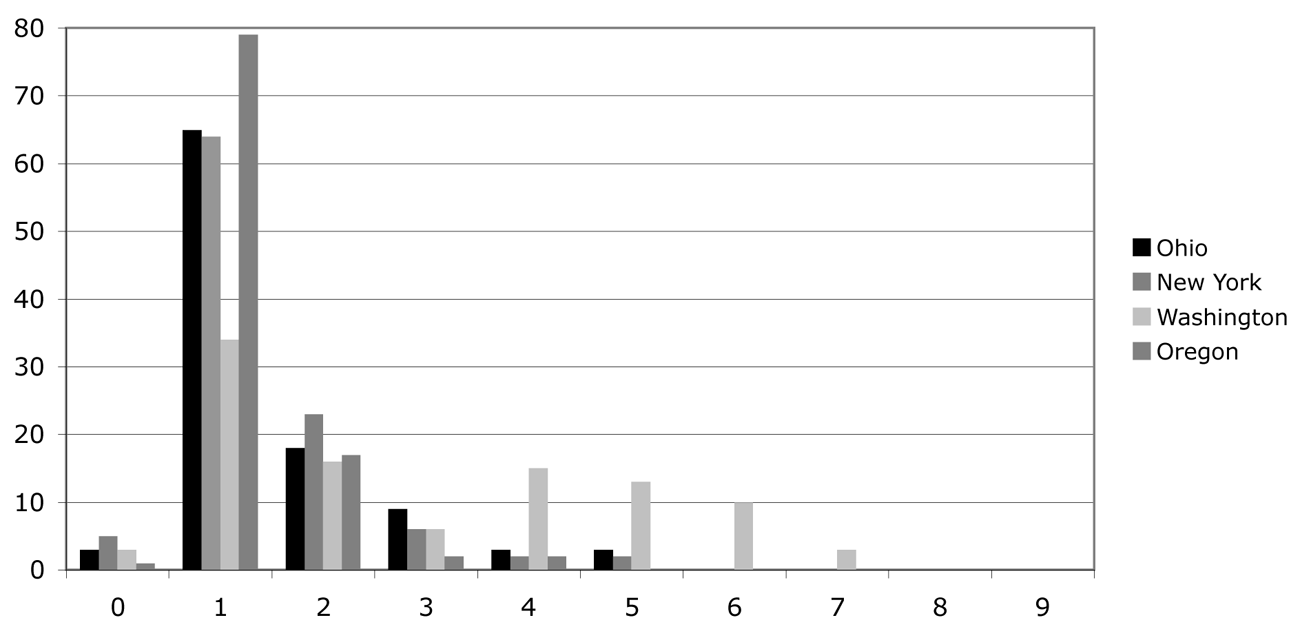
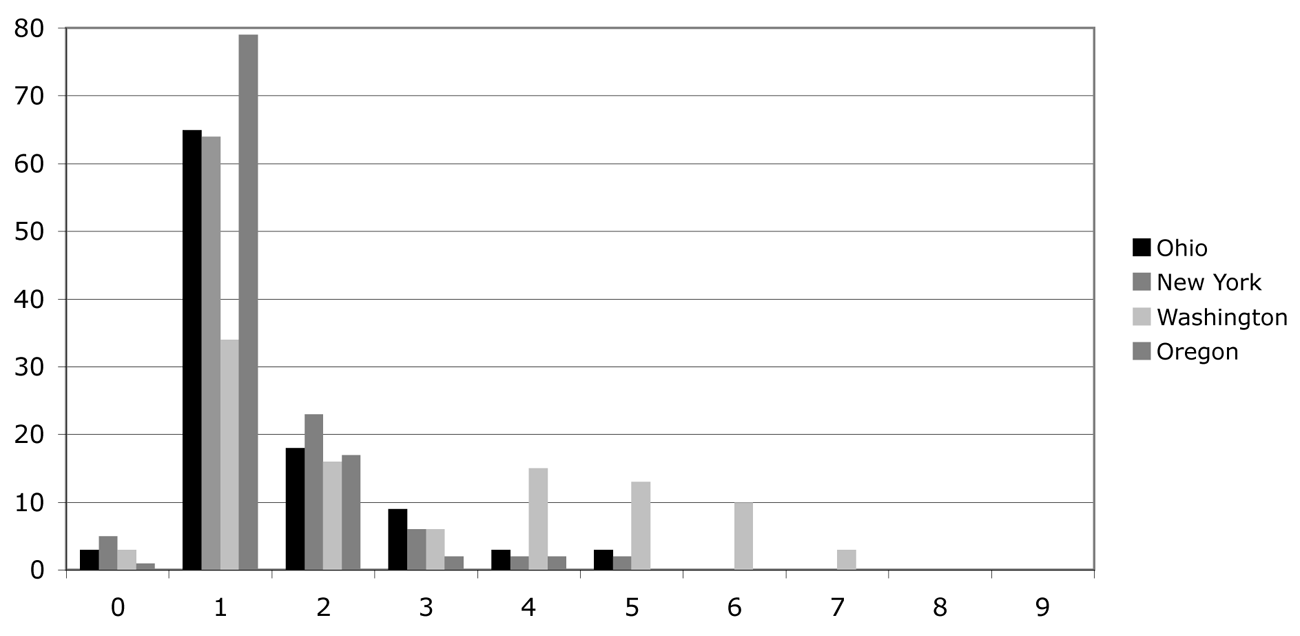
Comparative data help to more fully assess the impact of Gunwall and the criteria test on constitutional arguments. This necessary summary data present content data from three other states—Ohio, New York, and Oregon—gathered in the same manner as this study (Price 2012, 26–40). Internal engagement varied widely between these four states, with Ohio demonstrating little support and even a degree of hostility to state constitutional claims, New York adopting an ad hoc approach in accepting some claims with little guidance as to why, and Oregon adopting the primacy approach of dealing with state claims first in all constitutional cases. Figure 5 parallels figure 3 by comparing the rough complexity of constitutional claims using the total legal factors by percentage of brief. This compares Washington post-Gunwall with the overall trend found in the three other states. Even the imperfect compliance with the criteria test produced arguments that were more likely to look at a broad range of legal factors than the other states. In Washington, 41% examined four or more of these factors, where only 6%, 4%, and 2% of state constitutional claims in Ohio, New York, and Oregon, respectively, used a similar number. There is no reason to believe that the quality of lawyers varied significantly across these four states. Nor were the legal issues greatly varied between the states. The only significant difference between the states is the different approach adopted toward state constitutional law. The criteria approach forced lawyers to consider a wider range of legal issues in order to convince the Washington Court to consider the claim seriously.
Percentage of total factors for Ohio (1978–2000), New York (1970–2000), Washington (1990–2000), and Oregon (1970–2000).
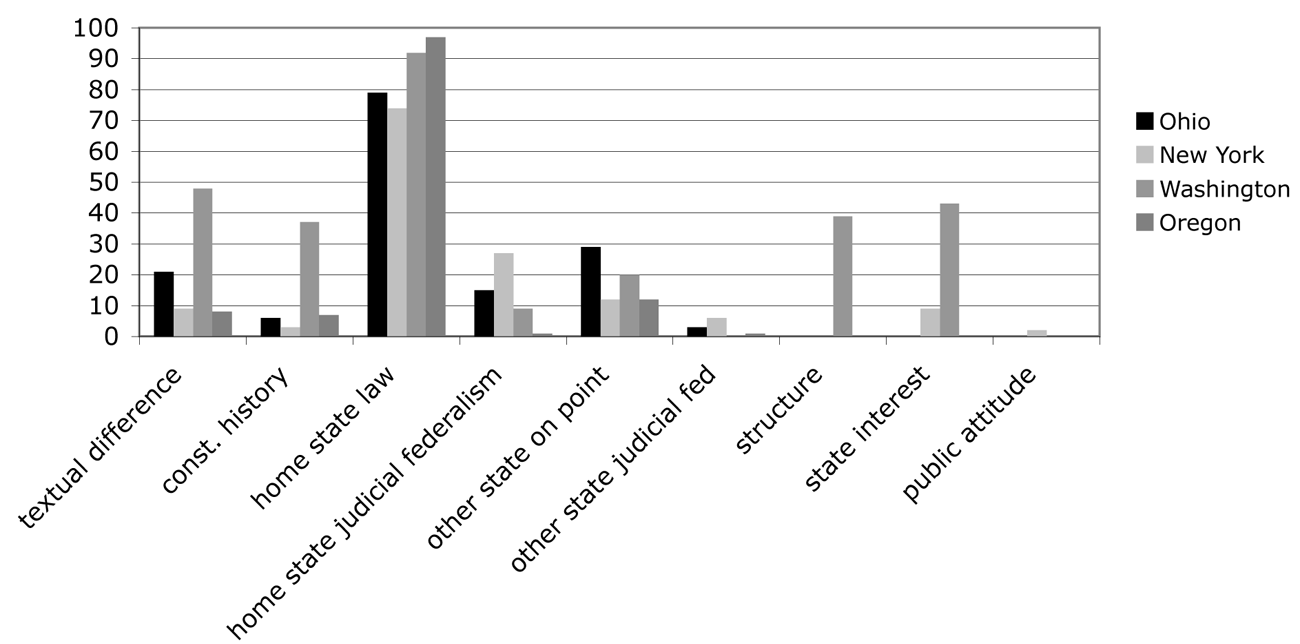
Turning to the factors individually in figure 6, we see a fairly dramatic set of differences. Only in Washington were structural and state interest arguments given attention, even if in a substantively minimal way. Much more robust claims were made using textual differences between state and federal provisions and state constitutional history. While textual difference claims are relatively easy ones to make (if difference exists), only Ohio exceeded 10% of briefs using such claims, and even it was far below the nearly half of Washington state claims to discuss textual differences. Research into state constitutional history is likely to be difficult and time consuming; in none of the other three states did the percentage of briefs looking at this history exceed 7%, where 37% of Washington briefs utilized such history. The use of state law demonstrates a difference, though not as dramatic. Naturally, precedent is the source of most constitutional arguments, and lawyers in most states are able to cobble together some precedent to support their claims, though only Oregon exceeded Washington’s percentage.
Percentage of state arguments citing each legal factor for Ohio (1978–2000), New York (1970–2000), Washington (1990–2000), and Oregon (1970–2000).
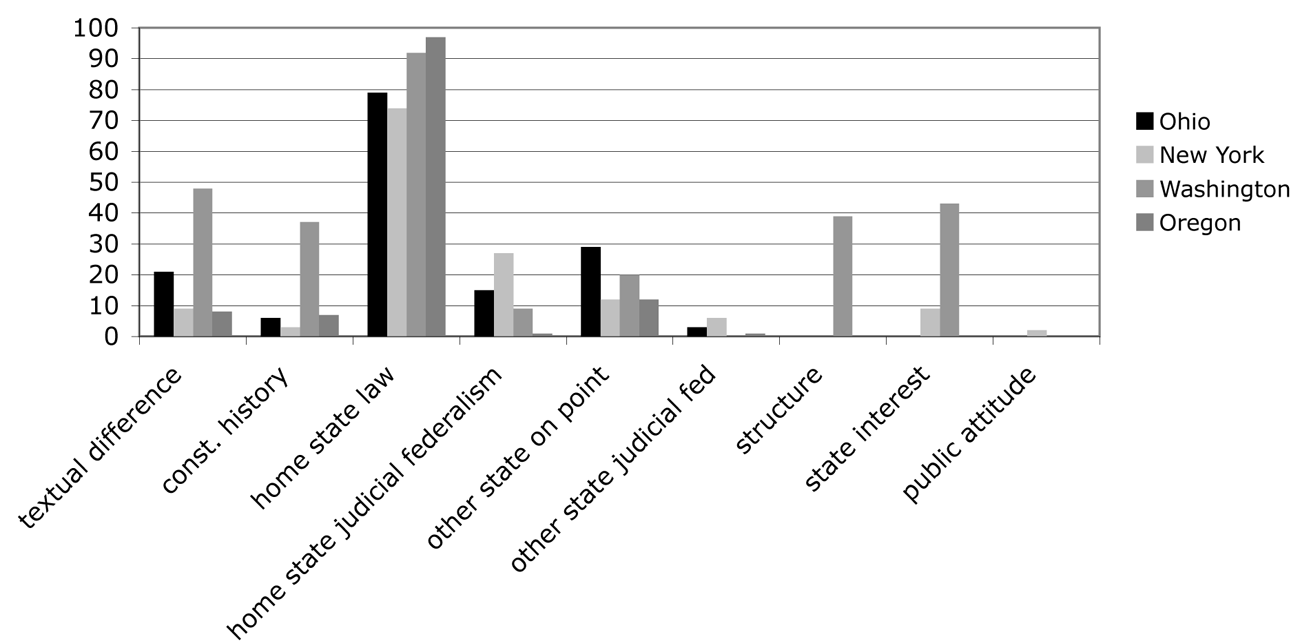
What figure 6 does not show is the degree to which state constitutional arguments were simply policy invitations to evade federal retrenchment. As discussed above, these arguments virtually disappeared in Washington even in arguments that failed to comply completely with Gunwall. Such arguments for evasion were dominant in Ohio and New York where the courts refused to give significant guidance to lawyers about state constitutional law.Footnote 37 Evasion arguments were virtually absent in Oregon as well, where its court adopted a primacy approach of dealing with state claims in all constitutional issues. Moreover, the Oregon Supreme Court was willing to build this law initially with almost no input from claimants (Price 2012, 128–65).Footnote 38 This finding only adds to the overall point of this article that internal signals can have a strong impact on how lawyers present state constitutional claims.
VIII. Conclusion
Of course, a case study of a single state is limited in its empirical reach. The goal here was narrow and aimed at using a single empirical examination of an interesting judicial federalism case to illustrate the value of legal signals and lawyers’ responses. The adoption of a criteria test by the Washington Supreme Court seems to have had a reasonably strong impact on state constitutional arguments. While there is little evidence that Gunwall induced state constitutional claims in areas we might not have expected given federal retrenchment, it did shift the content and nature of state claims when offered. Even though they failed to comply perfectly with Gunwall’s criteria, state constitutional claims showed a significant degree of attention to these criteria that lead to a generally more complex set of state constitutional claims than existed before Gunwall. Moreover, state constitutional claims that amounted to little more than invitations to evade some recent retraction of federal constitutional protections virtually disappeared. It appears that over time Washington claimants got the Court’s message and adapted, even if imperfectly, to the new internal signals offered by the Washington Court. The comparative data further support this point. Washington claimants after Gunwall were far more likely to give attention to various legal factors than claimants in other states. And only in Oregon, where a different set of signals were involved, did claimants also regularly avoid evasion arguments.
These findings support the broader argument that attention must be paid to the interactions between lawyers and courts in legal development generally and state constitutional law specifically. Courts send signals of interest in certain kinds of claims, but they rely on lawyers to pick up on these signals and develop the legal claims for the courts to act on later. Here, we have evidence that lawyers in Washington picked up on the signals and guidance provided by the Washington Supreme Court and over time adapted to the new state constitutional approach, even if compliance was imperfect. Beyond the scope of this article is the question of whether the changes in claimants’ arguments influenced the Washington Court’s jurisprudence. There is some evidence, however, suggesting that this did occur. Spitzer (Reference Spitzer1998, Reference Spitzer2006) examined the application of Gunwall at two different times. He found initially that Gunwall was generally used as a gatekeeping measure to block the consideration of inadequately briefed state issues. Seven years later, however, he argued that Gunwall had moved away from a primarily gatekeeping function to an actual interpretative guide where the Court applied the various criteria to a number of different constitutional questions. There may be a good argument that the changing nature of the constitutional arguments before the Court allowed it to make this transition. Perhaps the practice of state constitutional law became stronger under this approach than it would be otherwise.
Many avenues for future research to explore the dynamics between courts and lawyers exist. Obviously, one avenue would be to consider the criteria test in other states that adopted it, determining whether the effects are different than occurred in Washington. Another avenue is consideration of different legal signals sent by state courts in the form of alternative state constitutional theories, more expansive than the brief comparative presentation used here. An examination of legal interactions should also include the actions of governmental lawyers resisting rights claims. It would be fruitful to understand the tactics used by such lawyers and how they adapt over time to the same signals. Beyond the narrow confines of state courts, comparative examples abound where lawyers may reach to multiple sources in dealing with new constitutional and/or legal instruments. Finally, we might expand legal signals beyond courts alone and include lawyers in administrative cases where legal signals come from a complicated mix of president, Congress, agencies, and courts that interact over time and influence the behavior of attorneys navigating administrative law.