Introduction
Psychiatric disorders are among the most difficult medical conditions to treat successfully. Thus the top causes worldwide for burden of illness (years lived with disability) include major depression (#2), anxiety disorders (#7), schizophrenia (#16), bipolar disorder (#18), and dysthymia (#19). Reference Vos, Flaxman and Naghavi 1 Although medication and therapy can be quite effective in some patients, many other patients either experience little to no effect on their symptoms or they experience side effects that decrease compliance or necessitate discontinuation.Reference McClintock, Husain and Wisniewski 2 – Reference Sinclair and Adams 9 Because many different medications are available for every condition, treatment often pursues months of trial-and-error intuition about which medications to prescribe at which dose.
Genetic testing is emerging as a scientific way to guide the selection of the optimal treatment regimen for each patient. Numerous genetic variants have been described to influence the efficacy, metabolism, or safety of various psychiatric medications, and pharmacogenetic variants have already been linked to higher rates of therapeutic switch.Reference Bijl, Visser and Hofman 10 – Reference Uhr, Tontsch and Namendorf 16 Being aware of a patient’s genetic profile may help find the optimal prescription and dosage with fewer trial-and-error attempts. However, it is reasonable to expect that, until pharmacogenetic testing becomes a part of the clinical routine, patients whose treatment regimens have failed are the most likely to resort to pharmacogenetic testing, especially when several medications have been tried without success, rather than naïve patients.
In the past, one important barrier to the clinical adoption of pharmacogenetic profiling was that it sometimes remained unclear how a patient’s treatment regimen should be modified in light of the genetic information that would be provided from a genotyping laboratory. Neuropharmagen® (AB-Biotics, Barcelona, Spain) is a genetic profiling service for psychiatry and neurology that provides both the genotyping results and user-friendly pharmacological treatment recommendations. Neuropharmagen (NFG) tests for genetic variations in (1) genes that positively or negatively influence the efficacy of a drug, thus making that drug more or less suited for that patient; (2) genes that affect drug metabolism, thus calling for an adjustment or limitation of the dosage; and (3) genes that increase a risk for specific adverse events from a given drug, thus warning against it. Said recommendations are based upon the U.S. Food and Drug Administration (FDA)-approved drug labeling,Reference Drozda, Müller and Bishop 13 published pharmacogenetic guidelines,Reference Hicks, Swen and Thorn 14 , Reference Swen, Nijenhuis and de Boer 15 and various clinical studies reported in the scientific literature. This makes it easy and straightforward to translate the genetic lab findings into clinical practice based on current scientific understanding.
There has been only 1 previous report on the Neuropharmagen test specifically: a descriptive pilot study on the use of Neuropharmagen in 21 patients with a variety of psychiatric diagnoses. It showed that the test proposed medication alternatives for the patients’ diagnostic indications in 81% of the cases, and that the psychiatrists decided to change the patients’ medications in 57% of casesReference Vega, Sánchez and García 17 based on the test results, but the study did not report on the patient’s clinical status. The present article reports on the routine use of the Neuropharmagen test at 3 psychiatric clinics treating adult patients with a range of diagnoses whose previous medication did not achieve sufficient response or was difficult to tolerate. The aim of this study is to evaluate if pharmacogenetic testing with Neuropharmagen adds useful information to the doctor’s judgment when deciding the new treatment regimen.
Nonadherence is a global challenge for psychiatry and has been linked to poorer outcomes.Reference Chapman and Horne 18 Performing a genetic test has the potential to affect the attitude of the patient toward the post-test treatment regimen, resulting in increased adherence, as has been recently shown in other medical conditions.Reference Charland, Agatep and Herrera 19 Genetic testing could also result in increased placebo effect. In order to avoid these confounder effects, we sought to perform this retrospective study exclusively in patients who had been genotyped, rather than comparing patients who received pharmacogenetic testing to patients treated as usual. Thus, we compared the clinical improvement of patients whose treatment did versus did not follow the pharmacogenetic recommendations of the test, despite the recommendations being available to doctors in both sets of patients.
Methods
Study design
This is a retrospective, multicenter, observational naturalistic study of patients treated at 3 clinics from May 2010 to January 2013.
Ethics
The study protocol was approved by the IRB of the University Clinical Hospital of San Carlos in Madrid, Spain (reference #Reference Drozda, Müller and Bishop13/411-E), and complied with the Helsinki Declaration (rev. 1983). Because the study was retrospective, informed consent was not required for inclusion of subjects into the study. In accordance with the standard policy of AB-Biotics, all patients had provided written informed consent for the genetic testing.
Study centers
Patient data were retrospectively pooled from 3 psychiatric clinics in Madrid (see author affiliations) that had been using the Neuropharmagen test. These are small to medium size, private, general psychiatry clinics that treat a mix of diagnoses, about two-thirds on an outpatient basis, in a large, European, urban setting. All 3 clinics treat patients with similar sociodemographic and clinical profiles.
Patient inclusion and exclusion criteria
The study protocol called for including all patients with a psychiatric diagnosis [International Statistical Classification of Diseases and Related Health Problems, 10th revision (ICD-10) classification] whose previous treatment regimen had failed because of lack of adequate efficacy and/or poor tolerability, age 18 or older, for whom the Neuropharmagen CORE test (version 2.0 or 3.0) had been ordered. There were no restrictions on the type of psychiatric diagnoses, other medical conditions, or prescribed treatments. The protocol called for excluding patients who had any of the following criteria: (1) baseline Clinical Global Impression – Severity scale (CGI-S) score<3, or absence of a baseline CGI-S score; (2) pharmacogenetic testing with version 4.0 or later of Neuropharmagen, (3) inadequate information in the patient’s medical records to classify whether or not his or her treatment followed the Neuropharmagen test result recommendations (see below for further explanation).
Psychiatric treatment
All patients were treated by fully qualified, experienced psychiatrists. They were prescribed 1 or more medications for their conditions according to the professional judgment of their psychiatrists. No particular measures beyond routine practice were taken to monitor patient adherence to the prescribed treatment. When needed, patients also received individual psychotherapy and/or neuropsychology services.
Genetic sample collection
The patients provided a saliva sample using the Oragene DNA Sample Collection Kit (OG-510; DNA Genotek Inc., Murrieta, CA, USA). The procedure was therefore safe, painless, and easy to administer. The saliva sample was then shipped to the lab of AB-Biotics (Girona, Spain) for DNA extraction and analysis.
Laboratory procedures for genetic analysis
DNA isolation was performed with the Genomic DNA Isolation Kit (Norgen Biotek Corp., Thorold, ON, Canada) according to the manufacturer’s instructions. The quality and the concentration of the DNA obtained were measured with a Nanodrop 2000 microvolume spectrophotometer (Thermo Fischer Scientific Inc., Waltham, MA, USA). Single nucleotide polymorphism genotyping was then performed by Golden Gate Technology (Illumina Inc., San Diego, CA, USA). Data were generated with the BeadXpress Reader (Illumina Inc.) and then analyzed with Genome Studio Data Analysis Software (Illumina Inc.), which performs automated genotype clustering and calling. Samples with a call rate below 98% were discarded. The CYP2D6 gene copy number was typed using 2 commercial quantitative TaqMan copy number assays, Hs04083572_cn (intron 2) and Hs04502391_cn (intron 6), along with a Taqman Copy Number Reference Assay RNase P as an internal control (Life Technologies Inc., Darmstadt, Germany). For each experiment, 3 DNA controls were included from Coriell Institute: NA18529 (2 copies for CYP2D6), NA18968 (3 copies), and NA18945 (1 copy). All assays were performed in quadruplicate in a 7500 Real Time PCR System using TaqMan Genotyping Master Mix (Life Technologies Inc.) Relative quantification was performed with Copy Caller Software (Life Technologies Inc.) using the comparative ΔΔCT method. See Table S1 in the Supplementary Material for the complete list of genes analyzed.
Reporting of genetic findings and clinical recommendations
Neuropharmagen test covered 20 genes (some with multiple variants) and made recommendations for 35 or 39 different drugs (versions 2.0 and 3.0, respectively) that are commonly used for depression, bipolar disorder, anxiety disorders, psychoses, schizophrenia, obsessive-compulsive disorder, attention deficit hyperactivity disorder, epilepsy, and others. The test results and recommendations were provided online to the treating psychiatrist (within 5 working days of AB-Biotics receiving the saliva sample) on a secure Internet site, with an option to download the report. The report contains 2 main sections. The first section provides a summary table of all the drugs, classified into 4 color codes: (1) green: “increased likelihood of positive response and/or lower risk of adverse drug reactions,” (2) white: “no relevant genetic variants found; use as directed,” (3) yellow: “need for drug dose monitoring and/or less likelihood of positive response,” and (4) red: “increased risk of adverse drug reactions.” Although Neuropharmagen can assign multiple color codes to each drug (eg, a patient can have one genetic variation associated to good response and a second variation in another gene associated to a specific adverse effect), only 1 color label is reported for each drug in this first section, prioritization as red >yellow>green>white. The second section then lists all drugs in alphabetical order, with the complete analysis results and the drug-specific treatment recommendations. For further details, see the Supplemental Material for this article, available online, which provides an example of a Neuropharmagen report from one of the patients included in this study.
Study timeline
“Baseline” was defined as the clinic visit in which the saliva sample was taken. As none of the patients were drug naïve, “baseline treatment” was defined as the most recent medication(s) stated in the clinical records before the psychiatrist had the Neuropharmagen test results available. The Neuropharmagen test results were available to the treating psychiatrists within 2 weeks after baseline. The “follow-up” visit used in this study occurred 3 months (±30 days) after the baseline visit. “Post-test treatment” was defined as all medications recorded in the clinical records from the time the Neuropharmagen report was available until the follow-up visit.
Study groups
For this retrospective analysis, the patients were classified into 2 groups: (1) patients whose treatment regimen followed the Neuropharmagen recommendations or (2) patients whose treatment regimen did not follow the Neuropharmagen recommendations. This classification was based mainly on the “post-test treatment” (as defined above), with occasional consideration of the baseline treatment. Patients were classified as “did not follow Neuropharmagen recommendations” if any of the 4 following conditions applied: (1) the post-test treatment included a medication that received a red alert in the Neuropharmagen recommendations, (2) the Neuropharmagen recommendations provided 1 or more green alerts for medications indicated for the patient’s condition but the patient’s post-test treatment did not include any of such medications, (3) multiple baseline medications received a green alert and 1 or more of them were removed without being substituted for another medication with a green alert, or (4) no dose monitoring or changes were stated for medications with yellow alerts in the post-test clinical records. All other patients were classified as “followed Neuropharmagen recommendations,” including patients who were taking medication not covered by the pharmacogenetic test, as long as the test did not report green alerts for alternative medications for the same indication.
Data collection
The data were collected at the 3 clinics and were inserted into an electronic health record. This electronic record had internal coherence mechanisms for quality assurance of the data.
Study measures
Patient sociodemographic and substance use data were extracted from each patient’s intake records. The patient’s clinical status was assessed by the treating psychiatrist according to the CGI-S scale, a commonly used, clinician-rated, single-item, 7-point ordinal scale that assesses the severity of mental illness, applicable across all diagnoses. The CGI-S was rated at baseline and follow-up. Data on adverse events were extracted from the patient’s medical records. The severity and likely cause of adverse events were determined by the treating psychiatrist at the time of recording the information in the medical records. The main outcome (improvement) was defined when CGI-S score at follow-up was lower than the baseline CGI-S score, while stabilization was defined as CGI-S score ≤3 at follow-up.
Statistical analysis
Descriptive statistics were used to characterize the patient population. A chi-square test was used to calculate the statistical significance of the number of patients in each group who showed clinical improvement or stabilization. Backward stepwise multivariate logistic regression was used to assess which independent predictor variables were associated with the categorical dependent outcome variables of “clinical improvement” (on the CGI-S) and the occurrence of an adverse event. The independent variables included study group (as defined above), sex, age, duration of current disorder (years), diagnosis of depression (Y/N), diagnosis of psychosis (Y/N), hospitalization (Y/N), substance abuse (Y/N), concurrent physical illness (Y/N), baseline CGI-S score, version of Neuropharmagen test, and occurrence of an adverse event (Y/N). A similar backward stepwise multivariate linear regression was performed with the same independent variables and the actual magnitude of change of CGI-S score as the dependent outcome variable. All statistical analyses were performed with SPSS (IBM Corp., version 20.0, Armonk, NY, USA).
Results
Patient sample
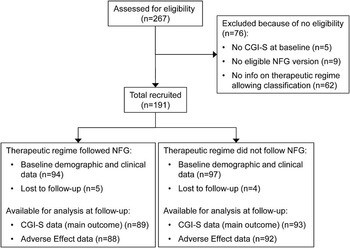
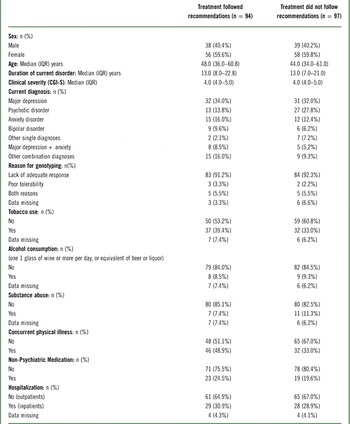
The study assessed 267 patients for eligibility, of whom 76 were excluded because of not meeting inclusion criteria. Additionally, 9 patients had been lost to follow-up (4.7% of the sample), thus leaving 182 patients available for analysis (Figure 1). Patients lost to follow-up were evenly distributed among the 2 study groups (5 in the group that followed the test recommendations and 4 in the group that did not follow the recommendations). The 2 study groups were similar on all baseline sociodemographic and clinical characteristics, except that the study group whose treatment did not follow the Neuropharmagen recommendations had about twice as many patients with a diagnosis of a psychotic disorder and more patients with concurrent nonpsychiatric disease (Table 1). Of note, lack of adequate efficacy of the previous medication was the most commonly cited reason in the clinical records for pharmacogenetic testing, accounting for more than 90% of the patients and with no differences among groups. Also, median duration of current disorder was 13 years, and thus the study population consists of patients with long-term mental illness. The excluded patients appeared similar to the included patients on all baseline variables, except that a meaningfully greater percentage of the excluded patients were daily consumers of alcohol, and there were noticeably higher portions of missing data (results not shown). Top-prescribed medications in the population available for analysis were escitalopram, paroxetine, clomipramine, fluvoxamine, mirtazapine, venlafaxine, sertraline, and duloxetine among antidepressants; quetiapine, aripiprazole, clozapine, and haloperidol among antipsychotics; lorazepam, clonazepam, bromazepam (not analyzed by NFG), and pinazepam (not analyzed by NFG) among anxiolytics; and lithium and lamotrigine among mood stabilizers.
Flowchart of patient eligibility, enrollment, and study group determination.

Baseline sociodemographic and clinical characteristics

Complete data were available for each variable except where indicated otherwise.
Clinical outcomes
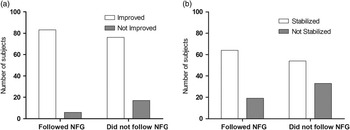
At the 3-month follow-up, improvement on the CGI-S was seen in 83 of 89 patients (93%) in the group whose treatment followed the Neuropharmagen recommendations and in 76 of 93 patients (82%) whose treatment did not follow the recommendations (Figure 2a); this difference was statistically significant (unadjusted OR=3.09, 95%CI 1.16–8.26; p=0.019). A sensitivity analysis that assumes the extreme scenario in which none of the missing patients would have improved results in a loss of significance, although the difference still shows a statistical trend (p=0.066). However, this assumption is highly unlikely, as nearly 90% of the patients in the total study sample had improved, and thus some improvement among missing patients should be expected. Assuming that all missing patients improved or an intermediate scenario in which half the missing patients improved in each group results again in significant differences between groups (p=0.018 and p=0.028, respectively).
Rates of improvement and patient stabilization at follow-up. (a) Comparison of the number of patients who did versus did not improve by follow-up in the 2 study groups (p=0.019). (b) Comparison of the number of patients stabilized (defined as a CGI-S score ≤3) versus not stabilized at follow-up in the 2 study groups (p=0.033), after excluding subjects already having a CGI-S score ≤3 at baseline.

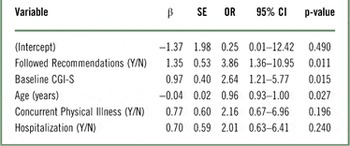
Multivariate logistic regression was performed to account for potential demographic and clinical confounders. The final model retained 5 factors that influenced the likelihood of improvement (Table 2). After multivariate adjustment (adjusted OR=3.86, 95% CI 1.36–10.95; p=0.011), patients whose treatment followed the Neuropharmagen recommendations had odds of showing improvement instead of non-improvement about 4 times greater than patients whose treatment did not follow the recommendations. Patients with higher baseline CGI-S scores were also more likely to improve, while older patients were less likely to improve. Presence of a concurrent nonpsychiatric disease and patient hospitalization also had a small effect on the final model, but did not change the significance of following the test recommendations. Importantly, gender, psychiatric diagnosis, time since diagnosis, and test version did not have a significant impact on the odds of improvement. Finally, in a multivariate linear regression of the actual magnitude of change of CGI-S scores, only the baseline score and study group (ie, following Neuropharmagen recommendations or not) remained significant predictors (details not shown). The average change was –1.43+/–0.65 and 1.25+/–0.85 in the group that followed and in the group that did not follow the test recommendations, respectively, with the mean score difference being 0.17+/–0.11. This difference was not statistically significant (P>0.05). However, upon performing the multivariate linear regression, the adjusted mean score difference increased to 0.24+/–0.10, with this difference being statistically significant (P=0.034).
Logistic regression final model for clinical improvement

To assess the rate of stabilization, arbitrarily defined as a CGI-S score≤3 at follow up, a subgroup analysis was performed after excluding subjects already having a CGI-S score≤3 at baseline (6 patients excluded from each group, 170 patients remaining for analysis). The rate of stabilization (Figure 2b) was also significantly higher in the group of patients whose treatment followed the Neuropharmagen recommendations (77% vs. 62%, p=0.033). A sensitivity analysis was performed to account for those patients with baseline CGI-S score≤3 but missing data at follow-up (4 in the group that followed test recommendations and 3 in the group that did not follow the recommendations). The 2 extreme scenarios (ie, all missing patients were stabilized and none was stabilized) yields p-values in the 0.030–0.056 range, while assuming an intermediate scenario results in significant differences between groups (p=0.035).
Only 12 patients reported adverse events, 6 in each study group (detailed in Table S2). Patients with depression were more likely to report an adverse event that patients with other psychiatric diagnoses (11.1% vs. 3.3%), although the difference did not reach statistical significance. Also, of the 52 patients that improved and were either ultrarapid or poor metabolizers for CYP2C19 and/or CYP2D6, 30 belonged to the group that followed Neuropharmagen recommendations and 22 to the group that did not follow the recommendations; this difference was not statistically significant.
Discussion
Psychiatric patients are among the most challenging to treat, and many of them undergo several different treatment regimens before showing improvement. Guidelines are starting to provide information on how to make use of pharmacogenetic testing as a way to personalize psychiatric treatment by identifying medications that will be more or less effective, will require a dose adjustment, or are riskier for a specific patient. The Neuropharmagen test may represent a useful tool because it provides clear clinical recommendations and explanations in addition to the genetic laboratory results themselves.
This multicenter, retrospective study found that patients whose treatment was consistent with the recommendations of their Neuropharmagen report had about 4 times greater odds of showing improvement of the severity of their symptoms according to a clinician rating at the 3-month follow-up. An increased rate of patient stabilization (defined as CGI-S≤3 at follow-up) was also found among patients whose regimen followed the pharmacogenetic test recommendations. These results must be interpreted in the context of a patient population with long-term psychiatric illness and whose previous medication had failed, such as the one in the study sample, and thus are encouraging. Conversely, no difference was found between the 2 study groups in regard to the incidence of adverse events in clinical records, but the study sample size was probably far too small to detect any such differences, since adverse events are uncommon. Notwithstanding, we are aware that sometimes patients do not report mild adverse events and deal with them by skipping doses, thereby compromising the efficacy of the treatment. Therefore, the effect of pharmacogenetic testing on reducing the incidence of adverse events, if any, could contribute to the observed effect on treatment efficacy. Of note, the number of patients with risk genotypes linked to poor or ultrarapid metabolism by CYP2C19 or CYP2D6 was not significantly larger in the group that followed the test recommendations than in the group that did not follow the recommendations. Thus, it is likely that the observed effect of pharmacogenetic testing on clinical outcome cannot be attributed solely to the identification of patients with impaired CYP2C19 or CYP2D6 activities, as the test analyzed variants in 20 genes.
Pharmacogenetic testing can potentiate a patient’s belief that he or she is receiving the most appropriate prescription, and thus is likely to increase both placebo effect and treatment compliance. Therefore, to avoid this potential bias, the control group was made of those patients having been genotyped whose treatment regime did not follow the recommendations of the test. Of course there may always be good reasons why a psychiatrist would not follow the recommendations based on pharmacogenetic testing. Pharmacogenetic recommendations are only one piece of the puzzle, and the treating psychiatrist must interpret them within a broader context, using his or her professional training and experience to choose the optimal treatment approach. Although a specific statistic could not be obtained due to the retrospective nature of the study, typical reasons were as follows: (1) according to the treating psychiatrist’s judgment, a different medication was better suited given the patient’s symptoms, clinical history, or preferences than the ones recommended by the test; (2) in polymedicated patients, the dose of one or more baseline medications was not changed despite the test recommendations because the treating psychiatrist considered that changes in other baseline medications was enough; (3) the medication recommended by the Neuropharmagen test was contraindicated given the patient’s health condition or concomitant nonpsychiatric medication. It could be argued that, if the group that did not follow the test recommendations included more patients with concurrent physical illness or nonpsychiatric medication, these factors could account for the lower improvement and stabilization rates observed in this group. However, there were significantly fewer patients with concomitant nonpsychiatric illness in the group that did not follow the test recommendations (33.0% vs. 48.9%, p=0.025), and the rate of patients with nonpsychiatric medication was similar in both study groups. Nonetheless, we accounted for this potential bias by considering concomitant illness in the multivariate analysis. Therefore we can assume that reasons #1 and #2 accounted for most of the difference attributable to following or not following the test recommendations.
This study has several limitations that must be kept in mind. First, this was a retrospective observational study, and thus inherently can only be considered level III evidence. Yet considering that pharmacogenetic testing is only a means to guide treatment selection and poses no risks itself, the results of a level III study may be sufficient for clinicians to begin judging its possible worth to their practice. Moreover, as an observational and naturalistic comparative research, this study has good external validity and should be representative of the results other clinicians would obtain in their routine practice. Second, the only measure of clinical outcome was the CGI-S, which is coarse (only 7 levels) due to the need of having a scale applicable to the different conditions included in the study. More finely quantitative patient-rated questionnaires of symptom severity would have provided useful supplemental information within each diagnostic group. Finally, the study was too small to draw any conclusions about the effect of Neuropharmagen on the incidence of adverse events.
The current study is consistent with the handful of previous clinical studies showing that pharmacogenetic testing can improve clinical outcomes in psychiatric patients. Most of these studies have used GeneSight (AssureRx Health Inc., Mason, OH, USA), a pharmacogenetic test that analyzed 5 genes to determine a patient’s composite phenotype, and then classified 26 antidepressant and antipsychotic drugs into red, yellow, and green bins according to the patient’s phenotype (only 1 color coding is assigned per drug). Some of the major differences between the Neuropharmagen test used in the present study and the GeneSight test are summarized in Table S3. A prospective, double-blind, randomized, controlled trial on 51 adult outpatients with major depression found that patients whose treatment was guided by pharmacogenetic testing had double the odds of being responders (OR=2.14) and nearly triple the odds of achieving remission (OR=2.75) according to the 17-item Hamilton scale of Depression (HAMD-17) compared to patients whose treatment was not guided by pharmacogenetic testing.Reference Winner, Carhart, Altar, Allen and Dechairo 20 Similarly, a prospective, nonrandomized, open-label study on 227 patients with depression found that patients with pharmacogenetically guided treatment had odds about 3 to 4 times greater of showing response (OR=3.59) and remission (OR=2.92) according to the HAMD-17.Reference Hall-Flavin, Winner and Allen 21 Also, a blind, retrospective study evaluated the healthcare utilization of 96 patients with a depressive or anxiety disorder during the 1-year period prior to genetic testing. They found that the 9% of patients whose pre-test medication was classified as “red bin” status had 69% more healthcare visits and 3 times as many medical absence days compared to all the other patients, thus strongly suggesting that pharmacogenetic testing could have substantially reduced the healthcare demands of this 9% of patients taking genetically inappropriate medication.Reference Winner, Allen, Anthony Altar and Spahic-Mihajlovic 22 Similarly, a retrospective study in schizophrenic patients found that pharmacogenetic testing significantly reduced costs among the extreme metabolizers (poor metabolizers and ultrarapid metabolizers) to 28%.Reference Herbild, Andersen, Werge, Rasmussen and Jürgens 23 Finally, a retrospective study compared 58 depressed patients who underwent ABCB1 genotyping at the Max Planck Institute of Psychiatry (Munich, Germany) to 58 matched controls who did not. They found that patients who received genotyping had higher remission rates (83.6% vs. 62.1%, p<0.01).Reference Breitenstein, Scheuer and Pfister 24 Altogether, the present and previous clinical studies provide consistent evidence for the benefit of pharmacogenetic testing in depressed patients. Moreover, the present study provides evidence that this benefit can be further generalized to other psychiatric conditions, as roughly two-thirds of the patients sample did not have a diagnosis of depression, and the effect of pharmacogenetic testing remained significant after multivariate adjustment for psychiatric condition.
Further research on the Neuropharmagen test should aim to better elucidate a few points. First, studies should be conducted prospectively and include a double-blind comparison study group in order to determine the effect of pharmacogenetic testing with more precision. Second, prospective studies should focus on patient samples that are diagnostically homogenous and should use more quantitative and disease-specific outcome measures in order to better assess the clinical benefits of Neuropharmagen for specific indications. This would be particularly important for diagnoses other than depression, where the overall body of scientific evidence on the impact of pharmacogenetic testing remains much thinner. Third, the use of large patient registries could enable researchers to gradually accumulate a database large enough to assess the effects of pharmacogenetic testing on the incidence of adverse events. Fourth, pharmacoeconomic evaluation of the benefits of pharmacogenetic testing with Neuropharmagen needs to be included among the issues to be studied in the future.
Conclusion
The present multicenter study in a “real-world” setting provides evidence that following pharmacogenetic-based, drug-specific recommendations, such as in the Neuropharmagen test, increases the likelihood of clinical improvement in patients whose previous treatment regimen has failed (either for lack of efficacy or poor tolerability). Viewed together with previous clinical studies and recommendations from the U.S. Food and Drug Administration (FDA), Clinical Pharmacogenetics Implementation Consortium (CPIC), or Dutch Pharmacogenetics Working Group (DPWG), the current study should serve as a basis for clinicians to consider using pharmacogenetic testing in their practice to help guide the selection of medications from the many available options. Pharmacogenetic testing can be easy to administer and involves no risks to the patient. Although its specific effect on reducing adverse events from medications remains to be determined, pharmacogenetic testing does make it more likely that the medications (and their doses) prescribed to the patient will be effective in alleviating his or her mental health symptoms.
Disclosures
Jordi Espadaler Mazo has the following disclosure: AB-Biotics, employee, salary. Miquel Tuson has the following disclosure: AB-Biotics, employee, salary. Jose Miguel Lopez-Ibor, Maria Ines Lopez-Ibor, and Francisco Lopez-Ibor do not have anything to disclose.
Supplementary material
To view supplementary material for this article, please visit http://dx.doi.org/10.1017/S1092852915000711