I. INTRODUCTION
High pressure die casting (HPDC) is a promising near net shape technology due to the eco-friendliness, good efficiency, and flexibility. Die castings possess good outlook, dimensional accuracy, and integrity, thus they are greatly expected to be used as automotive structural components (e.g., suspensions and B pillars Reference Brungs1,Reference Cole and Sherman2 ). Those components should own thin walls, complicated structures, and good toughness to reduce the weight of car body, moreover, they should also have moderate corrosion resistance due to the severe air pollution today.
To produce those high-duty structural components economically, several high performance die-cast aluminum alloys with a low Fe-content (≤0.2%) were developed. Reference Kaufmann and Uggowitzer3 As compared to other die cast alloys, AlMg5Si2Mn alloy has several advantages: Reduction of heat treatments, good corrosion resistance, and elongation. Reference Kaufmann and Uggowitzer4 Consequently, mechanical properties and microstructure segregation of AlMg5Si2Mn alloy have been extensively studied. For instance, Ji et al. Reference Hu, Wan, Wu, Wu and Liu5,Reference Ji, Watson, Fan and White6 systematically studied the tensile properties of AlMg5Si1.5MnFe0.25Ti0.2 alloy and highlighted its excellent elongation (δ = 15%). Kaufmann and Uggowitzer Reference Kaufmann and Uggowitzer4 compared the mechanical properties of die casting, squeeze casting, and semisolid casting AlMg5Si2Mn specimens, and they found that die casting specimens possess superior mechanical properties due to the finer average grain size and lower porosity. Otarawanna et al. Reference Otarawanna, Gourlay, Laukli and Dahle7,Reference Otarawanna, Gourlay, Laukli and Dahle8 documented that the interaction of liquid alloys, which have different solid fractions, is dominantly responsible for the formation of segregated microstructures, such as surface layer and shear bands.
Thus, previous research mainly focused on the static mechanical properties of HPDC AlMg5Si2Mn alloy, while the research on its dynamic mechanical behavior was very limited. Even though Wan et al. Reference Hu, Wan, Wu, Wu and Liu5,Reference Wan, Hu, Wu and Liu9 have documented that vacuum assistance slightly improved the crack growth rate of HPDC AlMg5Si2Mn alloy under tension-zero stress, more, fatigue cracks mainly initiated from air pores and ductile deformation area. However, structural components may be subject to the combined effect of dynamic loading and corrosive environment. Therefore, it is essential to elucidate the influence of the corrosive solution on the crack initiation and propagation mechanisms of HPDC AlMg5Si2Mn alloy, which was rarely reported before. Furthermore, the crack growth resistance of that alloy is evaluated by the da/dN–ΔK curves in the current work. The effect of aging on the mechanical properties and fracture behavior of HPDC AlMg5Si2Mn alloy is also involved.
II. EXPERIMENTAL PROCEDURE
A. Die casting process and microstructures
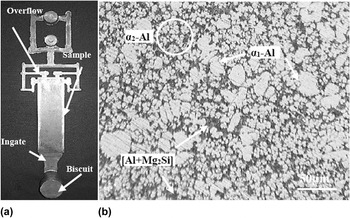
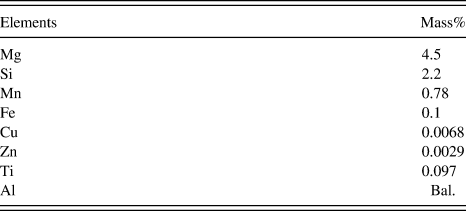
Plate samples [Fig. 1(a)] were produced by a horizontal cold chamber die casting machine. Die casting parameters (v 1 = 0.25 m s−1, v 2 = 2.5 m s−1, and P = 115 MPa) were optimized beforehand. Foundry ingots were melted in a graphite crucible by the electric resistance heating furnace. A required amount of pure magnesium was added into the melt when the temperature is 650 °C. Prior to the casting, the melt was degassed for 20 min with argon gas through a graphite lance and then poured into the shot sleeve at 680 °C. Several warm-up shots were made to obtain quasi-steady state thermal conditions in the shot sleeve and die. Accurate chemical composition of AlMg5Si2Mn alloy was confirmed by optical emission spectroscopy analysis and is listed in Table I.
(a) Image of the complete die-casting sample (dimensions: 200 mm × 60 mm × 4 mm). (b) Typical microstructure of HPDC AlMg5Si2Mn.

The nominal and actual chemical composition of AlMg5Si2Mn (mass%).

Figure 1(b) shows that the microstructure of HPDC AlMg5Si2Mn contains coarse α1-Al grains, fine size α2-Al grains, and [Al + Mg2Si] eutectic regions [dark regions in Fig. 1(b)]. α1-Al grains formed in the shot sleeve once the melt touched the wall of it, while α2-Al grains formed in the die cavity at an extreme high cooling rate. Due to the different cooling rates and solidification times, morphologies and sizes of α1-Al and α2-Al grains are distinctive. Spherical and dendritic α1-Al grains have significantly coarser size as compared to α2-Al grains. Reference Hu, Wan, Lü, Zhu and Wu10
B. Tensile tests and hardness
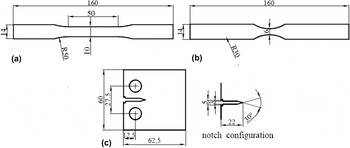
Tensile tests were carried out by an electronic universal testing machine at an ambient temperature (25 °C) and the loading rate was 5 mm/min. Elongation (δ) was obtained by a knife-edge extensometer fixed in the range of gauge length. Tensile specimens are schematically shown in Fig. 2(a). Brinell hardness was measured by a Wilson hardness testing machine. The diameters of the testing ball, the testing force, and the loading time are 5 mm, 750 kgf, and 20 s, respectively. To study the effect of age treatment on the tensile properties of HPDC AlMg5Si2Mn, a part of the tensile specimens were age treated at 250 °C for 1, 3, 5, 8, and 12 h (h) and four specimens were natural age treated for 60 days. Those experimental parameters are settled according to previous investigations.
Schematics of testing specimens: (a) Tensile specimens, (b) fatigue strength specimens, and (c) compact tension specimens.

C. Fatigue tests
Fatigue tests were conducted by a close-loop servo-controlled electro-hydraulic servo testing system (Shimadzu EHF-UV 100k2-040-1A, Japan). To remove the machining marks which may cause stress concentration, all fatigue specimens [Fig. 2(b)] were polished by abrasive papers (400 and 1000 grit) parallel to the loading direction.
After the ultrasonic cleaning, corrosion fatigue specimens were divided into three groups: the first group was loaded under varied stress amplitudes in a 3.5 wt% NaCl solution directly (group name: C). To investigate the influence of the prior-corrosion on the fatigue life of the alloy, the second group was corroded in the 3.5 wt% NaCl solution for 10 days prior to the fatigue life tests (group name: PC). The third group was tested in air (group name: A). The grip section of the precorroded specimen was masked by the nonmetallic lacquer and the gage section was exposed to the chloride solution. The “run out” specimens were subsequently loaded under the stress of 75 MPa to failure for the SEM observation.
Moreover, the fresh 3.5 wt% NaCl solution was made from laboratory grade sodium chloride and distilled water and the initial pH is 7. The gage section of each fatigue specimen was enclosed by an individual corrosion cell, which held 120 cm3 of corrosive solution and they were bonded by epoxy resin. Fatigue life tests in air were carried out under the frequency of 40 Hz and the stress ratio of −1, while the frequency of corrosion fatigue tests was 10 Hz, which was widely adopted in previous studies. Reference Chlistovsky, Heffernan and DuQuesnay11
Compact tension specimens [Fig. 2(c)] were sectioned from the initial die castings according to the requirement of ASTM E647. Fatigue crack growth tests were conducted under the stress ratio of 0.1 and the frequency of 5 Hz in air. Crack length was measured by current potential systems and the da/dN–ΔK curves were drawn by the data processing system automatically. Tensile and fatigue fracture surfaces are observed by SEM to analyze the crack initiation and growth mechanisms. EDS is adopted when necessary.
III. RESULTS
A. Tensile properties
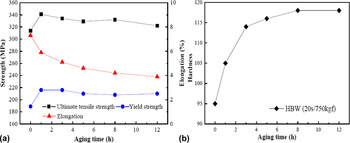
Mechanical properties of HPDC AlMg5Si2Mn alloy are shown in Fig. 3(a). Ultimate tensile strength (R m), yield strength (R 0.2), and elongation (δ) of the as-cast specimens are 314, 189 MPa, and 7.3%, respectively. The R m and R 0.2 of the 1 h age-treated specimens are 340 and 216 MPa, after that, they fluctuated around 330 and 210 MPa with the increasing aging time. However, elongation continuously decreased with increasing aging time and the lowest elongation (3.9%) is obtained as the aging time is 12 h. After 60 days of natural age treatment, R m, R 0.2, and δ are 313, 195 MPa, and 5.2%, respectively, thus, the natural age treatment just slightly improved the yield strength and decreased the elongation. The hardness of the as-cast samples is 95 and significantly increased to 118 after 8 h of age treatment [Fig. 3(b)].
Tensile test results of age-treated HPDC AlMg5Si2Mn: (a) Mechanical properties and (b) Brinell hardness.

B. Fatigue life in air and in corrosive environment
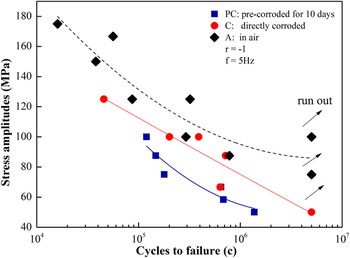
As shown in Fig. 4, fatigue lives of the A specimens under the stress of 100 and 75 MPa are above 5 × 10⁶ cycles (which is defined as “run out” in the present work). While the shortest fatigue life of the PC and C specimens is 119866c and 201133c, respectively, under the stress of 100 MPa, which are significantly lower than that of the A specimens. Under the stress amplitude of 50 MPa, the fatigue life of the PC and C specimens is 1374881c and 5 × 10⁶c, respectively. Difference between the fatigue life of corroded fatigue specimens and A specimens is more pronounced as the fatigue stress decreased. S–N curves indicated that fatigue lives of the PC and C specimens are nearly two orders of magnitudes lower than that of the A specimens. Moreover, fatigue lives of the PC specimens are just slightly shorter than those of the C specimens. Therefore, it can be concluded that the corrosive environment dramatically reduced the fatigue life, moreover, the fatigue life of precorroded and directly corroded specimens is similar to each other.
S–N curves of die cast AlMg5Si2Mn in air and in corrosive environment.

According to Zupanc Reference Zupanc and Grum12 and Jones, Reference Jones and Hoeppner13 the precorrosion significantly decreased the fatigue life of 2xxx and 7xxx alloys due to the formation of pits on the surface which act as crack initiation sites. Therefore, the reduced fatigue life of corroded specimens is often related to the detrimental effect of hydrogen embrittlement or pitting induced by the NaCl solution. Nevertheless, in this case, the insignificant effect of precorrosion on the fatigue life of HPDC AlMg5Si2Mn might be caused by the good corrosion resistance, which fails the formation of pits. Reference Hu, Wan, Lü, Zhu and Wu10
C. Crack growth rate
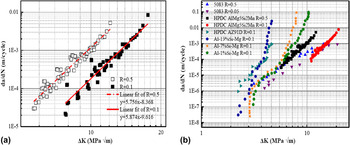
Crack growth rates of HPDC AlMg5Si2Mn are tested and the da/dN–ΔK curves are shown in Fig. 5(a). According to the crack growth rate tests, the specimens under the stress ratios of 0.1 and 0.5 fractured around the ∆K of 20 and 12 MPa√m, respectively. Logarithmic linear relationship between da/dN and ΔK in the Paris region is presented by the fitting functions. The fitting lines of the specimens tested under the stress ratios of 0.1 and 0.5 are nearly parallel to each other. According to the Paris law, Reference Paris and Erdogan14 the relation between da/dN and ΔK can be described by a power function (1):
 $${{{\mathop{\rm d}\nolimits} a} \mathord{\left/ {\vphantom {{{\mathop{\rm d}\nolimits} a} {{\mathop{\rm d}\nolimits} N}}} \right. \kern-\nulldelimiterspace} {{\mathop{\rm d}\nolimits} N}} = C{(\Delta K)^m}\quad {\rm{.}}$$
Fatigue crack growth rate of HPDC AlMg5Si2Mn: (a) da/dN–ΔK curves of CT specimens under the stress ratios of 0.1 and 0.5 on a double-log plot. (b) Comparison of the crack growth rate of multiple alloys commonly used in the die cast industry.

Therefore, the material constants C and m in Eq. (1) can be calculated according to the slope and intercept of the linear fitting functions in Fig. 4(a) and the results are: m = 5.756–5.874, C = 2.421 × 10⁻¹⁰ to 4.285 × 10⁻⁹. The value of exponent m is slightly greater than the typical value of some ductile aluminum alloys [m ≈ 2–4 (Ref. Reference Suresh15)] which indicated the great acceleration of the crack growth. The relatively high values of C and m can be attributed to the detrimental effect of the internal air pores, which could act as microcracks and accelerate the crack growth rate. Reference Hu, Wan, Wu, Wu and Liu5,Reference Suresh15
Figure 5(b) shows the comparison of the crack growth rates of multiple alloys commonly used in the automotive industry. The da/dN–ΔK curves of HPDC AlMg5Si2Mn located in the right side and the slope of the linear part m are smaller as compared to those of Al–Si–Mg Reference Lados, Apelian, Jones and Major16 and AZ91D alloys, Reference Venkateswaran, Ganesh Sundara Raman, Pathak, Miyashita and Mutoh17 which indicates that HPDC AlMg5Si2Mn alloy possesses superior crack propagation resistance. Moreover, a crack growth resistance of 5083 alloy is the best among the alloys listed in Fig. 4(b). The good crack growth resistance of AlMg5Si2Mn and 5083 alloys can be attributed to the excellent yield strength of the α-Al matrix, which is critical to reduce the dislocation formation and retard the crack growth through a plasticity-induced crack closure mechanism. Reference Suresh15,Reference Elber18
IV. DISCUSSION
A. Tensile fractography
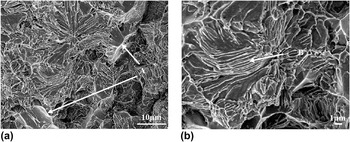
Fracture features of the as-cast and age-treated specimens are similar to each other and the typical fracture surface morphology is shown in Fig. 6. Numerous cleavage facets and steps can be observed in the tensile fracture surface. Locations labeled A and B in Figs. 6(a) and 6(b) represent the two dominant fracture characteristics. A represents the cleavage facets of α-Al matrix and there are many sharp boundaries, which are created as the cracks move across the adjacent grains with distinctive grain orientations. B represents the small cleavage steps located in eutectic regions, which are created by the microscale cleavage as the cracks move through the eutectic regions.
Morphology of the tensile fracture surface: (a) Low magnification image and (b) high magnification image of the cleavage steps. A and B locations labeled in (a) and (b) represent two different cleavage fracture structures.

B. Fatigue crack initiation mechanism
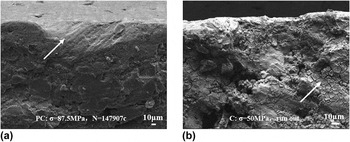
To explore the crack initiation mechanisms of the corroded fatigue specimens, crack initiation sites of the typical PC and C specimens are observed by SEM. Figure 7(a) shows the crack initiation site of the PC specimen under the stress of 87.5 MPa and the microcell with slip steps on the surface is pointed by the arrow. High cyclic stresses lead to severe surface ductile deformation and create those slip steps which act as stress concentrators and crack initiation sites, those microcells also indicate the deformation of adjacent grains and the good ductility of the alloy. Reference Hu, Wan, Wu, Wu and Liu5,Reference Yi, Gao, Lee and Lindley19 In addition, the electrochemical reactions preferentially occur around the stress concentrated areas and the surrounding area with less severe deformation often acts as cathode, Reference Suresh15 which also contribute to the premature crack initiation.
SEM images of the initiation sites of corrosion fatigue specimens: (a) Microcell in the surface of PC specimens. (b) Typical featureless morphology of the crack initiation site of C specimens.

Fatigue surface morphology of the specimens under a low cyclic stress (50 MPa) is shown in Fig. 7(b). A flat and featureless morphology around the crack initiation site was the typical characteristic of anodic slip dissolution, Reference Lin and Yang20 which has been observed at the initiation sites of 7075 alloy as the pits fail to form in a short time span. Reference Chlistovsky, Heffernan and DuQuesnay11 In this case, pits are seldom observed due to the good corrosion resistance of HPDC AlMg5Si2Mn and their negative effect on the fatigue life is insignificant. Therefore, the premature crack initiation is dominantly induced by anodic slip dissolution as the fatigue specimens are subjected to low stress amplitudes.
C. Crack propagation mechanism
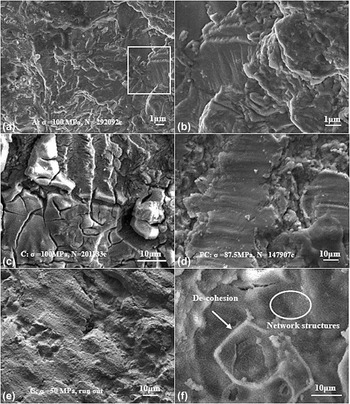
Figures 8(a) and 8(b) show the morphology of crack growth region of group A specimens. Numerous tear ridges and localized fatigue striations are clearly observed which interpreted the good ductility of the alloy and the typical trans-granular crack growth mode. Due to the severe crack face contact and fretting, those fatigue striations are not as clear as those of AlMg5Si2Mn tested under the stress ratio of zero. Reference Suresh15 The presence of the localized fatigue striations suggested the occurrence of stepwise crack growth, which were also observed in 5456 alloy by Menzemer and Srivatsan. Reference Menzemer and Srivatsan21 As shown in Figs. 8(c) and 8(d), fractured matrix and obscure fatigue striations are commonly observed as the stress amplitude is 100 and 87 MPa, while both of them nearly disappeared as the stress amplitude decreased to 50 MPa. In this work, the slightly shorter fatigue life of PC specimens seems to be caused by the longer exposure time in the NaCl solution, because 10 days of precorrosion of PC specimens may resulted in higher water vapor content inside them. In addition, it was documented that the water vapor content has negative influence on the crack growth rate of 7xxx aluminum alloy and the crack growth rate increased with increasing water vapor content. Reference Suresh15,Reference Hartman22 Actually, the fractured matrix caused by stress corrosion cracking (SCC) is commonly observed in the specimens subjected to the higher stress amplitudes, which may be greater than the minimum stress to induce SCC. While as the fatigue stress amplitude is lower than the minimum stress to induce SCC and the fatigue life is prolonged, thus the long term interaction of crack faces fretting and corrosive solution determine the morphology of fatigue fracture surface.
Crack propagation behavior of the fatigue life specimens: (a) Typical fractography of A specimens. (b) High magnification image of the enclosed region in (a). (c) Crack growth region of C specimen. (d) Crack growth region of PC specimen and (e) C specimen. (f) High magnification image of the featureless smooth facet observed in (e).

As shown in Fig. 8(e), smooth and flat area, which is the reminiscent of local brittle fracture, is observed. Formation of those area can be attributed to the localized microscopic deformation occurred around the hydrogen concentrated area. Reference Menzemer and Srivatsan21 Furthermore, de-cohesion behavior and considerable network structures are presented in those area [Fig. 8(f)]. Those network structures directly prove the discontinuous de-bonding of the crack faces and also present the brittleness of the matrix.
D. SCC
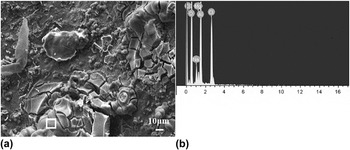
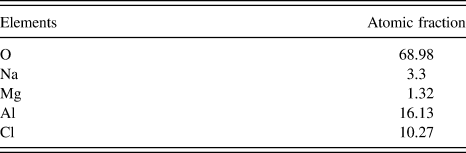
To elucidate the formation of fractured matrix [as shown in Figs. 8(c) and 9(a)], the chemical constitution of the fracture surface is analyzed. As shown in Fig. 9(b) and Table II, a high atomic fraction (68.98%) of oxygen indicates that the fractured matrix may be covered by aluminum oxides (e.g., Al2O3 or Al2O3•MgO). In fact, the combination of external cyclic stress and corrosive environment is capable of inducing SCC. Moreover, similar fractured structure was also observed in the SCC surface of Al–Zn–Mg alloy by Meyn. Reference Meyn23 Globally, the corrosion of aluminum in aqueous media can be expressed by the reaction [Eq. (2) (Ref. Reference Vargel24)]:
 $${\rm{Al}} + 3{{\rm{H}}_2}{\rm{O}} \to {\rm{Al}}{({\rm{OH}})_3} + {3 \over 2}{{\rm{H}}_2}\quad {\rm{.}}$$
Details of the cracked particles: (a) High magnification morphology of the cracked particles. (b) EDS results of the enclosed region in (a).

Chemical composition and reference atomic fraction of the enclosed region in Fig. 9(a).

After the reduction during corrosion, newly formed hydrogen can penetrate the metal at the metal-oxide interface and concentrate at the critical locations (such as the high tri-axial stress region ahead of fatigue crack tip, voids, and grain boundaries), and then form H2 in those area which promoted the local deformation and accelerated the crack growth rate. Reference Suresh15,Reference Vargel24 Consequently, those weakened areas act as the most favorable crack growth paths, more, the concentrated hydrogen harms the integrity of α-Al matrix and the fractured matrix formed as the localized stress is greater than its tensile strength. In addition, the corrosion products around the eutectic regions (anode) are alumina Al(OH)3, which is insoluble in water and precipitates as a white gel, and then decomposed into Al2O3 and H2O. Reference Vargel24 Electrical conductivity of those aluminum oxides on the fracture surface is poor, thus they are exhibited brighter in the SEM images.
V. CONCLUSION
The present work systematically investigates the fatigue and corrosion fatigue behavior of HPDC AlMg5Si2Mn. In addition, the crack initiation and propagation mechanisms in the 3.5% NaCl solution are analyzed in detail. The main results can be summarized as follows:
-
(1) Values of crack growth rate exponent m and coefficient C are in the range of 5.756–5.874 and 2.421 × 10⁻¹⁰ to 4.285 × 10⁻⁹, respectively, which interpret the good crack growth resistance of AlMg5Si2Mn alloy.
-
(2) Fatigue lives of corroded fatigue specimens are almost two orders of magnitudes lower than those of fatigue specimens tested in air. Fatigue lives of precorroded specimen are slightly lower than those of directly corroded specimens.
-
(3) Anodic slip dissolution is the dominant crack initiation mechanisms. Fatigue striations of specimens tested in NaCl solution are obscure due to the premature contact and fretting of the crack faces.
ACKNOWLEDGMENTS
This work was funded by Project 2012A090300016 supported by Guangdong Provincial Department of Science and Technology, China. Authors would like to express thanks to Material Institution of CAEP (China Academy of Engineering Physics). The authors would also like to express their appreciation to the Analytical and Testing Center, Huazhong University of Science and Technology.