Introduction
Surgeons are subjected to a variety of physical and emotional occupational risks on a daily basis, with resounding morbidity.Reference Vijendren, Yung and Sanchez 1 , Reference Soueid, Oudit, Thiagarajah and Laitung 2 Even in modern healthcare systems, with the availability of ergonomic operating chairs, remote-controlled operating tables and patient sliding devices, the operating theatre can be a hazardous environment.Reference Dorion and Darveau 3 Work activities that are frequent and repetitive, or activities which involve awkward postures (such as those that can be assumed during lengthy operations), are noted to exert a physical strain on one's body.Reference Soueid, Oudit, Thiagarajah and Laitung 2 , 4
Work-related musculoskeletal disorders can have serious implications on the surgeon's health, with reports of some taking sick leave, and seeking medical and operative interventions.Reference Soueid, Oudit, Thiagarajah and Laitung 2 , Reference Babar-Craig, Banfield and Knight 5 Not uncommonly, clinicians may be forced into early retirement, which can impact on patient care, health service delivery and surgical training.Reference Vijendren, Yung and Sanchez 1
The financial repercussions of work-related musculoskeletal disorders are another important consideration. The Health and Safety Executive annual statistics report for Great Britain showed that general workplace injuries and ill health resulted in a £13.8 billion cost to taxpayers in 2011, with musculoskeletal injuries being amongst the commonest. 6 Although specific figures for doctors were not available, healthcare workers were noted to have higher rates of work-related musculoskeletal disorders compared to the average across other industries, 7 , 8 highlighting its potential impact on the economy of healthcare institutions and nations.
Today, healthcare employers have a legal obligation to ensure tasks are risk-assessed and staff suitably trained prior to undertaking any form of moving and handling (including heavy lifting) work. 9 Many trusts have made health and safety an integral part of new doctors’ induction process.Reference Premier 10 Principles such as taking regular breaks and postural ergonomics have also been incorporated into online e-learning modules.Reference Premier 10 Despite such interventions being in place, there are growing concerns about the impact of work-related musculoskeletal disorders on ENT surgeons and its relative scarcity in reports.Reference Babar-Craig, Banfield and Knight 5 , Reference Mal 11 Hence, we conducted a literature search on the subject to evaluate its reporting frequency worldwide, and investigated the prevalence and effects of work-related musculoskeletal disorders within current UK otolaryngologists.
Materials and methods
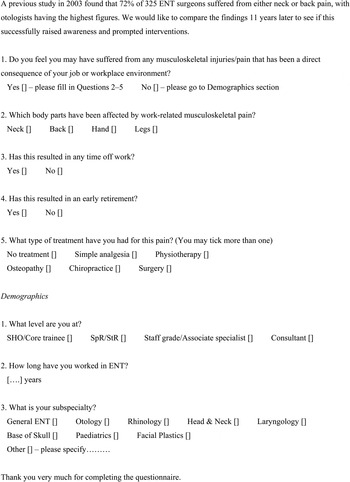
A survey containing questions on work-related musculoskeletal disorders was distributed electronically to the entire membership of ENT-UK (the official society of otolaryngologists within the UK). A literature search did not reveal any existing validated questionnaires on this topic; hence, the authors designed the questionnaire themselves. The survey incorporated questions on the occurrence of work-related musculoskeletal disorders, the location of the pain (e.g. neck, back, hand, legs), resultant time off from work, type of treatment sought (if any) and consequent early retirement (Figure 1). Demographic data on the respondents’ grade, subspecialty interest and years spent in ENT were also collected.
Questionnaire distributed through ENT-UK to assess work-related musculoskeletal disorders amongst ENT surgeons. SHO = senior house officer; SpR = specialist registrar; StR = specialty trainee

The questionnaire was edited and approved by the ENT-UK Survey Guardian. It was then distributed by the ENT-UK office via e-mail to its 1344 members between October and December 2013. The survey was emailed to 796 consultants, 253 specialist trainees or specialist registrars, 105 junior doctors or senior house officers, 35 fellows and staff grade doctors, 70 associate specialists, 20 affiliated members (general practitioners, speech therapists, audio vestibular physicians and so on), and 61 retirees.
All results were recorded on a Microsoft Excel™ spreadsheet and tabulated. Chi-square tests and Fisher's exact tests were employed for all categorical data analyses.
Ethical approval was not required as members of the aforementioned charitable organisation completed the survey on a voluntary basis.
A literature search was also conducted of peer-reviewed articles published worldwide between 1990 and 2015. PubMed, Embase, Medline and Google Scholar databases were searched using the following keywords in varying combinations: ‘ear’, ‘nose and throat’, ‘ENT surgeon’, ‘otorhinolaryngology’, ‘occupational pain’, ‘musculoskeletal pain’, ‘musculoskeletal injuries’, ‘work-related muscle pain’, ‘neck pain’, ‘cervical pain’, ‘shoulder pain’, ‘lumbar pain’, ‘back pain’, ‘hand pain’, ‘leg pain’, ‘upper limb pain’, ‘lower limb pain’, ‘carpal tunnel’, ‘repetitive strain injury’, ‘work place’, ‘risk factors’ and ‘occupational diseases’.
The bibliographies of identified articles were manually searched for relevant references. No language limitation was applied.
Results
We received a total of 323 completed questionnaires (24 per cent response rate); 224 responses were from consultant otolaryngologists (out of a total number of 796 consultants; 28.1 per cent). A total of 153 respondents reported having experienced work-related musculoskeletal disorders, giving a responding prevalence of 47.4 per cent.
Demographics
Respondents’ grade
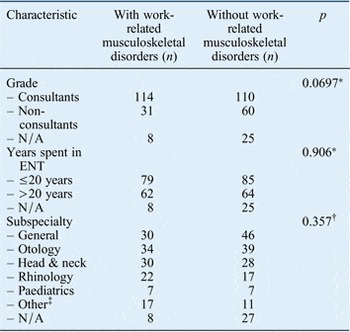
Of the 153 ENT-UK members affected by work-related musculoskeletal disorders, 114 were ENT consultants, 19 were specialist registrars or specialty trainees, and 12 were a combination of associate specialists and staff grades (Table I). There were no details from eight respondents. There was no statistical difference in the occurrence of work-related musculoskeletal disorders between consultants and non-consultants (p = 0.0697).
Baseline characteristics of respondents

*Fisher's exact test analysis; †chi-square test analysis. ‡Laryngology, skull base, dual specialist interest, sleep medicine, community ENT, and general practitioner with special interest in ENT. N/A = not applicable
Years in ENT
The afflicted respondents had spent between 2 and 46 years in ENT, with a median of 18.7 years and a mode of 20 years. No statistical difference was seen in the occurrence of work-related musculoskeletal disorders between respondents who had spent 20 or fewer years in ENT and those who had over 20 years of experience (p = 0.906; Table I).
Subspecialties
Thirty-four respondents with work-related musculoskeletal disorders had a subspecialist interest in otology, while there were 30 responses each from general ENT surgeons and head and neck surgeons. The subspecialist interests of the other affected respondents were as follows: rhinology (n = 22), paediatrics (n = 7), laryngology (n = 2), skull base (n = 6) and other specialties (dual specialty interests, sleep medicine, community ENT, or general practitioner with a special interest in ENT; n = 9). There were no details from eight respondents. No statistical differences were seen between the individual subspecialties (p = 0.357; Table I).
Body parts affected
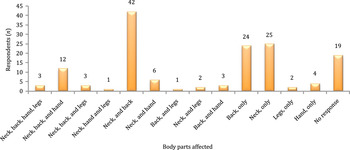
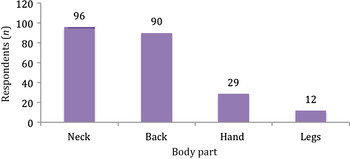
Of those who reported work-related musculoskeletal disorders, 24.1 per cent had pain in multiple parts of their body, whereas 16.7 per cent only had a single body part affected (further details in Figure 2). The commonest areas affected were the neck (29.7 per cent) and back (27.9 per cent), both individually and in combination, as noted in Figures 2 and 3.
Combinations of body parts affected by work-related musculoskeletal disorders.

Total distributions of body parts affected by work-related musculoskeletal disorders.

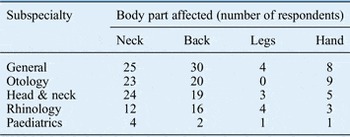
Table II shows the distribution of respondents with work-related musculoskeletal disorders based on their subspecialty and body part affected. The neck and back regions were the commonest areas reported as affected by all subspecialties.
Body parts affected by work-related musculoskeletal disorders per subspecialty

Treatment sought
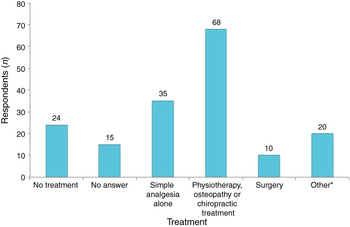
Of the 153 affected clinicians, 68 (44.4 per cent) had undergone physiotherapy, osteopathy or chiropractic treatment (Figure 4). Thirty-five (22.8 per cent) managed with simple analgesia alone and 10 (6.5 per cent) had undergone surgery. Twenty (13.1 per cent) sought other modalities of treatment, such as epidurals, regular exercise, Pilates, acupuncture and Ayurvedic medicine. Only 24 respondents (15.7 per cent) reported not having had any form of therapy.
Modes of treatment sought by respondents for work-related musculoskeletal disorders. *Regular exercise, epidural, Pilates, hydrotherapy, Alexander technique, ergonomic changes in operating theatre, nerve root injections, acupuncture, Ayurvedic medicine, transcutaneous electric nerve stimulation and sports massage

Time off work
Thirty-five surgeons (22.9 per cent) had taken time off work for work-related musculoskeletal disorders.
Early retirement
Six clinicians (5 consultants and 1 associate specialist) resorted to early retirement, with 128 surgeons able to continue with their daily work. There were no responses from 19 of the ENT surgeons with work-related musculoskeletal disorders on this matter. No data were collected on surgeons whose work was restricted as a result of work-related musculoskeletal disorders.
Literature search
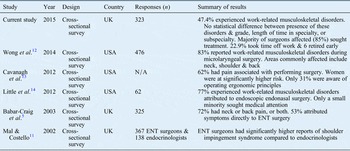
Our literature search revealed six papers. One was excluded, as it was not specific to ENT. All the remaining five studies were cross-sectional surveys (Table III).Reference Babar-Craig, Banfield and Knight 5 , Reference Mal 11 – Reference Little, Deal, Zanation, McKinney, Senior and Ebert 14 Three had been conducted in the USA and two in the UK. One of the UK studies compared ENT surgeons and endocrinologists. All studies had used varying types of questionnaires. The studies comprised data from between 62 and 476 respondents.
Summary of studies on work-related musculoskeletal disorders amongst ENT surgeons worldwide

N/A = not applicable
Discussion
Our study revealed that 47.4 per cent of 323 ENT surgeons had suffered a form of work-related musculoskeletal disorder. The vast majority of those afflicted (85 per cent) required treatment beyond self-medication (Figure 4). More seriously, 35 clinicians required time off work and 6 clinicians claimed that they took early retirement as a result of the work-related musculoskeletal disorder.
We found that the neck and back were the commonest body parts affected. This finding is similar to that noted in other surgical specialties, such as oral surgery,Reference Kazancioglu, Bereket, Ezirganli, Ozsevik and Sener 15 , Reference Rambabu and Suneetha 16 maxillofacial surgery,Reference Kazancioglu, Bereket, Ezirganli, Ozsevik and Sener 15 plastics surgeryReference Capone, Parikh, Gatti, Davidson and Davison 17 and orthopaedics,Reference Knudsen, Ludewig and Braman 18 suggesting that the neck and back probably experience the most strain during any form of operative work.Reference Kazancioglu, Bereket, Ezirganli, Ozsevik and Sener 15 , Reference Capone, Parikh, Gatti, Davidson and Davison 17 , Reference Liang, Levine, Dusza, Hale and Nehal 19 Equipment commonly used by the aforementioned specialties, such as microscopes, endoscopes, loupes and head-mounted lights, have been noted to contribute to work-related musculoskeletal disorders.Reference Soueid, Oudit, Thiagarajah and Laitung 2 In an attempt to provide the scientific rationale behind this, Nimbarte et al. conducted a field study amongst ophthalmic plastic surgeons, and found that there was significantly higher biomechanical loading on the cervical spine when loupes and headlamps are used.Reference Nimbarte, Sivak-Callcott, Zreiqat and Chapman 20 Other predisposing factors include prolonged operating and standing, inconsistent working patterns, and pre-existing musculoskeletal disorders.Reference Kazancioglu, Bereket, Ezirganli, Ozsevik and Sener 15 , Reference Capone, Parikh, Gatti, Davidson and Davison 17 , Reference Esposito, Najmaldin, Schier, Yamataka, Ferro and Riccipetitoni 21
The lack of differences between respondents who had experienced work-related musculoskeletal disorders in terms of grade, the amount of time spent in the specialty and subspecialty interest, as demonstrated in Table I, would suggest that all ENT surgeons are equally at risk. However, more information on the nature of work undertaken, operating patterns and pre-existing co-morbidities could shed extra light on potential predisposing risk factors. We did note that no otologist has complained of leg pain, possibly as a result of frequent operating in a seated position.
Despite a reasonably high prevalence in the UK, we were surprised to find only five articles worldwide relating to work-related musculoskeletal disorders amongst ENT surgeons (Table III). The three American studies showed that work-related musculoskeletal disorders are fairly common during microlaryngeal and endoscopic procedures, and are common amongst paediatric ENT surgeons.Reference Wong, Baker, Smith and Rosen 12 – Reference Little, Deal, Zanation, McKinney, Senior and Ebert 14 In the UK, Mal and Costello found that reports of shoulder impingement were significantly higher in otolaryngologists compared to endocrinologists, possibly as a result of continuous shoulder movements during clinical examinations and operations.Reference Mal 11
We were interested to find Babar-Craig and colleagues’ 2003 study on work-related musculoskeletal disorders amongst UK ENT surgeons,Reference Babar-Craig, Banfield and Knight 5 which was fairly similar to ours. Using a self-designed postal questionnaire, with the response options being a combination of tick boxes and free text entries, the authors reported that 72 per cent of 325 ENT consultants had either back or neck pain, with 53 per cent attributing their symptoms to their profession.Reference Babar-Craig, Banfield and Knight 5 The population of the survey was based on the registry of British Association of Otorhinolaryngologists, Head and Neck Surgeons (now ENT-UK) members.Reference Babar-Craig, Banfield and Knight 5 The paper concluded that future studies should provide insight into the ergonomics of ENT surgery and promote the development of techniques to address this.Reference Babar-Craig, Banfield and Knight 5 The prevalence of work-related musculoskeletal disorders in the present study appears lower than that in the 2003 studyReference Babar-Craig, Banfield and Knight 5 (47.4 vs 72 per cent). However, direct comparison of the two studies is not possible given the differing methodologies employed. The postal questionnaire used in the 2003 study focused solely on neck and back pain. Moreover, the authors of the 2003 paper only surveyed consultants, and the average length of time their respondents had spent in ENT was noted to be lower than ours (12 vs 18.7 years).Reference Babar-Craig, Banfield and Knight 5
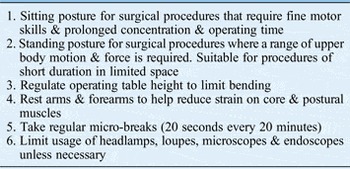
Understanding and applying the principles of surgical ergonomics, which has been noted to be severely lacking, is key in the control and management of this occupational hazard and in the prevention of work-related illness.Reference Cavanagh, Brake, Kearns and Hong 13 Rodigari et al. indicated that modifications such as being able to control working postures, regulating operating table height and resting forearms intra-operatively can be protective.Reference Rodigari, Bejor, Carlisi, Lisi, Tinelli and Toffola 22 Additionally, Dorion and Darveau reported on the value of intra-operative micro-pauses (20-second breaks every 20 minutes) in reducing muscular fatigue and improving surgical accuracy.Reference Dorion and Darveau 3 Incorporating such techniques (Table IV) alongside other principles into induction programmes and the Intercollegiate Surgical Curriculum Programme can help train a generation of surgeons who are ergonomically more conscious.
Intra-operative ergonomic tips to help reduce work-related musculoskeletal disorders

The myriad of treatment options employed by our responding cohort suggests that no one modality fits all. We are yet to discover any studies comparing the variety of treatment options for work-related musculoskeletal disorders, and would suggest that treatment selection is based on professional recommendation and personal choice. We hope that the present study reminds ENT surgeons to look after their own health as well as that of their patients. Prevention is key, and every ENT surgeon should be more aware of their posture and strain during surgical procedures. They should seek early help from their general practitioner or occupational health department to plan a suitable management strategy in order to prevent further deterioration and avoid career-limiting pain.
-
• Work-related musculoskeletal disorders are common within UK ENT surgeons, despite modern equipment, increasing awareness and mandatory training
-
• The majority of affected surgeons sought treatment and some even took early retirement
-
• This occupational hazard is underreported amongst otolaryngologists worldwide
-
• This study emphasises the importance of early recognition and appropriate ergonomic intervention for work-related musculoskeletal disorders
Aside from the aforementioned limitations, our survey did garner a relatively low response rate (24 per cent). Moreover, not all ENT surgeons in the UK are ENT-UK members, resulting in a proportion of affected UK otolaryngologists who may not have been captured in our study. We also accept that such surveys may be affected by response bias. In a bid to minimise this, ENT-UK awarded a number of continual professional development points to respondents for ‘self-reflection of their practice’. Overall, we were reassured that our response rates were similar to those of the other studies identified in our review.Reference Babar-Craig, Banfield and Knight 5 , Reference Wong, Baker, Smith and Rosen 12 Another potential flaw of our study is that the diagnosis of work-related musculoskeletal disorders is based on self-reporting, given the unavailability of a valid and standardised diagnostic questionnaire or process. We also feel that the inclusion of upper limb injuries into the survey would have helped identify a cohort of surgeons struggling with shoulder injuries, and could have helped raise further awareness on work-related upper limb disorders.
Acknowledgements
We are very grateful to Mr David Lowe (ENT-UK Survey Guardian), the ENT-UK survey team, and members of ENT-UK who help to develop knowledge within our speciality by sharing their Reflections on Practice.