INTRODUCTION
Since Sir Ronald Syme wrote a paper on the legions under Augustus,Footnote 1 there has not been much development on the movement of legions in Illyricum before a.d. 9. The basic reference work on the matter is still J.J. Wilkes's Dalmatia;Footnote 2 and the last considerable upgrade was made in this very journal—in the paper by Stephen Mitchell, who showed that legio VII was most probably one of the legions that Marcus Silvanus brought from Galatia to fight the Pannonians at the Volcaean marches in a.d. 7.Footnote 3 Since the presence and the movements of the legions in Illyricum during the Augustan era is clouded by the lack of new discoveries of inscriptions, I find it suitable to quote L. Keppie's note from the preface of the second edition of The Making of the Roman Army: ‘The pace of epigraphic discovery has not slackened, though the number of military inscriptions which can confidently be dated to before a.d. 14 remains disappointingly small.’Footnote 4
Interestingly, there has been an important discovery of the inscription of legio XX from the colony of Narona, which, oddly enough, has not been spotted by any of the scholars dealing with the Roman army in Dalmatia. The inscription was discovered in 1993 and published in 1998,Footnote 5 and, in my opinion, should be dated to before a.d. 14.
A monograph on the legio XX has recently been published from the pen of S.J. Malone.Footnote 6 The part on the early history of the legion does not include the inscription from Narona,Footnote 7 so the narrative on the theme can be slightly altered. Through analysis of the inscription and reassessment of the conclusions from the original publication, I will try to determine the character of the Narona inscription and to provide some different opinions on the presence of legio XX in Illyricum from what was previously thought.
I. THE INSCRIPTION FROM NARONA
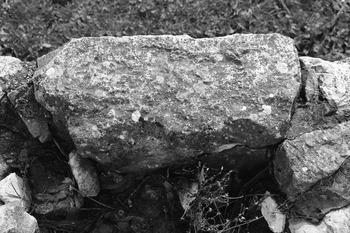
The inscription was found during the archaeological excavations of the early Christian church in today's village of Vid near Metković in Croatia (ancient Narona).Footnote 8 It was immured in the foundation of the church and, after it was removed, it was again embedded—but this time in the modern wall which surrounds the later Church of St Vid,Footnote 9 where it is present even today (fig. 1). In the preliminary publication, the inscription was described as part of the stēlē of a veteran, probably of legio XX.Footnote 10
The inscription from Narona (photo: N. Cesarik)

Such a conclusion seems rather questionable since the monument is a long block (cuboid), evidently broken in half, which does not resemble any kind of funerary monument. There are two main factors which allow us to deduce that this is not a part of a funerary monument.
First, the positioning and the height of the letters. The first letter is significantly indented to the right hand side, while the whole content seems to be perfectly centred inside the block (especially concerning the space above and below the letters). If there was any other potential line in the text, taking the amount of space above and below it, one would expect to see some indication of letters. The letters LEG are 9 cm, while the letters XX are 5,5 cm in height. As far as I know, there are no stēlai on the Eastern Adriatic where the height of the letters is as described. The stēlai of soldiers from Dalmatia characteristically show a decrease in the height of the letters from the first line downwards; or in some cases an evenness of the letters in all lines. In general, the letters in the first line of the inscription (with the name of the deceased) are higher than the letters in the lines below. For instance, I have examined all of the funerary stēlai of Roman soldiers from the Archaeological Museum in Zadar, many of which commemorated soldiers of legio XI (from a.d. 42 known as legio XI Claudia Pia Fidelis). The maximum height of the letters varies between 5 and 6 cm, and this height is generally applied to the letters of the first line of the inscription. The letters from the lines below, which contain the rank and the name of the legion, are always under 5 cm in height. In addition, if the inscription from Narona was a part of the funerary monument, presumably a stēlē, one would expect to see a trace of the framing on the left hand side, since it is an essential element of funerary stēlai on the eastern side of the Adriatic.Footnote 11 This suggests that the inscription contained only one line and that it started with the letters LEG XX.
Secondly, all of the surviving sides bear traces of chiselling, except for the back (fig. 2). That could imply that the stone was either broken during its reuse as a building material or (more likely) that the back of the stone was originally left unfinished. In conclusion, this indicates that the stone is part of a public inscription which was built into some unknown structure as a marker.Footnote 12 In other words, this block should be considered as a building inscription. Unfortunately, the character and the exact place of the building on which it was placed remain unclear, since the inscription was reused as a building material for the early Christian church, placed about 200 meters outside the city walls of Narona.
The back of the inscription from Narona (photo: N. Cesarik)

II. THE ANALOGIES
There are several questions that arise. First, should the inscription be read in the nominative case (if the legion is the subject of an action) or in the genitive case (if it refers to the ownership of the legion)? Second, since there is punctuation after the ordinal number, what kind of content could we expect to find in the missing part of the inscription? Third, are there any parallels of such an inscription in other places; and can they be dated to the time of Augustus or Tiberius? Finally, are there any similar inscriptions to be found inside other legionary fortresses across the Empire?
If my interpretation of the stone is correct, and if the inscription started with the name of the legion, then it seems more plausible that it refers to a legion as the subject of an action. I did not find any parallel for such an inscription that was read in the genitive case, so the reading in the nominative case seems reasonable. Considering the analogies from other inscriptions, various content could be assumed in the missing part. The first assumption would be a third-person singular verb, such as fecit. In looking for such parallels, Britain comes as an excellent source. However, most of these stones came from Hadrian's Wall, and do not refer to building activity inside the legionary fortress.Footnote 13 The only ones that are found inside the legionary fortress are from York, but these are antiquarian records of stones long lost.Footnote 14
Other analogies imply that the missing part could contain a title of the legion, or a subunit (that is, a legionary cohort). The only known title of legio XX is Valeria Victrix, which was apparently given to the legion after Boudicca's revolt.Footnote 15 However, we cannot be certain that the legion did not hold any titles in its early stages. For instance, we can draw a parallel with the legio VII, which was at some early point called legio VII Macedonica;Footnote 16 but in Dalmatia it was always referred to without any titles,Footnote 17 until a.d. 42, when it received the honorary title Claudia Pia Fidelis.Footnote 18 Debate over possible titles of legio XX at such an early stage would of course be pointless; but the possibility that it held some early titles cannot be definitively rejected. From what we know today, it seems that legio XX did not hold any titles prior to the title Valeria Victrix, but our view on the matter can easily be shattered by future evidence.
The parallels for the legionary title can be found at Mainz. One building inscription reads Leg(io) XIIII Gem(ina).Footnote 19 It was presumably found at the legionary fortress and is dated to the Augustan or the Tiberian period.Footnote 20 The other inscription records legio XXII Primigenia Pia Fidelis,Footnote 21 and is dated after a.d. 90.Footnote 22
Another good parallel is the collection of several building inscriptions of legio X Fretensis from Jerusalem, which become its main base after the First Jewish Revolt.Footnote 23 Three inscriptions record only its name—Leg(io) X / Fret(ensis),Footnote 24 while one records a legionary cohort—Leg(io) X Fret(ensis) / coh(ors) IIX.Footnote 25 The editors of the Corpus Inscriptionum Iudaeae/Palaestinae connected all of the inscriptions within the construction work of legio X Fretensis, inside its encampment. The last inscription—the one with the record of a legionary cohort—offers a good precedent for the possibility that the Narona inscription might have contained a record of a subunit in the missing part of the inscription.Footnote 26
Nevertheless, neither Britain nor Jerusalem nor the Rhineland would be a good parallel for the Augustan Illyricum. The most valuable comparandum will always be the province of Hispania Tarraconensis. Both provinces shared a similar fate and the final conquest of both territories is regarded as the greatest military achievement of Augustus’ Principate. Since modern archaeological research on the early Roman occupation of Illyricum is only in its infancy, archaeological research in the Iberian Peninsula offers excellent material for comparisons with Augustan Illyricum. In the last couple of decades, Spanish archaeologists have provided excellent data about the movements of the legions and (especially) about their permanent encampments.Footnote 27 In the case of Narona, the most important evidence would be two stone blocks from Astorica Augusta (modern Astorga, León) recording L(egio) X G(emina).Footnote 28
After the Cantabrian Wars, the legionary garrison of Hispania consisted of three permanently stationed legions—IIII Macedonica, VI Victrix and X Gemina.Footnote 29 Since Astorga is located on one of the most important strategic points in its region, it became the permanent base of legio X Gemina from about 15/10 b.c. to a.d. 15/20, when it was transformed into a town and the capital of conuentus Asturum. The definitive argument for the military character of the early settlement in Astorga is the discovery of a V-shaped double ditch, belonging to the defensive system of the legionary encampment. The discovery of several funerary monuments, as well as of two building inscriptions, has allowed researchers to identify legio X Gemina as an occupying force of the legionary fortress of Augustan Astorga.Footnote 30
The case is similar with Lucus Augusti (modern Lugo), which was apparently a military base during the Cantabrian Wars, after which it become a civilian town.Footnote 31 One of the stone blocks records L(egio) VI,Footnote 32 undoubtedly the legio VI Victrix, which was one of the permanently stationed legions of the exercitus Hispanicus during the reign of Augustus. Although there are still some open questions regarding this inscription, such as whether it should be connected with the military or the civilian phase of early Lugo, it is still a good parallel with the inscription from Narona, especially concerning its shape (it is also a long block, with the first letter indented to the right side).Footnote 33
Although all of these inscriptions from Spain share some evident similarities with the inscription from Narona, some elements are quite different. For instance, all of the Spanish inscriptions are carved with sigils (that is, ‘L X G’; ‘L VI’) and are not carved in such a high manner (concerning the lettering) as the inscription from Narona. However, since all of them are found in the context of military fortresses of Augustan Spain, they are all important comparanda for the theory that the Narona inscription belongs in a military context and that it was placed in or around the permanent encampment of legio XX. Astorga and Narona moreover shared a similar process of Romanization, both being important strategic points, which eventually became centres of juridical conuentus for peregrine communities.Footnote 34
Differences found in the inscriptions, regarding the lettering and the forms of abbreviation, cannot be considered as definitive arguments for discarding their parallels. The style of the letters and the form of the inscription should not be considered as elements, which blindly followed a general rule, since their differences were evidently based on various reasons that will be justified below.
In the search of comparanda for building inscriptions of Roman legions, I should mention one ‘Bauinschrift’ (as it is described in the epigraphic database Ubi Erat Lupa),Footnote 35 originating from Aquileia with the record of Leg(io) XIII.Footnote 36 The exact place of the inscription's discovery is unknown, as well as its purpose. There is not any other evidence, such as funerary monument, that could support the idea that legio XIII Gemina stayed at Aquileia at some point. However, legio XIII Gemina was reportedly one of the legions that took part in the conquest of Illyricum;Footnote 37 and Aquileia is thought to be the castra hiberna, or a jump-off point for the legions operating in Illyricum during Augustus’ reign.Footnote 38 It would not be unreasonable to assume that the stone is a remnant of the building activity by legio XIII Gemina in or around its encampment at Aquileia during this period. Unfortunately, such an encampment is still unproven in the archaeological case,Footnote 39 and the proof of the military occupation of Aquileia during the reign of Augustus is completely drawn from literal and epigraphic sources.Footnote 40
In the light of these different possibilities for the reconstruction of the missing part of the Narona inscription, it is sensible not to make assumptions. It would be best to leave a blank space after the ordinal number, until some better and firmer analogy emerges from the surface. Therefore, the proposed reading is: Leg(io) XX [---].
III. THE LETTERING
None of the other fragments of inscriptions from Narona can be connected with the inscription of legio XX.Footnote 41 In some elements, the inscription has a unique style of lettering, when compared with other inscriptions from the Eastern Adriatic. The distinctive features are elongated serifs, curves on the over-line above the ordinal number, thinness and elongation of the letters LEG, and dissimilarity of the height of the letters (the letters XX are almost half of the size of the letters LEG).
Besides, there is no systematic study of the palaeography of the inscriptions of Roman Dalmatia and there are not many public inscriptions in Dalmatia that are dated prior to a.d. 14, which can serve as a clear pattern for the studies of the lettering. I found only three accurately dated public inscriptions that can serve for comparison for the Late Republic/Early Augustan age. The oldest is the honorary inscription from Tasovčići near Narona,Footnote 42 erected to glorify Octavian's victory over Sextus Pompeius. The other two are from Iader and can be dated to the beginning of Augustus’ reign (the inscription of Cn. Tamphilus Vaala,Footnote 43 proconsul of Illyricum; and the inscription of Augustus,Footnote 44 who is recorded as parens coloniae). All three are quite different in their lettering, the one erected by Cn. Tamphilus Vaala being quite ornate (with curved serifs on letters T, L and V, as well as the curved punctuations).
From the Late Augustan period, there are also three inscriptions for comparison. The first is the fragmented inscription from Narona,Footnote 45 erected in the honour of Augustus, which can be dated between 2 b.c. and a.d. 1. The second is from Posuški Gradac (which is not far from Narona), erected in honour of M. Servilius, legatus Augusti pro praetore of Illyricum, which can be dated between a.d. 4 and 6.Footnote 46 The third is a fragment from Salona, with the names of Augustus and Tiberius, erected probably during the last years of Augustus’ life.Footnote 47 Again, the lettering on all of them is quite different in some elements (especially concerning the ornateness).
In the absence of other evidence, we may compare the lettering of the imperial inscriptions erected during the governorship of P. Cornelius Dolabella (legatus Augusti pro praetore from a.d. 14 to 20),Footnote 48 which again demonstrates that there is no standardized style of lettering during this short period of time.
It is evident, therefore, that the lettering on the public inscriptions from the Late Republic/Augustan age depended on various factors—such as type of monument, type and quality of stone, place of production, and ability and creativity of the carvers—rather than exclusively on the general pattern.Footnote 49 However, the above-mentioned inscription from Narona, erected in honour of Augustus himself,Footnote 50 certainly contains elements which can be connected with the lettering on the inscription of legio XX (especially the elongation of letters, serifs and the shape of the letter G, for instance). Therefore, it is most probable that the Narona inscription was erected in the Late Augustan period. I find that, in this case, historical criteria are more pertinent than the palaeographic criterion (which also has its place according to the analogy), and, considering the fact that legio XX went to Germania in a.d. 9,Footnote 51 it is quite reasonable to conclude that the inscription should be dated before that date.
IV. THE QUESTION OF ARRIVAL
The Narona inscription could change our understanding of the presence of legio XX in Illyricum. Velleius informs us that the legion was part of the army of Illyricum in a.d. 6 (Vell. Pat. 2.112.2), and Tacitus writes that it was stationed in Cologne in a.d. 14.Footnote 52 The definitive questions are: when did it arrive in Illyricum and where was it stationed?
For the first question two possibilities have been proposed,Footnote 53 but in my opinion the official date should be 11/10 b.c., that is, after the Pannonian War of Tiberius, when Illyricum became an imperial province (Dio Cass. 54.34.4). It could have been present in Illyricum before, perhaps even in 16 b.c.,Footnote 54 and was certainly in or around Aquileia during the Pannonian War in 12/11 b.c.,Footnote 55 but I am of the opinion that, after 11/10 b.c., it officially belonged to the army of Illyricum and was evidently stationed there permanently. Dio's statement makes it clear—‘Dalmatia was given over into the keeping of Augustus because of the feeling that it would always require armed forces’ (Dio Cass. 54.34.4).
Important evidence can be found in the inscription of L. Antonius Quadratus,Footnote 56 who was donatus torquibus armillis ab Tiberio Caesare bis. According to that inscription, R. Syme concluded that legio XX was one of the legions that conquered and reconquered Illyricum,Footnote 57 because it is probable that Quadratus was decorated not only in Tiberius’ ovation over Pannonia in 9 b.c.Footnote 58 but also in a.d. 12, when Tiberius celebrated his triumph over Illyricum.Footnote 59 That the soldiers of legio XX served Tiberius in many battles is also shown in Tacitus’ statement about Germanicus' speech to the soldiers of legions I and XX (Tac. Ann. 1.42).
V. THE QUESTION OF ENCAMPMENT
The legion did not leave many traces of its presence in Illyricum, which, of course, has significantly narrowed the choices for earlier scholars seeking to locate its fortress. Only three inscriptions of its soldiers were known before the discovery of the inscription from Narona. Two of them are funerary inscriptions of veterans, found at the colonies of Salona and Iader,Footnote 60 which do not provide any evidence about the legion's permanent encampment. The third is the inscription from Burnum—most probably a funerary inscription, attesting the centurion (hastatus prior) Salvius Frebranus Baculus.Footnote 61
Since Burnum is securely known to be a legionary fortress, which later housed the members of legio XI,Footnote 62 in earlier works it was proclaimed as a military base of legio XX.Footnote 63 However, such a conclusion is somewhat questionable. First, it is based on a single inscription, which is in fact only known from a nineteenth-century transcript. Second, there is not much evidence in archaeological material that can prove the early occupation of Burnum.Footnote 64 And third, two inscriptions from Burnum were described as the inscriptions of soldiers of legio XX in the first part of CIL 3 in 1873; but in the 1902 supplement they were revised. The first turned out to be the inscription of a soldier of legio XI;Footnote 65 and the second turned out not to be the inscription of a soldier at all.Footnote 66 We thus cannot be certain that Sal. Frebranus Baculus was a member of legio XX and not legio XI, which is documented in Burnum with dozens of inscriptions.Footnote 67
However, if we include the inscription from Narona in the corpus of traces of legio XX in Illyricum, the answer to the question of the presence of legio XX in Illyricum can definitely be ‘legio XX was stationed at Narona’. If it is a building inscription that was placed on a certain structure by the members of legio XX, then it documents that the legion was present at or near Narona at some point. Although it could be a small construction that could be done relatively quickly, it is still a better piece of evidence in comparison with a questionable inscription from Burnum, known only through a transcript.Footnote 68
If legio XX was stationed at or near Narona during the reign of Augustus, then, in my opinion, such a situation was not an ad hoc occurrence but the result of a careful plan carried out in 11/10 b.c. Because of its natural environment and its strategic and logistic advantages, Narona was an important jumping-off point for many campaigns against the Delmatae during the Republic—most notably the campaign of P. Vatinius who wrote to Cicero ex castris Narona (Cic. Fam. 5.9).
It all points to the conclusion that, after the Pannonian War of Tiberius, in 11/10 b.c., when Augustus took Illyricum under his own control,Footnote 69 the Romans decided to put troops in a place that had been used as a military stronghold for decades, even centuries. On the coastline of Illyricum, such a location was definitely the territory of Narona.
Additional support for such a conclusion can possibly be found on a fragmentary inscription of a signifer of the unknown legion, who originated from Italica.Footnote 70 According to the phrase annorum natus which can be found on early inscriptions,Footnote 71 it could be dated as early as the Late Augustan era. Although it is not a most convincing piece of evidence, it should be noted that, prior to Illyricum, legio XX was present in the Cantabrian Wars of Augustus.Footnote 72 It is also noteworthy that he obviously died as an active soldier and not as a settled veteran. During its presence in Hispania, the legion could have recruited a signifer buried at Narona.Footnote 73
Another interesting parallel is the case of P. Silius Nerva, who served as the legate of Hispania Citerior during the Cantabrian Wars,Footnote 74 after which he became the proconsul of Illyricum, and suppressed the turmoil of the Alpine tribes, as well as the Pannonians and the Norici in 16 b.c.Footnote 75 It is tempting to propose that he brought legio XX with him to Illyricum. Since Illyricum was not yet an imperial province, the legion most probably had its hiberna in Aquileia,Footnote 76 from where it marched into Pannonia in 12/11 b.c., after which it was permanently deployed in Illyricum.
CONCLUSION
Since Tiberius led the army of Illyricum to fight the Marcomanni in a.d. 6,Footnote 77 and legio XX was certainly a part of that contingent,Footnote 78 it could be concluded that the Narona inscription was most probably erected before a.d. 6, because it seems that the legion would not have conducted building activity during the course of a great war in Illyricum.Footnote 79 Legio XX was probably stationed in Narona from 11/10 b.c. until a.d. 6, when it went to Carnuntum for the march against the Marcomanni.
Narona was one of the main Roman colonies on the Eastern Adriatic,Footnote 80 and lots of inscriptions and small finds confirm an early Roman occupation of that area.Footnote 81 On the territory of pagus Scunasticus (today's Ljubuško polje), which earlier belonged to the colony of Narona, Tiberius settled the veterans of legio VII (and probably of legio XV Apollinaris).Footnote 82 Near the territory of pagus Scunasticus there was an auxiliary fort which housed a different variety of auxiliary units in later periods.Footnote 83 All those are clear indicators of the military importance of the territory of Narona during the Early Empire. However, more detailed information on the matter can only be provided by systematic archaeological excavations of Narona and other important military strongholds of Roman Dalmatia, such as Burnum and Tilurium.