Following the Tiananmen Square Massacre of 1989, the Chinese Communist Party (CCP) launched a ‘Patriotic Education Campaign’ (爱国教育运动) to bolster its nationalist legitimacy (see Zhao, Reference Zhao2004; Callahan, Reference Callahan2010). The educational system, then CCP General Secretary Jiang Zemin (Reference Jiang1991) declared in The People's Daily (人民日报), should teach the Chinese people, and especially its youth, to ‘guard against worshiping the West and fawning over the foreign’ (防止崇洋媚外). Only then, Jiang argued, could ‘national self-respect and national self-confidence’ (民族自尊心, 民族自信心) be enhanced.
Have Chinese today ceased ‘fawning over the foreign’? If so, is it because 25 years of ‘Patriotic Education’ have successfully socialized the Chinese people into a view of the rest of the world as being threatening?
Much Western scholarship suggests that it has. Despite its embrace of the free market under ‘reform and opening’ (改革开放), Anne-Marie Brady (Reference Brady2008) argues that the CCP has intensified its propaganda and ideological work. Interpreting a wide variety of texts, Bill Callahan (Reference Callahan2010: 194) has argued that patriotic education in China today teaches the Chinese people both how to view foreigners – ‘as barbarians: the United States as the Evil hegemon, Japanese as devils’ – and ‘what to feel’ about them: ‘humiliation, hatred, and revenge’. Kirk Denton (Reference Denton2014: 4) has similarly explored the role of Chinese museums in shaping Chinese views of their past encounters with foreigners. He concludes that ‘[t]he CCP exerts a profound influence over the memoryscape and mediascape of China’.
This article supplements such qualitative analyses with a quantitative one, exploring what recent surveys of Chinese public opinion can teach us about both what urban Chinese think about foreign countries, and why – the sources of their attitudes. Specifically, it assesses two competing hypotheses about the macro-drivers of international attitudes in China today. A ‘top-down’ socialization hypothesis holds that either social conformity (e.g. peer pressure) or the state-run educational and media systems (e.g. party propaganda) most shape the international attitudes of the Chinese people. A ‘bottom-up’ psychological hypothesis, by contrast, holds that individual differences like demographics (e.g. age and income) and personality (e.g. openness) are the primary drivers of international attitudes.
To preview, we find substantial evidence for the ‘top-down’ socialization hypothesis: exposure to education – but not media exposure – appears to overwhelm ‘bottom-up’ individual differences in accounting for Chinese survey responses to evaluative questions such as those asking how much China should trust foreign countries. But not all Chinese are alike, and their differences do matter. Specifically, the ‘bottom-up’ variable of personal interest in foreign affairs interacts with ‘top-down’ variables such as education and media exposure, leading some Chinese to toe the socially or politically correct line, while others do not.
The 2012 US‒China security perceptions surveys
Our analysis centers on data from the Carnegie Endowment's 2012 US‒China Security Perceptions Surveys (see Swaine et al., Reference Swaine, Esplin Odell, Yuan and Xiangdong2013). Our focus was a 2 May–5 July face-to-face survey of 2,597 adults in urban China conducted by Beijing University's Research Center for Contemporary China (RCCC). Participants were identified using GPS Assisted Area Sampling, providing excellent external validity for an urban Chinese sample (see Landry and Shen, Reference Landry and Shen2005). For comparison, we also explored data from a parallel Carnegie Pew telephone survey of 1,004 American adults conducted from 30 April to 13 May that same year (see Swaine et al., Reference Swaine, Esplin Odell, Yuan and Xiangdong2013).
For our dependent measures, we focused on two sets of questions. The first set asked both Chinese and Americans how much they thought that their country could trust a list of foreign countries. The second set, from the Chinese dataset only, asked how serious a list of US threats was to China.
We chose these dependent measures for both methodological and substantive policy reasons. Methodologically, trust in foreign countries is valuable because Chinese and American participants were allowed to choose from four largely continuous response categories, from ‘completely trust’ (非常信任) to ‘don't trust at all’ (一点都不信任), reducing measurement error common to questions with fewer response options or categorical response options. The list of five US threats (the US military presence in the Asia-Pacific, the US containing China's rise, US ‘hegemonism’, the US position on Tibet, and the US spying along China's coast) in the Chinese survey also included four response categories, from ‘very serious’ (非常严重) to ‘not at all serious’ (一点都不严重), allowing for the creation of a continuous variable for each. Averaged together the resulting five item scale of the perceived seriousness of the ‘US threat’ exhibited good internal reliability (Cronbach's α = 0.83).Footnote 1
Substantively, international cooperation and conflict in the twenty-first century hinge in large part upon whether Chinese and Americans view each other, and foreign countries more generally, as trustworthy or not. One reason that most neorealist IR theorists are so pessimistic about the prospects for international peace is that they believe that the structure of the international system dictates that there is ‘little room for trust among states’ (Mearsheimer, Reference Mearsheimer2001: 32). Liberal IR theorists, by contrast, have suggested that the ‘democratic peace’ rests in part on liberal democracies sharing common norms and thus being more trusting of each other (e.g. Russett, Reference Russett1994). Constructivist IR theorists like Alex Wendt (Reference Wendt1999: 358) argue that trust between states can be created through repeated social interactions and reciprocity, facilitating cooperation. While there has been some quantitative work on how much Americans trust other countries (e.g. Brewer, Reference Brewer2004; Gries, Reference Gries2014), and some on the drivers of Chinese feelings towards foreign countries (e.g. Gries et al., Reference Gries, Zhang, Crowson and Cai2011; Gries, Reference Gries2012), more empirical work is needed to better understand how trusting both Americans and Chinese are towards foreign countries.
Patterns of dis/trust towards foreign countries
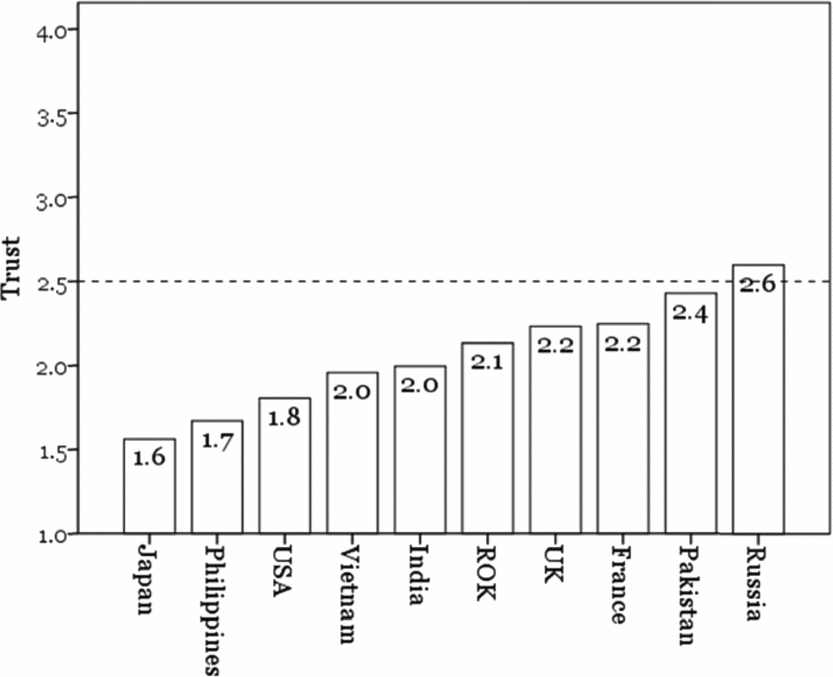
As displayed in Figure 1, on average the urban Chinese participants in the 2012 RCCC survey mistrusted foreign countries, but varied both substantially and meaningfully in the extent of their mistrust. The sequence of countries, with Japan the least trusted, followed by the Philippines, the United States, and Vietnam, makes intuitive sense, as does participants viewing Russia and Pakistan as the most trustworthy – though even they were not to be trusted (2.5 is the scale midpoint). This pattern of overall differences was extremely large, F(9, 1664) = 552.20, p < 0.001, ηp 2 = 0.25.Footnote 2 For instance, Russia was trusted massively more than Japan, t(2015) = 49.86, p < 0.001, Cohen's d = 1.48.Footnote 3
Urban Chinese mistrust most countries, but some (e.g. Japan) much more than others (e.g. Russia)

We also created a composite scale of trust in all ten foreign countries shown in Figure 1 (α = 0.87), and found that its mean (M = 2.06; SD = 0.50) was greatly below the scale midpoint of 2.5 (the dashed horizontal line in Figure 1), t(1665) = –35.35, p < 0.001, Cohen's d = 1.23. The 2,597 urban Chinese participants in the 2012 survey were thus, on average, extremely mistrustful of the ten foreign countries.
Could this disheartening result be the product of question wording or the specific list of ten countries Carnegie chose to ask about? To explore these questions, we conducted a similar analysis on a large (N = 2,208) Internet survey fielded in the winter of 2010–11 (for sample characteristics, see Gries, Reference Gries2012: 42–3). It asked not about ‘trust’ (信任) but about ‘feelings’ (情感) towards 19 foreign countries.Footnote 4 The mean score across all 19 countries was again substantially below the scale midpoint, t(2207) = –15.48, p < 0.001, Cohen's d = –0.66. This mean should be taken with a grain of salt, however: participants were recruited from a popular Chinese psychology website and asked to take the survey online. And, although the sample was diverse geographically, the participants were young (M = 23, SD = 6). This young and self-selected pool was likely a much more open and cosmopolitan sample than RCCC's representative urban sample. Presumably, a more representative urban sample with the same 19 countries and question wording would have produced even cooler average feelings towards foreign countries.
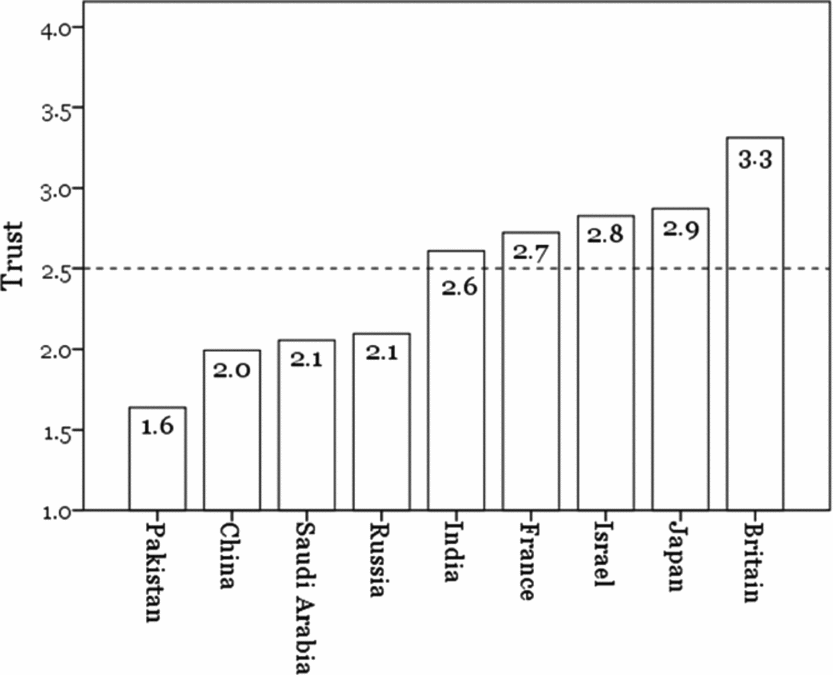
Figure 2 displays the corresponding pattern in Pew's 2012 US general population survey. The sequence again makes intuitive sense, with Pakistan the least trusted, followed by China, Saudi Arabia, and Russia. Great Britain, by contrast, was the most trusted, followed by fellow democracies, Japan, Israel, France, and India. The overall difference in mean scores was even more massive than the Chinese survey, F(8, 784) = 458.43, p < 0.001, η2 = 0.37, with Great Britain (M = 3.30; SD = 0.78) vastly more trusted than Pakistan (M = 1.63, SD = 0.69), t(905) = 48.36, p < 0.001, Cohen's d = 2.27. Compared to the scale midpoint of 2.5, Americans were only very slightly mistrusting (–0.04; t 784 = –2.38, p = 0.02, Cohen's d = –0.12) of the nine countries included in the battery, α = 0.77; M = 2.46, SD = 0.49. Americans trust some countries but distrust others.
Americans trust some countries (e.g Great Britain) and mistrust others (e.g. Pakistan)
These 2012 Pew results are consistent with a 2011 nationally representative YouGov survey that included a 0° to 100° cool to warm feeling thermometer towards 15 foreign countries (see Gries, Reference Gries2014: 6, Figure 0.3). It did not include Saudi Arabia, but included the other eight countries in the 2012 Pew survey, in the exact same ascending sequence of mean scores: Pakistan, China, Russia, India, France, Israel, Japan, and England. The difference between the coolest, Pakistan (29°) and the warmest, England (72°) was a massive 43°, t(999) = –45.44, p < 0.001, Cohen's d = 2.88. And the mean score across all eight countries (M = 49.72°, SD = 14.75) was not significantly different from the scale midpoint of 50°, t(999) = –0.61, p = 0.54. Again, Americans trust some countries but distrust others.
At the aggregate level, therefore, both Chinese and US survey data vary both substantially and meaningfully. These surveys suggest, however, that on average Americans are more trusting of foreign countries than Chinese are.
Correlates of dis/trust
What about the individual level? What predicts dis/trust towards foreign countries? To explore this question, we regressed age, gender, education, income, minority status, and CCP membership (Chinese sample only), onto scales of trust in all of the foreign countries measured.
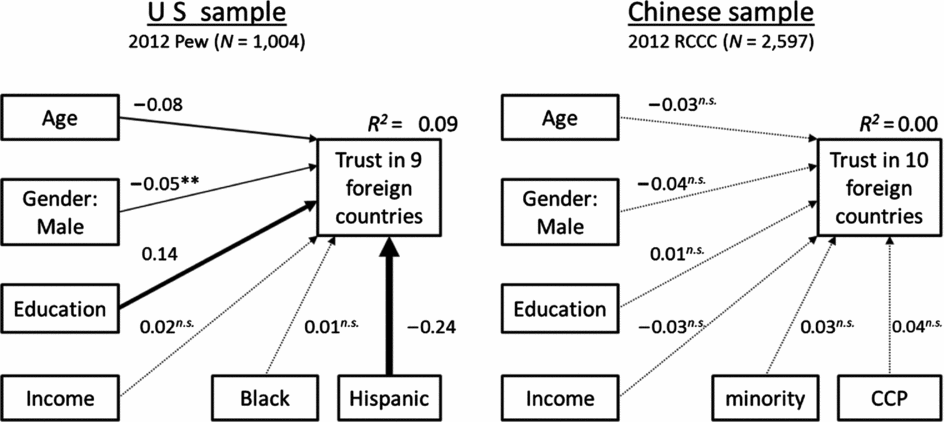
Figure 3 visually displays the results. In the US data displayed on the left, the individual differences variables accounted for a substantial 9% of the variance in trust for nine foreign countries. Greater education (β = 0.14) was associated with greater trust, while greater age (β = –0.08), and being male (β = –0.05, p < 0.01) or Hispanic (β = –0.24) were associated with greater distrust of foreign countries.
Correlates of trust in foreign countries: US and Chinese samples
Similar individual differences variables fail, however, to predict trust in the ten foreign countries in the Chinese survey. As the right side of Figure 3 reveals, none of the six predictors was statistically significant. And together, the six predictors did not account for any variation at all (R2 = 0.00). A Bayesian analysis replicated this non-finding.Footnote 5
Given the very large size of the dataset (N = 2,597), these two non-findings are truly puzzling. For instance, one might think that older Chinese, having personally experienced the Cold War, might be less trusting of ‘American imperialists’ (美帝) and ‘Soviet revisionists’ (苏修) than younger generations with no direct experience of that era, and plenty of exposure to American popular culture. But in the Chinese sample, age had no effect not just on the average score for all ten countries shown in Figure 3, but also on trust in both Cold War adversaries, America (p = 0.87) and Russia (p = 0.97).
Other individual difference variables exhibit the same pattern, accounting for variation in trust towards foreign countries in the US but not Chinese sample. For instance, in the US sample, self-reported ideology (conservative to liberal) significantly predicts six of the nine foreign country ratings over and beyond the effects of the demographic covariates, accounting on average for 1.5% of unique variance in country trust (on ideology's substantial impact on American foreign policy attitudes, see Gries, Reference Gries2014). By contrast, in the Chinese sample, a similar self-report ideology question (‘conservative’ [保守] to ‘open’ [开放]) does not significantly predict any country rating, accounting for literally 0% of variation in trust in any foreign country.
Is the failure of such individual difference variables to predict trust in foreign countries because they were poorly measured in the Chinese surveys, or that individual differences simply matter less in the more collectivist Chinese context? No. Further analyses revealed that the demographic variables appear to have been well measured because they do predict other variables in the Chinese dataset, both substantially and in the expected directions. For example, the 2012 RCCC survey included the question (C3), ‘Over the past month, how frequently did you obtain international news from the following sources?’ (过去一个月内, 您通过以下渠道获取国际新闻的频率如何?) The five sources, rated on a five point ‘very frequently’ (非常频繁) to ‘not at all’ (基本不用) scale, were: (1) newspapers and magazines, (2) books, 3) TV, (4) the Internet, and (5) mobile phone texting and mobile Internet. To control for individual differences in either over- or underreporting international news consumption, we added all five responses together to create a measure of total self-reported international news consumption, and then divided each of the five sources into it and multiplied by 100, creating a ‘percentage of international news’ from each media source variable for each.
Age was a powerful predictor of both the percentage of international news consumption from old (TV, books, and newspapers and magazines) and new media (the Internet and mobile devices). And the predictions were in the expected directions: greater age was strongly associated with greater consumption of old media (β = 0.30, p < 0.001) and less consumption of new media (β = –0.44, p < 0.001). Education, furthermore, was strongly associated (β = 0.28, p < 0.001) with getting more of one's international news from new media. Together, all the demographic predictors accounted for 11% of the variance in percentage of news from old media, and a remarkable 32% of the variance in percentage of international news from new media.
Similar results can be found for participant ratings of subjective interest in and attention to international affairs. The 2012 RCCC survey included the questions: ‘Are you interested in international news?’ (C1. 您对国际新闻感兴趣吗?) and ‘To what extent do you pay attention to international affairs?’ (C2. 您在多大程度上关注世界上和其他国家发生的大事?) The two items cohered well (α = 0.86), and were substantially predicted by every demographic covariate as well as the ideology variable, accounting for a very substantial 13% of its variance.
So why would demographics and other individual difference variables like ideology matter substantially for some variables (e.g. media consumption) but not for others (e.g. trust in foreign countries)? One possibility is that the type of question makes a difference. Social psychologists have demonstrated that people think differently about objective questions than they do about evaluative questions (Kaplan and Wilke, Reference Kaplan, Wilke, Forgas, Williams and Wheeler2001; Laughlin, Reference Laughlin and Fishbein1980; Laughlin and Ellis, Reference Laughlin and Ellis1986). When people answer objective questions, they rely on factual data, but when they answer evaluative questions, they tend to rely upon external authorities or the preferences of salient others (Kaplan et al., Reference Kaplan, Schaefer and Zinkiewicz1994; Rugs and Kaplan, Reference Rugs and Kaplan1993). In other words, the type of question may affect how people respond to it.
Consider the question, ‘Over the past month, how frequently did you use the following media to gather international news? . . . Internet’. The question is objective/factual. To answer it, a Chinese respondent would most likely rely upon his or her actual experiences – the facts about the media s/he consumes. S/he might read a fair amount of international news on the Internet, whereas his or her parents may hardly read any news on the Internet. In other words, individual differences in people's experiences should predict their responses to objective questions.
By contrast, ‘To what extent do you believe that China can trust the following countries? . . . Russia’ is a very different kind of question. It involves emotion and is ultimately an evaluation of how you experience your group's relationship to Russia. So, we might expect respondents to rely more upon other peoples’ preferences, values, and authority in responding to such questions. Individual differences in personality may matter less, especially if there are strong social or political pressures shaping an individual's response.
In short, demographics were properly measured and do matter in China. Not all Chinese are alike. When questions seem objective, people appear more likely to show variation in their responses. They likely rely more upon their actual beliefs and behaviors, as there may be less reason, for instance, to try to manage one's impression about the sources of media one consumes. However, when responding to sensitive evaluative questions such as the RCCC country trust questions, Chinese respondents appear to rely upon the evaluations dictated by the predominant social and/or political consensus. They then respond with attitudes that are unrelated to who they are (i.e. individual differences in age) or what they subjectively believe (i.e. conservative or open beliefs).
Testing for socialization effects
To test for socialization effects, we created a mean deviation score for each country trust variable in the Chinese dataset. To do so, we subtracted the group mean for each country trust variable from each participant's individual rating of trust in that country, and took the absolute value of the resulting difference score (abs|individual score – group mean|). With this deviation or distance measure, higher values represent scores farther from the group mean, whereas lower scores represent scores closer to the group mean. Therefore, predictors with positive beta in regression show greater distance away from the group mean, while predictors with a negative beta drive attitudes toward the group mean.
The ten country mean deviation scores were averaged together to create a reliable scale (α = 0.83) that we regressed in three stages onto (1) the five demographic covariates in the Chinese dataset (age, gender, income, and being a minority or a CCP member), (2) education and total international news consumption (our two variables of primary interest), and (3) individual differences in interest in foreign affairs and openness-conservatism. This model allows for a strong test of the effects of socialization (e.g. education and media) versus demographics and personality (e.g. interest in international affairs and ideology).
The regression model for the transformed country trust ratings was significant, R2 = 0.044, F(9, 909) = 4.65, p < 0.001. There was a very small main effect of income (β = –0.08, t = –2.42, p = 0.02), but no other demographic covariate significantly predicted an individual's deviation from the group mean. Among the socialization variables, only education and not media exposure significantly predicted the deviation scores (β = –0.15, t = –3.96, p < 0.001). As expected, Chinese who reported more years of education were more likely to give responses closer to the group mean. Personality differences had no effect at all (all p's > 0.31).
These results suggest that in China socialization through the educational system may be overriding individual differences in personality in accounting for responses to evaluative questions like how much China should trust foreign countries. However, a parallel regression was conducted using a transformed US threat scale as the dependent measure, and there were no significant effects at all (model p = 0.36).
To resolve this inconsistency, we sought out other sources of survey data to test for replicability. We first analyzed a convenience Chinese Internet sample gathered in fall 2013. The sample was relatively well educated and was not representative of the larger population (N = 187, 70% male, mean age = 22.64, median and modal income = ‘middle’, midway between ‘very poor’ and ‘very rich’, median and modal education = college). Participants were asked to indicate how coolly or warmly they felt toward four foreign countries (the United States, Canada, Brazil, and South Africa) on a 0 (cool) to 10 (warm) feeling thermometer (温度计). We created the same deviation scale (α = 0.77) described above, and regressed it onto our demographic variables: gender, age, income, and education. As expected, only education significantly predicted the deviation scores (β = –0.21, t = –2.61, p = 0.01). Greater education was substantially associated with responses closer to the group mean, again suggesting that education plays a socializing role. Importantly, this analysis shows that the same effect is detectable even when participants have the anonymity of an Internet survey, allaying concerns about the social desirability bias present in the face-to-face interviews of Carnegie's more representative RCCC 2012 survey.
The Asian Barometer survey provides further support for a socialization effect through education. In their 2006 nationally representative face-to-face survey, Chinese participants rated, on a 1 (‘don't trust at all’) to 4 (‘trust a lot’) Likert scale, how much they trusted their (1) central and (2) local government as well as (3) the dominant political party. Averaged together, these three questions formed a scale of acceptable internal reliability (α = 0.65), which was then used to create a deviation from the group mean score for each participant. Age significantly predicted deviation scores (β = –0.06, t = –2.20, p = 0.03), as did education (β = –0.07, t = –2.70, p < 0.01). Again, participants that were more educated were more likely to respond closer to the group mean.
To compare these Chinese results with a US sample, we also conducted a parallel analysis with Pew's 2012 US general population data. We regressed a scale of the same deviation from the group mean scores (α = 0.68) for trust in nine foreign countries onto gender, age, income, ethnicity (Hispanic), race (black), as well as education and ideology. Education did not significantly predict the mean difference scores, though the relationship was in the same direction (β = –0.06, t = –1.52, p =0.13). However, ethnicity (Hispanic β = 0.09, t = 2.42, p = 0.02) and race (black β = 0.13, t = 3.37, p = 0.001) predicted greater distance from the group mean, while income (β = –0.15, t = –3.52, p < 0.001) predicted greater agreement with the group consensus. These US findings further support the idea that individual differences like ethnicity, race, and income shape country trust attitudes in the American context, contrasting the lack of ‘bottom-up’ effects in the Chinese survey data.
Taken together, these analyses provide convergent evidence for a group socialization effect via education on evaluative questions in the Chinese context – but not the American. More years of education is repeatedly associated with greater congruence between a Chinese respondent's individual response and the group mean. This was the case across three independent Chinese samples using three distinct dependent measures: country trust (RCCC 2012 data), warmth towards foreign countries (2013 Internet data), as well as trust in the Chinese government (Asian Barometer 2006 data).
The only exception was the US threat scale in the RCCC 2012 data, where education did not predict deviation from the group mean. This anomaly may be due to question design. The question (B17) asked for assessments of the seriousness of eight ‘problems’ (问题) China faces. Six of the eight questions, however, referred specifically to the United States, one explicitly describing the US as ‘hegemonic’ or ‘bullying’ (霸权), perhaps constructing the very US threat the question sought to measure. Indeed, our five item US threat scale was substantially skewed towards the threat end of the distribution, approaching non-normalcy (the modal response was a full 4 out of a possible 4 across five items, and the skewness statistic approached the conventional cutoff of ±1 at –0.89, SD = 0.06. In other words, the data may have been too skewed by a ceiling effect for the correlation to emerge from the noise of measurement error.
Given convergent evidence across three independent samples, it seems reasonable to conclude that more years of education systematically shape Chinese responses to sensitive evaluative questions like how much to trust foreign countries. The more educated a participant was, the more likely that participant was to respond closer to the group mean. Although cross-sectional data such as these reveal why participants that are more educated are more likely to respond closer to the group mean, we can conditionally say that there is likely a top-down education effect on many evaluations made by Chinese survey respondents. We did not find any direct effect of news consumption, however, qualifying this socialization effect.
Person by situation interactions
While bottom-up individual differences such as age and gender did not have direct effects on evaluative questions like trust in foreign countries in the 2012 RCCC data, and there is convergent evidence that top-down socialization pressures are at work, could some individual differences interact with situational variables in shaping evaluative attitudes? For instance, Chinese who are more interested in international affairs may respond differently to socialization pressures associated with education and/or media exposure than Chinese who are less interested.
According to Petty and Cacioppo's (Reference Petty and Cacioppo1986) Elaboration Likelihood Model, people who are more interested in arguments process them ‘centrally’, whereas people who are less interested process them ‘peripherally’. When people process centrally, the content and valence of messages are assimilated. For instance, when exposed to large numbers of positive messages, people processing centrally will form attitudes that are more positive (Cacioppo and Petty, Reference Cacioppo and Petty1989). Similarly, when people are exposed to large numbers of threatening arguments, their subsequent attitudes become more negative – provided they are interested in the arguments (Crisp et al., Reference Crisp, Hutter and Young2009).
When people process peripherally, however, their attitudes depend on simple heuristics such as the number of arguments they are exposed to. The ‘mere exposure’ effect reveals that simply exposing uninterested people to a large number of messages on an issue – regardless of their valence – will lead to attitudes that are more positive toward that issue.
In short, research in social psychology shows that the content of the messages people receive from their social environment does not affect everyone the same way. How might this connect with Chinese attitudes toward foreign affairs? ‘Patriotic Education’, through the CCP's educational and media systems, may securitize (see Buzan et al., Reference Buzan, Wæver and de Wilde1998) foreign countries as less trustworthy, and the United States specifically as threatening. However, only people who pay attention to and are interested in the content of those messages should assimilate a suspicious view of foreign countries. Indeed, the US‒China Security Perceptions Survey data reveal that both interest in foreign affairs (r = 0.08, p < 0.001) and international news exposure (r = 0.08, p < 0.001) exhibited small zero-order correlations with a greater subjective sense of threat from the United States.
This might not be the case with all Chinese people, though. Among Chinese less interested in foreign affairs, a different pattern could arise. Because the information they are exposed to is less self-relevant for them, they might process it peripherally. In that case, the content of the messages would matter less. Simply being exposed to information about foreign countries like America could contribute to attitudes that are more positive towards America.
We hypothesize a person by situation interaction shaping Chinese evaluations of foreign countries. International attitudes will be the product of both the person (i.e. their degree of interest in foreign affairs) and the situations they are exposed to (i.e. their education level and/or exposure to international news). Specifically, the negative valence of the messages participants receive from the educational and media systems should be assimilated more among those Chinese more interested in foreign affairs, whereas the ‘mere exposure effect’ contributes to attitudes that are more positive among Chinese who are less interested.
To explore these hypotheses, we conducted a series of hierarchical linear regressions using interest in foreign affairs (person variable), education (situational variable), and news consumption (situational variable) as our predictors of primary interest. In these analyses, we relied on the raw (i.e. non-transformed) data from the 2012 RCCC survey. In the first step of the regression, we entered the demographics: gender, age, income, and being a CCP member or a minority. In the second step, we entered education, news consumption, and interest in international affairs as our main predictors. In the third step, we entered three interaction terms into the regression. This approach allows us to test under what specific circumstances education, interest, and media consumption shape judgments of trust and threat from foreign countries in general, and the US in particular.
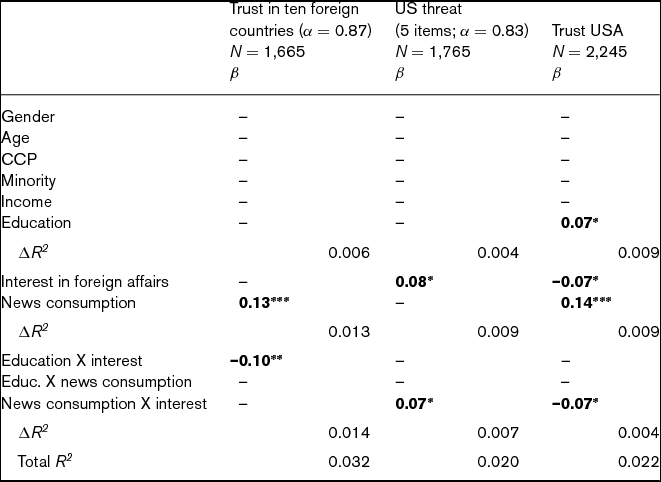
The regression analyses displayed in Table 1 reveal that the six standard demographic covariates accounted for almost no variation in our three dependent measures: (1) a scale of trust in ten foreign countries, (2) a scale of five items tapping the US threat, and (3) a single item tapping trust in America. However, the top-down socialization variables of education and news consumption interacted with the bottom-up person variable of interest in foreign affairs in different ways to predict all three of our dependent variables. We address each in turn below.
Regressions of trust and threat variables
Note: * p < 0.05, ** p < 0.01, *** p < 0.001. Betas listed are standardized and from the final step of the regression. Only significant betas are reported.
Trust in ten foreign countries
In terms of overall trust towards the ten foreign countries in the 2012 RCCC survey (the first column in Table 1: total R2 = 0.03, F(11, 962) = 2.89, p = 0.001), there was a small but positive main effect of total news consumption (β = 0.13, p = 0.001). Participants who consumed more media tended to trust other nations more.
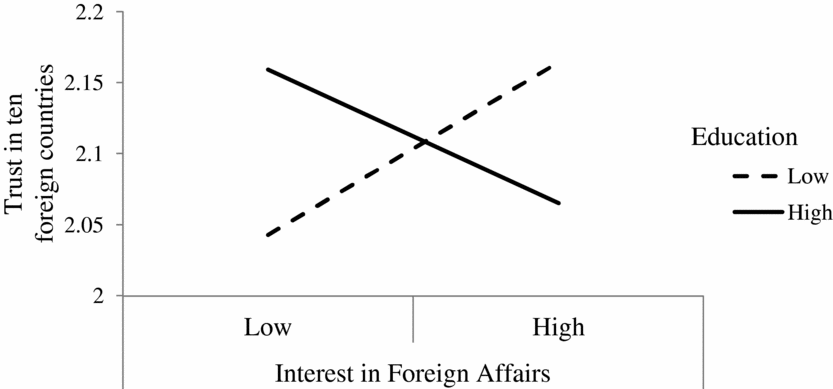
This main effect was qualified, however, by a significant education by interest in foreign affairs interaction (β = –0.10, p = 0.01, ΔR2 = 0.007, F = 6.58). To explore this interaction, values were plotted at ±1 SD of the predictors. As can be seen on the left side of Figure 4, among participants who were less interested in foreign affairs, greater education was associated with greater trust in foreign countries (p = 0.05). The reverse was true, however, among those more interested in foreign affairs (the right side): greater education was associated with less trust in foreign countries (p = 0.04).
Interest in international affairs (person variable) and education (situational variable) interact, such that neither has a direct effect on trust in foreign countries
Education thus has opposing effects on trust in ten foreign countries among different groups of Chinese people. Among those less interested in foreign affairs, greater education is associated with greater trust in foreign countries (Figure 4, top left). In terms of Petty and Cacioppo's (Reference Petty and Cacioppo1986) Elaboration Likelihood Model of persuasion, they likely respond peripherally. Not paying much attention, the ‘mere exposure effect’ suggests that they ignore the negative content of educational messages and simply become more familiar with, and thus trusting of, the foreign countries they hear more about.
However, the opposite is the case among those Chinese citizens who indicate high interest in foreign affairs. The more education they have, the more convinced they become that other nations are not to be trusted (Figure 4, bottom right). In terms of Petty and Cacioppo's Elaboration Likelihood Model of persuasion, they are likely engaging the central route and assimilating the (presumably negative) messages they receive: as those more interested are exposed to more education, they become more convinced that other nations are aggressive and not to be trusted.
The two slopes in Figure 4, notably, are in opposite directions: the interaction is disordinal. Taken together, interest in foreign affairs and education negate each other, so that there was no direct effect of either on trust in foreign countries (both β = 0.01, ps > 0.75; see Table 1, first column).
America: the ‘beautiful imperialist’
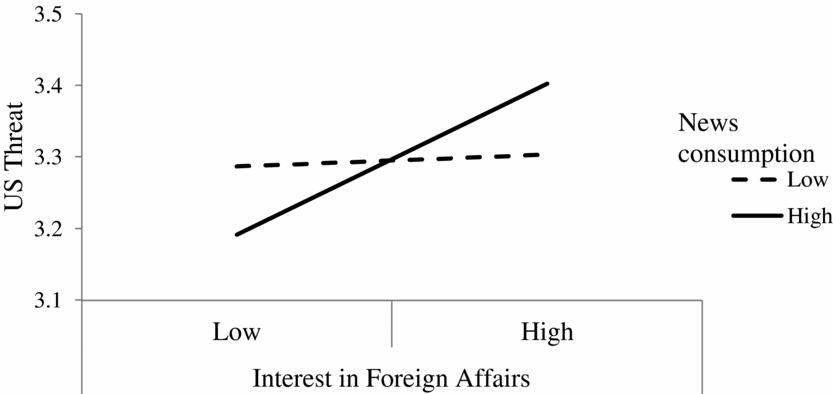
In terms of the threat posed by the United States (α = 0.83, R2 = 0.02, F 11, 1048 = 1.89, p = 0.04), Table 1, column 2 reveals that while there were no main effects of any of the six demographic variables, there was a small main effect of interest in international affairs, β = 0.08, p = 0.02. People who were more interested in international affairs tended to evaluate America as more threatening. This main effect was qualified, however, by a significant news consumption by interest in foreign affairs interaction, β = 0.07, p = 0.04, ΔR2 = 0.007, F = 4.18.
To better understand this interaction, values were again plotted at ±1 SD of the predictors. As can be seen in Figure 5, only the slope for those reporting high levels of international news consumption (the solid line) was statistically significant. Again, those who were less interested (Figure 5, bottom left) appeared to be processing peripherally: they found America to be relatively less threatening. However, those who were more interested (Figure 5, top right) seemed to be processing centrally: they likely paid more attention to the content and valence of media messages, and with greater exposure tended to think that the America was relatively more threatening. In short, the bottom-up variable of interest in international affairs interacted with the top-down variable of exposure to international news to shape perceptions of the US threat, such as the degree of ‘American hegemonism’ (美国霸道).
Greater interest in foreign affairs was associated with a greater perception of threat from America – but only among those Chinese who consumed more international news
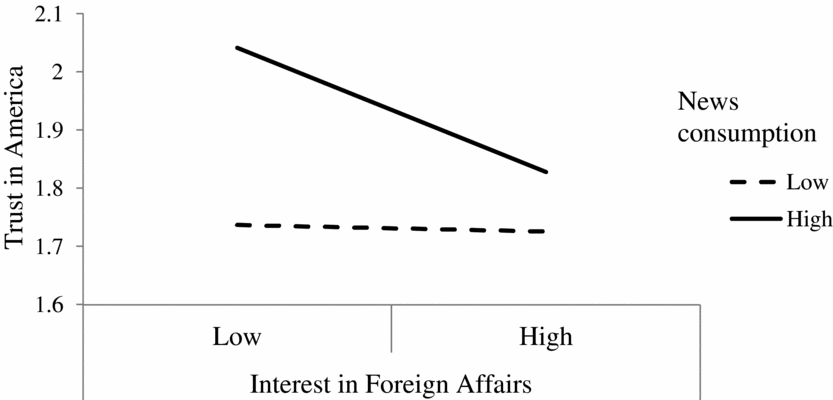
Given that US‒China relations are the most important state-to-state relationship of the twenty-first century, we ran the same regression on the RCCC survey's single item measure of trust in the America, R2 = 0.022, F(11, 1266) = 2.55, p = 0.003. As displayed in Table 1, column 3, there were positive main effects for education (β = 0.07, p = 0.04) and total news consumption (β = 0.14, p < 0.001). In other words, both greater education and greater news consumption were associated with greater trust in the United States. However, there was a negative main effect of interest in foreign affairs (β = –0.07, p = 0.04): those more interested tended to trust America less.
These main effects were qualified by a significant news consumption by interest in international news interaction, β = –0.07, p = 0.03, ΔR2 = 0.004, F = 4.52. To interpret this interaction, values were again plotted at ±1 SD of the predictors. As can be seen in the left column of Figure 6, among those less interested in foreign affairs, higher news consumption was associated with greater trust in the United States (Figure 6, top left), again suggesting a ‘mere exposure’ effect; however, international news consumption did not shape the attitudes of participants more interested in foreign affairs (Figure 6, bottom right).
A ‘mere exposure’ effect? Higher news consumption is associated with greater trust in America – but only among those Chinese less interested in foreign affairs
Conclusion: securitizing the world?
Do urban Chinese today distrust the world?
On average, yes. The US and Chinese data from the Carnegie Endowment's 2012 US–China Security Perceptions Surveys strongly suggest both that on average Americans are more trusting of foreign countries than urban Chinese are, and that urban Chinese do not trust foreign countries.
What is the source of their suspicion? Have 25 years of ‘patriotic education’ securitized Chinese to distrust foreign countries? Specifically, do ‘bottom-up’ individual differences in interest in foreign affairs, or demographic variables like age and gender, shape their international attitudes? Or do ‘top-down’ socialization pressures, whether political or social, overwhelm individual differences in shaping the international attitudes of the Chinese people?
Based on the analysis of four independent datasets, with a focus on the 2012 RCCC US‒China Security Perceptions Survey, this study argues that on evaluative questions, such as how much a respondent trusted their own government or a list of foreign countries, the demographic differences regularly found in US surveys do not appear. While trust in a list of ten foreign countries varied both substantially and meaningfully at the aggregate level (see Figure 1), standard demographic variables like age and gender could not explain any variation at all in such variables at the individual level (see Figure 3, right side).
What best explains this lack of ‘bottom-up’ effects on evaluative questions like dis/trust in foreign countries? Across three independent Chinese samples, we found that only more years of education was associated with responses closer to the group mean. This finding provides strong support for a ‘top-down’ socialization effect: the Chinese appear to be educated into greater awareness of the socially or politically acceptable consensus view on sensitive evaluative questions such as on how much to dis/trust foreign countries or how threatening America is.
How should this primary finding be interpreted? A pessimistic approach would suggest that ‘Big Brother’ is alive and kicking in China today. In this view, what the 2012 RCCC ‘years of education’ variable is capturing is the influence of the CCP propaganda apparatus, via the educational system, in successfully disseminating a malign view of foreign countries such as America.
A more optimistic interpretation might point to the distinction that Erving Goffman (Reference Goffman1959) has drawn between ‘front’ and ‘backstage’ behaviors. In this interpretation, what the RCCC's ‘years of education’ variable is capturing may not be the success of the CCP propaganda apparatus in its ‘patriotic education’ campaign, but instead a greater ‘impression management’ facility: better knowing what and how to perform on the ‘front’ or public stage when interviewed by a total stranger. That those with more years of education display greater mastery or facility with the socially or politically dominant narrative about foreign countries does not necessarily mean than they have appropriated or internalized those narratives into their identities.
Adjudicating between these optimistic and pessimistic interpretations is no easy task. Data gathered through face-to-face surveys can only teach us so much. As James Wertsch (Reference Wertsch2002: 119–23) has noted, it is extremely difficult to distinguish between the mere mastery of narratives (such as what one should say publicly about how much China should trust specific foreign countries), and the appropriation or internalization of those narratives.Footnote 6 It is very hard to know whether people have actually internalized the words and deeds that they perform in public.
To make matters more challenging, the Liberal tradition may contribute to a desire among Western observers to see more resistance to dominant discourses than actually exists. ‘Whether living in autocratic or democratic states’, Kirk Denton (Reference Denton2014: 267) thoughtfully writes, ‘most people accept prevailing narratives, not because they are unthinking or passive, but because their personal identities, subjectivities, economic well-being, and, yes, dreams are intertwined with those narratives’. In Wertsch's terms, there may be more appropriation or internalization of predominant narratives about foreign countries being untrustworthy and less ‘mere mastery’ of them than Liberal Westerners would like to admit.
In addition to the primary finding of a ‘top-down’ socialization effect linked to years of education, this study has also demonstrated that individual differences in interest in foreign affairs interacted with top-down socialization variables like education and quantity of news consumption to shape evaluative attitudes. Whether the dependent variable was trust in America, trust in all ten foreign countries, or how serious the respondent viewed the US threat, it was only those Chinese respondents who claimed to be more interested in foreign affairs who processed the messages they received centrally, displaying greater distrust towards America and the world.
By contrast, those Chinese claiming less interest in foreign affairs appear to have processed the socialization messages they received peripherally, ignoring the presumably negative content of CCP educational and media products. There may have been a passive ‘mere exposure’ effect, whereby increased exposure to even negative news about America contributed, ironically, to greater familiarity and trust.
There are other plausible interpretations of this interaction effect, however. Some Chinese respondents claiming less interest in foreign affairs may have responded actively to negative media and educational messages about America and the world with reactance, purposively increasing their trust to spite the propagandists. Another possibility is that responses to the interest in foreign affairs question were acting as a proxy for another individual difference variable, like nationalism, not measured in the 2012 RCCC survey. In other words, it may have been that respondents who were more nationalistic were also more likely to claim greater interest in foreign affairs than those who were less nationalistic. If so, what our interactions reveal may be that those Chinese higher on nationalism are also more susceptible to being influenced by greater exposure to the CCP's educational and media systems. In the end, our cross-sectional data cannot tell us why interest in foreign affairs interacted with news consumption to shape dis/trust in the US and the world – only that the pattern was consistent across a range of international attitudes.
A quarter century ago, the CCP elite convinced themselves that China's youth ‘worshiping the West and fawning over the foreign’ (崇洋媚外) was to blame for Beijing Spring, 1989. It therefore launched a ‘Patriotic Education Campaign’ (爱国教育运动) to instill in the Chinese people greater ‘national self-respect and national self-confidence’ (民族自尊心, 民族自信心).
Survey data suggest that the CCP has successfully created a hegemonic narrative of Western bullying and East Asian ingratitude that fosters popular distrust of foreign countries. How much this narrative is internalized is less clear, but it appears to be widely performed in the public sphere, with Chinese who are more educated displaying greater mastery of the orthodoxy. To the extent that public performances shape both individual beliefs and behaviors, this finding does not bode well for Chinese foreign policy in the twenty-first century.
About the authors
Peter Hays Gries is the Harold J. and Ruth Newman chair and director of the Institute for US–China Issues and professor of international studies at the University of Oklahoma. He is author of The Politics of American Foreign Policy: How Ideology Divides Liberals and Conservatives Over Foreign Affairs (2014) and China's New Nationalism: Pride, Politics, and Diplomacy (2004), and co-editor of Chinese Politics (2010) and State and Society in 21st-Century China (2004). He studies the political psychology of international affairs, with a focus on Chinese and American foreign policy.
Matthew A. Sanders holds a Ph.D. in social psychology from the University of Georgia. He is currently a healthcare analyst at the Hospital Corporation of America in Nashville, Tennessee.