The development and improvement of surgical techniques, along with the accumulated experience in the treatment of congenital cardiac disease, have significantly reduced the surgical and overall mortality of patients with congenitally malformed hearts, and improved their long term survival. In addition, despite the early recognition and, by and large, surgical treatment of congenital cardiac malformations in neonates, infants and children, there is a significant number of patients who reach adulthood without having undergone surgical or other correction. This has resulted in the development of a large group of adult patients with corrected or uncorrected congenital cardiac disease.Reference Moodie1 The variety of cardiac anomalies, the presence of residual or recurrent lesions from prior therapeutic interventions, and the particularity of each individual case, pose unique challenges in the monitoring and management of these patients, and have recently attracted worldwide attention of health professionals.Reference Moodie1–Reference Perloff and Warnes3 We present and analyze here the resu1ts of the surgical treatment of adult patients with congenitally malformed hearts in our department.
Materials and methods
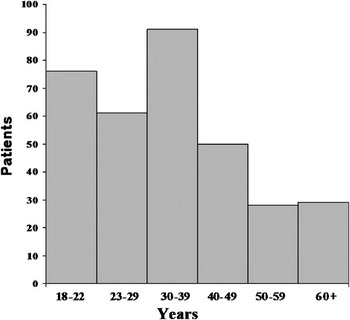
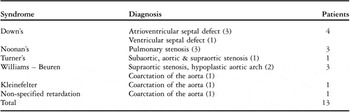
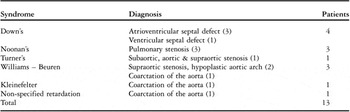
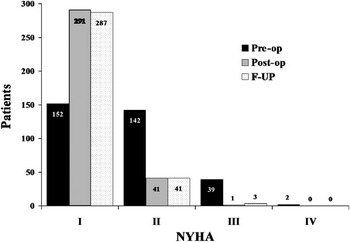
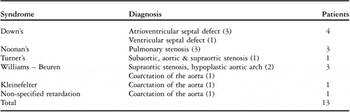
We reviewed the medical records of 335 patients with congenitally malformed hearts who underwent surgery in our unit over the period from September, 1997, through December, 2006. Their age ranged from 18 to 72, with a mean of 35 plus or minus 14 years (Fig. 1). Their mean weight was 71 plus or minus 16 kilograms, and body surface area 1.8 plus or minus 0.24 square metres. The distribution of gender was almost even, with 169 males and 166 females. They comprised 2.2% of all adults, and 18.5% of all patients with congenitally malformed hearts, undergoing cardiac surgery at our institution. Principal diagnoses and procedures performed are shown in Table 1. In 16 patients (5%), we found additional significant congenital cardiac malformations, while another 16 (5%) had acquired cardiac lesions requiring concomitant surgical intervention. Chromosomal abnormalities existed in 13 patients (3.8%) [Table 2]. Of the patients, 183 (54%) were symptomatic (Fig. 2). Diagnosis was reached by a combination of echocardiography and cardiac catheterisation, with coronary angiography performed in 201 cases (60%), while in the remainder echocardiography alone proved sufficient, except in 3 in whom magnetic resonance imaging was required. Most patients presented for the first time, yet 43 (12.8%) had undergone one to three prior surgical interventions. We found established disorders of rhythm in 42 patients (13%), with supraventricular tachyarrhythmia in 34. In 10 patients (3%), there had been prior, cardiac related, complications such as myocardial infarction, endocarditis, or stroke. We admitted 3 patients with atrial septal defects directly from the catheterisation laboratory to the operating room as emergencies, 2 for removal of misplaced occlusion devices, and 1 because of formation of thrombus on a catheter. All patients underwent complete surgical correction, which in 32 cases (10%) included multiple surgical procedures. In 319 patients (95%), surgery was performed with cardiopulmonary bypass support of 113 plus or minus 80 minutes mean duration. All but 12 (3.6%) surviving patients were contacted and interviewed for follow-up of their condition.
Age distribution of the patients.

Diagnoses and procedures.

Chromosomal anomalies.
Classification with the system devised by the New York Heart Association.

Results
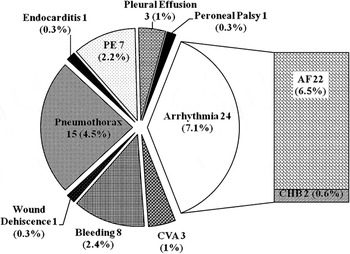
Of the patients, 2 died early (0.6%) due to an embolic stroke and subsequent cerebral haemorrhage in 1 patient with an atrial septal defect and chronic atrial fibrillation, and rupture of the atrioventricular groove in another with an atrioventricular septal defect with exclusive shunting at atrial level. A total of 63 complications occurred in 61 patients (18%) who, apart from the aforementioned cases, were treated successfully with no serious long term consequences (Fig. 3). Patients with chromosomal anomalies did not show a different incidence of complications from the rest. The median duration of mechanical ventilation was 9 hours, while the median intensive care unit and hospital stay were 2 and 7 days, respectively. During a period of postoperative follow up of 63 plus or minus 30 months, two late deaths occurred (0.6%), in patients with atrial fibrillation and pulmonary hypertension, respectively. The majority of the remaining patients are in excellent clinical condition with elimination of their symptoms, 86% being in the first class of the system devised by the New York Heart Association, or else showing significant improvement (Fig. 2).
Postoperative complications (AF = Atrial Fibrillation, CHB = Complete Heart Block, CVA = CerebroVascular Accident).

Discussion
Advances in surgical and medical care have resulted in a rapid increase in the number of patients with corrected or uncorrected congenital cardiac disease reaching adulthood.Reference Moodie1–Reference Perloff and Warnes3 In a clinical study of 1000 patients with congenital cardiac malformations treated surgically or medically in the 1950s, actuarial survival at 40 years was 72%.Reference Moller and Anderson4 Currently, it is estimated that around 85% of all children born with congenitally malformed hearts and undergoing surgical correction will survive at least until adulthood.Reference Moodie1 Furthermore, a recent report from a survey in Quebec, Canada, showed that, in the year 2000, there were nearly equal numbers of adults and children with severe congenital cardiac malformations.Reference Marelli, Mackie, Ionescu-Ittu, Rahme and Pilote5
Adults with congenital cardiac disease present either for primary surgical repair or for the surgical management of residual, recurrent lesions or expected degenerative changes.Reference Perloff and Warnes3, Reference Webb and Williams6, Reference Webb, Jenkins and Karpawich7 The most common types of uncorrected, non-cyanotic lesions seen in our group of adult patients were atrial and ventricular septal defects, aortic valvar lesions, and coarctation of the aorta. Of the cyanotic type, the most frequent lesion was tetralogy of Fallot. Rarer, complex congenital cardiac anomalies were also encountered, such as those with functionally univentricular hearts, Ebstein’s malformation, or congenitally corrected transposition.Reference Moodie8 The most commonly encountered residual problems, recurrences, and sequels after reparative surgery were degeneration of prosthetic materials, valvar lesions, residual or recurring defects, vascular disorders such as stenoses and aneurysms, pulmonary hypertension, and arrhythmias.Reference Perloff and Warnes3, Reference Engelfriet, Boersma and Oechslin9
Adults with congenitally malformed hearts are at increased risk of complications and death from both cardiac and extracardiac complications and diseases.Reference Engelfriet, Boersma and Oechslin9, Reference Kaemmerer, Fratz and Bauer10 It is well known that congenital cardiac disease, apart from atrial septal defect, is a significant risk factor for endocarditis. Reparative surgery, again apart from closure of atrial septal defects, or ligation of a patent arterial duct or repair of pulmonary stenosis, does not appear to alter this risk.Reference Chatzis, Saroglou, Giannopoulos and Sarris11–Reference Li and Somerville13 We observed development of endocarditis in 2 patients preoperatively, and 1 postoperatively. Also, there is an increased risk for arrhythmias and thromboembolic episodes.Reference Perloff and Warnes3, Reference Engelfriet, Boersma and Oechslin9 We found 34 patients with an established supraventricular prothrombotic tachyarrhythmia on presentation, and 3 of them suffered preoperative, and another 3 postoperative, strokes. Notably, 3 of the 4 patients dying in our series, and many of those suffering complications, had arrhythmias. Such complications might have been avoided had the patients been referred sooner for treatment.Reference Mott, Fraser and McKenzie14–Reference Triedman16 Surgical intervention, however, for the treatment of established arrhythmias, resistant to medical therapy, has proved to be effective only in a limited number of cases, mainly patients with the Fontan circulation.Reference Kawahira, Uemura, Yagihara, Yoshikawa and Kitamura17
In a previous report, we showed an immediate beneficial effect of corrective surgery on adults with atrial septal defects as evidenced by a reduction in cardiac size and long term clinical improvement.Reference Chatzis, Giannopoulos and Vahlas18 The results correlate favourably with the improvement in exercise capacity reported in adults following percutaneous closure of such defects.Reference Brochu, Baril, Dore, Juneau, De Guise and Mercier19 Similar results we have also shown in adults with atrioventricular septal defects and exclusive atrial shunting.Reference Chatzis, Giannopoulos and Vachlas20 Our excellent results in closing ventricular septal defects compare to those reported by other groups.Reference Bol Raap, Meijboom, Kappetein, Galema, Yap and Bogers21
Repair of the aortic valve is feasible at a young age with relatively good results. These patients, nonetheless, will usually require replacement of the valve, most likely in adulthood.Reference Rao, Van Arsdell, David, Azakie and Williams22 Our strategy is to replace the aortic valve whenever intervention is required. Isolated congenital mitral valvar pathology, or pathology of the left atrioventricular valve in the context of those with a common atrioventricular junction, with or without prior repair, along with those having disease of the tricuspid valve, often require valvar repair or replacement. Results for all valvar interventions were excellent in our patients, with minimal morbidity and mortality, matching those reported for acquired lesions.Reference van Gameren, Kappetein and Steyerberg23
The Fontan circulation is usually established at an early age and actuarial survival reaches 79% after 20 years, with patients enjoying a good quality of life.Reference Mair, Puga and Danielson24 For various reasons, nonetheless, patients may reach adulthood without repair. Early results of creation of the Fontan circulation in adults have been excellent, as was the case in our 4 patients.Reference Mott, Feltes and McKenzie25 Primary repair, or treatment of residual or recurrent lesions, in patients with tetralogy of Fallot has similarly been successful.Reference Ghavidel, Javadpour, Tabatabaei, Adambeig, Raeisi and Noohi26
In one of the few published compilations of surgery for adults with congenitally malformed hearts, albeit originating from a children’s hospital, mortality was 6%, with acceptable postoperative complications, including an incidence of 6% for postoperative arrhythmias.Reference Mott, Fraser and McKenzie14 We show 0.6% mortality and 7% postoperative arrhythmias, albeit that half our patients had atrial septal defects. Our results are also comparable to other large multicentric studies.Reference Padalino, Speggiorin and Rizzoli27, Reference Vida, Berggren and Brawn28
Systematic surgical and medical management of adults with congenitally malformed hearts is a relatively new challenge for the medical community. Both forms of management have been undertaken until recently by experienced medical professionals, yet mostly on an individual basis in both paediatric and adult cardiac surgical units. Many patients, even with successfully corrected conditions, such as those with atrial septal defects, who are considered to have been completely cured, are now known to develop late electrocardiographic changes, and to have a lower level of physical activity compared to the general population. Apart from the deleterious long term consequences of the congenital cardiac disease, some of these problems can be tracked to the lack of relevant experience at the centres where they have been followed.Reference Moodie8, Reference Lane, Lip and Millane29, Reference Wall, Oddson, Ternestedt, Jonzon, Nylander and Schollin30 The view that adults with congenitally malformed hearts should be treated in centres with experience in both congenital anomalies and acquired disorders that usually affect adults, therefore, is gaining increasing support.Reference Gatzoulis2, Reference Mott, Fraser and McKenzie14, Reference Marcelletti, Hanley and Mavroudis31, Reference Warnes, Liberthson and Danielson32 We believe that cardiac surgeons who treat such patients should have full training, and continuous involvement in both congenital and acquired cardiac disease. In that respect, we feel fortunate that, in our unit, we undertake cardiac surgery on patients of all ages with both congenital and acquired cardiac disease.