INTRODUCTION
Maasella edwardsi, also known as brown alcyonarian, is a soft coral belonging to the family Paralcyoniidae (Weinberg, Reference Weinberg and Hofrichter2003). The species is considered as a rare octocorallian by Giordano et al. (Reference Giordano, Mastascusa and Russo2012) and was first identified by de Lacaze-Duthiers (1888) as a Mediterranean endemic species distributed along the coasts of France, Italy, Sicily, Algeria, Spain, Alborán Island, the Ceuta region, the Adriatic Sea and the Northern Atlantic (Van Ofwegen et al., Reference Van Ofwegen, Grasshoff, van der Land, Costello, Emblow and White2001; Novosel et al., Reference Novosel, Bakran-Petricioli, Pozar-Domac, Kruzic and Radic2002; Moreno, Reference Moreno, En Paracuellos, Nevado and Mot2006; Weinberg & Corolla, Reference Weinberg and Corolla2011). Viguier (Reference Viguier1888) described this species for the first time in the Mediterranean Sea with the definition relating to its reproduction biology and gonochoric character. Maasella edwardsi is a zooxanthellate species inhabiting rocky substratums, coralligenous outcrops and calcareous bio-concretions, generally between the depths of 2 and 50 m (Templado et al., Reference Templado, Calvo, Garcia Carrascosa, Boisset and Jimenez2002; Ballesteros, Reference Ballesteros2006). It is also common in the lighter points of shaded environments (Moreno, Reference Moreno, En Paracuellos, Nevado and Mot2006). The colonies of this species consist of small groups of polyps connected to each other by means of stolon and, due to the zooxanthellate, they have a brown colour and a white oral disk in connection with their sclerite structure (Weinberg, Reference Weinberg1977; Reefcheck, 2008). Since the zooxanthellae's colours range from golden-yellow to brown, they give their hosts the same coloration (NOAA, 2011). Due to the difficulty of discovering the occurrence of this species, its habitat was specified as a cryptic locality in some research (Ballesteros, Reference Ballesteros2006). The present paper adds a new record to Anthozoan fauna of the Aegean Sea and the finding has enhanced the available data regarding the Turkish coasts.
MATERIALS AND METHODS
Specimens of Maasella edwardsi were collected by scientific divers from two different sites (Station 1: 40°00′22″N 26°13′15″E; Station 2: 39°57′07″N 26°09′42″E) in the north-eastern Aegean Sea (Figure 1), down to 22 m in depth between August 2012 and June 2014. The sizes and morphological characters of colonies and bottom structure were observed in situ by means of a macro-lens camera. The material collected was transported to the laboratory in 70% ethanol and deposited in the Piri Reis Museum of the Faculty of Marine Sciences and Technology (OM/PRM).
Map of the study sites showing the new distributional records of Maasella edwardsi (1: Station 1, Kumkale region; 2: Station 2, Kalafat region).

RESULTS AND DISCUSSION
Colonies of Maasella edwardsi were densely found attached to the roots and leaves of a Posidonia oceanica meadow at site 1. It was also found on rocky bottoms. The densities of populations observed were about 28 and 135 cm2 for sites, respectively. The number of polyps in these colonies ranged between 70 and 1008 individuals. To date, a total of 90 Anthozoan species have been reported from the Aegean Sea (Coll et al., Reference Coll, Piroddi, Steenbeek, Kaschner, Ben Rais Lasram, Aguzzi, Ballesteros, Bianchi, Corbera, Dailianis, Danovaro, Estrada, Froglia, Galil, Gasol, Gertwagen, Gil, Guilhaumon, Kesner-Reyes, Kitsos, Koukouras, Lampadariou, Laxamana, López-Fé de la Cuadra, Lotze, Martin, Mouillot, Oro, Raicevich, Rius-Barile, Saiz-Salinas, Vicente, Somot, Templado, Turon, Vafidis, Villanueva and Voultsiadou2010). According to the benthos studies performed in previous years, a total of 75 Anthozoans were recorded from the coasts of Turkey, some of which were recently found in the Sea of Marmara (Çınar et al., Reference Çınar, Yokeş, Açık and Bakır2014).
The occurrence of this species has recently been described from the Adriatic Sea and the Western and Ionian Basin, representing its presence in the Mediterranean, with the absence of any information on its occurrence in the Aegean Sea (Coll et al., Reference Coll, Piroddi, Steenbeek, Kaschner, Ben Rais Lasram, Aguzzi, Ballesteros, Bianchi, Corbera, Dailianis, Danovaro, Estrada, Froglia, Galil, Gasol, Gertwagen, Gil, Guilhaumon, Kesner-Reyes, Kitsos, Koukouras, Lampadariou, Laxamana, López-Fé de la Cuadra, Lotze, Martin, Mouillot, Oro, Raicevich, Rius-Barile, Saiz-Salinas, Vicente, Somot, Templado, Turon, Vafidis, Villanueva and Voultsiadou2010). This is the first record of M. edwardsi in the Aegean Sea and this finding shows that the species has expanded its distributional area to the northern Aegean coasts.
SYSTEMATICS
Order ALCYONACEA
Suborder ALCYONIINA
Family PARALCYONIIDAE
Maasella edwardsi (de Lacaze-Duthiers, 1888)
(Figure 2A–D)
Maasella edwardsi photos taken in situ (Station 1: A, B; Station 2: C, D). (A) Colonies spreading on the Posidonia rhizome at 22 m in depth, bar: 1 cm; (B) Macro photo of polyp, bar: 1 cm; (C) Colonies on rocky substratum at 18 m in depth, bar: 1 cm; (D) Macro photo of polyps (photographed by H.B Özalp).
MATERIAL EXAMINED
The north-eastern Aegean Sea: OM/PRM-CR, 2013-1, one colony, Kumkale (site 1), 40°00′22″N 26°13′15″E, 22 m, 01 January 2013, Posidonia oceanica roots and rhizomes, sandy bottom; OM/PRM-CR, 2014-40, one colony, Artillery (site 2), 39°57′07″N 26°09′42″E, 18 m, 04 June 2014, rocky substrate.
DIAGNOSIS
A dozen small colonies, branching and dome-shaped. Polyps brownish-white in colour and double the length of anthocodia (max: 2.6 cm in diameter). Antocodi brownish. Distal part thicker than polyp body. Pedicel reddish, while oral disc whitish and transparent. Proximal part equal to body in thickness.
PREVIOUS RECORDS
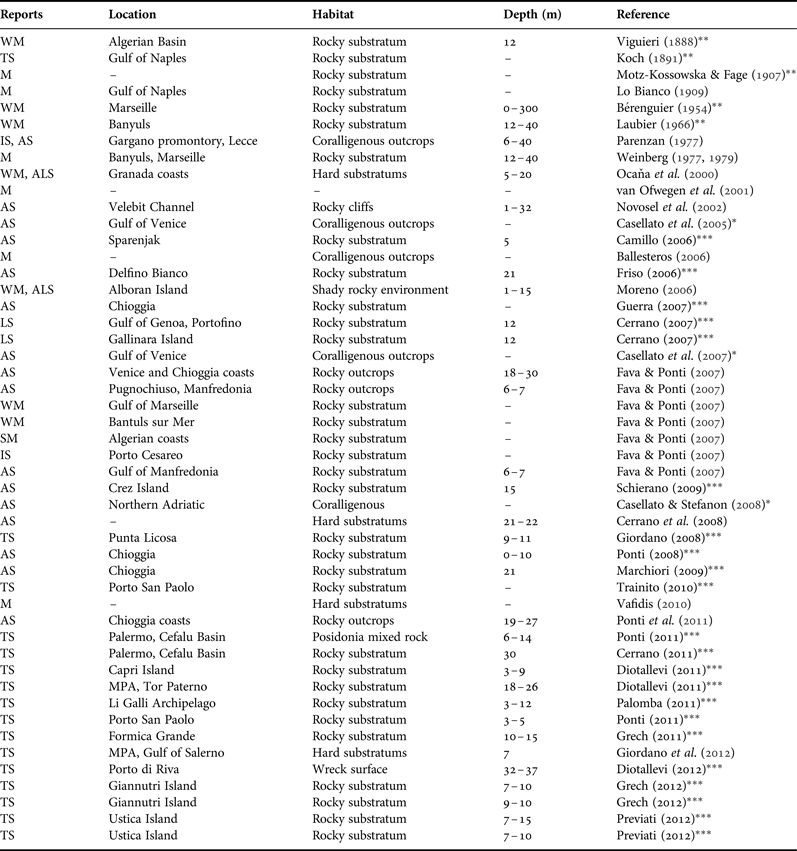
The species was reported for the first time from the Mediterranean Sea by Viguier (Reference Viguier1888). Other records of the species were given from different regions of the Mediterranean (Koch, Reference Koch1891; Parenzan, Reference Parenzan1977; Motz-Kossowska & Fage, Reference Motz-Kossowska and Fage1907; Lo Bianco, Reference Lo Bianco1909; Weinberg, Reference Weinberg1977, Reference Weinberg1979; Van Ofwegen et al., Reference Van Ofwegen, Grasshoff, van der Land, Costello, Emblow and White2001). Maasella edwardsi was reported from the Levantine basins of the Mediterranean and the Ionian Sea by Vafidis (Reference Vafidis, Coll, Piroddi, Steenbeek, Kaschner, Ben Rais Lasram, Aguzzi, Ballesteros, Bianchi, Corbera, Dailianis, Danovaro, Estrada, Froglia, Galil, Gasol, Gertwagen, Gil, Guilhaumon, Kesner-Reyes, Kitsos, Koukouras, Lampadariou, Laxamana, López-Fé de la Cuadra, Lotze, Martin, Mouillot, Oro, Raicevich, Rius-Barile, Saiz-Salinas, Vicente, Somot, Templado, Turon, Vafidis, Villanueva and Voultsiadou2010). Adriatic Sea records of species were presented by Novosel et al. (Reference Novosel, Bakran-Petricioli, Pozar-Domac, Kruzic and Radic2002), Fava & Ponti (Reference Fava and Ponti2007), Casellato & Stefanon (Reference Casellato and Stefanon2008) and Ponti et al. (Reference Ponti, Fava and Abbiati2011). Recently, Giordano et al. (Reference Giordano, Mastascusa and Russo2012) presented a new record from Punta Licosa, Italy. Additional individual GIS records of M. edwardsi for different regions of the Mediterranean are listed in Table 1 (Reefcheck, 2008).
A list of the first reports of Maasella edwardsi, with additional information regarding the location, habitat, depth and reference. M, Mediterranean Sea; SM, Southern Mediterranean; WM, Western Mediterranean; CM, Central Mediterranean; IS, Ionian Sea; AS, Adriatic Sea; TS, Tyrrhenian Sea; BS, Balearic Sea; LS, Ligure Sea; ALS, Alboran Sea.
*Casellato & Stefanon (Reference Casellato and Stefanon2008) reported the species occurrence attributing the references (Casellato et al., Reference Casellato, Sichirollo, Cristofoli, Masiero and Soresi2005, Reference Casellato, Masiero, Sichirollo and Soresi2007), although there was no detailed information about Maasella edwardsi presented in these papers. **Previously, the authors had given the species’ report as synonym names (Fascicularia radicans, Fascicularia edwards, Paralcyonium elegans, Viguieriotes edwardsi). Since the depth data is given as GIS in some references, it had not been indicated in the relevant surveys; this situation is not presented in the table. ***Retrieved from ArcGIS (2013).
Maasella edwardsi was reported previously from various localities of the Mediterranean. Ocaña et al. (Reference Ocaña, Sánchez Tocino and López-González2000) found the species present at depths between 5 and 20 m in the Alboran Sea and the number of polyps in the same colony were found to reach up to 100 individuals. We found the highest number of polyps was 1008 individuals. Parenzan (Reference Parenzan1977) recorded the species among the coralligenous substrates in the Gargano promontory, at depths of 6–7 m and he clarified that the species was very rare. Similarly, Casellato et al. (Reference Casellato, Sichirollo, Cristofoli, Masiero and Soresi2005, Reference Casellato, Masiero, Sichirollo and Soresi2007) reported this species from coralligenous environments. Ballesteros (Reference Ballesteros2006) emphasized that the species occurred mainly around cryptic habitats and, according to Moreno (Reference Moreno, En Paracuellos, Nevado and Mot2006), this cryptic habitat was a calm area.
We think that M. edwardsi has not been recorded to date in the Aegean Sea due to its cryptic-like living character. Because this species is difficult to observe, it was found in a place that was limited to the roots and leaves of Posidonia oceanica meadows (Linnaeus) Delile, 1813 and on rocky substrate. Fava & Ponti (Reference Fava and Ponti2007) reported the species from the escarpment of rocky outcrops at a depth of 18 m, in an area of 100 m2 in the Adriatic Sea. The occurrence of this species has recently been described from the Adriatic Sea and the Ionian Sea, with an absence of information from the Aegean Sea (Vafidis, Reference Vafidis, Coll, Piroddi, Steenbeek, Kaschner, Ben Rais Lasram, Aguzzi, Ballesteros, Bianchi, Corbera, Dailianis, Danovaro, Estrada, Froglia, Galil, Gasol, Gertwagen, Gil, Guilhaumon, Kesner-Reyes, Kitsos, Koukouras, Lampadariou, Laxamana, López-Fé de la Cuadra, Lotze, Martin, Mouillot, Oro, Raicevich, Rius-Barile, Saiz-Salinas, Vicente, Somot, Templado, Turon, Vafidis, Villanueva and Voultsiadou2010).
It is known that climate change and ocean acidification affect marine biodiversity in a negative way. The coral reefs of tropical and Mediterranean scleractinians are the main groups to be affected by this rapidly progressive contagion (Ateweberhan et al., Reference Ateweberhan, Feary, Keshavmurthy, Chen, Schleyer and Sheppard2013; Cerrano et al., Reference Cerrano, Cardini, Bianchelli, Corinaldesi, Pusceddu and Danovaro2013; OCEANA, 2006; Scheffran & Brauch, Reference Scheffran, Brauch, Goffredo and Dubinsky2014). However, it can be hypothesized that some species populations, which are thermophilic, are likely to increase in numbers due to the rising temperatures in the seas and, thereby, extend their distribution to new locations. These unpredictable results, which are relevant to the propagation of marine species, were given in some recent research (Azzurro, Reference Azzurro and Briand2008; RAC/SPA, 2010; Gianguzza et al., Reference Gianguzza, Visconti, Gianguzza, Vizzini, Sarà and Dupont2014; Tsikliras & Stergiou, Reference Tsikliras and Stergiou2014). Maasella edwardsi colonies are forming extensive patchy populations at an unprecedented scale, which has not been seen before in Ursica Island. Taking these changes into account, it may be stated that it is likely that this could also be happening in other warming areas of the ocean where temperatures are rising. We think that climate change in the coming future may be a trigger for coral distribution and substrate preference in some regions around the Turkish coasts, which are located far from the Mediterranean Sea.
ACKNOWLEDGEMENTS
We are very grateful to Kamil Emre Barış for his valuable support during the field surveys.