In the South West of England, the Peninsula Health Technology Commissioning Group (PHTCG) takes commissioning decisions collectively for Devon and Cornwall (population1.64 million) on the adoption of new health technologies. The local system complements national guidance from the UK National Institute for Health and Clinical Excellence (NICE).
The clinical subject of this study is a rare condition, T-cell prolymphocytic leukemia (T-PLL), which is often rapidly progressive and poorly responsive to chemotherapy. The incidence of T-PLL in the United Kingdom is uncertain but very low, at perhaps 200 cases per year. There is no established conventional therapy of choice for this condition. Allogenic stem cell transplant may be curative but many patients are not suitable due to comorbidity (Reference Dearden1;Reference Kruspe, Ashraf, Foran, Salzman, Reddy and Vaughan8).
Alemtuzumab is a monoclonal antibody to the CD52 antigen, expressed on white blood cells, and results in cell death. Although licensed only for the B-cell leukemia chronic lymphocytic leukemia, it represented at the time of its introduction a novel experimental treatment for T-PLL. Alemtuzumab is also a potential treatment for other diseases, for example, multiple sclerosis and bone marrow and kidney transplantation (Reference Schnitzler, Hasskarl, Egger, Bertz and Finke14).
Perhaps because of its rarity and the absence of regulatory approval, a literature review did not identify any published randomized controlled trials assessing treatments for T-PLL. Only two case series reporting the use of alemtuzumab for people with T-PLL were found. One reports the experience of thirty-nine participants (Reference Dearden, Matutes and Cazin2), while the other reports on seventy-six participants (Reference Keating, Cazin and Coutré7), with eighteen patients included in both studies. Most patients (95 percent) received alemtuzumab as a second, third (or later) line of therapy (Reference Dearden, Matutes and Cazin2). The only available data on comparator therapy was an observational study of seventy-eight patients who were treated with several different therapies including COP (cyclophosphamide, vincristine, and prednisolone), CHOP (COP + doxorubicin), other combinations with an anthracycline or mitozantrone, chlorambucil, or radiotherapy (Reference Matutes, Brito-Babapulle and Swansbury10). The question of interest to healthcare commissioners is whether alemtuzumab is a cost-effective treatment for patients who had completed at least one prior conventional therapy and were not suitable for stem cell transplantation.
To date, no study has assessed the cost-effectiveness of alemtuzumab in the treatment for T-PLL. In this study, we describe a decision-analytic model estimating the costs and benefits associated with alemtuzumab compared to conventional therapies for T-PLL. The analysis exemplifies and explores several important issues which are shared in other rare conditions; namely, a high degree of parameter uncertainty, a paucity of comparative data, and structural uncertainty regarding the place of treatment in the therapeutic pathway of a rare condition.
METHODS
Economic Evaluation
We estimated the cost-effectiveness of alemtuzumab by comparing alemtuzumab to the conventional chemotherapies in two simulated cohorts of people with T-PLL. The economic evaluation estimated the average total cost for the cohort of patients treated with alemtuzumab and the cohort of patients treated with conventional therapies, based on published data sources.
The evaluation takes a UK National Health Service (NHS) perspective and applies quality of life estimates (as utility weights) and costs associated with time spent on treatment, in response and in progressive disease. We applied an annual discount rate of 3.5 percent to costs and benefits (12). All monetary units were in euros, the conversion rate of euro to British Pound Sterling (GBP) used was 1.2099 (the rate on January 16, 2012). Average quality-adjusted life-years (QALYs) gained for the cohort treated with alemtuzumab and the cohort receiving conventional therapy were estimated by means of multiplying the time spent in each health state by the utility weight associated with this state. We calculated an incremental cost-effectiveness ratio (ICER) to estimate the additional cost per additional QALY associated with the use of alemtuzumab compared with conventional therapy. We estimated the cost-effectiveness of alemtuzumab by assessing whether the ICER exceeded or remained below a threshold for willingness-to-pay per QALY gained.
Model Design
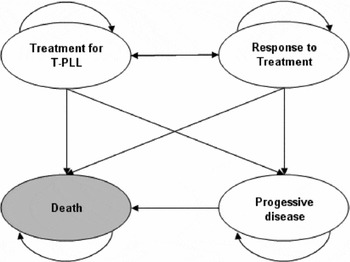
We used a decision-analytic model to assess the cost-effectiveness of alemtuzumab compared to conventional therapy in T-PLL. Our decision-analytic model follows patients from commencement of treatment with alemtuzumab to the end of the time horizon or death. Four health states are assumed in the model: (i) on treatment, (ii) in response, (iii) in progressive disease, or (iv) dead, as shown in Figure 1. These states are mutually exclusive. We assumed all patients, regardless of drug or treatment pathway, can only be in one state at any time-point.
Transition diagram of the health states in the decision-analytic model for patients with alemtuzumab or conventional therapies.

A “partitioned survival analysis” method was applied to model the effectiveness of the drugs. That is, we modeled treatment effect as percentage of patients in each health state at each time point in the model. In effect, therefore, we modeled treatment effect as the difference in proportion of patients alive before disease progression (i.e., in treatment or in response to the treatment) or alive after progression in each treatment group in each model cycle. The distributions of patients across health states through time were obtained using data reported in the two studies: Dearden and colleagues (Reference Dearden, Matutes and Cazin2) for alemtuzumab-treated cohort and Matutes and colleagues (Reference Matutes, Brito-Babapulle and Swansbury10) for the comparator cohort. Further details of methods are provided later. As patients may experience opportunistic infections in the alemtuzumab group, particularly cytomegalovirus (CMV) reactivation, we have modeled costs related to these events.
The design of the model was significantly influenced by the availability of data. The only available case series presented data on patients for whom treatment with alemtuzumab started an unknown length of time after diagnosis (Reference Dearden, Matutes and Cazin2), by which time patients had failed at least one prior conventional therapy (illustrated in Supplementary Figure 1, which can be viewed online at www.journals.cambridge.org/thc2012023). The model uses a lifetime horizon with a cycle length of 28 days.
Many assumptions were necessary to implement the decision model, so no single base case analysis is presented. Instead, we used multi-way and probabilistic sensitivity analyses (PSA) to explore the uncertainties around the results. PSAs were used to examine the impact on the resultant ICER when uncertainties in all parameters were considered simultaneously. We used the NICE willingness-to-pay benchmark of 24,200 euro - 36,300 euro (20,000 GBP - 30,000 GBP) per QALY to assess whether alemtuzumab could be considered cost-effective (11).
A consequence of limited current information is that a decision based on existing evidence is highly uncertain and there is a chance that the “wrong” decision may be made. Such a decision would have costs in terms of lost health benefits and resources. Therefore, we also calculated the expected value of perfect information (EVPI) for four different scenarios based on the combinations of two key assumptions in our model.
DATA
Clinical Effectiveness
Disease Progression on Alemtuzumab
The effectiveness of alemtuzumab was based on individual patient data (IPD) from a case series of thirty-nine patients with T-PLL who were treated with alemtuzumab (Reference Dearden, Matutes and Cazin2). Alemtuzumab was administered as a 2-hour intravenous infusion, generally three times a week. The IPD reported in this study allowed calculation of the percentage of patients in each health state (on treatment, in response, in progressive disease or dead) at each month. Approximately one-third of (eleven of thirty-nine) patients received two lines of treatment with alemtuzumab and experienced, at most, two responses. In the absence of evidence otherwise, we assumed there to be no differences in cost or utility between first and second treatment and consequent response, so these were combined. Therefore the treatment state included first and second lines of alemtuzumab and the response state included first and second response.
Weibull distributions were fitted to overall survival and time to progression. In this case series study (Reference Dearden, Matutes and Cazin2), 15 percent of patients were censored, that is, the study did not follow all participants from the start of alemtuzumab treatment to death. As a result, there is uncertainty about overall survival, particularly as the survival time increases. To assess the impact of different assumptions concerning this uncertainty, in sensitivity analyses we assumed three different survival curves for patients treated with alemtuzumab based on the proportion of patients who were still alive at the end of month 53: 3.5 percent, 6.7 percent, or 9.5 percent.
The percentage of patients on treatment at each month as calculated from the case series was used directly in the model. The percentage of patients in progressive disease at each month was calculated as the percentage alive minus the percentage alive before disease progression (on treatment or in response). See Supplementary Figure 2, which can be viewed online at www.journals.cambridge.org/thc2012024, for details of the percentages in each state.
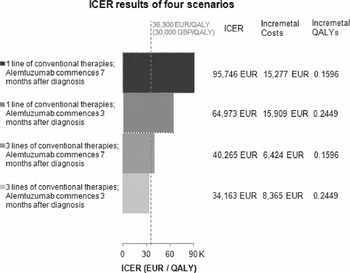
Incremental cost-effectiveness ratios (ICERs) for alemtuzumab versus conventional therapy corresponding to four scenarios (including different assumptions regarding the time between diagnosis and commencing alemtuzumab and the number of lines of treatment in the conventional therapy group).

Disease Progression on Conventional Therapy
In the comparator case series, only overall survival of patients was reported (Reference Matutes, Brito-Babapulle and Swansbury10). To model the different states of disease progression, we assumed that the average time spent in progressive disease was the same for patients regardless of whether they had received alemtuzumab or conventional therapy. This approach has been used elsewhere (12). Differences in the length of time in progressive disease for the two groups are assessed in sensitivity analysis.
Using the overall survival data reported by Matutes and colleagues (Reference Matutes, Brito-Babapulle and Swansbury10) and assuming the average time spent in progressive disease was the same as that in the alemtuzumab-treated cohort, the percentages of patients alive before disease progression were estimated (See Supplementary Figure 3, which can be viewed online at www.journals.cambridge.org/thc2012025, for details). Based on specialists’ clinical opinion, it was further assumed that treatment with conventional therapies involved pentostatin, CHOP, fludarabine, and cladribine, with one-quarter of patients assumed to receive each of these treatments. Again, in the absence of existing evidence, effectiveness was assumed to be equal between these four treatments.
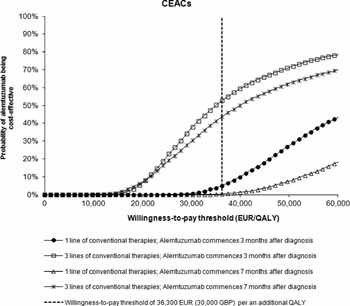
Results of the probabilistic sensitivity analyses. Cost-effectiveness acceptance curves (CEACs) corresponding to four different scenarios by varying two key assumptions regarding the time between diagnosis and commencing alemtuzumab and the number of lines of treatment in the conventional therapy group.

Assumptions also had to be made on the number of treatment courses received by patients and their duration of response. In the study by Dearden and colleagues (Reference Dearden, Matutes and Cazin2), before the commencement of alemtuzumab approximately 51 percent received only one line of conventional therapy and only less than 3 percent were given more than three lines of conventional therapy. Based on limited published evidence and clinical opinion two extreme scenarios for treatment length and response duration were compared.
(a) All participants received one course of conventional treatment and remained in response until they progressed, and that any time spent alive between end of treatment and progressive disease was all time spent in response;
(b) All participants received up to three courses of conventional treatment and a response period of 1 month between each course until they entered progressive disease.
One and three lines of conventional therapies were chosen to represent likely extreme numbers of treatment regimens received by patients.
Quality of Life
No data on quality of life for patients with T-PLL could be identified from the published literature. The utility values applied to being on treatment, in response, and in progressive disease were assumed to be as for those reported for patients with chronic lymphocytic leukemia (CLL): 0.8, 0.8, and 0.6, respectively (12). These uses were assumed to be the same regardless of whether patients received alemtuzumab or conventional therapy. In sensitivity analysis, clinician-derived utilities: 0.5, 0.8, and 0.4 (for on treatment, in response and in progressive disease, respectively) were assumed to explore the impact of utilities on resultant ICER.
Resource Use and Costs
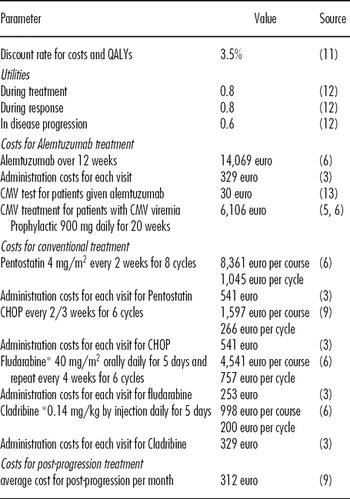
The costs considered in this model were those associated with drugs, drug administration and management of opportunistic infections in the alemtuzumab group, particularly cytomegalovirus (CMV) reactivation (3;6). Alemtuzumab costs 14,069 euro over 12 weeks per patient (6). Based on local specialists opinion, it was assumed that initially all patients treated with alemtuzumab were tested for CMV and that 50 percent of patients were then subsequently tested with 25 percent of patients requiring treatment for CMV reactivation (13). We assume that any other adverse events from treatment were the same regardless of the treatment received and therefore had no impact on the incremental costs and QALYs between treatments. When patients were in progressive disease they were assumed to leave treatment with alemtuzumab or the comparative conventional therapies and receive supportive treatment only. These patients all had the same treatment costs regardless of prior treatments. The parameter values used in the model are shown in Table 1.
Parameter Values and Sources for Utilities and Costs

Note. *These two drugs were not given to patients in the study by Matutes and colleagues (Reference Matutes, Brito-Babapulle and Swansbury10) but are used in patients reported by Dearden and colleagues (Reference Dearden, Matutes and Cazin2) and Keating and colleagues (Reference Keating, Cazin and Coutré7).
Further Assumptions
The baseline time-point for calculating survival of patients differed between the sources of evidence for alemtuzumab and conventional therapies. For patients treated with alemtuzumab the baseline point was the time at which first treatment with alemtuzumab began (Reference Dearden, Matutes and Cazin2). For patients treated with conventional therapy, survival was calculated from diagnosis of T-PLL (Reference Matutes, Brito-Babapulle and Swansbury10). As illustrated in Supplementary Figure 1, month 0 is the time of diagnosis and month N is the time of first administration of alemtuzumab for patients in the alemtuzumab group; that is, we assume all patients receive at least one prior therapy of conventional treatments during the time between month 0 and month N. After month N one group of patients receives alemtuzumab whilst the other group continues with the conventional therapies. The beginning of month N is the start point of the comparison between the two groups of patients.
Given the absence of clear criteria and guidelines for treatment in this condition, it was necessary to make an assumption regarding the time between diagnosis and initial alemtuzumab therapy. Evidence from Keating and colleagues (Reference Keating, Cazin and Coutré7) suggests that the median time from diagnosis to initial treatment with alemtuzumab was 7 months. Because the median overall survival time in people with T-PLL has been reported to be 7.5 months (Reference Keating, Cazin and Coutré7), it was believed that a shorter time-period between diagnosis to initiate alemtuzumab treatment should also be investigated, hence analyses are presented assuming: (i) N = 3, that is, alemtuzumab is given to patients 3 months after diagnosis; (ii) N = 7, that is, alemtuzumab is given to patients 7 months after diagnosis.
RESULTS
Given the remarkable uncertainty in this decision, we do not report a single preferred base case. Rather, we present a series of deterministic and probabilistic analyses to explore the uncertainty and understand better the determinants of likely cost-effectiveness. We also report analysis of the EVPI in this decision which calculates the upper bound on which research commissioners could fund further research. The results demonstrate a very wide range of possible cost-effectiveness outcomes and indicate a series of important issues which should be subject to further research.
One-way and Multi-way Sensitivity Analyses
Results show the particular importance of (a) the time between diagnosis and commencing alemtuzumab and (b) the number of lines of treatment offered in the conventional therapy group.
Figure 2 illustrates results of ICERs for alemtuzumab versus conventional therapy corresponding to four scenarios with different assumptions regarding the above two important uncertainties. As shown in Figure 2, assuming more lines of treatment in the conventional therapies group leads to smaller ICERs. This is as expected, because three lines of treatment in the conventional therapies group is more expensive than one, yet the benefit gained is unchanged. This highlights the uncertainty in comparator treatments which limits the feasibility of a complete economic evaluation in this case.
It is also seen from Figure 2 that a longer period between diagnosis and the start of alemtuzumab treatment yields bigger ICERs. This is because the overall survival of patients who survived at least 7 months is longer than patients who survived at least 3 months (illustrated in Supplementary Figure 4, which can be viewed online at www.journals.cambridge.org/thc2012026). That is, the health benefits for patients with conventional therapies who survive at least 7 months are greater while the health benefits for patients with alemtuzumab stay unchanged, so the incremental health benefits of alemtuzumab are smaller, leading to a higher ICER.
The lowest ICER in these four scenarios was 34,163 euro per QALY gained, with the following assumptions: (i) Patients received 3 lines of treatment in the conventional therapy group; (ii) Alemtuzumab treatment commenced 3 months after diagnosis.
We also carried out sensitivity analyses by varying other parameters in the model. Results of the sensitivity analyses show that slight changes in the survival curve for patients receiving alemtuzumab have a very large impact on the ICER. The resultant ICERs were 79,931 euro, 34,163 euro, and 24,176 euro per QALY, respectively, using the three different survival curves for patients treated with alemtuzumab based on the proportion of patients who were still alive at the end of month 53: 3.5 percent, 6.7 percent, or 9.5 percent.
Changing the utility values had a moderate impact on cost-effectiveness. When alternative (clinician-derived) utilities of 0.5, 0.8, and 0.4 (on treatment, in response and in progressive disease respectively) were assumed, a lower ICER (22,500 euro per QALY) was obtained compared with when utilities for patients with CLL were assumed. Although no evidence for a difference in quality of life depending on treatment received was found, it is likely that quality of life for patients receiving alemtuzumab is different from that for patients receiving conventional therapies, independent of disease stage.
Assuming differences in the length of time in progressive disease for the two groups also affected the ICER. Generally, the longer the time in progressive disease for the conventional therapies group, the lower the ICER became; because greater costs were thus associated with the conventional therapies group. However, the impact of the change in this assumption on the resultant ICER could not change the general conclusions.
Changing the discount rate for costs and QALYs had an impact on the ICER. However, the impact is relatively small because by varying the discount rate for costs and QALYs to 0 percent or 6 percent, the general conclusions drawn from the resultant ICERs stayed unchanged.
Probabilistic Sensitivity Analyses
We estimated the probability that alemtuzumab would be considered cost-effective at different willingness-to-pay thresholds in four scenarios:
• Scenario 1: one line of conventional treatment and 3 months between diagnosis and commencing alemtuzumab
• Scenario 2: three lines of conventional treatment and 3 months between diagnosis and commencing alemtuzumab
• Scenario 3: one line of conventional treatment and 7 months between diagnosis and commencing alemtuzumab
• Scenario 4: three lines of conventional treatment and 7 months between diagnosis and commencing alemtuzumab
Figure 3 gives the cost-effectiveness acceptance curves (CEACs) for the four scenarios, illustrating the probability that alemtuzumab was cost-effective using a threshold of 36,300 euro (30,000 GBP) per QALY gained in each scenario. This probability of alemtuzumab being cost-effective varied considerably with the different assumptions. In all four scenarios, alemtuzumab was more often found to be effective than not effective and always more costly than conventional therapy. The cost-effectiveness planes illustrating the results of the probabilistic sensitivity analyses are given in Supplementary Figure 6, which can be viewed online at www.journals.cambridge.org/thc2012028.
The highest probability of being cost-effective with a threshold willingness-to-pay of 36,300 euro (30,000 GBP) per QALY was 53 percent when alemtuzumab was given 3 months after diagnosis (at early stage of T-PLL) and patients received three lines of treatments in the conventional therapy group, thus, still indicating a great deal of decision uncertainty. Moreover, there is also considerable uncertainty around the structural assumptions, that is, is not clear which of the above four scenarios represents the most likely case. Therefore, based on existing evidence, assuming equal possibility among the four scenarios, alemtuzumab seems less likely to be cost-effective compared to conventional therapies at its current acquisition price for treatment of T-PLL using the willingness-to-pay threshold of 36,300 euro (30,000 GBP) per QALY.
Expected Value of Perfect Information
In EVPI the value of the decision uncertainty present in a cost-effectiveness analysis is calculated. This involves combining estimates of the value (in terms of lost costs and QALYS) of making the “wrong” decision based on current evidence and estimates of the size of the population to whom the decision applies and the likely timeframe over which the decision uncertainty may last. In this case within the total UK population an effective population of 1,405 is assumed (assuming 220 patients per year and an average survival time of 7 years).
EVPI for population with T-PLL in the United Kingdom are presented in Supplementary Figure 5, which can be viewed online at www.journals.cambridge.org/thc2012027. In three of the four scenarios, at a threshold of 36,300 euro (30,000 GBP) per QALY, alemtuzumab was not expected to be cost-effective and the EVPI was relatively low. Thus, even with perfect information alemtuzumab would not be cost-effective, so there is little value in obtaining additional information. However, in one of the scenarios, when the ICER is close to the willingness-to-pay threshold of 36,300 euro (30,000 GBP) the EVPI reached a maximum (1,735 euro per patient) indicating that it would be worthwhile to obtain more evidence to inform further cost-effectiveness analysis. This analysis highlights the value of information associated with the structural uncertainties present in the decision model. Only if the most likely scenario is that alemtuzumab is given 3 months after diagnosis and patients generally received no less than three lines of treatments in the conventional therapies group, would additional information be valuable to aid decisions on the cost-effectiveness of alemtuzumab when the willingness-to-pay threshold was 36,300 euro (30,000 GBP) per QALY.
DISCUSSION
Although there is a paucity of evidence on the effectiveness for patients treated with alemtuzumab or conventional therapies, an adoption decision is still required. A decision analytic model was developed to aid policy makers using a series of scenario analyses to assess the impact of uncertainties in current data. A wide range of assumptions was required to parameterize the model, which may be considered a weakness. We contend, however, that it is appropriate and necessary to explore the likely impact of a such a wide range of uncertainties, and that it may be possible (as here) to reach a conclusion of the likely value of a technology even in the face of such uncertainty. It is not unusual for unlicensed drugs to be used in cancer therapy, although the importance of careful risk-benefit analysis is required of professionals (4).
Results from the sensitivity analysis suggests assumptions regarding the time between diagnosis and commencing alemtuzumab and the number of lines of treatment in the conventional therapy group (1 versus 3) have a large impact on cost-effectiveness. This suggests that the place of alemtuzumab in therapy should be carefully considered if cost-effective treatment is a policy objective.
The lowest ICER in the four scenarios was 34,163 euro per QALY, which was based on the assumption that patients received three lines of treatment in the conventional therapy group and alemtuzumab treatment commenced three months after diagnosis. In all other scenarios alemtuzumab appears unlikely to be cost-effective compared to conventional therapy. Results from PSAs confirm this finding, although the highest probability was 53 percent, suggesting considerable uncertainty about the cost-effectiveness of alemtuzumab.
The EVPI calculations also verify the findings from the PSA results. Using a willingness-to-pay threshold of 36,300 euro (30,000 GBP) per QALY, additional information appears only valuable in one of the four scenarios. That is, when assuming that patients receive three lines of treatment in the conventional therapy group and alemtuzumab treatment commences three months after diagnosis. An implication of this finding is that further research to support the positioning of alemtuzumab in the therapeutic pathway for T-PLL would be most efficient if aimed at early treatment in cases who are likely to receive more cycles of conventional treatment (e.g., younger patients or those with good performance status).
Limitations of Economic Evaluation
As noted, due to the lack of available evidence many assumptions had to be made to model the cost-effectiveness of alemtuzumab for second or third line treatment of people with T-PLL. We, therefore, consider this study to be an exploration of the possible cost-effectiveness of alemtuzumab for patients with T-PLL, identifying the main sources of uncertainty. A range of uncertainties must be acknowledged.
An important assumption is that effectiveness data were obtained from only two small case series. That these are compared introduces significant methodological uncertainty into the analyses, with a high risk of bias and confounding. Neither study reported on the severity of disease observed in subjects. However, patients in the alemtuzumab case series (Reference Dearden, Matutes and Cazin2) were younger than those from the comparator case series (Reference Matutes, Brito-Babapulle and Swansbury10) with median age (range) of 57 years (34, 78) and 69 years (33, 91), respectively. This difference may bias effectiveness estimates in favor of alemtuzumab. In fact, Keating and colleagues (Reference Keating, Cazin and Coutré7) reported a median survival of 7.5 months compared to 10 months reported by Dearden and colleagues (Reference Dearden, Matutes and Cazin2). As expected, the survival parameter in the model is highly influential on the ICER and any bias in this will have a significant impact on cost-effectiveness estimates.
A further assumption relates to the dose received by participants described by Dearden and colleagues (Reference Dearden, Matutes and Cazin2), the assumed length of response and time in progressive disease for patients treated with the conventional therapies and the time between diagnosis and first treatment with alemtuzumab. Based on data reported by Matutes and colleagues (Reference Matutes, Brito-Babapulle and Swansbury10) and the opinion of our clinical advisor, we chose four treatments for conventional therapy and assumed equivalent effectiveness between these. In reality it is likely that these treatments will have differing effects and that many more therapies should be included as conventional treatment.
Moreover, the utility values used to describe the quality of life of patients with T-PLL were obtained from patients with CLL. To address the problem with estimating the utility values, future trials would ideally incorporate generic instruments to provide a direct measure of QoL before and following treatment with alemtuzumab and comparators.
CONCLUSION
There is no conclusive evidence on whether alemtuzumab should be considered a cost-effective use of resources for patients with T-PLL compared to current treatment with CHOP, fludarabine, cladrabine, and pentostatin. Depending on the assumptions made, the sensitivity analyses suggested that the ICER could be as low as less than 12,000 euro per QALY, or alemtuzumab may be dominated by conventional therapy (i.e., cost more but yield less health gain). Results from the PSAs demonstrated that if alemtuzumab is given 3 months after diagnosis for patients who may be expected to received more than three lines of conventional therapies, there is a 53 percent possibility that alemtuzumab could be considered cost-effective at a threshold of 36,300 euro (30,000 GBP) per QALY gained. This was also shown by EVPI estimations demonstrating a maximum value of further research under that scenario. Neither the EVPI nor the PSA can accommodate all the structural and methodological uncertainty in this analysis.
However, our analysis is important in demonstrating the very limited nature of the evidence base for alemtuzumab in this condition, in which there is considerable interest amongst hematologists. Our exploration of uncertainty highlights that the conditions under which alemtuzumab may be considered cost-effective are very limited. This reflects, perhaps, the high acquisition cost of the drug, making it difficult to obtain sufficient benefits, with appropriate certainty, to offset the costs. In this respect, our analysis demonstrates the feasibility of considering the cost-effectiveness of an agent, despite the presence of significant uncertainty, and of providing appropriate assessment information to policy makers.
SUPPLEMENTARY MATERIAL
Supplementary Figure 1
www.journals.cambridge.org/thc2012023
Supplementary Figure 2
www.journals.cambridge.org/thc2012024
Supplementary Figure 3
www.journals.cambridge.org/thc2012025
Supplementary Figure 4
www.journals.cambridge.org/thc2012026
Supplementary Figure 5
www.journals.cambridge.org/thc2012027
Supplementary Figure 6
CONTACT INFORMATION
Lanting Lu, PhD, Jaime Peters, PhD, PenTAG and PenCLAHRC, Peninsula College of Medicine and Dentistry, University of Exeter, Veysey Building, Salmon Pool Lane, Exeter, United Kingdom
Chris Roome, NHS Devon, Exeter, United Kingdom
Ken Stein, MB, ChB, MSc, MD, PenTAG and PenCLAHRC, Professor of Public Health. Director of PenTAG, Peninsula College of Medicine and Dentistry, University of Exeter, Veysey Building, Salmon Pool Lane, Exeter, United Kingdom
CONFLICT OF INTEREST
All authors report that this work was partially funded by the National Institute for Health Research (NIHR) through the Peninsula Collaboration for Leadership in Applied Health Research and Care (PenCLAHRC), which is based at the University of Exeter.