


Introduction
Paranoia in the general population
“Paranoia” can refer to a spectrum of thoughts from mild social evaluative concerns through ideas of reference to the unfounded fear that others intend to cause you harm (Freeman et al., Reference Freeman, Garety, Bebbington, Smith, Rollinson, Fowler, Kuipers, Ray and Dunn2005b). These are a frequently reported experience in the general population (e.g. Ellett, Lopes and Chadwick, Reference Ellett, Lopes and Chadwick2003; Freeman, Reference Freeman2006; Freeman et al., Reference Freeman, Garety, Bebbington, Slater, Kuipers, Fowler, Green, Jordan, Ray and Dunn2005a, Reference Freeman, Garety, Bebbington, Smith, Rollinson, Fowler, Kuipers, Ray and Dunnb; Johns et al., Reference Johns, Cannon, Singleton, Murray, Farrell, Brugha, Bebbington, Jenkins and Meltzer2004; Martin and Penn, Reference Martin and Penn2001; Peters, Joseph and Garety, Reference Peters, Joseph and Garety1999; Verdoux et al., Reference Verdoux, Maurice-Tison, Gay, Os, Salamon and Bourgeois1998). For example, Verdoux et al. (Reference Verdoux, Maurice-Tison, Gay, Os, Salamon and Bourgeois1998) found that 25% of a sample of 500 individuals without a history of psychiatric disorder reported persecutory thoughts. The prevalence of paranoia has led some to suggest that there is a need for detailed study of paranoid thinking aimed at the general population (Freeman, Freeman and Garety, Reference Freeman, Freeman and Garety2006; Freeman, Reference Freeman2007).
Many researchers and clinicians argue that psychotic symptoms such as delusions lie on a continuum with normal experience (e.g. Chapman and Chapman, 1980; Peters et al., Reference Peters, Joseph and Garety1999; Strauss, Reference Strauss1969; van Os, Hanssen, Bilj and Ravelli, Reference van Os, Hanssen, Bijl and Ravelli2000; van Os, Linscott, Myin-Germys, Delespaul and Krabbendam, Reference van Os, Linscott, Myin-Germys, Delespaul and Krabbendam2009). Consistent with this, individuals with non-clinical symptoms are at increased risk of a subsequent diagnosis of psychotic disorder (e.g. Van Os et al., Reference van Os, Hanssen, Bijl and Ravelli2000) and non-clinical and clinical experiences are associated with the same risk factors (e.g. Myin-Germeys, Krabbendam and Van Os, Reference Myin-Germeys, Krabbendam and van Os2003; Johns et al., Reference Johns, Cannon, Singleton, Murray, Farrell, Brugha, Bebbington, Jenkins and Meltzer2004). Persecutory delusions in individuals identified as having psychosis would reflect the severe end of the spectrum, but paranoid ideation would be present to a lesser degree in the general population, reflecting a milder more attenuated form of the experience.
Psychological models of persecutory delusions
Contemporary psychological models of clinical paranoia conceptualize persecutory delusions as the end result of an individual's attempts to explain or interpret ambiguous external or internal experiences (e.g. Bentall, Kinderman and Kaney, Reference Bentall, Kinderman and Kaney1994; Bentall, Corcoran, Howard, Blackwood and Kinderman, Reference Bentall, Corcoran, Howard, Blackwood and Kinderman2001; Freeman, Garety, Kuipers, Fowler and Bebbington, Reference Freeman, Garety, Kuipers, Fowler and Bebbington2002; Maher, Reference Maher1974, Reference Maher, Oltmanns and Maher1988). Individuals vulnerable to persecutory delusions may interpret events in a threatening way (Freeman et al., Reference Freeman, Garety, Fowler, Kuipers, Bebbington and Dunn2004), whether neutral (e.g. a glance in the street), negative (e.g. loss of a job), positive (e.g. a smile), or more unusual (e.g. perceptual anomalies). Recent research has suggested that perceived hostility may be strongest in ambiguous situations where situational cues are lacking (Combs et al., Reference Combs, Penn, Michael, Basso, Wiederman, Siebenmorgan, Tiegreen and Chapman2009). Psychological models emphasize a role for both cognitive and affective processes (and the interaction between them) in the development and maintenance of paranoid interpretations of these events (e.g. Bentall et al., Reference Bentall, Rowse, Shryane, Kinderman, Howard, Blackwood, Moore and Corcoran2009, Reference Bentall, Kinderman and Kaney1994; Freeman et al., Reference Freeman, Garety, Kuipers, Fowler and Bebbington2002; Freeman, Reference Freeman2007).
In the Freeman et al. (Reference Freeman, Garety, Kuipers, Fowler and Bebbington2002) model, paranoid beliefs are hypothesized to arise when a stressful event triggers an aroused perceptual state resulting in anomalous experience. The consequence for the individual is a search for meaning – an explanation for the experience shaped both by their emotional state and their “attributional style” regarding the causes of events. There is evidence, for example, that individuals vulnerable to paranoia adopt a particular attributional style when interpreting events; attributions for negative events are frequently directed at others rather than the situation and are characterized by inferences of blame and hostile intent (an “external-personalizing style”; e.g. Bentall and Kaney, Reference Bentall and Kaney2005; Candido and Romney, Reference Candido and Romney1990; Combs et al., Reference Combs, Penn, Michael, Basso, Wiederman, Siebenmorgan, Tiegreen and Chapman2009; Fear, Sharp and Healy, Reference Fear, Sharp and Healy1996; Kinderman and Bentall, Reference Kinderman and Bentall1996, Reference Kinderman and Bentall1997, Reference Kinderman and Bentall2000; Lyon, Kaney and Bentall, Reference Lyon, Kaney and Bentall1994). Other cognitive biases associated with psychosis, for example reduced data gathering or “jumping to conclusions”, contribute to a certainty of suspicion unwarranted by the available evidence and distinguish the presence of psychosis from merely neurotic disturbance (e.g. Garety and Hemsley, Reference Garety and Hemsley1994).
With regard to emotional processes, Freeman and colleagues (Reference Freeman, Garety, Kuipers, Fowler and Bebbington2002) conceptualize persecutory beliefs as a direct reflection of the underlying emotional state of the individual. Anxiety is given a focal role since the content of persecutory and anxious thoughts, i.e. fear about the threat of intended social, psychological or physical harm, share a cognitive theme of “anticipation of danger” (e.g. Eysenck and van Berkum, Reference Eysenck and Berkum1992; Freeman and Garety, Reference Freeman and Garety2000; Freeman, Garety and Kuipers, Reference Freeman, Garety and Kuipers2001). A number of studies have demonstrated a link between paranoid thoughts and anxiety in both clinical and non-clinical groups (e.g. Freeman and Garety, Reference Freeman and Garety2003; Freeman et al., Reference Freeman, Garety, Bebbington, Slater, Kuipers, Fowler, Green, Jordan, Ray and Dunn2005a, Reference Freeman, Garety, Bebbington, Smith, Rollinson, Fowler, Kuipers, Ray and Dunnb; Freeman, Dunn et al., Reference Freeman, Dunn, Garety, Bebbington, Slater, Kuipers, Fowler, Green, Jordan and Ray2005; Freeman, Gittens et al., Reference Freeman, Gittins, Pugh, Antley, Slater and Dunn2008; Johns et al. Reference Johns, Cannon, Singleton, Murray, Farrell, Brugha, Bebbington, Jenkins and Meltzer2004; Martin and Penn, Reference Martin and Penn2001; Startup, Freeman and Garety, Reference Startup, Freeman and Garety2007), and paranoid thoughts clearly build upon more common interpersonal anxieties in non-clinical groups (e.g. Freeman et al., Reference Freeman, Garety, Bebbington, Smith, Rollinson, Fowler, Kuipers, Ray and Dunn2005b). It has also been suggested that paranoid thoughts build upon interpersonal concerns rooted in negative schematic beliefs about the self (e.g. as vulnerable), about others and about the world (e.g. as dangerous). Such beliefs may have developed following early adverse experiences or trauma (e.g. Bentall et al., Reference Bentall, Kinderman and Kaney1994; Freeman et al., Reference Freeman, Garety, Kuipers, Fowler and Bebbington2002; Trower and Chadwick, Reference Trower and Chadwick1995). Processes associated with anxiety, for example safety behaviours, hypervigilance and worry, have also been linked with the persistence of persecutory beliefs (e.g. Freeman et al., Reference Freeman, Garety and Kuipers2001, Reference Freeman, Garety, Kuipers, Fowler, Bebbington and Dunn2007; Startup et al., Reference Startup, Freeman and Garety2007).
The current study
In the current exploratory study we set out to investigate paranoid ideas in a group of individuals sampled from the general population (i.e. without a history of mental illness) using a novel experimental design. In recent years a number of studies have adopted experimental paradigms to further understanding of the psychological mechanisms underpinning the development of paranoid ideas (Ellett and Chadwick, Reference Ellett and Chadwick2007; Freeman et al., Reference Freeman, Slater, Bebbington, Garety, Kuipers, Fowler, Met, Read, Jordan and Vinayagamoorthy2003, Reference Freeman, Garety, Bebbington, Slater, Kuipers, Fowler, Green, Jordan, Ray and Dunn2005a; Freeman, Pugh et al., Reference Freeman, Pugh, Antley, Slater, Bebbington, Gittins, Dunn, Kuipers, Fowler and Garety2008). We built upon this literature by examining spontaneous paranoid thoughts in response to two ambiguous, but otherwise neutral, experimental events. The first event was an interruption to the testing session by a male stooge, the second, exposure to audible male laughter outside the testing room.
Specifically, we were interested in determining whether our paradigm was able to elicit paranoid explanations for these events in some individuals and whether the presence of these ideas related to factors hypothesized in a cognitive model of clinical paranoia (Freeman et al., Reference Freeman, Garety, Kuipers, Fowler and Bebbington2002). We hypothesized, first, that mild paranoid thoughts would be elicited in a small proportion of non-clinical individuals in response to these ambiguous experimental events; second, that these individuals would report higher levels of trait paranoia (i.e. confirming the validity of the experimental method), and third, that factors from the cognitive model would predict a paranoid response: i.e. a bias in attributional style (in this case, a greater tendency to blame others for negative events), higher levels of emotional distress (depression, anxiety and anger), and stronger negative beliefs about the self and others.
Method
Participants
Recruitment to the study occurred in two phases. First, a sample of adults (N = 323) from both the local community and King's College London were recruited via email and local advertisement to complete an online survey that comprised two trait measures of trait paranoia: the Paranoia Scale (PS), Fenigstein and Vanable (Reference Fenigstein and Vanable1992) and the Green et al. Paranoid Thoughts Scale (GPTS), Green et al., Reference Green, Freeman, Kuipers, Bebbington, Fowler, Dunn and Garety2008. The inclusion criteria for completing the survey were adults aged 18–65, English as a first language, and normal or corrected-to-normal hearing. The main exclusion criterion was a history of mental illness.
On the basis of these trait paranoia scores, a sub-sample of survey respondents were then invited to participate in a study entitled “Understanding the causes of events” (the explicit aim of the study to elicit paranoid thoughts in some individuals was obscured from participants until they were fully debriefed following testing). This enabled recruitment of scorers from across the continuum of paranoia (i.e. from high scorers to low scorers). Care was taken to invite respondents from all four quartiles of scores on the PS. Seventy individuals were approached and 58 individuals consented to take part. The mean PS score of this sub-sample was 45.8 (SD = 16.6; minimum-maximum, 21–85; 25th percentile = 32.5; 50th percentile = 42.0; 75th percentile = 59.3). Kurtosis was within acceptable limits (−1 < −0.78 < +1).
Measures
Green et al. Paranoid Thoughts Scales (GPTS; Green et al., Reference Green, Freeman, Kuipers, Bebbington, Fowler, Dunn and Garety2008). The Paranoid Thoughts Scales consist of two multi-dimensional scales, one measuring ideas of social reference and the other current ideas of persecution across dimensions of conviction, preoccupation and distress. They are both 16-item self-report measures scored from 1 to 5 (1 = not at all, 5 = totally). Scores can therefore range from 16 to 80 on each of the sub-scales, with higher scores indicating higher levels of paranoid thinking. The scales have demonstrated good reliability and validity in a large non-clinical sample. Mean scores on the “Social Reference” and “Persecution” scales for the non-clinical development sample (N = 323) were 26.8 (10.4) and 22.1 (9.2) respectively.
Paranoia Scale (PS; Fenigstein and Vanable, Reference Fenigstein and Vanable1992). This is a 20-item self-report trait measure of paranoid ideation developed for use in the general population. Each item is rated on a 5-point scale (1–5). Scores can range from 20 to 100, with higher scores indicating greater paranoid ideation. In the original development sample (N = 323), the mean score was 42.7 (SD = 10.2).
Interpersonal Sensitivity Measure (IPSM; Boyce and Parker, Reference Boyce and Parker1989). This is a 36-item scale designed to assess interpersonal sensitivity. Self-statements are rated on a four point scale (1 = very unlike self, 2 = moderately unlike self, 3 = moderately like self, 4 = very like self). The scale generates a total score ranging from 36 to 144, as well as five sub-scales: “Interpersonal awareness” (7 items, range 1–28); “Need for approval” (8 items, range 8–32); “Separation anxiety” (8 items, range 8–32); “Timidity” (8 items, range 8–32) and “Fragile inner self” (5 items, range 5–20). Higher scores indicate greater interpersonal sensitivity. Mean scores for a non-clinical sample are 92.1 for the total score, 18.3 for “Interpersonal awareness”, 26.7 for “Need for approval”, 17.1 for “Separation anxiety”, 21.1 for “Timidity” and 8.9 for “Fragile inner self”.
Depression Anxiety Stress Scales (DASS; Lovibond and Lovibond, Reference Lovibond and Lovibond1995). The DASS is a 42-item instrument with three sub-scales measuring current negative emotional states of depression, anxiety and stress. Each of the sub-scales consists of 14 items with a 0–3 scale (0 = did not apply at all to me, 3 = applied to me very much). Participants are asked to rate the extent to which they have experienced each state over the past week. Higher scores indicate higher levels of emotional distress. Subscale scores range from 0 to 42. Total scores can range from 0–126. The scale has recently been shown to be reliable and valid in a large UK non-clinical population, (N = 1771; Crawford and Henry, 2003).
Social Avoidance and Distress Scale (SAD; Watson and Friend, Reference Watson and Friend1969). The SAD is a 28-item self-report measure used to assess social anxiety. It measures two aspects of anxiety - an individual's experience of distress (i.e. discomfort, fear, and anxiety); and the avoidance of social situations. Each item is rated either “True” or “False”, and scores can range from 0–28. Higher scores indicate higher levels of social anxiety.
Brief Core Schema Scales (BCSS; Fowler et al., Reference Fowler, Freeman, Smith, Kuipers, Bebbington, Bashforth, Coker, Gracie, Dunn and Garety2006). This is a 24-item measure of self-and-other evaluation. It contains four subscales, each of six items – “negative-self”, “positive-self”, “negative-others”, and “positive-others”. Individuals are first asked to indicate whether they hold a particular belief (No/Yes format), and if they answer yes to indicate their degree of conviction by circling a number from 1 to 4 (1= believe it slightly, 2 = believe it moderately, 3 = believe it very much, 4 = believe it totally). Scores can thus range from 0 to 24 on each of the sub-scales, with higher scores indicating greater strength in belief.
Internal, Personal and Situational Attribution Questionnaire (IPSAQ; Kinderman and Bentall, Reference Kinderman and Bentall1996). This is a 32-item self-report measure of attributional style. It requires participants to generate explanations about a series of positive and negative events and then categorizes these explanations on three potential loci: internal, external-personal or external-situational. Six sub-scores can then be calculated by summing the number of internal, personal-external and situation-external attributions for negative and positive events. Each sub-score ranges from 0–12. Two bias scores can then be calculated – the “externalizing bias” (EB), also known as the “self-serving bias” (SSB) and the “personalizing bias” (PB), referring to the tendency to blame other people rather than circumstances for negative events. The EB/SSB is calculated by subtracting the number of internal attributions for negative events from the number of internal attributions for positive events, and can therefore range from −12 to +12. Higher positive scores indicate a greater self-serving bias. The PB is calculated by dividing the number of external-personal attributions for negative events by the total number of external attributions for negative events (personal + situational). Scores higher than 0.5 in the PB are considered to reflect a tendency to attribute negative events to others rather than the situation or circumstances.
Visual analogue scales. 10 cm visual-analogue scales (0–10) were presented to participants before and after the experimental events to assess any emotional change in state feelings of anxiety, paranoia and persecution within the group as a result of the experimental procedure. Higher ratings (i.e. marks closer to 10) indicated higher levels of paranoia, persecution and anxiety.
The ambiguous experimental events and assessment of participant explanations. Two experimental events were presented during the testing session. These were a) an interruption by a male stooge calling the experimenter out of the room; and b) following the exit of the stooge and the experimenter, a 35 second audio recording of male laughter played outside the room. The recording was played using a lap top computer and portable speakers and was identical for each participant. The laughter was piloted in a sample of 5 individuals (without a history of mental illness and with English as a first language) to ensure it was audible to those inside the room without sounding so loud so as to seem artificial. The aim was to expose participants to two events that were neutral but ambiguous in their quality. At the end of the testing session participants were asked a series of questions to assess their explanations for these two events.
To minimize the possibility of individuals attributing the events as part of an “experiment”, questions were framed by first apologizing for the interruption by the stooge but presenting it to participants as an opportune moment to explore their explanations for that event further. Participants were first asked about their explanations for the interruption and then probed to see if they noticed anything when the stooge and the researcher left the room. If participants noted the laughter, further assessment of their explanations for this event was made. Full debriefing was given following completion of the interview.
Procedure
Participants were first asked to complete the self-report measures of interpersonal sensitivity (IPSM), affect (DASS), self- and other schemas (BCSS) and social anxiety (SAD). The IPSAQ was then completed, followed by a visual analogue scale to assess current feelings of anxiety, paranoia and persecution.
As a “filler” task, whilst the experimental events took place, participants were asked to provide a written description of their journey to the department that day. They were told they had 5 minutes to complete the task. Whilst they began this the experimenter explained they would be leaving the room briefly to file the questionnaires that had been completed earlier in the session. This gave the experimenter an opportunity to cue “the stooge”.
After 2 minutes the experimenter re-entered the room and sat quietly behind the participant whilst they continued with the filler task. The stooge (male) waited for 15 seconds after the experimenter had re-entered the room and then knocked at the door. The experimenter announced “come in” at which point the stooge opened the door and said “sorry to interrupt, may I have a word?” The two then exited the room together and closed the door. A recording of male laughter was then played immediately outside the door using a lap top computer and portable speakers. The recording lasted 35 seconds and was identical for each participant. The experimenter then waited a further 15 seconds before re-entering the room and waiting for the participant to complete the written task. After the 5 minutes allocated for this task had elapsed participants were asked to complete a second visual analogue scale of anxiety, paranoia and persecution. The semi-structured interview to elicit explanations for the events was then conducted.
Verbatim explanations given by individuals for each of the events were rated for the presence of a paranoid attribution (an idea of reference or an idea of persecution). An idea of reference was deemed present if an individual incorrectly attributed the event as self-relevant or of personal significance and contained themes of “observation of” the individual or “communication about” the individual (in line with PSE-10 criteria, WHO, 1992 and the definition proposed by Startup and Startup, Reference Startup and Startup2005). An idea of persecution was rated if the individual attributed the event to someone or some people trying to harm them in some way and that this harm was intended (in line with Freeman and Garety's (Reference Freeman and Garety2000) criteria for the presence of a persecutory delusion). Inter-rater reliability was confirmed in a sample of 10 cases by comparing ratings of the current author with that of another paranoia researcher independent of the study (MFA) (kappa = 0.87).
Statistical analysis
All analyses were conducted using SPSS for Windows (version 12) (SPSS, 2004). All significance results are quoted as two tailed probabilities. Due to the uneven size of the groups, all the main analyses were non parametric comparisons using the Mann-Whitney U test.
Results
Demographics
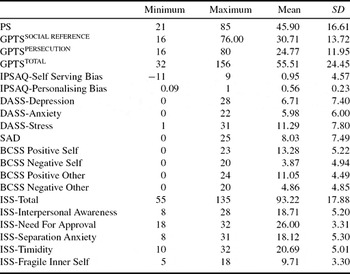
There were 58 participants who ranged in age from 18 to 65 (mean = 29.7, SD = 11.5). 31 were female (53.4%) and 27 were male (46.6%). The majority were white (N = 41; 70.7%). 7.0% had education up to GCSE level, 24.6% up to A-Level, 40.4% up to graduate level and 28.1% up to post-graduate level. The majority were students (55.2%). 29.3% were employed full-time and 8.6% were employed part-time. 5.2% were unemployed and 1 person (1.7%) was a homemaker. There were no missing data. Descriptive statistics for the self report measures are presented in Table 1.
Descriptive data for the self-report measures of the whole sample (N = 58)

Key: PS – Paranoia Scale GPTS – Green et al. Paranoid Thoughts Scales IPSAQ – Internal, Personal and Situational Attributions Questionnaire DASS – Depression Anxiety and Stress Scales SAD – Social Anxiety and Distress Scale BCSS – Brief Core Schema Scales ISS – Interpersonal Sensitivity Scale.
Explanations for the events
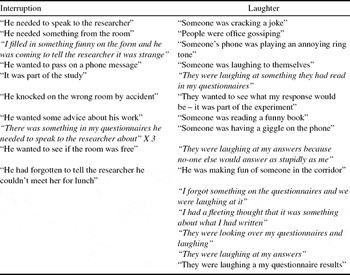
Examples of the explanations elicited by the two events are given in Table 2. All participants gave an explanation for the “interruption” event. Thirty individuals (51.7%) noticed the “laughter” and gave an explanation.
Examples of explanations given as to the cause of the experimental events (“paranoid” explanations marked in italics)

In total there were 11 ideas of reference from 9 participants reported in response to the events – from two individuals in response to the interruption, from five individuals in response to the laughter, and from two individuals in response to both events. This equated to 15.5% of the total sample. Ideas of reference included “I filled something funny in on the form, and he was coming to tell the researcher it was strange”; “They laughed at something they read in my questionnaires” (see Table 2). There were no attributions of hostile intent, i.e. ideas of persecution.
A small number of participants felt that the events were part of the research and designed to “test” them. For the interruption event, seven people gave this as an explanation. For the laughter event, two people gave this as an explanation. Individuals who noticed the laughter did not differ in levels of trait paranoia or levels of social anxiety from those who did not notice the laughter (on the PS, U = 418.5, p = 0.98 and on the SAD, U = 314.5, p = .10). There was no difference between the state feelings of anxiety (T = −1.8 9, p = .06), paranoia (T = −1.05, p = .29) or persecution (T = −0.79, p = .43) recorded before and after the experimental events (using visual analogue scales). This suggested that in the group as a whole, exposure to the events did not raise anxiety or paranoia significantly, consistent with their intended neutral, non-hostile quality.
Factors associated with the paranoid explanations of the events
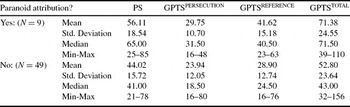
Trait paranoia. Mann-Whitney tests revealed significantly higher levels of trait paranoia in individuals reporting paranoid attributions across the PS (U = 128.5, p = .05), GPTSREFERENCE (U = 88.5, p = .02) and GPTSTOTAL (U = 94.0, p = .03) but not GPTSPERSECUTION (U = 119.0, p = .09) compared to the rest of the sample. Descriptive statistics are given in Table 3.
Trait paranoia scores for individuals reporting a paranoid attribution in response to the experimental events

Attributional style. There was a significant difference in “self-serving bias” scores on the IPSAQ (U = 70.5, p = .001), with lower self-serving bias scores in the paranoid attribution group (Mean = −4.0, SD = 4.33) compared to the non-paranoid attribution group (Mean = 1.9, SD = 4.03). The groups did not differ in terms of “personalising bias” (IPSAQ, U = 201.0, p =.68).
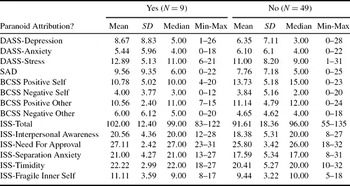
Emotion and schema. Descriptive statistics for the emotion measures in the “paranoid explanation” and “non-paranoid explanation” groups are presented in Table 4. A significant difference was noted between the groups in levels of interpersonal sensitivity (separation anxiety) (U = 131.0, p = .05) and there was a trend for the group who made paranoid attributions to lack a positive sense of self compared to those who did not (U = 138.5, p = .07). There were no other significant differences (p < .05) between the groups in terms of DASS anxiety (U = 205.5, p = .75), social anxiety (U = 204.5, p = .73) depression (U = 173.5, p = .31), stress (U = 169.5, p = .27), overall interpersonal anxiety (U = 153.0, p = .15) or schema (negative self: U = 181.0, p = .40; positive other: U = 196.0, p = .60 and negative other: (U = 195.5, p = .59), though scores were generally in the anticipated direction (e.g. higher levels of negative affect, less positive beliefs about the self and more negative beliefs about others in the paranoid group).
Descriptive scores for the emotion and schema measures for the “paranoid explanation” group (N = 9) and the “non-paranoid explanation” group (N = 49)

Discussion
We carried out a novel study of attributions for in-vivo ambiguous events. The results show that in a non-clinical sample, spontaneous attributions can be captured in an experimental setting. These can include paranoid explanations even for events that are designed to be ambiguous and non-hostile. Exposure to the ambiguous event did not increase subjective levels of anxiety, paranoia or feelings of persecution in the sample as a whole, which we suggest reflects their neutral quality. The results support the idea that paranoid ideas may be explanations for quite neutral events. These data therefore provide support for the study hypothesis that paranoid attributions would be elicited in some non-clinical participants.
The proportion of individuals who reported paranoid attributions was 15.5%. This figure is reasonably consistent with previous studies of non-clinical paranoid ideation, which estimates the frequency of these types of beliefs between 15–30% of the general population (e.g. Freeman, Dunn et al., Reference Freeman, Dunn, Garety, Bebbington, Slater, Kuipers, Fowler, Green, Jordan and Ray2005). Validation for the experimental design was reflected in the significantly higher trait paranoia scores for the individuals who gave paranoid explanations for the events. The paranoid explanations elicited were all ideas of reference, again consistent with our original hypothesis that any paranoid thoughts elicited would be mild. Interestingly, scores on a measure of Social Avoidance and Distress did not differ between the two groups, suggesting that the paranoid ideas elicited were not just simply due to variation in levels of social anxiety across the groups.
Recent evidence from large-scale epidemiological research suggests that the distribution of paranoid thinking is continuous and that, in fact, a “hierarchy” of paranoid ideas exists, extending from mild “social evaluative concerns”, through ideas of “social reference”, to “persecutory” beliefs concerning, mild, moderate and severe threat. In their survey of 1202 individuals from the general population Freeman and colleagues (Freeman et al., Reference Freeman, Garety, Bebbington, Smith, Rollinson, Fowler, Kuipers, Ray and Dunn2005b) found evidence that ideas of social reference build upon inter-personal sensitivities, and that rarer, less plausible persecutory ideas result from further appraisal of these more plausible inter-personal ideas.
There was some limited support for a cognitive model of clinical paranoia in the current study (Freeman et al., Reference Freeman, Garety, Kuipers, Fowler and Bebbington2002); individuals in the paranoid group showed a tendency to lack a positive sense of self and were significantly more interpersonally anxious, consistent with the model. A lack of further positive findings could be due to the low statistical power in comparing the two groups, given the small number of individuals in the “paranoid” group.
Interestingly, on a self-report measure of attributional style (IPSAQ), the “paranoid” group did not display a higher “personalizing bias” compared to the non-paranoid group. In fact, they showed a significantly lower self-serving bias, suggesting more of a depressive attributional style. This is perhaps understandable given that the paranoid explanations reported were ideas of reference, which by definition involve an incorrect attribution of personal significance. It may be that different styles of attribution operate at different points across the paranoia spectrum - an “external-personalizing” attributional style could, for example, play a role in shaping the development of more persecutory ideas at the severer end of the spectrum. In models of persecutory delusions, persecutory ideas are hypothesized to build upon ideas of reference (e.g. Freeman et al., Reference Freeman, Garety, Bebbington, Smith, Rollinson, Fowler, Kuipers, Ray and Dunn2005b), and are considered to involve appraisals of self-relevance (e.g. self as vulnerable) as well as attributions of hostile intent (Freeman et al., Reference Freeman, Garety, Kuipers, Fowler and Bebbington2002). It would be interesting for further research to explore the factors necessary (both intra-personal and environmental) to elicit attributions of hostile intent, i.e. persecutory ideas.
There are limitations to the current study. First, the sample is not epidemiologically representative, as it consisted mainly of students with higher levels of education. The results should therefore be interpreted with caution. Second, only a small number of participants elicited a paranoid attribution in response to the experimental event, significantly reducing the power of the analyses. One way to deal with this issue in future studies might be to focus recruitment on those scoring highest on screening measures of paranoia rather than selecting individuals from all four quartiles of scores. However, in this study we were interested to sample people across the continuum of sub-clinical paranoia. Third, the analysis has involved multiple comparisons, thus increasing the probability of chance findings. Fourth, the content of items on the attributional measure employed may also limit the assessment of attributional style in relation to paranoia – many concern failure and rejection, and other-person evaluation, and do not allow assessment of the evaluation of internal events, e.g. anomalous experiences, which are considered central to the development of paranoid beliefs (e.g. Freeman et al., Reference Freeman, Garety, Kuipers, Fowler and Bebbington2002). This may explain the lack of association between paranoia and an externalizing attributional style (e.g. Jolley et al., Reference Jolley, Garety, Bebbington, Dunn, Freeman, Kuipers, Fowler and Hemsley2006). In addition, the broader definition of paranoia adopted in this study (i.e. ideas of reference and persecution) may also have increased the possibility of picking up on sub-clinical depressive processes (in terms of attributional style) rather than processes more specific to paranoia as part of a spectrum leading to ideas of persecution.
In summary, the current study illustrates that paranoid explanations for events can be elicited and assessed in a real life situation, helping to complement the traditional questionnaire based studies of non-clinical paranoia. It also emphasizes the value of using non-clinical populations to provide further evidence for a “continuum” of paranoid ideas. The current data suggest that some of the processes considered central to clinical paranoia (e.g. emotion, schema and cognitive biases) may also be operating at the milder end of the spectrum but the data raise questions as to what processes might be responsible for transition across the spectrum from ideas of reference to persecutory ideation. Further research aiming to compare process across non-clinical, prodromal and clinical individuals will be helpful in clarifying these issues.



Comments
No Comments have been published for this article.