Learning science in schools involves developing conceptual and procedural knowledge and an understanding of the nature of science (Hodson, Reference Hodson2014). There is agreement that science knowledge is generated through asking questions, carrying out inquiry, and making evidence-based conclusions. In this research, school science inquiry is understood as:
an activity requiring identification of a question, using both conceptual and procedural knowledge in planning and carrying out the investigation, gathering, processing, and interpreting data and drawing conclusions based on evidence. Ideally, the process is iterative and the student has some choice in what they want to investigate. (Millar, Reference Millar, Osborne and Dillon2010, p. 109)
Internationally, the number of students opting to study science in high schools is declining, and there is general agreement that all students ought to learn science at least up to junior high school, and possibly beyond (Osborne, Simon, & Collins, Reference Osborne, Simon and Collins2003). Recent results of the Organisation for Economic Cooperation and Development Programme for International Student Assessment for scientific literacy show that although generally the achievement of New Zealand students is high, Māori students are underperforming (Glynn, Cowie, Otrel-Cass, & Macfarlane, Reference Glynn, Cowie, Otrel-Cass and Macfarlane2010). A similar pattern is seen in the National Education Monitoring Project for science where Māori students are, on average, achieving lower scores than non-Māori and Asian students (Woods-McConney, Oliver, McConney, Maor, & Schibeci, Reference Woods-McConney, Oliver, McConney, Maor and Schibeci2013). Science is a compulsory learning area until Year 10 (age 14) where disproportionately low numbers of Māori students continue with science through to Year 13 (age 17), the final year of school (Rata, Reference Rata2012). As little is known about teaching and learning science in Māori medium schools (wharekura), this paper addresses the call for research into effective practices for supporting the science learning of Indigenous students (McKinley, Reference McKinley2005) by reporting on part of a larger project that is investigating and extending understanding about how New Zealand teachers conceptualise science and science inquiry (investigation). The research reports how teachers in one wharekura conceptualise science inquiry and describes their perceptions of how and why their students should learn science and science inquiry. The paper also presents teachers’ views about their own development as science teachers.
Although most Māori students attend English medium schools, some parents choose to educate their children in wharekura, and approximately 15% of Māori students attend schools where the sole language of instruction is Te Reo Māori (Māori language). Wharekura are underpinned by Kura Kaupapa Māori (KKM) philosophy (Sharples, Reference Sharples and McQueen1994) which is a culturally specific philosophy of education that includes the elements of self-determination, cultural aspiration, culturally preferred pedagogy, socioeconomic mediation, extended family structure and collective philosophy (Pihama, Cram, & Walker, Reference Pihama, Cram and Walker2002). The philosophy is rooted in the belief that KKM enhances the educational achievement of Māori students because it provides an environment in which Māori can enjoy education success ‘as Māori’ (Ministry of Education, 2007a) as opposed to ‘by Māori’.
Glynn et al. (Reference Glynn, Cowie, Otrel-Cass and Macfarlane2010) argue that many Māori students disengage in classrooms where their traditional knowledge and worldviews may not be valued, and for many Māori students in English medium schools, success in science often comes at the cost of their language and culture. Smith (Reference Smith1995) believes that the development of KKM science education, that is, science education underpinned by Māori philosophy, would overcome science education disparity for Māori. However, Stewart (Reference Stewart2011) reports that the results to date show the opposite trend and that about 50% of all wharekura students actually continue to underperform in national certification examinations when compared with Māori students in English medium schools. The reasons for this finding are complex. Stewart (Reference Stewart2007) identifies knowledge and worldview clashes between ‘science’ and ‘Māori’ as: ‘the vast number of kupuhou (new Māori vocabulary) required for science, a shortage of teaching resources, facilities, and a “vacuum” of professional practice’ (pp. 4–5). There is the added challenge of there not being enough science teachers who are competent teaching in Te Reo Māori and wharekura are finding it difficult to employ science teachers who only teach in English.
Issues and complexity around science curriculum for Indigenous schools arise from views about ways of knowing, epistemology, what it is important to learn and how, medium of instruction and acknowledgement of values (McKinley, Reference McKinley2005; Wood & Lewthwaite, Reference Wood and Lewthwaite2008). The Pūtaiao document (Māori medium science curriculum) was developed in parallel with the science curriculum for wharekura: ‘Pūtaiao is undoubtedly significant for Māori. It establishes a precedent for the production of science curriculum policy in Te Reo Māori’ (Stewart, Reference Stewart2005, p. 858). The word taiao represents the natural world, earth, world, nature and pū means originate, precise, very exact. Pūtaiao is used as a general term for ‘translated western science’ or ‘traditional Māori knowledge’ (Stewart, Reference Stewart2011, p. 725). However, the current New Zealand Curriculum (Ministry of Education, 2007b) does not have a separate Pūtaiao document. The current curriculum for wharekura is a translation of the English version (Ministry of Education, 2007a). Consequently, the Pūtaiao curriculum document is no longer relevant; however, Pūtaiao as a Māori body of knowledge still exists and is accessible to all. The issues of Indigenous science and western science and the debate around the adequacy of the curriculum documents are beyond the scope of this paper but are well documented (McKinley, Reference McKinley2005; Stewart, Reference Stewart2011).
The goals of science education in New Zealand reflect those cited internationally, and include developing citizens who have conceptual, procedural and nature of science understandings and who can make informed decisions about socioscientific issues (Hodson, Reference Hodson2014). If these goals are to be achieved in wharekura, we need teachers who have the appropriate knowledge and understandings of science to support their students’ learning.
Teachers’ lack of confidence to teach science has been seen as a contributing factor in the little science being taught in New Zealand elementary schools (Bull, Gilbert, Barwick, Hipkins, & Baker, Reference Bull, Gilbert, Barwick, Hipkins and Baker2010). Teacher confidence determines whether or not teachers begin to teach primary science (Appleton, Reference Appleton and Appleton2006) and build the pedagogical content knowledge required to support their science teaching (Anderson & Clark, Reference Anderson and Clark2012). In the absence of formal science learning, teacher confidence among wharekura teachers may also be an issue. In mainstream schools science curriculum is a practical subject where hands-on engagement and active participation are promoted as preferred pedagogical approaches (Ministry of Education, 2007b). Currently, there is a paucity of research into pedagogical approaches for teaching science used in wharekura. Another possible barrier to science teaching is teacher belief. Friedrichsen, Van Driel and Abell (Reference Friedrichsen, Driel and Abell2011) suggest that teachers’ beliefs about the goals and purposes of science teaching, how it should be taught and their understanding about the nature of science, influence their practice. Teacher beliefs about science teaching and learning are considered to be key influences in the development of pedagogical content knowledge for science teaching in New Zealand (Anderson, Reference Anderson2014).
It is currently unclear how teachers in Māori medium schools conceptualise and practise science and science inquiry and what students in these schools learn from doing science inquiry. In some countries, science inquiry is known as science investigation (Moeed, Reference Moeed2015). In wharekura, there are the additional challenges of bringing together a Māori world view with what can be seen as the hegemonic western perspective of science. The challenges include absence of a science curriculum that reflects Māori epistemology and kura teachers having to teach western science and uphold tīkanga Māori (Māori culture).
The wharekura teachers participating in this research, although wanting to improve student outcomes for science, exemplify these challenges as they have had limited science education or science teacher education to enable them to teach science with confidence in high school. We therefore set out to investigate the following research problems:
-
1. How do participating wharekura teachers conceptualise science and science inquiry?
-
2. What are the views of the participating wharekura teachers as to why and how their students should learn science and science inquiry?
-
3. How can wharekura teachers be supported to teach science?
Research Design
The research presented here was conducted as a case study of learning science and science inquiry in wharekura. Case studies provide ‘thick rich description of the phenomenon under study’ (Stake, Reference Stake1995, p. 42) and when used with an inductive approach to data analysis, as was applied in this study, ‘generalisations, concepts or hypotheses emerge from an examination of the data grounded in the context itself’ (Merriam, Reference Merriam1998, p. 13). A case study was the best approach to gain a deeper understanding of the phenomenon under investigation in the unique setting of the wharekura. The results unpack teacher understandings and beliefs about the purpose of school science inquiry in students’ science learning. We also describe the Professional Development (PD) provided and report teachers’ views about their own science learning. The research was underpinned by constructivist theory of learning and supported by KKM philosophy.
Bishop and Glynn (Reference Bishop and Glynn1999) guided our thinking about the most appropriate manner in which to approach the wharekura and to address Māori participants’ concerns about who the research would benefit because in the past research has been ‘done’ on Māori and knowledge generated has been used to the advantage of the researchers. Bishop and Glynn (Reference Bishop and Glynn1999) assert that to Māori, knowledge is not just about gathering data and publishing the insights gained; rather, it is about how researchers’ findings may impact positively on the participants’ lives. We positioned ourselves as whānau (family and extended family) with a mutual interest in collaborating to create a space for science teaching and learning within the kura (school). Our intention was to accept Māori views about knowledge:
Knowledge is a taonga (treasure) handed down as ‘taonga tuku iho’, that is, treasure from ancestors, and as such is tapu (sacred). Knowledge is expressed in the form of power known as mana. How it is used is crucial. (Bishop & Gylnn, Reference Bishop and Glynn1999, p. 172)
We understood the need to be flexible and to ensure that the kawa/tikanga (protocol) was understood by all participants and suitable for the purpose. For example, according to wharekura tikanga, only Te Reo Māori is spoken in certain areas of the school, and we did not converse in English in those areas. As one researcher is a fluent speaker of Te Reo Māori, this was an easy tikanga to follow. We had talked with the principal and teachers who had decided that to make it possible for their students to learn science it would be taught in English. As the medium of instruction at wharekura is Te Reo Māori, the school whānau were consulted before the research project was put in place. Western ethical practices of respect and informed consent were followed, so too was ethics regarding tikanga, for example, ensuring that Māori concerns about students’ mana and the wharekura's principles and values were at no time compromised.
A collaborative study was designed with two researchers and two teachers working together. The school and teachers were keen to participate in the larger research project and we proceeded with the formal process of ethics approval. An interesting finding at the first meeting was that the wharekura was unable to attract science teachers, the outcome being that the participating students who were about to start high school had no formal science learning in the first eight years of schooling. This realisation resulted in a change to the original research design to include teacher PD. The researchers and teachers decided to implement PD where teachers would learn alongside the students while one researcher would teach once a week at the wharekura in the first year. The findings reported here are from hour-long individual interviews with the two teachers at the start, after six months into the project, and at the end of the year along with conversations during the academic year. The first interview was open and the teachers responded to the questions: What do you think science is? And why do you think students should learn science? The purpose was to gain as deep an insight as possible into both teachers’ current understandings. The subsequent interviews were semistructured and built around the observed lessons. Lesson plans were shared before each lesson, and the focus of the following lesson was decided collaboratively. Lessons were audio-recorded and a brief discussion took place at the end of the lesson, which was recorded by a researcher as brief field notes. During the year of teaching and data collection the teachers contacted the researchers either by email or by phone, and one teacher chose to visit one of the researchers to learn about the content and to ask questions to clarify their conceptual understanding of it.
The participants of the study are two teachers; ‘Sue’ and ‘Liz’ (pseudonyms) and their class of six girls and eight boys aged 13–15 years. It was a combined class of year 9 and 10 students. Both teachers are of Māori descent. Sue is a trained early childhood and elementary teacher who has taught in kura for 17 years, is fluent in Te Reo Māori, and has considerable cultural knowledge. Liz is a trained high school social sciences teacher in her fifth year of teaching. She has taught English, information and communication technology (ICT), and statistics in Te Reo Māori at this kura for three years. Both teachers are competent ICT users.
Results
The results presented here are drawn from the three teacher interviews, classroom observations and conversations with the teachers after each lesson. The results also include data from the first lesson taught by the teachers subsequent to the PD. The data were analysed inductively by two researchers who then agreed on the findings. The first question asked was:
Why Should Students Learn Science?
Sue talked about parental expectations that ‘you do well for their children’. Along with the importance to be cognisant of parental expectations, she has a strong belief that Māori children should have a strong identity as Māori and an understanding of their culture, and develop a Māori perspective above and beyond the teaching of science. She elaborated:
I suppose without putting science down because I do not profess to know everything about science, but for a Māori person it is important to have a Māori perspective. For our students who come through it is ingrained in them, understanding Māori philosophy, so that when they have got a good understanding of that, which is the eight years they have had. (Sue, first interview)
Sue prioritised identity before science learning and commented on the strong connection Māori have with their environment:
When they start moving into the fields of science they already know who they are so when we connect with Pūtaiao which is looking at their environment, whatever the field is, the environment still belongs to them, so the world view is their view. . . they are always the centre of the Pūtaiao, whether that be as an individual, them with their whānau or their iwi. All the science belongs to them and it is a matter of ensuring that they have all that. It is important that they have a handle on both worlds.
She believed in giving the children the tools so that they can go out into the world and pursue any science whether it be ‘genetics or farming.’ They have two perspectives: ‘the perspective of the world they live in today and the perspective of the world that their tipuna (ancestors) carried through for them, the path is always wider for them.’
Liz was asked why she got involved in this research project and, being forthright, said she was told that she was going to be part of it. Then she added, ‘I wanted to pick up science, I wanted to learn for the students and for the school.’ Her own experience of learning science at school was not a positive one: ‘Just sat in a class and filled out a book, watch the teacher and then went to the next class . . . it was boring.’
Views about Science Inquiry
Both teachers said they did not know much science, particularly physics and chemistry, but they wanted to learn. Once the researcher started to teach science (for one two-hour session a week), the teachers extended it by teaching Science for another two hours each week; however, the focus was vocabulary development and learning science facts. They were clear about the researchers teaching the science in English, in a particular space in the school where learning could take place in English. Even though one of the researchers is Māori, they considered it important that he ‘was the science expert’. The teachers viewed themselves as the language experts and they taught Science in Māori. Teachers were asked what they thought were the key elements of science inquiry. Sue was tentative when she started answering this question; she considered inquiry as hands-on engagement, being able to use the correct science terminology, giving students some science terminology in Māori, which in her view would enrich their learning. For example, she said:
I am not sure how to answer that. It is awesome that these children get the opportunity to have their hands-on, to experiment with it, pull it apart and put it back together, turn it upside down. Having you navigating them with a science world view, it allows them to get the right words that go with the right forms of experiments. Words like friction, forces, things like that don't mean a lot to them so when you have got someone supporting that while they are doing the experiments and we feed them the little hooks that they have in Te Reo, then it makes the learning much richer.
A further insight into Sue's view about inquiry was that she saw science learning through being shown how to do something and then being able to replicate it (a pedagogy widely used in KKM), yet when it came to the researcher teaching inquiry she accepted it as a different kind of knowledge. Sue gave an example:
A kaumatua (elder) had gone eeling and he took them through the whole process of preparing the eel from beginning to the end, which is science. What you are doing with our kids is science . . . knowledge is knowledge and who are we to say one is better than the other?
When students were asked to explore and plan investigations independently, they were reluctant to do so, which suggests the teachers’ belief about learning via observation and repeating was the practice in class. Liz said that she did not know what science inquiry was but was able to explain it quite well:
Doing of the inquiry is fine, but I think it is the ability to translate that and analyse it and relating what they saw back to the original question to form their conclusion. . . . I think science does this whole trial and error thing. . . it would be cool if schools could move into that and give kids free run to trial it. I want them to find out things for themselves rather than giving them the answers . . . Māori kids like to try things out, rather than being told, they get bored just listening.
Liz demonstrated her understanding of the processes involved in science inquiry. She understood the nature of science inquiry and explained it as an iterative process requiring evaluation of inquiry and being thoughtful about what changes may be required:
Planning out what you are going to do, how you are going to do it, data gathering, data display, working out formulae, and then thinking out what didn't work here, and what would have to be changed. . . . Last week we went out after we had done the golf experiment and we played basketball and figured out the speed of that ball.
She explained the purpose of science and what her approach to teaching science would be:
Real science is about going out there and looking for new things, I go diving, I would love to take these children snorkelling, so they can explore. . . [The lesson was led by the teacher]
As the year progressed, the teachers became more active participants in the lessons. They gained the confidence to ask questions, and classroom observation recordings show that they engaged in the hands-on activities more and more. One example was a lesson where students were exploring snails:
The first reaction of the teacher was negative and she did not want to touch the snails. Once the students started to participate in the activities she became really interested in what they were doing, asking questions and encouraging students to observe closely. (Classroom observation notes)
At the end of the year, Sue was very excited as she had been offered the job of coordinating ‘science learning’ in the wharekura. She had ideas about what she wanted to do in preparation for teaching science next year. Sue also enrolled and completed a six-week online science course at the university with a particular focus on the nature of science. She asked for help with planning this course and was keen to get started. She reports that this year the students at wharekura will, for the first time, be doing the science course in Year 11, and will be assessed for the National Certificate for Educational Achievement (NCEA) (Level 1). The wharekura have not offered this to the students in science before. Sue is confident that she will be able to teach this course. She said:
Our children need to learn science, they enjoyed learning with you last year and are keen to do NCEA science. You and Matua (teacher) . . . Have lighted a love for learning science. It is important that they have the science knowledge so that they can go on to study science at the university. Our children need to learn to be in both worlds, Māori and the other. (Sue, end of year interview)
Sue also said that she learnt science from us and the way we taught made her gain confidence: ‘I know that you will help when I don't understand something I have to teach’. During the school holidays she spent an afternoon with the researcher clarifying her own ideas about science.
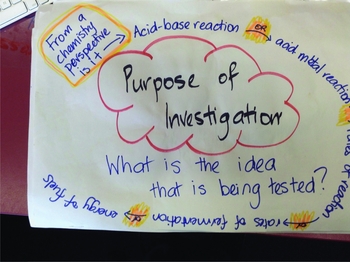
When it came to teaching inquiry, Sue co-constructed the framework with the students by ‘mind-mapping’. For example, the purpose of the inquiry was developed by group work where students contributed ideas to the teacher while she recorded them (see Figure 1).
Collaborative mind map produced by the class showing the purpose of investigation.

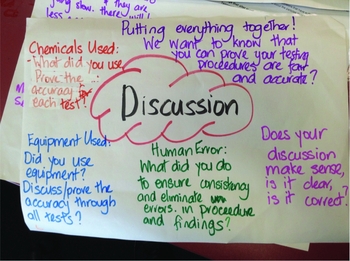
Students had access to the internet during this process. Sue addressed the inquiry sequence and reminded the students of the overarching purpose, asking ‘What is the idea that is being tested?’ This was followed by talking about the equipment they would need, the process of the inquiry, elements of design, discussion and conclusion. To support students’ understanding of what might be included in a discussion, she created space for them to contribute their ideas to the group (see Figure 2).
Collaborative learning about what to include in a discussion.

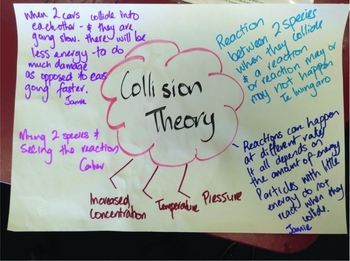
Similarly, the process of collating ideas of the collision theory that was the focus of the investigation was established through students gathering information from the internet and the teacher focussing on the main aspects (see Figure 3).
Mind map about collision theory developed together by the students and the teacher.

Liz is very shy and does not like to talk in the presence of others whom she considers to have more knowledge than her. However, she had organised her students to do independent research projects on an aspect of astronomy. She had planned a unit of work on how Māori used stars to navigate. When she was told by the students that they had already covered this in a social science class, she consulted the social science teacher and adapted the unit to focus more on the scientific principles. Liz has outstanding information technology skills and set up and monitored students’ work in class online. With encouragement she shared this with other teachers in our research cluster.
Discussion and Conclusion
It was clear that for these teachers, understanding Māori language and culture and developing identity as Māori were the first priority in their students’ learning. This belief is underpinned by KKM philosophy (Pihama et al., Reference Pihama, Cram and Walker2002; Sharples, Reference Sharples and McQueen1994). However, there was also understanding that these students walked in two worlds. Although both teachers were not confident to teach science, within a week they had gained the confidence to start teaching Pūtaiao to the children, which they had never done before. They believed in learning in the natural environment and considered guided exploration an important way to learn for Māori. These beliefs provide strong potential connecting points for teaching science through inquiry, which inherently involves exploration of the natural world. This process can be contrary to some traditional Māori pedagogy, which relies on modelling, then repeating the process as exemplified in Sue's comment about eeling. However, when it came to practice, she gave autonomy to students in developing the plan for the investigation and, although she had decided that the context of the inquiry would be acid and metal reactions, she encouraged the students to plan their own inquiry and make decisions about the data they would collect and record. Sue provided a framework for students’ learning, but this framework was developed collaboratively by encouraging students to critically think and to share their ideas with the class. Although Liz said that she did not know what science inquiry was, she had an informed understanding of the investigative process. She understood the need to plan, carry out the investigation, gather and process data and draw evidence-based conclusions. She also understood that inquiry does not always proceed as planned and that it was an iterative process.
The approach to school science learning taken by the teachers was strongly influenced by the modelling that was evident within their PD in the previous year. This evidence also suggests that the teachers are focussing on content and procedural knowledge and have some understanding of the nature of science inquiry (Hodson, Reference Hodson2014). They afforded students the opportunity to engage in an open-ended inquiry (Millar, Reference Millar, Osborne and Dillon2010).
Sue felt strongly that the two knowledge systems were equally important although Māori scholars argue that Māori knowledge and worldview are not valued generally in New Zealand education (McKinley, Reference McKinley2005); however, in the wharekura setting, they have primacy. Science education in this context must be respectful of these views and negotiated through partnership (Bishop & Glynn, Reference Bishop and Glynn1999).
Participants gained confidence through engaging in science themselves. The research findings suggest that both teachers, who already had pedagogical content knowledge, knowledge of their context and knowledge of their students, learnt science. Their participation and enthusiasm to learn more about the nature of science demonstrates a significant gain in confidence, enabling these primary school trained teachers to teach science (Bull et al., Reference Bull, Gilbert, Barwick, Hipkins and Baker2010; Moeed, Reference Moeed2015). It appears that we may have gained insight into how the issue of science teachers who know both science and Te Reo Māori to teach in wharekura may be addressed. We are midway into this two-year project and it has already created a space for science learning in this Indigenous school. The prospect of a PD model to facilitate science learning in wharekura is one step closer to being achieved.
We propose development of two possible models. First, as the wharekura are commonly located in areas where there is one or more English medium secondary school, similar support to that provided to the participating teachers can come from a science teacher who is able and willing to help. This support may well be reciprocal as often secondary schools struggle to support their Māori students and wharekura teachers can offer this in return for being able to observe some science teaching and have support to develop their science programme. There is, however, a special brokerage that is required to ensure that a relationship between supporting schools engaging productively across the cultural gap that may exist. A working relationship between mainstream and KKM schools will be ineffective unless the divide traversed within the ‘tikanga’ (way of doing) is appropriate.
The second model could be named the ‘snowball model’, where teachers like the participants of this study, once they have established a programme in their own wharekura, support other wharekura teachers. The causal effect with other wharekura would be nonlinear, accelerating to other schools.
The important aspect is the research model that was adopted (tertiary teachers teaching the students and their teachers) is removed as the reliance on tertiary providers for PD is not sustainable. We acknowledge that the research reported is a case study carried out in one wharekura and the findings cannot be generalised, however, the research adds new understandings of the challenges faced by Māori medium schools and suggests a way forward.
Acknowledgement
The authors would like to acknowledge and thank the New Zealand Ministry of Education for funding through the Teaching and Learning Research Initiative (TLRI). The authors would like to thank the teachers and students of the Wharekura without whose support this research would not have been possible. We would also like to thank Susan Kaiser for commenting on the draft and for her editorial support.
About the Authors
Craig Rofe is a senior lecturer in the Te Kura Māori School, Faculty of Education at Victoria University of Wellington, New Zealand. His research and teaching interests include Matauranga Māori (Māori knowledge), cultural responsiveness & competency, Māori epistemology and also science education.
Azra Moeed is a senior lecturer and curriculum leader of science education in the Faculty of Education at Victoria University of Wellington, New Zealand. Her teaching and research interests include teaching, learning and assessment of science, science teacher education and environmental education.
Dr Dayle Anderson is a senior lecturer in primary science and mathematics education at Victoria University of Wellington. Her research focuses on primary science education, in particular the nature and development of teacher knowledge and beliefs that support primary science. Current projects include investigating primary teachers' conceptualization of science investigation, and learning science through drama. Other research interests include pedagogy for initial teacher education and culturally responsive teaching in mathematics. Dayle designs and delivers professional development in science for primary teachers for the Royal Society of New Zealand and reviews and advises on the development of science and mathematics resources for NZ primary schools.
Rex Bartholomew has 30 years' experience as a classroom teacher, head of science, and acting associate principal in New Zealand secondary schools. He was national programme manager for ecological management training in the Department of Conservation for four years before being involved in education research and teaching in pre-service science education. Rex is interested in how teachers encourage their students to understand about the substantive and procedural nature of science in the context of teaching scientific concepts, especially in ecology. He is also studying the effectiveness of pre-service science education courses in preparing student teachers for professional practice.