Introduction
Morphological changes in the brain of patients with major depression have been reported by numerous neuroimaging studies and were confirmed in recent meta-analyses (Campbell et al. Reference Campbell, Marriott, Nahmias and MacQueen2004; Videbech & Ravnkilde, Reference Videbech and Ravnkilde2004; Koolschijn et al. Reference Koolschijn, van Haren, Lensvelt-Mulders, Hulshoff Pol and Kahn2009; Schmaal et al. Reference Schmaal, Veltman, van Erp, Sämann, Frodl and Jahanshad2016). Decreased gray matter volumes of the hippocampus, the anterior cingulate cortex and parts of the dorsolateral and dorsomedial prefrontal cortex are among the most reliable alterations (Arnone et al. Reference Arnone, McIntosh, Ebmeier, Munafò and Anderson2012; Bora et al. Reference Bora, Fornito, Pantelis and Yücel2012; Du et al. Reference Du, Wu, Yue, Li, Liao and Kuang2012). Because of its susceptibility to stressful life experiences such as childhood maltreatment, which are known to increase the risk for the development of major depression (Gilbert et al. Reference Gilbert, Widom, Browne, Fergusson, Webb and Janson2009), the hippocampus has been the focus of structural magnetic resonance imaging (MRI) studies in affective disorders (Dannlowski et al. Reference Dannlowski, Stuhrmann, Beutelmann, Zwanzger, Lenzen and Grotegerd2012; Stratmann et al. Reference Stratmann, Konrad, Kugel, Krug, Schöning and Ohrmann2014; Opel et al. Reference Opel, Zwanzger, Redlich, Grotegerd, Dohm and Arolt2016).
Although decreased hippocampal volume in major depression is a robust and reliable finding, the effect size of −0.14 standard deviations compared to healthy controls is rather small (Schmaal et al. Reference Schmaal, Veltman, van Erp, Sämann, Frodl and Jahanshad2016). One further problem repeatedly noted in meta-analyses is the high heterogeneity of sample and clinical characteristics. Whereas some studies included primarily young patients early in the disease process or patients with few illness episodes (Posener et al. Reference Posener, Wang, Price, Gado, Province and Miller2003; Lange & Irle, Reference Lange and Irle2004), others focused on late-life or recurrent depression (Sheline et al. Reference Sheline, Sanghavi, Mintun and Gado1999; Taylor et al. Reference Taylor, Steffens, Payne, MacFall, Marchuk and Svenson2005). Variance in hippocampal volume due to clinical heterogeneity has long been treated as an undesirable source of noise. The relevance of these clinical parameters for structural alterations, however, became obvious in a meta-analysis (McKinnon et al. Reference McKinnon, Yucel, Nazarov and MacQueen2009) that demonstrated that decreased volume was predominantly observed in subsamples of patients with more than two years of illness duration or in those with more than one episode. In conjunction with findings on lack of effects of acute symptom severity, these results implicate that gray matter decrease in patients with major depression seems to be the result of protracted illness exposure rather than acute depression. On the cellular level, progressive depression is thought to involve maladaptive neuroplastic changes such as dendritic regression, loss of hippocampal neurons and inhibition of neurogenesis (Pittenger & Duman, Reference Pittenger and Duman2008). All of these processes have also been observed in response to chronic stress and are likely to be mediated by a hypersecretion of glucocorticoids (Sapolsky, Reference Sapolsky2000; Conrad, Reference Conrad2008).
The first study to find evidence in favor of this hypothesis has been published 20 years ago and found a negative association of the untreated duration of depression and the volume of the hippocampus in n = 10 women (Sheline et al. Reference Sheline, Wang, Gado, Csernansky and Vannier1996), a result that was replicated by the same group a few years later in n = 24 patients (Sheline et al. Reference Sheline, Sanghavi, Mintun and Gado1999). Only one other study could demonstrate a relationship between the cumulative lifetime duration of depression and hippocampal volume (Frodl et al. Reference Frodl, Jäger, Smajstrlova, Born, Bottlender and Palladino2008), whereas other replication attempts failed (Frodl et al. Reference Frodl, Meisenzahl, Zetzsche, Born, Groll and Jäger2002; Lloyd et al. Reference Lloyd, Ferrier, Barber, Gholkar, Young and O'Brien2004). A comparable yet slightly different measure than the cumulative lifetime duration of depression is illness duration, which is defined as the elapsed time since onset of the first depressive episode. While some authors reported a negative linear association between illness duration and hippocampal volume (Bell-McGinty et al. Reference Bell-McGinty, Butters, Meltzer, Greer, Reynolds and Becker2002), others found the relationship to be better approximated by a logarithmic function (MacQueen et al. Reference MacQueen, Campbell, McEwen, Macdonald, Amano and Joffe2003). Yet, others did not find any associations at all (Hickie et al. Reference Hickie, Naismith, Ward, Turner, Scott and Mitchell2005; Frodl et al. Reference Frodl, Schaub, Banac, Charypar, Jäger and Kümmler2006). Furthermore, the clinical measure of lifetime depressive episodes in association with hippocampal volume showed inconsistent findings between studies. One study and one meta-analysis support the evidence for a negative association (Videbech & Ravnkilde, Reference Videbech and Ravnkilde2004; Stratmann et al. Reference Stratmann, Konrad, Kugel, Krug, Schöning and Ohrmann2014), whereas other studies failed to replicate such an association (Bremner et al. Reference Bremner, Narayan, Anderson, Staib, Miller and Charney2000; Bell-McGinty et al. Reference Bell-McGinty, Butters, Meltzer, Greer, Reynolds and Becker2002; MacQueen et al. Reference MacQueen, Campbell, McEwen, Macdonald, Amano and Joffe2003).
One major limitation of these studies is the focus on single, highly selective clinical variables. To obtain a better approximation of patients’ cumulative illness severity, it would be preferable to include multiple characteristics of illness severity on a composite score; however, previous studies have not derived a composite measure of cumulative illness severity. A composite measure has the advantage of integrating information from multiple variables and comprises a data-driven weighting of these variables.
To address this, we incorporated information from six clinical variables to investigate the influence of patients’ cumulative illness severity on hippocampal volume. Instead of analyzing these variables separately, we conducted a principal component analysis to identify latent components that best characterize cumulative illness severity. These components were tested as predictors of hippocampal volume using voxel-based morphometry in a sample of 213 inpatients with major depression. Additionally, we included a sample of 213 healthy controls to explore differences in hippocampal volume compared with patients. Our study design enabled us to investigate the following objectives: first, to replicate findings of hippocampal volume reductions in patients with major depression compared to healthy controls; second, to investigate whether patients’ cumulative illness severity correlates with hippocampal volume.
Materials and methods
Subjects
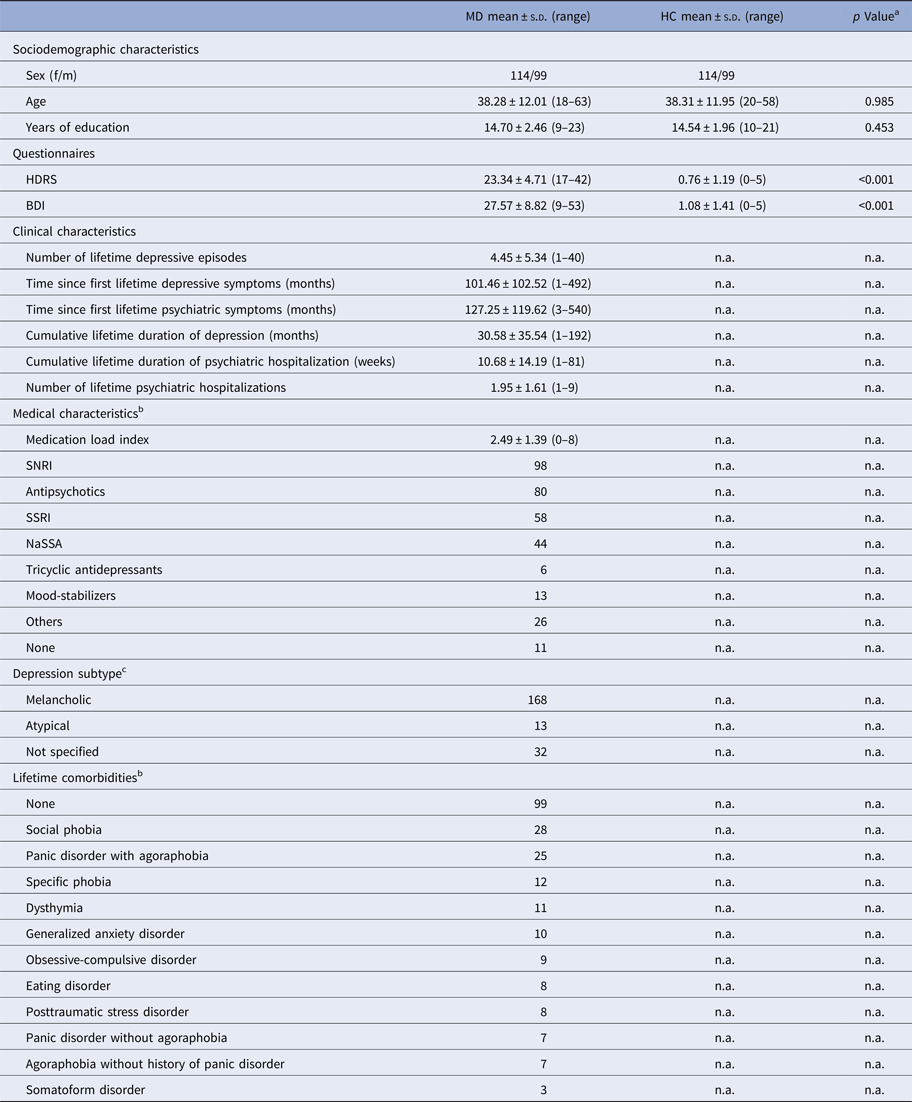
All inpatients from the Department of Psychiatry and Psychotherapy of the University Hospital in Muenster with a diagnosis of major depression were screened against study inclusion and exclusion criteria by attending therapists. Two hundred sixteen acutely depressed inpatients met criteria and were included. Three patients had to be excluded during preprocessing of MRI data (see the subsection ‘Voxel-based morphometry), leaving 213 subjects in the patient sample for statistical analyses. As a control group, we selected 213 healthy controls from an ongoing study investigating the neurogenetics of affective disorders, who were matched to patients according to sex, age, and years of education (for details, see Table 1). Subjects for the healthy control sample were recruited in response to local newspaper ads and public notices. The present sample was independent of our previous investigations on morphometric correlates in depression (Stratmann et al. Reference Stratmann, Konrad, Kugel, Krug, Schöning and Ohrmann2014).
Sociodemographic and clinical characteristics of our study sample consisting of 213 acutely depressed patients and 213 healthy controls

MD, major depression (n = 213); HC = healthy controls (n = 213); HDRS, Hamiton Depression Rating Scale; BDI, Beck Depression Inventory.
a p Values according to t tests.
b Multiple entries per patient possible.
c Based on DSM-IV-TR criteria.
Common exclusion criteria were any history of neurological illness, medical condition (e.g. cancer, chronic inflammatory, or autoimmune diseases, and infections), head trauma or unconsciousness, alcohol or substance dependence, psychotic disorders, prior electroconvulsive therapy, and usual MRI contraindications. Regular blood tests for inpatients ensured the absence of substance or alcohol use. All subjects underwent Structured Clinical Interview (SCID-I) for DSM-IV to obtain clinical diagnoses in patients and to ensure no history of psychiatric illness in controls (Wittchen et al. Reference Wittchen, Wunderlich, Gruschwitz and Zaudig1997). Comorbid anxiety, eating, and somatoform disorders in the patient sample were no exclusion criteria (for details, see Table 1). Acute symptom severity was verified by the 21-item Hamilton Depression Rating Scale (HDRS; Hamilton, Reference Hamilton1960) and the Beck Depression Inventory (BDI; Beck et al. Reference Beck, Steer and Brown1987). All patients had a minimum score of 17 points on the HDRS, whereas healthy controls were allowed to have a maximum score of five points on the HDRS. To assess patients’ cumulative illness severity, the following six variables were evaluated in structured clinical interviews by trained raters: number of lifetime depressive episodes, time since first lifetime depressive symptoms, time since the first lifetime psychiatric symptoms, cumulative lifetime duration of depression, cumulative lifetime duration of psychiatric hospitalization, and number of lifetime psychiatric hospitalizations. Most patients were medicated at the time of scanning (for details, see Table 1), while controls were free from any psychotropic medication. To evaluate the potential impact of psychotropic medication in patients, each substance was coded as absent = 0, low = 1 (equal or lower average dose), or high = 2 (>average dose), relative to the midpoint of the daily dose range recommended by Physician's-Desk-Reference. We calculated a medication load index for each patient by summing all individual medication, as used in previous studies (Redlich et al. Reference Redlich, Dohm, Grotegerd, Opel, Zwitserlood and Heindel2015a). The study was approved by the Ethics Committee at the University of Muenster and all participants gave written informed consent prior to commencing any study procedures.
Image acquisition
T1-weighted high-resolution anatomical images of the head were acquired (Gyroscan Intera 3T, Philips Medical Systems, the Netherlands) using a three-dimensional fast gradient echo sequence (turbo field echo), repetition time = 7.4 ms, echo time = 3.4 ms, flip angle = 9°, two signal averages, inversion prepulse every 814.5 ms, acquired over a field of view of 256 mm (feet–head) × 204 mm (anterior–posterior) × 160 mm (right–left), frequency encoding in feet to head direction, phase encoding in AP and RL directions, reconstructed to voxels of 0.5 mm × 0.5 mm × 0.5 mm.
Voxel-based morphometry
Hippocampal gray matter information was analyzed using the VBM8-toolbox (http://dbm.neuro.uni-jena.de/vbm). Pre-processing of T1-weighted images was performed using default parameters, as described in previous studies (Dannlowski et al. Reference Dannlowski, Kugel, Grotegerd, Redlich, Suchy and Opel2015; Redlich et al. Reference Redlich, Grotegerd, Opel, Kaufmann, Zwitserlood and Kugel2015b). Processing steps included bias-correction, tissue classification and normalization to MNI-space using linear (12-parameter affine) and non-linear transformations including high-dimensional DARTEL-normalization. As suggested in the VBM8 manual, normalized gray matter segments were modulated by non-linear components to compensate for the loss of information in absolute volume through spatial normalization. This step involved multiplying the spatially normalized gray matter segments by its relative volume before and after spatial normalization and thus removed confounding effects of different brain sizes. Non-linear modulation applied the correction for differences in total brain size directly to the data instead of including total intracranial volume in statistical models. Data quality of gray matter images was verified by implemented VBM8-functions using the covariance structure of each image with all other images. Modulated gray matter images were smoothed with a Gaussian kernel of 8 mm FWHM.
Statistical analyses
We conducted a principal component analysis to identify latent components underlying the six clinical variables (number of lifetime depressive episodes, time since first lifetime depressive symptoms, time since the first lifetime psychiatric symptoms, cumulative lifetime duration of depression, cumulative lifetime duration of psychiatric hospitalization, and number of lifetime psychiatric hospitalizations). Component analysis and extraction were computed with IBM SPSS Statistics 23. Based on the Kaiser–Guttman criterion, only components with an eigenvalue (EV) >1.0 were extracted.
Finally, we computed component scores for each extracted factor, which represented patients’ individual placement on this component, using a regression approach. To see if extracted factor scores were associated with acute symptom severity at the time of scanning, we computed non-parametric Spearman Rho correlations with HDRS scores.
Analyses of gray matter volume were calculated using statistical parametric mapping software (SPM12, Wellcome Department of Cognitive Neurology, London, UK; http://www.fil.ion.ucl.ac.uk/spm), using an absolute threshold masking of 0.1. To investigate differences in hippocampal volumes between patients and controls, we performed an ANCOVA with diagnosis as a between-subject factor (patients v. healthy controls), controlling for age, sex and years of education (objective 1). Although patients and controls were well matched for sociodemographic variables, we decided to include age, sex, and years of education as covariates in our model to account for small residual covariate imbalance between groups (Stuart, Reference Stuart2010). Second, multiple regression analyses restricted to the patient sample were applied to investigate potential associations between hippocampal volume and obtained component scores (objective 2). Each regression model comprised the particular component score, controlling for age, sex, BDI, and medication load index. To exclude confounding effects of antipsychotic medication and comorbid psychiatric illness, we repeated analyses with both variables as additional covariates (yes/no) to the regression models. Equivalent regression models were also conducted for each of our six clinical variables separately to demonstrate effects independent of component selection.
Using a region-of-interest (ROI) approach, we restricted analyses to the bilateral hippocampal and parahippocampal gyrus as defined by the AAL-atlas (Tzourio-Mazoyer et al. Reference Tzourio-Mazoyer, Landeau, Papathanassiou, Crivello, Etard and Delcroix2002), implemented in the WFU pickatlas (Maldjian et al. Reference Maldjian, Laurienti, Kraft and Burdette2003). Significance thresholds for multiple testing were obtained at the cluster-level by threshold-free cluster enhancement as a non-parametric approach, which is implemented in the TFCE-toolbox (http://dbm.neuro.uni-jena.de/tfce, Version 110). We established a conservative FWE-corrected threshold of p < 0.05 for the ROI obtained by 5000 permutations per test. Additionally, we performed exploratory whole-brain analyses at p < 0.001, uncorrected, with a cluster threshold of k = 50 voxels.
Results
Principal components of cumulative illness severity
Three patients had to be excluded for anatomical abnormalities, identified as extreme outliers in the check data quality function. The final sample for statistical analyses comprised n = 213 patients and n = 213 healthy controls.
Following principal component analysis, two components were extracted and retained (EVcomponent1 = 3.47, EVcomponent2 = 1.01). Both components together accounted for 75% of the variance (58% by the first component, 17% by the second component) and were highly correlated (r = 0.52). To enhance component interpretability, we performed an oblique promax rotation. Rotated factor loadings yielded a clear allocation of each variable to one of the two components (all factor loadings >0.60; see online supplementary Table S1). Variables associated with the first component were number of lifetime depressive episodes, time since first lifetime depressive symptoms, time since first lifetime psychiatric symptoms, and cumulative lifetime duration of depression. This component was termed Duration of Illness (Cronbach's α = 0.68). Variables associated with the second component were cumulative lifetime duration of psychiatric hospitalization and number of lifetime psychiatric hospitalizations. This component was termed Hospitalization (r S = 0.80). Whereas Hospitalization factor scores were significantly correlated with HDRS scores (r S = 0.159, p = 0.020), Duration of Illness factor scores showed a tendency in the same direction but failed to reach significance (r S = 0.132, p = 0.054).
Hippocampal volume differences between patients and healthy controls
The ANCOVA showed a tendency of reduced hippocampal gray matter volumes in patients compared to healthy controls, which did not survive rigorous FWE-correction (Cohen's d = −0.35, p FWE = 0.075). The opposite contrast (patients>healthy controls) revealed no significant clusters in the hippocampus.
Results from exploratory whole-brain analyses are listed in online supplementary Table S2. Notably, gray matter reductions in the right hippocampal formation, fusiform gyrus, and left cerebellum emerged. The only region increased in patients compared with healthy controls was the left middle and inferior occipital gyrus.
Principal component Duration of Illness and hippocampal volume
There was no significant association of hippocampal gray matter volume with Duration of Illness component scores (r = −0.17, n.s.). Out of four variables represented by Duration of Illness, only the number of lifetime depressive episodes showed a significant negative association with right hippocampal gray matter volume (x = 40, y = −24, z = −15, k = 245, p FWE = 0.014, r = −0.25). There was no correlation of hippocampal gray matter volume with time since first lifetime depressive symptoms (r = −0.13, n.s.), time since first lifetime psychiatric symptoms (r = −0.15, n.s.) nor with cumulative lifetime duration of depression (r = −0.18, n.s.). Exploratory whole-brain analyses showed a negative association between Duration of Illness and gray matter volume in a cluster in the right insula (see online supplementary Table S2).
Principal component Hospitalization and hippocampal volume
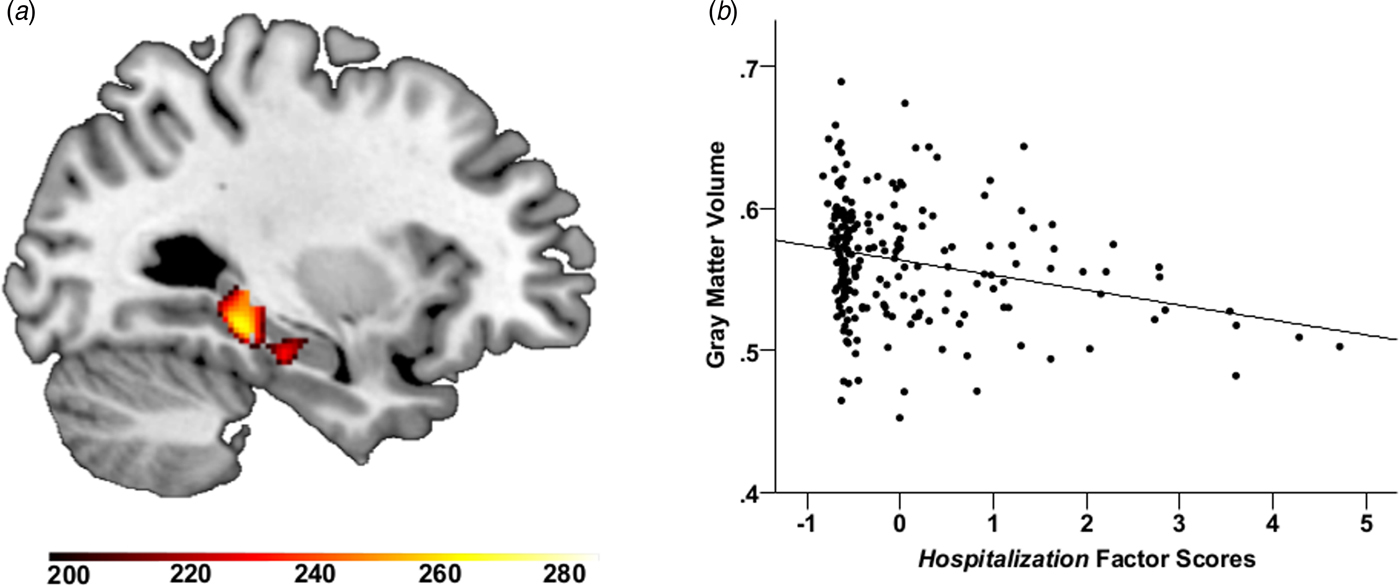
Multiple regression analyses in the patient sample revealed a significant negative association of bilateral hippocampal gray matter volume with Hospitalization component scores (left: x = −22, y = −24, z = −23, k = 525, p FWE = 0.021, r = −0.25; right: x = 22, y = −12, z = −12, k = 186, p FWE = 0.029, r = −0.23, see Fig. 1). Effects of Hospitalization remained highly significant after entering antipsychotic medication and comorbid psychiatric illness as additional covariates (left: x = −22, y = −24, z = −23, k = 466, p FWE = 0.021, r = −0.25; right: x = 22, y = −10, z = −12, k = 160, p FWE = 0.037, r = −0.21). Regression analyses based on the two raw variables revealed a significant negative association of left hippocampal gray matter volume with cumulative lifetime duration of psychiatric hospitalization (x = −33, y = −33, z = −12, k = 422, p FWE = 0.021, r = −0.24) and a tendency for a negative correlation with number of lifetime psychiatric hospitalizations (left: x = −22, y = −24, z = −23, k = 87, p FWE = 0.070, r = −0.22; right: x = 24, y = −10, z = −12, k = 84, p FWE = 0.065, r = −0.23).
Effect of Hospitalization component scores on hippocampal gray matter volume in patients with major depression. (a) Sagittal view (x = −31) depicting gray matter volume negatively associated with Hospitalization component scores. Color bar: TFCE values. (b) Scatter plot depicting gray matter volume at x = −22, y = −24, z = −23 correlated with Hospitalization component scores within the patient sample. Continuous line: regression slope.

Exploratory whole-brain analyses showed a negative association of Hospitalization and gray matter volume in clusters, which comprised parts of the temporal, frontal and occipital lobe as well as the hippocampus (see online supplementary Table S2).
As the main effect of group (patients<healthy controls) did not reach significance, we wanted to investigate if there was a hippocampal reduction if we only compared patients with high Hospitalization factor scores (upper half determined by a median split, n = 107) to healthy controls. Therefore, we performed an additional ANCOVA with diagnosis as a between-subject factor (patients with high Hospitalization factor scores v. healthy controls), controlling for age, sex and years of education. This yielded a highly significant effect, which indicated reduced bilateral hippocampal volumes in these patients compared to healthy controls (left: x = −30, y = −24, z = −26, k = 781, Cohen's d = −0.45, p FWE = 0.009; right: x = 22, y = −27, z = −15, k = 935, Cohen's d = −0.60, p FWE = 0.001).
Discussion
The present data highlight the influence of cumulative illness severity on hippocampal gray matter volume in patients with major depression. To the best of our knowledge, this was the first study to identify principal components based on multiple clinical variables, which characterize patients’ cumulative illness severity. The two components Duration of Illness and Hospitalization explained a significant amount of heterogeneity in cumulative illness severity. Furthermore, we could demonstrate robust inverse effects of the component Hospitalization on bilateral hippocampal gray matter volume.
In contrast to previous studies, we found only a trend of gray matter reductions in patients with major depression compared to healthy controls. Yet, those patients with a severe course of illness did show significant hippocampal volume reductions compared to healthy controls, which indicates that hippocampal alterations might be limited to severe depression. This observation is in line with previous findings on most pronounced reductions in recurrent depression (Stratmann et al. Reference Stratmann, Konrad, Kugel, Krug, Schöning and Ohrmann2014; Schmaal et al. Reference Schmaal, Veltman, van Erp, Sämann, Frodl and Jahanshad2016), early-onset depression (Schmaal et al. Reference Schmaal, Veltman, van Erp, Sämann, Frodl and Jahanshad2016), and patients with at least two years of illness (McKinnon et al. Reference McKinnon, Yucel, Nazarov and MacQueen2009). If only these extreme groups are considered, effect sizes of hippocampal volume reduction are almost always higher.
The component Hospitalization showed a strong association with gray matter values in the hippocampus, a result that could also be replicated given its underlying raw variable cumulative lifetime duration of psychiatric hospitalization. Negative associations of gray matter volume and hospitalization indices have previously been demonstrated in currently depressive inpatients (Axelson et al. Reference Axelson, Doraiswamy, McDonald, Boyko, Tupler and Patterson1993). In outpatients, however, these associations were absent (Bremner et al. Reference Bremner, Narayan, Anderson, Staib, Miller and Charney2000, Reference Bremner, Vythilingam, Vermetten, Nazeer, Adil and Khan2002). Unfortunately, we did not include outpatients in our study, which would have been interesting to enhance the generalizability of results. Compared with clinical variables such as illness duration or the number of lifetime depressive episodes, variables related to the intensity (i.e. number and/or duration) of inpatient treatment are still underrepresented in previous research. Given the pathophysiological relevance of these variables for hippocampal volume and their high reliability, future studies should focus more on variables based on inpatient treatment to investigate the neurobiological effects of cumulative illness severity. It should be noted that the effect of Hospitalization could be demonstrated, although acute symptom severity as indicated by the BDI was controlled for in the analysis. This is in line with previous results indicating that the effect of cumulative illness severity on hippocampal gray matter volume is independent of symptom severity at the time of scanning (McKinnon et al. Reference McKinnon, Yucel, Nazarov and MacQueen2009). Various studies assume that decreased hippocampal volume in patients with major depression is a product of cumulative illness severity (Bell-McGinty et al. Reference Bell-McGinty, Butters, Meltzer, Greer, Reynolds and Becker2002; MacQueen et al. Reference MacQueen, Campbell, McEwen, Macdonald, Amano and Joffe2003; Frodl et al. Reference Frodl, Schaub, Banac, Charypar, Jäger and Kümmler2006, Reference Frodl, Jäger, Smajstrlova, Born, Bottlender and Palladino2008; McKinnon et al. Reference McKinnon, Yucel, Nazarov and MacQueen2009; Zou et al. Reference Zou, Deng, Li, Zhang, Jiang and Huang2010; Stratmann et al. Reference Stratmann, Konrad, Kugel, Krug, Schöning and Ohrmann2014). Given the cellular processes involved in hippocampal atrophy (Sapolsky, Reference Sapolsky2000), it seems likely that neurotoxic damage in the brain is delayed and not immediately associated with acute symptom severity.
The lack of an association between hippocampal volume and the component Duration of Illness was surprising in the light of the neurotoxicity hypothesis. Yet, this result is in line with previous studies, which did not find any association between self-reported illness duration and hippocampal volume (Bremner et al. Reference Bremner, Narayan, Anderson, Staib, Miller and Charney2000; Frodl et al. Reference Frodl, Meisenzahl, Zetzsche, Born, Groll and Jäger2002, Reference Frodl, Schaub, Banac, Charypar, Jäger and Kümmler2006; Lloyd et al. Reference Lloyd, Ferrier, Barber, Gholkar, Young and O'Brien2004). On the other hand, methodological problems due to low accuracy of clinical variables might have driven this finding. This assumption is supported by the rather low reliability of Duration of Illness. Recalling the onset and duration of illness is very demanding for patients due to the often gradual development of depressive symptoms, the long course of illness over decades and the episodic nature of major depression (Wittchen et al. Reference Wittchen, Burke, Semler, Pfister, Cranach and Zaudig1989; Patten et al. Reference Patten, Williams, Lavorato, Bulloch, D'Arcy and Streiner2012). Furthermore, acutely depressed patients are known for their susceptibility to autobiographical memory biases and show a tendency to summarize categories of events rather than retrieving single episodes (Williams et al. Reference Williams, Barnhofer, Crane, Herman, Raes and Watkins2007). Information about past hospitalizations, however, can easily be recollected because hospital admissions reflect selective incidents in patients’ lives (Andrews et al. Reference Andrews, Aantsey, Brodaty, Issakidis and Luscombe1999). These differences in reliability might have driven a two-component structure, where accurate and reliable items loaded on the component Hospitalization and less accurate or biased items on the component Duration of Illness.
The significant negative correlation of the number of lifetime depressive episodes and hippocampal volume has already been shown by previous studies (Videbech & Ravnkilde, Reference Videbech and Ravnkilde2004; Stratmann et al. Reference Stratmann, Konrad, Kugel, Krug, Schöning and Ohrmann2014). This might be attributed to its intermediate position between Duration of Illness and Hospitalization, which was demonstrated by moderate factor loadings on both components (see online supplementary Table S1). Due to the aforementioned problems with recollection biases, hospitalization indices might nevertheless be more reliable than the number of lifetime depressive episodes to estimate cumulative illness severity.
Given the beneficial effects of antidepressant treatment on hippocampal growth in animal models and human patients (Malberg et al. Reference Malberg, Eisch, Nestler and Duman2000; Surget et al. Reference Surget, Saxe, Leman, Ibarguen-Vargas, Chalon and Griebel2008; Arnone et al. Reference Arnone, McKie, Elliott, Juhasz, Thomas and Downey2013), it is noteworthy that despite a long history of inpatient treatment and probably longer history of pharmacotherapy, treated patients still tend to show decreased hippocampal volume. This might result from the effect that patients with more and longer hospitalizations are among those with a severe and chronic disease course of illness, who are more likely to be unresponsive to standard antidepressant treatment. Unfortunately, although we collected medication data, we have no information on the level of individual treatment resistance in this sample following a standardized assessment such as the Thase–Rush Treatment-Resistant Depression Staging Method (Thase & Rush, Reference Thase and Rush1997). One might assume that the negative effects of cumulative illness severity on hippocampal gray matter volume were stronger than the compensatory effects of antidepressant medication, which could have led to an underestimation of the true effect sizes of Hospitalization. The effects of antidepressant medication might have been either too small to be observed in our study or were covered by stronger opposing effects of Hospitalization. Further, we acknowledge that the medication load index we computed was based on information from the current inpatient treatment only. Thus, our medication load indices reflected medication at the time of scanning but not the cumulative lifetime medication load. To exclude confounds due to psychopharmacological effects, more information about patients’ past medication would have been necessary. Although our key findings were not substantially influenced by medication load index or antipsychotic medication, these results need replication in unmedicated patients and longitudinal samples where medication is recorded.
Another potential confounder might have resulted from the inclusion of patients with non-affective psychiatric comorbidities. As decreased hippocampal volume has been demonstrated in various disorders, including anxiety disorders (Smith, Reference Smith2005), our results might be biased by psychiatric comorbidity. As it was important to us to have a large and representative sample of patients with MDD in our study, we decided not to exclude patients with comorbid psychiatric disorders from analyses. However, we accounted for comorbid psychiatric illness by entering an additional covariate to our model, which did not alter the effects of Hospitalization on hippocampal volume.
It should be stated that the component Hospitalization just met the Kaiser–Guttman criterion with an EV of 1.01. Furthermore, this component might be criticized because of psychometric problems of two-item-scales. It is generally suggested that extracted components should be based on at least three different variables (Velicer & Fava, Reference Velicer and Fava1998). However, due to the limited number of variables available, this recommendation could not be met in our study. As both items that underlied Hospitalization were highly correlated, the component might still be considered reliable based on information from only two items.
A limitation of our study is the difficulty to objectively assess measures of illness severity and chronicity and to rely on self-reported measures to characterize patients’ cumulative illness severity. Since self-reported variables are often biased by memory inaccuracies or tendencies towards social desirability, it would be advisable to use additional information sources such as reports from relatives, recent and former therapists or medical records. The inquiry about clinical course variables might be further improved by sophisticated assessment techniques such as the life-charting methodology (Post et al. Reference Post, Roy-Byrne and Uhde1988), which offers autobiographical anchor points to enhance recollection accuracy. However, most previous studies focused solely on patients’ self-report and only a few explicitly reported information from life-charting (Sheline et al. Reference Sheline, Sanghavi, Mintun and Gado1999, Reference Sheline, Gado and Kraemer2003; Lloyd et al. Reference Lloyd, Ferrier, Barber, Gholkar, Young and O'Brien2004) or psychiatric records (Lloyd et al. Reference Lloyd, Ferrier, Barber, Gholkar, Young and O'Brien2004). Furthermore, we were the first to perform principal component analyses on clinical course data, so that our observed two-component-solution needs further replication from independent samples and validation using confirmatory approaches.
The major strength of our study is the integration of multiple clinical variables on composite scores of cumulative illness severity using data-driven principal component analyses. We show that hospitalization indices are well suited to characterize patients’ cumulative illness severity because they might be less prone to memory biases. In sum, the present study clearly shows the importance of patients’ cumulative illness severity when it comes to decreased hippocampal volume in major depression. We conclude that structural characteristics of the brains of depressed patients seem to be susceptible to cumulative illness severity. Future studies should consider hospitalization indices to get an accurate and reliable approximation of patients’ cumulative illness severity. To further evaluate the prognostic power of hospitalizations, longitudinal designs are necessary, which aim at a characterization of patients during different phases of their illness. For a clinical application of our results, it would be interesting to study the plasticity of gray matter reductions trough psychopharmacological and psychotherapeutic interventions. First studies demonstrated hippocampal normalization and growth following electroconvulsive therapy (Redlich et al. Reference Redlich, Opel, Grotegerd, Dohm, Zaremba and Bürger2016), treatment with citalopram (Arnone et al. Reference Arnone, McKie, Elliott, Juhasz, Thomas and Downey2013) and remission of a current episode (Hou et al. Reference Hou, Yuan, Zhang, Bai, Hou and You2012; Phillips et al. Reference Phillips, Batten, Tremblay, Aldosary and Blier2015). Thus, the implications of hippocampal changes in major depression for treatment outcome and recovery are yet to be fully understood.
Acknowledgements
This work was supported by the German Research Foundation (U.D., grant numbers DA1151/5-1, DA1151/5-2, and SFB-TRR58 C09), (T.K., grant number KI588/14-1), (A.K., grant number KO4291/3-1); Innovative Medizinische Forschung (U.D., grant numbers DA120903, DA111107, and DA211012); the Rolf Dierichs-Stiftung (U.D., grant number ZUW80037); and the Interdisciplinary Center for Clinical Research (IZKF) of the medical faculty of Muenster (U.D., grant number Dan3/012/17).
Declaration of Interest
V. A. is a member of the advisory board of or has given presentations on behalf of, the following companies: Astra-Zeneca, Janssen-Organon, Lilly, Lundbeck, Servier, Pfizer, Otsuka, and Trommsdorff. These affiliations are of no relevance to the work described in the manuscript. H. Kugel has received consultation fees from MR:comp GmbH, Testing Services for MR Safety. This cooperation has no relevance to the work that is covered in the manuscript. All other authors report no conflicts of interest, financial or otherwise.
Ethical standards
The authors assert that all procedures contributing to this work comply with the ethical standards of the relevant national and institutional committees on human experimentation and with the Helsinki Declaration of 1975, as revised in 2008.
Supplementary material
The supplementary material for this article can be found at https://doi.org/10.1017/S0033291718000016