Developmental models predicting substance abuse and mental health have documented both negative and positive cascades. A developmental cascade is the longitudinal pathway examining how problems in individual functioning and environmental influences spill over into other domains of functioning and into subsequent developmental periods (Bornstein, Hahn, & Haynes, Reference Bornstein, Hahn and Haynes2010; Lansford, Malone, Dodge, Pettit, & Bates, Reference Lansford, Malone, Dodge, Pettit and Bates2010; Masten & Cicchetti, Reference Masten and Cicchetti2010). Although research has established that social environments are critical to the development of both maladaptive and adaptive functioning, these social environmental influences are sometimes absent from cascade models of development. Furthermore, although it is well known that mental health and substance abuse outcomes are correlated, and may stem from similar etiological roots, their intertwined unfolding across the life course is rarely examined. Moreover, little is known about the development of positive functioning and its relationship to mental health and substance abuse. The present study builds on the social development model and the development cascades framework to model the interplay between individual and social factors in the development of positive functioning, mental health problems, and substance abuse in four developmental periods: childhood, adolescence, the transition to adulthood, and adulthood.
Theoretical Frameworks: Social Development Model and Developmental Cascades
Two frameworks provide the theoretical basis for this study: the social development model and the developmental cascades framework. The social development model outlines specific social environmental mechanisms within each developmental period that drive prosocial and antisocial functioning. The developmental cascades framework provides guidance in conceptualizing multiply determined adaptive and maladaptive processes of development over time (Masten, Reference Masten2006). Putting these two theories together allows us to test a more holistic model of the interplay of individual functioning and social environmental influences in a life course informed, developmental model.
The social development model organizes established risk and protective factors for prosocial and antisocial behavior into a developmental theory (Catalano, Kosterman, Hawkins, Newcomb, & Abbott, Reference Catalano, Kosterman, Hawkins, Newcomb and Abbott1996). Building on social control theory (Hirschi, Reference Hirschi1969), social learning theory (Bandura, Reference Bandura1977), and differential association theory (Sutherland & Cressey, Reference Sutherland and Cressey1970), the social development model provides an organizing framework for studying family, peer, and school and work influences in childhood, adolescence, and adulthood. The social development model articulates the mechanisms of socialization and identifies parallel but separate causal paths for prosocial and antisocial processes. On each path, four socialization processes establish a social bond between an individual and a socialization unit: (a) perception of opportunities for pro- or antisocial behavior; (b) involvement with pro- or antisocial groups; (c) social, emotional, and cognitive skills that enhance involvements and make recognition or reward more likely; and (d) the perception of rewards for interactions with pro- or antisocial groups. Each path is affected by position in the social structure (e.g., race, gender, and socioeconomic status) and by individual difference characteristics (e.g., internalizing or behavioral disinhibition). Following rewarding involvement, youth develop a bond to prosocial or antisocial others and adopt their beliefs, which in turn affects engaging in prosocial or antisocial (health-risk) behaviors. The processes of socialization outlined by the social development model serve to define the nature of the social environment in each developmental period in our model. The social development model has been tested in multiple data sets at different stages of development and was found to predict substance use and misuse, depression, and other problem behaviors as well as positive functioning in adulthood (Brown et al., Reference Brown, Catalano, Fleming, Haggerty, Abbott and Cortes2005; Fleming, Catalano, Oxford, & Harachi, Reference Fleming, Catalano, Oxford and Harachi2002; Huang, Kosterman, Catalano, Hawkins, & Abbott, Reference Huang, Kosterman, Catalano, Hawkins and Abbott2001; Kosterman et al., Reference Kosterman, Hill, Lee, Meacham, Abbott and Catalano2014; Sullivan & Hirschfield, Reference Sullivan and Hirschfield2011).
The developmental cascades framework also guides the present study by theorizing the progression of adaptive and maladaptive development across the life course (Masten & Cicchetti, Reference Masten and Cicchetti2010). Stemming from the field of developmental psychopathology, developmental cascades refer to the within- and across-domain transactional or interactive processes of development from childhood to adulthood (Masten & Cicchetti, Reference Masten and Cicchetti2010). In this framework, outcomes are conceptualized as a result of interactions between individual functioning and environmental influences (Sameroff & MacKenzie, Reference Sameroff and MacKenzie2003). Another important characteristic of this approach is the focus on reciprocal spillover effects across domains of functioning, such as substance use and mental health. Mental health and substance use problems are often comorbid, and the social environments and individual behaviors within these domains likely influence each other. The bidirectional, cross-domain interactions between the individual and the social environment are important to analyze in order to understand the complexity of adaptive and maladaptive development (Masten, Reference Masten2006; Masten & Cicchetti, Reference Masten and Cicchetti2010). By conceptualizing development as a series of cascades, we can learn why some pathways and not others result in lasting difficulties into adulthood.
The developmental cascades approach and the social development model naturally complement each other. Whereas the developmental cascades theory proposes broad principles to organize the interplay between the individual and environmental factors, the social development model offers a specific sequence of social influence by which behavior is shaped. The social development model is inherently a developmental cascade model where the bonds, beliefs, and behaviors that are a result of earlier developmental processes (opportunities, involvement, skills, and rewards) in one developmental period go on to determine the opportunities available in the next developmental period (Elder, Reference Elder1998; Kosterman et al., Reference Kosterman, Hill, Lee, Meacham, Abbott and Catalano2014). However, no previous study has specifically modeled the way social development models flow from childhood to young adulthood and beyond. In addition, the social development model does not specifically theorize bidirectional or long-term influences of individual and social environmental functioning, or the role of mental health in the pro- and antisocial pathways. It is plausible that the social development model structure used to predict antisocial behavior can also predict mental health outcomes. In contrast, few cascade models have incorporated aspects of the social environment (drug-using peers: Haller, Handley, Chassin, & Bountress, Reference Haller, Handley, Chassin and Bountress2010; Lynne-Landsman, Bradshaw, & Ialongo, Reference Lynne-Landsman, Bradshaw and Ialongo2010; peer rejection: Lansford et al., Reference Lansford, Malone, Dodge, Pettit and Bates2010; social competence: Bornstein et al., Reference Bornstein, Hahn and Haynes2010; Burt, Obradović, Long, & Masten, Reference Burt, Obradović, Long and Masten2008; and family adversity: Herrenkohl et al., Reference Herrenkohl, Kosterman, Mason, Hawkins, McCarty and McCauley2010); and still fewer cascade models were found extending cascades of social environments to adulthood. Questions arise from the union of these theories: How do positive social environments in childhood influence later social environments? Is there a cascade of early substance-use environment or family history of depression that affects substance-specific and mental health–specific outcomes in adolescence and beyond? To what extent are these cascades intertwined?
As youth progress through development, the most salient social environment changes over time. Starting with the family in childhood, youth become involved with additional ecological domains as they enter school, meet friends, and connect with their community (Parker, Rubin, Erath, Wojslawowicz, & Buskirk, Reference Parker, Rubin, Erath, Wojslawowicz, Buskirk, Cicchetti and Cohen2006; Rubin & Bukowski, Reference Rubin and Bukowski2011). During the middle school period, peers take on increasing importance and social influence (Rubin & Bukowski, Reference Rubin and Bukowski2011). In late adolescence and increasingly in the transition to adulthood, newly formed romantic relationships become additional socializing agents, providing new opportunities, rewards, and norms (Furman, Simon, Shaffer, & Bouchey, Reference Furman, Simon, Shaffer and Bouchey2002). The social development model is developmentally oriented, such that opportunities, rewards, and norms all change depending on the age of the child and the domain of influence (Catalano & Hawkins, Reference Catalano, Hawkins and Hawkins1996). For example, opportunities for substance use involvement with peers are most frequent and most rewarding during adolescence.
In the current work, we distinguish social environmental influences that are general in nature from those that are specifically linked to substance use or mental health (Bailey, Hill, Meacham, Young, & Hawkins, Reference Bailey, Hill, Meacham, Young and Hawkins2011; Epstein, Hill, Bailey, & Hawkins, Reference Epstein, Hill, Bailey and Hawkins2013; Hill, Hawkins, Catalano, Abbott, & Guo, Reference Hill, Hawkins, Catalano, Abbott and Guo2005; Lee et al., Reference Lee, Hill, Guttmannova, Bailey, Hartigan and Hawkins2012). This separation of general and specific allows models to separate influences that may share common risk factors versus risks that are predictive of mental health or substance use problems alone (Bailey et al., Reference Bailey, Hill, Meacham, Young and Hawkins2011). General factors include the overall functioning of the social environment such as family management and family conflict, and are linked to a variety of subsequent problem behaviors and mental health outcomes (Reinherz, Giaconia, Carmola Hauf, Wasserman, & Paradis, Reference Reinherz, Giaconia, Carmola Hauf, Wasserman and Paradis2000). In contrast, specific factors are conceptualized as those environmental factors specifically related to the outcome under study such as family substance-use environment or family history of mental health problems. For instance, early exposure to mental health problems in the family domain has been linked to later mental health problems in offspring (Mars et al., Reference Mars, Collishaw, Smith, Thapar, Potter and Sellers2012; Weissman et al., Reference Weissman, Wickramaratne, Nomura, Warner, Pilowsky and Verdeli2006).
To sum, the current study examines general positive social environments and specific mental health and substance abuse domains. Building on the social development model and the developmental cascades framework, our model seeks to (a) concatenate multiple social developmental models from childhood, adolescence, and adulthood; (b) integrate general positive social environments, mental health, and substance use domains; (c) model the interactions between social environment and individual functioning across development from childhood to adulthood; and (d) model potential long-reaching effects of early social environments on later social environments and outcomes.
Positive Developmental Cascade
Positive social environments, such as well-functioning families and nondelinquent peers, play a critical role in healthy development (Catalano, Hawkins, Berglund, Pollard, & Arthur, Reference Catalano, Hawkins, Berglund, Pollard and Arthur2002). Each social environment contributes to development as individuals age and has the potential to have cascading influences over time. Because of their primacy in the developmental order, families have the greatest potential to influence further behavior as well as to create a structure for future social interactions with peers and, later on, with romantic partners (Catalano et al., Reference Catalano, Hawkins, Berglund, Pollard and Arthur2002; Donnellan, Larsen-Rife, & Conger, Reference Donnellan, Larsen-Rife and Conger2005; Rhule-Louie & McMahon, Reference Rhule-Louie and McMahon2007). Positive family environments have been shown to predict positive youth development and youth community contributions (Lewin-Bizan, Bowers, & Lerner, Reference Lewin-Bizan, Bowers and Lerner2010), positive social support in early and middle adulthood (Graves, Wang, Mead, Johnson, & Klag, Reference Graves, Wang, Mead, Johnson and Klag1998), reduced delinquency (Yoshikawa, Reference Yoshikawa1994), and better physical health in midlife (Repetti, Taylor, & Seeman, Reference Repetti, Taylor and Seeman2002; Russek & Schwartz, Reference Russek and Schwartz1997). In the positive social environment cascade, the current study explores long-term effects of positive families, and the effect of positive families on peer and romantic partner social environments and individual functioning.
Peer influences increase in importance as youth transition into middle school where they encounter more and more diverse peer networks (Catalano & Hawkins, Reference Catalano, Hawkins and Hawkins1996; Parker et al., Reference Parker, Rubin, Erath, Wojslawowicz, Buskirk, Cicchetti and Cohen2006; Rubin & Bukowski, Reference Rubin and Bukowski2011). As children spend more time away from their parents, peers become a powerful socializing force, one that can be either prosocial or antisocial. Peer relationships with prosocial peers can serve as powerful protective factors and have been linked to a lower likelihood of externalizing behavior (Criss, Pettit, Bates, Dodge, & Lapp, Reference Criss, Pettit, Bates, Dodge and Lapp2002). Positive peers have also been shown to mitigate the effects of negative family experiences and victimization (Schwartz, McFadyen-Ketchum, Dodge, Pettit, & Bates, Reference Schwartz, McFadyen-Ketchum, Dodge, Pettit and Bates1999). In contrast, having antisocial or substance-using peers is strongly linked to increased risk for substance use and poor mental health (Hawkins, Catalano, & Miller, Reference Hawkins, Catalano and Miller1992; Stone, Becker, Huber, & Catalano, Reference Stone, Becker, Huber and Catalano2012).
In young adulthood, as individuals begin forming lasting unions with romantic partners, they bring the skills and practices learned in their family of origin to their partner environments (Bachman et al., Reference Bachman, O'Malley, Schulenberg, Johnston, Bryant and Merline2002). Some have argued that peer relationships serve as important templates for later romantic relationships, and most romantic partners are selected from the peer group (Connolly, Furman, & Konarski, Reference Connolly, Furman and Konarski2000; Furman et al., Reference Furman, Simon, Shaffer and Bouchey2002). Forming a supportive and positive bond with a romantic partner can have cascading effects that increase positive functioning and reduce the likelihood of mental illness and substance use disorders (Horwitz, White, & Howell-White, Reference Horwitz, White and Howell-White1996; Leonard & Rothbard, Reference Leonard and Rothbard1999; Rhule-Louie & McMahon, Reference Rhule-Louie and McMahon2007).
Mental Health Cascade
Life course trajectories to mental health problems have many sources, some of which stem from early social experiences within families, family members that experience mental health problems, and individual difference characteristics. Each of these risk factors has been shown to contribute to the development of mental health problems across development (Mason et al., Reference Mason, Kosterman, Hawkins, Herrenkohl, Lengua and McCauley2004; McCauley, Pavlidis, & Kendall, Reference McCauley, Pavlidis and Kendall2001; Reinherz et al., Reference Reinherz, Giaconia, Carmola Hauf, Wasserman and Paradis2000; Reinherz, Paradis, Giaconia, Stashwick, & Fitzmaurice, Reference Reinherz, Paradis, Giaconia, Stashwick and Fitzmaurice2003; Repetti et al., Reference Repetti, Taylor and Seeman2002; Weissman et al., Reference Weissman, Wickramaratne, Nomura, Warner, Pilowsky and Verdeli2006). The mental health cascade examined in the current study includes family history of depression, internalizing tendencies in adolescence, and major depressive episode and generalized anxiety disorder symptoms and diagnosis.
Just as the general family environment has been shown to have long-lasting effects on functioning, early exposure to mental illness of family members has been linked to children's mental health problems in adolescence and young adulthood (McCauley et al., Reference McCauley, Pavlidis and Kendall2001). Family history of depression has been studied extensively and shown to be a strong predictor of mental health problems in childhood and adulthood, including internalizing and depression (Leve, Kim, & Pears, Reference Leve, Kim and Pears2005; Mars et al., Reference Mars, Collishaw, Smith, Thapar, Potter and Sellers2012; McCauley et al., Reference McCauley, Pavlidis and Kendall2001; Reinherz et al., Reference Reinherz, Paradis, Giaconia, Stashwick and Fitzmaurice2003; Weissman et al., Reference Weissman, Wickramaratne, Nomura, Warner, Pilowsky and Verdeli2006).
One mechanism for transmitting mental health problems from parents to children is through child internalizing. Internalizing has been conceptualized as a “core disturbance in intropunitive emotions and mood” (Zahn-Waxler, Klimes-Dougan, & Slattery, Reference Zahn-Waxler, Klimes-Dougan and Slattery2000, p. 443), suggesting an increased tendency toward anxiety and depression. That internalizing is a risk factor for later mood and anxiety symptoms is well established (Reinherz et al., Reference Reinherz, Giaconia, Carmola Hauf, Wasserman and Paradis2000), but studies of the cascading influences of internalizing have shown mixed results. Many researchers have found that internalizing impacts important developmental outcomes at various developmental periods. For example, Masten et al. (Reference Masten, Roisman, Long, Burt, Obradović and Riley2005) found that internalizing in adolescence was protective for developing later externalizing problems in adulthood, while Bornstein et al. (Reference Bornstein, Hahn and Haynes2010) found that internalizing in childhood predicted externalizing problems at age 14. Further research is needed to understand the developmental progression of internalizing tendencies as well as potential cross-domain cascading effects on other developmental outcomes.
Mental health problems in childhood and adolescence are often precursors to later life mood and anxiety problems. Etiological pathways predicting anxiety and depression have been found to be distinct (Roza, Hofstra, van der Ende, & Verhulst, Reference Roza, Hofstra, van der Ende and Verhulst2003), as well as interrelated, across time (Beesdo, Pine, Lieb, & Wittchen, Reference Beesdo, Pine, Lieb and Wittchen2010; Grant et al., Reference Grant, Goldstein, Chou, Huang, Stinson and Dawson2009). Symptoms of depression in adolescence have been linked to depression diagnosis in adulthood (Birmaher et al., Reference Birmaher, Ryan, Williamson, Brent, Kaufman and Dahl1996; Lewinsohn, Rohde, Klein, & Seeley, Reference Lewinsohn, Rohde, Klein and Seeley1999; McCauley et al., Reference McCauley, Pavlidis and Kendall2001; Pine, Cohen, Cohen, & Brook, Reference Pine, Cohen, Cohen and Brook1999). Similarly, continuity of anxiety from adolescence to adulthood has also been found in several epidemiological studies (Pine, Cohen, Gurley, Brook, & Ma, Reference Pine, Cohen, Gurley, Brook and Ma1998). In turn, anxiety and depression disorders in adulthood have been shown to impair psychosocial functioning, including reduced physical activity (Goodwin, Reference Goodwin2003) and quality of life (Schmitz, Kruse, & Kugler, Reference Schmitz, Kruse and Kugler2004). Less is known about the longitudinal progression of anxiety and depressive disorders in relation to social environmental influences and substances use.
Substance Use and Abuse Cascade
The etiology of substance abuse includes social environmental influences from family, peers, and romantic partners (Bailey et al., Reference Bailey, Hill, Meacham, Young and Hawkins2011; Haller et al., Reference Haller, Handley, Chassin and Bountress2010; Lynne-Landsman et al., Reference Lynne-Landsman, Bradshaw and Ialongo2010), as well as individual difference characteristics such as behavioral disinhibition (Englund & Siebenbruner, Reference Englund and Siebenbruner2012; Iacono, Malone, & McGue, Reference Iacono, Malone and McGue2008; Merline, Jager, & Schulenberg, Reference Merline, Jager and Schulenberg2008; Piehler, Véronneau, & Dishion, Reference Piehler, Véronneau and Dishion2012; Stone et al., Reference Stone, Becker, Huber and Catalano2012). Early substance use and behavioral disinhibition are both indicators of individual functioning that have been found to influence trajectories of substance abuse (Franken, Muris, & Georgieva, Reference Franken, Muris and Georgieva2006). The present study examines substance use specific family, peer, and partner social environments as well as individual factors of behavioral disinhibition, early substance use, and continued patterns of abuse and/or dependence.
As mentioned in the earlier section on positive cascades, poor family functioning, such as increased conflict and low bonding, have been related to youth substance use outcomes. Another important mechanism involves families that expose their children to substance use or involve youth in their own substance-using behaviors. These substance-specific attributes of families have been shown to significantly increase the likelihood that youth will use substances as adolescents and have substance use problems as adults (Bailey et al., Reference Bailey, Hill, Meacham, Young and Hawkins2011; Stone et al., Reference Stone, Becker, Huber and Catalano2012). Parental alcohol abuse is also a well-established risk factor for alcohol use disorder, which is likely related to shared genetic risk as well as modeling of alcohol-related behaviors (McGue, Iacono, & Krueger, Reference McGue, Iacono and Krueger2006; Merline et al., Reference Merline, Jager and Schulenberg2008). Individuals raised in families with histories of substance abuse have significant increased risk to develop substance use disorders later in life (Stone et al., Reference Stone, Becker, Huber and Catalano2012) and are more likely to start using substances early and use persistently (Chassin, Flora, & King, Reference Chassin, Flora and King2004). Children of parents who smoke are also more likely to smoke, and children of parents who use marijuana are more likely to use marijuana (Bailey, Hill, Oesterle, & Hawkins, Reference Bailey, Hill, Oesterle and Hawkins2006).
While family substance-using environments are a well-supported risk factor for substance use, less is known about how family substance-use environments will influence subsequent substance-using social environments. Growing up in a substance-using environment has been shown to be a risk factor for selecting into substance-using partner social environments (Epstein et al., Reference Epstein, Hill, Bailey and Hawkins2013; Harter, Reference Harter2000). In another example, Haller et al. (Reference Haller, Handley, Chassin and Bountress2010) found that parental alcoholism's cascading effect on adult alcohol dependence was mediated by affiliation with substance-using peers. These studies point to the importance of understanding the cascading effects families, peers, and partners have on the development of substance abuse problems at each stage in development.
Family substance use problems can also affect child substance use in indirect ways, such as increasing behavioral disinhibition tendencies that are, in turn, linked to problem behavior (Handley et al., Reference Handley, Chassin, Haller, Bountress, Dandreaux and Beltran2011). Behavioral disinhibition is theorized to be an enduring individual difference characteristic; it has been associated with an increased likelihood of early onset substance use (McGue, Iacono, Legrand, Malone, & Elkins, Reference McGue, Iacono, Legrand, Malone and Elkins2001; Tarter et al., Reference Tarter, Kirisci, Mezzich, Cornelius, Pajer and Vanyukov2003) and substance abuse in young adulthood (Bijttebier, Beck, Claes, & Vandereycken, Reference Bijttebier, Beck, Claes and Vandereycken2009; Franken & Muris, Reference Franken and Muris2006; Pardo, Aguilar, Molinuevo, & Torrubia, Reference Pardo, Aguilar, Molinuevo and Torrubia2007). Studies have also indicated that behavioral disinhibition is a precursor to association with deviant peers, and may be a mechanism driving youth to seek out substance-using peers (Kirisci, Mezzich, Reynolds, Tarter, & Aytaclar, Reference Kirisci, Mezzich, Reynolds, Tarter and Aytaclar2009; Yanovitzky, Reference Yanovitzky2005).
In adolescence, peer substance use has been shown to be a robust predictor of concurrent substance abuse because most substance use takes place in the peer social environment (Haller et al., Reference Haller, Handley, Chassin and Bountress2010; Hawkins et al., Reference Hawkins, Catalano and Miller1992; Oxford, Oxford, Harachi, Catalano, & Abbott, Reference Oxford, Oxford, Harachi, Catalano and Abbott2001; Piehler et al., Reference Piehler, Véronneau and Dishion2012). Adolescents choose their peers, and they may do so based on shared activities, including substance use; peers may also influence each other to try new things (Dishion & Owen, Reference Dishion and Owen2002; Knecht, Burk, Weesie, & Steglich, Reference Knecht, Burk, Weesie and Steglich2011; Knecht, Snijders, Baerveldt, Steglich, & Raub, Reference Knecht, Snijders, Baerveldt, Steglich and Raub2010; Poulin, Kiesner, Pedersen, & Dishion, Reference Poulin, Kiesner, Pedersen and Dishion2011). Researchers have found that associating with antisocial peers predicts substance use initiation (Guo, Hill, Hawkins, Catalano, & Abbott, Reference Guo, Hill, Hawkins, Catalano and Abbott2002) and persistent substance use into adulthood (Haller et al., Reference Haller, Handley, Chassin and Bountress2010; Lee et al., Reference Lee, Hill, Guttmannova, Bailey, Hartigan and Hawkins2012). In addition, because the peer environment is often the source of potential romantic partners and serves as an important social environment for learning relationship skills and patterns (Connolly et al., Reference Connolly, Furman and Konarski2000; Furman et al., Reference Furman, Simon, Shaffer and Bouchey2002; Rhule-Louie & McMahon, Reference Rhule-Louie and McMahon2007), peer substance-using social environments can influence youth to develop romantic relationships with substance-using partners.
Romantic partners have a high concordance of substance use behavior (Rhule-Louie & McMahon, Reference Rhule-Louie and McMahon2007). This may be due to a selection of romantic partners based on one's own substance use behavior, or through the social environmental influences of opportunities for substance use, perceived rewards for involvement, and bonding to the substance-using partner (Fleming, White, & Catalano, Reference Fleming, White and Catalano2010; Leonard & Rothbard, Reference Leonard and Rothbard1999). For example, Fleming et al. (Reference Fleming, White and Catalano2010) found that romantic partnerships were protective against substance use when one was bonded to a non-substance-using partner.
Interplay Between Social Environments and Individual Functioning
In addition to the effects of the social environment on individual functioning, individual functioning can have reciprocal effects on social environments. These person–environment correlations have often been discussed in the context of gene–environment correlation, citing evocative or reactive (different individuals evoke different environmental responses), selective (different individuals select different environments), and passive (parents who create a child's environment also share much of that child's genotype) mechanisms to account for these effects (Hicks et al., Reference Hicks, Johnson, Durbin, Blonigen, Iacono and McGue2013; Plomin, DeFries, & Loehlin, Reference Plomin, DeFries and Loehlin1977). However, this relationship is not simple because ultimately the pathway from genes to environments must involve behavior, which is itself determined by both genes and environments (Jaffee & Price, Reference Jaffee and Price2007; Knafo & Jaffee, Reference Knafo and Jaffee2013), and much of the work on measured gene–environment interplay over the last decade has been difficult to replicate (Colhoun, McKeigue, & Smith, Reference Colhoun, McKeigue and Smith2003; Duncan & Keller, Reference Duncan and Keller2011; Duncan, Pollastri, & Smoller, Reference Duncan, Pollastri and Smoller2014). Whatever the source of these individual differences, the possibility that individuals can influence their social environment through their behavior is at the core of the interplay of individual functioning and social environments. This interplay influences the developmental processes that lead to adaptive or maladaptive outcomes (Sameroff & MacKenzie, Reference Sameroff and MacKenzie2003).
The connecting link between individual functioning and social environment is especially evident in the peer domain during adolescence, where individual differences may influence the selection of friends with similar behaviors (Parker et al., Reference Parker, Rubin, Erath, Wojslawowicz, Buskirk, Cicchetti and Cohen2006). For example, several studies have shown that individuals with early manifestations of psychopathology, including tendencies toward internalizing, select less positive peers (Bornstein et al., Reference Bornstein, Hahn and Haynes2010; Burt et al., Reference Burt, Obradović, Long and Masten2008; Obradović, Burt, & Masten, Reference Obradović, Burt and Masten2009); and higher behavioral disinhibition has been linked to selecting into drug-using peer networks (Kirisci et al., Reference Kirisci, Mezzich, Reynolds, Tarter and Aytaclar2009; Yanovitzky, Reference Yanovitzky2005). Others have found that adolescents who experienced depression in their youth are more likely to have social problems and more difficulties with peer relationships (Lewinsohn, Rohde, Seeley, Klein, & Gotlib, Reference Lewinsohn, Rohde, Seeley, Klein and Gotlib2003).
Similarly, individuals tend to select romantic partners with similar patterns of behavior, and those mentally healthy individuals are more likely to be partnered (Knight, Reference Knight2011; Rhule-Louie & McMahon, Reference Rhule-Louie and McMahon2007). Thus, we might expect that one's mental health and substance use problems would impact the quality of an individual's romantic partner relationship by influencing selection of a less positive partner environment and difficulties in partnership due to mental health and substance use issues. Correlational studies have established associations between depression and romantic partner relationship strain (Teo, Choi, & Valenstein, Reference Teo, Choi and Valenstein2013), but no longitudinal studies were found linking depression to later romantic partner relationship quality. Further investigation of the relationship between early indicators of psychopathology and the selection of positive peer and partner environments, and their reciprocal influences over time is needed.
Interplay of Substance Abuse and Mental Health Cascades
The common co-occurrence of substance abuse and mental health problems is well documented in cross-sectional studies (Brady & Sinha, Reference Brady and Sinha2005; Compton, Thomas, Stinson, & Grant, Reference Compton, Thomas, Stinson and Grant2007) and has been estimated to range from 32% to 54% (Brady & Sinha, Reference Brady and Sinha2005). Some evidence suggests that substance use may drive mental health problems as well as the reverse. However, few studies have approached the comorbidity between substance use and mental health developmentally; consequently, we know little about the interplay between these disorders across developmental periods.
The pattern of effects is mixed in the literature testing the first hypothesis: that substance use predicts mental health problems. Substance use (and other externalizing behaviors) in youth have been linked with adult depression in some studies (Capaldi & Stoolmiller, Reference Capaldi and Stoolmiller1999; Wolff & Ollendick, Reference Wolff and Ollendick2006; Zoccolillo, Reference Zoccolillo1992), whereas others found no association (Wiesner & Windle, Reference Wiesner and Windle2006). In a review of 48 studies linking psychological problems and illicit drug use in young adults, Macleod et al. (Reference Macleod, Oakes, Copello, Crome, Egger and Hickman2004) found inconclusive evidence of this hypothesis and noted that associations between substance use and psychological problems were inconsistent across studies.
The reverse hypothesis that mental health problems may drive substance use is often referred to as the theory of self-medication, which suggests that individuals with mental health problems attempt to self-treat their symptoms by using substances (Khantzian, Reference Khantzian1997; Markou, Kosten, & Koob, Reference Markou, Kosten and Koob1998). For example, researchers have demonstrated that early internalizing has been shown to predict later alcohol and other drug use, as well as alcohol dependence (Englund & Siebenbruner, Reference Englund and Siebenbruner2012; Merline et al., Reference Merline, Jager and Schulenberg2008; Tomlinson & Brown, Reference Tomlinson and Brown2012). Some studies of adults have also found that depression or other mental health disorders often precede substance abuse (Burke, Burke, & Rae, Reference Burke, Burke and Rae1994; Mason, Hitchings, & Spoth, Reference Mason, Hitchings and Spoth2008). However, others have questioned the continued use of the self-medication hypothesis given its modest supporting evidence, especially the weakness of arguments establishing that mental health causes subsequent substance use (Lembke, Reference Lembke2012). In addition to the lack of consensus about mental health's influence on substance use, differences in the developmental timing of these effects are also missing from the literature.
Overall, the high concordance of mental health and substance use problems suggests that these issues should be examined together. Moreover, the interplay between substance use and mental health is likely to differ at different points in development. Finally, the concurrence is likely to be driven by shared risk and protective factors over time and may have common consequences. Thus, a developmentally sensitive cascade approach that models the interplay of social environmental and individual risk is needed.
The Present Study
In the present study, three developmental cascades were examined: positive environment and functioning, mental-health related environment and functioning, and substance-use environment and functioning. Three features were examined within each cascade: (a) continuity of social environments and individual functioning across developmental periods, (b) effect of social environments on proximal individual functioning, and (c) long-term effects of early social environmental influences on later social environments and outcomes within the same domain. In addition, we examined the reciprocal influence of individual factors and the social environment within a cascade, as well as the interplay between developmental cascades. We propose two broad research questions. Research questions 1a–c examined the developmental cascades of positive social environments, mental health, and substance use. Research questions 2a–b focused on the interplay between individuals and their social environment and the interplay of mental health and substance abuse cascades across development.
-
Research question 1a: What are the cascading effects of positive social environments across development?
We hypothesized that early exposure to positive family environment begins a developmental cascade influencing (a) the selection of positive peers in adolescence; (b) the selection of positive romantic partners in young adulthood; (c) improved proximal individual functioning, including in the areas of internalizing, behavioral disinhibition, and early substance use in adolescence; and (d) improved mental health and substance use outcomes in adulthood.
-
Research question 1b: What are the cascading effects of family history of depression on mental health across development?
Similar to research question 1a, we hypothesized that early exposure to mental health problems in the family would begin a cascade of mental health problems. We hypothesized that family mental health histories impact youth mental health by (a) increasing internalizing in adolescence, (b) increasing the likelihood of developing mood and anxiety disorder symptoms in young adulthood, and (c) increasing the occurrence of mental health diagnoses in adulthood.
-
Research question 1c: What are the cascading influences of early substance-using environments and substance use across development?
Similar to research questions 1a and 1b, we hypothesized that the effects of family substance-use environments cascade to (a) proximal individual functioning outcomes, including early substance use and behavioral disinhibition; (b) later substance-using environments, including selection of substance-using peers and romantic partners; and (c) substance use problems in increasing severity across development.
-
Research question 2a: How do individual differences and behaviors influence the selection of positive social environments?
We hypothesized that individual functioning also plays an important role in the development of positive social environment. We predicted that behavioral disinhibition, substance use, and mental health problems all negatively affect an individual's ability to engage with positive social environments. Specifically, we hypothesized that a tendency toward internalizing, behavioral disinhibition, and early substance use all influence the selection of fewer prosocial peers in adolescence. Similarly, we hypothesized that mental health and substance use problems in young adulthood negatively impact romantic partner social environment in early adulthood.
-
Research question 2b: How do mental health and substance abuse problems interact to influence each other across development?
We hypothesized that substance-using environments and one's own substance use will have an impact on the development of mental health problems across the life course. We also investigated the self-medication hypothesis by examining whether internalizing, mood, and anxiety disorder symptoms increase the likelihood of developing substance use problems at later time points.
Methods
Sample
This study used longitudinal data from the Seattle Social Development Project (SSDP), a community-based sample of 808 participants enrolled in a longitudinal study of the development of prosocial and antisocial behaviors. The sample was originally recruited in 1985 from 18 elementary schools serving primarily higher risk neighborhoods; however, due to mandatory bussing at that time, some participants were included from a range of other neighborhoods. Participants are ethnically diverse, with 47% identifying as Caucasian, 26% African American, 22% Asian American, and 5% Native American. The sample is also gender balanced (49% female), and 52% of the participants met criteria for the National School Lunch/School Breakfast program during at least 1 year between fifth and seventh grade. Participants were interviewed at ages 10, 11, 12, 13, 14, 15, 16, and 18; and their parents completed questionnaires when participants were age 10–16. Follow-up interviews were conducted with participants at ages 21, 24, 27, 30, and 33. SSDP has maintained retention rates above 90% in adulthood, with 92% of the still living sample interviewed at age 33 (23 participants were deceased by age 33). A subset of the SSDP sample received a preventative intervention in elementary school, consisting of individual, parent, and teacher components (for a full description of the intervention, see Hawkins, Catalano, Kosterman, Abbott, & Hill, Reference Hawkins, Catalano, Kosterman, Abbott and Hill1999).
Measures
Measures of the environment that are operationalized as scales that include items representing an underlying construct (e.g., general family environment) are reported with Cronbach α reliabilities. Measures that are dichotomous (e.g., early substance use) or index based (e.g., major depressive disorder symptoms or family history of depression) are not expected to have internal consistency, because they are not representative of an underlying construct. Thus, no reliabilities are reported for dichotomous or index variables. Details of each variable included in the analysis are enumerated below.
Family domain
The positive family environment scale included youth reports at ages 10 and 11 of family involvement, family bonding, family conflict (reverse coded), and family management. Items within each construct were averaged and standardized to create a scale score at each age, which was then combined for a single measure of family functioning at ages 10–12. The average reliability across ages 10–12 was α = 0.83. Examples of items included “The rules in my family are clear” and “Do you share your thoughts and feelings with your father?” The family substance-use environment scale included parent reports of parents and siblings using alcohol, tobacco, or marijuana; their attitudes toward these substances; and parents' involvement of youth in their use of these substances (e.g., lighting a cigarette for parent). Items were measured prospectively, when youth were between 10 and 12 years old. Scales were constructed by averaging and standardizing items. The average reliability of drug-specific environment across ages 10–12 was α = 0.71. Examples of items include “Has your child ever brought cigarettes for a family member” and “Has your child ever brought, opened, or poured a drink containing alcohol for a family member?” Family history of depression index was measured retrospectively by the participants at age 24. Participants reported whether their biological mother, father, siblings, or other family members had a history of depression. The number of family members with depression was summed for an overall score.
Peer domain
The positive peer environment scale in high school (ages 15–18) included measures of prosocial peer involvement in school, positive support from peers, peer efforts at success in school, and opportunities for antisocial involvement (reverse coded). These measures were collected prospectively at ages 15, 16, and 18, and had an average reliability across ages of α = 0.67. Positive peer support and involvement measures included items such as “Does your best friend try to do well in school,” “Does your best friend let you know when you've done something well,” and “Has your best friend ever asked or expected you to do things that could get you in trouble with your parents, the school, or the police?” The positive peer and antisocial opportunities (reverse coded) scales were averaged and standardized to create a scale of the general positive functioning of an individual's peer environment. The peer substance-use environment scale included measures of peer drinking and marijuana use. Peer marijuana use was measured prospectively at ages 15, 16, and 18, and included items about how many of the respondents' close friends used marijuana. Peer alcohol use was the number of friends who had tried alcohol (beer, wine, or liquor) without their parents' knowledge, gotten drunk, or used alcohol with friends. We created a measure of the proportion of respondents' friends who used alcohol or marijuana. If a respondent had more friends who used these substances, he or she would have a higher proportion of substance-using friends.
Partner domain
Positive partner environment is a scale of bonding to romantic partners, positive involvement with partner, and a lack of conflict with one's partner. Romantic partnerships were self-defined and included heterosexual and homosexual couples and married and nonmarried couples. Measures were collected prospectively at ages 24 and 27, and include items such as “Do you enjoy spending time with your partner,” “My partner includes me in important decisions,” and “How often do you and your partner quarrel?” The average reliability of these items across ages 24–27 was α = 0.89. Items were averaged and then standardized to create a scale score. Participants were given a scale score if they were partnered at either wave of data collection, age 24 or 27. There were 620 respondents who had a relationship at least one time point, 154 who did not, with 34 missing values. Those who were not partnered during either wave were treated as missing. Participants who were not partnered were included in the analysis because romantic partner relationships are just one mechanism in the model, and including unpartnered individuals allows their responses to inform the remainder of the model.
Partner substance-use environment
Participants were asked to report on their partner's substance use and whether he or she smoked, drank heavily, or used marijuana or other drugs in the past year. A dichotomous variable was created, coded as 1 if the participant's partner used any substances or drank heavily in the past year, and as 0 if he or she did not.
Individual functioning
An internalizing scale was created using teacher-reported items from the Child Behavior Checklist at ages 13–14. Using Achenbach's (Reference Achenbach, Dumenci and Rescorla2001) system of translating the Child Behavior Checklist items to DSM-like categories, items that were similar to affective problems and anxiety problems were used to create a scale of internalizing behavior. Examples of items used in the affective problems subscale include “cries a lot,” “feels worthless or inferior,” “apathetic or unmotivated,” and “unhappy, sad, or depressed.” Items from the anxiety subscale include “nervous, high-strung, or tense,” “too fearful or anxious,” and “worrying.” Item response options include not true, sometimes true, and often or very true. These subscales were averaged and standardized to create a scale score of internalizing, with an average reliability across ages 13–14 of α = 0.77. Teacher reports of internalizing have been found to have significant convergent validity (Kosterman et al., Reference Kosterman, Hawkins, Mason, Herrenkohl, Lengua and McCauley2010). A behavioral disinhibition scale was based on the measure of behavioral disinhibition from Hill et al. (Reference Hill, Hawkins, Bailey, Catalano, Abbott and Shapiro2010). This scale was created from items asked prospectively of participants at age 14. Examples of items include: “How many times have you done the following things: Done what feels good, regardless of the consequences? Gone to a wild, uninhibited party? Done risky things even if they are a little frightening.” Items were averaged and standardized to create a scale of behavioral disinhibition at age 14 with reliability of α = 0.78. Early substance use was created as a dichotomous variable of whether the participant reported using any marijuana, cigarettes, or alcohol at ages 13 or 14. Generalized anxiety disorder (GAD) symptoms was the count of the number of symptoms of GAD that a participant experienced in the past year on the age 21 survey using the Diagnostic Interview Schedule (DIS; Robins, Helzer, Croughan, Williams, & Spitzer, Reference Robins, Helzer, Croughan, Williams and Spitzer1981). The DIS was based on the DSM-III-R (American Psychiatric Association, 1987) diagnostic criteria. The DIS has frequently been used in studies of mental illness in adults from the general population, and it has been found to be both reliable and valid (Mason et al., Reference Mason, Kosterman, Hawkins, Herrenkohl, Lengua and McCauley2004; Newman et al., Reference Newman, Moffitt, Caspi, Magdol, Silva and Stanton1996; Reinherz et al., Reference Reinherz, Giaconia, Carmola Hauf, Wasserman and Paradis2000). GAD diagnosis was created by determining whether the participant met the diagnostic criteria for GAD diagnosis in the past year as determined by the DIS at ages 30 or 33. Participant were given a 1 if they met criteria for diagnosis at either age 30 or 33; 0 meaning that they did not meet criteria at either age. Symptom count was used as the measure at age 21 to capture subclinical symptoms, while diagnosis was used at ages 30–33 to assess an increase in severity. Major depressive episode (MDE) symptoms was the count of symptoms of an MDE experienced by the participant at age 21. This count was also collected using the DIS based on DSM III-R criteria. Similar to GAD diagnosis, MDE diagnosis at ages 30 or 33 was determined by whether the participant met criteria for a major depression episode in the past year at either the data collection at age 30 or 33. A dichotomous variable was created with 1 meaning that the participant had met criteria for an MDE episode at least once at age 30 or 33, and 0 meaning the participant did not meet criteria at either age. A global measure of positive functioning was created and based on Kosterman et al.'s (Reference Kosterman, Hill, Lee, Meacham, Abbott and Catalano2014) index of positive adult functioning. Using the constructs of constructive engagement, civic engagement, and physical exercise, an index of positive functioning was created at ages 30–33. Constructive engagement was defined as the total number of hours spent in work, school, or homework; civic engagement refers to the hours per month spent in community groups and volunteering; and physical exercise was measured by self-reported minutes per week of at least moderate intensity exercise. These scales were then averaged and standardized, and the mean standardized score across ages 30–33 formed the final continuous measure of positive adult functioning. Because we do not expect high correlation between the disparate scales of positive functioning, we constructed this measure as an index and not a scale, and therefore do not report reliability.
Control variables
We included a number of control variables in our model. Gender was self-reported, with males coded as 1 and females as 0. Race/ethnicity was a dummy variable of the primary ethnicity reported by respondents. European Americans were the referent group. Childhood poverty was included as a control, and was coded as a dichotomous variable of whether a participant's family met criteria for the free lunch program at school in either fifth, sixth, or seventh grade.
Intervention condition
To test for differences by intervention group, a dummy variable was created with 1 indicating that a respondent was part of the full intervention condition; a 0 meant that the respondent was not. A parallel process was used for the control group: a 1 indicated that the respondent was part of the control group and received no intervention and a 0 meant that the respondent was not in the control group.
Results
Analyses
Path analysis was employed to estimate all models using Mplus version 7.11 (Muthén & Muthén, Reference Muthén and Muthén2008). Eight variables (family positive environment, family substance-use environment, family history of depression, internalizing, behavioral disinhibition, peer substance-use environment, partner general environment, and positive functioning in adulthood) were treated as continuous, whereas the remainder were treated as dichotomous or ordered categorical.
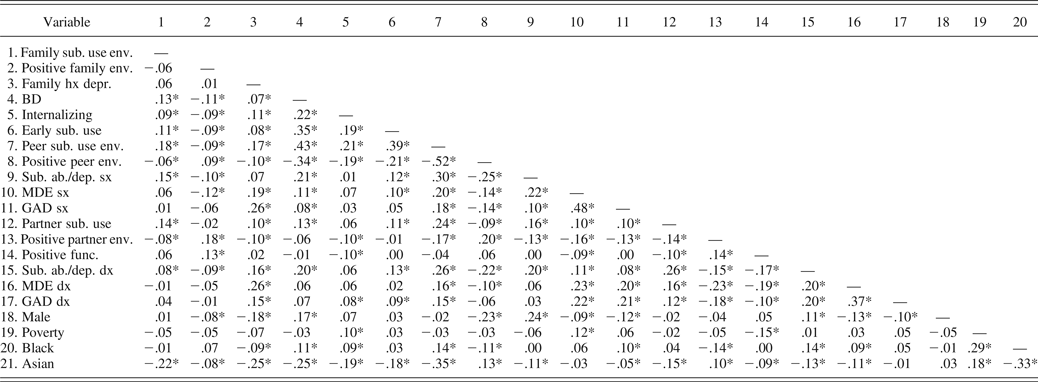
The weighted least squares mean and variance-adjusted estimator was used to account for nonnormal distribution of dependent variables. Missingness was accommodated with full-information maximum likelihood estimation. Correlations among exogenous variables as well as correlations among variables measured at the same time point were estimated in the model. Table 1 contains intercorrelations among variables in the model. Note at the level of zero-order correlations, the primary hypotheses of the study are generally supported. All variables in the model were adjusted for gender, race/ethnicity, and childhood socioeconomic status. Due to their smaller sample size (n = 43), Native Americans were not included in this analysis, bringing our sample size of analysis to 765.
Correlations between model variables

Note: The ethnicity reference group is White. Sub., Substance; Env., environment; hx, history of; depr., depression; BD, behavioral disinhibition; ab./dep., abuse or dependence; sx, symptoms; MDE, major depressive episode; GAD, generalized anxiety disorder; dx, diagnosis.
*p < .05.
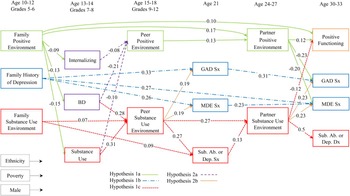
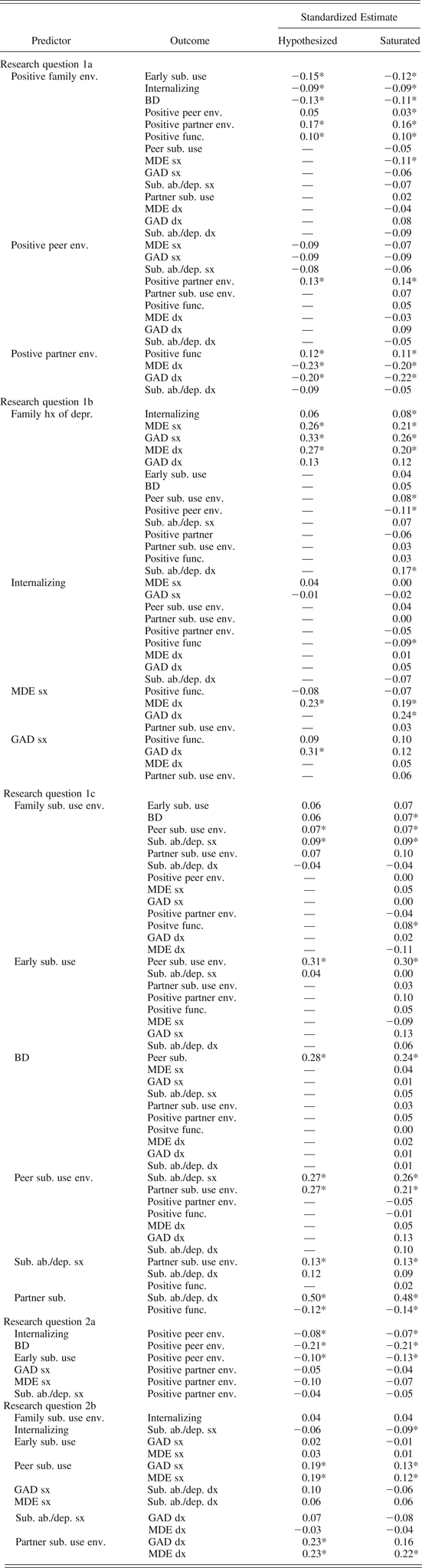
Table 2 presents the hypothesized model estimates from the path analyses. The hypothesized estimates reflect those parameter estimates for associations specifically hypothesized above. The final results of the path analyses are presented in Figure 1. Our discussion of the literature and research questions reflect both specific pathways as well as an interplay between pathways; thus, we modeled all hypothesized pathways in a single omnibus model. Specific paths hypothesized are discussed in detail below. The overall model fit was assessed using chi-square, comparative fit index, Tucker–Lewis index, and root mean square error of approximation statistics. The fit of the model was good, with χ2 (61) = 107.149 (p < .0002), root mean square error of approximation = 0.031, comparative fit index = 0.979, and Tucker–Lewis index = 0.929.
(Color online) Final hypothesized model. Sub., Substance; BD, behavioral disinhibition; ab., abuse; dep., dependence; sx, symptoms; dx, diagnosis; MDE, major depressive episode; GAD, generalized anxiety disorder.

Results for the hypothesized and saturated model estimates
Note: Standardized coefficients reported. Env., Environment; Sub., substance; MDE, major depressive episode; sx, symptoms; dx, diagnosis; GAD, generalized anxiety disorder; ab./dep., abuse or dependence; func., functioning; hx, history of; depr., depression; BD, behavioral disinhibition.
*p < .05.
Table 2 also presents estimates of the saturated path analysis. There are a number of pathways for which we did not have a specific hypothesis to warrant their inclusion. For example, we did not hypothesize relationships between family history of depression and positive environments, substance abuse, or substance-abuse environments, nor did we hypothesize the cross-domain effects of substance-using environments on positive social environments. However, to test whether any of these pathways were significant, we also examined the saturated model. Differences between the saturated and hypothesized model may suggest areas for further research and exploration in the future. Saturated model estimates are reported in the final column of Table 2, and the results are explored below.
Etiological analyses on samples where an intervention has been conducted must take into account potential validity threats caused by changes created by the intervention. Previous analyses have found differences in levels and prevalence of risk and protective factors and outcomes (Hawkins, Kosterman, Catalano, Hill, & Abbott, Reference Hawkins, Kosterman, Catalano, Hill and Abbott2008), but we have found no evidence of differences in etiological processes between conditions. That is, there is little reason to believe that the relationships between the variables examined here are different among participants in the intervention and control groups. However, to test for potential effects of the intervention on structural pathways of the model, we tested a multiple-group model with the intervention and control groups and tested for differences using a chi-square difference test (DIFFTEST in Mplus). We constrained all structural paths and tested against the fully unconstrained model. No significant differences were found, indicating that the model fit equally well for treatment and control groups (p = .41). Level differences between intervention and control conditions were present on various outcomes previously reported, but our analysis of differences in structural pathways indicated that etiological processes did not differ between intervention groups.
Research question 1a: What are the cascading influences of positive social environments across development from age 10 to 33?
We expected to see effects of family general environment on (a) functioning in the most proximal developmental period at ages 13–14, (b) future positive environments, and (c) positive functioning at ages 30–33. We also hypothesized that families would set up a template for developing future positive environments and have a positive effect on positive peer environment at ages 15–18 and on positive partner environment at ages 24–27. Finally, we expected a long-term effect of positive general family on positive functioning at ages 30–33.
Consistent with our prediction, there was a series of cascading effects of positive social environments across development from age 10 to ages 30–33 (see Figure 1). Family positive environment at ages 10–12 had a protective effect on early adolescent functioning (ages 13–14) by decreasing internalizing symptoms, reducing behavioral disinhibition, and decreasing the likelihood of early substance use. Family positive environment also had long-reaching effects to promote positive romantic partner environments at ages 24–27 and positive functioning at ages 30–33. Positive family environment did not have a unique effect on positive peer environment at ages 15–18 as expected.
We hypothesized that positive peer environments at ages 15–18 would also have a cascade of protective effects on individual functioning at age 21 (symptoms of drug abuse or dependence, GAD, or MDE) and on the selection of positive partners at ages 24–27. As predicted, positive peer environments at ages 15–18 was associated with selection of more positive partner environments at ages 24–27. However, contrary to prediction, positive peer environments at ages 15–18 did not have a significant unique effect on age 21 functioning after accounting for other variables in the model. Marginal associations were found between positive peer environment and MDE and drug abuse or dependence symptoms, though no association was found for GAD symptoms.
The cascade of positive partner environment at ages 24–27 was hypothesized to have protective effects on individual functioning (positive functioning, GAD, MDE, and drug abuse or dependence diagnosis) at ages 30–33. Consistent with prediction, partner general environment had a protective effect on mental health by reducing the likelihood of meeting criteria for GAD and MDE. Partner positive environment also predicted positive functioning. However, positive partner environments did not have a unique significant effect on symptoms of drug abuse or dependence once other variables were included.
Research question 1b: What are the cascading effects of family history of depression on mental health across development from ages 10 to 33?
The cascading effects of family history of depression and individual mental health problems were hypothesized to have an effect on mental health functioning in the next developmental period. Mental health problems were expected to increase in severity, progressing from family history of depression, to childhood internalizing at ages 13–14, to symptoms of anxiety and depression at age 21, and finally to meeting criteria for diagnosis of anxiety or depression at ages 30–33. Mental health problems at age 21 were predicted to decrease positive functioning at ages 30–33.
We found partial confirmation for the mental health cascade hypothesis that began with family history of depression. Family history of depression did not affect internalizing at ages 13–14. However, family history of depression had a direct effect on depression and anxiety symptoms at age 21 and on MDE (but not GAD) diagnosis at ages 30–33 above and beyond the impact on earlier mental health symptoms. We also found continuity in mental health problems over time, but only in adulthood. Internalizing symptoms at ages 13–14 did not predict mental health symptoms at age 21. However, GAD symptoms at age 21 predicted GAD diagnosis at ages 30–33, and MDE symptoms at age 21 predicted MDE diagnosis at ages 30–33. Finally, contrary to prediction, mental health symptoms at age 21 did not reduce positive functioning at ages 30–33.
Research question 1c: What are the cascading influences of drug-using environments and drug use across development?
Similar to having long-term effects of positive family environment in childhood, family substance-use environments were hypothesized to have cascading effects both on individual functioning and on future substance-use environments. We predicted that family substance-using environments would affect the proximal problems of behavioral disinhibition and early substance use at ages 13–14 and begin a cascade of involvement with substance-using peer and partner environments. We expected to find long-term impacts of family substance-use environments on drug abuse and dependence symptoms at age 21 and drug abuse and dependence diagnosis at ages 30–33. We expected that peer substance-using environment at ages 15–18 would have cascading effects on drug abuse and dependence symptoms at age 21 and on partner substance-use environment. Next, we predicted that partner substance-use environment at ages 24–27 would play a role in substance abuse or dependence diagnosis and positive functioning at ages 30–33. Finally, we expected continuity in substance use across development, with early substance use predicting substance abuse or dependence symptoms at age 21, which would in turn predict substance abuse or dependence diagnosis at ages 30–33.
Contrary to expectations, family substance-use environment at ages 10–12 did not predict behavioral disinhibition or substance use at ages 13–14. We did find strong continuity from family substance-use environment at ages 10–12 to peer substance-use environment at ages 15–18. There was also a long-term effect of family substance-use environment on symptoms of drug abuse and dependence at age 21 but not at ages 30–33. We did not find a unique long-term influence of family substance-use environment on partner substance-use environment at ages 24–27 once other variables were in the model.
The hypothesized cascading effects of peer substance-use environment on substance use and on choosing a substance-using romantic partner were confirmed by our analysis. Peer substance-use environment at ages 15–18 significantly increased substance abuse and dependence symptoms at age 21 as well as increased the likelihood of selecting a partner who uses substances at ages 24 or 27. In turn, romantic partner substance-using environments had strong proximal effects on both drug abuse and dependence diagnosis at ages 30–33 and on decreased positive functioning. With a standardized effect size of 0.5, the influence of partner drug use on individual drug abuse or dependence is the strongest in the model. Partner substance-use environment also decreased positive functioning at ages 30–33 as expected.
Counter to our hypotheses, we did not find continuity of substance abuse between time points. Early substance abuse at ages 13–14 did not uniquely predict symptoms of abuse or dependence at age 21, which in turn did not uniquely predict drug abuse or dependence diagnosis at ages 30–33 once other variables were in the model.
Research question 2a: How does individual functioning influence the selection of positive social environments?
For this hypothesis, we expected that individual functioning would impact the selection of positive social environments in subsequent periods. At ages 13–14 we predicted that internalizing, behavioral disinhibition, and substance use would influence individuals to select into a less positive peer environment at ages 15–18. Similarly, we expected that having symptoms of GAD, MDE, or substance abuse or dependence at age 21 would influence the proclivity to select into a positive romantic partner environment at ages 24–27.
We found support for this hypothesis; behavioral disinhibition, internalizing, and substance use at ages 13–14 all significantly predicted less positive peer environment at ages 15–18. Behavioral disinhibition and early substance use at ages 13–14 also predicted peer substance-using environment as hypothesized. However, this pattern of results was not repeated in the transition from age 21 to ages 24–27. Generalized anxiety and substance abuse or dependence symptoms at age 21 did not impact partner general environment. The path between MDE symptoms and positive partner environments was marginal.
Research question 2b: How do mental health and substance abuse problems interact to influence each other across development?
We hypothesized that substance use and substance-using environments would affect mental health functioning in subsequent time periods. Specifically, we hypothesized that (a) family substance-use environment would predict internalizing tendencies at ages 13–14; (b) peer substance-use environment at ages 15–18 would increase mental health problems (symptoms of GAD and MDE) at age 21; (c) partner substance-using environment would predict both MDE and GAD diagnoses at ages 30–33; and (d) individual substance use at ages 13–14 and at age 21 would predict mental health problems at age 21 and ages 30–33, respectively. As suggested by the self-medication hypothesis, we expected reciprocal effects of mental health problems on substance use. Internalizing at ages 13–14 was predicted to increase the likelihood of symptoms of substance abuse or dependence at age 21, and mental health at age 21 was expected to increase drug dependence at ages 30–33.
Contrary to prediction, family substance-using environment did not predict mental health (internalizing) at ages 13–14. However, consistent with the hypothesis, both peer substance-use environment and partner substance-use environment predicted subsequent mental health symptoms (GAD and MDE) at age 21, and mental health diagnosis (GAD and MDE) at ages 30–33. Individual substance use at ages 13–14 did not predict later mental health functioning at age 21 as we expected.
We found no support for the self-medication hypothesis. Internalizing at ages 13–14 did not predict symptoms of substance abuse or dependence at age 21, and mental health symptoms (MDE and GAD) at age 21 did not predict drug abuse or dependence diagnosis at ages 30–33.
Saturated model results
We also examined associations that we did not hypothesize a priori by testing a saturated path model. We found that childhood positive family environment, family drug environments, and family history of depression each had cascading effects on future environments and functioning beyond those we originally theorized. Positive family environments had an additional protective effect, reducing the likelihood of MDE symptoms at age 21, over and above the other predictors. Family drug environments predicted a decrease in positive functioning at ages 30–33. Finally, family history of depression significantly increased the likelihood of selecting into a peer substance-use environment, positive peer environment, and substance abuse or dependence diagnosis at ages 30–33 in the saturated model.
Other differences between the saturated and hypothesized models are important to note. When the path between MDE symptoms at age 21 and GAD diagnosis at ages 30–33 was included in the model, the continuity of GAD symptoms and partner drug environment on GAD diagnosis was no longer significant. In addition, the effect of internalizing at ages 13–14 significantly decreases positive functioning at ages 30–33, and decreases the likelihood of having symptoms of substance abuse or dependence at age 21. In the saturated model, family drug environments did impact behavioral disinhibition, which was a path we hypothesized that was not significant in the model shown in Figure 1.
Discussion
We proposed and tested two broad research questions that examined developmental cascades and the impact of the interplay of environmental influences and individual functioning on positive functioning, mental health, and substance abuse outcomes. Overall, the proposed model was largely supported by the results. These findings highlight important lessons learned from combining the social development model with a developmental cascades framework. First, there were short- and long-term cascading effects of positive social environments throughout development, with positive influences on proximal individual functioning and long-reaching effects of early positive family environment. We found cascades of family history of depression on mental health functioning throughout adulthood. Family substance use also began a cascade on substance-specific social environments across development, which was the pathway through which increasing severity of substance use problems flowed. Second, including social environmental influences in a developmental cascades model allowed interactions between individual functioning and the social environment to be examined over time. We found that social environmental influences were pivotal in the propagation of problems with individual functioning, especially for substance use. Third, patterns of results modeling the interplay between individual functioning and social environments and mental health and substance abuse highlight the interactive nature of these factors across development. Fourth, we found evidence that adolescent but not adult individual functioning influenced selection into positive social environments, and substance-using social environments had significant cross-domain detrimental effects on mental health.
Importance of early family experiences
Families play a critical role in beginning a trajectory toward positive and pathological development, and the effects of family social environments cascade across development. Results in the current study show that positive family functioning, family history of depression, and family substance-use environments echo forward through time in multiple developmental domains. This work is one of few to incorporate family influences in a cascade framework (Herrenkohl et al., Reference Herrenkohl, Kosterman, Mason, Hawkins, McCarty and McCauley2010). Fewer still have examined positive family environment alongside family psychopathology. Incorporating family influences in cascade models demonstrates how this important social environment shapes early trajectories through specific parenting behaviors and family psychopathology, all of which offer opportunities to intervene to interrupt processes of risk accumulation or support processes of protection.
Positive families help shape the nature of future social environments by influencing the selection of later positive social environments (Connolly et al., Reference Connolly, Furman and Konarski2000; Furman et al., Reference Furman, Simon, Shaffer and Bouchey2002). Previously, these links have been studied separately, or in a limited developmental span. The results of the present model suggest that families in childhood impact partner positive social environment and positive functioning in adulthood, above and beyond the presence of parental psychopathology, parent substance use, and all of the other factors in the model. The saturated model further revealed that positive families might also provide protection against symptoms of depression in young adulthood.
The results also provide strong support for the effect of family history of depression on the development of major depressive episode symptoms and generalized anxiety symptoms in early adulthood, as well as on depression diagnosis in adulthood. These findings add to the conversation about intergenerational transmission of depression (McCauley et al., Reference McCauley, Pavlidis and Kendall2001), because strong effects remained after including the effects of positive families, individual functioning, and substance-using social environments. The effects of family history of depression are not only far reaching and cross-domain but also some of the strongest effect sizes in the model. The saturated model showed that family history of depression had additional unanticipated effects on peer positive environments and peer substance-using environment, as well as drug abuse or dependence diagnosis in adulthood.
One area where the model hypotheses were not supported was the role of internalizing in the mental health cascade. Internalizing was hypothesized to be influenced by family history of depression and to be the beginning of a developmental path toward mental health problems. However, internalizing was not predicted by family history of depression (except in the saturated model), nor did it act as a precursor to later mental health problems as expected. It may be that teacher-rated measures of internalizing lack sensitivity or that internalizing at ages 13–14 is reflective of a passing state in our sample and is not a robust risk factor for later mental health problems. What is clear is that links between early internalizing and later mental health require further investigation in future analyses.
Another hypothesis that was not supported was our expectation that peer positive social environment operates similarly to the family and has cascading effects on functioning in the proximal developmental period. We also predicted that selecting into a positive peer environment would be predicted by the positive family environment, because families were theorized to provide a model of social relationships. However, we did not find a relationship between positive family environment and positive peer environment. We suspect that the influence of positive families may flow indirectly through the influence on individual functioning. It also may be that the relationships with peers are not as deep as with family and romantic partners; thus, the idea of thinking of families as templates for peer relationships is inaccurate.
As with positive families and family history of depression, early family substance-use environment began a cascade of influence across development. Although previous research has found that family substance use is a risk factor for adolescent and adult substance use problems (Hawkins et al., Reference Hawkins, Catalano and Miller1992; Stone et al., Reference Stone, Becker, Huber and Catalano2012), our results show that family substance use had a greater effect on adolescent peer substance use environment than adolescent substance use. It also set in motion continuity in substance-use environment, with substance-using families driving the selection of substance-using peers, which in turn predicted choosing substance-using romantic partners. The strength of these associations also increased at each step in the cascade. Finally, family substance-use environment had a long-reaching effect on substance-use problems in young adulthood. By the time individuals select partners who use substances, these cascades have set in motion a pattern of substance use and substance-using social environments.
The domain-specific cascades begun by positive families, family history of depression, and substance-using families offer opportunities to intervene to interrupt a process of risk accumulation or support a processes of protection. The aspects of family functioning explored by this study could serve as targets of prevention interventions. The fact that families are important for development is not a new concept, but the cascading influence of specific aspects of family environments on mental health and substance use outcomes through to adulthood provides additional clarity on the nature of families' influence, as well as the long-lasting influence of families through time.
Uniting the social environment with developmental cascades
Blending the social development model with the developmental cascades approach adds to the knowledge base about the interacting and cascading influences of functioning and social environmental influences on substance abuse and dependence, mental health, and positive functioning outcomes. The present study demonstrated important lessons learned by uniting these theories: that social environments have an important influence on the development and trajectories of psychopathology, and that these influences vary by developmental period and have important cross-domain effects.
The importance of social environmental influences on individual functioning is particularly evident in the substance use cascade. Prior substance use did not directly predict future substance use problems but operated through substance-using social environments. Thus, substance-using social environments are the primary driver for the continuation of substance use into adulthood. Because many cascade models do not incorporate the role of the social environment, individual substance use can be attributed to other individual-level factors, when it may be the social environment that is a crucial force maintaining substance use.
The reciprocal influences of substance-using social environments and individual substance use are evident in the model, because both selection and influence factors are in effect for peer and partner substance-use environments. Using substances early predicted selecting peers who use substances. Similarly, partner substance-use environment predicted substance abuse or dependence with some of the strongest effect sizes in our model. The strength of this association calls for additional research and intervention attention focused on partner social environments as critical in the etiological pathway to substance abuse and dependence diagnoses in adulthood, as well as a social domain to consider for intervention. This is critically important because many have found that partnering has a large impact on desistence of drug use during young adulthood (Bachman et al., Reference Bachman, O'Malley, Schulenberg, Johnston, Bryant and Merline2002). Our data indicate that partnering with a substance-using person will actually increase the likelihood of abuse and dependence diagnosis, suggesting the importance of considering the substance use of the partner, not just partnering per se.
These findings motivate continued research uniting the social development model and the development cascades approach, particularly in etiological work informing preventive interventions. Individuals who use substances are influenced to continue to use by the social environments to which they are exposed. The strong influence of the social environment points to the importance of substance-using social environments as points for intervention throughout the life course. Further, preventing early use may impact selecting peers who use substances, and preventing association with substance-using peers has the potential to decrease future problem substance use.
The interplay between cascades of individual functioning and social environments
Previous studies have attempted to understand the complex relationships between individuals and their environment and between mental health and substance abuse problems. However, few have examined either of these phenomena in a developmental cascade framework extending to adulthood. Taking a developmental cascades approach is advantageous to modeling interplay between these domains of functioning, because it calls attention to cross-domain effects and the potentiation of risk factors through time. One important finding resulting from this approach is the importance of the influence of individual functioning on selection into social environments, particularly in the adolescent period where individual functioning was shown to predict the selection into positive and substance-using peer networks. This finding is consistent with estimates of gene–environment correlation from twin studies reporting heritability estimates of 15%–35% for environment measures relevant to psychiatry/psychology (Kendler & Baker, Reference Kendler and Baker2007), and highlights the importance of this developmental period as a pivotal time point for intervention. Poor functioning may impact the ability of adolescents to form positive peer relationships. Because we do not see the same effects of functioning on the social environment later in development, middle adolescence may be a critical point for intervening in the lives of those with poor individual functioning.
Another important cross-domain finding concerned the complex interplay of mental health and substance abuse problems across development. This analysis provides evidence that substance-using environments affect mental health, above and beyond the additional influences of substance use behavior, positive social environmental factors, or family history of depression. However, support for the self-medication hypothesis was inconsistent in the results. If self-medication were a factor, we would expect that the presence of mental health problems would predict substance use problems in subsequent time periods, but the hypothesized model did not support these relationships.
Substance-using environments, but not substance use itself, had significant impacts on mental health both in the transition to adulthood and in adulthood. This may be because individuals select peers or romantic partners that have similar problems. Substance abuse and mental health problems are significantly correlated within each time point, lending support for this interpretation. Being surrounded by others who use substances could be distressing and drive mental health problems. Finally, selecting into substance-using social environments may have the same underlying risk factors (social and genetic) that drive mental health problems. Interrupting these mechanisms may be useful to mental health prevention strategies. Peer and romantic partner social environments are the two areas that individuals can select into (versus family, who are generally not chosen) and are thus potentially malleable through intervention. This pattern of results provides further support for the importance of incorporating substance-using social environments into substance use research as well as research regarding the development of mood and anxiety disorders. By incorporating additional potential sources of mental health problems into the model, the effect of substance-using environments on mental health can be further isolated. This finding helps to explain why prevention interventions focused on positive youth development and decreased substance abuse have had positive effects on the development of mental health problems, despite being designed to impact substance use outcomes directly (Hawkins et al., Reference Hawkins, Kosterman, Catalano, Hill and Abbott2008; Mason et al., Reference Mason, Kosterman, Hawkins, Haggerty, Spoth and Redmond2007).
Implications and future directions
Integrating the social development model and developmental cascades in this model has produced novel understanding of the interplay of positive and pathological development. The results confirm that mental health and substance abuse problems are multiply determined, interact over development, and that social environments play a critical role in the propagation of problems with mental health and substance use. The present study also had constraints that should be addressed in future studies. The retrospective measure of family history of depression may have resulted in biased reports based on the respondents' current mental health state. Future work should examine the effect of family history of depression that is prospective and self-reported by parents, or taken directly from medical records. In addition, having teachers assess the internal state of students based on their external behaviors may have affected the strength of our findings about the influence of internalizing on subsequent mental health. Parent or self-report of internalizing may be a better measure of children's internal states. Finally, future work should replicate these findings in samples in other geographic and ethnic compositions.
The present study has implications for theoretical advances in the field developmental psychopathology. First, developmental cascades models have tended to focus on cascades of behavior (e.g., cascading externalizing and cascading social competence). Some of our strongest findings were the cascading influence between social environments over time as well as between social environments and behavioral functioning, which suggests a broader focus of developmental cascades as the interplay between social environment and behavioral functioning. Second, our findings strongly suggest that these social–behavioral developmental cascades consider multiple domains of the social environment because salient proximal environments change across developmental periods. Third, our results suggest that social–developmental cascades models consider the distinct influences of general environmental functioning as well as problem-specific (e.g., substance using) social environments.
Fourth, our findings provide implications for the development of interventions that seek to promote positive adult functioning and prevent mental health and substance abuse problems. Research has shown that social development interventions in childhood can have long-term, cascading impacts on developmental processes (e.g., Hawkins et al., Reference Hawkins, Kosterman, Catalano, Hill and Abbott2008; Olds, Sadler, & Kitzman, Reference Olds, Sadler and Kitzman2007; Patterson, Forgatch, & DeGarmo, Reference Patterson, Forgatch and DeGarmo2010). Our findings support the importance of intervening in these early social environments in shaping these developmental cascades; however, our results also point to the importance of continued intervention in adolescence and adulthood. Uniting the developmental cascades framework with the social development model has extended our understanding of developmental processes leading to adaptive and maladaptive functioning, as well as articulated specific, actionable targets for intervention in childhood, adolescence, and adulthood.