


Introduction
Community health workers and promotoras (CHW/Ps) are becoming more involved in research with academic research teams for numerous reasons, including their ability to be trusted liaisons and engage meaningfully with community members who are often from their same community [1–Reference Nelson, Lewy, Dovydaitis, Ricardo and Kugel4]. This relationship has resulted in improved research processes, such as participant recruitment and retention, as well as enhanced effectiveness of health interventions [Reference Wagner, Barth and Bermúdez-Millán5–Reference Krok-Schoen, Weier, Hohl, Thompson and Paskett7]. Indeed, CHW/Ps have identified understanding and contributing to research as a necessary skill related to their role [Reference Harper, Perez and Mitchell8–Reference Findley, Matos, Hicks, Campbell, Moore and Diaz10]. Despite the promising potential and interest in integrating CHW/Ps into academic research teams, CHW/Ps often do not receive standardized training in research competencies [Reference Plasencia, Kaalund and Thoumi11–Reference Johnson, Sharkey, Dean, St John and Castillo14]. This can result in issues affecting the quality and rigor of research in which they are involved [Reference Terpstra, Coleman, Simon and Nebeker15].
To address this gap in research preparation of the CHW/P workforce, our team co-created with CHW/Ps a research best practices training [Reference Varma, Samuels and Piatt16]. This training is available to be taken either in English or Spanish, independently online or peer-led either in-person or virtually on the website: https://www.chwresearchtraining.org. Evaluations have revealed the research best practices training was relevant and useful to CHW/Ps’ work, enhanced their knowledge and skills, improved access to resources, further clarified their role in research, and helped to create a bridge between CHW/Ps and academic researchers [Reference Harper, Perez and Mitchell8,Reference Murphy, Harper and Jay17,Reference Murphy, Jay and Samuels18]. While this information is valuable for understanding the impact of the training within the institutions involved in creating it (i.e., University of California – Davis, University of Florida, and University of Michigan), information is lacking on the feasibility of new sites to implement the training, which is imperative for supporting widespread dissemination and sustainability efforts. We partnered with three research teams at academic institutions and one community-based organization to deliver the training. The purposes of this study were to evaluate (a) the implementation of the research best practices training for CHW/Ps at multiple new sites to gain insights into drivers of variation in providing the training as well as (b) what is needed to support widespread training delivery.
Methods
Training delivery at multiple sites
The following sites were engaged for the implementation effort and mixed methods evaluation: CAN DO Houston, the Knight Cancer Institute at Oregon Health Sciences University (referred to as OHSU), the Center for Community Health Alignment at University of South Carolina (referred to as USC), and University of Texas Rio Grande Valley (UTRGV). OHSU was recommended by a partner site that initially agreed but was unable to participate in this implementation effort. USC and UTRGV reached out to the team at University of Michigan after reading a publication from the parent study [Reference Murphy, Harper and Jay17] and were interested in using the research best practices training for their CHW/P workforce. We were also interested in including a community-based site, and the UTRGV team recommended CAN DO Houston. These sites were selected because they represented a geographically diverse sample that differed from the parent study sites (i.e., California, Florida, and Michigan).
To facilitate research best practices training for CHW/Ps at these sites, we engaged the lead trainer at University of Michigan to train the master trainer at each of the 4 sites, who then trained a Champion peer facilitator at each site. All materials for preparing Champions and facilitating the training were provided to each site by the Michigan team. Site leads included the principal investigator or director who facilitated staff selection and training delivery processes. Master trainers, selected by site leads, were individuals with skills to execute the train-the-trainer model, and it was preferrable if the master trainer had experience as a CHW/P or working with a CHW/P. Champion selection was made by each site based on guidance from the Michigan team from lessons learned. Specifically, a Champion was a CHW/P or individual working/volunteering with community-based organizations, ideally with some experience delivering trainings, though this was not required. Effective Champions were engaged learners authentically (e.g., shared their own experiences, communicated in a mix of English and Spanish), facilitated conversation among learners, and shared scientific information in plain language [Reference Harper, Perez and Mitchell8,Reference Murphy, Harper and Jay17]. Two sites combined the role of site lead and master trainer in alignment with skills and staffing priorities. Each site was responsible for recruiting and training at least 10 CHW/P learners in whichever format (online or in-person) and language (English or Spanish) met their needs. The University of Michigan team provided all sites with the following materials, in both English and Spanish, to support the implementation effort: PowerPoint and accompanying video files for each of the 5 training modules and a detailed facilitator’s guide that includes guidance for selecting Champions, the train-the-trainer process, recommended materials, and setting up in-person and virtual training sessions as well as suggested scripts for the modules, which can be modified for authenticity by Champions when delivering the training, All materials are freely available at: https://www.chwresearchtraining.org. Master trainers at each site were also provided forms for collecting implementation evaluation data for this study and trained in REDCap as needed to support this process.
Mixed methods evaluation
We conducted an explanatory sequential mixed methods design [Reference Creswell and Plano Clark19] to evaluate the implementation of the research best practices training for CHW/Ps. Site staff (i.e., site leads, master trainers, and Champions) at each of the 4 sites were approached for participation in the mixed methods evaluation. We first administered surveys to site staff to assess acceptability, appropriateness, and feasibility of the training. We analyzed these quantitative data and used the results to purposefully sample individuals for the follow-up qualitative interviews to help further explain the quantitative results (i.e., connecting integration) [Reference Fetters, Curry and Creswell20]. To obtain a more comprehensive understanding of the perceptions of training implementation, we conducted semi-structured interviews with site leads, master trainers, and Champions. Interviews explored their experiences preparing for and implementing the training, such as selecting and training Champions, delivering the training, and suggestions to refine implementation processes. Quantitative and qualitative results were merged to generate meta-inferences based on the staff’s experiences implementing the training [Reference Fetters, Curry and Creswell20,Reference Younas, Fàbregues, Munce and Creswell21]. This study was approved by the University of Michigan Institutional Review Board (HUM00248481).
Quantitative data collection and analysis
After each site finished delivering their training(s), we administered the following 3 surveys that use a 5-point scale to assess the implementation of the research best practices training: acceptability of the intervention, intervention appropriateness, and feasibility of the intervention (see supplemental materials) [Reference Weiner, Lewis and Stanick22]. All surveys were administered and data collected using REDCap, a secure, web-based platform hosted at University of Michigan. We used descriptive statistics to analyze quantitative survey data.
Qualitative data collection and analysis
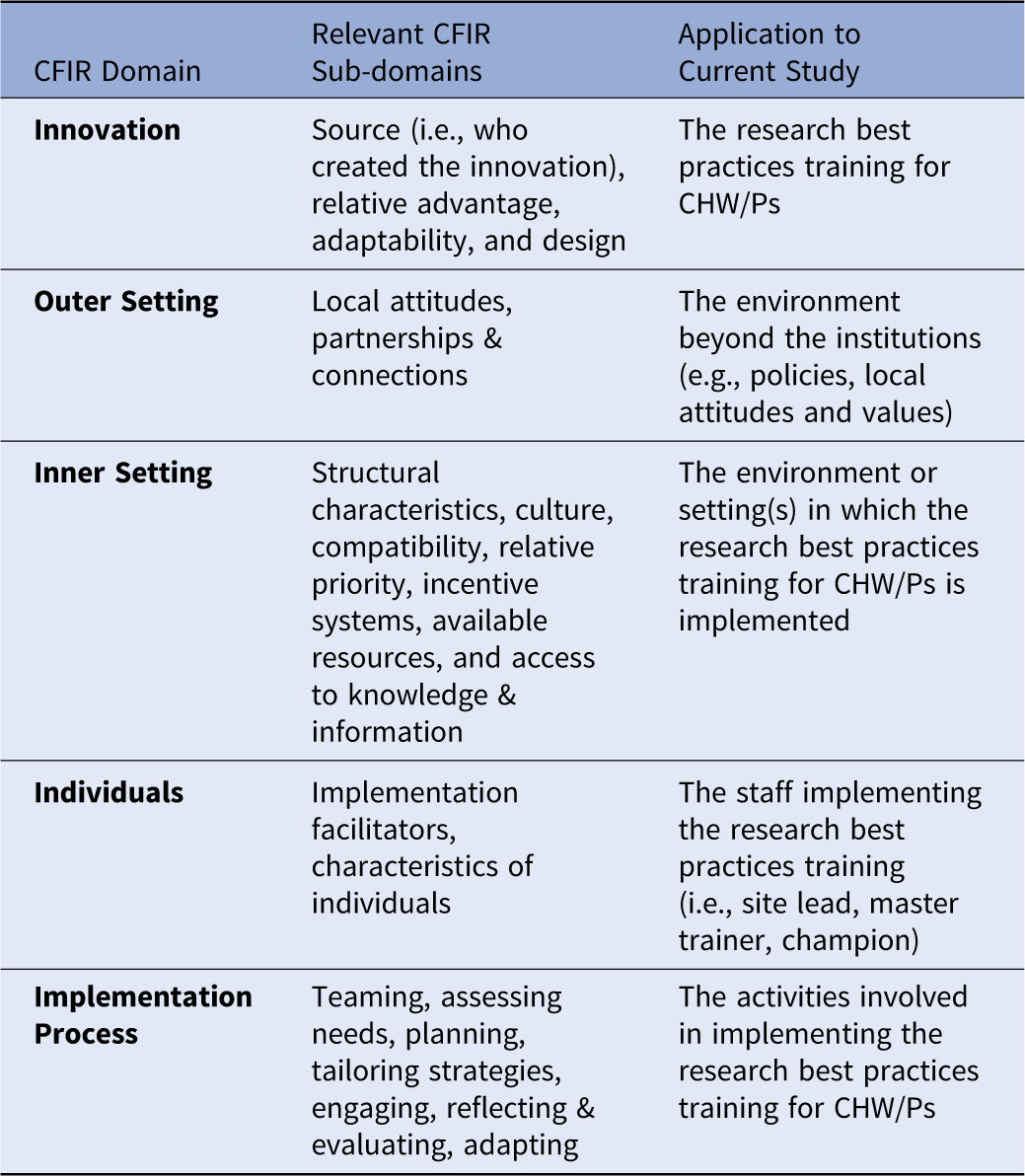
To expand on staff survey responses, we conducted semi-structured interviews (see supplemental materials). We also collected demographic data about each site from the site lead, such as population(s) served and number of CHW/Ps employed by the site. Interviews ranged from 22 to 50 minutes. To analyze the data, we used an inductive coding approach using MAXQDA [23]. Once data were inductively coded, we deductively applied the Consolidated Framework for Implementation Research (CFIR) [Reference Damschroder, Reardon, Widerquist and Lowery24] to the existing codes. The CFIR [Reference Damschroder, Reardon, Widerquist and Lowery24] is one of the most widely used implementation frameworks that investigators use to help understand contextual factors (i.e., determinants) across 5 separate domains that can influence implementation efforts. Table 1 provides a brief overview of the CFIR domains and their application to the current study. We then used the Code Relations Browser in MAXQDA to identify overlaps between our inductive and deductive codes. We combined similar CFIR sub-domains into categories, and the categories informed the overarching themes. As such, we used the domains from the CFIR to anchor our resultant themes in this mixed methods evaluation.
Operationalization of CFIR domains and relevant sub-domains to the study

Table 1. Long description
A table with three columns and five rows, including a header row. The columns are labeled CFIR domain, Relevant CFIR sub-domains, and Application to current study. The rows detail the following information: Row 1: CFIR domain, Innovation; Relevant CFIR sub-domains, Source (i.e., who created the innovation), relative advantage, adaptability, and design; Application to current study, The research best practices training for CHW/Ps. Row 2: CFIR domain, Outer setting; Relevant CFIR sub-domains, Local attitudes, partnerships & connections; Application to current study, The environment beyond the institutions (e.g., policies, local attitudes and values). Row 3: CFIR domain, Inner setting; Relevant CFIR sub-domains, Structural characteristics, culture, compatibility, relative priority, incentive systems, available resources, and access to knowledge & information; Application to current study, The environment or setting(s) in which the research best practices training for CHW/Ps is implemented. Row 4: CFIR domain, Individuals; Relevant CFIR sub-domains, Implementation facilitators, characteristics of individuals; Application to current study, The staff implementing the research best practices training (i.e., site lead, master trainer, champion). Row 5: CFIR domain, Implementation process; Relevant CFIR sub-domains, Teaming, assessing needs, planning, tailoring strategies, engaging, reflecting & evaluating, adapting; Application to current study, The activities involved in implementing the research best practices training for CHW/Ps.
Results
Each site served a different and diverse community across Oregon, South Carolina, and Texas. An overview of the 4 sites is available in Table 2.
Characteristics of the new sites implementing the CHW/P training

Table 2. Long description
A table comparing characteristics of four sites implementing CHW/P training. The table has 12 rows and 5 columns. The columns are labeled CAN DO Houston, OHSU, South Carolina, and UTRGV. The rows are grouped into Organization Descriptors, Staff descriptors, and Number of trainings. Under Organization Descriptors, the row labels are Relationship with academic system, Primary region served, Community served by age, and Community served by primary topic(s) and population(s). Under Staff descriptors, the row labels are Administrative, CHW/Ps, employed or volunteering, CHW/Ps working in-person and remotely, CHW/Ps working in-person only, CHW/Ps working remotely only, Bilingual CHW/Ps, English-only CHW/Ps, and Spanish-only CHW/Ps. Under Number of trainings, the row labels are Virtual, English, Virtual, Spanish, In-Person, English, and In-Person, Spanish. Row 1: Relationship with academic system, None, Part of academic system, Part of academic system, Part of academic system. Row 2: Primary region served, Harris County, TX, Columbia River Gorge, Oregon, South Carolina, Lower Rio Grande Valley, TX. Row 3: Community served by age, Across the lifespan, Adolescence through end of life, Perinatal, early intervention, adults, older adults, Primarily adults 18-64 years old. Row 4: Community served by primary topic(s) and population(s), Chronic disease management, under-resourced communities, Cancer screening, prevention, treatment, education, and outreach, No singular primary topic or population focus, Immigrants, maternal health, mental health, chronic disease management. Row 5: Administrative, 1-5, 1-5, 1-5, 1-5. Row 6: CHW/Ps, employed or volunteering, 9, 4, 11, 15. Row 7: CHW/Ps working in-person and remotely, 9, 4, 0, 15. Row 8: CHW/Ps working in-person only, 0, 0, 4, 0. Row 9: CHW/Ps working remotely only, 0, 0, 7, 0. Row 10: Bilingual CHW/Ps, 8, 2, 3, 10. Row 11: English-only CHW/Ps, 1, 2, 8, 2. Row 12: Spanish-only CHW/Ps, 0, 0, 0, 3. Row 13: Virtual, English, 1 (4 CHW/Ps), 1 (7 CHW/Ps), 0, 0. Row 14: Virtual, Spanish, 1 (5 CHW/Ps), 1 (4 CHW/Ps), 0, 0. Row 15: In-Person, English, 0, 0, 1 (11 CHW/Ps), 1 (11 CHW/Ps). Row 16: In-Person, Spanish, 0, 0, 0, 0.
*Site has no formal affiliation with an academic system, but the site lead has an affiliation with an academic system. **Number of administrative staff was provided as a range rather than discrete count.
OHSU = Oregon Health Sciences University; UTRGV = University of Texas Rio Grande Valley.
The 4 sites trained a total of 42 CHW/Ps (N = 6 trainings) from July to September 2024. Two sites each conducted 2 virtual trainings, 1 in English and 1 in Spanish, and the other 2 sites each conducted 1 in-person training in English. All sites delivered the training in one day rather than split across two days. Following the implementation effort, 10 staff were recruited to participate in the mixed methods evaluation, of which 8 completed surveys and all 10 completed interviews from July to October 2024.
Quantitative survey findings
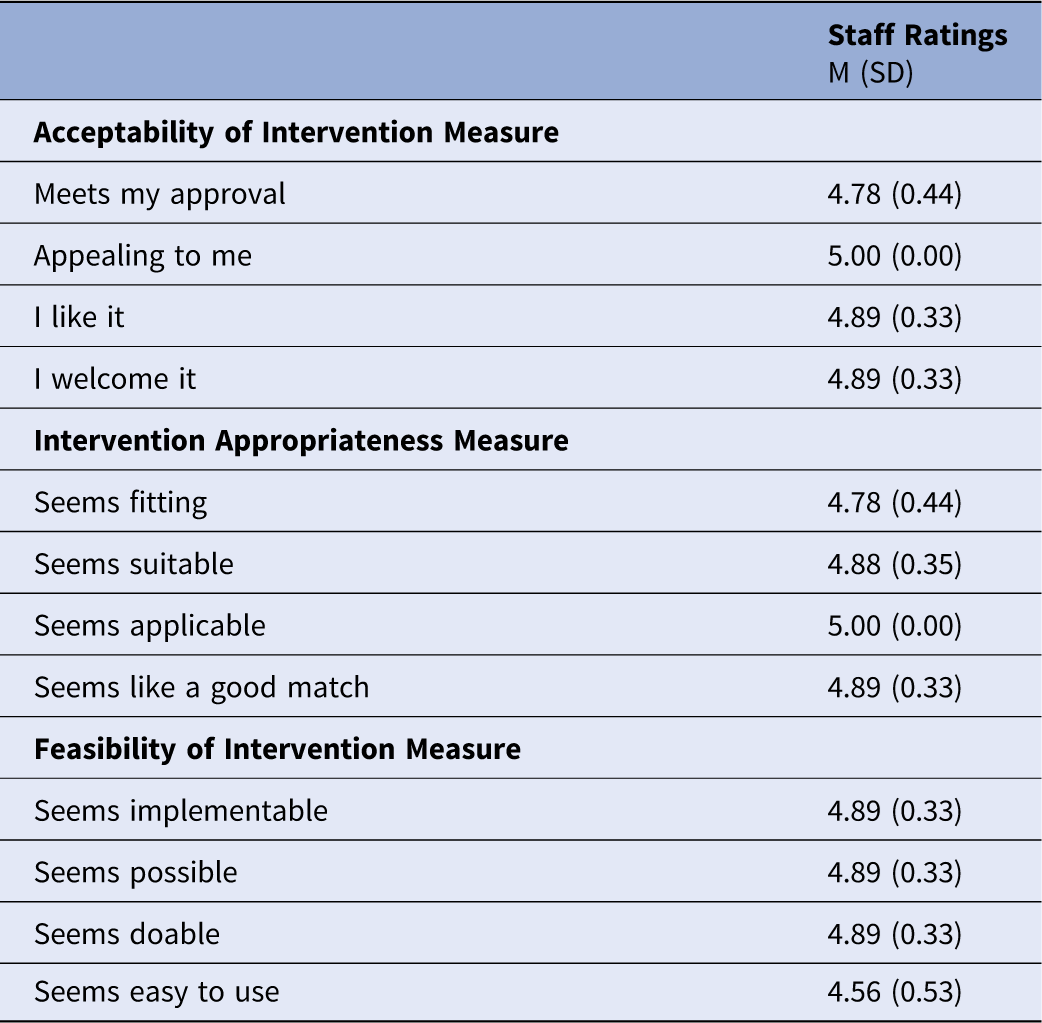
Staff surveys revealed positive ratings of the acceptability, appropriateness, and feasibility of the research best practices training for CHW/Ps (Table 3). Mean acceptability and appropriateness items were rated between 4.78 and 5 on a 5-point scale anchored by strongly disagree (1) and strongly agree (5). This was consistent with ratings for feasibility except for the item “seems easy to use,” which had a mean rating of 4.56 (0.53).
Staff survey results (N = 8)

Table 3. Long description
A table showing staff ratings of the acceptability, appropriateness, and feasibility of implementing the research best practices training for CHW/Ps. The table has three main sections: Acceptability of Intervention Measure, Intervention Appropriateness Measure, and Feasibility of Intervention Measure. Each section contains several items rated on a 5-point scale anchored by strongly disagree (1) and strongly agree (5). The table includes mean ratings and standard deviations for each item. Row 1: Acceptability of Intervention Measure. Row 2: Meets my approval, 4.78 (0.44). Row 3: Appealing to me, 5.00 (0.00). Row 4: I like it, 4.89 (0.33). Row 5: I welcome it, 4.89 (0.33). Row 6: Intervention Appropriateness Measure. Row 7: Seems fitting, 4.78 (0.44). Row 8: Seems suitable, 4.88 (0.35). Row 9: Seems applicable, 5.00 (0.00). Row 10: Seems like a good match, 4.89 (0.33). Row 11: Feasibility of Intervention Measure. Row 12: Seems implementable, 4.89 (0.33). Row 13: Seems possible, 4.89 (0.33). Row 14: Seems doable, 4.89 (0.33). Row 15: Seems easy to use, 4.56 (0.53).
Notes. Data missing from one site lead and one combined site lead/master trainer. Items were on a 5-point scale.
Qualitative semi-structured interview findings
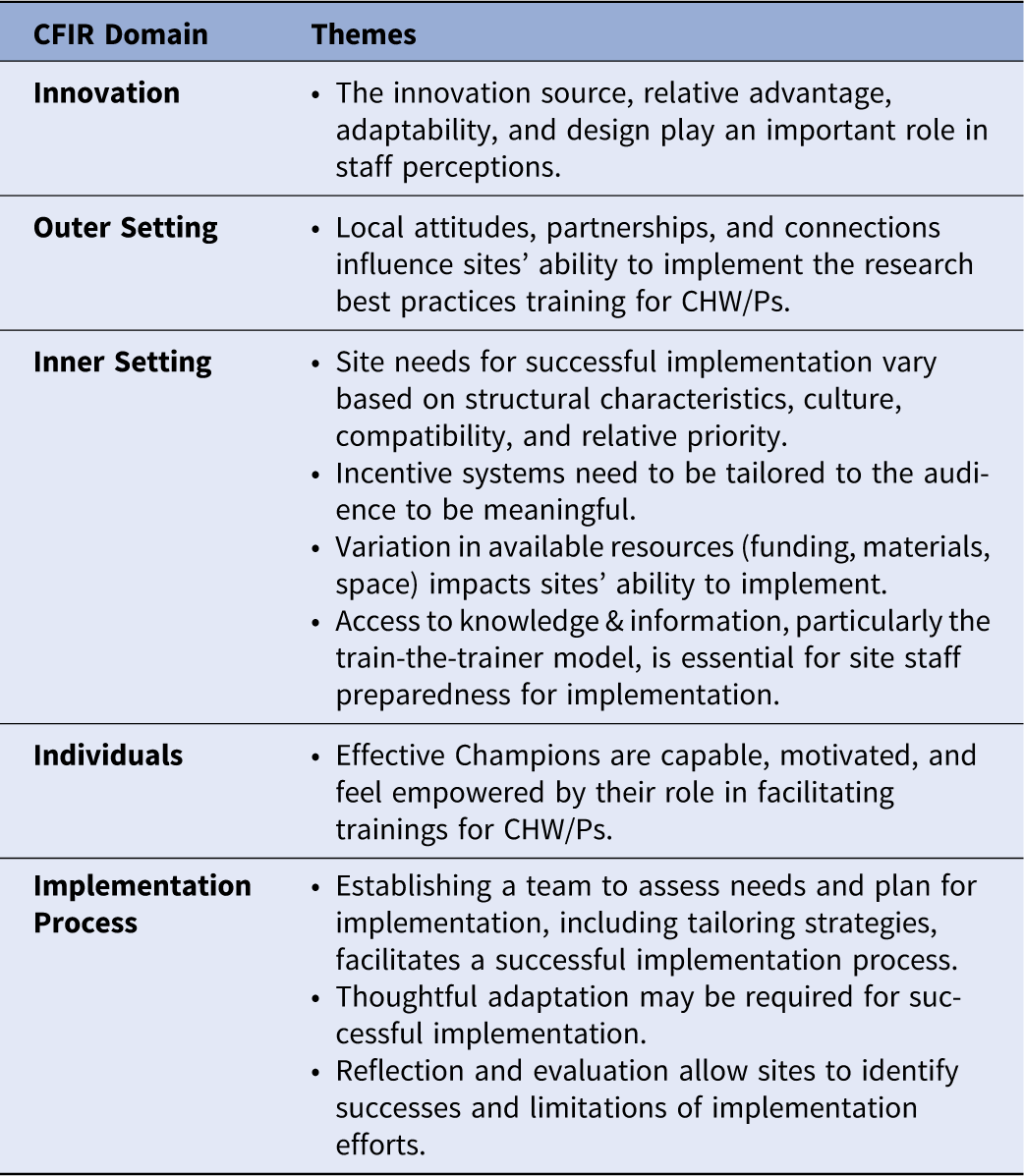
An overview of the themes that emerged from the 10 staff interviews aligned with the corresponding CFIR domain is provided in Table 4.
Qualitative themes according to CFIR domain

Table 4. Long description
A table categorizing qualitative themes from staff interviews according to CFIR domains. The table has six rows and two columns. The first column lists the CFIR domains: Innovation, Outer Setting, Inner Setting, Individuals, and Implementation Process. The second column lists the corresponding themes. Row 1: Innovation, The innovation source, relative advantage, adaptability, and design play an important role in staff perceptions. Row 2: Outer Setting, Local attitudes, partnerships, and connections influence sitesʼ ability to implement the research best practices training for CHW/PS. Row 3: Inner Setting, Site needs for successful implementation vary based on structural characteristics, culture, compatibility, and relative priority. Incentive systems need to be tailored to the audience to be meaningful. Variation in available resources (funding, materials, space) impacts sitesʼ ability to implement. Access to knowledge and information, particularly the train-the-trainer model, is essential for site staff preparedness for implementation. Row 4: Individuals, Effective Champions are capable, motivated, and feel empowered by their role in facilitating trainings for CHW/PS. Row 5: Implementation Process, Establishing a team to assess needs and plan for implementation, including tailoring strategies, facilitates a successful implementation process. Thoughtful adaptation may be required for successful implementation. Reflection and evaluation allow sites to identify successes and limitations of implementation efforts.
Innovation
The innovation source, relative advantage, adaptability, and design play an important role in staff perceptions
The innovation source (i.e., credibility of the team that created the training), relative advantage of the training compared to existing offerings, and the adaptability and design were critical components in staff members’ perception of the research best practices training. Staff reported that having a local peer Champion facilitator already familiar with the CHW/P community was reassuring for CHW/P learners. While the training was perceived as a refresher for some, it was seen as filling a training gap in community-engaged research for CHW/Ps. Indeed, staff indicated substantial interest in the training because CHW/Ps want relevant, trusted information about research skills specific to their role. Staff also noted that the training was adaptable to local contexts in terms of delivery language (i.e., English or Spanish) and the materials themselves. Specifically, Champions were able to adapt examples and scenarios to their audiences, with one noting, “it was great to…use these food insecurity examples…in the recent project that we’ve been working [on]…it was good to relate it [the training] back to those experiences” [ID1]. For some sites, having virtual training was helpful for increasing accessibility to CHW/Ps in rural areas.
Generally, staff reported that the design of the training itself along with the preparation (e.g., train-the-trainer) and implementation materials (e.g., delivery format, facilitator guides) were flexible rather than strictly protocolized, which was valuable for meeting local needs. The videos were also helpful in furthering learner understanding. The group size (4–11 learners) was appropriate, with some staff preferring smaller groups because it better promoted robust conversation among learners. Furthermore, staff noted that the design of the content, slides, and guides made it easy for Champions to step into the facilitator role.
Outer setting
Local attitudes, partnerships, and connections influence sites’ ability to implement the research best practices training for CHW/Ps
Without a built-in or existing partnership with academic research organizations, staff reported it can be difficult for CHW/Ps to become trained or get involved in community-engaged research. Specifically, one staff person said:
I love the idea of community health workers being more involved, but…it feels very nebulous and they’re like, well…we’re not being asked…if these trainings are going to be carried out locally, maybe a suggestion I would have is…connect with local research entities that… do community-based participatory research…but we don’t really know how to get them into the door…They want to be involved…they don’t know how to get invited. [ID2]
Staff also reported that establishing connections and routine communications (e.g., attending monthly meetings) with a CHW/P organization can facilitate involvement of CHW/Ps in the research best practices training and future initiatives at the site.
Therefore, timely, straightforward, thorough, and instructive communication with academic partners (i.e., University of Michigan team) was seen as supportive. Additionally, according to site staff, the term “research” can be intimidating for people who are not engaged in everyday research, as is the case with most CHW/Ps. Therefore, language is an important consideration for advertising and recruitment.
Inner setting
Site needs for successful implementation vary based on structural characteristics, culture, compatibility, and relative priority
There were variations in sites’ support needs based on structural characteristics. For example, the non-academic partner needed IRB support (e.g., third party review) to participate in community-engaged research activities, whereas IRB support was an existing component within academic institutions. Nonetheless, academic institution partners endorsed other complications, such as long or drawn-out procedures for hiring and onboarding staff, resulting in delays affecting timing for preparing Champions and delivering the training. One staff member noted, “the hardest part was actually with my institution getting [Champion] onboarded…that was the most time consuming” [ID6]. The information technology infrastructure occasionally led to glitches (e.g., lag, need for adapters, difficulty connecting to speakers), but preparing resources that were not reliant on technology (e.g., print out of slides) alleviated difficulties. Moreover, it was meaningful to provide multiple strategies for accessing the materials due to variation in sites’ use of non-free resources (e.g., Microsoft PowerPoint).
Regardless of site structural characteristics, aspects of site culture and the compatibility and relative priority of the CHW/P training simplified preparations. Although no site had an existing team of trainers and Champions to deliver the training, each site had staff with knowledge, expertise, and/or connections to facilitate implementation of the training. Specifically, sites noted that having an existing team of staff already in place with an interest in and priority for training CHW/Ps simplified preparations. Sites also reported that having an existing relationship with a CHW/P who could serve as a Champion facilitated the implementation process.
Incentive systems need to be tailored to the audience to be meaningful
Offering an incentive to participate was essential. Staff at all sites noted the importance of providing compensation for CHW/P learners, but $50 may not be adequate compensation for a 5-hour training. Staff indicated that continuing education units (CEUs) or credits would be meaningful incentives for participation, even more so than money. One staff member said, “it would’ve incentivized a little bit more and it would’ve helped them at the same time…to apply towards renewing credit for their CHW [certification]” [ID5]. Staff recognized the variability in state-based requirements for CEUs for CHW/P recertification but still prioritized CEUs as potentially the most meaningful form of compensation for CHW/Ps.
Variation in available resources (funding, materials, space) impacts sites’ ability to implement
In-person was more costly than virtual training. Each site was provided $7,500 to support implementation at their site, which did not include the $50 compensation per CHW/P learner paid by the University of Michigan team. Some sites (both academic and community-based) paid out-of-pocket from their own various funding sources for deliverables (e.g., printing handouts for PPT presentations, binders) and mileage to deliver in-person trainings. Some sites sought to borrow space for in-person training from existing partnerships/collaborations, though there might have been some limitations to those spaces (e.g., small room). Other sites had to rent space for in-person training.
Access to knowledge & information, particularly the train-the-trainer model, is essential for site staff preparedness for implementation
Champions and master trainers perceived the train-the-trainer process to be enjoyable, helpful, useful, and an efficient strategy for preparing Champions. The train-the-trainer process, including allowing for flexibility with how this process was accomplished (e.g., single-day training vs. a module per day training) was beneficial. As a final step in the train-the-trainer process, master trainers and Champions noted that having an opportunity to teach a practice session was helpful feeling prepared. One Champion commented, “it was an enjoyable experience. I felt super supported, and [master trainer] was on both trainings with me and gave me really good feedback” [ID2].
Individuals
Effective Champions are capable, motivated, and feel empowered by their role in facilitating trainings for CHW/Ps
Traits of effective Champion facilitators included having prior experience in: (a) working with CHW/Ps, (b) teaching/facilitating training, and (c) research. Figure 1 depicts common words used by site staff to describe an effective Champion facilitator. It was particularly beneficial when Champions were bilingual and able to shift communication to meet the diverse needs of the CHW/Ps they trained. One staff member who delivered an in-person training in English reflected, “they [CHW/P learners] are bilingual [and] they would sometimes talk in Spanish, too, and I talk Spanish, so we were English, Spanish, English, Spanish…that’s what made them comfortable” [ID4]. It was also advantageous when the Champion came from the community of CHW/Ps they were training because of existing familiarity and trust. Champions were interested in facilitating future trainings because they had been encouraged to be their authentic selves when delivering the content and felt empowered by their role and the opportunity to advance CHW/Ps in research. They also expressed a desire for content on more advanced topics related to CHW/P involvement in research, such as special populations (e.g., maternal health, diabetes).
Common descriptors of effective Champion facilitators. Created using www.wordclouds.com.

Figure 1. Long description
A word cloud in the shape of 5 hands grasping each other, displaying various descriptors of effective Champion facilitators. The words are arranged to form the shape of a circle with 5 separate hands grasping the wrist of another, with larger words indicating more frequent or significant descriptors. Notable words include Friendly, Engaging, Well-spoken, Patient, Go-getter, Bright, Peer, Capable, Thorough, Independent, Confident, Humble, Bilingual, Good Listener, and Calm. These words are scattered throughout the shape, with some words appearing more prominently than others.
Implementation process
Establishing a team to assess needs and plan for implementation, including tailoring strategies, facilitates a successful implementation process
Staff noted a few strategies that facilitated successful implementation of the training, particularly in terms of pre-implementation preparedness. Having an extra person was helpful to test equipment (e.g., audio, Zoom) immediately prior to training delivery as well as to support real-time implementation (e.g., taking attendance, answering questions). One strategy used by several sites to facilitate participation of CHW/Ps was to survey potential learners to assess their needs and identify preferences for training delivery (e.g., language, virtual or in-person) before training implementation. One staff member reflected, “I went to the first [local CHW/P organization] meeting…to ask what their preference [for training delivery] would be…to get a feel of what we were going to focus on” [ID5].
Successful implementation requires engagement with Champions and CHW/P learners before and during the training
Master trainers initially engaged potential Champions in a multitude of ways, including through preexisting relationships, outreach to trusted partners for recommendations, and through purposeful interview processes. One master trainer commented, “[Champion] and I…have worked together on a previous project…so I was familiar with her skillset and was confident that the training would go well with her” [ID7]. Champions found practicing the training materials with master trainer support before delivering the material helped them to feel more prepared.
CHW/P learners were encouraged to complete the training because the content was seen by site staff as relevant to and enhancing the work that they already do. Providing refreshments, printed handouts of slides, and bilingual materials were meaningful strategies for engaging with CHW/P learners. Among some sites, a preidentified team of CHW/Ps within the organization was targeted for participation, which simplified recruitment. Having connections (e.g., attending monthly meetings) with a CHW/P organization facilitated recruitment of CHW/P learners. Champions who engaged learners with respect and authenticity (e.g., mix of English and Spanish, personal anecdotes) and adjusted materials (e.g., provided additional examples) to meet the needs of CHW/P learners established strong learning environments.
Thoughtful adaptation may be required for successful implementation
Champions reported feeling a disconnect when learners had cameras off, so having cameras on was identified as a meaningful strategy to facilitate participation and engagement. Some Champions suggested splitting the training into multiple days (e.g., lunch and learn) to break up the content and facilitate consistent engagement. Champions appreciated the opportunity to turn the script into their own language to make it feel more authentic: “I tailored it for my vernacular” [ID3].
Reflection and evaluation allow sites to identify successes and limitations of implementation efforts
Groups that were attentive, excited, motivated, and engaged in dialogue with each other made for a positive training experience. The opportunities to reflect on information learned (e.g., practice application questions) during the training enabled sites to evaluate impact of the innovation (i.e., mastery of knowledge). Master trainers were responsible for gathering implementation evaluation data from REDCap (e.g., fidelity, attendance). Despite varying preferences for REDCap based on familiarity with the system, the evaluation forms were generally perceived as easy to complete, noting that it was best to do these forms immediately after training while information was fresh. One master trainer noted, “questions were easy to walk through, and then we had an opportunity…to provide some more context…which was…optional, which I thought was good” [ID8].
Integrated results
A joint display illustrating the integrated quantitative and qualitative results according to CFIR domains is provided in Table 5. Staff reported high levels of approval and found the training to be appealing, enjoyable, and welcomed it as a part of their CHW/P research readiness preparations. Survey results were expanded upon by the qualitative findings for the innovation domain, demonstrating that the innovation source, its relative advantage, and design were particularly influential in staff members’ perceptions of the training and its implementation. The adaptability of the training was a critical factor that enhanced the training itself and its acceptability by staff. Overall, staff found the training to be appropriate with respect to fit, suitability, and applicability; it was a good match for their needs. Expanding on these quantitative results within the inner setting, although staff found the training appropriate, there were some structural characteristics that varied across sites and affected implementation, such as available resources. Particularly, while monetary incentives were beneficial for recruiting CHW/P learners, CEUs were considered a more relevant and meaningful incentive for participation in the training. For the implementation process domain, staff reported that the training was feasible and easy to implement. To further augment these quantitative findings, staff expressed that the implementation process was highly adaptable to the needs of the sites. Moreover, the process of working closely as a team helped facilitate the implementation of the training and created a space to openly share strategies for success and any additional adaptations.
Joint display of quantitative and qualitative results and meta-inferences

Table 5. Long description
The table presents a joint display of quantitative survey results, qualitative interview themes, and meta-inferences across various CFIR domains. It is structured into three main sections: Acceptability of Intervention Measure and the Innovation domain, the Outer Setting domain without an accompanying quantitative measure, the Intervention Appropriateness Measure and Inner Setting domain, the Individuals domain without an accompanying quantitative measure, and the Feasibility of intervention Measure with the Implementation Process domain. Each CFIR domain includes relevant sub-domains. The table has 14 rows and 4 columns. The columns are labeled as Quantitative survey results (N = 8), CFIR domains, Qualitative interview themes, and Meta-inferences. The rows are labeled with specific subcategories under each main section. The table includes both quantitative measures and qualitative themes, with the outer setting and individuals domains lacking quantitative measures and meta-inferences. The table captures the perceptions and feedback from staff regarding the training, highlighting aspects according to the CFIR domains of innovation, outer setting, inner setting, and implementation process. Each row provides detailed information on the specific aspects evaluated and the insights gained. The table aims to provide a comprehensive overview of the factors influencing the acceptability, appropriateness, and feasibility of implementing the research best practices training for CHW/Ps.
* No survey data were available for integration with qualitative follow-up data; thus, we were unable to develop meta-inferences.
Discussion
This study presents the evaluation of the implementation of a peer-led research best practices training for CHW/Ps among multiple new sites to address the desire and need for role-specific training for CHW/Ps involved in community-engaged research [Reference Klein, Tucker and Ateyah9]. Prior implementation of the training occurred within the 3 academic sites that developed the training, and evaluations have centered around the perspective of the CHW/P learners receiving the training [Reference Harper, Perez and Mitchell8,Reference Murphy, Harper and Jay17,Reference Murphy, Jay and Samuels18]. Building on that work, the current study revealed that staff responsible for delivering the research best practices training for CHW/Ps perceived it to be acceptable, appropriate, and feasible for implementation within both academic institutions and community-based organizations, though different supports may be needed to meet the unique contextual needs of sites.
The training differs from others [Reference Yakubov, Pimenova and Ahmed25] in that it is delivered by peers, is available in languages that align with community needs (e.g., Spanish), does not include a test of learning per the preference of the CHW/Ps involved in co-creation [Reference Varma, Samuels and Piatt16], and is designed to be flexible to meet sites’ needs through the use of adaptable training materials. Further, the training is specific to research best practices broadly, rather than study-specific best practices, which is often the focus of CHW/P training [Reference Koskan, Friedman, Brandt, Walsemann and Messias26]. The flexible delivery format of the training was perceived as a critical factor in potentially mitigating barriers to implementation. Delivering the training during work hours was useful for mitigating funding concerns by avoiding paying for extra training outside the workday. The 5-module training can be delivered in 1 day or 2 days, as in this study, and staff identified that delivering the training as lunch-and-learn sessions during the workday across a full week could be another appropriate delivery strategy to alleviate financial stress on the academic institutions and community partners who need to train CHW/Ps as part of their research teams. This is particularly important as CHW/Ps often face challenges in identifying funding sources for training [Reference Felix, Gibson and Alvisurez27]. Therefore, identifying optimal ways of facilitating and disseminating research training material, while also ensuring CHW/Ps are being paid appropriately, are paramount for enhancing the capacity of this workforce.
The mode of training (in-person vs. virtual) dictated some differences in perceived facilitators, which is not surprising based on differences in perceptions of in-person and virtual trainings [Reference Fernandez, Green and Noble28,Reference Goodman, Dias and Stafford29]. For example, food and refreshments were key facilitators to the successful implementation of the in-person trainings but not able to be utilized for virtual trainings. Offering those resources helped to encourage attendance, participation, and engagement throughout the training. When implementing the research best practices training with CHW/Ps, it is important to engage learners in understanding what would appeal to them (e.g., food) and to budget for those, especially for in-person sessions.
We also found that it is crucial to meet implementation partners where they are at in terms of outer setting. When partnering with sites that engage with CHW/Ps, it is important to acknowledge that some sites need varying levels of support. For example, it can be particularly beneficial for academic institutions to partner with CHW/P organizations to facilitate research training for CHW/Ps. Developing relationships to promote academic and community-engaged research is a meaningful strategy for disseminating the research best practices training for CHW/Ps [Reference Gallegos, Durham, Rutter, McKechnie and Srinivasan30].
In the context of this study, teams had to complete certain forms such as for administration (e.g., invoicing) and initial study startup (e.g., community agreements, IRB application). While future sites may not deliver the training as part of a research study, it is important to consider the steps and time required for initial planning and pre-delivery stages of the implementation. Therefore, ensuring there is an administrative lead with knowledge of these processes may be beneficial when navigating the planning/pre-delivery phase of the implementation.
Limitations
Although staff survey results were inclusive of staff at each site, data were missing from a couple of site leads, creating a potential gap in knowledge. However, information from the staff members most closely involved in the implementation effort (e.g., Champions, master trainers) were captured, enhancing the reliability of results. Additionally, the staff sample was small, preventing between-site comparisons of ratings. Furthermore, we had little open-ended survey data available and surveys did not cover all CFIR domains, limiting our ability to develop meta-inferences, especially related to Outer Setting and Individuals. Nonetheless, the interviews allowed us to further explore the open-ended responses and provided a more complete understanding across all CFIR domains, including the Outer Setting and Individuals that did not have corresponding quantitative measures. Although mixed methods meta-inferences were unable to be generated for the Outer Setting and Individuals domains and results must be interpreted only according to qualitative data gathered, the qualitative interviews offered a strategy to mitigate the lack of quantitative data while still ascertaining staff input on these domains.
Future directions
This study provided a framework-driven, mixed methods strategy for evaluating implementation efforts, and a study examining the natural adoption and implementation of the research best practices training for CHW/Ps would be meaningful for providing additional insights into drivers of successful implementation. More mixed methods research would be valuable to determine how best to recruit, support, and engage Champions in delivering the training both in English and in Spanish. Future research would also be meaningful to identify needs for modifying and/or tailoring the training to support widespread implementation (e.g., additional languages, different delivery format). Further, research to develop quantitative measures within implementation science to quantify facets of the Outer Setting and Individuals domains would advance the science and investigators’ ability to examine these domains.
Conclusion
The research best practices training for CHW/Ps can be disseminated and adopted by research teams involving CHW/Ps in their work. Building on prior evaluations of CHW/P learners, staff responsible for delivering the training perceived it to be acceptable, appropriate, and feasible for implementation in English or Spanish, in-person or virtually, and in academic institutions and community-based organizations. Staff noted that the training can enhance the capacity of CHW/Ps to contribute to community-engaged research teams and to adhere to research best practices, specifically because CHW/Ps better understand the importance of these processes. The research best practices training for CHW/Ps and materials needed to implement it are freely available at: https://www.chwresearchtraining.org.
Supplementary material
The supplementary material for this article can be found at https://doi.org/10.1017/cts.2026.10812.
Author contributions
Alexandra E. Harper: Conceptualization, Data curation, Formal analysis, Investigation, Methodology, Writing-original draft, Writing-review & editing, Analay Perez: Conceptualization, Data curation, Formal analysis, Investigation, Methodology, Writing-original draft, Writing-review & editing, Gretchen Piatt: Conceptualization, Methodology, Writing-original draft, Writing-review & editing, Gina M. Jay: Data curation, Project administration, Writing-review & editing, Jasmine J. Opusunju: Project administration, Resources, Supervision, Validation, Writing-review & editing, LaKeisha M. Batts: Project administration, Validation, Writing-review & editing, Giselle M. Garza: Project administration, Validation, Writing-review & editing, Tania Terezon: Project administration, Validation, Writing-review & editing, Blanca I. Flores: Project administration, Validation, Writing-review & editing, Tiffani L. Howard: Project administration, Resources, Supervision, Validation, Writing-review & editing, Jackilen Shannon: Project administration, Resources, Supervision, Validation, Writing-review & editing, Sarah Covington Kolb: Project administration, Resources, Supervision, Validation, Writing-review & editing, Kimberly Rawlinson: Project administration, Validation, Writing-review & editing, Richard L. Strater: Project administration, Validation, Writing-review & editing, Candace A. Robledo: Project administration, Resources, Supervision, Validation, Writing-review & editing, Loren Clark: Project administration, Supervision, Validation, Writing-review & editing, Linda Cottler: Conceptualization, Funding acquisition, Writing-review & editing, Sergio Aguilar-Gaxiola: Conceptualization, Funding acquisition, Writing-review & editing, Susan L. Murphy: Conceptualization, Funding acquisition, Methodology, Writing-original draft, Writing-review & editing.
Funding statement
This project was supported by a grant from the National Center of Advancing Translational Sciences, National Institutes of Health (U01TR003409; MPIs Murphy, Aguilar-Gaxiola, Cottler) and supported by Clinical Translational Science Awards from the Michigan Institute of Clinical and Health Research (UM1TR004404), the University of California, Davis Clinical and Translational Science Center (UL1TR001860-06), and the University of Florida Clinical and Translational Science Institute (UL1TR001427). This research was also, in part, supported by the National Institutes of Health (NIH) Agreement OT2HL158287 and the NIH Community Engagement alliance teams from CAN DO Houston and University of Texas Rio Grande Valley who collaborated on this project.
Competing interests
The authors have no conflicts of interest.



 Open access

