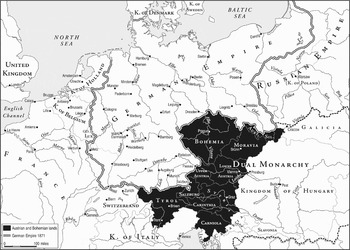
In1960, Robert A. Kannpointed out in A Study in Austrian Intellectual History: From Late Baroque to Romanticism that “[h]istorians of the future will still have to meet the challenging task of writing the comprehensive German-Austrian intellectual history.”Footnote 1 The value of the project Kann called for is generally acknowledged, but there is no clear agreement in the field about what a survey of German-Austrian intellectual history should look like. In 2007, I argued in an article for The Austrian History Yearbook that the scope of Austrian intellectual history still needs to be circumscribed and characterized adequately—geographically, linguistically, and comparatively. Rather than concentrating on Vienna or extending the field to the whole of the Habsburg monarchy, including Hungary and Galicia, I proposed that we concentrate our approach to this question on the historic core of the Austrian state: the Austrian and Bohemian Crownlands, a unity from at least 1749 to 1918. This was the region where state-building, centralization, and reform were most coherently pursued in the century after 1749, when the German language was dominant in education and public life. I contrasted this view to the disembodied approach to the German intellectual life of the entire Habsburg monarchy, which relies on conventions that were developed for dynastic and diplomatic history, conventions that also work quite well for economic history or even for cultural history, neither of which is so directly dependent on language. The region I have in mind is the southeastern part of the German Confederation that was included in the Frankfurt Parliament in 1848 but excluded from Bismarck's Germany in 1866.Footnote 2 The very existence of this region, let alone its long and rich history since the Middle Ages, often gets lost in political narratives of German nationalism and the Habsburg monarchy (Figure 1).
Austrian and Bohemian lands, 1871. Cartography by Philip Schwartzberg, Meridian Mapping, Minneapolis.

Especially in the context of nationalism, teleological arguments have come to shape the histories of Central Europe. The German national narrative marginalizes Austria and Bohemia, except perhaps in visions of grossdeutsch nationalism, whereas the Austrian Republic is regarded as the successor to the Habsburg Empire, and the Czech Republic becomes the successor to Bohemia and Moravia.Footnote 3 In my article for the Austrian History Yearbook, I outlined the book I am writing on Austrian intellectual history since the eighteenth century: The Austrian Tradition in German Culture: An Intellectual History. In this book, I aim to clarify our understanding of Austrian intellectual history in relation to the multinational (and continually varying) Habsburg monarchy and in relation to the broader realm of German culture.
Today I want to emphasize a different aspect of my project. I want to encourage Austrian historians to look more closely at early-nineteenth-century intellectuals and their relationship to German culture before German unification, again a concern that Kann pointed to thirty-five years ago.Footnote 4 I want to do this in a way that helps us move toward a broader, more inclusive, more flexible understanding of European intellectual history since the nineteenth century. German intellectual history in Austria, what Kann called German-Austrian intellectual history, has received very little attention from intellectual historians for the years between 1792 and 1866. Our view of these years is in some ways less defined than the Enlightenment or the Baroque, and this period displays with special force the most problematic issues confronting a German-Austrian intellectual history. Here we have what we might call the Old Austria, the age of Josephinist bureaucracy that culminated in the liberal era and nationalism, explosively in 1848 but more gradually in the following decade and a half.
It is easy to forget that during the early stages of the French Revolution, Austrian elites (including Leopold II) were in a position to regard France as simply catching up with the reformist achievements of the Austrian state, much as Prussia entered its famous period of reform only after a devastating defeat by Napoleon. Conventions about progress and reaction, as well as assumptions about comparative modernization, often oversimplify the realities in Europe between 1780 and 1806. At the same time, it is also true that by 1795 Francis II had given up on the reformist approach to the state that his family had adopted since the 1740s. He was left by Prussia after 1795 to deal with Napoleon more or less alone, and his announcement of an Austrian Empire in 1804 was not really a new beginning so much as an attempt to cope with the realities of Napoleonic power and the collapse of imperial institutions in Germany. It was during these years of Prussian isolation from European affairs between 1795 and 1806 that the transformation of modern German thought in idealism and romanticism occurred in Northern Germany.Footnote 5 This is also a decisive moment in Austrian intellectual history, and it marks the continuity of the Austrian tradition with the Enlightenment and German Classicism, as well as Josephinist Catholicism. This fundamental distinction between the intellectual history of Austria and developments north of the Main has still not been adequately understood or (for the most part) even addressed. Once Napoleon had taken over Europe, Emperor Francis, now Francis I of Austria, turned to Metternich to stabilize internal developments and preserve the Habsburg Empire, but for intellectual history it is Austria's isolation from idealism and romanticism that was decisive.
The period between 1792 and 1866 was by no means homogeneous in political terms, but it was defined by a centralized administrative system, which had replaced the decentralized forms of Baroque power but had not yet given way to the liberal institutions that were established in the Ausgleich (Compromise) of 1867. Although there was an effort in these years, as there had been in the eighteenth century, to extend the German bureaucratic system of Austria and Bohemia to the rest of the monarchy, the successes were generally limited and temporary, and these were almost entirely abolished in 1848 and then pushed back to an absolute minimum in the Ausgleich. Between 1792 and 1866, the core of the monarchy—that is, Cisleithanian Austria in the geographic sense of the Austrian and Bohemian Crownlands—was also the core of German-speaking intellectual history in the empire.
In this short discussion, I will only touch on three major figures who are particularly important for understanding Austrian intellectual history in the early nineteenth century: Franz Grillparzer (1791–1872), Adalbert Stifter (1805–1868), and Bernard Bolzano (1781–1848). These three figures give some indication of what is not visible about Austrian intellectual history from a European or even a German point of view. I hope that this will help to raise the more fundamental question of where and when German intellectual history, or even German history itself, was—at least before 1866. I want to locate these Austrian intellectuals more specifically in a German-speaking world between Vienna and Prague and point to some of the ways that this German intellectual history is quite different from the story most of us have heard. It is not to be understood simply in terms of Metternich and Habsburg rule, and it is not simply a matter of extrapolating from what we already know about German intellectual history in the national tradition. I want to see this region in relation to German culture in a way that invites a fuller account of the intellectual histories of East Central Europe and encourages a European intellectual history that is not so focused on England, France, and a German national view of what is German.
It is probably fair to say—especially from the point of view of many North German scholars—that it is Catholicism that makes Austrian intellectual history difficult to appreciate, especially in the early nineteenth century. But we often forget that this was a Josephinist Catholicism, which left its stamp on the three figures I want to talk about today. Grillparzer, Stifter, and Bolzano were all minds of the Enlightenment, and this is both what is old-fashioned about Austria and what separates it from the familiar narrative of German intellectual history in the early nineteenth century. These figures represent a blend of classical and Christian, of Enlightenment and Catholicism, that is sometimes regarded as the central theme of the Austrian intellectual tradition.
The Austrian Enlightenment drew strongly on the ideas of the German philosopher Wilhelm Leibniz (1646–1716), who emphasized that there can be no contradiction between religious and scientific truth. In one of his most characteristic passages, Leibniz argued “[t]hat love for God demands on our part complete satisfaction with and acquiescence in that which he has done.”Footnote 6 This passage captures something of the way in which Catholicism and a scientific approach to the objective world were compatible in Austria. This view was especially influential in Bohemia, and it is a view that conceives the relationship between the individual and the objective world, between freedom and necessity, quite differently from most Western liberals in the early nineteenth century. For Leibniz, scientific determinism is entirely compatible with love for God and respect for reality, and William Johnston has emphasized that the Austrian educational system was reformed after 1848 on the “Leibnizian premise that religion and science cannot contradict each other.”Footnote 7 These values of the Enlightenment shaped the intellectual world of the three figures I want to consider today.
Writing in 1877, Ferdinand Kürnberger, one of the most expert commentators on nineteenth-century Austria, argued that: “In the history of culture [Grillparzer] stands for the separation of Austria from Germany.”Footnote 8 And Grillparzer's importance for shaping an Austrian tradition was by no means merely literary. His delightful remark about Hegel set the terms for the Austrian reception of German idealism: “What is it that I like best about your system? That it is as incomprehensible as the world.”Footnote 9 One could hardly imagine a view more distant from the standard German intellectual histories of the early nineteenth century. At the same time, Grillparzer has a tendency simply to fall out of the German narrative as insufficiently national and not part of the teleological account, even though a modern German nation-state did not exist until the year before he died.
Grillparzer wrote about a dozen important plays; his novella, The Poor Fiddler, has become surprisingly popular in English; and his diaries are well worth the attention of historians.Footnote 10 But his plays are still not well known even by Austrians, and he suffers in Austria from being presented as the Austrian national poet. The musicality of his poetry and his theatricality are both qualities that American audiences are unlikely ever to appreciate (although these issues arise in somewhat different ways with Goethe as well, of course). Nonetheless, certain themes still attract the attention of contemporary critics: the prominence of women in his plays, his explorations of politics, his psychological subtlety, his unconventional approach to freedom and fate, and his anticipations of postmodernism.Footnote 11 Grillparzer's figures are often driven by irrationality or conditioned by external powers that they are unable to control, and his mature dramas present protagonists who are characterized by humility, wisdom, and a realistic sense of limitations.
Although many Austrians regarded Vienna as the center of German theater, this was difficult for North Germans to reconcile with the German they heard in Viennese coffee shops. Moreover, to North German critics, Grillparzer seemed to embody a pessimistic, fatalistic, and unmanly view of the world.Footnote 12 Although Grillparzer conceded the silliness of making tiny distinctions between Swabian and Austrian literature and the like, he did think that certain qualities of Austrian literature stood out: modesty, healthy common sense, and authentic feeling.Footnote 13 And his work challenged North German assumptions and perspectives of the early nineteenth century such as idealism, romanticism, and subjectivity. Ideologically, Grillparzer challenged the liberal and nationalist values of the early nineteenth century that seemed obvious to many German and French intellectuals. Later in the century, Friedrich Nietzsche expressed his admiration for “honest Grillparzer” and his critique of Gervinus and the ideology of progress.Footnote 14 Grillparzer's well-known epigram on nationalism is hardly a remark that would have occurred to most West European intellectuals in 1849. “The path of modern education goes from humanity through nationalism to bestiality.”Footnote 15
One striking fact about Grillparzer's dramas is the prominence of female characters, beginning with the Ancestress, his first success on the Viennese stage. And women continued to play leading roles in his plays—Sappho, Hero, Libussa, Rahel, Esther, and the Jewess of Toledo—to say nothing of the grocer's daughter in his novella about the poor fiddler. Moreover, Grillparzer often concentrated his own experience as a creative person in these women. Seen together, his plays raise important questions regarding our assumptions about the way men portrayed women in the nineteenth century.Footnote 16
Benno von Wiese has suggested that Grillparzer's Catholic view “saw divinity in a very objective way and could not subsume it within an idealistic view of history as in romantic theory.”Footnote 17 We need not regard Grillparzer as pious to recognize that a Josephinist Catholicism was a fundamental shaping feature of his world, a significant dimension of his cultural location, whatever his religious convictions may have been. Although Wiese's account is generally sympathetic and perceptive, this remark recalls how much a Protestant bias has shaped our conception of German intellectual history.
Between Goethe and Thomas Mann, there were only a few German novelists of great stature: the Swiss Keller, the Prussian Fontane, and, above all, the second person I want to discuss today, Adalbert Stifter. His stories are like cut stones, and the early stories were already well known when he expressed his admiration for Grillparzer's The Poor Fiddler in 1847.Footnote 18 Grillparzer's novella and Stifter's stories show the common ethical and aesthetic ground of the two writers who more or less invented what has come to be known as the Austrian tradition in literature: an unpretentious view of the artist and an emphasis on simple characters and everyday life. As a mature man, Stifter wrote three enormous epic works: Der Nachsommer, Witiko, and Der Mappe meines Urgrossvaters.
Stifter grew up in Bohemia in Oberplan near Český Krumlov and lived much of his adult life across the border in Upper Austria, although he did spend a significant amount of time in Vienna as a young man. Almost all of his work deals with Bohemia or with the region on the border between Bohemia and Austria—and it touches on Vienna much as it does on Prague, as the great urban centers of this region. This hinterland of Vienna—in Bohemia, Moravia, and Alpine Austria—is rarely adequately taken into account in today's intellectual histories of Austria, which ordinarily focus on Vienna. This is the same Austria that Grillparzer circumscribed in his plays as the German and Bohemian Crownlands.Footnote 19 The importance of Bohemia for the Austrian tradition in German culture is apparent if we consider Stifter's Witiko along with the founding history of Bohemia and the Czech people: Palacký's Geschichte von Böhmen. Footnote 20Witiko is a wonderful book that rivals Stifter's more famous Indian Summer—because of the elegance of his classical prose and because of his imaginative representation of the world of Germans and Czechs in the twelfth century. The German literary critic, Ulrich Greiner, recently called Witiko “one of the least known and most astonishing novels of world literature.”Footnote 21 Like Joseph Dobrovsky's Geschichte der böhmischen Sprache,Footnote 22 Palacký's history of Bohemia originally appeared in German; and Stifter may deserve to be regarded as the Austrian Michelet, just as Palacký was the Czech Ranke. By approaching German intellectual history in the context of nation-state traditions, we have lost track of one of the most cosmopolitan dimensions of German culture: the emergence of Czech history and the history of the Czech language—and the ways in which the stories of Germans and Czechs are interwoven from Prague to Vienna.
Stifter is important for his stories and novels, rather than for theoretical arguments about art and politics, but the world of his fiction is well described by his notion of das sanfte Gesetz, “the gentle law,” first presented in the preface to Bunte Steine in 1852, in response to Friedrich Hebbel's criticism that he wrote only about unimportant things. Stifter conceived the gentle law to describe his stories of the 1840s, but it applies as well to the epic narratives of his mature work. It is, to be sure, an image and not a mathematical formula. “The blowing of the wind, the rippling of the water, the growing of the grain, the waves in the ocean, the greening of the earth, the shining of the heavens, the shimmer of the stars I regard as great.” Among less great phenomena he thought of thunder and lightning, earthquakes, and other temporary disturbances.Footnote 23 And roughly this is his view of what is great and less great in the human world. As Stifter's biographer, Wolfgang Matz, recently put it: “Think like the forest—that is Stifter's central idea. Nature as our mentor, as aesthetic model, as he formulated it in his ‘gentle law.’”Footnote 24 Nature is Stifter's model even in writing history, as we see in Witiko, Stifter's account of the origins of the Rosenberg family in the region on the upper Moldau (Vłtava) in Southern Bohemia where Stifter grew up.Footnote 25 In this historical novel, Stifter achieved what he had aimed at: “The novel has a scholarly side, which before the fact lies in no human soul, but which it must achieve: the historical. This must be so faithfully approximated that author and reader breathe in the air of those bygone times, and the present no longer exists. This alone gives truth. But, for that, historical knowledge alone is not enough.”Footnote 26 Stifter's emphasis on the powerful forces of nature and the objective world is quite striking by comparison with Northern German writers of the early nineteenth century. The emphasis in Grillparzer and Stifter on respect for the objectivity of the world recalls the identification of God with reality in Leibniz, and one critical study speaks of “that typical interplay of scientific and religious vocabulary in Stifter.”Footnote 27
Bernard Bolzano, my third figure today, was an important contributor to the emergence of scientific philosophy and a key figure in the way philosophy developed in Prague and Vienna. He is sometimes regarded as the founder of Austrian philosophy, and it is quite correct to call him a Bohemian philosopher, although it seems unlikely that he will ever be regarded as a Czech philosopher. On the other hand, he has been marginalized within German philosophy (as an Austrian Catholic and un-Kantian) and often absorbed into a Vienna-centered or even broadly imperial conception of Austrian philosophy—although he spent his entire life in Bohemia. Bolzano regarded himself as a “Bohemian of the German tongue” who came to the defense of “Bohemians of the Slavic tongue.” Many historians would be surprised to learn about this priest from Prague who advocated the complete equality of mankind. Bolzano contrasted happiness [Glückseligkeit] to the preoccupation with selfishness or eudaemonism or hedonism or purely sensuous well-being. He found his well-being in serving the greatest good. This was “a humanistically conceived, philanthropic utilitarianism,” which was close to Bentham but not to the mainstream of early-nineteenth-century liberalism.Footnote 28 Today I only have time to locate him briefly in the history of philosophy.
Bolzano and Hegel were both post-Kantian philosophers of the early nineteenth century, although Bolzano was somewhat younger. Hegel was a Lutheran pastor from Swabia, and Bolzano was a Catholic priest from Bohemia, but neither was very conventional religiously and both were powerfully influenced by the Enlightenment. Hegel was centrally concerned with history and the human sciences, whereas Bolzano (like Kant and the Enlightenment as a whole) was more interested in the foundations of the natural sciences and mathematics. Perhaps the most important logician between Leibniz and Frege, Bolzano construed the field somewhat more broadly than it is understood today.Footnote 29 He was a serious, though critical, student of Kant's works; he had a major influence on secondary schools in Austria; and he is a crucial figure for understanding Franz Brentano and Edmund Husserl, as well as analytic philosophy. Bolzano's decisive contribution to a critique of Kant was his emphasis on the importance of making a sharp distinction between the subjective and the objective, that is, between subjective ideas or representations and objective thoughts in themselves.Footnote 30 And his approach contributed to the philosophical critique of psychologism, of regarding thought as a mental event. As Rudolf Haller puts it: “It is Bolzano's great, outstanding achievement to have made clear that the true path of knowledge is not to be sought out and found by way of the individuality of the subject, but only beyond the subjective.”Footnote 31 Bolzano became an important influence on the resistance to German idealism at the University of Vienna, especially through the work of Robert Zimmermann (1824–1898).Footnote 32
At least since Janik and Toulmin's Wittgenstein's Vienna (1973), intellectual historians and philosophers have been revising postwar distinctions between Anglo-American and continental philosophy. It is now widely appreciated that contemporary analytical philosophy is indebted to Central European philosophy, and philosophers like Haller and Barry Smith have developed the idea of an Austrian philosophy distinct from the familiar tradition of German idealism from Kant to Hegel.Footnote 33 Some recent commentators have even argued that both the analytic and the phenomenological traditions of philosophy grew out of the work of nineteenth-century German-speaking philosophers, including Bolzano.Footnote 34 In this context, figures like Bolzano, who are almost unknown or apparently quite old-fashioned, turn out to be more important for contemporary philosophy than the familiar figures of German idealism after Kant. Bolzano, like Grillparzer and Stifter, presents a very different view of the balance between subjectivity and objectivity from what is familiar to us from our knowledge of the German tradition. We find in all three of these figures the continuing power of the Enlightenment and modern science, as well as a resistance to German idealism and romanticism.
The Austrian intellectual tradition has been variously described as scientific, empirical, phenomenological, Leibnizian, and Catholic. For this period, the emphasis on the force and reality of the external world and the modesty and sense of limits in the accounts of the individual subject are what stand out. Grillparzer, Stifter, and Bolzano are certainly representative figures, and they were all influenced by the Enlightenment from Leibniz to Kant. The real divide came with Hegel: it is rare to find an early-nineteenth-century Austrian writer or philosopher who was attracted to Hegel, although a few German post-Kantians, such as Schopenhauer and Herbart, did influence Austrian intellectual life in this period.
The way we write European intellectual history today is still predominantly shaped by the original history of the reception of these ideas, especially the prominence of England and France in the American view of the world since the colonial period and the role of Northern, Protestant German views of Central Europe in the Anglo-American world in the late nineteenth century. In particular, the compact, teleological account of modern German intellectual history ordinarily identifies a continuous story from Goethe and Kant to romanticism and Hegel in a seamless way that hardly knows what to make of Bolzano or Stifter or Grillparzer—and it has never quite been clear how to discuss the German-ness of Sigmund Freud or Robert Musil or Franz Kafka. In this way, important figures and insights are driven to the periphery.
Jerrold Seigel's The Idea of the Self: Thought and Experience in Western Europe since the Seventeenth Century is a revealing example of the marginalization of Austria in accounts of European intellectual history.Footnote 35 This book brings out especially clearly the broader conventions of the field of European intellectual history. Seigel organizes his book according to the familiar convention of concentrating his discussion on England, France, and Germany, even though he begins two centuries before Bismarck's Germany came into being. This framework has the effect of marginalizing the intellectual history of Central and East Central Europe. Obviously no book can discuss everything, and Seigel's book is about Western Europe; but this is the standardized code of the field, which no longer seems to require explicit justification and clarification, especially when the emphasis is on the nineteenth century as it is for Seigel. The first three parts of Seigel's book are organized in terms of England, France, and Germany down to the mid nineteenth century (while Austria is not discussed); and the fourth part draws together thinkers from Mill and Nietzsche to Foucault and Heidegger in a discussion of the modern self. Seigel postpones sustained discussion of Freud to the epilogue and decides not to discuss Musil, even in the context of postmodern accounts of the self.
European historians rarely take Austrian intellectual history into account until they turn to the story of Vienna at the end of the nineteenth century; and certainly Grillparzer, Stifter, and Bolzano have contributed very little to their accounts of the intellectual history of the early nineteenth century—or to our understanding of European views of the self. What is perhaps most striking about the Austrian intellectual tradition in the early nineteenth century, even in the three quite different forms of the theater, the novel, and philosophy, is the lack of emphasis on the romantic self or the heroic ego or the subjectivist understanding of German idealism in its quite different forms from Kant to Hegel, including the nationalism that emerged out of radical idealism in Fichte. The relationships among idealism, romanticism, and nationalism in the German tradition are often oversimplified; and certainly more understanding of the Austrian tradition in German culture would open up a richer understanding of these issues and the history of Central Europe. This points to the value of telling the story of German intellectual history in a way that is more authentically located in a multinational Europe—especially Central Europe—and less pulverized by German and Czech nationalism.
I hope what I have said here about Grillparzer, Stifter, and Bolzano can contribute to a more complex, more interesting intellectual history of modern Europe than the conventional narrative of German history normally allows.Footnote 36 Robert Kann's Multinational Empire of 1964 was a crucial step toward taking seriously the histories of the nationalities in Austria and Hungary; and this is a basic, underlying assumption of my argument.Footnote 37 I believe it is very much in Kann's spirit to address the intellectual history of the Habsburg monarchy in a way that neither reduces it to a German story nor blocks the complex connections between the monarchy and the states of Central and Eastern Europe since World War I, so that we are less puzzled to find the German story of the self culminate in Freud and Musil in the twentieth century.