

“There is might in mass prayer,” averred Armin Gesswein, an associate evangelist with Billy Graham in 1980. “It is the power of sun rays and rain drops which bless, because there are so many of them.” Writing in one of the regular mailings of the International Intercessors, a prayer ministry of some 17,000 associated with the evangelical humanitarian organization World Vision, he counseled, “We Christians must learn to flash hundreds of instantaneous prayers at people far and near.” Although each intercessor prayed alone, her voice could mingle with others to better reach God.
Gesswein believed this united effort was indexed by bodily sensations, which he suggested readers try to identify by recalling something familiar: the affective charge when their local congregation prayed together—that “strange, strong, delightful response from all parts of the room. We feel lifted, almost as though an invisible arm held us up; our hearts burn, tears lie close…. Commonplace truth becomes incandescent and burns like liquid metal.” As this metal metaphorically poured down, it approximated the feelings at Pentecost. Gesswein quoted from Acts 1:14: “These all continued with one accord (unanimously) in prayer and supplication.”Footnote 1 On the page opposite was a calendar: on this day pray for students at a Bible Institute in Brazil, on another day for a World Vision employee in Kenya.
Prayer calendars have a long history in the United States. World Vision based its model on earlier bulletins, such as Global Circle, mailed out by the Great Commission Prayer League founded at the Moody Church in 1908.Footnote 2 Calendars were a tool to bring Christians from around the world into one chorus for the same need. They did so by specifying a particular object of prayer for a requisite period of time. In May 1980, for example, a World Vision Intercessor would have opened her calendar to read:
May 16: Pray for children in Zimbabwe Rhodesia who live in disease-ridden urban slums.
May 17: Pray specifically for the many children left orphaned by the atrocities in Cambodia.
May 18: Pray for the increasing numbers of Ethiopian children who are escaping the armed conflict.
May 19: Pray for children of the Vietnamese “boat people” living in cramped, temporary quarters on the Anambas Islands.Footnote 3
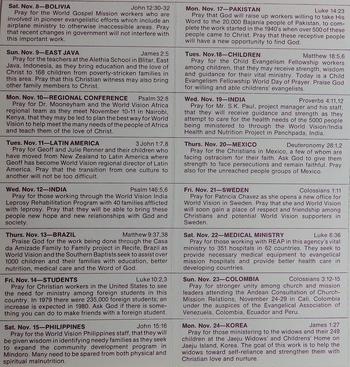
The calendars took various forms. Some included pictures and world maps so one could follow the trajectories of prayers. Others were so plain they resembled to-do lists (Figure 1). Regardless, they offered what modern U.S. Protestants called an “intelligent” approach to prayer—one with laser-focus on specific needs. Intercessors’ supplications zipped across the world, pinpointing conflict and poverty hotspots that were familiar from U.S. media coverage. It let Americans “reach around the world to touch the lives of millions,” wrote World Vision Magazine.Footnote 4
Prayer calendar mailed to members of World Vision's International Intercessors, November 1980. Folder 13: Ministries “Int. Intercessors” January–December 1980, Courtesy of World Vision International Archives, Monrovia, CA.

The World Vision Intercessors were largely white, Christian women from North America, though they were assured that their group's thousands hailed from at least fifty-eight countries.Footnote 5 “All around the world,” World Vision president Stan Mooneyham told them, “prayer warriors of all races, denominations and ages have joined hearts to bring before the throne of grace the many vital matters which demanded God's interposition.”Footnote 6 Armed with their calendars, American prayer warriors engaged in what they understood to be mutual prayers with diverse believers from other countries, or “native Christians” in the parlance of the time. The roots of World Vision's project for unified prayer stretched back more than two centuries, but the form it took, and the urgency with which intercessors prayed, tracked more recent imperial and technological developments.
The Christian longing for some form of world unity traces back at least to Augustine, who interpreted Eden as the loss of ideal harmony between divine and human will. Reading Eden alongside Babel, medieval theologians made language integral to these yearnings: In both founding myths, humans began with a single tongue that expressed the accord between God and his creations. The divine punishment for sin was a profusion of languages that divided nations and peoples from each other.Footnote 7 Unified prayers and hymns expressed a quest to revive what once was—to call forth the elusive concord that characterized God's creation and foreshadowed the world to come.
This ideal began to take on a more practical character by the eighteenth century. Through global conquest and exchange, Christians had come to view the Kingdom of God as much larger than they had imagined just two centuries before. As Anglo-Protestants settled in far-flung colonies, Christendom was more extensible yet seemed more fragile too; the possibilities for the world's conversion and renewal were exhilarating yet daunting. In response, a group of Scottish ministers in 1744 announced what they called a concert for prayer. For the next two years, congregations across Scotland prayed the same words each first Tuesday of the quarter, hoping that this clear expression of unity would chorus up to God and hasten his Kingdom.Footnote 8 The scheme was so popular that it was followed by another tract, “A Concert For Prayer, To Be Continued For Seven Years,” that made its way through England and the American colonies, where it captured the imagination of famed Congregational minister Jonathan Edwards, who penned a book on the topic in 1747.Footnote 9 Over the next generation, concerts spread to nearly every major denomination and became a regular feature of Anglo-Protestant global engagements.
The conviction that harmonized voices most closely approximated divine order was embedded into charity and missionary school curricula, where American workers trained foreign children's voices along Protestant lines, both because they could not abide “heathen” praying and singing, especially in minor keys, and because such harmonizing seemed to attest to the children's inner transformation—and thus to the global spread of Christianity. Vocal experiences were fundamental to the production of Christian globalism in other ways too: When people of many tongues sang together it seemed to manifest God's all-encompassing power by flashing back to the perfect language of Eden and forward to the moment when believers from every nation would chorus around the Throne in Heaven. American Protestants sometimes produced this sound by asking groups of missionaries on furlough to simultaneously perform a single hymn or prayer in multiple languages. Audiences remarked with wonder how the disparate voices produced “not a discordant note, but one harmonious song.”Footnote 10
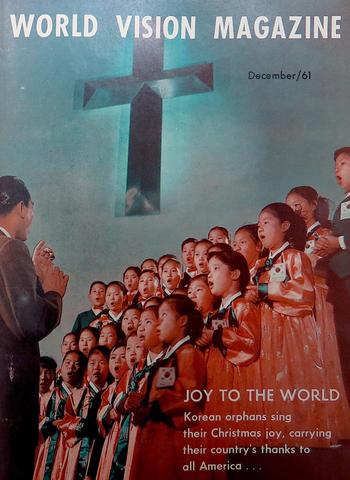
World Vision drew inspiration from these forms of hymnody and prayer. Its Korean Orphan Choir, the best known of the foreign children's choirs that fundraised in churches across midcentury America, recalled earlier missionary choruses (Figure 2). Often dressed in “native” style, the Korean children joined U.S. Christian audiences in song, moving through repertoires of “The Old Rugged Cross,” “Away in a Manger,” “Swing Low Sweet Chariot,” and other “old familiar hymns,” to quote one brochure—hymns that were familiar to Americans, that is, not to the children who learned them by rote.Footnote 11 Such choirs also performed Protestant hymns translated into Korean and set to Asian-inspired music, which allowed Americans to hear their own sacred music rendered global through a prism of, to them, exotic sounds.Footnote 12 Sunday school teachers used recordings of these choirs as pedagogical tools to inculcate globalism among their students. Teachers were counseled to pick from an album one of “our wonderful old traditional Christian children's chorus numbers … songs American kids cherish,” and instruct their pupils to sing it. Then immediately cue up the Korean voices: “Play the record after your class has sung the same song. It's most effective!”Footnote 13
The Korean Orphan Choir in mid-song during their U.S. tour in 1961. Cover image, World Vision Magazine, December 1961. Courtesy of World Vision International Archives, Monrovia, CA.

Just as much as trade, communications technology, or mass media—the sinews of globalization—connected humans across vast distances, so too could prayers create a “time–space compression” that rendered faraway people or events more present.Footnote 14 Unified prayer seemed to extend space by constraining time; its ability to penetrate places in need around the global was predicated upon bringing far-flung Christians into synchrony. Such prayers also conjured globalism of a particular sort, in which people marked as “diverse” by their dress, accents, or race acted in concert with U.S. Christians by doing or saying things that were familiar to Americans and thus legible to them as godly, such as when foreign children sang Anglo-Protestant hymns, or Intercessors in fifty-eight countries prayed in U.S. evangelical terms.Footnote 15
This goal distinguished synchronized hymns and prayers in the second half of the twentieth century from those in earlier periods. Prayer concerts had initially developed to unite white Anglo-Protestants with each other. They had relied on the formalized prayers of their respective denominations, framed in general eschatological terms and sung in congregational settings. Thus members of a Presbyterian congregation in Scotland pictured themselves in concert with people in the colonies who looked like them, inhabited equivalent church spaces, and followed the same English hymnal. But the prayer calculus changed significantly as U.S. Christians sought to support independent “native” churches and later as they began to recognize a major demographic shift with the gospel spread across the global south. Cultural differences once thought to need “civilizing” were now celebrated as powerful illustrations of the global reach of the Christian God. Formalized prayers gave way to informal ones, which could be said in any vernacular and organized through, among other things, the loose structure of prayer calendars.
In this climate, unified prayer clarifies a broader ontological project in late twentieth century U.S. Christianity whereby bringing faraway people of any class or culture into contact through prayer was understood to make them into something new (“one new man” in Christian parlance). This monologic project, to paraphrase philosopher Mikhail Bakhtin, used displays of marked racial and cultural difference to reify an essentialized core human sameness—the soul, free will, and universal rights that World Vision supporters believed all humans possessed by virtue of their shared relation to a single creator.Footnote 16 Ultimately, of course, diversity was a model of and for God's immense global project. “One of the exciting experiences of heaven, after we've really become acquainted with the actual person of our Lord,” wrote Intercessors director Herbert Scott to subscribers in 1976, “will be to meet and share with our brothers and sisters of all ages and climes” who make up the global prayer team. “What a beautiful illustration of the diversity and variety of the Body of Christ!”Footnote 17
World Vision's choir performed less often after the mid-1970s and was eventually retired. The Intercessors ended in 1983. However, unified prayer and hymnody remain powerful tools in U.S. Christianity. Foreign children's choirs still embark on charity tours.Footnote 18 YouTube mash-ups feature clips of Christians across the world singing the same hymn or reciting the Lord's Prayer—a concert for prayer 2.0. World Vision now distributes monthly Prayer Team e-newsletters and offers a prayer app for smart phones. Its May 2017 call for a Global Day of Prayer encouraged Americans to join Christians across the world in prayer for specific famine hotspots and the upcoming G7 summit. A chorus of voices, they hoped, would knit human beings together, foment united action, and address a common creator.Footnote 19 The great project of Christian globalism reverberates still.