


Introduction
Microswitches are technical tools designed to help persons with multiple disabilities control their immediate environment with simple responses: it can be of many different kinds (e.g. pressure, wobble, pull, pedal, and leaf microswitches) to suit the physical conditions and behavioural characteristics of the users (Crawford and Schuster, Reference Crawford and Schuster1993; Gutowski, Reference Gutowski1996; Lancioni, Singh, O'Reilly, Sigafoos, Didden et al., Reference Lancioni, Singh, O'Reilly, Sigafoos, Didden and Oliva2009; Lancioni et al., Reference Lancioni, Singh, O'Reilly, Sigafoos, Oliva and Baccani2007; Lancioni, Singh, O'Reilly, Sigafoos, Oliva et al., Reference Lancioni, Singh, O'Reilly, Sigafoos, Oliva and Cingolani2009; Leatherby, Gast, Wolery and Collins, Reference Leatherby, Gast, Wolery and Collins1992; Saunders et al., Reference Saunders, Questad, Kedziorski, Boase, Patterson and Cullinan2001). To introduce a person with multiple disabilities to a microswitch-aided program, one has to select a plausible response and a microswitch suitable to that response (Glickman, Deitz, Anson and Stewart, Reference Glickman, Deitz, Anson and Stewart1996; Lancioni, O'Reilly and Basili, Reference Lancioni, O'Reilly and Basili2001). Evaluators determine the best type of switch based on individual characteristics and considerations of position, mounting, and placement requirements. Various responses have been suggested in literature as highly plausible and convenient, for example, hand-pushing, head-turning, hand movements, and vocalization (Kinsley and Langone, Reference Kinsley and Langone1995; Lancioni, O'Reilly, Oliva and Coppa, Reference Lancioni, O'Reilly, Oliva and Coppa2001; Sullivan, Laverick and Lewis, Reference Sullivan, Laverick and Lewis1995). Microswitches matching such responses have been developed and results have generally been fairly encouraging (Gutowski, Reference Gutowski1996; Lancioni et al., Reference Lancioni, O'Reilly, Singh, Oliva, Coppa and Montironi2005; Lancioni et al., Reference Lancioni, Singh, O'Reilly, Sigafoos, Oliva, Costantini, Gatto, Marinelli and Putzolu2006; Lancioni, Singh, O'Reilly, Sigafoos, Oliva et al., Reference Lancioni, Singh, O'Reilly, Sigafoos, Didden and Oliva2009; Lancioni et al., Reference Lancioni, Singh, O'Reilly, Oliva, Scalini, Vigo, Groeneweg and 2004). Although satisfactory outcomes have often been reported, these responses and microswitches may not be suitable for children with multiple disabilities who have minimal motor control (i.e. children who have extensive paralysis of their body and can effectively control only very limited movements). For these children, it is necessary to identify some minor movements to use as target responses and set up microswitches that can detect such responses.
The computer mouse has gained wide acceptance as an input device that could be used in a “natural way” to indicate position on a display screen. Based on ergonomics, the mouse has been designed to allow most individuals to operate it easily. Individuals can interact with a computer by moving, pressing and releasing the button of a mouse. Even 3-year-old children can use a mouse (Strommen, Revelle, Medoff and Razavi, Reference Strommen, Revelle, Medoff and Razavi1996). Some studies have indicated that children with developmental disabilities can learn pointing (Durfee and Billingsley, Reference Durfee and Billingsley1999; Missiuna, Reference Missiuna1994; Shimizu and McDonough, Reference Shimizu and McDonough2006).
A trackball is a type of mouse consisting of a ball held by a socket containing sensors to detect rotation of the ball about two axes. The user rolls the ball with the thumb, the fingers, or the palm of the hand to move a cursor. It is the preferred pointing device for numerous computer users, particularly for people with some form of motor impairment. Trackballs are generally either thumb-operated, with the ball moved by the thumb and the buttons clicked by the fingers, or finger-operated, with the ball moved by the middle fingers and the buttons by the thumb and little finger. For people with low strength, poor coordination, wrist pain, or a limited range of motion, rolling a trackball can be easier than shuttling a mouse across the surface of a desk. From this point of view, the trackball is a sensitive detector, designed to detect thumb/finger poke on the ball, and transfer the wheel rolling into the movement of the computer cursor. Therefore a trackball can be used as a special switch, because its control surface is easier to manipulate than a standard mouse and it can accurately detect any thumb/finger movements. It has the basic on/off (roll/stop) function like a switch, and it can detect small rotations of the ball about two axes.
In addition, as a commercial product, a trackball also has the advantages of low cost, good technical support, can be easily procured, and can be updated with the newest technology (i.e. 2.4G wireless or Bluetooth trackball). Therefore, in addition to the exclusive use of specialized switches, people with disabilities would also gain from being trained to use very common, cheap and powerful commercial trackballs. Although a standard trackball has all the advantages mentioned above, it is difficult to apply to other applications, especially those concerning persons with disabilities.
Normally, when a trackball is connected to a computer by hand, the Windows operating system (OS) will identify this device and install its driver automatically, then define its function as moving the cursor. Therefore it is not easy to change its function into other applications (i.e. thumb/finger poke detector) to meet the needs of the people with disabilities.
Redesigning mouse drivers can redefine mouse functions, turning it into a much more powerful tool, but this is rarely proposed by researchers because of the complexity of the technology required. Only a few recent researches (Shih, Chang and Shih, Reference Shih, Chang and Shih2009; Shih, Chung, Chiang and Shih, Reference Shih, Chung, Chiang and Shih2010; Shih, Hsu and Shih, Reference Shih, Hsu and Shih2009; Shih, Huang, Liao, Shih and Chiang, Reference Shih, Shih, Lin and Chiang2009; Shih and Shih, Reference Shih and Shih2009a, Reference Shih and Shihb, Reference Shih and Shihc, Reference Shih and Shihd; Shih, Shih, Lin and Chiang, Reference Shih, Shih, Lin and Chiang2009) adopted software technology to redesign the mouse driver, and turned the mouse into a useful tool for many applications dedicated to persons with disabilities, providing them with additional choices in assistive technology.
Shih and Shih (Reference Shih and Shih2009d) applied Shih's revised mouse driver (i.e. a new mouse driver replaces standard mouse driver, and turns a mouse into a precise two-dimensional motion detector) to assess whether two persons with profound multiple disabilities would be able to control environmental stimulation using hand swing and a standard mouse with a newly developed mouse driver. Data showed that, with the assistance of Shih's revised mouse driver, both participants significantly increased their target response (hand swing) to activate the control system to produce environmental stimulation and maintained this performance.
Therefore it can also be realized through revising Shih's mouse driver to change a trackball into a precise thumb poke detector, especially suitable for persons with multiple disabilities and minimal motor skill.
This study was directed at two children with profound multiple disabilities and minimal motor skill whose most plausible response seemed to be thumb poke. In our case, the target response consisted of a sequence of thumb pokes. The possibility of making this response instrumental in controlling environmental stimuli was through a wireless trackball placed under their hands. Both trackballs installed Shih's revised mouse driver developed for this target response. The function of this revised driver would transfer thumb poke into a sequence of poke data instead of standard cursor movement. Through the above configuration, a standard trackball can be used as a precise detector to detect any tiny thumb poke. Trackball device does not need additional design or modification, and offers many choices based on its various formations. For example, a wireless trackball can be turned into a wireless thumb poke detector.
Method
Participants
The participants Lai and Wong were 12 and 10 years of age respectively. Lai was rated in the severe intellectual disability range. He was in a wheelchair due to spasticity, scoliosis, and foot abnormalities, and had hardly any initiative in performing foot or leg movements. He had limited physical control, but his left thumb had poke ability. He had no apparent interaction with objects and seemed very withdrawn.
Wong had congenital cerebropathy due to perinatal hypoxia. She presented spastic tetraparesis with modest head control and lack of trunk control, undetermined residual vision, and absence of speech. She was considered to be in the profound range of intellectual disability. She had poor finger function, but could still control her wrist. Her right thumb had poke ability. She would react to familiar sounds and songs, loud noises, and praise by alerting (turning/widening her eyes) or smiling. Their parents have given formal consent for their involvement in this experiment.
Target response, trackball setting, control system, and stimuli
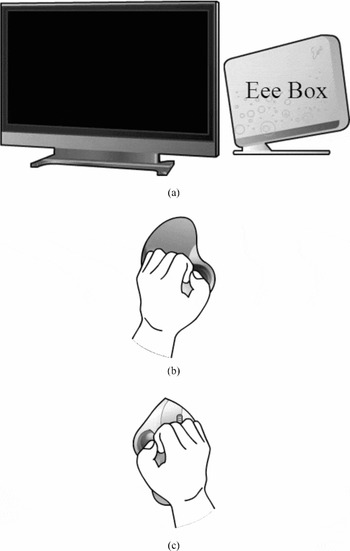
The configuration of this experiment is shown in Figure 1. The target response consisted, as mentioned above, of a sequence of thumb pokes. Two Logitech wireless trackballs, installed with Shih's revised mouse driver to detect the target response, were placed under Lai's left hand (rotated clockwise 180° to help him hold it), and Wong's right hand. Shih's revised driver rotated Lai's trackball coordination by 180° clockwise, cancelled button functions of both trackballs, and transmitted the thumb poke signal to a control system.
The configuration of this study, including a control system and two trackballs installed with Shih's revised mouse driver. The control system is connected to TV through cables, and both send the thumb poke signals through wireless to the control system. (a) The control system – an Eee Box mini computer connected to TV through cables. (b) Lai's trackball. It is rotated 180°clockwise and installed with Shih's revised mouse driver sending left thumb poke signals through wireless to the control system. (c) Wong's trackball. It is installed with Shih's revised mouse driver sending right thumb poke signals through wireless to the control system.

The thumb poke signal, transmitted via wireless to the control system, is a sequence of thumb pokes. The control system is an Eee Box mini computer (ASUS, 2009), which is a mini host, with built-in Microsoft Windows XP Home Edition. It was connected to a TV through cables to play participants’ favourite videos and music. Because of its low power consumption (saving up to 90% in energy consumption), small size and low price, it is practical to develop it as the control system for the disabled.
A critical value is necessary to be set for the participants’ thumb poke amount, because any slight but undesired poke could be detected by the precise trackball. The control system would check the poke amount, and served to start a 6-second stimulation period contingent on the response (except in baseline phases) and to record the response, once the poke amount exceeded the critical value. The critical value could be adjusted according to the participants’ personal conditions. The stimulation period involved the activation of one favourite stimulus (i.e. stimuli that had produced smiling or voice reactions). The favourite stimuli involved various types of cartoon videos and music, offered by their parents.
Experimental conditions
Lai and Wong initially received an ABAB sequence, in which A represented baseline and B intervention phases (Richards, Taylor, Ramasamy and Richards, Reference Richards, Taylor, Ramasamy and Richards1999). A post-intervention check was conducted 2 months after the second B phase. Three to five sessions a day occurred within those study periods. Sessions lasted 10 minutes and were conducted at home. Responses were recorded automatically through the Eee Box control system.
Baseline phases. The baseline phases included 15 and 12 sessions respectively. The wireless trackball and the Eee Box control system were available, but the control system did not produce any stimulation. At the start of the sessions, both participants received verbal promptings to respond (i.e. verbal promptings from a therapist who asked them to poke the trackball). Promptings would be repeated during the sessions after periods of about 1 minute of non-response.
Intervention phases. The intervention phases included 45 and 60 sessions respectively. Procedural conditions were the same as during baseline except the control system produced 6 seconds of his/her favourite stimulation. A new activation, occurring while the previous one was still being followed by the favourite stimuli (i.e. within the 6-second interval in which the stimuli were on), was not recorded and did not cause an additional stimulus presentation.
Post-intervention check. During the period separating the end of the second intervention phase and the post-intervention check, both participants continued to receive sessions comparable to those occurring during the intervention. Eighteen sessions (carried out 2 months after the end of the second intervention phase) were used for the post-intervention check.
Results
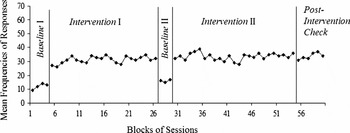
Lai's data are shown in Figure 2. During the first baseline phase (15 sessions), Lai had a mean of about 12 independent responses per session. During the first intervention phase (45 sessions), the mean increased to about 31 responses per session. This mean frequency dropped to 16 during the second baseline phase (12 sessions) to be fully restored and eventually increased during the second intervention phase (60 sessions). The intervention frequencies were largely maintained at the post-intervention check (18 sessions). The differences between the baseline responding frequencies and the intervention and post-intervention frequencies were significant (p < .01) on the Kolmogorov-Smirnov test (Siegel and Castellan, Reference Siegel and Castellan1988).
Lai's data. Data points represent mean frequencies of Lai's target responses per session (independent of prompting) over blocks of three sessions. Only the final points of a phase can represent a block of two sessions.

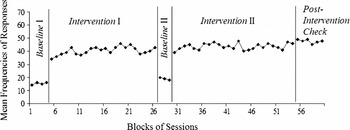
Wong's data are shown in Figure 3. During the first baseline phase, Wong had a mean of about 15 independent responses per session. During the first intervention phase, the mean increased to about 40 responses per session. This mean frequency dropped to 19 during the second baseline phase to be fully restored and eventually increased during the second intervention phase. The intervention frequencies were largely maintained at the post-intervention check. The differences between the baseline responding frequencies and the intervention and post-intervention frequencies were significant (p < .01) on the Kolmogorov-Smirnov test (Siegel and Castellan, Reference Siegel and Castellan1988).
Wong's data. Data points represent mean frequencies of Wong's target responses per session (independent of prompting) over blocks of three sessions. Only the final points of a phase can represent a block of two sessions.

Discussion
This experiment has demonstrated that both children had a large increase in the target response (thumb poke) to activate the control system and produce environmental stimulation. The use of thumb poke in connection with a standard trackball allowed the children with multiple disabilities and minimal motor skills to increase their response level and stimulation control. This achievement can be considered relevant as it represents new environmental engagement and an exercise of self-determination. These aspects, combined with the new opportunity of stimulation control, can be very important for improving quality of life (Felce and Perry, Reference Felce and Perry1995; Wehmeyer and Schwartz, Reference Wehmeyer and Schwartz1998). A better quality of life represents a top priority for any program aimed at helping people with profound multiple disabilities (Lancioni, O'Reilly, Oliva et al., Reference Lancioni, O'Reilly and Basili2001; Schalock et al., Reference Schalock, Brown, Brown, Cummins, Felce, Matikka, Keith and Parmenter2002).
Redesigning the commercial devices into assistive devices has the advantages of low cost, being easy to procure and to be updated to meet the needs of the people with disabilities. Another advantage of using standard commercial products is that they are easily updated with the newest technology. Results of this experiment also indicated that, with the assistance of Shih's revised mouse driver, the standard trackball can be used as a high performance and high resolution thumb/finger poke detector. Except for the trackball adopted in this study, the functions of the standard mouse can also be adjusted through driver technology to extend its applications (Shih and Shih, Reference Shih and Shih2009d; Shih, Shih et al., Reference Shih, Huang, Liao, Shih and Chiang2009). This study only addressed two children with profound multiple disabilities and minimal motor skills whose most reliable response was to poke their thumbs in order to control environmental stimulation through standard trackballs. Other persons with profound multiple disabilities, like those with only hand swing ability, are not mentioned.
Further studies are necessary to focus on turning other commercial products into assistive devices through software technology for persons with multiple disabilities. Hopefully, standard product implementations can provide disabled users with additional choices in assistive technology and make it more affordable in educational and home contexts.



Comments
No Comments have been published for this article.