Introduction
Embryo transfer, more specifically in vitro production (IVP), in livestock production systems is a growing business, allowing for drastic genetic improvement in a short span of time and increasing the number of offspring from the desired genetic lines. The number of IVP bovine embryos has been increasing steadily over the past 20 years, and the number of bovine IVP embryos generated and transferred has surpassed that of in vivo-derived embryos by nearly double (Viana, Reference Viana2018). Unfortunately, IVP embryos tend to be of inferior quality and produce lower pregnancy rates compared with their in vivo counterparts (Hasler, Reference Hasler2000; Ealy et al., Reference Ealy, Wooldridge and McCoski2019). Within the past 20 years, little change in the methodology for producing and selecting suitable embryos for transfer has occurred. Embryo quality is traditionally determined through morphologic evaluation and, while evaluations from a single embryologist are fairly consistent, evaluations between embryologists can vary greatly, highlighting the subjectivity in our current methods (Farin et al., Reference Farin, Britt, Shaw and Slenning1995; Baxter Bendus et al., Reference Baxter Bendus, Mayer, Shipley and Catherino2006).
Recently there has been a push for more objective methods for embryo evaluation. Common endpoints used in research, like blastomere number and proportion of apoptotic cells (Knijn et al., Reference Knijn, Gjørret, Vos, Hendriksen, van der Weijden, Maddox-Hyttel and Dieleman2003; Gómez et al., Reference Gómez, Gutiérrez-Adán, Díez, Bermejo-Alvarez, Muñoz, Rodriguez, Otero, Alvarez-Viejo, Martín, Carrocera and Caamaño2009), chromosomal abnormalities (Liang et al., Reference Liang, Wang, Sun, Liu, Li, Witz, Williams, Griffith, Skorupski, Haddad, Gill and Wang2013; Viuff et al., Reference Viuff, Greve, Avery, Hyttel, Brockhoff and Thomsen2000; Booth et al., Reference Booth, Viuff, Tan, Holm, Greve and Callesen2003), or genetic/epigenetic analyses (Balasubramanian et al., Reference Balasubramanian, Son, Kumar, Ock, Yoo, Im, Choe and Rho2007; O’Doherty et al., Reference O’Doherty, O’Shea and Fair2012), are inapplicable to industry practices because of their terminal nature. Therefore, there is a need for non-invasive techniques to obtain objective evaluation. Previous studies that examined non-invasive markers of embryo quality have focussed on embryo metabolism (Tejera et al., Reference Tejera, Herrero, Viloria, Romero, Gamiz and Meseguer2012; Gardner and Wale, Reference Gardner and Wale2013) and morphokinetics of developing embryos (Lundin et al., Reference Lundin, Bergh and Hardarson2001; Cruz et al., Reference Cruz, Garrido, Herrero, Perez-Cano, Muñoz and Meseguer2012; Coticchio et al., Reference Coticchio, Mignini Renzini, Novara, Lain, De Ponti, Turchi, Fadini and Dal Canto2017). Other methods to determine oocyte morphology and its developmental capacity have been tested and incorporated into IVP systems with promising results, including ooplasm homogeneity and colour (Nagano et al., Reference Nagano, Katagiri and Takahashi2006), in addition to the compactness of the cumulus complex (Hazeleger et al., Reference Hazeleger, Hill, Stubbing and Walton1995). The transition of these technologies to application in livestock production and human clinics lags due to technological challenges and variability, as well as the lack of agreement with post-transfer success (Gutiérrez-Adán et al., Reference Gutiérrez-Adán, White, Van Soom and Mann2015; Sanchez et al., Reference Sanchez, Seidler, Gardner, Needleman and Sakkas2017). Furthermore, bovine production systems that use IVP and embryo transfer would benefit from the ability to predict embryo developmental capacity by improving the efficiency of embryo transfer recipient use, greatly reducing the costs associated with embryo transfer (Lamb and Mercadante, Reference Lamb, Mercadante and Hopper2014).
Much of this evaluation occurs at the blastocyst stage, but it may be beneficial to identify viable oocytes and embryos at an earlier stage. For example, early identification of viable embryos may be able to rescue the development of lesser quality embryos by supplementing viable zygotes with decreased quality zygotes to increase the beneficial paracrine factors. Early identification also has applications for embryo manipulation or developmental studies. By utilizing the most viable starting material, expensive necessary reagents such as CRISPR systems will not be wasted on embryos that have little chance of development. Conversely, having an idea of which zygotes will develop or not may help to identify the molecular pathways necessary for development.
We hypothesized that physical parameters that can be accessed by microscopy and easily measured in oocytes and presumptive zygotes were correlated with developmental capacity. The objectives of this study were to investigate if physical parameters of artificially activated bovine oocytes and presumptive bovine zygotes could be indicative of development potential, as determined by blastocyst development, and blastocyst quality, as determined by total cell number. Activated oocytes were first used as a model, and then a second study was performed with in vitro fertilized (IVF) zygotes to assess the validity of outcomes.
Materials and methods
Oocyte collection and maturation
Bovine ovaries were obtained from the Brown Packing Co. (Gaffney, SC, USA) and cumulus–oocyte complexes (COCs) were incubated in 500 µl of maturation medium (TCM-199 medium with Earle’s salts supplemented with 10% (v/v) fetal bovine serum, 25 µg/ml bovine follicle stimulating hormone (Bioniche Animal Health Canada Inc., Belleville, Ontario, Canada), 2 µg/ml estradiol (Sigma-Aldrich, St. Louis, MO, USA), 22 µg/ml sodium pyruvate, 1 mM glutamine, and 25 µg/ml gentamicin sulfate) at 38.5°C in 5% CO2 in humidified air, as previously described (Xie et al., Reference Xie, McCoski, Johnson, Rhoads and Ealy2017; Wooldridge and Ealy, Reference Wooldridge and Ealy2019). Maturation of COCs intended for activation lasted 24 h, while COCs for IVF embryos matured in 21–23 h.
Artificial oocyte activation
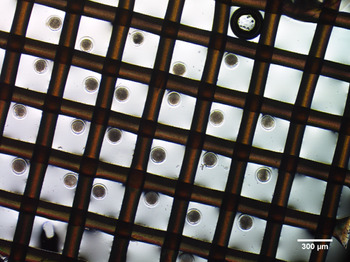
Artificial activation was performed as previously described (Susko-Parrish et al., Reference Susko-Parrish, Leibfried-Rutledge, Northey, Schutzkus and First1994) with some modifications. Matured COCs were denuded by vortexing in HEPES-buffered synthetic oviductal fluid (HEPES-SOF; Denicol et al., Reference Denicol, Block, Kelley, Pohler, Dobbs, Mortensen, Ortega and Hansen2014) with hyaluronidase (1000 U/ml) for 4 min. Oocytes with visible polar bodies and an evenly distributed cytoplasm (n = 723; 8 replicates) underwent activation. Oocytes were incubated in 5 µM ionomycin (Sigma-Aldrich, St. Louis, MO, USA) in HEPES-SOF for 5 min, washed in HEPES-SOF, and immediately placed in 2 mM 6-dimethylaminopurine (6-DMAP; Chemodex, St. Gallen, Switzerland) in SOF-Be1 culture medium (Fields et al., Reference Fields, Hansen and Ealy2011) for 3 h at 38.5°C under 5% CO2, 5% O2, and 90% N2 in am humidified atmosphere. After activation, oocytes were placed in 5-µl droplets of SOF-Be1 under oil and photographed individually using a Nikon camera on an inverted microscope. Activated oocytes were then group cultured in 50-µl droplets of SOF-Be1 (20–30 oocytes per droplet) under oil at 38.5°C under 5% CO2, 5% O2, and 90% N2 in a polyester micromesh with 300-µm openings (Spectra Mesh woven filters, Spectrum Labs, Repligen), enabling identification of individual oocytes during culture (Fig. 1). The mesh was prepared by cutting it into 4 × 6 mm squares and melting the edges of mesh to the culture plate with a hot awl. Plates were rinsed with water and ethanol to remove debris, then sterilized in ethanol for 1 h. Plates dried for at least 3 h in a sterile hood before culture droplets were added over the mesh squares. Cleavage rate was assessed on day 3 and development to the blastocyst stage was assessed on days 7 and 8 of culture.
Presumptive zygotes in micromesh with 300 µm openings. After mesh is adhered to the plate and sterilized, culture medium droplets are place over the mesh. One zygote per square of mesh opening.

In vitro fertilization
In vitro fertilization for bovine embryo production was performed as previously described (Fields et al., Reference Fields, Hansen and Ealy2011; Xie et al., Reference Xie, McCoski, Johnson, Rhoads and Ealy2017; Wooldridge and Ealy, Reference Wooldridge and Ealy2019), with some modifications. Matured oocytes (n = 875, 11 replicates) were incubated in SOF-FERT fertilization medium (Sakatani et al., Reference Sakatani, Alvarez, Takahashi and Hansen2012) with sperm purified from frozen–thawed semen washed on a BoviPure™ density gradient (Nidacon; Spectrum Technologies Healdsburg, CA, USA) for 16–19 h. Semen contained the ejaculate of four Holstein bulls (donated by Select Sires, Inc., Plain City, OH, USA). Presumptive zygotes were denuded, photographed individually, and group cultured (20–30 zygotes per culture droplet) in a micromesh, as described above. Cleavage rate was assessed on day 3 and development to the blastocyst stage was assessed on days 7 and 8 of culture.
Blastomere staining
Nuclear staining was performed on day 8 of culture on IVF blastocysts (n = 87) to assess total blastomere number. Blastocysts were fixed in 4% paraformaldehyde in PBS-PVP for 15 min, permeabilized with 0.25% Triton X-100 (v/v) in PBS-PVP for 20 min, then incubated with 1 µg/ml of Hoechst 33342 stain (Life Technologies) for 15 min at room temperature. Stained embryos were mounted onto a glass slide with coverslip. Total blastomere number was assessed using the cell count function of FIJI (Schindelin et al., Reference Schindelin, Arganda-Carreras, Frise, Kaynig, Longair, Pietzsch, Preibisch, Rueden, Saalfeld, Schmid, Tinevez, White, Hartenstein, Eliceiri, Tomancak and Cardona2012).
Image analysis
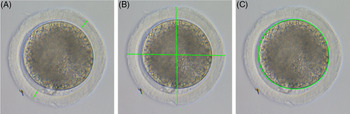
Each image was analyzed using FIJI software (Schindelin et al., Reference Schindelin, Arganda-Carreras, Frise, Kaynig, Longair, Pietzsch, Preibisch, Rueden, Saalfeld, Schmid, Tinevez, White, Hartenstein, Eliceiri, Tomancak and Cardona2012) with scale based on the image of a haemocytometer grid taken at a similar magnification. On each activated oocyte/presumptive zygote, the ZP thickness, ooplasm area, and diameter (including ZP) were measured (Fig. 2). An average of two measurements were collected for ZP thickness and diameter.
Size parameters of activated oocytes and zygotes. (A) Zona pellucida thickness, average of two measurements. (B) Outer diameter, average of two perpendicular measurements. (C) Ooplasm area.

Statistical analysis
Statistics were performed using R v.3.6.1 (R Core Team, 2016) with the lme4 package (Bates et al., Reference Bates, Mächler, Bolker and Walker2015). Residual estimates of area and ZP thickness in relation to diameter were used to address collinearity. Predictors were also scaled using the Z-statistic. Correlations between size parameters were assessed using the Pearson correlation test. Development rates on days 7 and 8 were assessed with a generalized linear mixed effects model with binomial distribution and blastomere numbers from IVF embryos were assessed with a linear mixed effects model. Fixed effects were diameter, residual estimate of area, and residual estimate of ZP thickness, and random effects were culture drop and replicate. Significant interactions remained in the model. P-values were obtained using Wald tests, with significance set at P < 0.05 and tendencies set as 0.05 < P ≤ 0.1.
Results
Size parameters
Size parameter measurements are displayed in Table 1. There was a positive correlation between diameter and ooplasm area in activated oocytes (r = 0.69, P < 0.01) and IVF zygotes (r = 0.67, P < 0.001). A positive correlation existed between ZP thickness and diameter in activated oocytes (r = 0.35, P < 0.01) and IVF zygotes (r = 0.32, P < 0.001). There was little correlation between area and ZP thickness in activated oocytes (r = 0.08, P < 0.05) and no significant correlation in IVF zygotes (r = −0.03).
Size parameter measurements and Pearson’s correlations for activated oocytes and in vitro fertilized (IVF) zygotes

Parameters included outer diameter including zona pellucida (ZP), ZP thickness, and ooplasm area.
*P < 0.05, **P < 0.01, ***P < 0.001, NS not significant.
Blastocyst development
Overall cleavage rate was 68.4 ± 7.2% and day 7 blastocyst rate was 18.1 ± 1.4% for activated oocytes. For IVF zygotes, overall cleavage rate was 76.7 ± 4.6% and day 7 blastocyst rate was 9.8 ± 1%. Day 8 blastocysts rates were 33.5 ± 1.8% for activated oocytes and 23.1 ± 1.4% for IVF zygotes. For both oocytes and zygotes, a larger diameter was more beneficial. Diameter had a significant effect on the probability of development in activated oocytes on day 7 (P < 0.01) and day 8 (P < 0.001; Fig. 3). Diameter had a tendency to have an effect on development potential on day 8 (P = 0.08) in IVP zygotes, but was not significant for day 7. Zona pellucida thickness also affected the probability of development in activated oocytes on day 7 (P < 0.001) and day 8 (P < 0.001; Fig. 3). For IVF zygotes, ZP had an effect on day 8 (P < 0.05), but was not significant on day 7 (Fig. 4). For both oocytes and zygotes, a thinner ZP was beneficial. Area did not significantly affect development potential on either day for both activated oocytes and IVF zygotes. There was a significant interaction between diameter and ZP thickness on day 7 (P < 0.05) and day 8 (P < 0.01; Fig. 4) observed only in IVF zygotes. Zygotes with a larger diameter and a thicker ZP, as well as zygotes with a smaller diameter and a thinner ZP were more likely to develop to the blastocyst stage.
Probability of development to the blastocyst stage for artificially activated oocytes on day 7 (A) and day 8 (B) across varying diameters and zona pellucida (ZP) thickness, given average area (10,453.6 µm2). Diameter and ZP thickness effected the probability of development for both days (P < 0.01). Area had no significant effect.

Probability of development to the blastocyst stage for in vitro fertilized zygotes on day 7 (A) and day 8 (B) across varying diameters and zona pellucida (ZP) thickness, given average area (9856.69 µm2). There was a tendency for an effect of diameter (P = 0.08) and an effect of ZP thickness (P < 0.05) on the probability of development for day 8. There was a significant interaction between ZP thickness and diameter on day 7 (P < 0.05) and day 8 (P < 0.01). Area had no significant effect.

Blastomere number
Blastomere number averaged 119.61 ± 4.40 cells per blastocyst. There was an effect of area on the total number of blastomeres on day 8 of culture, with a positive but weak correlation (P = 0.01; conditional R 2 = 0.09; Fig. 5) There was no significant effect of diameter or ZP thickness on total blastomere number.
Total blastomere number correlated with ooplasm area. Trendline represents correlation between blastomere number and area accounting for average diameter (151.22 µm) and average zona pellucida (ZP) thickness (11.75 µm). There was an effect of area on blastomere number (P = 0.01), but no significant effect of diameter nor ZP thickness.

Discussion
Several studies have aimed at correlating size parameters of bovine oocytes and blastocysts with development. These studies have only obtained observations prior to fertilization or at the blastocyst stage, while our data was collected immediately after activation or fertilization, adding novel information to the field. Our findings indicated that zygotes and oocytes with larger diameters are more likely to develop, and agreed with previous research (Fair et al., Reference Fair, Hyttel and Greve1995; Otoi et al., Reference Otoi, Yamamoto, Koyama, Tachikawa and Suzuki1997). These studies, however, examined bovine ooplasm diameter prior to fertilization. The ooplasm shrank in response to maturation, removal of cumulus cells, and fertilization and had undergone drastic changes by the time our measurements were taken (Suzuki et al., Reference Suzuki, Yang and Foote1994; Tartia et al., Reference Tartia, Rudraraju, Richards, Hammer, Talbot and Baltz2009; Walls et al., Reference Walls, Hart, Keelan and Ryan2016). This may explain why we did not observe an effect of ooplasm area on development potential while others have done so. We observed a positive correlation between diameter and area, which was likely to represent a larger ooplasm area prior to fertilization. The significant effect of outer diameter seen in our study may be an artefact of larger oocyte area prior to fertilization.
It has been demonstrated that increased total blastomere number was correlated with increased blastocyst quality in bovine (Jiang et al., Reference Jiang, Wang, Lu, Gordon and Polge1992), porcine (Papaioannou and Ebert, Reference Papaioannou and Ebert1988), and human blastocysts (Matsuura et al., Reference Matsuura, Hayashi, Takiue, Hirata, Habara and Naruse2010), therefore we aimed to see if activated oocyte/presumptive zygote size parameters could be indicative of future blastocyst quality by assessing total cell number on day 8 of IVF embryos. Other studies have also examined blastocyst diameter and demonstrated that larger blastocyst diameters were correlated with increased cell number (Hoelker et al., Reference Hoelker, Schmoll, Schneider, Rings, Gilles, Tesfaye, Jennen, Tholen, Griese and Schellander2006; Mori et al., Reference Mori, Otoi and Suzuki2002). It is important to note the stage at which measurements were taken. A larger diameter blastocyst is in a more developed stage, and logically should have more cells. Our study did not measure blastocyst diameter, but measured ooplasm area after fertilization and found that larger areas had increased total blastomere number by day 8 of culture. Our research is novel compared with previously published work in that we could draw a correlation between an objective size parameter and an indication of blastocyst quality before reaching the blastocyst stage. It is important to note, however, that the correlation between the area and cell number was weak and only total blastomere number was assessed in this study.
Zona pellucida thickness in relation to development competence has been well studied in humans, while the majority of work in bovine has focussed on ultrastructural aspects of the ZP. In humans, ZP thickness decreases with successful fertilization and is correlated with embryo quality (Bertrand et al., Reference Bertrand, Van den Bergh and Englert1995; Balakier et al., Reference Balakier, Sojecki, Motamedi, Bashar, Mandel and Librach2012). Our observation of increased likelihood of development with thin ZP may be reflective of the increased probability of development associated with successful fertilization. While there is little evidence that these findings on ZP in humans are applicable to bovine, similar trends exist that have related large diameters of oocytes to developmental competence in humans (Durinzi et al., Reference Durinzi, Saniga and Lanzendorf1995) and other species including pig (Hirao et al., Reference Hirao, Nagai, Kubo, Miyano, Miyake and Kato1994) and buffalo (Raghu et al., Reference Raghu, Nandi and Reddy2002). It is plausible that trends in ZP thickness are also conserved across species. Furthermore, in bovine, the smaller diameters for ZP with an increased number of pores, determined by electron microscopy, are related to superior oocyte quality as well as to a greater rate of blastocyst formation (Santos et al., Reference Santos, Chaveiro, Simoes and Moreira da Silva2008; Choi et al., Reference Choi, Bang, Jin, Kim, Jo, Deb, Ghanem, Cho and Kong2013; Báez et al., Reference Báez, Camargo and Gastal2019). This finding corroborated our results and indicated an increased ability to undergo the maturation process, the expansion of cumulus cells, and the maturation of the ZP after fertilization (Suzuki et al., Reference Suzuki, Yang and Foote1994).
An interaction between ZP thickness and diameter was only observed in IVF embryos. Although novel, this finding emphasized that parthenogenetic embryos may not always be the best models for developmental studies. Important biological processes, such as oocyte activation differ between activated oocytes and IVF zygotes. Fertilized oocytes experience oscillating calcium levels, while artificially activated oocytes undergo only one initial rise in intracellular calcium, causing differences in cortical granule exocytosis (Soloy et al., Reference Soloy, Srsen, Pavlok, Hyttel, Thomsen, Smith, Prochazka, Kubelka, Hoier, Booth, Motlik and Greve1997; Nakada and Mizuno, Reference Nakada and Mizuno1998). Secondly, artificial activation does not reflect the male contribution to development success. The biggest known paternal influences on development rates in bovine IVF are individual sire and semen quality (Ortega et al., Reference Ortega, Moraes, Patterson, Smith, Behura, Poock and Spencer2018; Siqueira et al., Reference Siqueira, de Castro, de Assis, Bicudo, Mendes, Nichi and Visintin2018), but less information is known about how oocyte size can influence aspects of fertilization involving sperm such as sperm–oocyte binding, effective polyspermy block, pronuclear formation, and subsequent epigenetic reprogramming. In pigs, meiotic competence is correlated with oocyte size (Hirao et al., Reference Hirao, Nagai, Kubo, Miyano, Miyake and Kato1994). The same situation is true for bovine oocytes, however there is little to no relationship between ooplasm diameter and sperm penetration (Otoi et al., Reference Otoi, Yamamoto, Koyama, Tachikawa and Suzuki1997).
Even though in our experiment we found an agreement in maternal parameters such as oocyte size and ZP thickness among the two models, care should be taken when using only parthenogenetic embryos in place of IVF embryos. One hypothesis for the observed interaction between oocyte size and ZP thickness is that there is an ideal, median area size that is important for development success. A small oocyte with a thin ZP is likely to have a more similar ooplasm area compared with a large oocyte with a thick ZP. Although increasing ooplasm is beneficial for development, it may reach a point at which too large is detrimental. Otoi and colleagues noted that ooplasm diameters above 130 µm did not develop to the blastocyst stage (Otoi et al., Reference Otoi, Yamamoto, Koyama, Tachikawa and Suzuki1997), however their sample size for this size group was small and results should be extrapolated with care. A study by Kyogoku and colleagues reported that large cytoplasmic size is linked to more error-prone chromosome segregation in oocytes (Kyogoku and Kitajima, Reference Kyogoku and Kitajima2017). Our observations that a large diameter with a thick ZP is beneficial may be due to a slightly reduced area inside the ZP.
The lack of agreement between parameters that affect probability of development on day 7 and day 8 for IVF embryos is likely to be due to the poor development rates for IVF embryos, weakening the power of the data set. These development rates are below normal and embryos were group cultured with the standard 20–30 zygotes per 50 µl droplet, however the process of individually photographing and culturing a large number of embryos (typically 100–150 at a time) prolonged exposure to atmospheric conditions that can be detrimental to development. Hundreds more observations in the IVF embryos are likely to be necessary to see a more robust agreement between day 7 and day 8 results, as well as between the activated oocytes and IVF data. Nonetheless, our data indicate congruency between activated oocytes and IVF parameters on day 8.
The methods used in this study are simple and easy to implement, but have great potential for improvement. The polyester micromesh allows for beneficial group culture with easy identification of individuals. However, it does lend some limitations. While the majority of oocytes and zygotes remains in place, some will occasionally drift into openings with other zygotes. It is also not always conducive to taking proper measurements, as sometimes edges of zygotes are not clearly visible. To combat this problem, we photographed zygotes in 5-µl SOF-Be1 droplets under oil. This approach does increase exposure time to atmospheric conditions. Culture dishes utilizing a well-of-the well system (Vajta et al., Reference Vajta, Korösi, Du, Nakata, Ieda, Kuwayama and Nagy2008) may be more optimal for photographing large quantities of zygotes and reducing time outside the incubator. This approach was not carried out in this study, as wells that are too deep or jagged disrupt optics and produce inaccurate measurements. The ever-increasing prevalence of artificial intelligence and machine learning in biological sciences is going to play a major factor in future non-invasive selection methods. Measurements, currently done manually, could be automated and software developed for ease of use. Advancements in predictive modelling and further exploration of other potential physical parameters will better develop predictive abilities. While our methodology is rudimentary, there is unlimited potential for growth.
This study demonstrated that physical parameters of bovine zygotes have potential as markers for developmental competence. Zygotes with larger diameters and thinner ZP are more likely to develop to the blastocyst stage. Area after fertilization had no effect on development potential, but the larger area was associated with increased quality as determined by total blastomere number. Interestingly, there is an interaction between the zona thickness and diameter not observed in activated oocytes. The techniques used in this study can only be improved with the advancements of micro-fabrication technology and machine learning and, in the near future, could be transformed into an effective and easy-to-use system to predict the viability of embryos. Future work that assessed the applicability of these results to post-transfer outcomes is crucial for the advancement of this methodology. Future work should also examine what specific size parameters are the most beneficial but, as a starting point, selecting oocytes above the average 150 µm may improve development rates.
Financial support
This research did not receive any specific grant from funding agencies in the public, commercial, or not-for-profit sectors. Fellowship support for C.L. Timlin and L.K. Wooldridge was provided by the Institute for Critical Technology and Applied Sciences (ICTAS) Doctoral Scholars Program at Virginia Polytechnic Institute and State University, Virginia, USA.
Statement of interest
Authors declare no conflict of interest.
Ethical standards
The authors followed the Virginia Tech Scholarly Integrity and Research Compliance guidelines in all research procedures described here.