


I. Introduction
Interest groups play a central role in democratic governance, contributing to representation, agenda-setting and policy-making processes. While scholarship in political science and public administration has traditionally focused on lobbying and advocacy, litigation has increasingly emerged as a relevant – yet comparatively underexplored – instrument through which interest groups seek to influence public policy and social change. For more than 70 years, the use of courts as arenas for social, political and legal transformation has been a well-established and thoroughly studied practice in the United States.Footnote 1 In Europe, by contrast, strategic litigation has historically been less prominent and comparatively understudied.Footnote 2 Over the past decade, however, litigation initiated by interest groups appears to have been gaining momentum across Europe.
This development is particularly visible in the Netherlands, where broad standing rules enable interest groups to litigate on behalf of collective and public interests. The most striking example is the fight for a better climate. In 2013, the Urgenda foundation initiated a climate case that led, in 2019, to the landmark ruling by the Dutch Supreme Court ordering the State to reduce greenhouse gas emissions by at least 25% by the end of 2020 compared to 1990 levels.Footnote 3 This decision not only inspired climate litigation worldwide, but also triggered a wave of highly influential follow-up cases in the Netherlands. Friends of the Earth Netherlands successfully sued Royal Dutch Shell, resulting in a court order requiring the company to reduce its greenhouse gas emissions.Footnote 4 Greenpeace Netherlands, in turn, challenged the State’s nitrogen policy, leading to a court-mandated 50% reduction target by 2030, under the threat of a €10 million penalty payment.Footnote 5 It also brought a successful case concerning insufficient climate measures in Bonaire, highlighting unequal treatment between the Caribbean and European parts of the Kingdom of the Netherlands.Footnote 6
These climate cases form part of a broader pattern. Dutch courts are confronted with strategic litigation by interest groups across a range of legal domains. In the field of human rights, the Clara Wichmann Foundation challenged the State’s failure to address the exclusion of women from electoral candidate lists of the SGP (a conservative Christian Party).Footnote 7 Meanwhile, a coalition of civil society organisations successfully contested the legality of the Dutch System Risk Indication (SyRI), a data-driven fraud detection system, on human rights grounds.Footnote 8 The Dutch Council for Refugees initiated lawsuits to compel the Dutch State to bring accommodation for asylum seekers up to international standards,Footnote 9 while NGOs like Oxfam Novib successfully litigated to halt the export of F-35 fighter jet components to Israel.Footnote 10
Taken together, these high-profile cases are often taken to indicate a significant increase in strategic litigation in the Netherlands. They have also sparked significant political turmoil, as several political parties portrayed such litigation as democratically problematic.Footnote 11 Dutch legal scholars, in turn, have debated whether these developments ultimately strengthen or undermine democratic governance under the rule of law.Footnote 12 Yet, despite the prominence of these claims, systematic empirical research into the nature, scope and prevalence of strategic litigation remains scarce.Footnote 13 It is therefore unclear whether these highly visible and prominent cases are representative of the prevalence of strategic litigation by interest groups or whether they are merely highly visible outliers.
This empirical gap extends beyond the Netherlands to Europe more broadly, where strategic litigation is likewise perceived to be emerging as a more prominent tool for advancing social and political change, while systematic empirical studies are scarce.Footnote 14 Existing studies tend to focus on specific interest groups (like NGOs), legal domains (such as climate or human rights), or a small number of salient cases.Footnote 15 While these studies provide valuable insights into specific segments of strategic litigation by interest groups, they offer only a partial view and do not capture its broader landscape. For example, more localised cases brought by smaller organisations or mass damages claims risk remaining overlooked, while such cases may also be pursued with a view to achieving social, political or legal change, albeit in smaller, more local, incremental or indirect ways.Footnote 16
The lack of systematic empirical analysis has important implications. First, it constrains theoretical development, as key assumptions about actors, patterns and functions of strategic litigation remain insufficiently tested. Second, it weakens normative debates, which frequently rely on selective or anecdotal evidence when assessing the democratic legitimacy and impact of such litigation. By overlooking the diversity of actors and cases involved, existing accounts risk mischaracterising both the scale and the nature of strategic litigation in practice.
This article addresses this gap by exploring the foundational question of how strategic litigation can be studied in a more systematic and empirically grounded way, to achieve a more comprehensive account of its nature and prevalence. Positioned at the intersection of legal scholarship and research on interest groups, it proposes a mapping strategy that shifts the focus from emblematic cases and specific domains to a broader empirical analysis of litigation patterns. This approach enables us to study which interest groups litigate, how frequently, in which legal fields, before which courts, against which defendants, and with what characteristics, thereby capturing the wider landscape in which high-profile cases are embedded.
The Netherlands, with its broad standing rules for interest groups, serves as an empirical laboratory to explore the potential and limitations of this approach to develop insights relevant for the study of strategic litigation across Europe more broadly. By applying a judgement-based mapping of litigation involving interest groups, the article demonstrates how such a strategy can generate a more comprehensive empirical picture of strategic litigation by interest groups than is currently available in the literature. It also illustrates how methodological choices shape what becomes visible as strategic litigation. Rather than offering definitive conclusions, this exploratory analysis aims to assess how more systematic empirical approaches can contribute to more robust theoretical and normative debates.
The focus on interest groups is both substantive and methodological. As collective actors claiming to represent broader societal interests, they feature prominently in debates on the democratic legitimacy of litigation. This focus also enables engagement with adjacent literatures in political science and public administration, where the study of interest group strategies has yielded more advanced methodological tools for analysing collective action. Drawing on these traditions helps situate strategic litigation within the broader repertoire of interest group strategies and strengthens the empirical approach developed here. At the same time, this focus is analytical rather than exclusive: there is no reason to assume that the patterns identified for interest groups would not extend to other actors, such as companies, engaging in strategic litigation, given that strategic litigation is a strategic phenomenon characterised but not fully defined by the organisational entities engaging in such behaviour.Footnote 17
The remainder of this article proceeds as follows. Section II examines how existing approaches contribute to empirical blind spots and fragmented understandings. We subsequently argue for a more integrative mapping strategy of strategic litigation, which is developed in Section III. Section IV applies such a comprehensive mapping strategy to the Dutch context and presents the empirical findings. Our findings reveal that the scope and nature of such litigation are much broader and more diverse in nature than commonly assumed in normative debates or implied by current empirical assessments. Section V reflects on how this empirical approach can inform future research as well as more grounded normative debate, by identifying avenues of research that can benefit from this empirical richness.
II. Why we see what we see: empirical blind spots in strategic litigation research
What we know about strategic litigation by interest groups is shaped as much by how we study it as by the phenomenon itself.Footnote 18 While there is a substantial body of systematic empirical research on interest group strategies in the political arena,Footnote 19 our knowledge of their activities in the legal arena remains comparatively underdeveloped. The growing literature on strategic litigation has generated valuable insights into how courts are used as instruments for social, political and legal change. At the same time, this literature remains fragmented, limiting our ability to identify the full range of interest groups engaging in strategic litigation, obscuring variation across legal domains and making it difficult to distinguish typical patterns from exceptional cases. As a result, the existing literature, while providing valuable insights, does not yet cumulate into a coherent, systematic and generalizable understanding of the phenomenon. It risks offering a skewed and incomplete picture of the scope, nature and prevalence of strategic litigation by interest groups. We identify three interrelated reasons for this fragmentation.
The first is conceptual ambiguity. Strategic litigation is closely related to, and often conflated with, concepts such as public interest litigation, impact litigation and legal mobilization. These concepts largely originate in different disciplinary traditions and emphasize distinct actors, objectives and forms of legal action. As a result, what counts as “strategic litigation” is not always clearly or consistently defined, which in turn leads scholars to delineate their empirical objects of study in different and often incompatible ways. Although important conceptual contributions have increased conceptual awareness,Footnote 20 a widely shared and stable definition remains elusive. Fragmentation therefore continues to shape how the phenomenon is studied empirically, limiting the comparability and cumulative potential of empirical findings across studies.
Second, disciplinary differences reinforce these dynamics. Political scientists, political sociologists and public administration scholars have generated important insights into advocacy strategies and organisational behaviour, but often engage only to a limited extent with legal scholarship, legal doctrine and judicial processes.Footnote 21 Conversely, legal scholars tend to focus on doctrinal analysis and case law, with less systematic attention to broader patterns of interest group behaviour and strategy. Although important strands of interdisciplinary and socio-legal scholarship exist, persistent disciplinary orientations make it difficult to develop a shared analytical framework, contributing to the fragmented and only partially cumulative nature of the empirical knowledge base.
Third, the dominant research designs contribute to a partial and selective evidence base. Much existing scholarship relies on qualitative, small-N studies, centred on individual or small numbers of cases.Footnote 22 This is particularly characteristic of socio-legal research, which emphasises law in action and provides rich, in-depth insights into litigation practices and their societal context. However, such approaches tend to prioritise context-specific, interpretive analyses over systematic mapping across actors, cases, or domains, thereby limiting their explanatory reach. Without a broader empirical frame of reference, it remains difficult to assess whether the cases under study reflect broader patterns or constitute exceptional instances.
More specifically, the small-N, context-rich approach often includes distinctive units of analysis by focusing on a selective set of judgaments, domains and/or actors. We witness, for instance, a recurring focus on landmark judgaments and high-profile cases.Footnote 23 While highly visible and analytically appealing, those may not reflect the more routine, locally oriented and less visible forms of strategic litigation by interest groups.Footnote 24 As a result, landmark decisions risk becoming the empirical backbone for broader claims about the rise, nature, legitimacy and effectiveness of strategic litigation. In addition, many studies adopt an actor-centered perspective that foregrounds NGOs as the primary drivers of strategic litigation.Footnote 25 While NGOs are indeed prominent actors, this focus risks overlooking other types of interest groups. Similarly, a significant portion of the literature adopts a domain-specific lens, concentrating on areas such as human rights, migration or climate law.Footnote 26 Yet, when such limited selections of units of analysis are not explicitly theorized or their scope conditions remain implicit, questions arise as to whether findings can be generalised to other legal and policy domains, where strategic litigation may take different or less visible forms.Footnote 27
Taken together, these conceptual, methodological and empirical limitations mean that existing scholarship provides valuable but incomplete insights into strategic litigation by interest groups. While we have detailed knowledge of specific actors, cases and domains, we still lack a systematic and comprehensive empirical understanding of broader patterns of strategic litigation by interest groups, the variation therein and their implications for the rule of law and democratic decision-making. To contribute to this literature, we develop an integrative empirical mapping strategy of interest groups engaging in strategic litigation.
III. Towards an integrative mapping strategy of strategic litigation
To address the fragmentation identified above, and to move beyond small N-case studies, highly visible cases and actor and domain-specific analyses, this article develops an integrative mapping strategy to identify and analyse the broader landscape of strategic litigation by interest groups. Developing such a systematic, cross-cutting strategy requires a series of conceptual and methodological choices, which we outline below.
To develop an integrative empirical mapping strategy, we draw on large-scale comparative research projects on policy advocacy by interest groups. Several decades ago, the study of policy advocacy faced similar fragmentation, conceptual diversity and reliance on small-N, context-rich studies as now characterises the study of strategic litigation.Footnote 28 This inspired scholars to develop a more integrative empirical approach to arrive at a more systematic and valid understanding of multiple dimensions of policy advocacy and lobbying.Footnote 29 One key challenge was the lack of large-scale datasets and conceptualisations enabling comparison of policy advocacy across political systems and actors. In response, these scholars developed larger-scale comparative research strategies based on several principles to arrive at a more systematic understanding of policy advocacy.
These research design principles include (1) concept formation that facilitates valid inclusion of empirical variation; (2) sampling strategies facilitating the development of large-N datasets to assess the external validity of individual cases; and (3) transferable explanatory factors facilitating (inter)national or (inter)organisational comparison of policy advocacy. We adopt these principles from the interest group literature and adjust them to develop an integrative empirical mapping strategy of strategic litigation by interest groups.
1. Principle 1: ensure conscious concept formation to facilitate systematic analyses
One of the first and most important principles to arrive at an integrative empirical research approach is to ensure conscious concept formation of both strategic litigation and interest groups to enable valid inclusion of empirical diversity. To facilitate systematic and comparative analyses, concepts should refer to a minimum number of properties or attributes of a given phenomenon to ensure equivalence when comparing across different cases or domains.Footnote 30
a. Strategic litigation as a beyond-individual legal strategy
A first challenge concerns the conceptualisation of strategic litigation. The literature employs a wide range of partially overlapping concepts, including public interest litigation, impact litigation, legal mobilisation. Although these labels are sometimes used interchangeably, they often reflect different disciplinary traditions and analytical perspectives. What appears to be conceptual plurality in fact conceals deeper disagreements about what kinds of litigation are being studied and why. In other words, the properties or attributes of litigation vary across cases, sometimes implicitly, and are not always neatly nested concepts that allow a meaningful abstraction or making a concept more concrete.
Some approaches emphasise litigants’ intentions, defining strategic litigation as cases deliberately brought to achieve broader policy change. Others focus on effects, considering litigation strategic when it produces consequences beyond the parties involved. Still others foreground particular actors, such as NGOs or social movements, or specific legal issues, such as human rights litigation, or the type of interest, such as diffuse and general interests where there may not be an exclusive individual holder of the interest being enforced (as will often be the case in climate or environmental litigation). As a result, the boundaries of what counts as “strategic” litigation remain contested:Footnote 31 the same case may fall inside or outside the concept depending on the analytical lens adopted. This complicates systematic comparison.
While these differences sometimes reflect explicit theoretical choices, they also often rest on implicit assumptions about the nature of the phenomenon. Scholars frequently adopt labels without defining them or rely on definitions taken for granted within particular traditions. Although a growing body of literature seeks to clarify and disentangle these concepts, definitions continue to vary across disciplines, jurisdictions and research traditions and empirical studies do not always explicitly position themselves within these conceptual debates or specify the definitional choices underlying their analysis.
For the purposes of developing an integrative mapping strategy, we conceptualise strategic litigation based on a minimum number of characteristics while emphasising the strategic behaviour characteristic.Footnote 32 We define strategic litigation as litigation in which courts are used as arenas for pursuing social, political or legal change that transcends the individual dispute,Footnote 33 either in terms of its purpose or its effects. This definition allows us to capture variation across different forms of litigation and to shift the analytical focus from a narrow subset of canonical cases to mapping the broader phenomenon in which such cases are embedded.
b. Interest groups as overarching concept of organized societal actors
While this conceptualisation is intentionally broad, empirical research requires some form of delineation. To operationalise strategic litigation in a way that enables systematic data collection, we focus on litigation initiated by interest groups as an empirical entry point into strategic litigation. We draw on recent interest group research that similarly adopts a broad conceptualisation to allow for integrative empirical analyses as well. In this literature, “interest groups” captures a wide range of collectively organised entities that seek to influence public policy without seeking political office themselves.Footnote 34 These three defining characteristics (some form of collective organisation, an observable intent to influence public policy and, not seeking political office themselves) facilitate inclusion of organisations ranging from labour unions and professional associations to employers’ associations, citizen collectives and NGOs.
Conceptualising interest groups as a broad category of societal actors with similar strategic behavioural objectives serves several purposes. First, although not all litigation by interest groups will necessarily qualify as strategic litigation (e.g., for lack of strategic intent), interest groups are particularly likely to pursue goals that transcend individual disputes, rendering them appropriate objects of study to explore the phenomenon of strategic litigation conceived as a beyond-individual purpose legal strategy.Footnote 35 Second, focusing on organisational entities facilitates systematic identification in large-scale datasets. Third, it connects the study of strategic litigation to broader debates and integrative empirical studies of interest group mobilisation and political participation. Finally, it facilitates a more integrative empirical approach via which structural biases in collective action and political influence can be made visible.Footnote 36
We acknowledge that strategic litigation is not limited to interest groups: individuals, companies or public bodies (like public enforcers) may also use litigation to pursue broader regulatory, legal or policy change.Footnote 37 However, identifying such cases typically requires more fine-grained qualitative methods, as strategic intent or broader impact beyond the individual party is not easily visible in large-N datasets. Focusing on organisational actors therefore reflects a trade-off between conceptual comprehensiveness and empirical tractability.
2. Principle 2: adopt a judgement-based sampling strategy
A subsequent methodological choice concerns the type of data used to identify strategic litigation and uncover relevant data. In the absence of comprehensive registries of reporting obligations, we adopt a judgement-based approach using judicial decisions as our primary data source.Footnote 38 This choice is motivated both by necessity and analytical considerations. Unlike policy advocacy, which is (partially) captured in most political systems through transparency registers, consultation registries or public agendas of political officials,Footnote 39 there are no systematic records of litigation efforts by interest groups. Alternative sources, such as media coverage, are selective and shaped by news values which tend to privilege high-profile cases. Moreover, journalistic accounts may omit or misinterpret legally relevant information. Judicial decisions, by contrast, provide a relatively structured and standardised source of information, typically containing details about parties, legal claims and outcomes. This makes them particularly suitable for systematic, comparative analysis across legal domains and courts.
At the same time, reliance on judgements has limitations.Footnote 40 Not all decisions might be published, and publication practices may vary across countries, courts and legal areas, potentially introducing selection bias. Judicial decisions also do not necessarily reveal broader strategic contexts such as strategic intent, coordination between actors, long-term objectives or (actual or desired) impact. Despite these limitations, we argue that a judgement-based approach provides a sufficiently robust empirical foundation for an integrative mapping exercise, especially when the aim is to identify broader patterns across a large number of cases rather than reconstruct individual litigation trajectories in detail. Our approach builds on and extends the growing use of systematic case law analysis in empirical legal research.Footnote 41 While such studies often focus on specific legal doctrines, our approach extends this methodological tradition by using judgements to map a cross-cutting socio-legal phenomenon.
3. Principle 3: identify contextual and organisational-level explanatory factors
To identify systematic patterns of strategic litigation, we adopt three key factors to allow comparison at the organisational and contextual level to explain variation in strategic litigation. This choice builds on prior research on policy advocacy, showing that the combination of organisational-level and contextual-level variables facilitates a more comprehensive understanding of policy advocacy and lobbying.Footnote 42
First, we include a policy-domain variable. Policy advocacy research shows that policy context is an important explanatory factor. The policy domains in which interest groups are active, and more specifically, the policy issues which they focus on, vary in terms of technical complexity and salience, as well as social and political conflict lines, which are important drivers of policy advocacy.Footnote 43 Second, and related to the importance of including contextual factors, we add a legal-domain factor. Unlike the policy–domain factor, it focuses on the legal opportunity structures rather than on the substantive characteristics of policy issues, to capture how different procedural conditions in different legal regimes (e.g., administrative law or civil law) shape who can litigate and about what, through standing rules, the availability of collective or representative procedures, the types of governmental conduct that may be challenged, the available remedies, and the procedural costs.Footnote 44 Third, we include organisational-level factors commonly used in policy advocacy studies to capture variation in organisational capacities across interest groups.Footnote 45
In the remainder of this article, we illustrate how these design principles can be empirically applied via a study of strategic litigation by interest groups in the Netherlands. By systematically analysing litigation initiated by interest groups across different policy and legal domains in the Dutch context, we aim to provide an example of a more comprehensive empirical account of strategic litigation and to contribute to a more empirically grounded conceptual and normative debate about its role in democratic governance and the rule of law.
IV. Mapping strategic litigation in the Netherlands
Due to relatively permissive legal opportunity structures in the Netherlands, a wide range of organised groups can access Dutch courts to pursue collective and public interests across legal and policy domains. This institutional openness makes substantial variation in litigation practices by interest groups likely. The Dutch case thus provides a useful “laboratory” to apply the three design principles outlined above and demonstrate how a more systematic and inclusive mapping of strategic litigation by interest groups can be carried out in practice.
1. Applying principle 1: proceeding from a consciously constructed, inclusive conceptual approach
This section applies the principle of conscious concept formation. The Dutch legal context provides favourable conditions to operationalise this principle. Compared to other European jurisdictions, the Dutch procedural framework allows a very broad range of organised groups to access courts across multiple legal domains. This institutional openness allows us to implement a conceptualisation of strategic litigation that is deliberately broad and based on a limited set of defining characteristics.
Both civil and administrative law provide permissive standing rules for legal entities (legal persons) to initiate proceedings in defence of collective and public interests. Under article 3:305a, first paragraph, of the Civil Code (CC) “a foundation or association with full legal capacity may initiate an action seeking to protect similar interests of other persons, provided that it advances those interests under its articles of association and that those interests are adequately safeguarded.” Following from the second paragraph, these interests are “adequately safeguarded where the legal entity [….] is sufficiently representative, given its constituency and the size of the claims represented.” The foundation or association also needs to meet subsequent standing requirements regarding transparency, good governance and finance, but most of these only apply for entities claiming mass damages.Footnote 46 In administrative law, access to the administrative courts is limited to “interested parties.” Article 1:2, paragraph 3, of the General Administrative Law Act (GALA), states that “as regards legal entities, their interests are deemed to include the general and collective interests which they particularly represent in accordance with their objects and as evidenced by their actual activities.” Dutch law thus allows associations and foundations to represent group or public interests in both civil and administrative court. These provisions do not restrict access to specific policy fields, rights, or organisations, creating a fertile setting to observe diverse litigation practices by interest groups.Footnote 47
Following section 3.1, we conceptualise strategic litigation as litigation in which courts are used as arenas for pursuing social, political or legal change. To render this concept empirically traceable, we focus on litigation initiated by interest groups, understood – in line with section 3.1 – as collectively organised entities seeking to influence public policy without pursuing political office themselves. Applying this conceptualisation to the Dutch context implies that the empirical mapping is not restricted to specific substantive areas (such as human rights or environmental law). Instead, it encompasses a wide range of organisational actors that meet the minimal defining standing rules of being a foundation or association representing group or public interests, corresponding with the key element in the definition of interest groups that they need to be some form of organisational entity. Our dataset thus includes, among others, citizen initiatives, environmental and human rights organisations. professional and business associations and labour unions.
By proceeding from this consciously constructed, inclusive conceptual approach, the Dutch case allows us to map litigation patterns without being limited to a small number of exceptional cases, specific policy domains or certain types of interest groups, offering the opportunity to illustrate how one could adopt an integrative empirical strategy to study strategic litigation.
2. Applying principle 2: using a judgement-based sampling strategy
This section applies the second principle by adopting a judgement-based sampling strategy to identify instances of strategic litigation by interest groups in the Dutch context. As argued above, the absence of comprehensive registries of litigation efforts by interest groups necessitates a reliance on alternative data sources. Following this reasoning, we use published judicial decisions as our primary empirical entry point to map litigation practices.
The Dutch publicly available, online database rechtspraak.nl provides extensive access to judgements, enabling us to construct a systematic dataset of cases in which interest groups appear as plaintiffs. Lawsuits brought under Article 3:305a CC and Article 1:2, paragraph 3, GALA, are, by definition, initiated by interest groups and always concern interests that transcend the individual dispute, as parties need to represent collective or public interests rather than their own individual or economic interests. Focusing on cases brought under these provisions therefore allows us to identify litigation that is oriented toward collective or broader societal concerns while relying on a clear and replicable selection criterion.
Publication of judgements on rechtspraak.nl is governed by the Besluit selectiecriteria uitsprakendatabank Rechtspraak.nl, which requires courts to select rulings for publication based on their societal relevance, legal novelty and/or significance for the development of the law. As a result, publication practices may introduce a degree of selection. However, in the context of this research, the inherent limitations of relying on published judgements seem limited, for several reasons. First, cases brought under article 3:305a CC or 1:2, paragraph 3, GALA are highly likely to meet the selection criteria. Second, we cross-checked the civil cases we found on rechtspraak.nl with the collective actions registered in the publicly accessible register Centraal register voor collectieve vorderingen,Footnote 48 in which interest groups since 2020 need to register all cases brought under Article 3:305a CC. This comparison allowed us to verify that rechtspraak.nl provides near-complete coverage for civil cases brought by interest groups for the period under study (2020-2025),Footnote 49 with the exception of preliminary reference proceedings.Footnote 50 Third, for administrative law, we focus only on judgements by the Administrative Jurisdiction Division of the Council of State, the highest general administrative court. Given the large volume of administrative litigation involving organisations, limiting the dataset to this court ensures a manageable and analytical meaningful dataset. Importantly, based on the Besluit selectiecriteria uitsprakendatabank Rechtspraak.nl, all decisions by this court as a highest court have to be published, ensuring comprehensive coverage of interest group litigation at the administrative level.Footnote 51
Using keyword searches and manual verification,Footnote 52 we identified 627 cases brought by interest groups under Article 3:305a CC and 1:2, paragraph 3, GALA, in the period between 1 January 2020 until 9 April 2025. These include 78 cases involving interest groups before civil courts, and 549 cases involving interest groups at the highest general administrative court. Because a single dispute may give rise to several judgements at different procedural stages, we linked rulings that relate to the same underlying case, such as decisions by district courts, courts of appeal and the Supreme Court. As judgements in summary proceedings (kort gedingen) are not all published and judges in these proceedings typically address some of the variables we study less extensively, we excluded summary proceedings (civil law) and provisional measures proceedings (administrative law) from our dataset. The dataset thus only contains judgements in proceedings on admissibility and/or the merits.
3. Applying principle 3: including contextual and organisational explanatory factors
This section operationalises contextual and organisational-level explanatory factors to analyse patterns of strategic litigation in the Dutch dataset. First, we include a legal domain factor, distinguishing between administrative and civil litigation, based on the type of court that rendered the judgement. This distinction reflects differences in legal opportunity structures due to different procedural frameworks, which are likely to shape how and when interest groups engage in strategic litigation.
Second, to capture policy factors, we code each case according to its policy domain, using the classification developed in the Comparative Agendas Project.Footnote 53 This is a widely used to analyse how political attention varies across different political, policy and media agendas and helps understanding the formation of advocacy coalitions and lobby patterns. Where cases concerned multiple policy domains, we coded the policy domain that constituted the primary focus of the dispute, operationalised as the first policy area mentioned in the case.Footnote 54
Third, for the organisation-level factors, we distinguish between different types of interest groups, based on a coding scheme developed in the international research project “Interest groups across political arenas.”Footnote 55 We also distinguish between national and local groups, as this level of mobilisation is an important explanatory factor for variation in interest group mobilisation.Footnote 56 We also include additional indicators that provide insight into litigation behaviour, specifically whether litigation involves single actors or broader coalitions of interest groups and the types of defendants they litigate against. Taken together, these variables provide insight into both the substance of the cases as well as prevalence and type of litigation.
V. An exploratory empirical picture of strategic litigation in the Netherlands
Having outlined the conceptual rationale and the methodological approach underlying our dataset, we now turn to the empirical analysis. This section examines the prevalence and distribution of litigation initiated by interest groups across the Dutch legal system. By systematically examining judicial decisions in cases initiated by interest groups, we seek to identify which, where, how often, about what and against whom interest groups litigate. Mapping these patterns provides a first empirical indication of the scale and diversity of strategic litigation by interest groups in the Netherlands.
1. Legal domain-factor
We begin with a legal domain based mapping strategy, focusing on the institutional distinction between different legal domains as a contextual variable for understanding where interest groups most frequently engage in strategic litigation. In the Dutch legal system, the most relevant distinction for this purpose is that between administrative law and civil law, which involve different types of disputes, procedural frameworks and judicial forums.
Administrative law primarily concerns disputes between private parties and public authorities regarding the exercise of public powers. In the Dutch context, administrative cases typically involve challenges to administrative decisions (besluiten), for which the possibility of appeal is (mostly) limited to individual, concrete administrative decisions (beschikkingen), like permits, fines, asylum decisions and social benefits. In general, it is not possible to appeal legislation or other kinds of general (policy) rules.Footnote 57 In environmental law, there is an important exception, through which it is possible to appeal zoning plans. Civil law, by contrast, governs disputes between private parties, but also allows claims against public legal persons, like the state, for example through tort law. Figure 1 maps the dispersion of litigation by interest groups across these two legal domains.
Strategic litigation across legal domains, in %, Period: 01-01-2020 and 09-04-2025; N = 627 (civil courts, n = 78; administrative court = 549).

As shown in Figure 1, applying this distinction to our dataset reveals a clear difference in the distribution of cases. Of the 627 cases identified, 549 were brought before the administrative court, while “only” 78 before the civil courts. This difference is likely even larger in practice, since the dataset only includes cases before the Administrative Jurisdiction Division of the Council of State, the highest general administrative court, whereas the civil dataset covers all judicial levels (district courts, courts of appeal and Supreme Court). As a result, the number of administrative cases in which interest groups engage in litigation is likely to be even higher in reality.
Several factors may explain the predominance of administrative litigation. First, administrative proceedings are generally much less costly and procedurally less complex than civil collective actions. Whereas in administrative litigation legal representation is not required and the court fee for interest groups is currently €397,- and in appeal €596, existing research suggests that the costs for a relatively simple collective case in a district court may start around €40.000,- and can rise to several million euros in large and complex mass-damages proceedings.Footnote 58
Second, the nature of the cases differs significantly. Administrative litigation usually concerns individual decisions, such as permits or enforcement actions, requiring organisations seeking policy change to pursue many separate cases over time. In civil litigation, on the contrast, it is possible to directly appeal national policy. This is evident in Dutch nitrogen litigation by environmental groups. Whereas Greenpeace recently brought a single civil case against the Dutch State seeking stricter national nitrogen policies, administrative nitrogen litigation consists of numerous cases brought by environmental organisations challenging individual permits or enforcement decisions concerning specific farms or infrastructural projects. Issued by different local authorities. In each of these cases, the organisation must show that the particular decision allows for nitrogen emissions and therefore directly affects its statutory objective of protecting biodiversity. As a result, administrative litigation tends to generate far larger numbers of interest group cases than civil litigation, even where both pursue broader policy change.
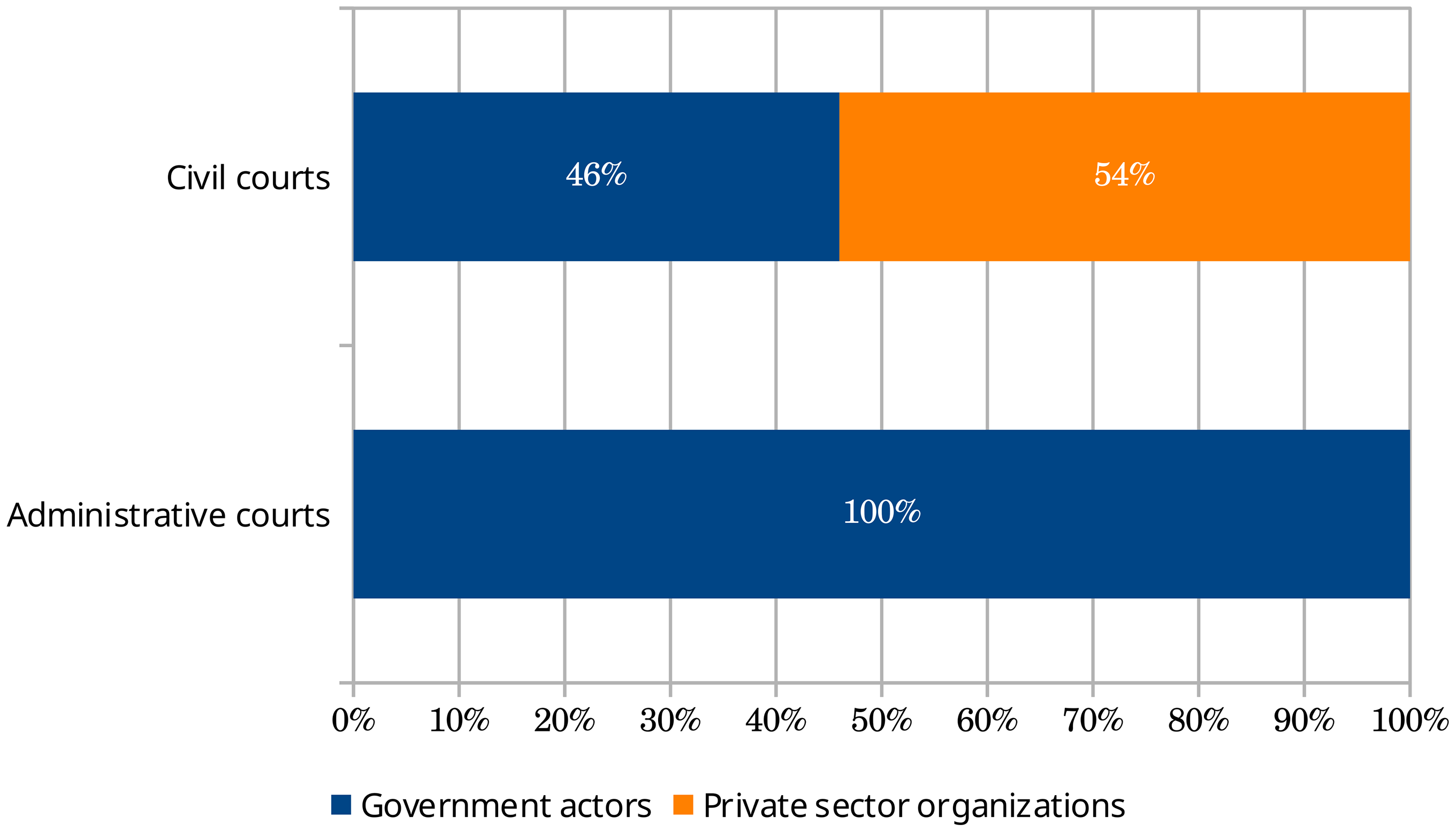
The legal–domain-distinction also corresponds with differences in defendants. As shown in Figure 2, administrative litigation exclusively targets public authorities (namely administrative bodies; bestuursorganen), whereas civil litigation by interest groups is directed against both governmental and private actors, with slightly more cases (54%) involving private defendants (like companies).Footnote 59
Type of defendants across legal domains in the Netherlands in %; period 01-01-2020 until 09-04-2025, N = 627 (civil courts, n = 78; administrative court = 549).

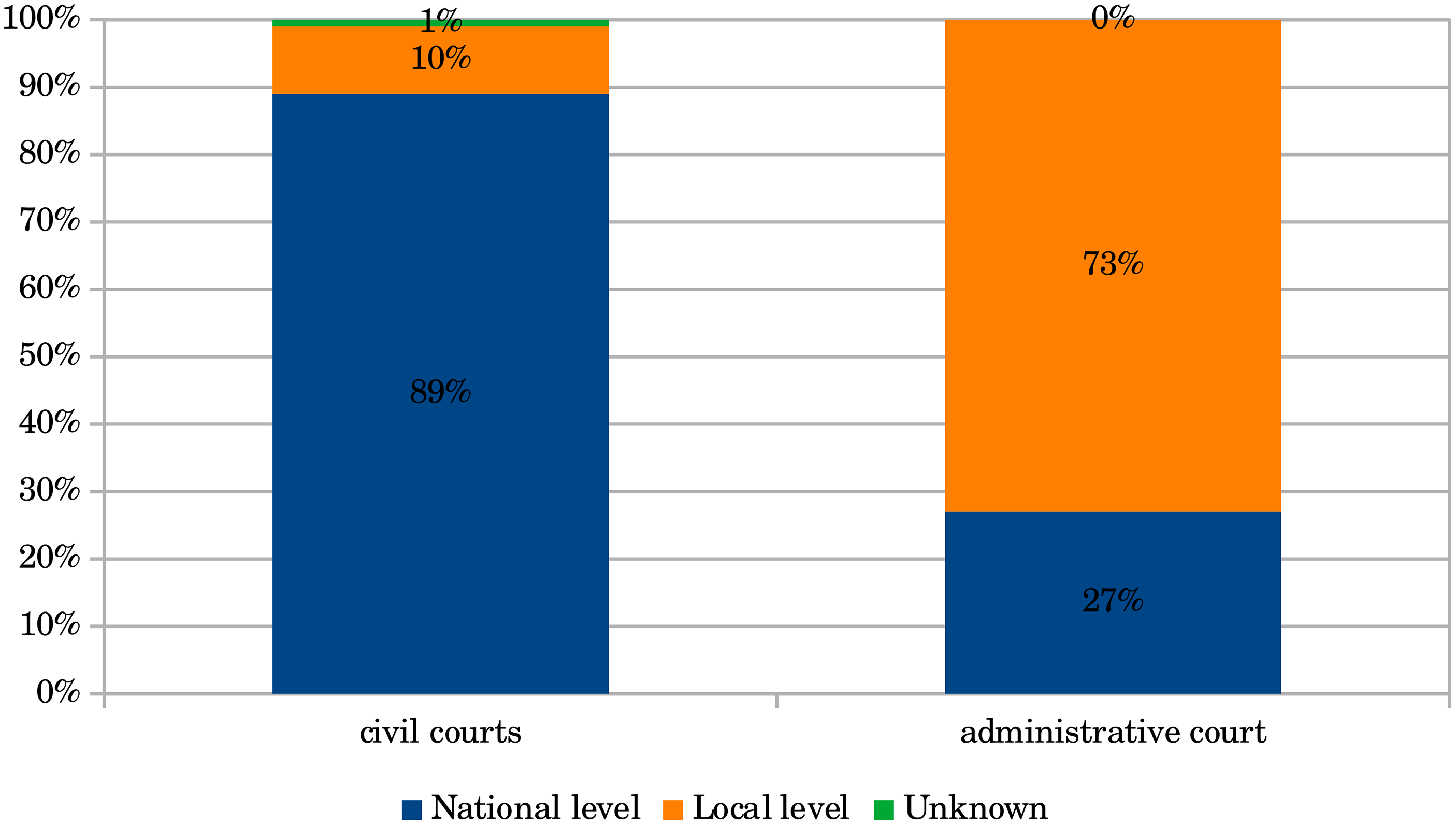
Given the exclusive focus on public authorities within administrative law, it is possible to further unpack the different types and levels of administrative bodies acting as defendants. Figure 3 shows that administrative litigation most frequently targets municipal and provincial authorities. National-level actors such as ministers or secretaries of state appear less frequently. This distribution reflects the fact that many of the contested decisions in administrative litigation by interest groups concern environmental law and spatial planning, which is in the Netherlands often adopted at the municipality or province level.
Strategic litigation and type of public defendants in % in administrative law in The Netherlands, period: 01-01-2020 until 09-04-2025, N = 549.

Overall, the comparison between the two legal domains demonstrates that strategic litigation differs substantially between administrative and civil law in terms of scale, targets and procedural function. This distinction therefore remains central throughout the remainder of the empirical analysis, allowing us to identify whether patterns of litigation differ systematically between these two legal domains.
2. Policy factors
The second contextual variable concerns policy factors that allows us to identify the substantive areas in which interest groups resort to strategic litigation. Mapping across policy fields helps determine whether strategic litigation is concentrated in a limited number of highly visible domains, or dispersed more broadly across the legal system. Figure 4 presents the distribution of cases across policy domains before the civil and the administrative court(s).
Strategic litigation across policy domains in % in The Netherlands, period: 01-01-2020 until 09-04-2025, N = 627 (civil courts = 78; administrative court = 549), based on policy domain/interest first mentioned in the judgment.

It shows a strong concentration of administrative litigation in environmental and spatial planning related fields. Infrastructure and water management (277 cases, 50%) and environment (182 cases, 33%) together account for the vast majority of administrative cases initiated by interest groups. These disputes typically concern zoning plans, environmental permits, infrastructural projects, enforcement decisions or other spatial planning decisions taken by administrative authorities. Other policy domains appear only sporadically.
Civil litigation displays a more diverse policy distribution. The most prominent domains are civil rights, immigration and integration (20 cases, 26%), domestic commerce and corporate management (15 cases, 19%), environment (11 cases, 14%) and health (11 cases, 13%). Labour law disputes (9 cases, 12%) and housing and urban development (5 cases, 6%) also appear regularly. This broader spread reflects the wider range of disputes that can be brought before the civil courts, including claims against both private and public actors, as indicated above.
A possible explanation for the strong concentration of administrative litigation in environmental and spatial planning disputes lies in the structure of Dutch administrative law itself. Although Article 1:2, third paragraph, GALA grants broad standing to interest groups, an interest group may only challenge an administrative decision if that decision directly affects the collective or general interest that the organisation represents. This requirement had important implications for the types of administrative disputes in which interest groups can participate. Environmental and planning decisions are among the few categories of administrative decisions that, by their nature, directly affect collective or diffuse interests. A zoning plan authorising a new residential development, for example, may directly affect the collective interests of local residents in their living environment, while an environmental permit for a certain activity may directly affect broader environmental interests, such as biodiversity or air quality through increased nitrogen emissions. Because these decisions have immediate consequences for interests extending beyond those of a single individual, they provide a natural basis for interest group litigation on behalf of collective and general interests.
By contrast, many other areas of administrative law, such as migration law or social security law, are largely centred on decisions addressed to a specific individual. A decision refusing asylum or denying a social security benefit primarily determines the legal position of the individual applicant. Although an interest group representing refugees or welfare recipients may have a strong interest in the broader legal principles applied in such cases, Dutch courts have consistently held that this is insufficient to establish standing. The fact that a judgement may set a precedent for other members of the group does not mean that the collective interest itself is directly affected by the individual decision. Rather, the collective interest exists at the level of the underlying legislation or policy framework governing all comparable cases. Since Dutch administrative courts generally review only individual administrative decisions, and are prohibited from reviewing legislation or general policy rules themselves, interest groups have limited opportunities to challenge broader structural issues through administrative litigation in these fields.
In the absence of a directly affected collective interest, interest groups in these fields may therefore be more likely to pursue broader policy challenges through civil litigation instead.
Taken together, the policy-based mapping suggests that the distribution of strategic litigation across policy domains is shaped not only by the substantive nature of the conflict, but also by the procedural opportunities and constraints of the respective legal framework.
3. Organisation-level factors
The third mapping strategy focuses on the organisational characteristics of the litigants. Organisation-based mapping allows us to examine which types of interest groups engage in litigation, how frequently they do so and whether litigation tends to involve single actors or broader coalitions.
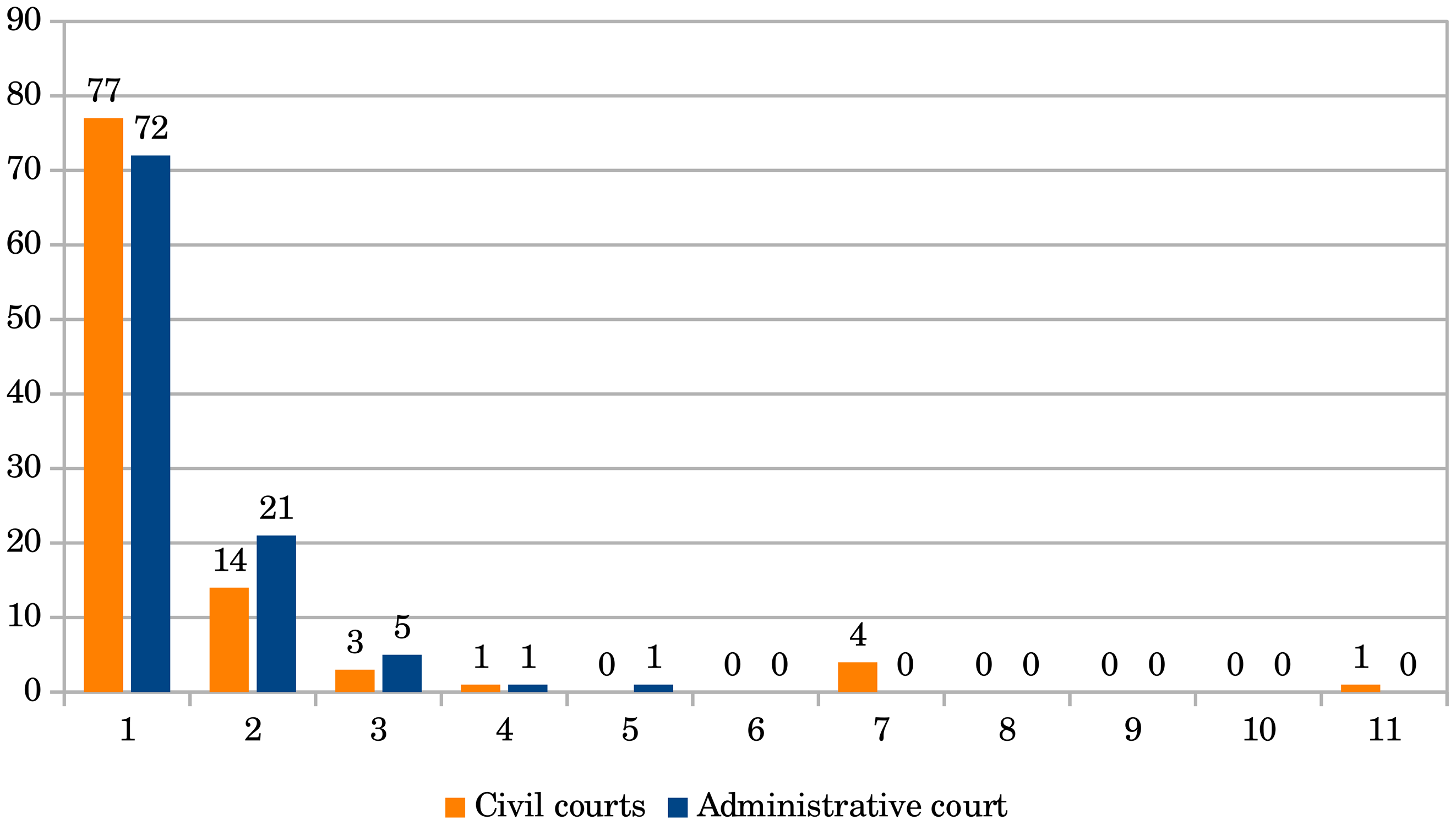
Figure 5 shows the number of interest groups involved in each case. Most cases involve a single organisation or two organisations. Larger coalitions occur only occasionally. The pattern is similar for both civil and administrative litigation, although a few civil cases involve relatively large coalitions of organisations. Overall, these results suggest that litigation is generally pursued by individual organisations rather than broad alliances, although that does occur in some cases.
Number of interest groups per court case in The Netherlands, period: 01-01-2020 until 09-04-2025, N = 627 (civil courts = 78; administrative court = 549).

A second variable concerns the types of interest groups that initiate litigation, based on the classification mentioned in the methods section and covering a wide variety of interest groups. Figure 6 demonstrates that public interest groups, groups that represent collective interests such as environmental protection, public transportation, better education, etc. dominate litigation in both legal domains, particularly in administrative law, where they account for the vast majority of cases. Identity groups, groups that represent individual based on identity such as gender, ethnicity or age, appear far less frequently, followed by business associations, while trade unions are mainly active in civil litigation. Religious organisations play only a minor role.
Interest group type across legal domains in The Netherlands, period: 01-01-2020 until 09-04-2025, N = 627 (civil courts = 78; administrative court = 549).

The third organisational variable concerns the geographical scope of the organisations, distinguishing between national and local actors. Figure 7 reveals that the geographical scope of organisations also differs between legal domains. Administrative litigation is dominated by local organisations, reflecting the local nature of many environmental and planning disputes. Civil litigation, by contrast, is more often initiated by national organisations, likely because these cases are more expensive and/or concern broader policy questions or nationwide interests.
Level of mobilization across legal areas in The Netherlands in %, period: 01-01-2020 until 09-04-2025, N = 627 (civil courts = 78; administrative court = 549).

Overall, the organisation-based mapping reveals three key patterns: litigation is usually initiated by single organisations rather than coalitions, public interest groups dominate litigation activity and civil litigation typically involves national organisations whereas local organisations dominate administrative litigation.
VI. Mapping strategic litigation: potentials, limitations and future directions
The exploratory application of our integrative mapping strategy to the Dutch context demonstrates the analytical potential of a judgement-based approach to studying strategic litigation by interest groups. Most importantly, the strategy reveals that the landscape of strategic litigation is considerably broader and more diverse than commonly suggested by existing scholarship and public debate. By shifting focus from high profile cases and predefined issue areas toward a broader set of judicial decisions across legal domains, the approach reveals forms of litigation that are more routine, localised, incremental or technical in nature, yet may still pursue broader social, political or legal change. Our approach thus provides a broader empirical baseline against which assumptions about the prevalence, nature and implications of strategic litigation can be assessed more systematically.
Our mapping strategy reveals a much broader and more diverse litigation landscape than is often reflected in political or academic debate. In the Netherlands, political discussions frequently focus on civil collective actions, particularly against the state. Our data show, however, that most litigation initiated by interest groups takes place before administrative courts, while civil litigation constitutes only a relatively small share of the cases identified. Moreover, more than half of the civil cases are directed against private companies rather than public actors. Although interest group litigation before civil courts often attracts significant political attention, it represents only a small segment of the broader litigation landscape.
Our analysis also shows that strategic litigation by interest groups constitutes only a tiny proportion of the overall litigation in the Netherlands, consistent with earlier survey research indicating that relatively few Dutch interest groups report using litigation as part of their advocacy strategies.Footnote 60 At the same time, the more than 600 cases identified over four and a half years demonstrate that litigation can be considered a well-established strategy for collective interest representation, alongside lobbying, coalition building, public campaigning and demonstrations.
While high profile climate or refugee cases are indeed present in the Dutch context, they represent only a highly visible segment of a much broader litigation landscape spanning diverse legal domains, organisational forms and governance levels. The Dutch case illustrates how prevailing scholarly attention may obscure important litigation patterns. Legal and normative debates often concentrate on high-profile civil cases against the state or corporations, whereas our analysis shows that much litigation by interest groups occurs in administrative law and concerns localised disputes. Although such cases are less publicly visible, they occur far more frequently and may cumulatively shape policy implementation and public decision-making.
The findings furthermore demonstrate substantial diversity in both the policy domains and organisational actors involved. Litigation concerns areas including labour relations, data protection, housing, urban development and environmental governance. In addition to NGOs and public interest organisations, many cases are initiated by trade unions, business associations and other membership-based organisations. Important differences also exist between legal domains: labour unions appear prominently in civil litigation, whereas administrative litigation more often involves neighborhood associations and environmental groups. Cases range from local citizen initiatives contesting local projects to large, professionalised organisations challenging national regulatory frameworks. Similarly, while climate litigation attracts disproportionate academic and media attention, environmental litigation more broadly often concerns spatial planning, permits and local environmental governance. Taken together, these findings underline the importance of simultaneously analysing policy domains, legal venues. and organisational types in order to obtain a comprehensive picture of interest group activity before the courts.
At the same time, the Dutch application highlights important methodological trade-offs. A judgement-based approach necessarily depends on publication practices and on what becomes visible in judicial decisions. Not all litigation results in published judgements, and judgements themselves may reveal little about broader litigation strategies, coalition structures, funding arrangements or litigant motivations. In addition, the relatively short time period covered by the dataset limits conclusions about long-term developments. Longer time series would help distinguish structural developments from fluctuations related to case management or publication practices.
The identification of judgments involving interest groups may also present methodological challenges that depend on how collective access to justice is structured within a jurisdiction. In the Dutch civil context, identifying interest group litigation proved relatively straightforward due to the search term “3:305a” and the existence of a public register. In administrative law, however, searches based on “1:2, paragraph 3” generated substantial noise because these article-numbers appear across many statutes and judgements. Identifying instances of strategic, administrative litigation by interest groups therefore required combinations of substantive search terms such as “foundation,” “association,” “public,” and “collective” interests and thorough manual checks. As such, the feasibility and reliability of large-scale mapping partly depend on the procedural and doctrinal organisation of collective standing within a legal system.
Moreover, although interest groups are among the actors most likely to engage in strategic litigation and therefore provide a suitable starting point for large-N empirical analysis, a focus on them may overlook strategic litigation pursued by companies or individuals. At the same time, there is little reason to assume that the broader analytical insights generated by this approach would not also apply to such actors. Such actors may, however, prove more difficult to identify systematically within judicial datasets, making them potentially less amenable to large-scale mapping strategies.
Future research could also extend the present mapping by incorporating additional variables. For example, coding the type of relief sought (e.g., declaratory relief, injunctive relief, or mass damages) could provide a more nuanced understanding of the strategies pursued by interest groups. Future studies could likewise include interim proceedings. Although their exclusion in the present study improved comparability, given the limited availability of published decisions, it may also have omitted an important dimension of strategic litigation, particularly in environmental and regulatory disputes where interim relief often plays a strategic role. Other potentially relevant variables include the type of claims made, the type of change sought, litigation outcomes, and whether cases proceeded on appeal. The approach developed here should therefore not be understood as capturing the entirety of strategic litigation, but rather as offering a structured and scalable entry point for systematic empirical analysis. Its value is likely greatest when combined with other qualitative and quantitative methods. Large-scale mapping can identify broader patterns, outliers or underexplored domains, which may subsequently be examined through case studies, interviews, ethnographic research or doctrinal analysis. In this sense, the integrative mapping strategy is best understood not as a standalone method, but as a valuable component within a broader mixed-method research design.
The integrative mapping strategy may benefit several avenues of future research. First, it may contribute to conceptual debates by enabling more systematic examination of the nature of strategic litigation. By systematically capturing variation in actors, policy domains and litigation practices, the approach supports the development of more inclusive and empirically grounded definitions, typologies and understandings of the forms, objectives and pathways associated with strategic litigation.
Second, it facilitates comparative research into how legal opportunity structures shape patterns of strategic litigation across jurisdictions. Institutional arrangements such as standing rules, procedural mechanisms, litigation costs and the types of governmental conduct that can be challenged may influence the likelihood and form of strategic litigation. Our findings suggest that such opportunity structures matter not only across countries but also within legal systems themselves, where differences between legal domains, in this case civil and administrative law, shape when and how interest groups litigate strategically.
Third, by connecting strategic litigation research to broader interest group scholarship, the approach creates opportunities to study litigation as part of wider repertoires of advocacy and political mobilisation. Litigation often forms only one element within broader advocacy strategies that also include lobbying, coalition building and public campaigning.Footnote 61 Combining integrative mapping strategies with data on organisational behaviour could therefore help connect litigation practices to broader patterns of policy advocacy. More generally, interdisciplinary perspectives and broader conceptions of interest groups reveal a more diverse landscape of actors and strategies than narrower doctrinal understandings of public interest or strategic litigation suggest.
Finally, a broader empirical understanding of strategic litigation may enrich and ground normative debates on its legitimacy. Public and political debates frequently rely on exceptional or highly visible cases when evaluating the societal role of courts and procedural rules governing collective access to justice. A more empirically grounded understanding of litigation practices is therefore essential for evaluating proposals seeking to restrict or regulate access to courts for interest groups.
VII. Conclusion
This article set out to develop a more systematic empirical approach to the study of strategic litigation by interest groups. While existing scholarship has generated valuable insights through in-depth analyses of selective, often highly visible cases, such approaches make it difficult to assess more systematically the prevalence, nature and broader implications of strategic litigation for democratic governance and the rule of law. To address this limitation, we developed an integrative mapping strategy by adjusting three core design principles from the study of policy advocacy to systematically examine strategic litigation: (1) a conscious approach to concept formation as theoretical foundation for a valid comparative and systematic empirical analysis; (2) a judgement-based sampling strategy capable of supporting large-N analysis; and (3) attention to contextual and organisational-level explanatory factors to enable meaningful comparative analyses. Together, these principles enable more systematic analysis and comparison of strategic litigation across different domains, organisations, and jurisdictions.
The exploratory application of this approach to the Dutch context demonstrates its analytical value. By moving beyond landmark cases and predefined issue areas, the analysis reveals a more diverse and much broader landscape of litigation by interest groups than is commonly reflected in public or academic debate. Strategic litigation occurs across multiple legal and policy domains, governance levels, and organisational forms, ranging from local neighbourhood associations contesting permits to professionalized organisations challenging national regulatory frameworks. Our analysis shows, for example, that interest groups predominantly litigate before administrative courts, that environmental and spatial planning disputes occupy a central place, that many administrative cases concern local effects and are aimed at local public bodies, while civil litigation spans a broader range of (national) policy domains, and that litigation is most often initiated by individual organisations rather than coalitions. At the same time, the findings also show that such litigation remains a relatively rare form of legal mobilisation within the broader litigation landscape.
The main contribution of our integrative mapping strategy lies in its capacity to move beyond fragmented, case-based accounts and situate individual cases within a broader landscape. This makes it possible to identify structural patterns, underexplored domains and variations across legal avenues and organisational actors that remain difficult to observe in more narrowly focused studies. It also enables assessment of how representative highly salient cases are of the prevalence of strategic litigation. At the same time, the approach also has some limitations. A large-scale mapping strategy necessarily prioritises breadth over depth and depends on what becomes institutionally visible in published judgements. As a result, less visible or indirect forms of strategic behaviour, coalition building, or informal mobilisation may remain outside the scope of analysis. Our approach relies heavily on databases with court decisions, underlining the importance of such publicly available, complete and up-to-date databases to facilitate large-scale comparative research on strategic litigation.
The approach developed in this article should therefore not be understood as a replacement for in-depth qualitative or doctrinal research, but rather as a complementary methodological tool in the context of mixed-method research designs. Combining large-scale empirical mapping with case studies, interviews or ethnographic approaches may ultimately provide a more complete understanding of how, where and by whom strategic litigation is pursued. Such an empirically grounded perspective is essential not only for advancing conceptual and comparative scholarship, but also for informing normative debates about the role of courts, strategic litigation and interest groups in contemporary democratic governance under the rule of law.
Acknowledgments
We would like to thank research assistants Sjoukje Kraak and Evert-Jan van Veldhuizen for their assistance in compiling the database.
Funding Statement
Open access funding provided by Leiden University.
Competing interests
The author(s) declare none.





 Open access

