Introduction
Pterygometopine trilobites are well represented in Middle and Upper Ordovician strata of the western European countries of Baltica (Jaanusson and Ramsköld, Reference Jaanusson and Ramsköld1993), but are restricted to species of the youngest genus, Achatella, Delo Reference Delo1935, in Laurentian North America. Achatella enters the succession in Laurentia during the Katian, but its record in Baltica extends down into Dariwillian strata (McNamara, Reference McNamara1980; Jaanusson and Ramsköld, Reference Jaanusson and Ramsköld1993) As such, the appearance of Achatella is generally viewed as a case of immigration (e.g., Ludvigsen and Chatterton, Reference Ludvigsen and Chatterton1982) associated with the “Trenton transgression” (Shaw and Fortey, Reference Shaw and Fortey1977; Ludvigsen, Reference Ludvigsen1978b). Achatella becomes a persistent element in Upper Ordovician faunas of eastern and central North America, but the most recent revision (Ludvigsen and Chatterton, Reference Ludvigsen and Chatterton1982) was based solely on material from the Lake Simcoe and Ottawa regions of Ontario and Quebec. In this paper, we offer a broader assessment of the genus from new and archival specimens from Oklahoma, Missouri, Illinois, Kentucky, and Ontario.
Ludvigsen and Chatterton’s (Reference Ludvigsen and Chatterton1982) study of Pterygometopidae proposed a traditional, stratigraphic phylogeny in which Pterygometopinae was represented by Achatella, Pterygometopus, and Estoniops; Achatella was interpreted as a descendant of Pterygometopus. In this study, we assess the relationship between Baltic and Laurentian species attributed to Achatella with a computer-based parsimony analysis. This analysis will place hypotheses of immigration of Achatella on a firmer footing, and is a first step toward a more comprehensive revision of Family Pterygometopidae.
Stratigraphic setting
Achetella has a paleogeographic range that spans Laurentia and Baltica. Geographic and stratigraphic occurrences of Baltic species are reviewed by Jannusson and Ramsköld (Reference Jaanusson and Ramsköld1993) and by Pärnaste et al. (Reference Pärnaste, Bergström and Zhiyi2013). Distribution of Laurentian species is discussed below.
Ohio and Kentucky
Achatella carleyi (Meek, Reference Meek1872) was described from Katian (Maysvillian) strata in the Cincinnati, Ohio, region. The original collecting horizon was listed simply as “the Cincinnati group of the Lower Silurian,” but Foerste (Reference Foerste1919) considered A. carleyi to occur in the Fairmount Member of the Maysville Formation. In current nomenclature, the Fairmount is the younger of two members of the Fairview Formation and (Datillo et al., Reference Datillo, Brett, Tsujita and Fairhurst2008, fig. 2) and lies in depositional sequence C2. New sclerites of A. carleyi were collected from older strata of the Fulton Submember at the base of the Kope Formation (Datillo et al., Reference Datillo, Brett, Tsujita and Fairhurst2008, fig. 2) at the Blue Licks locality in northern Kentucky (see Bulinski Reference Bulinski2007). This new material is fragmentary and generally poorly preserved; it adds no new information on anatomy of the species and is not illustrated. However, they provide important data on stratigraphic occurrence and extend the range of A. carleyi down to the lower part of sequence C1.
Missouri and Illinois
Achatella katharina (Bradley, Reference Bradley1930) is from the Upper Ordovician Kimmswick Limestone in this region and, contrary to Ludvigsen and Chatterton’s (Reference Ludvigsen and Chatterton1982) interpretation, it is a valid species rather than a junior synonym of A. achates (Billings, Reference Billings1860). Bradley’s holotype and some paratypes were collected near Batchtown, Calhoun County, Illinois, but other paratypes are from Glen Park, Jefferson County, Missouri. We were unable to gain access to the abandoned quarries at Glen Park, and could not locate the Batchtown site.
New sclerites of A. katharina were collected from two previously unstudied localities that will be described in detail elsewhere. Section M was measured and sampled at a large road cut through the uppermost Decorah and Kimmswick formations along County Road M, Jefferson County, Missouri, 200 m southeast of the intersection with Old Lemay Ferry Road, about 6.5 km west of the intersection with Interstate 55, and about 8.5 km west of Bradley’s (Reference Bradley1930) Glen Park locality. Material was collected about 16 meters from the base of the section. Section 79-M was at a low road cut along State Highway 79, Lincoln County, Missouri, approximately 5.25 km south of the village of Elsbury, about 1.25 km north of the intersection with County Road MO-M, and about 13 km northwest of Bradley’s (Reference Bradley1930) Batchtown locality. Sclerites of Achatella were collected 1 m above the base of the section. At both of the new sections, the sampled horizons are likely near the base of the C1 sequence (Swisher, Reference Swisher2015).
Oklahoma
Amati and Westrop (Reference Amati and Westrop2006) reported Achatella from the Upper Ordovician (latest Sandbian–Katian) Viola Springs Formation as part of their Thaleops Biofacies, and further study demonstrates that it represents A. katharina. The species is present in the Katian reference section at State Highway 99, Pontotoc County (Goldman et al., Reference Goldman, Leslie, Nolvak, Young, Bergström and Huff2007; see Amati, Reference Amati2014, for a section log), ranging from 38 to 51 m above the base of the Viola Springs, and probably falls in sequence M6 and, possibly C1 (Westrop et al., Reference Westrop, Amati, Brett, Swisher and Carlucci2012; Swisher, Reference Swisher2015; see Young et al., Reference Young, Saltzman and Bergström2005 for an alternative interpretation). As such, the occurrence of A. katharina probably overlaps with the range in Missouri, where it was sampled from what is likely the lower part of sequence C1.
New York, Ontario, and Quebec
The type species, Achatella achates (Billings, Reference Billings1860), was initially reported from the “Trenton Limestone” in Ottawa, Ontario, and subsequent work shows that this occurrence lies within upper Trenton Group strata (Ludvigsen and Chatterton, Reference Ludvigsen and Chatterton1982) that are currently assigned to the Lindsay Formation (Dix et al., Reference Dix, Coniglio, Riva and Achab2007, fig. 10); archival material at the Royal Ontario Museum from the other side of the Ottawa River in Hull, Quebec, is simply listed as from the “Trenton Group.” Achatella achates is also known from the underlying Verulam Formation (Wilson, Reference Wilson1947; Ludvigsen and Chatterton, Reference Ludvigsen and Chatterton1982). Archival material from the Royal Ontario Museum included in this study is from the Verulam Formation at various quarries in the Lake Simcoe region, Ontario, about 285 km southwest of Ottawa. These include the well-known quarries at Gambridge, and Lakefield (McFarland et al., Reference McFarland, Westrop and Cheel1999). The range of A. achates extends into New York as well, with occurrences reported from the Rust Formation (Brett et al. Reference Brett, Whiteley, Allison and Yochelson.1999).
A second species, Achatella clivosa Lespérance and Weissenberger, Reference Lespérance and Weissenberger1998, occurs in the Late Ordovician (late Katian; Ashgill) Pabos Formation and the informal, correlative Grande Coupe beds, of the Percé area, Quebec.
Laurentian Britain
At least five species of Achatella have been reported from the Laurentian terranes (Chew and Strachan, Reference Chew and Strachan2013, fig. 2) of Scotland and Northern Ireland (Morris, Reference Morris1988, p. 11), although only three of these are known well enough to merit discussion. In the Girvan area of Scotland, the mostly deep water, Middle to Upper Ordovician succession of the Midland Valley Terrane is a cover sequence above the Ballantrae ophiolite complex. The latter was emplaced on the Laurentian margin during Early-Middle Ordovician continent–arc collision (Chew and Strachan, Reference Chew and Strachan2013). Achatella consobrina (Tripp Reference Tripp1954) is from the Kiln Mudstone Member of the Craighead Limestone (Tripp, Reference Tripp1980b), which is assigned to the Dicranograptus clingani graptolite zone (Tripp, Reference Tripp1980a). This zone correlates into the lower part of the Katian Stage and the M5 or M6 depositional sequences of eastern Laurentia (Goldman et al., Reference Goldman, Leslie, Nolvak, Young, Bergström and Huff2007, fig. 2). As such, A. consobrina is approximately the same age as A. achates and A. katharina from eastern and central Laurentia. Achatella retardata (Reed, 1914) is younger than A. consobrina, occurring in the Lady Burn Starfish Beds of the South Threave Formation (Morris and Tripp, 1984; see Harper, Reference Harper1982 for a review of the stratigraphy). According to Harper (Reference Harper1982), the South Threave Formation falls in the Rawthyan Stage of the Ashgill Series of British nomenclature, which correlates with the upper Katian (Bergström et al., Reference Bergström, Chen, Gutiérrez-Marco and Dronov2009, fig. 1). This means that A. retardata is closest in age to A. clivosa from Quebec. Even higher in the Girvan succession is a species from the latest Ordovician (Hirnantian) High Mains Formation, identified by Owen (Reference Owen1986) as A. cf. truncatocaudata (Portlock, Reference Portlock1843). This represents the youngest occurrence of the genus.
Achatella truncatocaudata was originally described (Portlock, Reference Portlock1843) from the Killey Bridge Beds in County Tyrone, Northern Ireland, which is also part of the Midland Valley Terrane (Chew and Strachan, Reference Chew and Strachan2013). This unit is assigned to the Cautleyan and, probably, Rawthyan stages of the Ashgill Series (Cripps, Reference Cripps1988; Harper and Parkes, Reference Harper and Parkes2000) and thus falls in the upper Katian. A single cephalon from the Knockerk House Sandstone Member of the Knockerk Formation, Gangreeth Terrane, was assigned questionably to A. truncatocaudata by Romano and Owen (Reference Romano and Owen1993, fig. 5A, F). As Romano and Owen recognized, this specimen is characterized by anteriorly positioned eyes and in our view records a distinct species. The Grangegeeth Terrane is currently interpreted as a peri-Laurentian volcanic arc (McConnell et al., Reference McConnell, Crowley and Riggs2010), and the Knockerk House Sandstone Member was correlated into the lower part of the Laurentian Mohawkian Series by both Romano and Owen (Reference Romano and Owen1993) and Harper and Parkes (Reference Harper and Parkes2000). This indicates that “A. truncatocaudata” from the Grangegeeth Terrane is likely latest Sandbian in age (e.g., Bergström et al., Reference Bergström, Chen, Gutiérrez-Marco and Dronov2009, fig. 1), and is therefore significantly older than the type material from County Tyrone. It is also older than A. achates and A. katharina, the earliest species from Laurentian North America.
Phylogenetic analysis
Taxon selection and coding sources
All species of Achatella from Laurentian North America were coded from examination of type or other archival material and sclerites from new field collections (Figs. 3–12), with the exception of A. clivosa, which is based on images published by Lespérance and Weissenberger (Reference Lespérance and Weissenberger1998). Coding of A. retardata and A. consobrina from the Midland Valley Terrance of Scotland used images published by Morris and Tripp (Reference Morris and Tripp1986) and by Tripp (Reference Tripp1954, Reference Tripp1980b), and A. truncatocaudata was coded from high-resolution images of Portlock’s syntypes (GSM 13988, 19194, 19195; British Geological Survey, Keyworth, Nottingham) that are available on-line from the British Geological Survey (http://www.3d-fossils.ac.uk). Achatella cf. truncatocaudata of Owen (Reference Owen1986) does not differ from A. truncatocaudata in coding of observable character states and was not included in the analysis. Achatella species from Baltica, A.schmidti (Warburg, Reference Warburg1925) and A. kuckersianus (Schmidt, Reference Schmidt1881) were coded using illustrations in Jaanusson and Ramsköld (Reference Jaanusson and Ramsköld1993); Ingriops trigonocephalus (Schmidt, Reference Schmidt1881), which has a somewhat elongate pygidium similar to Achatella, was also included in the analysis and was coded largely from images in Jaanusson and Ramsköld (Reference Jaanusson and Ramsköld1993). Previous workers (e.g., Whittington, Reference Whittington1966; McNamara, Reference McNamara1980; Ludvigsen and Chatterton, Reference Ludvigsen and Chatterton1982) have considered Pterygometopus to occupy a basal position in Pterygometopinae, and P. sclerops (Dalman, Reference Dalman1827) was selected as the outgroup (coding based on images in Jaanusson and Ramsköld, Reference Jaanusson and Ramsköld1993).
Character coding
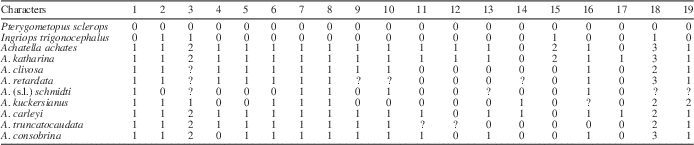
The data matrix (Table 1) is composed of 10 ingroup species, 15 binary characters, and four unordered multistate characters (Appendix). Inapplicable character states (e.g., character 3) were handled by reductive coding (Strong and Lipscomb, Reference Strong and Lipscomb1999). Autapomophies of individual species were excluded except where parts of multistate characters (e.g., character 19), and branch collapsing rules were not enforced.
Character matrix used in the phylogenetic analysis (Fig. 2)
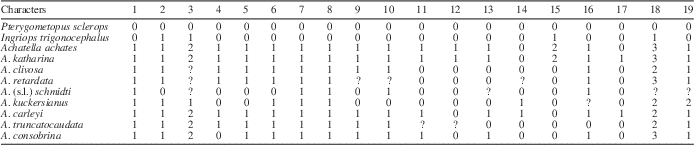
Details of characters and character states are given in Appendix 1.
Results
Parsimony analysis was conducted using both PAUP* (Swofford, Reference Swofford2001) and TNT (Goloboff et al., Reference Goloboff, Farris and Nixon2008) and yielded the same set of 42 trees, with length, 31, C.I., 0.77, R.I, 0.79; R.C., 0.62; the strict consensus tree is shown in Fig. 2.1. Tree support metrics (Fig. 2.1) were calculated using TNT and character optimization (Fig. 2.2) was performed with both PAUP* and Winclada (Nixon, Reference Nixon2002). Support for individual nodes was low, with only two with Bremer support greater than one; three nodes have GC values above 50, and three nodes have standard boostrap values above 50.
Achatella is defined by several synapomorphic characters (Fig. 2.2), including a relatively flat cephalon with a weak anterior arch [1(1)], subtriangular L3 lobe with conspicuous adaxial taper [7(1)] and is also longer (exsag.) than L1 and L2 [8(1)]; almost all species possess a posterior branch of the facial suture that is nearly straight [16(1)]. Achatella kuckersianus (Schmidt, Reference Schmidt1881), the type species of of A. (Vironiaspis) Jaanusson and Ramsköld, Reference Jaanusson and Ramsköld1993, is part of a polytomy in our strict consensus tree and, accordingly, we leave Achatella undivided at the subgeneric level. The Laurentian species form a distinct, derived group within Achatella, with the representatives from Baltica lying in a basal position (Fig. 2.1). This result is consistent with a single invasion of Laurentia with subsequent radiation, rather than multiple invasions of species from Baltica.
Systematic paleontology
Repositories for figured material are indicated by the following acronyms: CM, Cincinnati Museum of Natural History, Cincinnati, OH; UC, Field Museum of Natural History, Chicago, IL; GSC, Geological Survey of Canada, Ottawa; OU, Oklahoma Museum of Natural History, Norman; ROM, Royal Ontario Museum, Toronto.
Morphological terminology follows Whittington et al. (Reference Whittington, Chatterton, Speyer, Fortey and Owens1997); however, the occipital ring is designated LO (lobus occipitalis) and the occipital furrow is designated SO (sulcus occipitalis). Proportions expressed as percentages in the descriptions and diagnoses are means, with numbers in parentheses indicating the range of values. All measurements were made on digital images to the nearest tenth of a millimeter using the Measure Tool of Adobe Photoshop.
To maximize depth of field, all digital images were rendered from stacks of images focused at 100- to 500-μm intervals using Helicon Focus 4.0 for the Macintosh <http://www.heliconsoft.com>. All specimens were coated with a sublimate of ammonium chloride prior to photography.
Family Pterygometopidae Reed, Reference Reed1905
Subfamily Pterygometopinae Reed, Reference Reed1905
Genus Achatella Delo, Reference Delo1935
Diagnosis
Cephalon relatively flat with a weak anterior arch [1(1)]. L3 lobe subtriangular with conspicuous adaxial taper [7(1)], and longer (exsag.) than L1 and L2 [8(1)]. Posterior branch of facial suture nearly straight [16(1)]. Pygidium elongate, subtriangular in outline.
Remarks
In our analysis, Achatella is a clade that includes both Baltic and Laurentian species, with species from the former continent occupying a basal position in the cladogram (Fig. 2). Jaanusson and Ramsköld (Reference Jaanusson and Ramsköld1993) named a new subgenus of Achatella, A. (Vironiaspis), with Phacops (Pterygometopus) kuckersianus Schmidt, Reference Schmidt1881, from Baltica (northern Estonia), as the type species. As this species, the only one assigned to A. (Vironiaspis) with any confidence (Jaanausson and Ramsköld, Reference Jaanusson and Ramsköld1993, p. 766), forms part of a polytomy at the base of Achatella in the strict consensus tree (Fig. 2.1), subgenera are not used in this paper.
Three characters states are unambiguous synapomorphies of Achatella in the phylogenetic analysis (Fig. 2.2): a relatively flat cephalon with weak anterior arch [1(1)] (e.g., Figs. 5.1, 8.2, 8.5); a subtriangular L3 lobe that exhibits a conspicuous adaxial taper (7[1]), and which is longer (exsag.) than L1 and L2 (8[1]; e.g., Figs. 3.1, 8.1, 8.7). With the exception of A. truncatocaudata, which retains the plesiomorphic state seen in Pterygometopus (16[0] in the Appendix), all species of Achatella possess a posterior branch of the facial suture that is nearly straight (16[1]) (e.g., Fig. 8.1, 8.4). Where known, a long genal spine is present (e.g., Figs. 4.5, 8.1; A. schmidti [Warburg] is an exception that lacks a genal spine), and the pygidium is elongate and subtriangular in outline, with a gently rounded to pointed posterior terminus (e.g., Jaanusson and Ramsköld, Reference Jaanusson and Ramsköld1993, pl. 5, fig. 2a; Figs. 5.5, 12.1, 12.4).
Laurentian species share weak expansion (tr.) of the anterior glabellar lobe (5[1]) and an apodemal pit at intersection of L3 and axial furrow (9[1]). A derived group of four Laurentian species, A. consobrina, A. carleyi, A. katharina, and A. achates, are characterized by a median embayment on the anterior glabellar margin (11[1]; e.g., Figs. 3.1, 6.4, 6.5, 8.7), and eyes that do not reach the axial furrows anteriorly (13[1]; e.g., Figs. 6.1, 6.6, 8.11). The median embayment appears to be associated with a weakly inflated, often barely perceptible, subtriangular region on the frontal lobe (e.g., Figs. 4.2, 9.5, 9.8) that corresponds to the pterygometopid cephalic muscle insertion scar as defined by Eldredge (Reference Eldredge1971). As this scar also occurs on chasmopine (Eldredge, Reference Eldredge1971, fig. 2H) and eomonorachine (Eldredge, Reference Eldredge1971, fig. 3) trilobites, it is very likely plesiomorphic for Achatella. However, similar triangular scars occur without a median embayment in other species of Achatella (e.g., Owen, Reference Owen1986, fig. 2a), so that the embayment itself is interpreted as an apomorphic state. In some species, the edges of the embayment are marked by conspicuous tubercles (e.g., Figs. 3.1, 9.5, 9.7. 9.8).
Among other pterygometopines, Ingriops Jaanusson and Ramsköld, Reference Jaanusson and Ramsköld1993, is likely the closest relative of Achatella from the presence of a distinct genal spine and a relatively long pygidium (Jaanusson and Ramsköld, Reference Jaanusson and Ramsköld1993, pl. 5, fig. 1; see also Schmidt Reference Schmidt1881, pl. 1, figs. 9, 10).
Achatella achates (Billings, Reference Billings1860)
1860Dalmanites achates Billings, p. 63, fig. 9.
1897Dalmanites achates; Clarke, p. 726, fig. 44.
?1910Dalmanites carleyi-rogersensis Foerste, p. 85.
?1914Dalmanites achates; Foerste, p. 147, pl. 1, fig. 18.
1919Pterygometopus achates; Foerste, p. 397, pl. 19, fig. 8.
?1919Pterygometopus carleyi-rogersensis; Foerste, p. 398, pl. 19, figs. 18a, b.
1921Dalmanites achates; Raymond, p. 38, pl. 11, fig. 3.
1935Achatella achates, Delo, p. 416, figs. 38, 39.
1940Achatella achates, Delo, p. 110, p1. 13, figs. 19-21.
?1940Achatella carleyi var. rogersensis; Delo, p. 111, p1. 13, figs. 25.
1942Achatella achates; Okulitch, p. 104, p1. 1, fig. 1.
1944Achatella billingsi Sinclair, p. 17, p1. 1, figs. 1, 2.
1947Achatella achates; Wilson, p. 60, p1. 10, fig. 16.
1947Pterygometopus billingsi; Wilson, p. 55, p1. 10, figs. 4a and b.
1978aAchatella achates; Ludvigsen, p1. 5, fig. 47.
1979Achatella achates; Ludvigsen, fig. 47a and b.
1982Achatella achates; Ludvigsen and Chatterton, p. 2183, pl. 1, figs. 1–7, fig. 3.
1999Achatella achates; Brett et al., p. 300, fig. 8.4
2002Achatella achates; Whitely et al., p. 145, pl. 115.
Diagnosis
Eye extending from L3 to S2 or anterior tip of L2; located very close to glabella anteriorly, so that palpebral ridge barely recognizable. Conspicuous glabellar tubercles on each side of anterior glabellar embayment. Lateral cephalic margin evenly curved. Pygidium with pointed posterior margin.
Holotype
An incomplete, flattened exoskeleton (GSC 1784; Fig. 3.5), probably from the Lindsay Formation of Ottawa, Ontario.
Other material
An enrolled exoskeleton missing the pygidium (ROM 49475), two nearly complete exoskeletons (ROM 63161, ROM 63162), four cephala (ROM 18747, ROM 63163, ROM 35371, ROM 63160), and a pygidium (ROM 63159).
Description
Cephalon well rounded, subcircular to subovate in outline; maximum width approximately two times maximum length. Glabella outline pinches inward toward L1 between LO and L2; LO slightly wider than L2, while L2 is only marginally wider than L1. Outline expands rapidly laterally from L2 to the widest point across the anterior lobe. Axial furrow moderately to strongly developed around the glabella. Glabellar furrows also moderately to strongly developed, tending to become shallower adaxially. SO approximately transverse to forwardly curved medially; strongly developed near the axial furrows, more shallowly impressed adaxially. S1 variable in appearance, relatively transverse near the axial furrows, then slightly curved anteriorly toward the axis; weakly bifurcate adaxially with short, posteriorly directed, shallow, secondary furrow. S2 relatively straight, angled inward and forward; terminates short of axial furrow in some specimens. S3 also nearly straight, directed more steeply inward and backwards; may deepen slightly adaxially; well-developed apodemal pit at intersection with axial furrow (e.g., Fig. 4.5, 4.6). LO with conspicuous backward curvature. L1 relatively transverse, but with weak forward projection near axial furrow. L2 expands slightly adaxially. L3 approximately triangular in outline, narrowing conspicuously adaxially. Anterior lobe transversely subovate in outline. Triangular, weakly inflated muscle scar (pterygometopid insertion scar) on anterior glabellar lobe expands forward; anterior end of scar marked by two tubercles separated by gentle median embayment (e.g., Fig. 3.1). Narrow but well-defined anterior border present, marked by a change of slope at anterior end of glabella and finely etched preglabellar furrow. Arcuate palebral lobe relatively small, strongly elevated and centered opposite posterior tip of L3; anterior end positioned close to anterior tip of L3, and posterior end opposite S1. Anterior branch of the facial suture curves outward laterally from anterior tip of L3, then bends strongly inward along cranidial margin. Posterior branch of the facial suture nearly transverse near eye, then curves gently backward toward lateral cranidial margin. Posterolateral projection relatively broad and flat, with strongly developed posterior border furrow. Genal spine relatively long, exceeds glabellar length, and relatively flat where it merges with the lateral cranidial margin; narrows posteriorly to thin, rounded tip posteriorly. Sculpture of tubercles developed along the glabella and sparsely on posterior fixigena; tubercles largest on anterior lobe of glabella, becoming smaller and fainter toward LO.
Librigenal field strongly curved, raised toward the subocular furrow; subocular furrow firmly impressed. Lateral border broad, flat, defined largely by change in slope.
Pygidium approximately triangular in outline and relatively wide, tapers to posterior tip at approximately 45-degree angle. Axis relatively narrow, approximately 37% of total pygidial width at maximum; tapers gradually toward posterior. Axial furrows present but weakly developed. Nine to 10 well-defined, nearly transverse axial rings and furrows with at least two indistinct segments incorporated into terminal piece. Pleural field relatively flat near the axis, curves strongly downward near the lateral margin. Interpleural furrows faint, separating at least nine pairs of pleurae. Pleural furrows firmly impressed, oblique, and terminating short of pygidial margin; separate subequal anterior and posterior bands. Faint tubercle sculpture developed over entire pygidium except for furrows.
Remarks
Ludvigsen and Chatterton (Reference Ludvigsen and Chatterton1982) considered Achatella katharina to be a junior synonym of A. achetes, but study of type and new material indicates that they are closely related (Fig. 2) but distinct species. Characters shared between A. achates and A. katharina include a relatively short (exsag.) eye extending from L3 to S2 or the anterior tip of L2, and distinct tubercles on either side of the median embayment of the anterior glabellar margin. Achatella katharina differs in having a palpebral lobe that is farther away from the glabella (e.g., compare Fig. 8.4, 8.11 with Figs. 4.2, 4.6 and 5.4), and outward curvature of the lateral cephalic margin behind the intersection with the posterior branch of the facial suture. The latter feature is expressed on well-preserved, uncompacted cephala from both the Kimmswick Limestone (e.g., Figs. 8.1–8.7, 9.1–9.3) and the Viola Springs Formation (e.g., Fig. 10.4–10.8), and appears to be of biological rather than taphonomic significance.
Achatella carleyi is also a distinct species, and is separated from A. achates by possession of a larger eye that extends farther back on the cephalon (e.g., Fig. 6.1, 6.6, 6.10), and outward curvature of the lateral cephalic margin behind the posterior branch of the facial suture (e.g., Fig. 6.1, 6.6). S2 is noticeably shorter (tr.) on testate surfaces in A. carleyi and does not reach the glabellar margin (e.g., Fig. 6.1, 6.6). The pygidial margin is rounded posteriorly, rather than pointed (e.g., Fig. 7.3, 7.5). The sculpture comprises coarse, closely packed granules with scattered tubercles on the glabella (e.g., Fig. fig. 7.1). Achatella achates shares the glabellar tubercles, but these are set in background sculpture of very fine, barely perceptible granules (e.g., Fig. 5.3). Achatella consobrina Tripp (Reference Tripp1954, pl. 4, figs. 26–33) has eyes that extend back as far as S1, although they do not reach the axial furrow. The median embayment is well developed but tubercles are not developed at the lateral margins. The pygidium of A. consobrina has a relatively longer axis that terminates very close to the posterior margin.
Several other species are characterized by larger eyes than A. achates and which reach the axial furrow anteriorly, including A. clivosa Lespérance and Weissenberger (Reference Lespérance and Weissenberger1998, fig. 4.1), A. retardata (Reed, Reference Reed1914; Morris and Tripp, Reference Morris and Tripp1986, pl. 4, fig. 2), and A. kuckersianus (Jaanusson and Ramsköld, Reference Jaanusson and Ramsköld1993, pl. 5, fig. 3a–b). The latter species has shorter genal spines than A. achates, whereas A. schmidti (Warburg, Reference Warburg1925; Jaanusson and Ramsköld, Reference Jaanusson and Ramsköld1993, pl. 5, fig. 4a) lacks genal spines entirely.
Foerste (1910; see also Foerste, Reference Foerste1919) established a new variety of A. carleyi, A. carleyi rogersensis, for material from the “Cynthiana Formation” (= Point Pleasant Member of the Lexington Formation of modern nomenclature; Osborne, Reference Osborne1968) at Rogers Gap, Scott County, Kentucky. The holotype cranidium (Foerste, Reference Foerste1919, pl. 19, fig. 18a) appears to have an evenly curved lateral cephalic margin and a relatively small eye. It differs from A. carleyi in these respects but resembles A. achates, to which it is assigned questionably.
As revised here, A. achates is variable in several characters, including expression of the large tubercle on the occipital ring, which is barely perceptible in some cranidia (e.g., Fig. 4.2). While faintly developed in some specimens (e.g., Fig. 4.6), all cranidia display a degree of bifurcation of the S1 furrow and a secondary forward inflation of L1 near the axial furrow. The development of the subtriangular pterygometopid cephalic muscle scar is variably expressed, as is the median embayment of the anterior glabellar margin. The latter feature is generally more weakly expressed than in A. katharina and A. consobrina, and more similar in appearance to the subtly developed embayment of A. carleyi. Sculpture across the glabella ranges from large, irregularly spaced globular tubercles set in a background of very fine granules (e.g., Fig. 4.1–4.3, 4.6, 4.7) to smaller, more uniformly sized and spaced tubercles (e.g., Figs. 3.1–3.4, 5.1–5.3).
Achatella carleyi (Meek, Reference Meek1872)
1872Dalmanites carleyi Meek, p. 424.
1873Dalmanites carleyi ; Meek, p. 170, pl. 14, figs. 2a–d.
1919Pterygometopus carleyi; Foerste, pl. 19. fig. 17.
1940Achatella carleyi; Delo, p. 111, pl. 13, figs. 22–24.
Diagnosis
S2 narrow (tr.), terminates short of glabellar margin. Weakly developed median embayment on anterior glabellar margin. Eye does not reach axial furrow; extends from S3 to S1; weakly conical in lateral view. Lateral cephalic margin curved outward behind intersection with posterior branch of suture. Pygidium with rounded posterior margin. External surfaces of cephalon and pygidium with finely granulose sculpture, augmented by tubercles on glabella.
Lectotype
According to Nitecki and Golden (Reference Nitecki and Golden1970), a cranidium (UC 965; Fig. 6.9, 6.10) in the Field Museum was originally part of the collection of U.P. James, and was figured by Meek (Reference Meek1873, pl. 14, fig. 2a) in his description of Dalmanites carleyi. We select it as the lectotype. It is most likely from the Fairmount Member of the Fairview Formation (Foerste, Reference Foerste1919) of the Cincinnati region.
Other material
Five cephala (CM 51280a, CM 51280b, CM 51280c, CM 31699a, CM 31699b), and two pygidia (CM 51280d, CM 31699c).
Description
Cephalon is relatively wide, semielliptical outline (excluding genal spines); cranidium approximately subtrapezoidal in outline. Cranidial length approximately 47% of the cranidial width across the posterolateral fixigena. Axial furrow generally shallowly impressed; the furrow tends to weaken in front of L3. Well-defined apodemal pit at intersection of S3 and axial furrow. Glabella outline pinches inward from the LO to the narrowest point across L1, slowly expands from L2, then more rapidly across L3 and the anterior lobe. The anterior tip of LO and the posterior tip of L2 are approximately parallel. Maximum width of the glabella across the anterior lobe is approximately 48% of cranidial width; glabella has low convexity, relatively flat adaxially. LO relatively wide and long; generally subovate in outline but posterior margin nearly transverse medially; expands outward beyond level of L1. LO occupies approximately 19% of total glabellar length. L1 relatively transverse, elongate subrectangular in outline. L2 angled slightly posteriorly, middle portion of the lobe is slightly expanded, but outline is otherwise subrectangular. L3 is larger, subtriangular in outline, narrows sharply toward the axis. Anterior lobe is relatively long and narrow, only slightly extending past L3; subovate in outline, rounded anteriorly especially along the lateral margins. SO narrow, shallowly impressed along the axis, then marked by deeper lateral furrows angled very slightly anteriorly. S1 furrow moderately impressed, transverse laterally, curves gently anteriorly adaxially. S2 furrow directed obliquely backward, more strongly developed adaxially, terminating short of lateral glabellar margin. S3 extends oblique forward; becomes more strongly impressed abaxially toward the apodemal pit. Palpebral lobe narrow, arcuate band that tapers abaxially; palpebral furrow is finely etched groove. Eye extends from S3 to S1; does not reach axial furrow anteriorly. Anterior branch of the facial suture curves inward to follow anterolateral margin of the anterior glabellar lobe. Posterior branch of facial suture poorly preserved but apparently nearly transverse. Genal spine moderately long, less than half of total librigenal length and slightly less than glabella length. Coarsely granulose sculpture covers entire cranidial surface, with tubercles on central part of glabella and anterior lobe; on well-preserved specimens, weak median embayment on anterior glabellar margin flanked by indistinct, larger tubercles.
Librigenal lateral border and border furrow well defined; furrow expressed as a relatively wide, trough-like break in slope. Librigenal field moderately convex; subocular furrow gently impressed. Visual surface of eye weakly conical in lateral view, with width approximately three-fourths of height. Twenty-two columns of lenses with up to eight lenses. Strongly developed granular sculpture across the librigena.
Pygidium elongate, triangular to subtriangular in outline, length approximately 90% of width. Axis of 11 to 12 well-defined rings and furrows outlined by distinct axial furrows. Pleural field relatively flat adaxially, but with strong change in slope distally toward weak lateral border defined only by absence of furrows. Up to 12 pairs of oblique, firmly impressed pleural furrows; interpleural furrows obsolete. Granulose sculpture developed along the axis.
Remarks
In their revision of Achatella, Ludvigsen and Chatterton (Reference Ludvigsen and Chatterton1982) noted the limited information available for A. carleyi (Meek, Reference Meek1872), although they speculated that it might be a junior synonym of A. achates. In addition to the lectotype, we had access to archival specimens from the type area (Figs. 6, 7). They are mostly compacted to varying degrees but demonstrate clearly that A. carleyi is a distinct species in the C1 and C2 deposition sequences in southern Ohio and northern Kentucky. Lespérance and Weissenberger (Reference Lespérance and Weissenberger1998, p. 313) interpreted Foerste’s (Reference Foerste1919, pl. 19, fig. 17) image of A. carleyi as showing a small occipital spine. There is no trace of a spine in any of our cephala, although there is an occipital tubercle (e.g., Fig. 6.2), which could perhaps be exaggerated by compaction in Foreste’s specimen. Meek (Reference Meek1872, 1873) does not mention either feature in his description. The pygidium that Meek (1873, pl. 14, fig. 2d) attributed to the species has a rounded posterior margin that resembles those illustrated in this paper (Fig. 7.3, 7.5).
Achatella carleyi was compared to A. achates earlier, under the discussion of the latter. It shares an outwardly curved lateral cephalic margin behind the posterior branch of the suture with A. katharina from Missouri and Oklahoma. However, it differs from A. katharina in having a much larger palpebral lobe (compare Fig. 6 and Fig. 8.8–8.11), a shorter (tr.) S2 glabellar furrow that terminates well short of the lateral glabellar margin (compare Fig. 6.1, 6.6, and 6.10 with Fig. 10), and a background sculpture of coarser granules; the posterior margin of the pygidium is rounded (Fig. 7.3, 7.5) rather than sharply pointed (Fig. 12.4).
Achatella consobrina (Tripp, Reference Tripp1954, pl. 4, figs. 26–33) has a similarly sized eye to A. carleyi, but is closer to the glabella. The lateral margin of the cephalon appears to be evenly curved, rather than curved outward behind the posterior suture. The S2 furrow is better defined and extends to the lateral glabellar margin, and the sculpture of the glabellar surface includes numerous, more closely spaced fine tubercles. Other species, including A. kuckersianus (Schmidt), A. clivosa Lespérance and Weissenberger, and A. retardarta (Reed) have eyes that extend forward to reach the axial furrow.
Achatella katharina (Bradley, Reference Bradley1930)
1930Dalmanites katharina Bradley, p. 286, pl. 30, figs. 19–28.
1940Dalmanites katharina; Delo, p. 112, pl. 13, figs. 26–29.
Diagnosis
Eye extending from L3 to S2 or anterior tip of L2; located away from glabella anteriorly, with fixigena traversed by short palpebral ridge (e.g., Fig. 8.4, 8.11). Conspicuous glabellar tubercles on each side of anterior glabellar embayment. Lateral cephalic margin curved outward behind intersection with posterior branch of facial suture. Pygidium with pointed posterior margin.
Holotype
A cephalon (UC 20685; Fig. 8.5–8.7) from the Kimmswick Limestone near Batchtown, Calhoun County, Illinois.
Other material
Paratypes: three cephala (UC 33780a, 33780c, 33780e), a hypostome (UC 28975a) and two pygidia (UC 33780b, UC 28977 [latter specimen assigned questionably to the species]); additional sclerites from Missouri: three cephala (OU 222760, OU 222761, OU 222763,), a cranidium (OU 222762), a librigena (OU 222764), and three pygidia (OU 222766, OU 222767, OU 222768); sclerites from Oklahoma: three cephala (OU 12121, 12123, OU 222765), a cranidium (OU 12124) and a pygidium (OU 12125)
Description
Cephalon semielliptical in outline, excluding genal spines. Cranidial outline subtriangular to subtrapezoidial, narrowing toward a gently rounded anterior margin. Cranidial length approximately 48% of maximum cranidial width. Axial furrows are shallow grooves, with conspicuous apodemal pit at intersection with S3. Glabella moderately convex, expands evenly forward from minimum width at S1 to maximum width across the anterior lobe; maximum glabellar width approximately 45% of maximum cranidial width. Median embayment of anterior glabellar margin flanked by conspicuous tubercles. SO nearly transverse, deepest abaxially and curved slightly forward, but shallows medially. S1 also transverse, expands adaxially becoming weakly bifurcate with very shallow, short (exsag.) branch in some specimens (e.g., Fig. 8.7). S2 strongly incised, proceeds obliquely forward from axial furrow; width (tr.) equal to 27% of glabellar width at L3. S3 shallower than S2; extends obliquely backward from prominent apodemal pit at axial furrow; terminates adaxially at second shallower pit. LO curved gently backward, increasing in length (exsag.) toward midline; maximum length approximately 17.5% of glabella length; dorsal surface slopes upward and backward, becoming raised above the rest of the glabella. L1 approximately transverse, expands forward weakly near axial furrow. L2 with straight posterior and oblique anterior margins; expands adaxially. L3 subtriangular in outline with adaxially convergent margins so that length (exsag.) becomes reduced by approximately 50% away from axial furrow. Anterior lobe suboval in outline. Anterior border very short, separated from glabella by shallow preglabellar furrow; narrows abaxially and eventually cut out entirely by suture. Palpebral lobe forms narrow (exsag.), steeply inclined, tapering band (Fig. 8.10); eye short (exsag.), extending from L3 to S2 or anterior tip of L2; located away from glabella anteriorly, with steeply inclined palpebral area of fixigena traversed anteriorly by short palpebral ridge. Palpebral furrow well defined, finely etched groove. Anterior branch of the facial suture runs approximately parallel to margin of glabella before curving inward sharply along the anterior margin of the anterior lobe. Preoccular fixigena is narrow (tr.), tapers anteriorly. Posterior branch of the facial suture curves gently backward toward genal spine. Posterolateral projection of fixigena is wide (tr.) with strong posterior border furrow that gently curves toward genal spine, fading beyond intersection with shallow lateral border furrow. Lateral cephalic margin curved outward behind intersection with posterior branch of facial suture. Genal spine relatively long, slightly greater than 50% of cephalon length. Sculpture of rounded tubercles developed moderately across glabella and fixigena. Conspicuous median tubercle on posterior margin of LO.
Lateral librigenal border widest (tr.) opposite librigenal field, but becomes greatly reduced anteriorly along sutural margin. Border furrow weak and expressed largely by change in slope between the librigena field and lateral border. Librigena field strongly convex; suboccular furrow well defined. Eye raised above level of glabellar crest; strongly curved and subconical; basal width in lateral view equal to approximately 85% of height. Visual surface with 20 columns of domical lenses, with up to nine lenses per column.
Pygidium relatively narrow, long and triangular in outline, with maximum width approximately 90% of pygidial length. Lateral and posterior profiles strongly convex. Axial furrows well defined, shallow toward posterior. Axis moderately convex and tapers backwards toward a bluntly pointed posterior tip; width approximately 39% of pygidial width across the anteriormost ring; includes 12 well-defined axial rings and short (sag.) terminal piece that comprises at least two segments. Axial ring furrows strongly impressed anteriorly, becoming more faintly impressed posteriorly; deepest abaxially, shallowing and becoming slightly longer (sag.) medially. Pleural field strongly convex with steeply sloping lateral margin. Faint interpleural furrows oblique, becoming curved backward distally, and defining up to 12 pairs of pleurae. Pleural furrows deep and oblique; define subequal anterior and posterior bands. Slight dorsal flexure present along pygidial axis, readily apparent in lateral view (e.g., Fig. 12.2), raising posterior tip. External surface generally smooth and lacking large tubercles. Doublure strongly concave in dorsal view and lacks terrace ridges; extends to level of abaxial termination of pleural and interpleural furrows.
Remarks
The short (exsag.), tall eye (e.g., Fig. 8.8–8.11) separates A. katharina from all other members of the genus apart from A. achates; these species were compared in detail under the discussion of the latter. One of Bradley’s paratype pygidia (Fig. 11.1–11.3) is relatively shorter than all other pygidia (e.g., Fig. 11.4–11.9) and is assigned only questionably to the species.
Stratigraphic distribution of Achatella species from Laurentian North America. Third order depositional sequences from Holland and Patzkowsky, Reference Holland and Patkowsky1996. Sources of regional stratigraphic data: Missouri, Swisher, Reference Swisher2015; Oklahoma, Amati, Reference Amati2014, Carlucci et al., Reference Carlucci, Westrop, Brett and Burkhalter2014, Westrop et al., Reference Westrop, Amati, Brett, Swisher and Carlucci2012; Cincinnati, Brett et al., Reference Brett, McLaughlin, Cornell and Baird2004, Datillo et al., Reference Datillo, Brett, Tsujita and Fairhurst2008; Ontario, Mitchell et al., Reference Mitchell, Adhya, Bergström, Joy and Delano2004, Sharma et al., Reference Sharma, Dix and Riva2003, Amati and Westrop, unpublished.

Results of a phylogenetic analysis of a character matrix (Table 1; see appendix for list of characters) for Achatella species. (1) Strict consensus of 42 trees discovered with a branch-and-bound search (implicit enumeration). Support metrics (calculated in TNT; Goloboff et al., Reference Goloboff, Farris and Nixon2008) show by numbers are Bremer support (boldface; only values >1 are shown), GC bootstrap support (italics) and conventional bootstrap support (roman font). Shaded region comprises species of Achatella as diagnosed in this study. B, species from Baltica; L, species from Laurentian North America and Britain; (2) optimized character distribution plotted on one of the most parsimonious trees. Numbers above circles refer to characters and those below identify particular states (Appendix). Only unambiguous transformations (i.e., optimize to the same nodes under the assumptions of both ACCTRAN and DELTRAN) are shown; filled circles show states that originate at a single node, and open circles indicate states that are homoplastic.
Achatella achates (Billings, Reference Billings1860) from Ontario. (1–4) Enrolled exoskeleton (ROM 49475), dorsal, ventral, lateral and anterior views, ×7, Verulam Formation, Gamebridge Quarry, Gamebridge; (5) complete, somewhat compacted exoskeleton (GSC 1784, holotype), ×3.75, Lindsay Formation, Ottawa.
Achatella achates (Billings, Reference Billings1860) from Canada. (1–3) Cephalon (ROM 63163), anterior, dorsal and lateral views, ×5.5, Trenton Group, Hull, Quebec; (4) Incomplete exoskeleton (ROM 63161), dorsal view, ×4.5, Trenton Group, Hull, Quebec; (5) cephalon (ROM 18747), dorsal view, ×4.5, Trenton Group, Hull, Quebec (illustrated previously by Ludvigsen and Chatterton, Reference Ludvigsen and Chatterton1982, pl. 1, figs. 2); (6, 7) cephalon (ROM 63160), dorsal and posterior views, ×10, Verulam Formation, Lakefield Quarry, Lakefield, Ontario.
Achatella achates (Billings, Reference Billings1860), Canada. (1–3) Cephalon (ROM 35371), anterior, lateral and dorsal views, ×6.5, Lakefield Quarry, Lakefield, Ontario; (4) nearly complete exoskeleton (ROM 63162), dorsal view, ×4, Trenton Group, Hull, Quebec; (5–7) pygidium (ROM 63159), dorsal, lateral and posterior views, ×10, Verulam Formation, Gamebridge Quarry, upper face.
Achatella carleyi (Meek, Reference Meek1872), Cincinnati region, Ohio. (1–3) Cephalon (CM 51280a), dorsal, anterior and lateral views, ×8, middle Fairview Formation, Cincinnati, Hamilton County, Ohio, off 747 on Dues Road at intersection with Ocean Road; (4, 5) cephalon (CM 31699a), dorsal and anterior views, ×12, “Lorraine Group” Formation, Cincinnati, Hamilton County, Ohio; (6–8) cephalon (CM 51280b), dorsal, lateral and posterior views, ×8, middle Fairview Formation, Cincinnati, Hamilton County, Ohio, off 747 on Dues Road at intersection with Ocean Road; (9, 10) cephalon (UC 965; lectotype), lateral and dorsal views, ×8, Fairview Formation, Cincinnati.
Achatella carleyi (Meek, Reference Meek1872), Cincinnati region, Ohio. (1, 2) Cephalon (CM 51280c), dorsal and anterior views, x9, middle Fairview Formation, Cincinnati, Hamilton County, Ohio, off 747 on Dues Road at intersection with Ocean Road; (3) pygidium (CM 31699c), dorsal view, ×10, Lorraine Group”, Cincinnati, Ohio; (4, 5) pygidium (CM 51280d), posterior and dorsal views, ×7, middle Fairview Formation, Cincinnati, Hamilton County, Ohio, off 747 on Dues Road at intersection with Ocean Road; (6) cephalon (CM 31699b), dorsal view, ×6, “Lorraine Group,” Cincinnati, Ohio.
Achatella katharina (Bradley, Reference Bradley1930), Kimmswick Formation, Batchtown, Illinois. (1–3) Cephalon (UC 33780a; paratype), dorsal, anterior and lateral views, ×4.5; (4) cephalon (UC 337380a; paratype), dorsal view, ×4.5; (5–7) cephalon (UC 20685; holotype), anterior, lateral and dorsal views, ×6.5; (8–11) cephalon (UC 33780e; paratype), anterior, lateral-exterior, lateral-interior and dorsal views, ×6.5.
Achatella katharina (Bradley, Reference Bradley1930), Kimmswick Formation, Missouri. All from a road cut along State Highway 79, Lincoln Co., Missouri, approximately 5.25 km south of the village of Elsbury, except (1–3) (road cut on County Road M, Jefferson Co., Missouri, 200 m southeast of the intersection with Old Lemay Ferry Road). (1–3) Cephalon (OU 222760), anterior, dorsal and lateral views, ×6.5, collection M19; (4–6) cephalon (OU 222761), anterior, dorsal and lateral views, ×6.5, collection 79 M-1 m; (7) cranidium, (OU 222762), dorsal view, ×6.5, collection 79 M-1 m; (8–10) cephalon (OU 222763), dorsal, anterior and lateral views, ×10, collection 79 M-1 m; (11) free cheek (OU 222764), lateral view, ×12, collection 79 M-1 m.
Achatella katharina (Bradley, Reference Bradley1930), all from Viola Springs Formation, roadcut along west side of U.S, Highway 99, 5 km south of Fittstown, Pontotoc County, Oklahoma (except 9, 10, Lawrence Quarry, approximately 10 km southwest of Ada, Pontotoc County). (1–3) Cephalon (OU 12121), anterior, dorsal and lateral views, ×5.25, collection 99-51; (4–6) cephalon (OU 12123), anterior, lateral and dorsal views, ×6, collection 99-float; (7, 8) cephalon (OU 222765), lateral and dorsal views, ×5.5, collection HW99-51; (9, 10) cranidium (OU 12124), latex cast from external mold, dorsal and anterior views, ×5.25.
Achatella katharina (Bradley, Reference Bradley1930), Kimmswick Formation. (1–3) Pygidium (UC 28977; paratype of A. katharina but assigned doubtfully to that species in this paper), dorsal, posterior and lateral views, ×7, Glen Park, Missouri; (4–6) pygidium (UC 33780b, paratype), dorsal, lateral and posterior views, Batchtown, Illinois, ×7; (7–9) pygidium (OU 222766), posterior, lateral, and dorsal views, ×7, collection 79 M-1 m.
Achatella katharina (Bradley, Reference Bradley1930). All from the Kimmswick Formation, road cut along State Highway 79, Lincoln Co., Missouri, approximately 5.25 km south of the village of Elsbury except (8–10) (Viola Springs Formation, roadcut along west side of U.S, Highway 99, 5 km south of Fittstown, Pontotoc County, Oklahoma, collection 99-49). (1–3) Pygidium (OU 222767) dorsal, lateral, and posterior views, ×15, collection 79 M-1 m; (4) pygidium (OU 222768), dorsal view, ×15, collection 79 M-1 m; (5–7) hypostome (UC 28975a, paratype), posterior, ventral, and lateral views, ×16; (8–10) pygidium (OU 12125), posterior, lateral, and dorsal views, ×10.
Acknowledgments
This research was supported by NSF grant EAR 0819715. D.M. Rudkin and P. Fenton at the Royal Ontario Museum, B. Hunda and J. MacKnight at the Cincinnati Museum, M. Coyne at the Geological Survey of Canada, and P. Meyer at the Field Museum arranged loans of type material. T.N. Barker, D.K. Moss, and A. Thomas assisted in fieldwork in Missouri; R. Burkhalter provided invaluable help in the lab and in fieldwork in Oklahoma and Missouri; C.E. Brett guided us to the Blue Licks locality in northern Kentucky. Alan Owen and an anonymous reviewer provided useful comments that improved the paper.
Appendix Characters used in the phylogenetic analysis
1. Cephalic convexity. 0, strongly convex with conspicuous anterior arch (e.g., Jaanusson and Ramsköld, Reference Jaanusson and Ramsköld1993, pl. 1, fig. 2b); 1, relatively flat with weak arch (e.g., Fig. 8.2, 8.5, 8.8).
2. Genal spine. 0, absent (e.g., Jaanusson and Ramsköld, Reference Jaanusson and Ramsköld1993, pl., fig. 2a); 1, present (e.g., fig. 8.1)
3. Genal spine length. 1, short (equal to less than cranidial length [sag.]) (e.g., Jaanusson and Ramsköld, Reference Jaanusson and Ramsköld1993, pl. 5, fig. 3a); 2, long (length greater than cranidal length) (e.g., Fig. 8.1); ?, inapplicable.
4. Preglabellar furrow. 0, firmly impressed (e.g., Jaanusson and Ramsköld, Reference Jaanusson and Ramsköld1993, pl. 1, fig. 2a); 1, border separated from glabella largely by change in slope (e.g., Fig. 8.1–8.7).
5. Anterior expansion of glabella beyond L3. 0, strong (e.g., Jaanusson and Ramsköld, Reference Jaanusson and Ramsköld1993, pl. 1, fig. 2a); 1, weak (e.g., Fig. 8.1, 8.7).
6. Minimum glabellar width. 0, at L2 (e.g., Jaanusson and Ramsköld, Reference Jaanusson and Ramsköld1993, pl.1, fig. 2a); 1, at L1 (e.g., Fig. 8.1, 8.7, 8.11).
7. Shape of L3 lobe. 0, roughly even in length (exsag.) and subtrapezoidal in outline (e.g., Jaanusson and Ramsköld, Reference Jaanusson and Ramsköld1993, pl., fig. 2a); 1, conspicuous adaxial taper in length (exsag.), with minimum adaxial length half or less of length at axial furrow, and subtriangular in outline (e.g., Fig. 8.1, 8.7).
8. Lengths (exsag.) of L1–L3 lobes. 0, roughly equal in length (e.g., Jaanusson and Ramsköld, Reference Jaanusson and Ramsköld1993, pl. 1, fig. 2a); 1, L3 noticeably longer (e.g., Fig. 8.1, 8.7).
9. Apodemal pits in L3 at axial furrow. 0, absent (e.g., Jaanusson and Ramsköld, Reference Jaanusson and Ramsköld1993, pl.1, fig. 2a); 1, present [note, often infilled with matrix] (Fig. 8.1)
10. Tuberculate sculpture on glabella. 0, weak or absent (e.g., Jaanusson and Ramsköld, Reference Jaanusson and Ramsköld1993, pl. 1, fig. 2a); 1, well defined (e.g., Fig. 8.1).
11. Anterior glabellar embayment. 0, absent (e.g., Jaanusson and Ramsköld, Reference Jaanusson and Ramsköld1993, pl. 1, fig. 2a); 1, present (e.g., Fig. 8.1–8.7) see text for further discussion).
12. Pair of conspicuous tubercles at edges of glabellar embayment. 0, absent (e.g., Jaanusson and Ramsköld, Reference Jaanusson and Ramsköld1993, pl.1, fig. 2a); 1, present (e.g., Fig. 8.1–8.7).
13. Eye position. 0, abuts glabella anteriorly (e.g., Jaanusson and Ramsköld, Reference Jaanusson and Ramsköld1993, pl. 1, fig. 2a); 1, separate from glabella anteriorly by strip of fixigena (e.g., Figs. 6.1, 8.4). Lésperance and Weissenberger (Reference Lespérance and Weissenberger1998, p. 312) first noted that several species of Achatella possess eyes whose anterior tip reaches the axial furrow, including A. clivosa, A. retardata and A. kuckersianus. This state is shared with Ingriops and Pterygometopus, and is plesiomorphic.
14. Subocular furrow. 0, deep, well-defined groove (e.g., Jaanusson and Ramsköld, Reference Jaanusson and Ramsköld1993, pl. 1, fig. 2b; Fig. 8.9); 1, narrow, shallow groove (e.g., Fig. 6.7).
15. Palpebral lobe length. 0, extends from anterior tip of L1 to S3 (e.g., Jaanusson and Ramsköld, Reference Jaanusson and Ramsköld1993, pl. 1, fig. 2a); 1, extends from posterior tip of L1 to L3 (e.g., Jaanusson and Ramsköld, Reference Jaanusson and Ramsköld1993, pl. 5, fig. 1a); 2, extends from anterior tip of L2 or S2 to L3 (e.g., Fig. 8.11).
16. Posterior branches of sutures. 0, curved forward abaxially (e.g., Jaanusson and Ramsköld, Reference Jaanusson and Ramsköld1993, pl. 1, fig. 2a); 1, nearly straight (e.g., Figs. 8.1, 9.2).
17. Outward curvature of cephalic margin behind suture. 0, absent (e.g., Jaanusson and Ramsköld, Reference Jaanusson and Ramsköld1993, pl. 1, fig. 2a; Fig. 5.3); 1, present (e.g., Figs. 6.1, 6.6, 8.1, 8.7, 9.2, 10.6).
18. Pygidial length. 0, short, rounded posteriorly, length/width = 0.65 (e.g., Jaanusson and Ramsköld, Reference Jaanusson and Ramsköld1993, pl. 1, fig. 2b); 1, intermediate, rounded posteriorly, length/width = 0.73 (e.g., Jaanusson and Ramsköld, Reference Jaanusson and Ramsköld1993, pl. 5, fig. 1c); 2, long, rounded posteriorly. length/width = 0.85 or greater (e.g., Jaanusson and Ramsköld, Reference Jaanusson and Ramsköld1993, pl. 5, fig. 2a); 3, long, pointed posteriorly, length/width =0.85 or greater (e.g., Fig. 12.4).
19. Pleural field. 0, gently arched distally (e.g., Jaanusson and Ramsköld, Reference Jaanusson and Ramsköld1993, pl. 1, fig. 2a); 1, nearly vertical flanks (e.g., Fig. 12.3, 12.8); 2, gently concave flanks (e.g., Jaanusson and Ramsköld, Reference Jaanusson and Ramsköld1993, pl. 5, fig. 2c).