Introduction
When infected by a pathogen, hosts have evolved a series of defensive responses that can be broadly categorized into three strategies: (i) avoidance; defined as behaviour to reduce contact with pathogens; (ii) resistance; defined as the ability of a host to limit or inhibit pathogen replication, thus reducing infection severity and parasite burden and (iii) tolerance; defined as the ability of an infected host to limit the impact of infection on host fitness (Hart, Reference Hart1990; Råberg et al., Reference Råberg, Sim and Read2007, Reference Råberg, Graham and Read2009; Medzhitov et al., Reference Medzhitov, Schneider and Soares2012). When relying on resistance a host can employ a multitude of, often costly, behavioural, morphological, physiological defence mechanisms to limit and eliminate the negative effects of the pathogens (Lochmiller and Deerenberg, Reference Lochmiller and Deerenberg2000; Råberg et al., Reference Råberg, Graham and Read2009). Unlike resistance, host tolerance does not limit infection, but reduces or compensates parasite-induced damages through reduced immuno-pathology, increased wound repair mechanisms and greater resilience to tissue injuries (Råberg et al., Reference Råberg, Graham and Read2009). Tolerance thus offsets and/or reduces the pathogen's impact at significantly lower fitness costs compared with responses involving resistance (Råberg et al., Reference Råberg, Graham and Read2009). Both resistance and tolerance have been shown to be genetically controlled, be heritable and often evolve independently (Mazé-Guilmo et al., Reference Mazé-Guilmo, Loot, Páez, Lefèvre and Blanchet2014; Lough et al., Reference Lough, Kyriazakis, Bergmann, Lengeling and Doeschl-Wilson2015).
Resistance and tolerance may result in a similar fitness benefit for the host. However, their outcomes give rise to two different evolutionary scenarios. Assuming that resistance carries a cost (see above), when a gene conferring pathogen resistance spreads through a population, the prevalence of the pathogen declines, reducing the fitness advantage of carrying the resistance gene and therefore ultimately resulting in a negative feedback loop (Roy and Kirchner, Reference Roy and Kirchner2000; Råberg et al., Reference Råberg, Graham and Read2009; Hayward et al., Reference Hayward, Garnier, Watt, Pilkington, Grenfell, Matthews, Pemberton, Nussey and Graham2014). The combination of the fitness cost and a possible co-evolutionary relationship between pathogen and host will prevent resistant genes from becoming fixed within a host population (Roy and Kirchner, Reference Roy and Kirchner2000). Tolerance, however, does not directly affect pathogen survival and its effect on pathogen prevalence (Roy and Kirchner, Reference Roy and Kirchner2000; Råberg et al., Reference Råberg, Graham and Read2009). This strategy results in prolonged period of pathogen infection ultimately resulting in an increase in pathogen prevalence within the host population. It, therefore, creates a positive feedback loop that increases the chance of ‘tolerance genes’ becoming fixed in the host population (Roy and Kirchner, Reference Roy and Kirchner2000; Lough et al., Reference Lough, Kyriazakis, Bergmann, Lengeling and Doeschl-Wilson2015). Therefore, the two host defence strategies may have opposing outcomes; host resistance has been considered to promote host heterogeneity, while tolerance has been proposed to purge the heterogeneity in the host population (Hayward et al., Reference Hayward, Garnier, Watt, Pilkington, Grenfell, Matthews, Pemberton, Nussey and Graham2014). However, if the efficiency and the cost of the two strategies are different, or if a trade-off exists between resistance and tolerance, then host genetic variance can be maintained even under tolerance (Best et al., Reference Best, White and Boots2008; Carval and Ferriere, Reference Carval and Ferriere2010; Hayward et al., Reference Hayward, Garnier, Watt, Pilkington, Grenfell, Matthews, Pemberton, Nussey and Graham2014).
As proposed by Dillman and Schneider (Reference Dillman and Schneider2015), resistance and disease tolerance should be applicable to any challenges to the host that is to say not only to infections but also to cancer. Despite the importance of oncogenic processes in animal evolutionary ecology (Thomas et al., Reference Thomas, Jacqueline, Tissot, Henard, Blanchet, Loot, Dawson, Mery, Renaud, Montagne, Beckmann, Biro, Hamede and Ujvari2017), the concept of tolerance to cancer has until now received little attention. We propose that the ubiquity of oncogenic processes among metazoans is not only attributable to limitations in resistance mechanisms but also to tolerance to cancer. Before discussing this topic, it is important to first define cancer, a family of potentially lethal pathologies in which normal cells lose their typical cooperative behaviour, proliferate, spread and hence become malignant. The majority of deaths directly caused by cancer can be attributed to metastases (i.e. disseminated tumour spread), not to the oncogenic phenomena occurring along the continuum of precancerous lesions to locally confined tumours (i.e. in situ neoplasia). Even if they do not always lead to metastases, the presence of oncogenic processes has been demonstrated in both human and animal populations (Madsen et al., Reference Madsen, Arnal, Vittecoq, Bernex, Abadie, Labrut, Garcia, Faugère, Lemberger, Beckmann, Roche, Thomas, Ujvari, Ujvari, Roche and Thomas2017; Thomas et al., Reference Thomas, Vavre, Tissot, Vittecoq, Giraudeau, Bernex, Misse, Renaud, Raven, Beckmann, Hamede, Biro and Ujvari2018b). Invasive cancers are therefore the final stage of a series of oncogenic phenomena that are widespread among metazoan species. The dynamic interaction between the malignant cells and the host determines why certain malignancies evolve into invasive cancers while others do not. Although the majority of invasive cancers occur in old age, the development of precancerous lesions, dysplasia and hyperplasia in youth can however still impair fitness, particularly when their control requires the activation of host defences (i.e. trade-offs) (Jacqueline et al., Reference Jacqueline, Biro, Beckmann, Moller, Renaud, Sorci, Tasiemski, Ujvari and Thomas2017; Thomas et al., Reference Thomas, Donnadieu, Charriere, Jacqueline, Tasiemski, Pujol, Renaud, Roche, Hamede, Brown, Gatenby and Ujvari2018a, Reference Thomas, Vavre, Tissot, Vittecoq, Giraudeau, Bernex, Misse, Renaud, Raven, Beckmann, Hamede, Biro and Ujvari2018b).
Secondly, it is also important to point out that while the dynamics of ‘typical’ host-pathogen interactions (that occur across generations) can be easily translated to transmissible tumours that also affect several generations, applying the classical co-evolutionary theory to non-transmissible cancers is not that straightforward. Non-transmissible cancers do not experience any epidemiological feedback because these malignant cell lines arise and go extinct within the same host, i.e. the only evolutionary pressure on non-transmissible cancers is the intrinsic defences of a single host genotype and any external anti-neoplastic therapeutic modality. We therefore explore the concept of tolerance being a potential host response to both transmissible and non-transmissible cancers.
The trade-offs of resisting non-transmissible and transmissible cancers
Non-transmissible premalignant lesions and malignant transformation occur throughout the life of organism, and although defence mechanisms are effective in suppressing tumour growth to a certain extent (DeGregori, Reference DeGregori2011), cancer cells (similar to pathogens (Janeway et al., Reference Janeway, Travers, Walport, Janeway, Travers and Walport2001; Finlay and McFadden, Reference Finlay and McFadden2006)) may eventually evolve to circumvent and/or escape immune control (e.g. the process of immunoediting: Elimination, Equilibrium, Escape, (Dunn et al., Reference Dunn, Old and Schreiber2004)) and ultimately cause the demise of the organism. Our defences against malignant cells could in theory be more efficient, but they are also traded against other fitness-related functions (Jacqueline et al., Reference Jacqueline, Biro, Beckmann, Moller, Renaud, Sorci, Tasiemski, Ujvari and Thomas2017). Depending on several intrinsic (e.g. lifespan, metabolic rate) and extrinsic factors (e.g. resource availability), the organism can optimize its response to cancer by resisting and suppressing malignant cell growth or to tolerate neoplasia and allocate resources to other processes that directly and/or indirectly maximize reproduction. The high cost of immune system functioning leads to trade-offs with other life history traits and demands (Norris and Evans, Reference Norris and Evans2000; van der Most et al., Reference van der Most, de Jong, Parmentier and Verhulst2011) and determines the best host strategy to achieve maximal fitness. Accordingly, over the last decades, immuno-ecological studies have illustrated various trade-offs between host responses, i.e. immune activation and investment in other anabolic activities (Sheldon and Verhulst, Reference Sheldon and Verhulst1996; Sadd and Schmid-Hempel, Reference Sadd and Schmid-Hempel2009). For example, under natural conditions, the immune system of multicellular organisms is regularly challenged by both micro- and macro-parasites, as well as by malignant cells, and hence it is required to act at both fronts. While producing a Th1 response is usually protective against cancer and intracellular pathogens (Knutson and Disis, Reference Knutson and Disis2005), Th2 activation is both linked to negative prognosis in some cancers (Lippitz, Reference Lippitz2013) but also to conferring protection against macro-parasites. Jacqueline et al. (Reference Jacqueline, Biro, Beckmann, Moller, Renaud, Sorci, Tasiemski, Ujvari and Thomas2017) suggested that trade-offs may exist because the cytokines that instruct immune cells to differentiate into the Th1 pathway tend to inhibit Th2 effectors (Kidd, Reference Kidd2003).
In Tasmanian devils, where a transmissible cancer epidemic, the devil facial tumour disease (DFTD), has decimated devil numbers, there is some evidence for the recent evolution of resistance mechanisms. Indeed, in areas where the cancer has been present for more than four generations, changes in allele frequencies of key immune genes related to cancer and immune function have been observed (Epstein et al., Reference Epstein, Jones, Hamede, Hendricks, McCallum, Murchison, Schönfeld, Wiench, Hohenlohe and Storfer2016; Hubert et al., Reference Hubert, Zerjal and Hospital2018). Furthermore, genome comparison of healthy devils and animals with regressed tumours identified three genomic regions and proposed a polygenic basis to DFTD (Margres et al., Reference Margres, Ruiz-Aravena, Hamede, Jones, Lawrance, Hendricks, Patton, Davis, Ostrander and McCallum2018). In addition, natural immune responses (DFTD antibodies) have resulted in tumour regressions and recovery after infection (Pye et al., Reference Pye, Pemberton, Tovar, Tubio, Dun, Fox, Darby, Hayes, Knowles, Kreiss, Siddle, Swift, Lyons, Murchison and Woods2016) and differences in expression of immune profiles (Ujvari et al., Reference Ujvari, Hamede, Peck, Pemberton, Jones, Belov and Madsen2016b) have had significant effects on susceptibility to acquire DFTD. In areas where devil populations have been exposed to DFTD through multiple generations, infected individuals have doubled their survival time from 6–9 months to 18–24 months after acquiring DFTD (Hamede et al., Reference Hamede, Lachish, Belov, Woods, Kreiss, Pearse, Lazenby, Jones and McCallum2012; Wells et al., Reference Wells, Hamede, Kerlin, Storfer, Hohenlohe, Jones and McCallum2017). Although a longer lifespan may also result from the devils developing a higher tolerance to tumours, the genetic studies indicate that devil populations are adapting to the cancer epidemic via shifting the frequency of alleles (Epstein et al., Reference Epstein, Jones, Hamede, Hendricks, McCallum, Murchison, Schönfeld, Wiench, Hohenlohe and Storfer2016; Hubert et al., Reference Hubert, Zerjal and Hospital2018) and potentially via phenotypic plasticity (Ujvari et al., Reference Ujvari, Hamede, Peck, Pemberton, Jones, Belov and Madsen2016b) that provide resistance to DFTD. Nevertheless, the efficiency remains limited given the high-DFTD prevalence in the wild.
Similarly, another naturally occurring transmissible cancer cell line, the canine transmissible venereal tumour (CTVT), has caused host adaptations over the last 6000–10 000 years (Murgia et al., Reference Murgia, Pritchard, Kim, Fassati and Weiss2006; Siddle and Kaufman, Reference Siddle and Kaufman2013; Murchison et al., Reference Murchison, Wedge, Alexandrov, Fu, Martincorena, Ning, Tubio, Werner, Allen, De Nardi, Donelan, Marino, Fassati, Campbell, Yang, Burt, Weiss and Stratton2014; Decker et al., Reference Decker, Davis, Rimbault, Long, Karlins, Jagannathan, Reiman, Parker, Drögemüller, Corneveaux, Chapman, Trent, Leeb, Huentelman, Wayne, Karyadi and Ostrander2015; Siddle and Kaufman, Reference Siddle and Kaufman2015; Ostrander et al., Reference Ostrander, Davis and Ostrander2016). CTVT is a sexually transmitted naturally occurring tumour in dogs that has most likely originated in a post-domestication canid (Murchison et al., Reference Murchison, Wedge, Alexandrov, Fu, Martincorena, Ning, Tubio, Werner, Allen, De Nardi, Donelan, Marino, Fassati, Campbell, Yang, Burt, Weiss and Stratton2014; Decker et al., Reference Decker, Davis, Rimbault, Long, Karlins, Jagannathan, Reiman, Parker, Drögemüller, Corneveaux, Chapman, Trent, Leeb, Huentelman, Wayne, Karyadi and Ostrander2015). The malignant cell growth is generally localized on the external genitalia and the cancer cells are transmitted during coitus. Metastases and the death of the host have only been observed in young and immunosuppressed adult dogs (Yang, Reference Yang1988; Das and Das, Reference Das and Das2000; Mukaratirwa and Gruys, Reference Mukaratirwa and Gruys2003). While the transmissible cancer cells might have killed their ancestral host during the early stages of emergence and development, at present the tumour can regress after a short progressive growth phase in healthy dogs (Yang, Reference Yang1988). Regression occurs via a step-wise process: initiated by a strong inflammatory response followed by immune cell infiltration (T, NK and B cells), cell cycle arrest and ultimately ending in the loss of tumour cells and cell migration (Frampton et al., Reference Frampton, Schwenzer, Marino, Butcher, Pollara, Kriston-Vizi, Venturini, Austin, de Castro, Ketteler, Chain, Goldstein, Weiss, Beck and Fassati2018). CTVT can be cured by a single dose of vincristine or radiation (Gonzalez et al., Reference Gonzalez, Griffey, Naydan, Flores, Cepeda, Cattaneo and Madewell2000), and thus Frampton et al. (Reference Frampton, Schwenzer, Marino, Butcher, Pollara, Kriston-Vizi, Venturini, Austin, de Castro, Ketteler, Chain, Goldstein, Weiss, Beck and Fassati2018) proposed that ‘CTVT is particularly susceptible to changes that break tolerance to this cancer’. CTVT represents the final stages of an evolutionary tug-of war between selfish malignant cell lines and host genomes resembling to that observed in host-parasite interactions (sensu ‘Red-Queen’ dynamics; Van Valen, Reference Van Valen1973; Schmid-Hempel, Reference Schmid-Hempel2011). Over the last 5–10 millennia both the host and the contagious cancer cells had to continuously adapt to avoid the extinction of either and/or both (Ujvari et al., Reference Ujvari, Gatenby and Thomas2016a). Adaptive immune responses can now be observed in dogs, and the CTVT genome also bears evidence to such ongoing arms-race (Decker et al., Reference Decker, Davis, Rimbault, Long, Karlins, Jagannathan, Reiman, Parker, Drögemüller, Corneveaux, Chapman, Trent, Leeb, Huentelman, Wayne, Karyadi and Ostrander2015), i.e. somatic mutations in the CTVT genome in all aspects of somatic cell participation in immune surveillance, genome integrity maintenance and the regulation of cell apoptosis. The aetiology of CTVT in combination with host adaptive immune responses carries the signature of thousands of years of co-evolution between the dogs and their parasitic malignant cell line (Decker et al., Reference Decker, Davis, Rimbault, Long, Karlins, Jagannathan, Reiman, Parker, Drögemüller, Corneveaux, Chapman, Trent, Leeb, Huentelman, Wayne, Karyadi and Ostrander2015; Ostrander et al., Reference Ostrander, Davis and Ostrander2016).
Strong immune responses also cause costs in terms of oxidative stress levels since the production of reactive oxygen species is a defence mechanism used by immune cells to limit pathogen progression (Klasing, Reference Klasing2007; Hasselquist and Nilsson, Reference Hasselquist and Nilsson2012). A tolerant strategy at the organism level would thus prevent the establishment of systemic levels of oxidative stress that would impair reproduction. Similarly, a tolerant strategy might be adopted at the organ level to protect organs essential for reproduction and/or short-term survival (i.e. ovaries, testes, brain etc.) from developing oxidative stress levels that would impair the normal functioning of these tissues. Inversely, organisms might use a resistant strategy to prevent the development of neoplasia in important tissues and especially small ones like the pancreas since the establishment and growth of any tumours would impair the normal functioning of these tissues (as opposed to the lungs, where one lobe can still function with a non-invasive tumour) (Thomas et al., Reference Thomas, Nesse, Gatenby, Gidoin, Renaud and Roche2016).
Strong immune responses can also lead to autoimmune diseases and tumours may in return exploit mechanisms selected to prevent these autoimmune disorders, precluding the development of an adequate antitumour response. In this process, called immune tolerance, tumours themselves have the ability to thwart the development of effective immune responses against their antigens (Mapara and Sykes, Reference Mapara and Sykes2004). Both infectious pathogens and cancer cells may take advantage of immune tolerance to escape immune recognition and elimination (de Lafaille and Lafaille, Reference de Lafaille and Lafaille2009). Treg cells inhibit anti-tumour NK cells and hence immune tolerance may actually lead to cancer progression (Ghiringhelli et al., Reference Ghiringhelli, Ménard, Martin and Zitvogel2006). For example, increased Treg levels (measured by the expression of the Treg marker FOXP3) were found to be important to tumour establishment in various human cancers (Wieczorek et al., Reference Wieczorek, Asemissen, Model, Turbachova, Floess, Liebenberg, Baron, Stauch, Kotsch and Pratschke2009). Additionally, accumulation of metabolic enzymes, such as IDO and arginase, and high expression of tolerance-inducing ligands like FasL, PD-1, CTLA-4 and B7 suppress T cell proliferation and activation in the tumour microenvironment (Maher et al., Reference Maher, Toomey, Condron and Bouchier-Hayes2002; Becker et al., Reference Becker, Andersen, Schrama and Straten2013). Regulating host immune responses and initiating host immune tolerance could be beneficial for both non-transmissible and transmissible cancers. The fitness of a non-transmissible malignant cell is determined by its own proliferation. Thus, cell properties, such as initiating host immune tolerance, that maximize proliferation in local tissues will be selected. The fitness of transmissible cancer cells is also defined by their ability to be transmitted from one host to another, suggesting that Darwinian forces will also tend to maximize the transmission related traits, e.g. evoking tolerance by the host that would allow more time to jump host (Ujvari et al., Reference Ujvari, Gatenby and Thomas2016a).
Over the lifetime of an individual, natural selection has also mainly favoured the evolution of resistance to cancer that acts before or during reproductive age (Crespi and Summers, Reference Crespi and Summers2005; DeGregori, Reference DeGregori2011). Natural selection is indeed unlikely to favour efficient anticancer defences that emerge or progress after the reproductive life (Jacqueline et al., Reference Jacqueline, Biro, Beckmann, Moller, Renaud, Sorci, Tasiemski, Ujvari and Thomas2017). Thus, following the attenuation of immune and tumour suppressor mechanisms (e.g. the progressive decline of the immune system with age, also termed immunosenescence), it is therefore expected that malignant progressions are facilitated with advancing age, but see Matheu et al. (Reference Matheu, Maraver, Klatt, Flores, Garcia-Cao, Borras, Flores, Viña, Blasco and Serrano2007). Certain cancers may also have a very slow progression rate (e.g. for prostate cancer, malignant cells often grow so slowly that they never break free of the gland, spread to distant sites and pose a serious risk to health and longevity (Nelson et al., Reference Nelson, De Marzo and Isaacs2003)), so that even if they emerge during the reproductive period they are unlikely to significantly impact host fitness (except in species for which a long post-reproductive lifespan improves the likelihood that the grandchildren reach the age of sexual maturity (Engelhardt et al., Reference Engelhardt, Bergeron, Gagnon, Dillon and Pelletier2019)). For such cancers, natural selection would not be expected to favour mechanisms that prevent the progression, even during the reproductive period (Hochberg et al., Reference Hochberg, Thomas, Assenat and Hibner2013). Intermediate situations can also theoretically exist, when for instance only a partial (and thus low cost) defence, that does not involve complete tumour elimination, is enough to contain the disease until the end of the reproductive period. For instance, Thomas et al. (Reference Thomas, Donnadieu, Charriere, Jacqueline, Tasiemski, Pujol, Renaud, Roche, Hamede, Brown, Gatenby and Ujvari2018a) recently argued that to delay malignant progression, our immune system may have been shaped by selection to act in the same way that adaptive therapy (Gatenby et al., Reference Gatenby, Silva, Gillies and Frieden2009), i.e. to kill only a few malignant cells to control tumour burden by maintaining competition between immune-sensitive cells and resistant ones (i.e. a natural adaptive therapy).
Apart from evolutionary trade-offs, another factor that is likely to influence the evolution of cancer resistance is the body size of the species (Caulin and Maley, Reference Caulin and Maley2011). Peto's paradox demonstrates that, despite having larger bodies with more potential cells to develop cancer, the risk for cancer does not scale with size in larger species. Within a species, the opposite is true – shorter individuals tend to have cancer at a lower rate than taller individuals (Nunney, Reference Nunney2018). Since large-bodied species have intrinsically higher resistance to cancer (due to duplications of tumour-suppressor genes, as well as due to other genomic and anatomical adaptations that prevent the initiation of cancer, e.g. (Abegglen et al., Reference Abegglen, Caulin, Chan, Lee, Robinson, Campbell, Kiso, Schmitt, Waddell, Bhaskara, Jensen, Maley and Schiffman2015; Tollis et al., Reference Tollis, Robbins, Webb, Kuderna, Caulin, Garcia, Bèrubè, Pourmand, Marques-Bonet, O'Connell, Palsbøll and Maley2019), it is also likely that both tolerance and resistance strategies may be influenced by body mass.
All these limitations in our resistance mechanisms are likely to be relevant in explaining the ubiquity of oncogenic processes. Apart from strategies primarily based on malignant cell eradication, the theory also predicts the existence of alternative options, such as tolerating malignant cells, to alleviate the fitness costs associated with cancer progression.
Several theories can explain the evolution of tolerance to cancer
It is empirically known that certain individuals, for genetic and/or environmental reasons, cope better than others with their cancer, sensu they expressed lower pathological consequences associated with the presence of tumours (Sanchez-Ortiz et al., Reference Sanchez-Ortiz, Troncoso, Babaian, Lloreta, Johnston and Pettaway2006; Reyes-Gibby et al., Reference Reyes-Gibby, Shete, Rakvåg, Bhat, Skorpen, Bruera, Kaasa and Klepstad2007; Matic et al., Reference Matic, Lm Jongen, Elens, Wildt, Tibboel, Ae Sillevis Smitt and Hn van Schaik2017; Zhang et al., Reference Zhang, Edwards, Flemington and Zhang2017). The same phenomenon occurs in animals, i.e. in Tasmanian devil females have been found to be more tolerant to DFTD (measured as the decrease in body condition index per unit of tumour volume) than males (Ruiz-Aravena et al., Reference Ruiz-Aravena, Jones, Carver, Estay, Espejo, Storfer and Hamede2018). Furthermore, although no sex-specific differences have been observed in the frequency of biting injuries, and DFTD equally effecting both sexes (Hamede et al., Reference Hamede, McCallum and Jones2013), recent studies have shown tumour regression in more females than in males (six females vs one male in (Margres et al., Reference Margres, Ruiz-Aravena, Hamede, Jones, Lawrance, Hendricks, Patton, Davis, Ostrander and McCallum2018); and five females vs one male in (Wright et al., Reference Wright, Willet, Hamede, Jones, Belov and Wade2017)). The sex-specific differences might be related to their different energetic and physiological demands at the critical time of infection (mating season, (Hamede et al., Reference Hamede, Bashford, McCallum and Jones2009)) and disease progression. Females are able to maintain body condition, particularly early in DFTD progression when tumour volume is low, due to their plasticity in response to infection, including reallocation of resources (e.g. manipulating litter size) across reproductive stages such as pregnancy, carrying pouch young and late lactation. Males, on the other hand, suffer the greatest energetic costs during the intensive mating season, where they can lose up to 25% of their body weight and undergo sharp endocrine stress. Given the low chances of surviving to the next mating season (devils are annual breeders), males could optimize their fitness by allocating most resources to the current mating season at the expense of fighting DFTD infection. The differences in tolerance to infection in the devil/DFTD system suggest that, given the premises of phenotypic variation in response to infection (Ujvari et al., Reference Ujvari, Hamede, Peck, Pemberton, Jones, Belov and Madsen2016b; Ruiz-Aravena et al., Reference Ruiz-Aravena, Jones, Carver, Estay, Espejo, Storfer and Hamede2018) and changes in host genome (Epstein et al., Reference Epstein, Jones, Hamede, Hendricks, McCallum, Murchison, Schönfeld, Wiench, Hohenlohe and Storfer2016; Hubert et al., Reference Hubert, Zerjal and Hospital2018) and the tumour (Murchison et al., Reference Murchison, Schulz-Trieglaff, Ning, Alexandrov, Bauer, Fu, Hims, Ding, Ivakhno and Stewart2012; Hamede et al., Reference Hamede, Pearse, Swift, Barmuta, Murchison and Jones2015), long-term coevolution should select for an endemic transmissible cancer in a highly tolerant host. However, the topic of tolerance to cancer is still in its infancy, and hence lacks clear definition. Here, under the umbrella of tolerance to cancer we propose to include all processes that, alternatively to resistance, permit equivalent fitness outcomes.
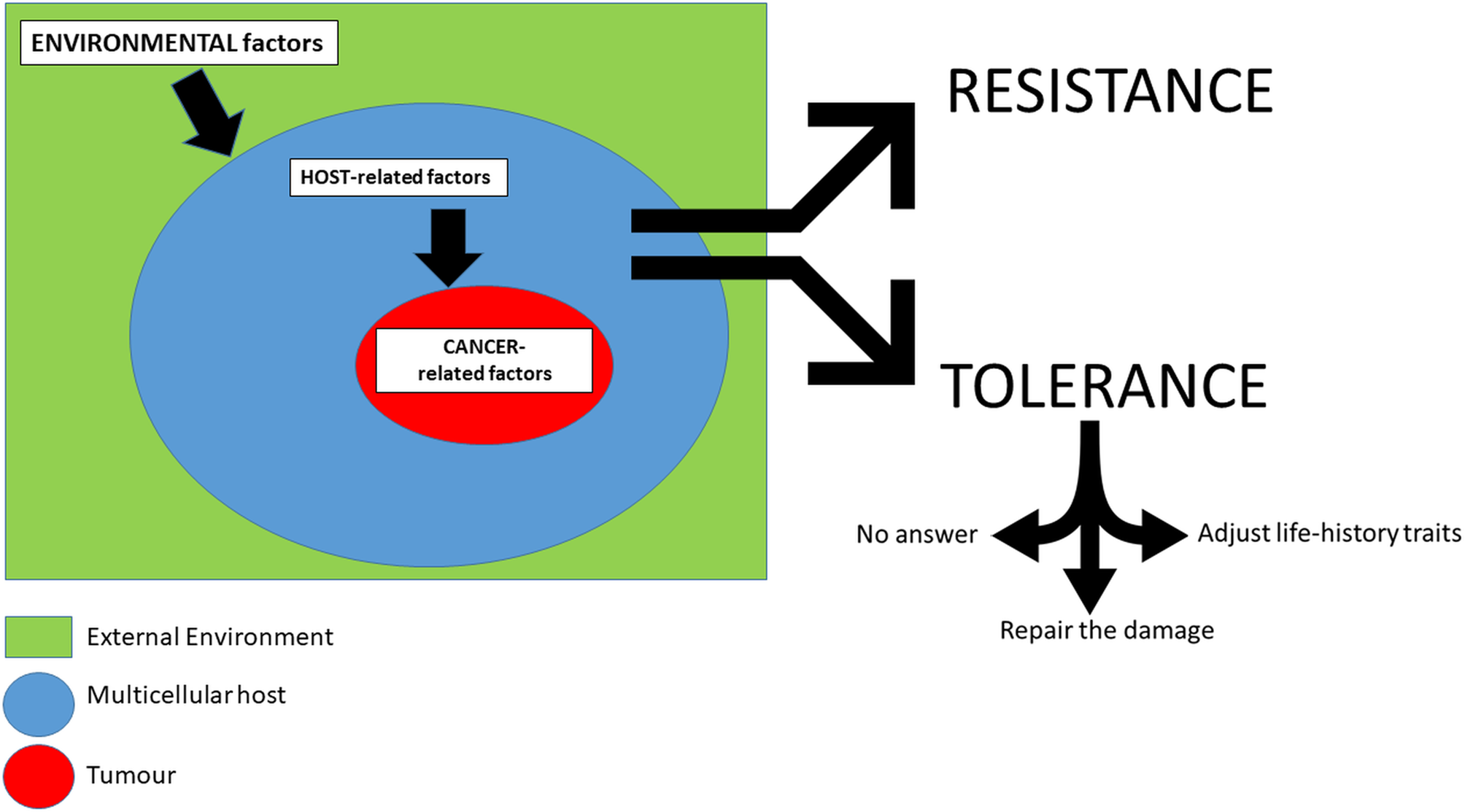
The fact that certain individuals tolerate the presence of tumours better than others in Darwinian terms might be mediated through several mechanisms (Fig. 1). All things being equal, a first explanation could be simply related to the probability of metastasis. Cancer is usually not detrimental/lethal until it metastasizes. The distribution pattern of metastatic cancer will undoubtedly influence disease trajectory (i.e. how well the cancer is tolerated). In this regard, various factors such as tissue of origin, oncogenic driver mutations as well as anatomical features (e.g. proximity to lymphatic vessels) may impact the ability of cancer to disperse and to establish metastatic niches in other tissues/organs (Obenauf and Massagué, Reference Obenauf and Massagué2015). Since metastasis is partially a stochastic process, and due to the variance in the dissemination pattern of metastatic cancer cells, disease trajectories can vary. Individuals may exhibit differences in their ability to tolerate cancer simply based on the chance distribution of metastatic cancer cells to vital organs (van Niekerk et al., Reference van Niekerk, Loos, Nell and Engelbrecht2016).
Factors influencing the balance of resistance/tolerance to cancer. Environmental factors: Level of resources, competition, predation, impact of parasites and ecological stochasticity. Host related factors: 1. Fixed traits: ecological status, gender etc. 2. Variable traits: age, size, energy reserves. Cancer related factors: 1. Cancer traits (proliferation rate, invasiveness, ‘bad luck’/metastasis). 2. Affected organ (key and accessory organs).

The co-evolutionary nature of host-tumour interactions in the context of transmissible cancers, in contrast to non-transmissible ones, is theoretically expected to interfere with the evolution of tolerance responses. The coevolutionary arms races between hosts and classical parasites are indeed likely to favour adaptations of parasites that lead to tolerance as opposed to resistance, because the selection pressure on the parasite to overcome tolerance is not as great as it is to overcome resistance. Therefore, the potential for the evolutionary arms race and hence for the evolution of parasite driven (i.e., cancer cell-driven) tolerance mechanisms may appear restricted for non-transmissible cancers. The reason why it seems paradoxically not to be the case suggests that the evolution of tolerance is mostly host-driven, and/or that it occurs mostly in the case of those cancers for which tolerant responses from the hosts will be efficient at limiting the fitness costs due to malignant progression (i.e. resistance vs. tolerance is adjusted by the host in a plastic way depending on cancer types).
Here, we also propose three additional non-exclusive strategies. First, individuals might not develop any answer in response to the emergence of neoplasia if the cost is too high. A second option might favour the repair of the damage caused by the tumour to keep the body functioning. Finally, with the last strategy, individuals affected by cancer might adjust their life-history strategy (by breeding at a younger age or by investing more in reproduction) to compensate for a potential decrease of fitness caused by the development of neoplasia. Both transmissible and non-transmissible cancers may trigger the evolution of these host responses.
The first option should mostly occur in species having fast life-history traits, and also when cancer resistance is costly and/or when cancer progression is slow. In these situations, due to the high costs associated with the activation of both innate and adaptive immune responses, it might be a priori more profitable in Darwinian terms to do nothing against the malignant progression. This strategy should often be associated with the reallocation of resources to reproduction and thus an adjustment of life-history traits (see below for examples). Under the second option, similar to host-parasite interactions, host responses could manifest in repairing the damage caused by malignant cells, thus tolerating the cancer while maintaining the functioning of the body. Mechanisms related to the detoxification of host-derived and tumour-produced toxic compounds would also fall under the umbrella of this strategy. This second scenario is likely to occur in species displaying slow life history traits and when tumours grow slowly. Among the possible evidence of the second option, meningioma is a kind of brain malignancies that mostly grows on the surface of the brain, pushing it away instead of growing from within. Meningiomas are slow-growing tumours with low potential to spread, and evidence suggests that the brain is capable of adjusting to their presence, up to the time point when further adaptation is not possible anymore (Jurić et al., Reference Jurić, Jančuljak, Tomić and Štimac2013). In this case, brain plasticity includes adaptation and autoregulation of the circulation, thus ensuring stable blood flow. As a consequence, meningiomas may grow quite large before they cause symptoms (d’Avella et al., Reference d'Avella, Salpietro, Alafaci and Tomasello1999; Tuna et al., Reference Tuna, Grocer, Gezercan, Vural, Ildan, Haciyakupoglu and Karadayi1999; Pawełczyk et al., Reference Pawełczyk, Łojek, Rabe-Jabłotiska, Pawełczyk, Godlewski and Radek2012; Mumoli et al., Reference Mumoli, Pulerà, Vitale and Camaiti2013). Additional examples of giant tumours also exist (e.g. esophagus and cardia (Tsuzuki et al., Reference Tsuzuki, Kakegawa, Arimori, Ueda, Watanabe, Okamoto and Akakura1971)), potentially implying tissue adaptability to keep the body functional.
The last option to mediate a tolerant strategy in response to cancer development is the potential adjustment of life-history traits. An abundant literature on host-parasite relationships has now shown that life-history traits in host species can undergo plastic responses to parasitism to compensate for the negative costs exerted by parasites on host fitness (Wieczorek et al., Reference Wieczorek, Asemissen, Model, Turbachova, Floess, Liebenberg, Baron, Stauch, Kotsch and Pratschke2009, Becker et al., Reference Becker, Andersen, Schrama and Straten2013). Parasitized individuals may, for instance, increase their reproductive activities before dying or being castrated by parasites (Minchella and Loverde, Reference Minchella and Loverde1981; Sorci et al., Reference Sorci, Clobert and Michalakis1996; Polak and Starmer, Reference Polak and Starmer1998; Adamo, Reference Adamo1999). If they are unable to resist infection by other means (e.g. inducible defences, immunological resistance, long-distance migration etc.) selection should indeed favour life-history adjustments if they partly compensate the parasite-induced losses by reproducing earlier (Forbes, Reference Forbes1993). Among recent examples, Vézilier et al. (Reference Vézilier, Nicot, Gandon and Rivero2015) demonstrated that female mosquitoes, when parasitized by Plasmodium falciparum, compensate their reduced lifespan and loss of fecundity by beginning to lay their eggs two days earlier. In the context of cancer, there is little evidence of such adjustments, at the individual or population levels. For instance, Arnal et al. (Reference Arnal, Jacqueline, Ujvari, Leger, Moreno, Faugere, Tasiemski, Boidin-Wichlacz, Misse and Renaud2017) found that females in Drosophila harbouring early stages of a gut cancer reach the peak of oviposition earlier than healthy females, before dying sooner too. Another example of altered life-history strategies in response to exposure to cancer involves the Tasmanian devils (Sarcophilus harrisii) and their transmissible cancer, the DFTD. Following the appearance of this cancer, the vast majority of females only survive to produce one litter (Jones et al., Reference Jones, Cockburn, Hamede, Hawkins, Hesterman, Lachish, Mann, McCallum and Pemberton2008), but precocial breeding by one-year-old females has been observed at several study sites. Thus, although we cannot exclude that it simply results from a reduced competition for resources, devil populations may have responded to the cancer-induced mortality by rapidly transitioning from an iteroparous (multiple reproductive cycles) to a semelparous (single breeding) reproductive strategy (Jones et al., Reference Jones, Cockburn, Hamede, Hawkins, Hesterman, Lachish, Mann, McCallum and Pemberton2008). In humans, BRCA1 and BRCA2 mutations are inherited and predispose women to breast and ovarian cancer, but even though carriers of these mutations have reduced survival, they also have enhanced fertility (Easton et al., Reference Easton, Ford and Bishop1995; Smith et al., Reference Smith, Hanson, Mineau and Buys2011). While this result may indicate antagonistic pleiotropy (i.e. when one gene controls more than one trait, at least one of these traits is beneficial to the organism's fitness and at least one is detrimental to fitness), it is also compatible with the hypothesis of adaptive adjustments of life history traits in individuals harbouring inherited oncogenic mutations (Arnal et al., Reference Arnal, Tissot, Ujvari, Nunney, Solary, Laplane, Bonhomme, Vittecoq, Tasiemski and Renaud2016).
Ecological and evolutionary implications of tolerance to cancer
Transmissible cancers can interfere with the evolution of host resistance. For instance, in Tasmanian devils, the probability of achieving earlier maturity (either due to decreased competition resulting in increased resource availability, or due to direct selection for precocial breeding) may have delayed the evolution of resistance to DFTD, by permitting the transmission of genes of DFTD sensitive individuals to the next generation. In addition, the lack of development of resistance to DFTD across populations continues to facilitate the spread of this transmissible cancer. Since Tasmanian devils need to reach a critical body mass to become sexually mature, and hence Tasmanian devils cannot breed at an age younger than one year, it could be expected that their populations are now at the critical point when selection will favour resistance to this cancer. Similarly, when cancer is not-transmissible but is due to inherited oncogenic mutations, the adjustments of life history traits can also prevent natural selection from purging bad genes in the population. In the human example previously mentioned, the higher fertility of women bearing BRCA1 and BRCA2 is likely to favour the transmission of these oncogenic mutations to the next generations. This suggests that the existence of life-history trait adjustments could influence the persistence of oncogenic mutations in certain populations (Arnal et al., Reference Arnal, Tissot, Ujvari, Nunney, Solary, Laplane, Bonhomme, Vittecoq, Tasiemski and Renaud2016).
Wildlife species are currently exposed to an increasing number of mutagenic substances and environmental conditions resulting from human activity (i.e. chemical pollutants, light pollution, non-natural food etc.), and hence cancer rates are likely to increase in many species (Giraudeau et al., Reference Giraudeau, Sepp, Ujvari, Ewald and Thomas2018). However, at the moment it is unclear whether animals affected by malignant growths will respond by adapting resistance or tolerance strategies, and whether one can predict these responses (for example by comparing their life history traits, or their level of exposure to malignant transformations). In any case, animals naturally or artificially exposed to environmental oncogenic factors might, sometimes rapidly, evolve specific adaptations to cope with pollutants and their adverse effects on fitness (Vittecoq et al., Reference Vittecoq, Giraudeau, Sepp, Marcogliese, Klaassen, Renaud, Ujvari and Thomas2018). Studying these species could be important in identifying when and why tolerance will be the favoured option by selection.
Medical and societal implications of tolerance to cancer
Similarly to therapeutic approaches that aim to prevent malignant progression, natural tumour suppressor responses will likely favour the evolution of mechanisms allowing cancer cells to circumvent them (i.e. the mutual antagonism between hosts and malignant cells can generate strong natural selection), while solutions that do not prevent progression do not trigger this selection. Similar to host-parasite systems, tolerance or resistance is therefore expected to influence the evolutionary trajectory of oncogenesis in radically different directions. Even when the proliferation rate looks similar (e.g. a lower level of resistance after the reproductive period can result in the same proliferation rate than under a tolerance scenario), the tumours will be qualitatively different. From a medical perspective this is important to consider because when cancer is diagnosed, the tumours have often already been present for years, and have been exposed to and have responded to our natural immune and tumour-suppressor responses. If they respond differently to therapies, knowing which scenario shaped the tumour development prior to detection is important for the prediction of treatment outcomes.
A good example of the crucial role of these strategies (i.e. tolerance vs resistance) on neoplasia development and aggressiveness is the fact that both these strategies can theoretically impact the level of intratumoural heterogeneity, an important clinical determinant of patient outcomes. Intratumoural heterogeneity can be the underlying factor of incomplete treatment responses, acquired and/or innate resistance and disease relapse in response to chemotherapy and targeted agents (Maley, Reference Maley2007; Meacham and Morrison, Reference Meacham and Morrison2013; Mengelbier et al., Reference Mengelbier, Karlsson, Lindgren, Valind, Lilljebjörn, Jansson, Bexell, Braekeveldt, Ameur and Jonson2015; Pribluda et al., Reference Pribluda, Cecile and Jackson2015; Roerink et al., Reference Roerink, Sasaki, Lee-Six, Young, Alexandrov, Behjati, Mitchell, Grossmann, Lightfoot and Egan2018). Giraudeau et al. (Reference Giraudeau, Sepp, Ujvari, Renaud, Tasiemski, Roche, Capp and Thomas2019) recently proposed that some organs might have developed stronger immune defences than others with a better ability to counteract the emergence and development of neoplasia, leading to higher levels of intratumoural heterogeneity. In other words, only aggressive neoplasms with higher levels of intratumoural heterogeneity should succeed in emerging and developing in organs strongly protected by immune defences. In this context, we can thus predict that a resistant strategy at the individual or at the organ level would select for aggressive tumours with high levels of intratumoural heterogeneity, while a tolerant strategy would lead to the faster development of less aggressive tumours.
More research is needed to understand when and why, resistance, partial resistance (e.g. natural adaptive therapy) and/or tolerance are the options retained by multicellular organisms during their lifetime. We also need to better understand their consequences for individuals reaching the end of the reproductive period. Indeed, although these options can sometimes be equivalent from an evolutionary perspective, they can have a dramatic impact on current treatment approaches and life aspirations that prioritize maximizing survival, rather than fitness. Because of a mismatch between what evolution would have selected for and personal life expectations of individuals, it is therefore important to identify the strategies a given organism follows to deal with malignancies. Therapies could be developed to mimic and/or enhance these natural defence approaches (being selection or tolerance) to enhance organismal survival.
Acknowledgement
This work is supported by an ARC Linkage (LP170101105), ARC DE170101116, Deakin SEBE_RGS_2019, an ANR TRANSCAN (ANR-18-CE35-0009), the Rotary Club Les Sables d'Olonne and a CNRS ‘International Associated Laboratory Grant'.