During 2008 and 2009 I worked as a classroom teacher at a primary school in an Aboriginal community in Queensland. In previous settings I had experienced success in engaging challenging students through hands-on projects connected with restoration of damaged ecosystems, and looked towards the possibilities of using such an approach with Indigenous learners. I undertook to complete a research project on the topic as part of a Master of Environmental Education. An exploratory investigation in the qualitative tradition, the research involved interviews with experienced educators of Indigenous learners, (both Indigenous and non-Indigenous), Indigenous learners and community members. This article focuses on the local situation, to what extent the existing literature was applicable to it, and tries to give some sense of the demanding personal journey it entailed. Some anecdotes are included to illustrate aspects of interactions between theory and practice as I investigated literature on Indigenous education, interviewed experienced educators, and worked day to day as a teacher of Indigenous students in an Aboriginal community.
Out of the Comfort Zone
My first term was difficult and confronting. Children expressed their resistance through a range of behaviours, especially ridicule, disruption, walking out and what Folds (Reference Folds1987 p. 41) calls the ‘wall of silence’, whereby they refuse to participate in lessons. With most of my class displaying the full range of ‘resistance behaviours’ (Partington, Reference Partington1997), and the school administration in denial, I found myself in a situation that pushed me to the verge of walking out by Easter of the first year.
The grim reality of life in the school was that many students were well behind standard expectations, although political expediency made it difficult to say so. White and Wood (Reference White and Wood2009) report that, for Indigenous students, ‘despite educational policies and practices at Federal and State levels accompanied by substantial funding, educational outcomes have not greatly improved in recent years’ (p. 4). In my own class, only three of the children displayed literacy and numeracy skills comparable with their peers in non-Indigenous schools where I had taught for the previous decade. Other symptoms of social dysfunction impacted on school attendance and performance, including lack of regular nutritious food, crowded unsettled households where sleep patterns were disrupted, and a town environment where loud, noisy and very public arguments were commonplace. At times these erupted into brawls that were regarded as entertainment by the children, who would swarm out of class to watch. They sometimes boiled over into secondary disputes where family members at school would take up the cudgels on a relative's behalf.
In light of the difficulties I was experiencing, it soon became of paramount importance to gain what I could through reading first-hand accounts of people in similar situations. My literature review became survival text! Fortunately for me, at Easter a friend gave me an orange and green book he had found at a library sale for 20 cents. From the day it was given to me, Gary Partington's Perspectives in Aboriginal and Torres Strait Islander Education became my reference manual. At night, away from my home and family, it became my companion. With relief, I found I was not alone. In Chapter 9, contributor Geoff Munns (Reference Munns and Partington1998) notes that: ‘Teachers, in recalling their first days in [Aboriginal] schools invariably tell of difficult periods of initiation, during which ideas and practices are constantly re-assessed’ (p. 172).
I made it my first project to implement Munns’ suggestion that this period of initiation might productively be devoted to establishing positive classroom relationships and reassessing classroom practices (Munns, Reference Munns and Partington1998, p. 173). Reassessing my classroom practices meant abandoning the parts of the daily routine that triggered the most violent opposition. For example, mathematics texts were replaced by small group rotations of mathematics games. Establishing positive relationships entailed outreach beyond the classroom. One of the keys to defusing resistance behaviour lay in my gaining acceptance by students’ extended family members, and in this regard grandmothers seemed to have special clout. Small gestures such as home visits when children were sick started this process. A potted basil plant improved relationships with one gardening granny. Among early indications about how to bring out the best in my class was the day when, at the invitation of a colleague at a nearby school, we set off to see their permaculture gardens and share a school-grown and -cooked meal. I set off with some trepidation and, to his shame, held one young person's hand firmly as we exited the bus. As the day went on, I gradually let go and the students held chooks (gently), harvested vegetables, watered the gardens and very successfully interacted with the students from the other school.
Not Taking It Personally
Historically, a resistance ethic on the part of Aboriginal people has developed for cultural survival in contexts openly hostile to expressions of traditional culture, including the speaking of Australian languages, which occurred in many schools. Rigney (Reference Rigney1997) points out ‘the cultural assumptions throughout dominant epistemologies in Australia are oblivious of Indigenous traditions and concerns’ (p. 11). Harris and Malin (Reference Harris and Malin1994) point out that dissonance between the perceived values of school and community can negatively impact on children's engagement and achievement.
In his research into resistance behaviour on schools on Pitjantjatjara lands, Folds (Reference Folds1987) found that ‘values of sharing, of cooperation, of reliance on people rather than money, of using and employing rather than hoarding and storing, were replaced in the classroom by the middle-class values of the technological, acquisitive world of the walypala’ (p. 10). He argues that when schools’ values do not match those of the community, they accelerate the destruction of culture. This led me to an examination of the pedagogical discourses underlying the education of Indigenous learners. Assimilationist discourses in education contain assumptions that the dominant culture is superior and that through education, Indigenous children should lose their ‘difference’ (Norris, Reference Norris2006, p. 137). I had to accept that, as agents of the dominant culture, teachers are initially regarded with suspicion, and resigned myself to the knowledge that it would take time to build trust.
The challenge repositioned itself into finding an avenue of engagement for these learners that did not accelerate the loss of their remaining culture and values. I began to develop an hypothesis that Education of Sustainability might successfully be adapted to this purpose.
Education for Sustainability
Education for Sustainability (EfS) grew from the tradition of environmental education, characterised by concerns with preserving the viability of the earth's natural systems and instilling in learners both knowledge of natural science and an appreciation of the wonders of the natural world. In addition to this aspect, which draws on more traditional environmental education, Lucy Sauve points out:
EfS evolved to counter a certain conception that the natural sciences strand of environmental education was focusing too narrowly on the protection of natural environments (for their ecological, economic or aesthetic values), without taking into account the needs and rights of human populations associated with these same environments, as an integral part of the ecosystem. (1996 p. 8)
Concerns over inequity and injustices for Third World and Indigenous populations contributed to the positioning of EfS firmly in the realm of social justice and the social sciences. Tilbury (Reference Tilbury1995 p. 199) sees EfS principles operating within an ethical and values-based framework, using issue-based learning and employing an activist orientation. This suggests use of empowering pedagogical strategies including cooperative learning, hands-on activities and a practical, real-world orientation. Michael Christie, who worked with Traditional Indigenous people in Yolgnu lands, documented a delightful example of working with elders to provide an integrated curriculum around the culturally-significant cycad plant. He reports that during his years teaching in Arnhem land, the most fundamental principle the elders taught him is that “subject matter is to be examined and interpreted only as it is found embedded in its context.”
In a school workshop centering on the cycad plant the students were actually taken to stay for a week in a place which is of major totemic significance in the production of cycad bread. The actual examination and identification of the palm and its fruits was almost identical to stories and demonstrations of its use as a food, the complex preparation process, its ceremonial uses, the traditional accounts of its use in purification rituals, its manifestation in sacred clan designs and songs, its kin affiliations to the various clans represented at the workshop, and old people's childhood experiences involving the cycad bread. (Christie Reference Christie1991 pp. 29-30)
Christie's (Reference Christie1991) analysis shows how profoundly Indigenous scientists anticipated the ‘holism’ of EfS with their seamless blend of spiritual, ecological, economic and political knowledge, the sustainable lifestyle this produced, and their immensely successful pedagogical techniques for passing these on.
Rather than simply focusing on curriculum content, EfS implies a participatory approach based on equity, sharing, listening, reflection, co-learning, negotiation, ‘critical’ thinking, cooperation, collaboration, and futures-orientation (Tilbury, Coleman, & Garlick Reference Tilbury, Coleman and Garlick2005). EfS principles include operating within an ethical and values-based framework, using issue-based learning and employing an activist orientation (Tilbury, Reference Tilbury1995, p. 199). The principles of EfS suggest particular pedagogical strategies, including cooperative learning, hands-on activities and a practical, real-world orientation, all of which seemed to suit my young learners. However, such pedagogical approaches offer many challenges to our current educational settings. Ferreira, Ryan, and Tilbury (Reference Ferreira, Ryan and Tilbury2006) find that many teachers do not have the skills to deal with management or pedagogical challenges posed by sustainable schooling.
Teachers in Australian schools tend to be inadequately prepared for the challenges of participatory pedagogy, interdisciplinarity, action learning and critical thinking that are commensurate with whole-school approaches. (Ferreira et al., Reference Ferreira, Ryan and Tilbury2006p. 17)
Values Synthesis: Critical Pedagogy of Place
Our word ‘home’, warm and suggestive though it be, does not match the Aboriginal word that may mean ‘camp’, ‘hearth’, ‘country’, ‘everlasting home’, ‘totem place’, ‘life source’, ‘spirit centre’, and much else. (WEH Stanner 1968, quoted in Huggins, Reference Huggins2006)
Abundant evidence exists in history and folklore of the special relationship between Australian Aboriginal people and their place of origin. Copland, Richards, Walker, and Zucker (Reference Copland, Richards, Walker and Zucker2006, p. 81) quote the heart-rending pleas of survivors of the early 20th century land wars in Western Queensland to be allowed to stay and die on their ‘dear tauri’ (home lands) rather than be relocated to Cherbourg. Marker (Reference Marker2006, p. 491) notes that Aboriginal pedagogies are intensely ecological and place-based, being drawn from the living landscape within a framework of profound ancestral and personal relationships with place. Indigenous people's highly developed sense of place contains detailed ecological knowledge embedded in an overarching emotional connection to ‘country’ (Huggins, Reference Huggins2006).
Grunewald's formulation of a critical pedagogy of place respects ‘rootedness in particular landscapes’ and combines it with a transformative, or socially critical educational discourse.
A critical pedagogy of place challenges all educators to reflect on the relationship between the kind of education they pursue and the kind of places we inhabit and leave behind for future generations. (Grunewald, Reference Grunewald2003, p. 3)
Marker (Reference Marker2006) points out: ‘Conceptualising a place-based education grounded in the ethical and epistemological understandings of Indigenous Knowledge represents a deep challenge to the mainstream values and goals of schooling’ (p. 483), and the depth of that challenge became increasingly manifest as my first year in the school progressed.
Issues of Egalitarianism, Autonomy and Peer Bonds
Equality of Status
I was initially confused by the way my students would at times be very affectionate and physically demonstrative, but when any schoolwork deemed challenging was expected, their affection and familiarity soon turned to outbursts and walk-outs. In a study by Partington, which examined the experiences of 19 student teachers in Aboriginal schools, some of the student teachers were charmed by the children's willingness to ‘climb all over them’. However, many were taken aback when the mood changed: rather than evidence of affection, the author warned that physical familiarity ‘reflected the equality they perceived: rather than regarding the student teachers as of higher status and therefore to be respected, the children considered them to be of equal status’. He concludes that Indigenous children have a more egalitarian attitude to teachers and that respect and trust are not automatically given (Partington, Reference Partington1997, p. 57).
Regarding the importance of positive relationships with their teachers, Munns warns that pedagogical relationships must be distinguished at times from the personal:
If the personal and pedagogical relationships are not in the right balance, there is a danger that in the face of persistent opposition teachers will compromise the curriculum, offer easier work and provide unproductive ‘help’ to allow students to ‘survive’ and get through school (Munns, Reference Munns and Partington1998, p. 184).
I began to understand why my (mostly younger) colleagues offered me advice about keeping lollies handy and had the colouring-in sheets ready when things turned nasty. All manner of extrinsic rewards had become expected at the school over the years, based on behaviourist theories and practices of previous regimes. Having high expectations sounded good in theory, but was not so easy in practice as I strove to be caring without ‘lowering the bar’.
Personal Autonomy
The refusal to be controlled is consistent with reports by various authors of the relative independence of Aboriginal children (Harris, Reference Harris1990; Malin, Reference Malin, Harris and Malin1994), which they regard as a continuation of traditional autonomy of the individual in traditional society. Harrison (Reference Harrison2008, p. 104) describes the contrast for such an Indigenous child who comes from an independent environment at home and is reluctant to seek approval from the teacher to do things like speak out, get up from their seat, or go to the toilet. Different child-rearing practices and social mores also meant that my students were forthright in their speech and certainly quick to let me know when things were ‘boring’.
Peer Bonds
Another fact of life which necessitated changes in my classroom practice was the strong peer bonds between students (Cronin, Sarra, & Yelland, Reference Cronin, Sarra and Yelland2002). This manifested in resistance to competitive ranking, and I had to rethink my expectations for individualistic behaviour. Pressure on individuals to answer when they had not been paying attention was always undermined by whispered answers from other class members. More capable students could not be dissuaded from telling answers, to save classmates from embarrassment through being put in an uncomfortable position of individual scrutiny, which they called ‘shame’. As I strove to turn these characteristics into positives, I became even more interested in finding out how others had achieved it. When I began my interview process, this was a topic I put to my informants. Participant MB31 advised:
If you can, foster group work, but within the group, the group doesn't succeed unless everyone in the group succeeds. And I use groups in all work from primary to tertiary. Use peers to help strugglers, frees you up to do targeted work. It follows cultural rules, family relationships.
The Process
In seeking inputs from students’ extended families, I felt constrained by limited opportunities for authentic interaction with community members. Again, following suggestions from my orange and green handbook, I set about taking opportunities for interaction. In view of the space limitations, I will outline my methodology briefly. After gaining ethical clearance, a local Council meeting was the occasion when I strove to explain the project to local councillors and the Mayor. After about seven PowerPoint slides, several councillors displayed a strong grasp of the compatibility of EfS with traditional ecological values, particularly management of limited resources. Some councillors also suggested extension ideas about other places where such educational innovations might be tried, such as the local Juvenile Detention Centre. In a cross-cultural situation, New Zealand Maori theorist Linda Tuhiwai Smith describes such research as insider/outsider research, where the researcher acknowledges difference, but does not try to assume the role of an outsider who can observe objectively. Smith states, “Indigenous research approaches problematise the insider model in different ways because there are multiple ways of both being an insider and an outside in Indigenous contexts” (1999 p. 137).
The local radio station was warmly cooperative and advertised meeting times, which was especially helpful as some community members had limited reading skills. These did improve on numbers attending two of the focus groups. Where conversations with families revealed relevant attitudes and perceptions about education and what worked with their children, I tried to note down the conversation at the first opportunity. Those who demonstrated interest in, and understanding of, the project included health workers, elders, educators, as well as FM radio station staff and local authorities, as already mentioned. Parents also gave permission for selected students to be interviewed.
Inputs were sought from other settings. Educational institutions were approached, personal contacts followed up, questionnaires circulated and Indigenous Studies Units in Australian universities contacted. Although I quote from some relevant interviews, this article focuses upon the impacts of reading and research on the lived experience in my own setting. In all, of 75 people who had input into the research, about one third identified as Indigenous and of these, most were associated with the school community as educators, students or family members.
Meeting Halfway
Among the early responses to my questionnaires a participant who reported no issues with ‘resistance behaviour’ piqued my interest. DW20, who had worked with ranger groups in the Top End, attributed his students’ cooperation in part to his willingness to learn to speak Yolgnu language. He felt that his learners perceived him as meeting them halfway, using the phrase bala ga lili, roughly meaning ‘giving and taking’. Later in a face-to-face interview in Darwin, DW20 elaborated further about two-way learning obligations. By expressing a desire to learn the Yolgnu language, he opened the way for his ‘students’ to teach him. This satisfied his learners’ cultural protocols, opening the way for them to accept his knowledge on an equal basis.
Taking on what I'd been learning from Yolgnu studies here at CDU, they have a very big focus on the pedagogical model of education as a two-way process. The pedagogical model which evolved in Europe and in China is not one which is shared by these Indigenous people, especially people who are on their own land and speaking their own language. (DW20)
The possibility that taking an approach based on EfS represented such a halfway point gained strength in my mind as I found that, against all odds, people still care so deeply for Country. Readings had made it clear that Indigenous thinkers had posited the idea of a schooling system that respected both cultures. In 1976, Gurindji elder Pincher Nyurrmiyarri, proposed a ‘both-ways’ schooling model. He described the Dagaragu school as a ‘one-way school’ — that is, ‘only kartiya (European way)’ and gave the alternative as a ‘two-way’ school — ‘both kartiya way and ngumpit [Aboriginal[way’ (Ober & Bat, 2006, p. 73). Key elements of both-ways thinking point towards the repositioning of feeling for place at the centre of educational practice (Yunkaporta & McGinty, Reference Yunkaporta and McGinty2007). EfS seemed to hold the potential to include primacy of place, with its emphasis on local, meaningful real-world projects.
Community Concern with Environmental Issues
Although the particular community is popularly regarded as having lost much tradition, culture and language, during my time there adults communicated concerns about at least three environmental issues. Informant JS49 related that before the state government handed their claim over to the Indigenous residents in 1986, the community's citrus orchards, vegetable gardens, workshops and other employment and self-sufficiency facilities were bulldozed. This is seen by older residents as depriving people of fresh local food and the means to provide it, undermining their self-sufficiency and contributing to the loss of skills and widespread consumption of fast foods in the younger generation.
Another historically emotive issue that still impacts on the community today is water quality. Community elders predicted problems several decades previously when the state government undertook construction of a large storage dam on the local creek. Interviews with elders from the period note their opposition to the project (Conlon, personal communication). Informant ER56 commented that elders predicted that if the dam was constructed, custodians responsible for water would die. For two decades, the massive impoundment rarely overflowed, depriving the creek of flushing flows and leading to water quality issues including blue-green algae outbreaks in the creek where local kids love to swim. Informant AC44, who was born on the community and spent her early childhood there, recalled the different character of the creek banks before the upstream impoundment: ‘We used to all go and swim there as kids. We used to call it the bralbin. There was a little sandy beach there in those days . . .’.
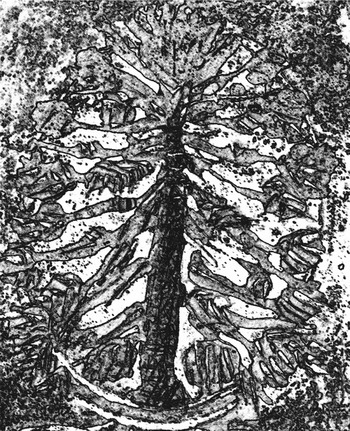
One morning on my way to work during 2009, I saw a hand-lettered banner draped over the war memorial, with the red words ‘Save our Bunya Trees’. When I arrived at school an aide demanded to borrow my camera and ran off to document what was happening. This issue concerned the felling of some mature local food trees that were regarded as dangerously close to the helipad which airlifts emergency patients to a large regional hospital. Community opposition stalled the process for 6 months. Finally, an agreement was reached with senior women whereby the Aboriginal Council undertook to plant a ‘Bunya Grove’ to replace the felled trees.
Bunya tree (Zela Bissett, digitally altered photograph of relief sculpture)

School units developed around replacing lost food forests or improving water quality would, I believe, have enjoyed widespread community support. School units developed around regional food self-sufficiency, replacing lost Bunya forests or improving water quality would, I believe, have enjoyed widespread community support.
Vignettes and Small Victories
The following anecdotes reflect significant shifts in my own thinking and attitudes that I believe allowed me to create a bicultural ground on which I could meet my learners, who also became my teachers. By mid-year, after seeing my class shine at an outdoor education camp, I began to appreciate that my academically ‘deficient’ children possessed other remarkable capacities. Informant MM23 described a parallel experience:
I moved to an environmental education centre. It was a bush setting, and we had mangroves and coral reefs close by. It was there that I saw how the Aboriginal kids changed in that natural setting. They really felt at home and became the leaders, the knowers, even the teachers! They had the knowledge of what was around them that the white kids didn't. That put things in quite a different perspective and that's when I became really interested in traditional knowledge.
Excellence in what we now term ‘sport’ demands exceptional capacities in athleticism, endurance and spatial orientation. These qualities appear to have been cultivated by traditional pedagogies and were demanded by adulthood rituals, especially for males. Persistence of this inclination and capacity are obvious today. Currently, several young men from the community are successfully playing football for major national clubs. Historically, it boasts many great athletes, including cricketers, footballers and the first Indigenous man to win a Commonwealth Games gold medal. Tying in learning mathematics with this area of strength through throwing games represented my first success in meeting my learners halfway. The games, modelled on traditional games following the research of Edwards (Reference Edwards2008), were so popular that truants from other classes would line up to play.
On home visits, I was walking from one child's home to another family's house around the corner. A number of children from the first house joined me, including a toddler wearing only a nappy. After the visit was over and we were returning to the first house, I noticed that the toddler was no longer with us. When I asked where the little one was, one of the older children replied, ‘Oh, she'll go home over the back fence.’ No further supervision or checking was regarded as necessary. Frigo (Reference Frigo1999) suggests that Indigenous parents may cultivate children's ability to orient themselves and find significant places:
. . . some Aboriginal parents viewed their children's spatial ability as a measure of intelligence in the same way that Anglo-Australian parents valued their children's ability to count as an indication of intelligence. (p. 9)
By the middle of the second year, I recognised the event as indicative of both the relative autonomy of young children and the development of strong spatial orientation, rather than parental neglect.
Another afternoon, after class I walked with some of my students across town to a large indoor sports complex. After playing around for a little while on the basketball court, one of the boys said he wanted to show me the waterhole. This initially sounded like a professionally unwise idea, and I regretfully declined. However, during the last swelteringly hot weeks of the year, I agreed that we would have our break-up party at the waterhole. The Phys Ed teacher was asked to come along to provide lifesaving skills. Our group arrived at morning tea time to find the other half of the class already there, splashing and soaking, with many younger siblings in tow. As we stood in the cool shade cutting up a watermelon, the Phys Ed teacher, who had been at the school for a decade, declared: ‘I had no idea this place was here!’ I thereafter cherished a hope that willingness to share such a special place constituted a sign of acceptance by the children.
Another outdoor pastime on the community is night walking. In the evenings, whole family groups set out. Grandmothers accompanied by older children, often pushing a baby in a stroller, walk for extended periods along the township roads with no apparent destination. Groups of six to twelve same-sex groups of young people also walk, although their progress is sometimes punctuated by stopping to ‘taunt’ each other. Conversations around the topic gave me no indication of its purpose, although the teaching of knowledge of the night sky has been suggested.
Literacies of Print and Country
Examples have been provided which demonstrate community concern over issues of ecological integrity. This in turn suggests that educational projects about engaging students in real-world projects designed to alleviate problems of water quality and/or restore food security would enjoy high levels of community endorsement and approval. Input from research participants suggests that if EfS can build from Indigenous people's strong traditional ties with their homelands, some of the chronic sadness and grief that underlie many areas of social dysfunction (Sanderson Reference Sanderson2007) can be alleviated. Healing aspects of disturbed people being reunited with country were recounted by several informants, including this participant from Western Australia:
It was the first time these multi-generational groups had ever been out on country together. Some of the elders hadn't been on country for up to 50 years! Some people spoke four languages and had never been to country. And then you had family groups who had never walked and talked together as a unit on country before. I felt that people walked taller, felt prouder. They had a real sense of identity when they were on country and were able to connect with it. (HWS21)
During my last months at the school I was occupied with analysing the research data I had collected. My school situation did not permit a trial of the kind of EfS project I had envisaged, so I had to examine qualitative data collected in face-to face interviews, conversations and questionnaires along with my lived experience. Significant themes recurred. Educators’ own appraisals of what had ‘worked’ to engage their learners (and produce what they regarded as significant learning outcomes) revealed that many had used environmentally oriented projects. A high proportion of students also mentioned outdoor pursuits as enjoyable and memorable. Popular projects also used, and often integrated, music, performance, visual art and digital technologies, including film-making.
One aspect of the findings seems significant both at my specific site and across other settings. Category 5 of the analysis concerned the use of relevant instructional materials. Cataldi and Partington (Reference Cataldi, Partington and Partington1998) recount statistically documented reading improvement in a Central Australian Aboriginal school when reading materials were overhauled to feature stories of familiar activities and places. A special subcategory, ‘Drawing on Local Environmental Content’, emerged as one of the most worthwhile aspects of the study. The most compelling examples of literature that Indigenous learners found engaging display a combination of paying homage to significant places through traditional story-writing and rendering the content in written form, creating a connection between literacy and place.
I was fortunate to participate in the creation of such a book, which began with a trip to the waterhole with a local story-teller who told the children about an experience she had there with a mysterious water creature. Working from recall, prompts and photographs, the children were supported to reconstruct the story in written form. The story was broken into page-length instalments (story-boarding), and children created the illustrations. This story formed the basis of the class's end-of-year presentation, with all students showing high levels of motivation to be able to read ‘their’ page, the text of which was projected up behind the stage for the audience. Many participants reported similar experiences. MB31 reported from the Alice Springs area that making culturally appropriate resources during 1995–1996 using early computer technology was ‘the biggest grounding I had in the right ways of doing things’. JH18 recounts using this method on Elcho Island:
With the help of elders we would find what animals and birds were in the woodlands. I would write that up while community people were talking and then I would take that back to the elders. If it was approved it would go to the literature production centre. The book would be guided by what's flowering now, and if turtle were laying eggs, and we would go and get the turtle eggs. Then what I would do on the educational side of it would be get the kids to take the photos, and we'd write the book. The kids would practise and practise and practise, they'd be really excited about their book.
Such a book is then used for a range of literacy exercises in the classroom, including spelling, oral reading, and text variations. The literacies of ‘reading’ country, of tracking, of watching for the flowering of particular trees or the appearance of constellations in the night sky and understanding their connection with other natural events such as laying of eggs have been part of Indigenous heritage for millennia, along with the stories, songs and ceremonies that encapsulate intimate knowledge of place. Rendering some of this knowledge in the new literacy of the written word represents an important connection between past, present and future. Some participants went even further and were rendering the stories and songs of Country through digital and computer technologies, such as participant JB71's DVDs of the Yanuwa songs of Salt Water Country. These examples illustrate that successful educators have succeeded in investing written and other contemporary forms of literature with something of the sense of place that animated the older oral traditions. A remarkable cross-cultural achievement of this sort is generated only when minds meet on common conceptual ground.
You know, we can say what we like about sending them away to boarding school and all of the rest of it, but at one level these kids want to know about home! (JB71)
Conclusion
In summary, an educative process drawing on EfS has the possibility of meeting Indigenous learners halfway on the following fronts:
• It respects feeling for place through worthwhile real-world objectives aimed at restoring damaged landscapes.
• It respects the autonomy of the learner and his/her desire to understand the purpose for mastering intellectual skills
• It provides practical hands-on experiences, often outside the classroom, catering to strengths rather than dwelling on deficits.
• It respects the need of Indigenous students to feel that school and home share significant values.
• The process of negotiating projects around which formal key learning areas will be structured is empowering to the local community and thereby improves relationships with educational providers.
• Peer bonds are respected through cooperation on mutually agreed projects.
• Very significantly, it offers a way to use literacies of country to create a cultural bridge over which students may travel in order to master the ‘new’ literacies of print, text and technology.
Indigenous education is beset with very real challenges. However, the most common responses offer learners simply more of the same, falling back on intensive tutoring and remedial programs, without addressing deeper issues. Participant MB31, who has worked at ‘almost every school in the Central Desert’ articulates a different vision:
And I think that . . . EfS will allow them to shine in those areas that they have those strengths without shaming them. Instead of focusing on deficits, and saying ‘You have to go in this remedial group’, or ‘I'll get you some extra help’, you're creating recognition for something they know about, say fishing, about burning off, why you do it like this, and they have a whole heap of skills in this field, because their identity is enmeshed in environment.
The aspect of empowerment is one of the fundamental distinctions between EfS and catch-up programs that fail to address assimilationist assumptions underlying much mainstream education. EfS, and place-based education in particular, have much to offer precisely because they do not see the loss of Indigenous values systems as essential to educational progress, but rather embrace connection to country as a strength. The cooperative nature of group work and the practice of letting each person contribute from their areas of strength demonstrate respect for peer relationships and subvert the competitive paradigm which Indigenous learner groups emphatically reject. Action-orientation supports the initiation of purposeful campaigns and plans to restore damaged ecosystems, change public practice and attitudes (Tilbury et al., Reference Tilbury, Coleman and Garlick2005). The exploratory findings suggest that its possibilities warrant a fuller trial of the EfS approach, where changes can be more fully implemented and documented. Indications suggest that locally significant projects negotiated with broader community embodying the principles of Education for Sustainability represent innovative possibilities in the search for ethical engagement of Indigenous learners.
Post Script
At the end of two years, as my posting was coming to a close, I had reached a point where mothers at school would greet me by name. Entrants in the council's garden competition were requesting my advice (and seedlings). Some glimmerings of appreciation for my eccentric pedagogy were starting to arise among my colleagues. I returned to my home town with mixed feelings: regret that I had not accomplished more and joy to be back among my family and friends. Connections with community and place endure.
Author Biography
Susan Zela Bissett was born in in Maryborough, in Queensland, Australia, where she attended school. A scholarship took her to university in Brisbane during the turbulent years of the Whitlam government. She was involved in the first Black Moratorium, anti-Uranium protests and the Right to March campaign against Bjelke-Peterson's repressive legislation. After studying Fine Arts majoring in Ceramics, Zela ran a pottery studio selling wares at markets and galleries. With her partner Glen Hills, Zela reared three children on a community in South East Queensland, growing organic food and earning a precarious living firing stoneware in a wood-fired kiln. In 1996 she became a teacher with Education Queensland.
Activist, artist, author, educator, environmentalist, permaculture gardener and slow food cook, Zela completed a Master of Environmental Education with Honours (Teaching and Learning for a Sustainable Future) through Griffith University in 2010. The research for this degree was conducted while teaching on an Aboriginal community during 2008 and 2009. It focused on engaging Indigenous learners through environmental education methodologies. Since 2010 she has been seconded to roles as a Science Spark (2010-2011) and Earth Smart Facilitator (2011–2012), delivering professional development to staff from Queensland state schools, organising environmental activity days, assisting schools in improving wildlife habitat within school grounds and facilitating community partnerships.