On July 17, 1539, the evangelical preachers in the free imperial city Augsburg petitioned the town council to thoroughly evangelize the surrounding countryside. The clerics bemoaned the treatment of “the poor peasantry, which has been lamentably misled and left to flounder without the word of God. The peasants are very confused, for they recognize papal teachings as deceptive yet are robbed of the Gospel's healthy teaching.” It was unnatural that “so many subjects in the countryside are separated, divided, and alienated from their divinely established magistracy in matters of faith.” To remedy the situation, the pastors exhorted Augsburg's councilors to provide the villagers “with fatherly care” through “the preaching of the Gospel.” They followed this injunction with a warning. If it took no action, “then truly the honorable council will have to answer before God, since the council collects tithes and taxes (zins und gult) from the poor people as its subjects, but it does not supply them with the food of souls.”Footnote 1
For Augsburg's evangelical clergy, the preaching of the pure Gospel could not be confined within city walls. Just as it fed the souls of Augsburg's burghers, the Word needed to nourish those outside the city who still lived under the authority of Rome. This powerful ideal of evangelization tied the religious duty of urban magistrates to the spiritual fate of their rural subjects. From 1538 to 1547, Augsburg's council took up its preachers' call by pursuing reform in multiple rural parishes, most notably in two nearby villages named Haunstetten and Mindelaltheim. Both communities owed fealty to monastic institutions located in Augsburg that had come under the control of Augsburg's council after its January 1537 introduction of the Reformation. By using the rights possessed by the Dominican convent St. Katharina and the Benedictine abbey St. Ulrich and Afra to spread reform, Augsburg's council sought to increase its jurisdiction in villages where it had previously exercised limited political authority. The expansion of reform outside the city presented an opportunity to disseminate Augsburg's version of the Reformation while enlarging the council's religio-political sphere of influence, both major goals of Augsburg's external policy during the 1530s and 1540s. For many magistrates and preachers in Augsburg, the consolidation of the city's internal reformation required the exporting of reform to neighboring communities.
The reform initiatives of Augsburg's council and the 1539 clerical supplication highlight the interconnected nature of urban and rural reform during the first half of the sixteenth century. While historians have long characterized the Reformation as an “urban event,”Footnote 2 each city's participation in regional trade and communication networks ensured that urban reform did not occur in isolation. As Peter Blickle's “communal Reformation” model argues, the movement of reform ideas between city and countryside often shaped the Reformation's course in both settings.Footnote 3 Rural agitation for wide-sweeping reform such as the 1524–1526 Peasants' War led many urban magistrates to suppress the Reformation. Conversely, villages that differed in confession from nearby cities offered a religious alternative for Catholics or evangelicals who could not practice their faith openly within city walls.Footnote 4 This dynamic placed pressure on urban magistrates to try to regulate religious practices in their rural hinterland. Similar to their influence in the economic sphere, many evangelical cities also acted as regional hubs for the distribution of reform ideas. The importance of this urban–rural relationship has led Rolf Kiessling to conclude that in most south German principalities, “the connection to imperial cities as centers of reform was itself decisive for the disposition to reform [rural territories].”Footnote 5
Peasants and burghers were therefore integrated in an economic, political, and religious framework that stretched beyond the boundaries of local communities.Footnote 6 These close ties influenced how religious reform spread. This realization, combined with a focus on the village commune as a site of religious experience, has led scholars in the last three decades to devote great attention to the process of rural reform. One school of thought emphasizes the growing power and reform initiative of central authority against the rural population, culminating in the social disciplining of villagers through the so-called “Princes' Reformation.” This perspective has crystallized most clearly in the confessionalization thesis, which remains a dominant concept in Reformation studies. Supporters of this paradigm place the impetus for religious change in the hands of ruling magistrates and clerics, arguing that over the course of the sixteenth century, political authorities imposed new confessional models on the general population. In the process, the confessionalization thesis tends to view rural inhabitants as largely passive recipients of top-down reform.Footnote 7 In reaction to this theory, many scholars have argued that rural reform, in both Catholic and Protestant territories, resulted from a process of discourse or dialogue between the laity, clergy, and local magistrates. In this model, political authorities did not impose the Reformation or Tridentine reform from above. Rather, reform evolved from a continual give and take between numerous parties.Footnote 8 Recently David Mayes has added another viewpoint, claiming that until the Peace of Westphalia, rural communities in Upper Hesse avoided attempts at confessionalization by practicing a unique form of “communal Christianity.” According to Mayes, rural religiosity before 1648 deemphasized doctrinal issues in favor of ethical concerns and the maintenance of communal norms, which allowed it to coexist with confessionalized versions of Christianity favored by central authorities.Footnote 9 Despite their differing conclusions, these various studies tend to examine rural reform in the same two contexts: during the early 1520s or after the 1555 Peace of Augsburg.Footnote 10 Most emphasize the Peasants' War as a decisive turning point in the Reformation's appeal to rural populations, frequently pointing to the rebellion's failure as a watershed moment in suppressing rural zeal for reform. This conclusion is particularly evident in the work of Blickle, who asserts that the war caused “rural society [to drop] out as a supporter of the evangelical movement.”Footnote 11
Such an approach, which Heinz Schilling has dubbed “the ‘mystification’ of the year 1525,”Footnote 12 obscures the importance of the 1530s and 1540s for the Reformation's course in many parts of Central Europe. Contrary to the perception that this period was a static or uneventful time for rural reform, the Reformation expanded rapidly across southern Germany during these decades. In numerous areas, the years between the Peasants' War and the Peace of Augsburg constituted a key period that witnessed new attempts to introduce the Reformation into countless communities. This was especially true in Swabia, where many imperial cities and princely territories did not adopt the Reformation until after the 1530 Diet of Augsburg. Ulm in 1531, the Duchy of Württemberg in 1534, and Augsburg in 1537—to name but a few—all introduced evangelical reform several years after the Peasants' War, but each had a stake in reforming villages in their regions. A process of conflict and negotiation resulted between ruling magistrates, the common folk, and outside political entities that shaped the Reformation throughout southern Germany. An analysis of peasant reactions to reform during this crucial period reveals that many in the rural laity retained interest in evangelical reform after the end of the Peasants' War. While most villagers no longer sought to totally remake society, many continued to push for localized change through religious reform, which opened new religious, political, and economic opportunities for rural inhabitants. The strategies they employed often depended on the specific political context of their communities, a fact that necessitates a study from the local level in order to address broader issues of causation in the early Reformation.
In this context, the villagers' role in Augsburg's rural reform attempts offers a particularly interesting case study. Unlike other imperial cities such as Nuremberg and Ulm, Augsburg did not possess an extensive hinterland. The council therefore lacked direct jurisdiction in the countryside, instead exercising authority through “indirect lordship” based on individual rights held by the city's monastic institutions.Footnote 13 Accordingly, Augsburg's efforts to evangelize surrounding villages encountered opposition from Catholic polities that possessed equal or greater rights of jurisdiction in these communities. The ensuing conflicts frustrated Augsburg's attempts to spread reform, but they also gave local villagers the chance to voice their opinions concerning reform and the proper ordering of relations between rulers and subjects. The circumstances surrounding reform in Haunstetten and Mindelaltheim therefore allow one to investigate the interplay between “multilateral voices and perspectives” in the process of reformation.Footnote 14 In both communities, the Reformation enabled the inhabitants to pursue an expanded range of religio-political strategies by breaking down old ties of authority and forming new ones in their place. The villagers proved to be flexible and opportunistic, utilizing Augsburg's desire to spread reform to further their own interests while affirming the validity of their existing rights and privileges. The dynamics of rural reform in Haunstetten and Mindelaltheim therefore complicate models of top-down confessionalization by showing how villagers could manipulate disputes over legal jurisdiction and sovereignty. Rural inhabitants were far from passive recipients of reform, and magistrates and monks alike recognized the need to secure their support. In the decades after the Peasants' War, villagers in Upper Swabia displayed both resourcefulness in how they responded to reform and a willingness to use the Reformation for their political and spiritual benefit.
I. Reform in Haunstetten
Augsburg's first major rural reform attempt began in 1538, roughly one year after the council's January 1537 decision to abolish the Latin Mass in all the city's churches. This official introduction of evangelical reform led many of Augsburg's Catholic clergy to leave for exile in neighboring territories. Among those who departed were the monks of the Benedictine imperial abbey St. Ulrich and Afra, one of the city's largest and most important monastic institutions. Founded at the start of the eleventh century, the abbey controlled a sizeable compound at the southern end of town. Its centerpiece was the basilica of Ulrich and Afra, which housed the remains of three prominent local saints: St. Afra, St. Simpert, and St. Ulrich.Footnote 15 Its claim to status as an imperial abbey gave St. Ulrich greater independence from the city council than other monastic institutions in the city, but the advent of Augsburg's evangelical reformation caused all but one of the abbey's monks to withdraw to their rural holdings at Unterwittelsbach in Bavaria. One monk, Joachim Gabold, stayed behind to care for the abbey's buildings, but once his brethren had departed, Gabold declared his support for the Reformation by taking a wife and swearing an oath of citizenship. Augsburg's council responded by proclaiming Gabold the monastery's true abbot, since he was now the sole inhabitant of St. Ulrich's urban complex. It then ordered the city's burghers to direct all payments due the abbey to Gabold rather than Unterwittelsbach.Footnote 16 The exiled monks objected to no avail.
Emboldened by their seizure of urban tithes, Augsburg and Gabold next laid claim to some rural payments due the abbey. Their target was Haunstetten, a village located a few kilometers south of Augsburg that belonged with all rights of high and low jurisdiction to St. Ulrich. On July 21, 1538, Gabold, accompanied by several armed guards provided by Augsburg's council, entered Haunstetten and compelled the villagers to transfer their oath of fealty from the exiled monks to him. This act meant all feudal payments owed St. Ulrich by the village now went to Augsburg rather than the monks in Unterwittelsbach.Footnote 17 It provoked an immediate protest from St. Ulrich's abbot Johannes VII, who petitioned the German King Ferdinand for aid. A lengthy legal conflict ensued that lasted until 1541. At the center of the controversy stood the Haunstetter, to whom both sides appealed directly for loyalty. The villagers' responses reveal how the inhabitants of one rural community sought to use disputes caused by the Reformation to reshape their economic, political, and religious status in the decade following the Peasants' War.
Augsburg's actions in Haunstetten formed part of a larger program to expand the city's religio-political sphere of influence by exporting Augsburg's version of evangelical reform to nearby communities. While the council officially recognized the Augsburg Confession—the main statement of Wittenberg reform presented at the 1530 Diet of Augsburg—it did so to maintain membership in the Schmalkaldic League, a military alliance pledged to defend the Confession's adherents. In their own churches, most of Augsburg's magistrates and their preachers favored a local version of reform that struck a balance between the poles of Zurich and Wittenberg theology. Augsburg's reformed liturgy differed substantially from Wittenberg's,Footnote 18 while the celebration of the Eucharist in Augsburg occurred according to a formula neither Zwinglian nor Lutheran in orientation.Footnote 19 It was this specific Augsburg-style reform that the council wished to spread to nearby communities, including the imperial cities Donauwörth and Kaufbeuren, where Augsburg's magistrates hoped to foster “fine, right-believing flank town(s) that, God willing, will not only stand beside the city of Augsburg in religious matters, but also in other Christian and neighborly affairs as well.”Footnote 20 These efforts to enlarge the city's religio-political sphere of influence led the council to use the Reformation to augment its jurisdiction in the countryside. In the process, the religious and political interests of the council fused in a way that made the religious good politically desirable.
In the case of Haunstetten, the personal ambition of Augsburg's leading politician Wolfgang Rehlinger seems also to have influenced the council's readiness to support Gabold. In 1536, Rehlinger attempted to buy lordship over Haunstetten from St. Ulrich for 60,000 fl. The monks refused to sell the village, citing their exclusive ownership of legal rights in the community as well as “the roughly 600 years that the village Haunstetten has belonged to the monastery, a right guaranteed by a charter from Emperor Friedrich Barbarossa.” The monks took great pains to secure the support of nearby noblemen for this decision, since St. Ulrich's abbot feared “our refusal to sell might provoke displeasure and possibly even anger from [Rehlinger].”Footnote 21 The bishop of Augsburg also appears to have suspected an ulterior or possibly vindictive motive from Rehlinger. In a September 1536 letter to Duke Wilhelm of Bavaria, Bishop Christoph von Stadion asked Wilhelm not to support Rehlinger's bid to buy Haunstetten “for reasons we will explain to your lordship in a timely manner off the record.”Footnote 22 Coming a few months before Augsburg's city council eliminated the Latin Mass within its walls, the bishop's statement could very well indicate a fear that the alienation of Haunstetten to Rehlinger would bring attempts to reform the local parish. Whether or not he relayed this suspicion to Duke Wilhelm is unknown, but the bishop's misgivings, as well as those of the monks, seem to have hit the mark, since Rehlinger's failed purchase likely shaped Augsburg's subsequent policy toward the village.Footnote 23 In a 1543 letter to Landgrave Philip of Hesse, Augsburg's city physician Gereon SailerFootnote 24 opined that
Rehlinger undertook these actions against St. Ulrich in Haunstetten with the appearance that he wished to enrich the city. Instead, he wanted to buy the village himself. For this reason, Rehlinger promised St. Ulrich's chancellor that Augsburg's council would pay a commission of 200 fl. if the chancellor could bring the village under its control.Footnote 25
In Haunstetten, the individual interests of Rehlinger converged with the broader religio-political goals of the council to encourage the Reformation's spread to a nearby rural community.
St. Ulrich's reluctance to sell its jurisdiction in Haunstetten stemmed largely from the taxes it collected from the village, which represented one of the monastery's most important sources of rural income. The abbey's rights in Haunstetten were greater than in any other community under its authority, which meant the village held symbolic importance for the monks as well, as evidenced by their appeal to Barbarossa's charter. A specially appointed bailiff oversaw the monastery's interests in the community, and St. Ulrich's abbot designated two of the four members of the Vierer, the ruling Council of Four that comprised Haunstetten's local political leadership.Footnote 26 This privilege gave the monks substantial influence over Haunstetten's internal political organization, a fact that may help explain the villagers' willingness to pledge fealty to a new lord. Switching loyalties to Gabold gave the Haunstetter control over the appointment of all four councilors, placing greater autonomy in the hands of the commune. It also allowed the villagers to pursue obedience to a different religious authority, which carried the potential for a simultaneous reformation of the community's religious and economic situation.
Although St. Ulrich's abbot permitted the Haunstetter to appoint two of the four Vierer, the villagers had little opportunity to speak for themselves in political affairs. They possessed no right to correspond directly with foreign authorities, and all communication with Augsburg, Ferdinand, and other polities occurred through St. Ulrich's chancellery. By pledging fealty to Gabold, the Vierer became responsible for its own correspondence with outside powers.Footnote 27 This transfer of loyalties enabled the villagers to act in ways previously closed to them, making them active participants in the controversy surrounding religious practice in their village. Their responses to the parties involved—the exiled monks at Unterwittelsbach and Ferdinand on one side, Gabold and Augsburg's council on the other—reveal the types of political strategies employed by villagers to justify changes in religio-political orientation. Caught between two opposing powers that claimed lordship over the village, the Haunstetter sought to exploit the situation in order to recast their economic, political, and religious circumstances in the most favorable way possible.
In addition to the potential religio-political advantages of switching loyalties to Gabold, there appear to have been long standing economic tensions between the monks and villagers that shaped their desire to escape St. Ulrich's control. While the monastery had exercised jurisdiction over Haunstetten for centuries, the beginning of the sixteenth century brought a new dynamic, as the village underwent a demographic transformation from a purely agrarian base to a mixed population of farmers and small artisans. This development created an increased level of economic disparity in Haunstetten, which may have been one factor that led some of the villagers to join the rebel forces during the Peasants' War. While the rebellious peasants were eventually subdued, the war soured relations between St. Ulrich and the Haunstetter, many of whom continued to resent the monastery's economic demands.Footnote 28 During the 1530s, this disgruntlement manifested itself in the Haunstetter's refusal to pay their yearly tithe money.Footnote 29 In 1539, St. Ulrich's abbot claimed the Haunstetter “have been averse to paying for many years” and “owe as much as one thousand Gulden in missed tithes and outstanding loans.” Avoidance of payment had therefore been going on for some time before the monks' exile in Bavaria, predating the introduction of the Reformation in Augsburg. Indeed, according to the abbot the villagers “continue to owe unpaid taxes and tithes dating back to 1536 through the time of our departure.”Footnote 30
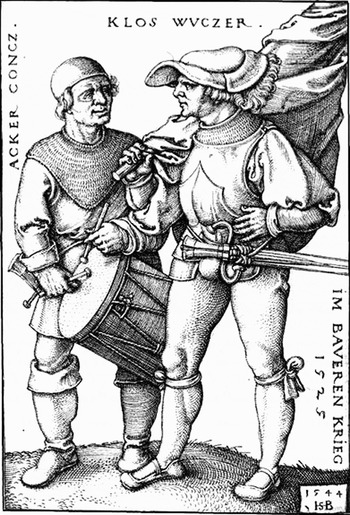
Depiction of two rebellious peasants during the Peasants' War. Hans Sebald Beham, Standard Bearer and Drumer, 1544, engraving.

In this light, the villagers' willingness to switch loyalties to Gabold and by extension Augsburg represented the culmination of ongoing reluctance to render payment to St. Ulrich. The Haunstetter's actions fit the category of tithe disputing described by C. Scott Dixon in his analysis of rural reform in Brandenburg-Ansbach-Kulmbach. Building on the work of James Scott, Dixon argues that refusal to pay taxes or tithes represented “resistance without protest,” a strategy “employed by the peasantry . . . to secure the utmost advantage from a limited reservoir of possibilities.” This form of “native pragmatism” appears throughout the dispute over HaunstettenFootnote 31 and is key for understanding the Haunstetter's actions in the early stages of the conflict. The villagers were already resisting St. Ulrich's authority prior to Augsburg's intrusion, and their reorientation toward the imperial city provided a sudden and unexpected way of freeing themselves from the monks. At least initially, the villagers were more willing to deal with Augsburg than with the exiled clerics who traditionally demanded Haunstetten's loyalty.
The long-term deterioration of relations between Haunstetten and St. Ulrich provides the necessary context for understanding the villagers' decisions in 1538–1539. While the Haunstetter did not initiate the monks' exile or the establishment of a new religio-political authority in the village, their oath of fealty to Gabold legitimized their non-payment to Unterwittelsbach. This switching of loyalties also possessed a decidedly religious element. The village's old lords were clergy of the Catholic Church, while its new lord actively supported evangelical reform and had abandoned vows of monastic celibacy. Indeed, both Augsburg's council and the exiled monks were aware of the implications the transfer of Haunstetten's fealty had for the village's religious orientation. According to St. Ulrich's chancellor Mang Nusser, shortly after the Haunstetter swore obedience to Gabold, “the Haunstetten priest Liedel Kamrer . . . volunteered to take a wife, to halt celebration of the Mass, and to accept many more things that are very pleasing to the Augsburger.”Footnote 32 An essential part of Haunstetten's switch in political loyalties, therefore, involved a change in the village's religious affiliation. By renouncing St. Ulrich, the villagers not only denied the abbey's political dominion in Haunstetten. They also rejected the monks' spiritual authority through acceptance of the Reformation.
For their part, St. Ulrich's monks viewed the transfer of Haunstetten's tithes as a religious as well as a political and financial matter. Gabold's actions “violate the imperial peace as well as godly and human statutes. They are a breach of the recesses promulgated by the general imperial estates at numerous imperial diets. Even those who name themselves Protestants have accepted these recesses.”Footnote 33 Gabold's conduct was illegal on political and religious grounds, and the monks feared setting a dangerous precedent: “Other of our subjects who occupy the countryside around Haunstetten may learn through these actions how easily they can pledge themselves to apostate monks and thereby engage in apostasy themselves.”Footnote 34 St. Ulrich's abbot portrayed the events in Haunstetten as something greater than a loss of income for the monastery. On a larger scale, Gabold's actions represented an attack on the traditional nature of rural religious practice and political authority that imperiled the souls of all peasants in the region.
For economic, political, and religious reasons, therefore, the exiled monks at Unterwittelsbach were intent on reestablishing their authority in Haunstetten. After an initial complaint went unanswered, on October 8, 1538, the monastery sent a second letter to the villagers condemning their disloyalty. Johannes VII hoped the Haunstetter “would consider your honor and persist in the duties you have sworn to us.” The villagers should come to Unterwittelsbach and pay “the yearly tithe. Moreover, you should offer our apostate, disloyal brother absolutely no reverence and pay him not one Heller.”Footnote 35 To strengthen these demands, the abbot cautioned the villagers about the consequences of continued disobedience. If the Haunstetter “abandon us without any cause, in violation of your honor and duty, we will be forced to take action against your possessions and goods. We offer you this as a fatherly warning to remain loyal.”Footnote 36
Both Gabold and the Haunstetter stayed defiant. In response to the monastery's threats, the ex-monk and Haunstetten's Vierer met in Augsburg on October 15 with the imperial notary Silvester Raid. Gabold explained he had remained in Augsburg and taken the citizenship oath “out of the conviction of my conscience and a true zeal for the Christian religion.”Footnote 37 Such an act was possible thanks to the city council's decision “to alter and eliminate in its parish churches various inappropriate, godless abuses concerning the papal Mass and other ceremonies that strongly contradict the word of God.”Footnote 38 Since his fellow monks had “impiously, obstinately, and wantonly” fled the city and abandoned their duties, Gabold had decided, “to collect the yearly rent, taxes, and tithes due St. Ulrich.”Footnote 39 He had not overstepped his authority, but was simply acting in his capacity as caretaker of the monastic complex.
The Vierer voiced support for Gabold. The villagers had received a “wanton and impudent letter” (frvenliche und vermessen geschefftbrieff) from Unterwittelsbach ordering them “from this point forward to offer Joachim Gabold no obedience and to pay him not one Heller.”Footnote 40 Instead, the Vierer avowed, “such taxes and tithes have always, in every way, as far as memory records, been paid to St. Ulrich's complex in Augsburg. Haunstetten belongs with rights of jurisdiction to [the complex] in Augsburg alone.”Footnote 41 From the perspective of Haunstetten's villagers, the traditional location of their payment superseded the new demands of the exiled monks. The Haunstetter owed obedience not to the individual members of the cloister but to the actual physical location of the monastery's buildings in Augsburg. By leaving their complex for exile in Bavaria, St. Ulrich's monks had alienated themselves from their rural subjects. Consequently, the Haunstetter would rather pay “Gabold and the cloister St. Ulrich in Augsburg than a strange, foreign lord.”Footnote 42
The Vierer's October 15 pronouncement emphasized two themes that dominated the villagers' perceptions throughout the conflict: the nature of lordship and the importance of traditional rights. Despite their earlier actions, the Haunstetter did not dispute their duty to render tithe payments. Rather, they contested the jurisdiction of the exiled monks based on their physical location. This argument derived from the Vierer's belief in the power of traditional rights and privileges. The village had always delivered payment to the monastic complex in Augsburg. According to established custom, paying tithes to Gabold was the appropriate course of action, since he occupied the proper seat of lordship for the village. Transferring payments to Unterwittelsbach would have violated the traditional arrangements that bound the community and its ruler together, an unjust innovation that threatened to alter the legal status of the villagers for the worse. It would not have resulted in a diminution of taxes, as their tithe dispute sought, but would have added an additional economic burden that lacked historical precedent. In order to protect their traditional rights, therefore, the Haunstetter cleaved to their new religio-political authority in Augsburg.
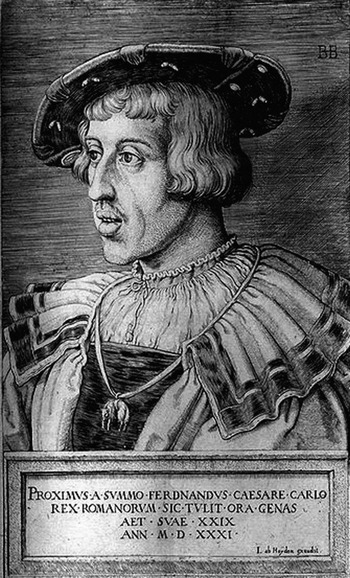
Ferdinand, Archduke of Austria and Margrave of Burgau, at the time of his election as German King. Barthel Beham, 1531, engraving.

The Haunstetter's continued refusal to render tithes led St. Ulrich's abbot to seek assistance from King Ferdinand, who issued a mandate to the villagers on December 7, 1538. The king lamented that Haunstetten “has fallen away from its true and orderly authority” by pledging fealty to a monk “who has abandoned his religion.” He ordered the villagers “to offer the abbot all proper and dutiful obedience as the one to whom you are bound by vows and oaths of duty. If this does not happen, and you persist in your disobedience, we will be forced to levy penalties against you.”Footnote 43 This royal ultimatum presented the Haunstetter with an unusual decision. Should they continue paying their tithes to Gabold, as they claimed their traditional rights demanded, but risk punishment by the king? Alternatively, should they transfer their payments to the Unterwittelsbach monks, an innovation the villagers had already opposed for over a year? On January 22, 1539, the Vierer wrote St. Ulrich's abbot “as poor subjects and peasants who greatly desire to do the right thing and avoid injustice.” They informed him “we are currently in the process of composing our written response to the king, which we will send out soon. We are of the humble opinion the king will be pleased with our response.”Footnote 44
In February, the Vierer answered Ferdinand. The village leaders had “sworn an oath of duty both to the abbot and the cloister St. Ulrich in Augsburg to pay our rent, taxes, and tithes in a subject and obedient manner. According to old customs, this payment takes place in Augsburg.” This arrangement worked well until “about two years ago,” when the abbot and some of his monks, “for reasons unknown to us, left St. Ulrich and settled in Unterwittelsbach.” At the time, the abbot's chancellor ordered the Haunstetter “to pay tithes and taxes to the cloister complex in Augsburg according to traditional practice, which we have loyally and willingly done.”Footnote 45 Now that Gabold was the abbey's sole inhabitant, the abbot demanded “we should pay our tithes and taxes in another place other than the cloister. Such an arrangement would not only be a breach of our duties. It would violate our rights and privileges.” The current “schism and conflict in our lordship pains our hearts,”Footnote 46 but “the abbot and his convent have sworn to permit us our old customs, rights, and traditions and not to burden us with any additional demands.”Footnote 47 In order “to fulfill our sworn oath to St. Ulrich,” the Haunstetter proclaimed they would continue to pay “our rent and taxes to the St. Ulrich cloister complex. Our forefathers did the same many years ago when another abbot fled the monastery and wished to receive payment from the villagers.”Footnote 48
The Vierer's letter to Ferdinand displays the same logic as its October 15 pronouncement. As before, the villagers contested not their duty to render tithes but the demand that they make payments to Unterwittelsbach. For the villagers, transferring the site of tithing from Augsburg to another location violated their long-standing privileges, which the monks had explicitly sworn to uphold. Infringing upon traditional rights represented a breach of the lord–subject relationship as well as a contradiction of historical precedent. This emphasis on preserving “old customs and traditions” formed the core of the Vierer's legal justification. In a world where lordship and customary privileges bound communities together, the Vierer used the tithe dispute to contest the very nature of St. Ulrich's dominion in the village. This strategy marked a continuation of their previous resistance to the monastery that predated their allegiance to Gabold. While the villagers did not initiate their reorientation away from the exiled monks, they sought to exploit the conflict brought on by the Reformation to minimize St. Ulrich's authority in Haunstetten.
In their response to Ferdinand, the Haunstetter purposefully avoided mention of religious developments in Augsburg and the surrounding countryside. The villagers remained silent regarding their priest's decision to marry and the elimination of the Latin Mass. They even claimed to be unaware of why the monks departed Augsburg. The Haunstetter could hardly have been ignorant of the monks' reasons for fleeing the city, however. After leaving Augsburg in 1537, Abbot Johannes VII “went to the village Haunstetten and stayed there for many days. He spoke to several people and ordered them not to stray from him or his convent.”Footnote 49 The Haunstetter knew the motivations for the monks' departure, and they were aware of the larger religious context surrounding their oath of obedience to Gabold. By avoiding mention of the religious question, the villagers offered tacit approval of the changes introduced in their church. If they had found the expansion of religious reform from the city into the countryside heretical or oppressive, they could have petitioned Ferdinand to restore their rightful religio-political lords. Instead, the Vierer self-consciously sidestepped the issue, justifying their actions by accusing St. Ulrich of dereliction in its lordship.
Simon Goll, St. Ulrich's new abbot, sharply rebuked the Vierer's arguments.Footnote 50 He dismissed Haunstetten's claim that “it owes allegiance only to the cloister complex and its walls, since my convent and I are the cloister.”Footnote 51 The abbot asked Ferdinand “to carry out your mandate to return our disobedient subjects to obedience. This will also ensure that we continue to collect tithes from our other renters and subjects.”Footnote 52 The king obliged, issuing a second decree on May 24, 1539. This time Ferdinand threatened a fine of “10 gold marks” if the Haunstetter did not pledge renewed obedience to their “rightful and orderly prelate.”Footnote 53 To add urgency to his demands, Ferdinand commanded the royal notary Martin Hochenrainer to visit Haunstetten and read the decree aloud. Hochenrainer and six witnesses arrived in Haunstetten on June 15. The notary assembled the villagers in the central square, but before he could finish reciting the decree, Gabold's agent in the village interrupted and mocked Hochenrainer. He ordered the Haunstetter “not to obey or accept any such royal mandate.” The villagers agreed, explaining to Hochenrainer that they “do not wish to disdain the mandate, but neither do they wish to obey or accept it. They say they already have a lord in St. Ulrich in Augsburg to whom they wish to be obedient.” After repeated attempts to sway the villagers, Hochenrainer and his witnesses left Haunstetten in dismay. The frustrated notary informed Ferdinand that the Haunstetter “have indeed disdained your majesty's mandate and are in breach of it.”Footnote 54 The king should deal with them accordingly.
The failure of Hochenrainer's mission marked an escalation of the conflict. What began as a local tithe dispute between a rural community and its monastic overlord quickly evolved into a complex legal battle between royal agents and urban magistrates. The next move came from Augsburg's council, which instructed its jurist Lucas Ulstat to examine Ferdinand's May 24 mandate. Ulstat declared the royal decree invalid, contending that it lacked the proper seal. The king's demands also violated the recently signed Truce of Frankfurt, argued Ulstat, which declared “all clerics, even evangelicals, should be allowed to remain true to their current religious persuasion.”Footnote 55 Accordingly, Ulstat concluded that Haunstetten should not return to the exiled monks, for such an action would alter the village's confessional orientation, thereby abrogating the treaty's terms. In stark contrast to the Haunstetter, therefore, Augsburg's magistrates employed religion as the primary justification for opposing Ferdinand and St. Ulrich. They did so in a way they hoped would give legal weight to the city's newly acquired jurisdiction in the village. For Augsburg's council, the religious and political stakes at play in Haunstetten were closely intertwined, which made the expansion of the city's sphere of authority dependant on the successful spread of the Reformation. The king countered on September 11 with a third mandate. Ferdinand ordered the Haunstetter “to pay the abbot within one month's time all overdue and unpaid tithes, rent, taxes, and services. From this point forward you should display proper and dutiful obedience toward the abbot.” If this did not happen, “we will be forced to proceed against you immediately according to our previously threatened penalties in order to correct your disobedience.”Footnote 56
Ferdinand's September ultimatum sparked debate within the village about the wisdom of continued opposition to St. Ulrich.Footnote 57 At the same time, the Haunstetter faced growing pressure from neighboring rural communities to capitulate to the monks' demands. In a letter to Augsburg's council written in the first half of October 1539,Footnote 58 the Vierer complained “when we meet our neighbors and other honorable people we are often ill-received. They address us as those who abandoned their true lord unreasonably and without need. They say we will have to answer for this before God.”Footnote 59 Both the king and many of their fellow peasants called for the Haunstetter “to display obedience in all matters to our correct and natural lord the prelate of St. Ulrich.”Footnote 60 Accordingly,
we are in no way disposed to continue striving against his majesty's royal mandates, which would mean the ruin of our possessions and goods. We have no intention to burden our conscience and souls further. Above all else, we wish to follow our conscience, which directs us to God Almighty and demands that we offer full obedience to our correct and natural authority. We therefore dissolve our oath of duty to Joachim Gabold.Footnote 61
Both sides responded swiftly to the Haunstetter's announcement. On October 11, the village sent a delegation to Gabold informing him of its decision. Upon their arrival in Augsburg, Gabold “imprisoned the delegates in his house for approximately two hours.”Footnote 62 The next day, Gabold petitioned Augsburg's council for assistance dealing with “the Haunstetter, who willingly offered vows of duty to me.”Footnote 63 He asked “the council to offer advice and help so the Haunstetter do not fall under the authority of the abbot and the invalid convent. This is necessary so other authorities do not establish themselves in the hearts of the Haunstetter, thereby turning the rightful master into a servant.”Footnote 64 Augsburg's council agreed, reacting to the Haunstetter's revocation of loyalty with force and intimidation. On October 16, “three men [from Haunstetten] who were in Augsburg on business were all taken prisoner by the Augsburger and placed in irons.” These actions worried the monks at Unterwittelsbach, “since if the Augsburger act against the poor people in such a deplorable manner, there arises the concern that, out of fear, the people may return to their apostasy.”Footnote 65 To prevent this, Abbot Simon wrote directly to the Vierer. He assured the Haunstetter “if you receive molestation from the apostate monk or anyone else who wishes to help or assist him in this matter, we stand ready to offer you solace, help, and support. This is our fatherly pledge to you, our obedient and beloved subjects.”Footnote 66
Despite the punitive measures employed by Augsburg and Gabold, the tide was turning. The villagers' decision to renounce Gabold convinced St. Ulrich's abbot that Haunstetten was once again within his grasp. Abbot Simon therefore issued renewed appeals for aid to Ferdinand while striking a more conciliatory tone toward the Haunstetter. By offering fatherly assistance to his “obedient and beloved subjects,” the abbot sought to contrast for the villagers the strong-arm tactics of Augsburg with the promised benevolence of their traditional lord, St. Ulrich. This shift in rhetoric shows the speed with which the tone of dialogue between subject and lord could change based on larger religio-political circumstances. Against the opposition of Ferdinand, St. Ulrich, and now the villagers, Augsburg could not hold out for long. In late November, Ferdinand made good on his previous threats. On orders from the king, “this past Sunday November 23, the knight Wolf Dietrich von Knöringen entered the village with thirty riders. He forced the peasants, who were assembled together in church at the time, to take an oath affirming they would pay their taxes from this point forward to the exiled monks in Unterwittelsbach.”Footnote 67 Augsburg's council dutifully protested this military action, initiating a protracted legal controversy over possession of the ius reformandi in the village that lasted for two years. As of November 23, 1539, however, Haunstetten returned to its “rightful and orderly prelate.” The village once again became a possession of the exiled monks, who restored Catholic religious practice in Haunstetten.
Throughout the duration of the dispute, the Haunstetter never employed religious reform as justification for their actions. Instead, the villagers based their resistance on a specific interpretation of their traditional “rights, privileges, and customs.” In this respect, their actions fit C. Scott Dixon's observation that “a tithe dispute was a local concern; it had specific legal and temporal reference, and nothing to do with God's Word.”Footnote 68 At the same time, however, the events in Haunstetten possessed a decidedly religious overtone, which temporarily opened up new political and economic opportunities for the villagers. The transfer of the village's loyalty from the exiled monks to Gabold entailed a shifting of Haunstetten's confessional allegiance. This development turned the tithe dispute into a conflict between different views of Christianity. St. Ulrich ordered the Haunstetter to renounce both their “apostasy” and “the apostate monk,” while Augsburg's council defended the villagers' actions by appealing to imperial treaties protecting religious reform. By avoiding the dispute's religious dimensions, the villagers may have sought to simplify the debate by focusing on “legal and temporal” matters where they felt they had the upper hand. In some respects, the tithe controversy over Haunstetten represented a local affair that centered on rights of dominion and tradition. It also involved competing religious interests that were inseparable from the larger political and economic issues surrounding the village.
While engaged in the dispute, the Haunstetter displayed the ability to formulate complex legal arguments and justifications, as well as the willingness to pursue new religious, political, and economic strategies they believed in their self-interest. By cooperating with Gabold and Augsburg, the Haunstetter were able to escalate their preexisting tithe dispute with St. Ulrich while opening the village to the evangelical faith. Many of the villagers appear to have been receptive to these new arrangements. Unlike their relationship with the old monastic leadership, the Haunstetter even paid their tithe to Gabold.Footnote 69 In the end, much as had happened during the Peasants' War, military force returned the villagers to St. Ulrich's fold. Tellingly, von Knöringen's raid occurred on a Sunday with the Haunstetter assembled in church. The timing ensured a majority of people were present in one place at one time to facilitate the new oath of obedience. It also meant a forceful termination of the new religious situation that had existed in the village since July 1538. Symbolically, von Knöringen's disruption of evangelical church services made a powerful statement about the political and religious supremacy of St. Ulrich. In the immediate circumstances surrounding Haunstetten's return to the Catholic Church, the religious devotion of the local villagers intertwined with the ongoing conflict of opposing Christian confessions within the empire as a whole.
II. Mindelaltheim and “the Food of Souls”
Five years after the failure of its policy in Haunstetten, Augsburg's council tried again to reform a nearby village under the jurisdiction of another territorial lord. Control of the council had shifted in the intervening period to a different leadership group,Footnote 70 which pursued a more aggressive strategy of religio-political expansion than Rehlinger and his associates had. A central aspect of their external policy involved the extension of Augsburg-style reform to the countryside, efforts that took on increasing urgency as civil war within the empire drew nearer. After securing pledges of support from its ally Ulm, in October 1544 Augsburg's council installed an evangelical preacher named Hans Hess in the vacant parish of Mindelaltheim, a hamlet in the Habsburg Margraviate of Burgau. Low justice, the parish's ius patronatus, and its tithes belonged to the Augsburg Dominican convent St. Katharina, which Augsburg's council had taken under its full protection in 1537. King Ferdinand, in his role as margrave, controlled high justice in the village. As he had done in Haunstetten, the king opposed Augsburg's actions, arguing his ownership of high justice allowed him to determine the religious orientation of subjects in his principalities. After months of legal wrangling, Ferdinand's argument won the day. Augsburg's council ultimately removed Hess in June 1545, less than one year after installing him in the rural parish. Similar to events in Haunstetten, Augsburg's second major attempt at rural reform became “a matter that could make us look foolish.”Footnote 71
Despite the similar outcomes, the circumstances surrounding Augsburg's pursuit of religious reform in Haunstetten and Mindelaltheim were quite different. The Mindelaltheim affair did not involve a tithe dispute. The legal debate focused solely on Augsburg's claim to the ius reformandi in a village where Ferdinand exercised territorial lordship. Moreover, Augsburg's installation of a preacher in Mindelaltheim occurred at the direct request of the villagers, who petitioned the imperial city for a pastor in summer 1544, over two years after the village's last Catholic priest had died.Footnote 72 During that time, Mindelaltheim had been “left without any church service, pastor, or proclamation of the word of God.Footnote 73 Not only are the imprudent youth left without any explanation of the articles of the holy Christian faith, but general morals and fear of God are also less nurtured.”Footnote 74 The villagers turned to Augsburg as their “dear authority,” exhorting the council “not to leave us, a poor, subject community, without your fatherly care.”Footnote 75 A preacher was needed soon, for
the longer we wait, the greater the danger and disadvantage to us becomes. Since no one besides your honor the council will accept our petition, we humbly beseech you to act as our fathers, to whom we are devoted with our love and service, and to give us an instructor in holy teachings and the word of God. . . . This person should deliver and explain to us the food of souls, for one does not live by bread alone, but draws life from the Word that issues forth from the Lord's mouth.Footnote 76 In this manner, we wish to behave as pious parishioners and to serve you in any way possible.Footnote 77
This petition, especially the peasants' desire for a cleric versed “in holy teachings and the word of God” who could bring “the food of souls,” echoed closely the injunction Augsburg's preachers had offered to their council five years earlier. The similarity of this rhetoric could reveal a desire for closer contact with evangelical ideas, but it could also indicate a deliberate strategy on the part of the villagers to employ language likely to receive a favorable response from Augsburg. Intriguingly, the Mindelaltheimer's letter did not make any claim to communal control over the local church or pastor. Such requests had appeared in the pre-Reformation era and were a hallmark of peasant demands before and during the Peasants' War.Footnote 78 The villagers did assert, however, their right to stipulate which moral and intellectual attributes their new pastor should possess, a move they justified through a call for preaching based on scripture. This request for a specific type of preacher, while distinct from earlier, more radical programs of peasant reform, shows the ongoing ability of rural inhabitants to seize the initiative in recruiting preachers for their community.Footnote 79 Taken together with the rhetoric used in the letter, it reveals one way in which peasants continued to use reform after the Peasants' War to push for change in their local spiritual and political conditions.
This reading is supported by the central metaphor the Mindelaltheimer employed in their letter, that “one does not live by bread alone.” This expression referred to the Gospel of Matthew 4:4, wherein Christ rejects the first of Satan's three temptations in the desert. Through this appeal to scripture, the Mindelaltheimer expressed a biblical understanding of their relationship to Augsburg that emphasized Augsburg's duty to care for the villagers' spiritual health. Dietmar Schiersner has described a similar dynamic between Augsburg and the inhabitants of Lützelburg, another village in Burgau where Augsburg's council possessed the right of patronage. In 1603, roughly sixty years after the Mindelaltheim affair, the Lützelburger petitioned Augsburg to fill their vacant preachership. The absence of a cleric meant the villagers were “without the public proclamation of God's Word.” Consequently, they felt “like sheep left without a shepherd.”Footnote 80 Schiersner reads this statement as a reference to Matthew 9:35–38, in particular to Christ's view of the Israelite crowds as “sheep without a shepherd.” By framing their situation in these scriptural terms, argues Schiersner, the Lützelburger simultaneously expressed “an identification with those living around Jesus” and a demand that “political authority feel sympathy for its ‘people’ and make sure they were sent a cleric.”Footnote 81
In their 1544 supplication, the Mindelaltheimer evoked a similar biblical connection. The villagers stressed that only a preacher sent by their “dear authority” Augsburg could slacken their hunger for the “food of souls.” They highlighted this dependence through the idea of fatherliness, a form of address employed in sixteenth-century correspondence to indicate deference toward another party, usually one of higher authority.Footnote 82 The Mindelaltheimer's appeal to Augsburg's “fatherly care” implied religio-political reliance on the council. It also offered an injunction to urban magistrates to fulfill their responsibility to care for the villagers' souls. As holder of the parish's ius patronatus, Augsburg's council had a duty to minister religiously to the villagers. Its failure to appoint a new cleric had left the peasants lost in a desert of temptation.Footnote 83 Only Augsburg's magistrates could remedy the situation by fulfilling their obligations and supplying the village with preaching based on the gospel. In the eyes of Mindelaltheim's peasants, the city council's rights gave it privilege, but they also made Augsburg responsible for the community's spiritual well being. For this reason, the Mindelaltheimer used their relationship with Augsburg's council to press for what they believed was needed improvement in their community.
Closely connected to Mindelaltheim's request for a preacher was the villagers' desire to preserve moral discipline. This concern resulted directly from the lack of a cleric, which left the villagers without sure religious guidance during their proverbial time in the desert. The Mindelaltheimer's petition cited this as one of their chief concerns, emphasizing the neglect of “general morals and fear of God” that resulted from the absence of an official religious presence. The Mindelaltheimer lamented especially the lack of religious instruction for the village's youth, and they stressed that this erosion of community morals “has given rise to considerable dangers” that threatened the village's social fabric.Footnote 84 By appealing to Augsburg for a cleric, the villagers sought spiritual care as well as the restoration of proper discipline, which in their thinking appear to have been intertwined. Ironically, while uncertainty surrounding the Reformation had led to the absence of a cleric and the breakdown of morals in the first place, allowing religious reform into the community now presented an opportunity for the Mindelaltheimer to reestablish moral order while simultaneously receiving confirmation of their rights as Augsburg's subjects. As had the Haunstetter, the Mindelaltheimer sought to manage the religio-political situation in which they found themselves in order to serve the community's best interests.
Augsburg's council granted the Mindelaltheimer their wish by installing Hess. Unlike the Haunstetter, the Mindelaltheimer did not play a prominent role in the ensuing conflict between the city and Ferdinand, although Augsburg's council did employ the villagers' petition as justification for its actions. The magistrates defended their preacher with the claim that he had gone to the village “at the urgent request of the poor people, who had been robbed of all care for their souls.”Footnote 85 This argument, while it failed to persuade Ferdinand, points to an important connection between urban reform centers and nearby villages. The Mindelaltheimer took the initiative in trying to change their spiritual circumstances, but they could not achieve their goals without Augsburg's cooperation. The village relied on Augsburg religiously, a responsibility the magistrates took seriously. This dependence formed the cornerstone of relations between the two sides. By petitioning Augsburg for a preacher, the Mindelaltheimer sought the fulfillment of their rights as the city's religious subjects. By supplying a preacher, Augsburg's council hoped to extend its sphere of influence while discharging its religious obligations to peasants under its authority.
This dynamic reflects the notion of Herrschaft described by David Warren Sabean and C. Scott Dixon for rural communities in Württemberg and Franconia. According to Dixon, “this notion of obedience, inherent in the relations between ruler and ruled in early modern Germany . . . was also fundamental to the parishioners' reception of the faith. The villagers demanded the word of God, for . . . it was their right as . . . subjects.”Footnote 86 This statement rings true for Mindelaltheim. Augsburg's council held the village's ius patronatus through St. Katharina and therefore controlled the appointment of clergy. It was natural that the Mindelaltheimer petitioned aid from Augsburg, but they also recognized their right to proper spiritual care as Augsburg's subjects. In order to meet this need, they wrote their “fathers,” reminding the magistrates of their duty and urging them to care for the villagers' souls. As in Haunstetten, the options available to the villagers depended on the local political climate and the constellation of legal rights surrounding the parish. Within these confines, the Mindelaltheimer proved capable of employing specific religio-political strategies that allowed them to address perceived problems of moral and spiritual stagnation in their commune.
The general contours of religiosity evident in Mindelaltheim's letter recall the facets of communal Christianity sketched by David Mayes. This apparent similarity could indicate that the relationship between rural Christianity and official reform present in Upper Hesse during the latter part of the sixteenth century existed in some places already in the first half of the century. However, in attempting to draw such parallels, one must be careful about projecting late sixteenth- and seventeenth-century norms back onto the early part of the Reformation. The pitfalls of doing so appear in the parallel language used by the Mindelaltheimer and Augsburg's preachers, especially in their central metaphor of the “food of souls.” Rather than suggesting that clerical authorities “absorbed and appropriated . . . certain concepts that would sooner be associated with the peasant world,”Footnote 87 as Mayes argues for Upper Hesse, the metaphors used by Augsburg's clerics and Mindelaltheim's peasants had a common basis in biblical norms. While each side naturally applied their use of these metaphors to their own interests, the language itself derived from sacred idioms based on scripture with which both could identify. Peasant concepts about religion, therefore, did not always operate in an autonomous sphere shaped by wholly different concerns than those who lived in cities. They existed in a reciprocal environment where urban and rural religious forces influenced and often paralleled each other through a common grounding in biblical imagery.
III. Conclusion
During the late 1530s and 1540s, the inhabitants of Haunstetten and Mindelaltheim sought to use the Reformation to serve their own local interests. In Haunstetten, the Reformation accompanied the village's reorientation toward Augsburg and the renegade monk Joachim Gabold. Economic disgruntlement over the village's tithe dispute with St. Ulrich fused with religious and political interests to make the local population receptive to this change in lordship. This dynamic opened new political strategies for the villagers that allowed them to ward off a quick return to their former overlord. In correspondence with Catholic authorities, the Haunstetter self-consciously avoided the religious question, justifying their actions based on their “traditional rights and privileges” while remaining silent concerning their “apostasy.” For reasons outside the villagers' control, they could not sustain this line of argumentation. Despite the eventual outcome, however, the Haunstetter helped determine the nature and course of the conflict. Their responses to Augsburg, Ferdinand, and St. Ulrich's abbot reveal their sense of Haunstetten's place in the larger religio-political landscape of Upper Swabia, as well as one way in which common folk in the countryside could justify allegiance to a new religious authority.
In Mindelaltheim, the villagers played a less prominent role than the Haunstetter in the legal controversy surrounding reform. This does not mean they were passive actors or indifferent to the religious issues under debate. On the contrary, by petitioning Augsburg for a new preacher, the Mindelaltheimer helped to redraw the boundaries of local religious practice. Their emphasis on the educational and moral standards the new preacher should meet affirmed the community's desire to stipulate the character of their pastor, while the rhetoric of their letter points to an ongoing rural interest in addressing local spiritual and ethical problems through scriptural ideals. Indeed, the Mindelaltheimer's direct appeal to the imperial city advanced a call for ministry that paralleled the hopes of Augsburg's preachers by expressing a hunger for “the food of souls.” Augsburg's clergy had been encouraging their council to deliver such nourishment for the better part of five years. When it finally came to Mindelaltheim, the Reformation failed not because of lay opposition or apathy, but because of specific rights of authority in Burgau.
The events in Haunstetten and Mindelaltheim reveal the continued desire of many Upper Swabian villagers for contact with the Reformation, as well as the ability of villagers to use reform to achieve their own goals. In the process, the experience of these villages undercuts the view of the 1530s and 1540s as a static period marked by rural apathy toward religious reform. The Reformation's course in each village depended on multiple contingencies and evolved out of a process of discourse between local political authority, the villagers, and external agents such as Ferdinand. Particularly noteworthy in both instances was the villagers' use of sophisticated political strategies aimed at improving their religio-political circumstances. According to Peter Blickle, the Peasants' War marked “a distinct and irreversible setback” for the Reformation in many rural regions of southern Germany.Footnote 88 In Haunstetten and Mindelaltheim, however, support for reform ideas and the attendant reorganization of religious life existed almost two decades after the end of the Peasants' War. Neither set of villagers were passive bystanders but instead sought to manipulate the conditions present in their village while receiving confirmation of their traditional rights. While the Peasants' War represented an important turning point in the history of the rural Reformation, therefore, by itself the war can explain neither the subsequent course of rural reform nor the nature of disputes like the one between Haunstetten and St. Ulrich. Most importantly, even as it may have impaired attempts to communalize local churches, the Peasants' War did not mark the end of villagers using reform for political, economic, or religious gain. Mindelaltheim's requests in its letter to Augsburg, as well as the political maneuvering of the Haunstetten villagers, reveal this ongoing dynamic.
At the same time, the strategies employed by the Haunstetter and Mindelaltheimer operated within restricted parameters. Repeatedly, the peasants returned to the idea of Herrschaft. In Blickle's words, during the communal Reformation, “submission to the gospel became the stamp of legitimacy. Lordship as such meant nothing.”Footnote 89 By the late 1530s, lordship once again meant something. When viewed from the perspective of the ensuing decades, the radical relationship of the Peasants' War to the Reformation appears as the aberration, not the norm, for how rural communities encountered and reacted to religious reform in the early Reformation. Any timeline that overemphasizes the Peasants' War therefore runs the risk of missing the fluidity of rural reform in the Reformation's first decades, as well as the central place bonds of authority held for rural inhabitants.Footnote 90 Authority and lordship sat at the heart of interaction between peasants and larger political entities, but this relationship was a two-way street. It could allow villagers, at least for a short time, to manipulate their religio-political situation to their perceived advantage. Top-down models of confessionalization often overlook this dynamic. The village political strategies employed in Upper Swabia, however, reveal the active manner in which many peasants continued to confront reform years after the tumult of the Peasants' War had past.