1. Overview
Koeneman & Zeijlstra (henceforth K&Z) (Reference Koeneman and Zeijlstra2014) ‘rehabilitate’ the Rich Agreement Hypothesis along with its familiar diachronic prediction that loss of rich agreement triggers loss of V-to-I. In a critique of this approach, Heycock & Sundquist (henceforth H&S) (Reference Heycock and Sundquist2017) argue that K&Z fail to give a satisfactory account of the protracted time lag between these two processes in the history of Danish. H&S point out that reanalysis of ‘unexpected’ putative V-to-I as V-to-C, i.e. ‘embedded V2’ (EV2) – the mechanism K&Z propose to deal with such cases – is in conflict with the seemingly frequent occurrence of V-to-I in non-EV2-contexts during the critical historical stage(s) of Danish, as documented by Sundquist (Reference Sundquist2002, Reference Sundquist2003).
In this paper, I argue that H&S’s conclusion may be premature, given that characterizations of the core diagnostic ‘EV2-hostile’ environments differ when distinct varieties of EV2 are taken into account. In particular, ‘narrow’ EV2 (nEV2), as familiar from the modern Mainland Scandinavian languages, confines EV2 to roughly speaking ‘assertion-friendly’ contexts, while ‘broad’ EV2 (bEV2), reported for certain varieties of Modern Icelandic and for Old Norse, has a wider distribution. A selective look at examples from Early Modern Danish that Sundquist (Reference Sundquist2002, Reference Sundquist2003) categorizes as showing bona fide V-to-I reveals complications with both non-restrictive relatives and conditional clauses: The former arguably count as ‘EV2-friendly’ environments even within an nEV2 system and the latter do so within bEV2, at least in Old Norse. Given evidence that Middle Danish possesses bEV2 (Vikner Reference Vikner1995), this paper must be taken as an appeal to revisit the historical facts from Early Modern Danish with an eye on its EV2-type. The larger agenda promoted here concerns developing a better documentation and understanding of bEV2, which will make it possible to assess proposals like K&Z’s V-to-C reanalysis of V-to-I on firmer and independent theoretical grounds.
2. Rich agreement and V-to-I
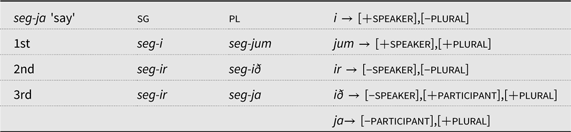
At least since the publication of works by I. Roberts (Reference Roberts1985), Kosmeijer (Reference Kosmeijer1986), Platzack & Holmberg (Reference Platzack and Holmberg1989), and Rohrbacher (Reference Rohrbacher1994), richness of subject–verb agreement has been hypothesized to correlate with the presence vs. absence of syntactic V-to-I movement, i.e. movement of the verbal head of VP to the (abstract) head of IP. Among the core examples for this belongs the contrast between Modern Icelandic and Modern Mainland Scandinavian, here represented by Modern Swedish: The former, possessing ‘rich’ agreement as shown in Table 1, requires V-to-I movement, (1a)/(1b).Footnote 1 The latter, lacking rich agreement as illustrated in Table 2, disallows V-to-I movement, (1c)/(1d).
(1)


Modern Icelandic agreement.

Modern Swedish agreement.

As can be seen in (1), the canonical syntactic diagnostic for V-to-I involves ordering of the finite verb relative to sentential negation within certain types of subordinate clauses. Determining the exact clausal environments involved is what this paper is about and I will come back to the matter momentarily.
The question as to how richness of verbal agreement should be characterized has been studied intensively (see e.g. Vikner Reference Vikner and Haegeman1997). Since precise detail is not crucial here, I present the relevant facts in the format provided by K&Z (Reference Koeneman and Zeijlstra2014:576), whose approach to V-to-I will take center stage below. K&Z’s theory boils down to counting agreement as rich when a threshold of three person and two number values is reached. Thus, Modern Icelandic distinguishes [+speaker] (‘1st person’), [–speaker][+participant] (‘2nd person’), and [–participant] (‘3rd person’) in the person dimension, as well as [+plural] and [–plural] in the number dimension. Modern Swedish, on the other hand, doesn’t make any such distinction and therefore misses the threshold for rich agreement. On the basis of this, K&Z (Reference Koeneman and Zeijlstra2014:576) state a version of the Rich Agreement Hypothesis (RAH), which can be formulated as follows.Footnote 2, Footnote 3
(2) The Rich Agreement Hypothesis (simplified)
Language L exhibits V-to-I movement if and only if L possesses rich verbal agreement.
The formulation in (2) itself, of course, is not new. Close variants of (2) have been stated and been the subject of thorough debate over the years. In particular, as acknowledged by K&Z, empirical evidence challenging both directions of (2) has been brought up: ‘language varieties that are poorly inflected but still display V-to-I movement (e.g. Jonas 1995 for Faroese, … Bentzen et al. 2007 for Regional Northern Norwegian varieties), as well as varieties that do not display obligatory V-to-I movement despite being richly inflected (e.g. Garbacz 2010 for Älvdalen Swedish)’ (K&Z Reference Koeneman and Zeijlstra2014:571). As a consequence, the suggestion has been made to abandon the RAH entirely (Wiklund et al. Reference Wiklund, Hrafnbjargarson, Bentzen and Hróarsdóttir2007),Footnote 4 or at least weaken it from a biconditional (‘if and only if’) to a conditional (‘if’), such that rich agreement entails V-to-I but not vice versa (see e.g. Bobaljik & Thráinsson Reference Bobaljik and Thráinsson1998). It is therefore of high interest that – in full reversal of the above trend – K&Z propose to ‘rehabilitate’ the RAH and reinstall it ‘in its strongest, bidirectional form’ (K&Z Reference Koeneman and Zeijlstra2014:572). This involves demonstrating ways in which challenges to the RAH can be met, and, importantly, some of the most intricate issues here concern the diachronic development of the Scandinavian languages. They are going to be focused on in the following discussion, which I hope will contribute to a deeper understanding of the ‘diachronic consequences’ of the RAH.
3. The RAH and diachrony
Let me begin by citing K&Z (Reference Koeneman and Zeijlstra2014:577), who themselves note that
[t]he RAH also predicts that changes in the verbal syntax and changes in the verbal paradigm should be closely related: morphological deflection should trigger the loss of V-to-I movement. This prediction is borne out. Take, for instance, Old Swedish … and Middle English[.] Both are richly inflected[.] Both display V-to-I movement, as expected[.]
At the same time, they address one of the major and most interesting challenges to the RAH (K&Z Reference Koeneman and Zeijlstra2014:606; see Vikner Reference Vikner and Haegeman1997:Section 4.3):
it has been observed, as a critique of the RAH, that there can be a significant time gap between the loss of the relevant agreement inflection and the loss of V-to-I … movement.
The authors (K&Z Reference Koeneman and Zeijlstra2014:606)Footnote 5 suggest that
such time gaps are not at all problematic, however, since the input in those stages is still paradoxical, containing both input for a poor agreement paradigm and evidence for V-to-[I] movement.
More concretely, the idea is that the ‘paradox’ will be resolved by standard mechanisms of language acquisition, the one of interest here being based on the assumption that ‘the learner can … take the word order as primary’ (K&Z Reference Koeneman and Zeijlstra2014:607). K&Z claim that this is what happened in Faroese, where, as a consequence, ‘learners reanalyzed V-to-[I] movement as embedded V-to-C movement’ (p. 607). This proposal, of course, rests on the well-known fact (see e.g. Holmberg Reference Holmberg1986:112) that, in languages with ‘medial’ I°, standard cases of bona fide V-to-I, as seen in (3a), and subject-initial ‘embedded V2’ (EV2) clauses,Footnote 6 seen in (3b), are string-identical.Footnote 7
(3) a.… [IP SU Vfin [VP NEG/ADV [VP … t V …
b.… [CP SU Vfin [IP t SU t V’ [VP NEG/ADV [VP … t V …
In a recent critique of K&Z (Reference Koeneman and Zeijlstra2014), H&S (Reference Heycock and Sundquist2017:175 fn. 1) rightly point out that ‘the evidence for this reanalysis in Faroese is largely circumstantial, given the gap in the documentary evidence for Faroese between the medieval period and the late 18th century’. Thus, to make a better case for a reanalysis of V-to-I as EV2, one has to tackle more thoroughly documented cases, such as Danish and Swedish. The former is directly addressed by H&S (Reference Heycock and Sundquist2017:173–174):Footnote 8
Sundquist (Reference Sundquist2002; Reference Sundquist2003) shows that while by 1350 there was at most a singular/plural distinction encoded in the verbal morphology of Middle Danish, V-to-I is still evidenced robustly in the data for more than two centuries after that date. In texts from the first half of the 16th century – two hundred years after the morphology has become ‘poor’ by the definition in K&Z – V-to-I appears at a rate of 42%. In fact, even in … the second half of the 17th century, it still occurs at a rate of above 10% (Sundquist Reference Sundquist2003, p. 242).
And, importantly, H&S (Reference Heycock and Sundquist2017:175) directly dismiss the option of V-to-C reanalysis, stating that ‘[t]his explanation for the persistence of V–Neg/Adv orders in Danish was … already ruled out in Sundquist (Reference Sundquist2002; Reference Sundquist2003)’.
4. Varieties of EV2
Although I think that the point H&S (Reference Heycock and Sundquist2017) make is largely valid, I will argue that certain difficulties in teasing apart EV2 and V-to-I may blur their results and make arguments against K&Z’s proposal less conclusive.
To begin with, it is clear that in order to rule out V-to-C reanalysis one needs to find instances of bona fide V-to-I. In the core case, this requires identifying environments where pattern (3a) above occurs but pattern (3b) is blocked. Let us call such environments ‘EV2-hostile’. The latter are standardly characterized ex negativo, i.e. via providing criteria for ‘EV2-friendly’ environments. However, two things stand in the way of making this an easy task. First, there is so far no fully satisfactory theory of the distribution of EV2. And, second, it is clear that the boundary between EV2-hostile and EV2-friendly environments can shift both across languages and diachronically. The interdependence of these issues makes it necessary to address them together.
4.1 Narrow vs. broad EV2
At least for the modern Mainland Scandinavian languages, a fairly solid characterization of EV2-friendly environments can build on work by, among others, Andersson (Reference Andersson1975) and Wechsler (Reference Wechsler, Leffel and Bouchard1991) and identify them – as long as we are dealing with declarative clauses – with ‘assertion-friendly’ environments. This means that the content of the V2-clause counts as something the speaker actively commits to and as intended to enrich the common ground (see e.g. Wiklund Reference Wiklund2010:87). In addition, provisos have to be made to include ‘derivative’ (or ‘shifted’) uses of EV2 in speech and thought representation.Footnote 9
Now, as is well-known, there are varieties of Modern Icelandic where EV2 shows a broader distribution, as exemplified in (4b) (Rögnvaldsson & Thráinsson Reference Rögnvaldsson, Thráinsson, Maling and Zaenen1990:23) and contrasted with Modern Swedish, (4a) (see Hrafnbjargarson & Wiklund Reference Hrafnbjargarson and Wiklund2009:33).
(4) a. *Johan tvivlar på [CP att [CP i morgon skall [IP Maria gå upp tidigt]]].
b. Jón efast um [CP að [CP á morgun fari [IP María snemma á fætur]]].
‘John doubts that Mary will get up early tomorrow.’
Clearly, given the meaning of ‘to doubt’, Mary’s getting up early on the next day is nothing the speaker commits to (via an utterance of (4)), nor does it correspond to the content of John’s thought (or speech). Yet, EV2 is possible in Icelandic here, instantiated by non-subject-initial V2, the hallmark of bona fide V-to-C. Let us call the distribution of EV2 where EV2-friendly and ‘assertion-friendly’ environments coincide ‘narrow EV2’ (nEV2) and the extended one displayed by certain varieties of Modern Icelandic ‘broad EV2’ (bEV2).Footnote 10
From these brief and sketchy considerations we can already see that the adequacy of K&Z-style V-to-C reanalysis of V-to-I depends on the EV2-type – nEV2 or bEV2 – of the language(s) in question. This is what will be addressed next.
5. V-to-C reanalysis
Sundquist’s crucial observation, on which H&S build their assessment that V-to-C reanalysis of V-to-I is excluded for Danish, concerns the absence of any drop in ‘frequency of V–Neg/Adv orders’ in EV2-hostile environments. However, the method of identifying such environments is neither very elaborate (see Garbacz, Håkansson & Rosenkvist Reference Garbacz, Håkansson and Rosenkvist2007) nor does it take into account the difference between nEV2 and bEV2. As summarized by H&S (Reference Heycock and Sundquist2017:175),
[i]n order to control for the possibility that the high position for the verb in his data was due to EV2 rather than V-to-I, Sundquist isolated the cases that did not occur in an embedded declarative (operationalized as a clause introduced by the complementizer at ‘that’).
[EV2] is excluded – or at best highly disfavored – in relative clauses, indirect questions, and most types of adverbial clauses[.]
Now, among the clause types actually presented by Sundquist (Reference Sundquist2002, Reference Sundquist2003) as displaying bona fide V-to-I, relatives and conditionals figure prominently. Let us discuss each type in turn.
5.1 Relative clauses
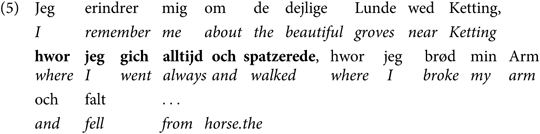
Quite strikingly, the two instances of relative clauses that Sundquist (Reference Sundquist2002:298) provides as evidence for Early Modern Danish V-to-I are both non-restrictive or ‘appositive’. They are presented in boldface with their fuller contexts in (5) and (6).Footnote 11
(5)
(6)

That the author always went for walks there, in (5), and that Miss Helle Lyche always was with her, in (6), is additional information about independently established referents: the beautiful groves near Ketting in (5), and Miss Helle Lyche’s late mother in (6). This information meets the criteria for assertion in being actively committed to by the speaker/author and intended to enrich the common ground. Consequently, appositive relative clauses (ARCs) would have to be considered EV2-friendly environments even in (the more limited) nEV2 systems (Section 4.1).Footnote 12 Further empirical evidence for this comes, among other things, from the ease with which speech act sensitive items like modal particles and the performative marker hereby can be inserted into ARCs (see Andersson Reference Andersson1975:69, 74 for Swedish, and Reis Reference Reis2006:Section 3.1 for German). What is more, Modern English, which can be considered to possess ‘residual’ nEV2, allows subject–auxiliary inversion (SAI) – standardly analyzed as (non-subject-initial) V-to-C – in ARCs (Hooper & Thompson Reference Hooper and Thompson1973:472):
(7) Hal, who under no circumstances would I trust, asked for a key to the vault.
Thus, further technicalities aside,Footnote 13 a V-to-C analysis of the putative V-to-I cases in (5) and (6) may have to be envisaged:
(8) a. [CP hwork Ø [CP jegj gichi [IP t j t i' [VP alltijd [VP t i t k]]]]]
b. [CP Op k som [CP Jomfru Helle Lychej waari [IP t j t i' [VP alltijd [VP t i hoß t k]]]]]
The case against K&Z’s proposal of V-to-C reanalysis would therefore be strengthened by minimizing reliance on ARCs as evidence.
Two caveats are in order here. One concerning ARCs in general, the other regarding (5) and (6) in particular. As for the former, ARCs in full-fledged modern Germanic V2-languages differ from their Modern English counterparts in (7) in disallowing EV2. (9) illustrates this for the direct translation of (7) into German.Footnote 14
(9) *Hal, dem unter keinen Umständen würde ich vertrauen, fragte nach einem Schlüssel zum Keller.
The discrepancy between apparent EV2-hostility and existence of the earlier mentioned markers of ‘assertion-friendliness’ is one of the main points raised by Reis (Reference Reis2006) against simplistic assertion-based definitions of EV2-friendly environments for nEV2-languages. The same tension is also indirectly noted by Andersson (Reference Andersson1975:69), who points out the necessity of finite verbs in Modern Swedish to follow modal particles like ju ‘as you know, obviously’ – analyzed as instantiating VP-attached ADV in (3) – in ARCs.Footnote 15
(10) Igår träffade jag Eva, som du (ju) känner (*ju) bättre än jag.
‘Yesterday I met Eva, who you (obviously) know better than I.’
If these facts are taken as default property of nEV2-systems, an alternative characterization of EV2-friendly environments has to be found for such systems that excludes ARCs.Footnote 16 Thus, if H&S’s critique of K&Z is to eventually be put on a principled basis, a simple case by case listing of EV2-hostile clause types is unsatisfactory.
The second caveat concerns the diagnostic status of alltijd ‘always’, which occurs in both (5) and (6). Falk (Reference Falk1993:171–172) provides evidence from earlier varieties of Swedish that adverbs differ from sentential negation in allowing lower attachment inside VP.Footnote 17 (5) and (6) might therefore instantiate an alternative to the patterns in (3), shown in (11), with short verb movement within a layered vP/VP:
(11) … [IP SU I° [vP t SU Vfin [VP ADV [VP … t V …
This is what K&Z (Reference Koeneman and Zeijlstra2014:586) propose to meet related putative challenges from Regional Northern Norwegian and Kronoby Swedish to the RAH (see Wiklund et al. Reference Wiklund, Hrafnbjargarson, Bentzen and Hróarsdóttir2007). Crucially, Vfin>ADV-orders of this kind are no reliable indicator of V-to-I and thus the question of violating the RAH would not arise for (5)/(6) independently of EV2 reanalyzability.Footnote 18
5.2 Conditional clauses
Consider the conditional (protasis), in boldface in (12), offered by Sundquist (Reference Sundquist2002:297) as another instance of V-to-I in Early Modern Danish.
(12)

That the author and her husband receive the answers they desire is not asserted here. Nor is it a ‘premise’ in the sense of Haegeman (Reference Haegeman2003), who shows that ‘premise conditionals’ may host ‘main clause phenomena’ in English.Footnote 19 Thus, if Early Modern Danish possesses nEV2, the conditional in (12) constitutes an EV2-hostile environment and a V-to-I analysis is indeed called for.
However, importantly, conditionals belong among the evidence in favor of taking older stages of Scandinavian to possess bEV2. This is exemplified for Old Icelandic in (13).Footnote 20
(13)

Again, we can assume to be dealing with a standard ‘hypothetical’ conditional, which renders this an EV2-hostile enviroment under nEV2. The possibility of non-subject-initial EV2 in (13) thus indicates the kind of extension of EV2-friendly environments characteristic of bEV2. By contrast, the unacceptability of counterparts of (13) in Modern Danish (Vikner Reference Vikner1995:160) conforms to the standard assumption that the modern Mainland Scandinavian languages have nEV2.Footnote 21
We can infer from this very brief look at conditionals that examples like (13) only constitute evidence against K&Z’s V-to-C reanalysis proposal for Danish if Early Modern Danish can be assumed to be an nEV2 system like Modern Danish, rather than a bEV2 system. That this is not a priori clear is suggested by observations about Middle Danish, the immediately preceding historical stage, at which according to H&S agreement already counts as poor by the standards of the RAH (see Sections 2 and 3 above). Thus, the following Middle Danish counterpart of (13), i.e. a hypothetical conditional displaying the critical pattern in (3) has been presented by Bentzen & Hróarsdóttir (Reference Bentzen, Hróarsdóttir, Mohanty and Menon2009:128; citing Hrafnbjargarson Reference Hrafnbjargarson2004:212).Footnote 22
(14)

At the same time, on the basis of the som-equative in (15), Middle Danish has been argued by Vikner (Reference Vikner1995:160) to display bEV2.Footnote 23
(15)

It has to be stressed, though, that what we have here is only ‘circumstantial evidence’. A more thorough reassessment of Early Modern Danish EV2 is required for establishing its EV2-type.
5.3 V-to-C reanalysis and EV2-types
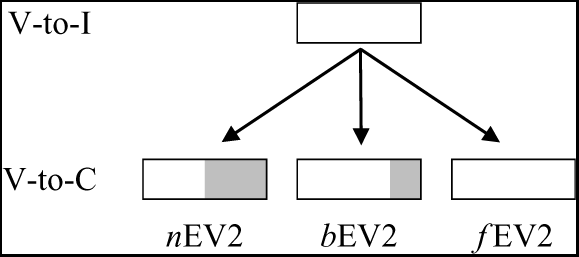
Abstractly, the situation can be summarized as follows. Assume that a language possesses V-to-I in all ‘embedded’ clause types. As depicted in Figure 1, V-to-C reanalysis, which in the core case means transition from structures like (3a) to structures of type (3b) (Section 3), implies avoidance of EV2-hostile environments (here marked as shaded areas).
V-to-C reanalysis and EV2-types.

The distributional consequences of this avoidance, however, depend on the EV2-type of the language at the stage of the reanalysis. If the language possesses ‘free EV2’ (fEV2), i.e. a (hypothetical) type where all environments are EV2-friendly, there would be no observable consequences. The strings representing pattern (3) above would continue to occur in all embedded environments. If, by contrast, we are dealing with an nEV2 system, such strings will be confined to ‘assertion-friendly’ environments. Finally, under bEV2 we end up somewhere in between. The EV2-friendly region is expanded without constituting an ‘anything goes’. Thus, to repeat, in order to settle the case for or against K&Z’s V-to-C reanalysis of V-to-I, one needs to establish the EV2-type of the language in question at the historical stage the reanalysis is supposedly taking place.
6. Broad EV2
From the discussion so far we can conclude that an important step toward a defense of K&Z’s V-to-C reanalysis approach would consist in showing that Danish was a bEV2 system at the stage(s) where putative V-to-I configurations continued to occur in the absence of rich verbal agreement. If that were possible, a follow-up step would have to consist in arguing on independent theoretical grounds that V-to-C is the correct analysis in all of the controversial cases. However, given (i) the doubly negative characterization of bEV2 – broader than nEV2 but narrower than fEV2 – and (ii) the still only partially understood nature of nEV2 (Section 4.1), it may be difficult to make any further progress fast. Since it is impossible to do justice to the intricacies of this within the confines of the present paper, I’ll leave the topic for further research. Instead, I’ll conclude by briefly revisiting an approach to bEV2 that links it back to the RAH.
6.1 Broad EV2 and rich agreement
Holmberg & Platzack (Reference Holmberg and Platzack1995:Sections 3.4.3–3.4.6) analyze EV2 in terms of ‘CP-recursion’ (see e.g. Vikner Reference Vikner1995, and Vikner Reference Vikner, Freitag, Bott and Schlotterbeck2017a for recent revisions), where the difference between nEV2 in modern Mainland Scandinavian and bEV2 in Modern Icelandic and Old Norse hinges on the absence vs. presence of an additional finiteness feature [+F] on the outer C° (p. 84). This is schematically shown in (16a)/(16b), corresponding to the relevant parts of (4a)/(4b), respectively.
(16)
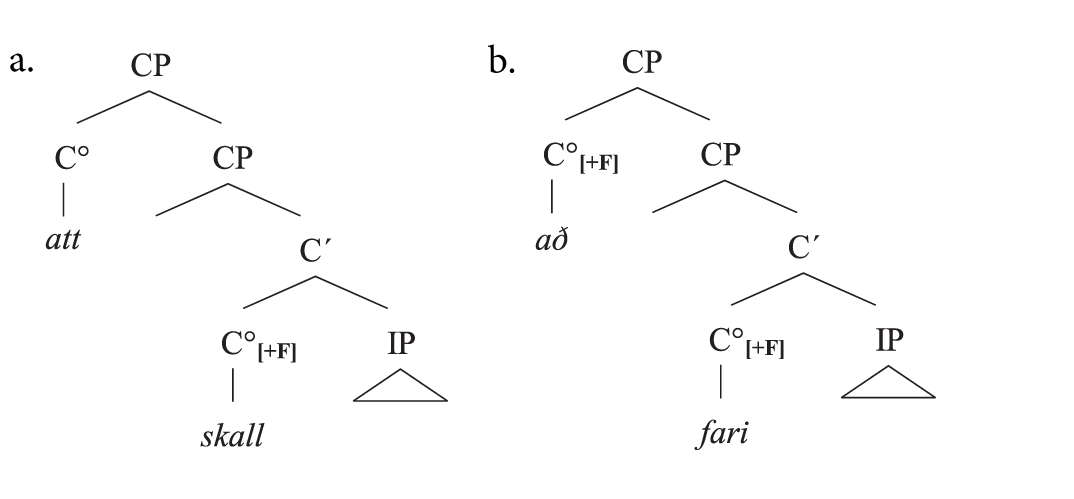
Crucially, the additional [+F] is licensed ‘only in a language with nominative Agr’ (p. 84), that is, a language with rich verbal agreement. Secondly, lexicalization of [+F] by the finite verb is assumed to trigger ‘main clause interpretation’ (p. 86), which confines the EV2-clauses in question to ‘assertion-friendly’ environments. This is what enforces nEV2 for languages lacking rich agreement like Swedish, as exemplified in (16a)/(4a). Lexicalization of [+F] by a complementizer results in a standard subordinate clause, compatible with whatever semantics subordination requires. Where both types of lexicalization cooccur as in (16b), the outer specification wins out and ‘main clause interpretation’ triggered by V-to-C is suspended (p. 86). This allows EV2-clauses in languages with rich agreement like Icelandic, (16b)/(4b), to behave like ordinary subordinate clauses, which is the basis for bEV2.
Turning to the diachronic consequences of the above account, we can notice that the RAH becomes part of a larger ‘conspiracy’. Loss of rich agreement not only results in loss of V-to-I (see also Holmberg & Platzack Reference Holmberg and Platzack1995:77) but in addition it comes with a switch from bEV2 to nEV2, as summarized in (17).
(17) rich agreement & V-to-I & bEV2
⇓
poor agreement & V-in-situ & nEV2
This immediately predicts that K&Z’s V-to-C reanalysis of putative ‘late’ V-to-I should occur in an nEV2 context. Thus, the strategy of accounting for verb positioning in, for example, conditionals like (12) by postulating the relevant historical stage of the language to display bEV2 would no longer work.
However, the close link in (17) is dubious for the simple reason that – as already hinted at in Section 4.1 – in Modern Icelandic bEV2 is found only in certain varieties. On the whole, Modern Icelandic shows variation between bEV2 and nEV2 (Jónsson Reference Jónsson1996:39). At the same time, all varieties of Modern Icelandic continue to possess both rich agreement and V-to-I. Likewise, the combination of poor agreement and bEV2 may exist in some varieties of Modern Norwegian, where, according to the survey by Bentzen (Reference Bentzen2014a), counterparts of (4b) were found acceptable. Similarly, the combination seems to show up in Middle Danish, as indicated at the end of Section 5.2 above.Footnote 24
7. Conclusion
As part of their ‘rehabilitation’ of the Rich Agreement Hypothesis, Koeneman & Zeijlstra (K&Z) (Reference Koeneman and Zeijlstra2014) subscribe to a close diachronic correlation between loss of rich agreement and loss of V-to-I. They propose to meet the familiar challenge of a protracted time lag between loss of agreement and loss of V-to-I (see e.g. Vikner Reference Vikner and Haegeman1997) by a number of reanalysis mechanisms, reanalysis of V-to-I as V-to-C, i.e. as ‘embedded V2’ (EV2), being the one focused on here. In a critique of K&Z’s approach, Heycock & Sundquist (H&S) (Reference Heycock and Sundquist2017) point out that V-to-C reanalysis is not an option in the case of Danish, for which Sundquist (Reference Sundquist2002, Reference Sundquist2003) expressly sought to identify instances of V-to-I in non-EV2 environments at the relevant historical stage(s).
In this short paper, I have argued that settling the case for or against V-to-C reanalysis requires carefully taking into account the ‘EV2-type’ of the languages under investigation. In particular, the familiar ‘narrower’ distribution of EV2 (nEV2) in modern Mainland Scandinavian – confined to, roughly speaking, ‘assertion-friendly’ environments – is known to contrast with a ‘broader’ distribution (bEV2) in certain varieties of Modern Icelandic and Old Norse. As a consequence, the borderline between ‘EV2-hostile’ and ‘EV2-friendly’ environments varies.
By way of illustration, I have raised concerns about some examples from Early Modern Danish that Sundquist (Reference Sundquist2002, Reference Sundquist2003) classifies as bona fide V-to-I. First, among relative clauses, non-restrictives must be handled with care, since, encoding ‘secondary’ assertions, they would constitute EV2-friendly environments even within the more limited nEV2-type.Footnote 25 Second, ‘hypothetical’ conditionals, which must be considered EV2-hostile under nEV2, have been shown to constitute EV2-friendly environments in (Old Norse) bEV2. Thus, putative V-to-I in such conditionals would resist K&Z-style V-to-C reanalysis only if the historical stage of the language in question counts as nEV2. This may not hold for Middle Danish, where evidence for bEV2 has been provided. The EV2-type of Early Modern Danish needs to be investigated.
Let me stress that I’ve chosen to focus on cases problematic for H&S in order to make a methodological point about the importance of distinguishing EV2-types.Footnote 26 Thus, even if it can be shown that both Middle Danish and Early Modern Danish possess bEV2, V-to-C reanalysis of the entire set of putative V-to-I cases in those languages will have to be argued to be the correct approach on independent theoretical grounds. What is more, given the doubly negative characterization of bEV2 – broader than nEV2 but narrower than an entirely unconstrained ‘free’ EV2 (fEV2) – and the still only partially understood nature of ‘assertion-friendly’ environments as basis for nEV2 (Section 4.1), no firm conclusions about the controversy can be drawn. Instead, a much more careful study of (varieties of) EV2 in the history of Scandinavian seems to be called for.
Acknowledgements
I am grateful to three anonymous reviewers, the editors of this volume, as well as Johan Brandtler, Þórhallur Eyþórsson, Cecilia Falk, Caroline Heycock, Jóhannes Gísli Jónsson, John Sundquist, and Sten Vikner for advice, comments, and criticisms at various stages of the research reported on here. I would also like to thank the audiences at the workshop on ‘Morphological Effects on Word Order from a Typological and a Diachronic Perspective’ (DGfS Konstanz, February 2016), the Departments of Linguistics at Wuppertal University and Cambridge University (March 2016), the Budapest–Potsdam–Lund Colloquium (Budapest, June 2016), and the workshop on Scandinavian syntax at the University of the Faroe Islands at Tórshavn (February 2017). I acknowledge support by the National Research, Development and Innovation Office (NKFIH) (project number K115922). Common disclaimers apply.