


“The nation state . . . found the novel. And vice versa: the novel found the nation-state” (Moretti 17). Franco Moretti's famous formulation has proved as partial as it is influential, challenged by a growing body of transnational scholarship.Footnote 1 It is challenged as well by a different set of novels from the canonical ones Moretti has in mind: working-class penny fiction. Given the inequities of society, it is not surprising that this literature expresses a more complicated relationship to England. The working classes laid claim to England itself, insisting that their autochthonic status made them its true sons but that within the nation-state they were subjects, not citizens.Footnote 2 The gap between this deep sense of belonging and formal political exclusion structures hundreds of penny novels produced in the mid-nineteenth century.
Here I examine a decidedly un-representative but nevertheless significant trio of novels written by popular author G. W. M. Reynolds and inspired by the Crimean War, which provoked a crisis in class relations: Leila; or the Star of the Mingrelia (1856), The Loves of the Harem; or, A Romance of Constantinople (1855), and Omar: a Tale of the War (1856).Footnote 3 These novels focus on the Caucasus, Turkey, and Poland – what Thomas McLean calls “the Other East,” a useful phrase I will appropriate for this article. Mixing real people and events with outlandish plot devices and invoking a motley array of historical periods, these novels would seem to have a precarious hold on reality, let alone on a functional political agenda. However, they mark an important if unfulfilled shift in the imaginary of radical politics.Footnote 4 Decentering England and turning away from the dream of national belonging, they sketch a nascent international vision, provoked by the frustrating class dimensions of the Crimean War.Footnote 5 In doing so, they give us a window onto the affective dimension of radical politics, especially the profound disaffection of the working classes at this historical moment. Moreover, as modern scholars increasingly critique “blood and soil” or “birthright” citizenship, which depend on the same autochthonic claims promoted by Victorian radical politics, Omar in particular deserves attention as it considers how a different kind of community could be as satisfying as a territorial “home.”
Penny Fiction and Radical Politics: Tales of Land and Blood
Since the 1830s, when they first appeared, penny novels played an important role in a robust alternative public sphere, organizing the aims of radical politics into compelling, accessible fantasies.Footnote 6 Often advertised and sometimes serialized in populist periodicals, they were read in the context of political arguments. Moreover, as Ian Haywood asserts, “the supposed boundary between the fictional and the political was in fact highly permeable” (172).Footnote 7 Journalism freely adapted the tropes and rhetoric of melodrama, while fiction allegorized political issues in individual stories and interpolated political materials such as annual poverty statistics into the narrative flow. Such gestures told readers that novels spoke to the real world in spite of their extravagant plots.Footnote 8 Reynolds was easily the most widely read author in this popular genre. He pioneered this hybrid form, mixing politics and fiction, reality and fantasy.Footnote 9 An arresting public speaker and an elected member of the executive committee of the National Chartist Association, Reynolds was also the publisher of Reynolds's News and Reynolds's Miscellany, becoming a kind of populist brand-name through these overlapping endeavors. Serializing many of his novels in the Miscellany, Reynolds implicitly instructed readers to interpret them within the framework of the political news and commentary that appeared alongside them. Reynolds was hugely popular among the working classes, outselling Dickens and reaching a broader, less privileged audience. In his obituary, the Bookseller called Reynolds “the most popular writer of his time” (“G. W. M. Reynolds” 600).Footnote 10 Though forgotten today, it is likely that these three novels were widely read, and read as symbolic versions of real political aspirations. Their sensational fantasies enlisted readers’ emotions and desires, inviting vicarious participation in their alternative imagined communities.Footnote 11
In order to understand how radical these “Other East” novels are, it is important to understand the dominant metanarrative of populist politics and the conventions that emplotted it in much penny fiction. The essential story, political and fictional, is one of belonging, dispossession, and restitution.Footnote 12 According to radical history, the Saxons enjoyed an egalitarian, democratic, agrarian society until the Normans invaded, stole the people's land, and installed a foreign hereditary aristocracy.Footnote 13 This injury was repeated hundreds of years later when the Enclosure Acts seized common land and annexed it to large estates. This second usurpation destroyed the commons, abrogated the people's ancient right of access, and exiled small farmers and their families from land they had worked and lived on for generations. They became refugees in their own country. Though historians continue to dispute the actual effect of the acts, their cataclysmic injustice was an article of faith for radical politics.Footnote 14 Chartists advanced this metanarrative to justify universal male suffrage, arguing that the people deserved formal citizenship because of their ancient relationship to the land.Footnote 15 In other words, Chartism assumed the people's claim to what modern theorists call “birthright” or “blood and soil” citizenship, the assertion of an essentialist national identity based on place of birth. With terms such as “primordial” and “metaphysical,” theorists emphasize the profundity of the connection between land and people to explain the claim's staying power.Footnote 16 The highly-charged distinction between insiders and outsiders, between those who belong and those who trespass or usurp, originates in the assumption that the natives of a place have unique worth and special status, a kind of priority citizenship.
The fictional versions of this metanarrative use the family and the land – two of the most common tropes for the nation – to symbolize national belonging.Footnote 17 Working-class protagonists discover that they are long-lost members of aristocratic families, entitled to names and estates by biological kinship. As one aristocratic character announces to the formerly plebian heroine, “The blood of the Claverings rolls through your veins, Mary Price; and therefore I have willed unto you . . . the domain of my ancestors” (Reynolds, Mary Price 2: 346). In some novels, the restoration of identity achieves political agency as well. When he discovers his aristocratic heritage and inherits an estate, the erstwhile servant Joseph Wilmot gains the vote and becomes an M.P., having fulfilled the property requirement for suffrage and Parliamentary service (Reynolds, Joseph Wilmot), while lowly Allan Fearon manages an even more impressive feat of social ascent when he is recognized as “a prince of royal blood” – that is, the illegitimate son of the Prince Regent – and is granted an Earldom, complete with all the perquisites of a peer of the realm (Rymer, 2: 246). In these allegories of restitution, “blood” signifies the immutable belonging of the people, while the inheritance of an estate fulfills an inalienable claim to the land. With the tropes of family and home, these novels symbolically realize the essentialist claims to blood-and-soil Englishness. They also chart the enormous affective dimension of radical politics, which went well beyond the limited agency that could be achieved by reforming the franchise. Marginalized and disdained in real life, working-class readers could imaginatively enter an alternate reality, a virtual England in which they were privileged members.
To radicals, the metanarrative seemed irrefutable, based on the very essence of England itself, but of course Parliament and the establishment press repeatedly rejected their demands. Not surprisingly, members of the House of Lords were not inclined to see the estates their families had held for centuries as stolen property or to regard English history since 1066 as a misguided departure from the country's true destiny. Though it offered a deep sense of affirmation to the working classes, the metanarrative lacked persuasive power among England's elite. Radical politics’ continued commitment to these claims through much of the century is a good example of Lauren Berlant's cruel optimism: “a sustaining inclination to return to the scene of fantasy that enables you to expect that this time, nearness to this thing will help you or the world to become different in just the right way” (2). Even as Parliament repeatedly rebuffed suffrage petitions, motivated by its own fantasies of working-class incapacity, radical politics clung to its original story.
The International Turn
“What happens when those fantasies [that sustain optimism] start to fray?” Berlant asks (2). Though the metanarrative never disappeared, the working classes also looked to other nations for ideas and inspiration. By the time of the Crimean War, English radicals had been forging relationships with their counterparts in other nations for some time, a dimension of working-class history that lays the foundation for the fantasies that animate these Other East novels. Reynolds enthusiastically supported this international turn. A seven-year sojourn in France as a young man left him with a lifelong admiration for that country's republican politics, along with a French passport, while Reynolds's News and Reynolds's Miscellany provided extensive coverage of popular movements in other countries.Footnote 18 Drawing out and simplifying threads of complex relationships, Reynolds's novels highlight these new identifications and moments of solidarity to craft a utopian vision of an extra-national community.
Ideologically, the most significant contribution of European radicalism was the idea of natural or human rights, grounded in Enlightenment values and popularized by Thomas Paine's The Rights of Man (1791). Departing dramatically from land-based claims rooted in a specific national history, the doctrine of human rights asserted that all men are entitled to political agency simply by virtue of being human. Powerfully influential, it managed to co-exist alongside nativist claims despite the obvious logical contradiction.Footnote 19
Less concrete but equally powerful were the psychic rewards that attended encounters with international others. External support and validation provided a temporary escape from a discouraging lack of status or progress at home. In England radicals were rebuffed by Parliament and frequently reviled in the mainstream print culture, especially when they were represented as a group exercising agency. Individual workers might be reasonable, articulate, or pathetic, but as a political bloc, they were mostly demonized as members of an animalistic mob or as a frightening, undifferentiated, non-human mass whose sheer numbers would “swamp” more deserving voters.Footnote 20 But in meetings with foreign counterparts, radicals were welcomed as important allies and political thinkers. When a Chartist delegation traveled to France in 1839, it engaged in a kind of unofficial (or anti-official) diplomatic mission, reassuring French working men that it rejected the English government's hostility and discussing possible responses to the shifting alliances among France, England, Russia, Austria, and Turkey (Lowery 164–65). Reflecting the movement's sophisticated understanding of international politics, these discussions created a sense of political participation, solidarity, and agency that was difficult to achieve at home. To borrow the rhetoric of Jacques Rancière, working people moved from a national context in which they were “the uncounted, a part of those who have no part” (33) to an international one in which they played an important part and their ideas were taken into account.
This contrast intensified in 1848. While populist revolutions raged in Europe, English Parliament rejected yet another suffrage petition and O'Connorville, a Chartist agrarian community, began its slide into legal dissolution. Seeing themselves as citizens of the world, the working classes could stand with French, Italian, and Hungarian patriots and imaginatively participate in the birth of new democratic orders. Extensive newspaper coverage brought details of these revolts to readers. Exiled patriots such as the Italian Giuseppe Mazzini and the Hungarian Lajos Kossuth were fêted in London as celebrities while the popular press chronicled their movements and circulated their portraits, knitting these foreign personages into the fabric of English politics. Emerging from this moment, the Association of Fraternal Democrats sought to model an international community held together by a shared commitment to freedom that transcended national boundaries. Englishmen, Frenchmen, Poles, and Hungarians, all victims of government oppression, formed a “holy alliance” in the organization (Frost 128), while representatives of other nations grouped themselves together under the title “Young Europe.” At a series of meetings of the Association of Fraternal Democrats, founded in London in 1845 and active until 1853, Russians sat with Polish members, and Spaniards joined the French. All held membership cards bearing the motto “All men are Brethren” in twelve languages (126). According to historian Margot C. Finn, such connections were part of “an international community of labour [united] . . . behind a common political cause” (122).Footnote 21 Chartist Thomas Frost describes a euphoric meeting celebrating the abdication of King Louis-Philippe of France: vividly portraying the multicolored flags hanging together on the wall, Frost depicts the “electrical” effect of the announcement of the abdication (128): the “mingled assemblage of Englishmen, Frenchmen, Germans, Poles, and Hungarians” hoisted up the flags of each other's nations and then, “with linked arms and colors flying,” spilled out into the street in a display of “enthusiastic fraternization” (130).Footnote 22
Reynolds offers a similar scene of international community in his novel Joseph Wilmot, which eventually awards its hero an estate, the vote, and Parliamentary membership. When Joseph travels to France and stumbles upon a secret society planning to overthrow Louis-Philippe, he finds a “conclave of all grades and of both sexes, linked together by one common bond of patriotic enthusiasm” (1: 406). Overcome by this display of unity, Joseph agrees to help them and is embraced as a full-fledged member: “You are welcome, citizen, amongst us; and you will receive the thanks of the patriots here assembled for yielding to the impulses of your own generous nature and joining the sacred cause we have in hand” (1: 404). Before he attains his English birthright, Joseph finds a better home among French rebels. Serialized on the eve of the Crimean War, Joseph Wilmot suggests the endurance and attraction of the dream of international brotherhood, even within a story arc largely shaped by the nativist metanarrative.
The satisfactions of international encounters – the exhilaration and sense of belonging – must have been powerful. They held out a glimpse of an expansive class-specific community, aspirational but believable. Perhaps because these moments were intermittent, unlike the ongoing struggles of domestic radicalism, they were easy to idealize. Standing at a distance from internal conflicts, foreign patriots could function in similar ways, as political imagoes. So Reynolds's Miscellany described Mazzini, the Italian patriot, as “a type of moral and intellectual genius and strength,” an “exemplification of genius” who is “incarnated with the grand conception of Italian republican unity . . . [and] the divine spirit of Dante” (“Joseph Mazzini”). The rhetoric of “type,” “exemplification,” and “incarnated” promised readers that their ideals could come into being, whole and perfect. Of course, relations with European counterparts were not always rosy, nor did they definitively undermine a sense of national identity. Competing expatriots fell in and out of fashion, while, in solidarity meetings, different groups sometimes engaged in a kind of parallel play: national toasts and rituals were honored but not always engaged in, or even understood, by members of other groups. Still, internationalism became a key component of English radical politics. The 1848 revolutions promised such dramatic, wholesale change that they provided resources for utopian fantasies that were as compelling as the dream of national inheritance and were more firmly grounded in the real world.
The Crimean War both exacerbated class antagonism and renewed the internationalism that had abated somewhat in the intervening years. A showcase of aristocratic privilege and military ineptitude, the war further alienated the working classes from their own country. While the English aristocracy had been the standard villain in the metanarrative, resentment spread to England itself, undermining the “partisan patriotism” that co-existed, somewhat paradoxically, with relentless critique (Finn 172).Footnote 23 Real-time exposure provided ample opportunity for commentary and judgment. Describing the conflict as the first “media war,” Stefanie Markovits analyzes the extensive, first-hand coverage it received as it was unfolding (3). Unlike previous conflicts in which information was carefully packaged in official dispatches, this one attracted an array of on-the-spot reporters from the Times’s official correspondent William Howard Russell to the soldiers themselves, whose letters home were published by their families. This widespread and diverse coverage created a new discursive context: strategies, battles, and logistics were dissected as never before, making the war a site of concerted public reflection on England itself and its role on the international stage. Though the conflict was no one's idea of a well-managed endeavor, criticism in elite periodicals was nothing compared to the vituperation heaped on the government and its generals by the radical press. While the mainstream press reported military failures, it also struggled to find some shred of heroism or bravery. Radical papers dispensed with the struggle; for them, the only story was the military ineptitude that resulted directly from class privilege. Indeed, the war not only reflected but intensified class injustice. According to Reynolds, the elite background of the generals trained them only in arrogance and stupidity, yet these “aristocratic nincompoops” actually enlarged their privileges as they were awarded additional titles and estates for their service (“Omar Pasha and General Williams”).Footnote 24
Moreover, the interpretation of the conflict itself broke down along class lines: what the government saw as a potentially dubious attempt to control Russian aggression and maintain its own sphere of power in eastern Europe, popular periodicals saw as a transnational, populist struggle for freedom. While class oppression in England was a national problem to be addressed by the franchise, the Norman invasion also defined it as the outcome of a foreign occupation, an understanding that enabled identification with the targets of Russian imperialism.Footnote 25 Just as the radical press presented the French, Italian, and Hungarian people as fellow-travelers in the cause of democracy, so Reynolds's Newspaper encouraged readers to identify with the Circassians, the Mingrelians, the Wallachians, the Turks, and the Poles. Indefatigable (if unsuccessful) defenders of their liberty, the Poles were frequently compared to the English; in the words of a popular ballad, they “sustained a hundred fights” to defend their independence, just as the English “are born to freedom” (qtd. in Finn 175).Footnote 26 The Circassians were celebrated for their defense against foreign incursions, while Turkey was viewed as exemplary in its fierce resistance to Russian aggression, representing the ideals of the free-born Englishman better than his own country. The subtitle of one article praising the Turks, “Ottoman Bravery and English Calumny,” re-situates patriotic pride in a foreign land (“The Turkish Victory at Kars”).Footnote 27 Just as it had idealized Mazzini, the radical press promoted the bravery and intelligence of foreign leaders, urging readers to invest in the heroes of other nations. It lionized Schamyl as “the Prophet Warrior” (“Schamyl the Prophet Warrior”) and extolled Omar Pasha is “the greatest field-general of his day” (Reynolds, “Who Must Be Blamed?”) while denouncing the failures of English officers.Footnote 28
In its most radical form, such critiques identified England with Russian tyranny in spite of its military opposition to Russia. In the cases of Poland, Turkey, and Circassia, England's indifference is understood as enabling Russian aggression.Footnote 29 Indeed, by failing to protect the integrity of the Turkish people, “the allies have done in Turkey what Russia sought to do” (“Kossuth and the English People”). Addressing an audience in London, the Hungarian patriot Kossuth accused England of fighting to defend Austrian tyranny rather than Turkish freedom (“Kossuth and the Austrian Alliance”).Footnote 30 Aligning England ideologically with the despotic countries it opposes militarily, Kossuth suggests that the interests and values of the English working-classes are better promoted by Turks and Hungarians. Though the allies won militarily, England lost the war of ideals that inspired the working classes:
We were fighting for freedom and civilization; the object of the war was to restrain barbarism, to overthrow tyranny. . . . These dreams of the British people, it is not necessary to state, have not been realized. The European peoples, thanks to the management of [the British government], are still in their chains. (“Reasons for Rejoicing”)
Thus, the popular press redrew official alliances, associating England as a nation with Russia the oppressor on the one hand, and the English working classes with oppressed Eastern populations on the other. The category of “the people” superseded that of nation.
Leila, The Loves of the Harem, and Omar owe their plots and values to this context. As a group, they take the Crimean War as their direct or indirect inspiration, assuming readers’ knowledge of the region and its issues. (The Loves of the Harem is particularly opportunistic, as Reynolds exploited the conflict to repurpose some exotic eastern stories as inset tales within a new frame narrative.) Along with the political reporting quoted above, periodicals published descriptions of Constantinople, a profile of the Turkish Sultan Abdul Medjid Kahn, a short story about a Circassian slave, the review of a travelogue about the region, and similar pieces. These articles fleshed out the map of the Other East geographically, politically, and symbolically, bringing this once-exotic region home to readers in concrete ways. Published on the heels of one another, these novels are linked together and to the war by multiple intertextual connections: the first chapters of Leila and The Loves of the Harem appear in Reynolds's Miscellany alongside Omar on 5 January 1855 (369–73); and references to Mingrelia, Circassia, Turkey, Wallachia, Moldovia, and Poland cross over from one novel to another. Set in 1807, The Loves of the Harem makes an anachronistic allusion to the Crimean War when a Russian frigate attacks a Turkish pleasure boat in spite of the alliance between the two countries, a reference that would not have been lost on a reading audience steeped in reports of Russian aggression. Moreover, the presence of historical figures in the novels, counterbalancing their more fantastic elements, encouraged readers to see them as relevant to real life. Omar appeared frequently in the press, while various other characters such as King John Soblieski of Poland, Kara Mustapha, Sultan Selim the Third, and Sultan Mahmoud the Second, who populate The Loves of the Harem, were historical figures.
Drawing on the Crimean conflict enabled these novels to challenge the primordial Englishness that was also celebrated by radical politics. Most obviously, unlike the novels shaped by the metanarrative, these do not take place on English soil and, except for Omar, make almost no reference to England. Offering no English characters worthy of emulation, these novels encourage readers to reorient their imaginative sympathies to the heroes and destinies of other countries. While other penny novels maintain a sense of England as a homeplace, only temporarily in the hands of usurpers and soon to become the property of its true inheritors, these novels do not give readers an imaginary England to inhabit or a utopian national future to anticipate. Instead, the notion of a stable national territory and a single, immutable national identity is undermined by the chaotic geopolitics of the region. Land grabs, foreign occupations, and shifting national boundaries draw the novels into the flow of modern history, displacing the ahistorical metanarrative. The fantasy worlds of these novels are composed of different places and peoples, even different conceptions of place and identity. Leila touches briefly on this possibility, while The Loves of the Harem deploys it suggestively but chaotically. The potential of these new conceptions is realized most completely in Omar, which thematizes them (relatively) coherently, imagining a fully-formed if counterintuitive community beyond the nation.
Setting the Stage: Leila and The Loves of the Harem
Leila and The Loves of the Harem consistently direct readers’ investments to the Other East. The Loves of the Harem, for instance, dislodges Eurocentrism by dating several tales according to the Muslim as well as the Christian calendar and referring to Europe as “the Far West,” adopting the perspective of the Turks (136). Echoing journalistic accounts, the novels portray Eastern peoples as freedom fighters whose love of liberty parallels that of the English working classes. In the face of Russian incursions, the Mingrelians retain “a certain shadow of independence, with their own princes, and their own laws” (Reynolds, Leila 4).Footnote 31 Poland, the subject of the longest of the inset tales in Loves of the Harem, protects Venice from foreign invasion. In clear if implicit references to England, these novels praise the good government of their heroes, setting their utopias on foreign soil. A Mingrelian sovereign is “beloved and adored by his people” because of “the undeviating course of justice which he pursued and the liberal institutions which he voluntarily established” (Reynolds, Leila 90), while Mahmoud the Second is “a liberal, and an enlightened” ruler, always “faithful to the interests of his subjects” (Reynolds, Loves 333). Wish-fulfilling resolutions occur, not on a landed English estate, but under the benevolent rule of Eastern leaders.
Even more radical is the play of identities this setting allows. Religion is a particularly fruitful ground for re-making identities – or rather, for replacing identity with identifications. In the region's turbulent history, countries that were once Christian are now Moslem; and countries are divided between Christianity and Islam, making religious affiliation a matter of chance and choice rather than deep, enduring faith. One tale in The Loves of the Harem opens as an entire village converts from Christianity to Islam (21).Footnote 32 Throughout, religious identity is mutable, contingent. When an erstwhile Christian prays to Mohammed for the defeat of a Christian army, explains to a surprised companion, “Young man, thou knowest not how soon circumstances may turn the heart, and eradicate those ideas and prejudices in which we were born” (64). Circumstances and new loyalties trump inherited identities.
In Loves of the Harem, this religious fluidity has the most far-reaching effects. Multiple time frames and settings fracture the coherence of a single national history. The tales are set in 1287, 1389, the end of the fourteenth century, 1483, the seventeenth century, 1803, and 1683; geographically, they take place in Serbia, Bavaria, France, Turkey, Greece, Venice, and a part of Asia Minor “occupied by a Byzantine or Greek garrison” (21). They narrate various historical conflicts in the general region such as an ancient battle in Kosova involving Serbs, Bulgarians, Albanians, Walachians, Poles, Hungarians, and Turks; and the siege of Venice by the Ottoman Empire, turned back by the heroic resistance of John Sobieski, King of Poland. In this stew of nations and periods, England is completely displaced, its geography and history nowhere to be found. Alliances change; though the Turks are the heroes in the frame narrative, they are the enemy of the Poles during the siege of Venice, while Albania is a separate nation in the fourteenth-century inset narrative but is partially absorbed into Turkey in the 1807 frame narrative (37). Although the Other East remains the novel's setting, the reader's more specific sympathies shift from tale to tale along with national borders and transnational alliances (though Russia is always the enemy). However shallow or commercial Reynolds's reasons for creating such a pastiche, the chaotic structure of The Loves of the Harem dismantles the idea of a single national origin or history, a single national or religious identity, a privileged place or people. Nations are not conceived as static essences but as contingent entities subject to historical change. This layered history creates multicultural spaces such as Constantinople, where “Turk, Armenian, Jew, Greek, [and] Frank” coexist (2). Individuals also have multiple identity markers: a Greek man makes his home in the Turkish section of Albania, a Turkish man looks like a Parisian, while a Bavarian man looks Greek. In its treatment of nations, alliances, and religion, Loves of the Harem presents a world in which nations are flexible formations, complicated and revised over time.
Given the new alliances and precarious national borders that characterized the Crimean war, this understanding is resonant but also disturbing: in this modern context, what would become of the metanarrative of radical politics, based on an essentialist conception of people and nation? Perhaps this anxiety underlies the ambiguous attention the novel gives to the Janizaries. This elite (and real) military corps is composed of Christian soldiers who are forced to convert to Islam, protect the sultan, and fight against soldiers of their own nation. In the siege of Vienna, the Janizaries fight fiercely of necessity: “Christian renegades, or the sons of Christians who had abjured their faith, what mercy could they expect at the hands of soldiers who might be almost termed their fellow country-men?” (Reynolds, Loves 306). These warriors are a fun-house mirror reflection of the fruitful mutability that threads through the rest of the novel. They exemplify disloyalty, ruthlessly extorting wealth from their leaders with threats of rebellion and staging a coup against the benevolent sultan.
This predicament suggests the dark side of The Loves of the Harem’s fluidity as the novel registers the cost of relinquishing national identity: the loss of a stable community, dependable attachments, and enduring loyalties. The increased vulnerability of the Janizaries in battle also signifies the psychic toll of contingent identities and historical change. To a people accustomed to staking their claim in terms of a primordial connection to the land and an essentialist sense of Englishness, embracing a more instrumental version of national inclusion would be difficult. Whatever formal mechanisms of citizenship they won and whatever new agency they attained, their privileged status would count for nothing. What conception of belonging could take its place? What affective satisfaction would be sacrificed with loss of the autochthonic fantasy? What articles of faith would have to be demoted to the status of illusion and given up? Berlant insists that cruel optimism should not be seen as an “error” but as “a scene of negotiated sustenance that makes life bearable” (14). Primordial belonging was a counterweight to the profound depredations suffered by the working classes: not only poverty and the lack of political agency but the indignity of subordination, demonization, and invisibility. Primordial status granted the working classes a valued and central personhood they did not have in real life. The loss of this security threatened familiar forms of community and communal identity. As Berlant writes, imagining new formations calls for “compensation for . . . profound, collective, material, and fantasmic loss” (222).
Omar's Imagined Community
Omar: a Tale of the War takes up this anxiety by imagining a community based on neither blood nor soil. Using the war to disavow England and the very idea of national identity, it displays a full-fledged anti-Englishness, fashioning a multi-national community from flexible, layered identities.Footnote 33 Though it follows the episodic, multi-plot format of most penny novels, it tames the chaos of The Loves of the Harem and streamlines its anarchic structure into a more coherent narrative.Footnote 34 Capitalizing on the ability of fiction to cultivate identifications and dis-identifications through character and narrative, Omar implicitly urges readers to de-cathect from Englishness.
Published as the conflict was unfolding and taking the war as its subject, Omar had an unusually close relationship to journalism, exploiting a class-specific perspective to fashion characters and events. Serialized literally alongside commentary in Reynolds's Miscellany and in the midst of news reports in other radical periodicals, it relied on readers’ knowledge of the war (Figures 16 and 17). Profiles of generals, descriptions of Constantinople, and advertisements for maps to help readers visualize events appeared alongside the parts of the novel, while the novel itself included maps and detailed descriptions of battles. At one point, Reynolds apologizes for including so much “purely historical” material in a novel, but it is clear that, if he fears boring his readers, he nevertheless wishes to shape their responses in politically salient ways (Omar 262). The Reynolds brand tied together Omar, Reynolds's Miscellany, and Reynolds's Newspaper, ensuring that, in spite of Reynolds's apology, Omar presented itself as a credible, reality-based recounting of the war, though an unusually lively one.
Reynolds's Miscellany covered the Crimean War as it unfolded during the publication of Omar (“Camp Scene in the Crimea,” Reynolds's Miscellany, 3 Mar. 1855, 80).

Omar opens with an illustration much like those used in news coverage of the war (Reynolds's Miscellany, 6 Jan. 1855, 369).

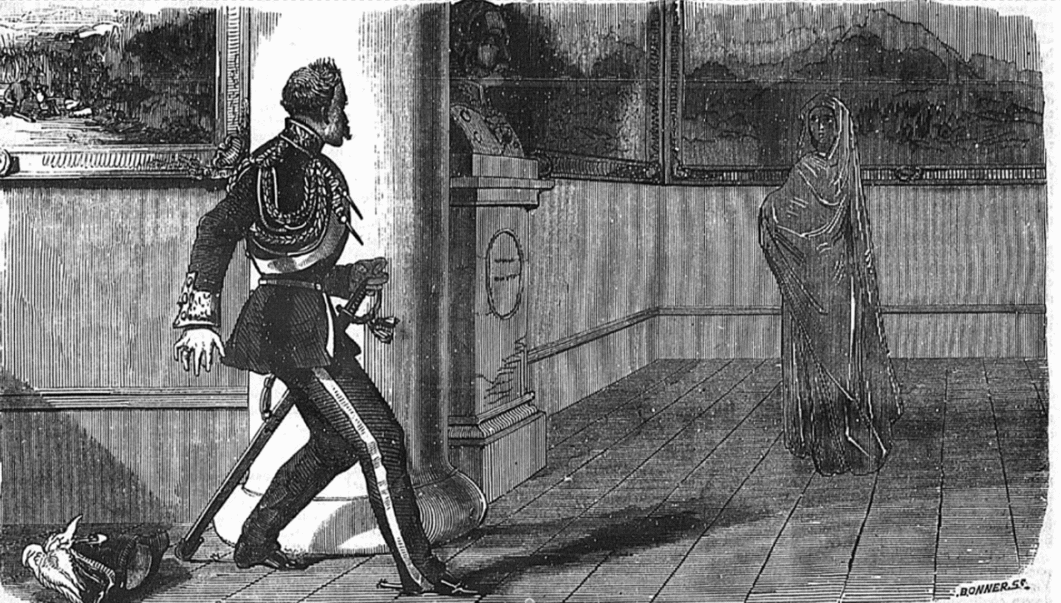
Reynolds's decision to focus his novel on Omar Pasha, the Turkish general, immediately suggests the novel's intent. A key signifier in the class-specific analysis promoted by the populist press, Omar marked a dividing line between the English establishment and radical politics. Along with its more general excoriation of aristocratic incompetence, Reynolds's Newspaper repeatedly held up Omar as a true hero, unlike England's incompetent generals (Figure 18). The organization of his forces is “acknowledged to be perfect in every respect,” Reynolds claims, adding that the English army's usual fortifications would “bear no comparison” (“A Scene”). Reynolds's Newspaper assures its readers that England is alone in failing to honor Omar – “on the Continent, the Pasha's name is mentioned with profoundest respect in all military circles” (“Omar Pasha and General Williams”) – a neglect it characterizes as “inexpressibly mean” and motivated by jingoistic “envy” (“Omar Pasha's Victory,” “Omar Pasha – The Betrayal of Kars”). These articles shift readers’ investment to Omar as the exemplar of heroism and honor. Reynolds further encourages this shift by aligning Omar with European populist heroes. Though the novel generally occupies the first page of the Miscellany, it is twice displaced by profiles of the European patriots Mazzini and Kossuth, creating a lineage of political imagoes that includes Omar (Figures 19, 20, and 21). Emphasizing the roles of Kossuth and Mazzini in the 1848 uprisings, the profiles remind readers of this moment of international brotherhood and suggest that it might be a precursor to similar revolts against the tyrants of the Crimea. Narratively and visually, the novel underscores this connection when a ghost who appeared in 1848 to signal the death of a despotic Prussian king returns to haunt his descendant in 1855 (Figure 22).
Before the publication of the novel, the real Omar was presented as a military hero (“Omar Pasha: A Personal Sketch,” Reynolds's Miscellany, 11 Mar. 1854, 97).

Omar on the first page of an issue of Reynolds's Miscellany during the novel's publication (Reynolds's Miscellany, 4 Aug. 1855, 17).

Mazzini takes over (“Joseph Mazzini,” Reynolds's Miscellany, 24 Nov. 1855, 273).

Kossuth takes over the first page of Reynolds's Miscellany during the novel's publication (“Louis Kossuth,” Reynolds's Miscellany, 1 Dec. 1855, 189).

The ghost of 1848 reappears in 1855 (Reynolds, Omar 289).
In contrast to over-privileged English generals, Omar occupies a lower rung of the social hierarchy and expresses the populist solidarity that goes with it. A “subaltern” who is above “national prejudices,” he eagerly joins a foreign army to confront Austrian imperialism (Reynolds, Omar 2). As in Leila and The Loves of the Harem, the egalitarian institutions of the Other East shame England. Omar does not need to be an aristocrat, or even a Turk, to command the Turkish army because “promotion was rewarded to merit and . . . the humblest individual might hope to rise to the loftiest position – inasmuch as no patrician exclusiveness or hereditary privilege usurped the monopoly on all posts of honour and distinction as the aristocracy does in other countries” (11) (Figure 23) Unlike the English army, which reproduced the class system and alienated ordinary soldiers, this army welcomes anyone who shares its idealistic goals.Footnote 35 Along with his military triumphs, Omar molds his men into his own image, urging them to lay aside partisan attachments and enter fully into the community of the army. Only by recognizing the abilities of their fellow soldiers can they promote the army's ideals. He fulfills the role of imago by modeling not only expert generalship but also interpersonal ethics. As he counsels a particularly hard case, “to be generous is to be just” (160).
The Turkish sultan selects Omar to command his forces (Reynolds, Omar 41).

The hard case is Sidney Hazlewood, an English officer, who, if not the villain of the novel, nevertheless has a lot to learn. His Englishness is his problem: he is xenophobic, envious, arrogant, and elitist, exemplifying all the qualities Reynolds reviles in his news reports about English generals. Competing with the French officer Adrian Delancey for the hand of the lovely Eloise Cuthbert, Hazlewood has ample opportunity to display his character: while Delancey is all fairness and openness, Hazlewood is ever on the lookout for “mean, paltry, insignificant” ways to undermine his “chivalrous” rival, in spite of the former's inconvenient habit of saving his life (Reynolds, Omar 84).Footnote 36 He is equally contemptuous of Gustave, a member of the Zouave regiment (a French division made up mostly of Algerians) who acts as his servant. Though, again, Hazlewood owes Gustave his life, he cannot imagine befriending someone who is so far his inferior in race, class, and nationality (Figure 24). (The fact that both characters need to save his life in order to budge him even a little from his chauvinism suggests just how entrenched, even constitutive, it is.) Hazlewood's English pride threatens the cohesion of the army when, dissatisfied with a military assignment, he draws his sword on Tewarik, Omar's nephew and second-in-command. His strong sense of national identity is dysfunctional, reproducing the dangerous antagonisms of the war within the army itself (Figure 25).
Disguised as Gustave, a member of the Zoave regiment, Catherine saves Hazlewood's life (Reynolds, Omar 165).
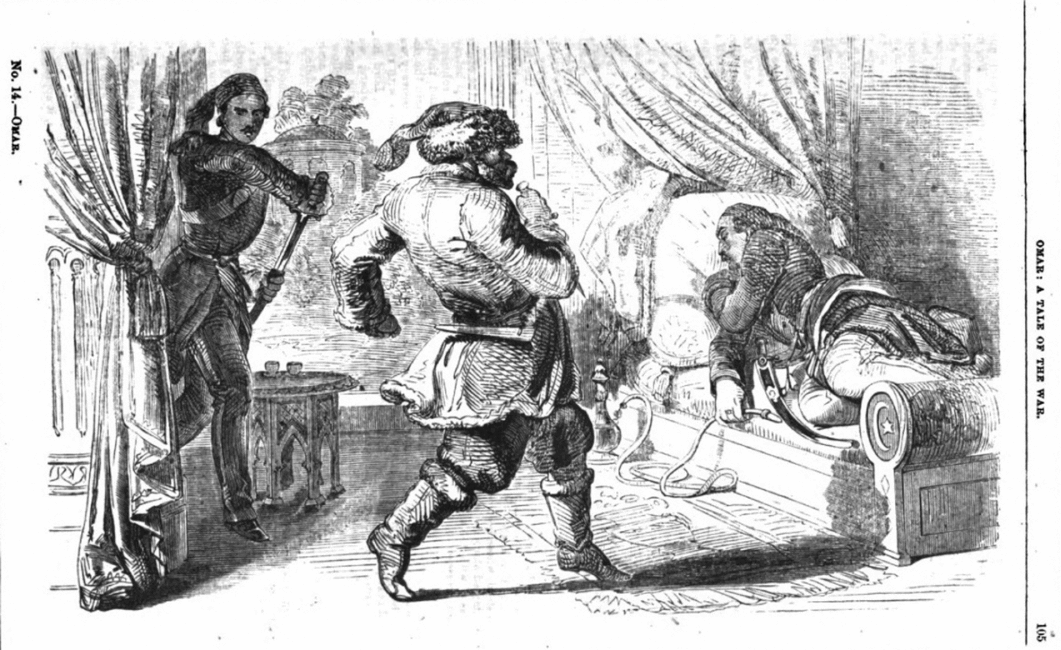
Hazlewood asks Omar's forgiveness for his transgressions (Reynolds, Omar 153).

Confirming the alienating qualities of the English, General Cuthbert, Eloise's father, is horrified by her love for a Frenchman, since he considers the French “one of the natural enemies of the British nation” (Reynolds, Omar 37).Footnote 37 Displaying his twin statues of Wellington and the defeated Napoleon at Waterloo in a nationalistic shrine, he is “an Englishman to his very backbone – English in all his ideas and habits – English in his opinions, in his pride, and his sympathies – and English too in his prejudices” (35). The repetition of “English” captures the reified quality of his character: one-dimensional, dependent on fetishized props, phobic about national others. In Omar, this is what national identity has come to.
In contrast to the jingoistic fixity of the English, Omar offers a different kind of identity. A remarkable mixture of different national and religious identifications, and speaking multiple languages, Omar is a prime example. Beginning the novel as Theodore Lattos, a Christian living in the Austrian section of Croatia, he crosses the border into Turkish-occupied Croatia to fight Austria and its Christian allies. Delighted by the cosmopolitanism of Constantinople, with its “population of Turks, Armenians, Jews, Greeks, and Franks” (Reynolds, Omar 11), Lattos adopts the name “Omar” to start his new life. Born a Christian, he declares himself willing to “make any sacrifice – even that of creed itself – in order to have an opportunity of someday fighting against the Austrians” (15), but he follows Christian “conduct” with his monogamous marriage (29). Religion is an identification rather than a fixed identity: Omar's “sacrifice” implies an attachment to Christianity but one he is willing to put aside to become, mostly, a Muslim, while retaining one of Christianity's central tenets. His nephew Tewarik, also named Theodore as a Christian living in Austrian Croatia, likewise changes his name, nationality, and religion. As in The Loves of the Harem, it is possible to change religion instrumentally and even to semi-change it to follow a hybrid set of practices. These characters are creatures of chosen affiliations and identifications – sequential, partial, and layered.
Gustave is another example of this kind of identity, and his membership in the French/Algerian regiment is not the half of it. Gustave, it turns out, is really Catharine, a Polish woman who, in a labyrinthine plot twist that is extreme even for penny fiction, is actually Hazlewood's wife, whom he abandoned in search of a more elite mate. Catharine models a flexible identity: a woman disguised as a man, a multilingual traveler, a Pole disguised as a member of a hybrid French/Algerian regiment allied with the Turkish army. It is poetic justice that Hazlewood finally acknowledges his marriage to Catharine, a national other who, like Omar, has much to teach him about his English hubris, just as it is appropriate that the novel bestows Eloise on Delancey the Frenchman. These mixed marriages repudiate the xenophobia of “English . . . English . . . English” and ensure the hybridity of the next generation.
Moreover, Catharine's Polishness is not really a national identity in the traditional sense since, as the novel reminds its readers, Poland has been “blotted as a nationality from the map of Europe by Russia” (Reynolds, Omar 132). Rather than locking her in a reified position, Catharine's Polishness is a notional status that leads her to identify with other beleaguered people. When her father complains that their family has been “stripped of our estates – beggared – . . . [and exiled] from our native soil” – a plight that would have resonated with post-Enclosure Acts working-class readers – Catharine sees their dispossession as the grounds for identification with others, a paradoxically international nationalism. “We are Poles” she tells her father, urging him to express his indignation by joining the Turks in “the cause of patriotism” against the Russians (150). Her “patriotism” consists of fealty to an ideal of freedom rather than a particular territory. In Omar, this imaginary Poland is the best kind of nation precisely because, freeing its people from the rigidity of birthright citizenship, it enables transnational attachments.
In this respect, it resembles the unlikely incarnation of such a community: Omar's army. While characters (mostly) retain some marker of their national origin, they must submerge that loyalty in their military membership. Contemplating the French and English banners flying “in the same breeze,” Delancey counsels Hazlewood, “our hands ought to join in a true fraternal clasp, and our hearts ought to be united by the firmest bonds” (Reynolds, Omar 84). Delancey's assertion recalls the flag-sharing, hand-clasping fraternal sentiment with which European and English radicals celebrated the abdication of Louis Philippe in 1848. In Omar's army as in that real encounter, national banners exist to signal alliance, not separation and competition. With only the most meager tokens of their origins, the army's irregulars, its fiercest fighting unit, exemplify the ideals of the army as they march together in a kind of diversity parade:
Some were appareled in a semi-European, semi-Asiatic fashion – others altogether in the primitive Asiatic style, with full ballooning breeches, caftan, and turbans. . . . Their countenances were as diversified as their costumes. There was the fairer European Turk – there was the darker Asiatic – there the still swarthier Moslem from the Levantine Isles of the African coast. (166)
The army itself becomes a model for multi-national cooperation.
Clearly, this community departs from the elitist, nationalistic ethos imputed to the English aristocracy. What is more surprising is that it also dispenses with the imagined England of radical politics, whose unchanging roster of insiders and outsiders stretched back to ancient Saxon culture. Omar's army exists within the temporal flow of history, accepting new members and reorganizing its structure as the need arises. In perhaps the most dramatic departure from the dominant conventions of penny fiction and the working class political imaginary, the setting of the Crimean War disenchants “the land” into a collection of strategic territories. This point is underscored by the status of Omar Pasha's birthplace, Croatia. Split in two and occupied by both Austria and Turkey, it is part of the modern world of geo-political conflict rather than an ancient homeland whose enduring metaphysical meaning confers an identity on its inhabitants. Likewise, the army sets its boundaries in non-territorial terms. It is always on the move, marching from battle to battle, with temporary encampments but without a home.
What holds the army together is what Omar calls “moral courage,” the quality necessarily to relinquish a sense of unique worth to forge broader loyalties (Reynolds, Omar 159). This is the term Omar uses to urge Hazlewood to accept others who do not share his ethnicity, class, or nationality – Gustave, the Zouave servant; Catharine, the Polish wife; Delancey, the French rival. Moving beyond the formal qualifications for military service, moral courage requires the practice of specific ethical behaviors and the cultivation of new affective ties. Though Hazlewood's physical bravery is never in doubt, he repeatedly violates the rules of group cohesion. Within the official boundaries of the army, defined by formal rights and responsibilities, is a second, unofficial community, an inner army of values and relationships. Members of this inner army consciously and voluntarily enroll themselves by demonstrating moral courage. Englishness is no longer privileged – in fact, the English are the least appealing characters in the novel, presented primarily as object lessons in the dysfunctionality of nationalism. Breaking with England, Omar makes an equally dramatic break with the working-class metanarrative and blood-and-soil citizenship, disidentifying with its own traditions and with the imaginary of radical politics.
Citizenship: A Thought Experiment
Omar's army is a disquieting utopian space. There is certainly something bizarre about using a military unit as a figure of harmony; of course, it exists to destroy the armies of other nations, and it has its own reified borders, though they are not territorial. However, in his anti-Englishness, his general internationalism, his class-specific investment in the Crimean war, and his hero worship of Omar Pasha, Reynolds fashioned the Turkish fighting force into an idealized site of community. Moreover, Reynolds's fiction may have some historical logic, for wars are among the few events large enough to compel cooperation across borders. Analyzing the forces that have begun to give rise to what he calls a global imaginary, Manfred B. Steger identifies World War II as a significant factor, in part because multi-national troops modeled, reflected, and consolidated transnational alliances (131). While Omar’s military utopia is hard to swallow, it may rest on a realistic sense of how such alliances could emerge in the era of nation-states.
Of course, Omar does not provide a functional blueprint for a populist community uniting England, Europe, and the Other East, nor did international class solidarity survive the Crimean War. After the conflict, the working classes turned their attention back to the nation, renewing their demand for suffrage.Footnote 38 Though the fetishization of the land continued, it was increasingly displaced by more strategic demands and alliances. Setting aside mistrust, working-class and middle-class radicals joined forces, recognizing that England could not avoid becoming a modern representative democracy and arguing that many working men had attained enough education and self-discipline to qualify for the vote.Footnote 39 Though it is hard to believe that these Other East novels exerted any immediate influence on radical politics, they were prescient in revising their settings, narrative conventions, and tropes away from the land, the family, and birthright belonging, and perhaps took some part in opening this new direction. Their legacy is not historical but imaginative, as they sketch possibilities that still remain far from realization.
The value of Omar in particular is that it offers a provocative thought experiment as it implicitly considers what is lost when birthright belonging is given up and what could take its place. In the age of the nation-state, Omar fantasizes about ways of bonding people to a large public community that is not a nation, that actively rejects place of birth as a criterion for membership and sets boundaries in non-territorial terms. Rejecting fetishistic national identities in favor of voluntary and sometimes multiple identifications, as in the case of Omar and Catharine, its community forms around a commitment to the ideals of political freedom and intersubjective responsibility. In the distinction between physical and moral courage, Omar represents the distinction between membership – being an official part of a larger whole – and belonging, which implies a feeling of fitting into a chosen group, of affirming and being affirmed by the other members. Echoing the slogan of the French revolution, the soldier's “fraternal clasp” replaces the hereditary entitlements signified by “blood” with a voluntary recognition of mutual value and attachment. In this way, Omar preserves the affective dimension of national citizenship without the nation. It offers the intangible but bounded arena of the army in place of the land and the interpersonal relationships among soldiers in place of the family.Footnote 40
In doing so, Omar also exposes a limitation of human rights, the primary alternative to the autochthonic myth. Despite its promise, Victorian radicals never fully embraced it, perhaps because, as James Vernon suggests, its rationality lacked emotional appeal.Footnote 41 It could not compete with stirring narratives of Englishness – the golden age of Saxon democracy, the drama of dispossession and restitution. After the war, the re-vamped radical strategy of promoting a certain kind of working man as qualified to vote – educated, responsible, self-disciplined – also marked off an irresponsible, uneducated minority that should still be excluded. This putative solution, which acquiesced to negative stereotypes and split “the people” into deserving insiders and devalued outsiders, is certainly disheartening. Priority citizenship dies hard. In its schooling of Sidney Hazlewood, Omar registers the difficulty of relinquishing this sense of specialness. I have called this process as “voluntary,” but the word hardly captures the effort required. Omar's “moral courage” is a better descriptor because it implies the effort of will and the element of risk involved in giving up the security of autochthonic belonging.
Today, the conception of human rights has been crucial in asserting the rights of individuals living outside their home countries: immigrants, guest workers, refugees, asylum seekers. Peter Geschiere argues that, in a modern global setting, autochthonicity has no place: it is likely to be invented in order to extort resources, and, invented or not, it is “quite an empty notion” that “only expresses the claim to have come first” (28). But this narrow definition fails to take account of the satisfactions it provides, with which any alternative form will have to reckon. Geschiere himself notes that autochthonicity carries with it the powerful sense of “home,” in spite of his insistence on its fictionality (29). An indispensible framework for enfranchising the disenfranchised, human rights nevertheless does not provide this sense of home. The category “human” enfranchises everyone; by virtue of its very inclusiveness, the membership it confers is abstract, unmoored to any particularity of place or identity, indifferent to interpersonal relationships. Even staunch opponents of blood-and-soil citizenship acknowledge that human rights does not satisfy the need for the feeling of belonging; when place and birth no longer determine belonging, “the identity and self-determination that belong to bounded political membership” are also lost (Schachar 260).
As they consider the possibilities for post-national or world citizenship, citizenship theorists often turn to terms that engage the intersubjective and affective dimensions of Omar's army. Seyla Benhabib, for instance, draws on Kant's concept of “hospitality.” Following Kant, she is careful to distinguish this word from its commonplace meanings of “kindness” and “generosity” because they imply charity rather than mutuality, a continuation of the distinction between insiders and outsiders. What is important are the “reciprocal moral obligations” Kant's hospitality involves, obligations that tie two parties together (Rights of Others 26). With this careful delineation, “hospitality” still carries a sense of welcome and acceptance, an active desire to share space and resources. Similarly, Margaret Somers has adapted Charles Taylor's recognition ethics to argue for a conception of citizenship that depends on “attachments and inclusion” (7). For Somers, citizenship involves not only political membership but also “the right to recognition by others as a moral and social equal . . . due the same level of respect and dignity as other members” (6). I don't intend to collapse these two terms and their implications into one another (indeed, elsewhere Benhabib is quite critical of recognition ethics as a basis for citizenshipFootnote 42 ); nor do I claim that Omar's army exemplifies either one. Rather, I see this fictional fantasy responding to roughly analogous impulses to conceive citizenship as a form of belonging, with all the emotional and psychic comfort that word implies. In the words of another contemporary theorist, citizenship must be understood as “more than a status. It is also is a feeling and a practice” (Staeheli 632).
The centerpiece of Victorian radical politics was the People's Charter, composed of six specific suffrage demands. But around this document swirled desires and grievances that no concrete, list-able political reforms could address. In Leila, The Loves of Harem, especially Omar, these unruly impulses surfaced, even as they contradicted the most cherished beliefs of the political movement that gave rise to them. The Crimean War did not inaugurate an era of international populism, but its frustrations opened up new imaginative channels. A flashpoint where class conflict and international relations intersected, it can be seen as a “historical juncture” at which “the rules [of nationality and citizenship] and the struggles surrounding them become much more transparent and visible than at other times,” if only for a brief period and if only for the working classes (Rights of Others 18). Paradoxically, the historical and geographical particularities that made these novels so topical, so rooted in a narrow sliver of time and a handful of now-obscure places, also allowed them to dramatically re-map and re-imagine the world they knew.Footnote 43 Traveling beyond politics as usual, they suggested new possibilities precisely because of their improbability. As Berlant says, “The energy that generates this sustaining commitment to the work of undoing a world while making one requires fantasy to motor the program of action, to distort the present on behalf of what the present can become” (263). With implausible fantasies, these novels momentarily loosened the grip of the nation-state, imaginatively if not politically. Their imagined communities participate in a long, uneven process of rethinking the possible sites of citizenship and the affective dimension of political belonging.



