INTRODUCTION
The fruits of fig trees (Ficus spp., Moraceae) are an important food source for fruit-eating vertebrates throughout the tropics and subtropics. Globally, over 1200 species of bird and mammal (>10% of the world's birds and >6% of mammals) are known to feed on figs and Ficus is considered the most important plant genus for tropical frugivores (Shanahan et al. Reference SHANAHAN, SO, COMPTON and CORLETT2001). Locally, Ficus is usually the most diverse genus and always ranks among the top 10 most diverse genera in lowland tropical forests (Harrison Reference HARRISON2005). Figs are consumed by up to 45% of the local bird and mammal faunas (Shanahan et al. Reference SHANAHAN, SO, COMPTON and CORLETT2001). Figs also represent a critical resource for particular groups of species such as Asian hornbills (Bucerotidae), by providing a large proportion of their diet and influencing their grouping and ranging patterns (Kinnaird & O'Brien Reference KINNAIRD, O'BRIEN, Dew and Boubli2005, Kinnaird et al. Reference KINNAIRD, O’BRIEN and SURYADI1996).
The importance of fig trees hinges on their capacity to produce fruit throughout the year. Fig pollination depends on a specialized relationship with agaonid wasps which, with few exceptions, is species-specific (Cook & Rasplus Reference COOK and RASPLUS2003). Female wasps emerging from a tree need to find another tree in a short time, with syconia in the appropriate stage for colonization. Thus, syconium production within a tree is synchronous but among trees it is asychronous. Fruit production of figs is usually abundant, and trees of different species at a particular locality initiate syconium production at different times, resulting in fruit being available every month of the year (Milton Reference MILTON1991, Ragusa-Netto Reference RAGUSA-NETTO2002, Tweheyo & Lye Reference TWEHEYO and LYE2003).
The abundance and constancy of fig availability year-round support the proposition that these trees are keystone resources for the frugivore community of tropical forests. The role of figs as a keystone resource has been supported by work in Malaysia (Lambert & Marshall Reference LAMBERT and MARSHALL1991), India (Kannan & James Reference KANNAN and JAMES1999), South Africa (Bleher et al. Reference BLEHER, POTGIETER, JOHNSON and BÖHNING-GAESE2003) and Panama (Korine et al. Reference KORINE, KALKO and HERRE2000). However, for various reasons that include low fig densities and not providing sufficient resources during periods of scarcity, other studies have not found support for the keystone role of figs in localities in Gabon (Gautier-Hion & Michaloud Reference GAUTIER-HION and MICHALOUD1989), Uganda (Chapman et al. Reference CHAPMAN, CHAPMAN, ZANNE, POULSEN, CLARK, Dew and Boubli2005), India (Patel Reference PATEL1997) and Colombia (Stevenson Reference STEVENSON, Dew and Boubli2005).
Peres (Reference PERES2000) proposed that a keystone resource should meet the following criteria: (1) exhibit low redundancy, i.e. be available during periods of overall fruit scarcity, (2) be consumed by a large percentage of the frugivore community, (3) exhibit interannual reliability, and (4) be abundant. In this paper we describe the fig tree assemblage of a cloud forest in the tropical Andes of Colombia to evaluate its potential role as a keystone plant resource. Over 1 y, we followed the phenology of five species of fig tree and quantified fruit production in comparison with overall fruit production in the forest, to test the hypothesis that figs provided abundant food during periods when other fruits were scarce. We also estimated fig tree density and surveyed bird and diurnal mammal consumers to determine whether fig trees at this site met the criteria of being abundant and consumed by a large proportion of local frugivores. Our study lasted only 1 y so we cannot test the criterion of interannual reliability, but we can determine whether during our study figs were a keystone resource.
STUDY AREA
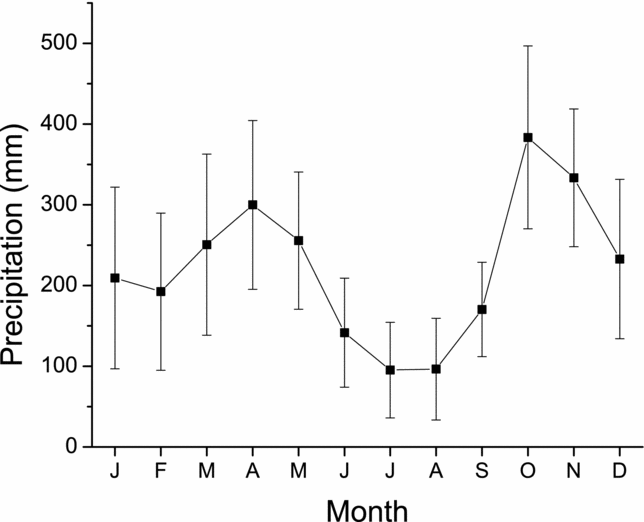
The study was conducted at Otún Quimbaya Flora and Fauna Sanctuary, a 411-ha protected area on the western slope of the central range of the Andes of Colombia, near the city of Pereira. Otún Quimbaya spans altitudes of 1800–2000 m asl and is adjacent to Ucumarí Regional Park, another protected area of 4000 ha encompassing altitudes between 1700 and 2600 m asl. The area is covered with humid, montane cloud forest in a mosaic of mature forest and secondary regeneration of different ages between 10 and 60 y old. Annual precipitation is 2650 mm, with two peaks of rainfall in April and October and relatively drier seasons in December–January and July–August (Aguilar & Rangel Reference AGUILAR, RANGEL and Rangel1994; Figure 1).
Precipitation regime at El Cedral meteorological station, 2000 m asl, 6 km east of the Otún Quimbaya Flora and Fauna Sanctuary, central range of the Colombian Andes. The graph shows mean and SD for 30 y.

METHODS
We collected data along 14 trails of variable length. Each fig tree within 8 to 22 m of either side of the trails (depending on visibility) was marked and located on a map of the study area. Phenology was monitored monthly between November 2003 and November 2004. We recognized five phases of syconium development: pre-female, female, interfloral, male and postfloral (mature syconia). We estimated crop size by counting the number of fruits on a visible branch and extrapolating to the entire tree. We collected 50 fruits from different trees (depending on how many trees fruited) for each fig species, and obtained dry mass by drying fruits in an oven until constant mass. We also measured their height and width. Voucher specimens of the five species were deposited at the herbarium of Universidad del Valle (CUVC) in Cali, Colombia.
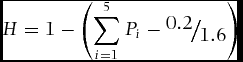
To test for temporal differences in number of individuals in fruit, number of fruits and dry biomass, we used a χ2 test, with the mean value for the 12 mo as the expected value. We tested for asynchrony in the inter-tree phenological patterns with the evenness index H (Bronstein & Patel Reference BRONSTEIN and PATEL1992),
 \begin{equation*}
H = 1 - \left( {\sum\limits_{i = 1}^5 {P_i - {\raise0.7ex\hbox{${0.2}$} \!\mathord{\left/
{\vphantom {{0.2} {1.6}}}\right.\kern-\nulldelimiterspace}
\!\lower0.7ex\hbox{${1.6}$}}} } \right)
\end{equation*}
where Pi is the proportion of trees with syconia in the five phases of development. The index varies between 0 and 1 and a value of 1 indicates an even distribution, i.e. asynchrony.
To estimate fig tree density we marked and counted fig trees in 0.5-ha plots (N = 18). Between December 2003 and September 2004 we conducted 190 h of observation of bird and mammal consumers in 24 focal trees of three species of Ficus (F. andicola, F. killipii and F. mutisii; Table 1). The number of trees monitored varied between one and six per month. For each tree, we made between three and eight observation sessions between 06h00 and 10h00. For each bird and mammal visitor, we noted the species and counted the number of consumption events. A consumption event was defined as an individual arriving at the tree and feeding on fruits, independently of the number of figs eaten.
Ficus species recorded at the study site, Otún Quimbaya Flora and Fauna Sanctuary, Central Andes of Colombia. Taxonomic order according to www.figweb.org/Ficus/Classification_of_figs. For each species, the table shows median crop size (with range and sample size in parentheses), the total number of trees monitored (N), fig dimensions based on 50 syconia of each species, and mean tree density ± SD obtained from 0.5-ha plots (N = 18).
To determine whether Ficus spp. were fruiting during periods of fruit scarcity, we used community-wide phenological data obtained in a parallel study over the same time period (M. Kessler-Rios & G. Kattan, unpubl. data). Monthly estimates of fruit production were obtained from all trees and shrubs with dbh >2.5 cm in 15 transects (50 × 4 m) in the same habitats. For each plant in fruit, the number of fruits on a visible branch was counted or estimated and this number was extrapolated to the entire plant. Samples of fruit pulp of all plants were dried until constant mass and weighed. From these data we extrapolated to the entire crop to obtain monthly estimates of dry biomass production. For species with large seeds (e.g. Lauraceae, Arecaceae), we removed the seeds and dried the pulp but for some species with watery fruits and very small seeds (e.g. Melastomataceae), the seeds were not removed.
RESULTS
The five fig tree species produced fruit during the year of study. There was great variation among species in crop and syconium size (Table 1). During the year of observation, 81 out of 206 trees (39.3%) presented syconia in at least one of the five development phases. Thirteen trees aborted their syconia after the female phase, and our study ended before three additional trees reached the ripe fruit phase. Therefore, we have complete cycles for 65 trees.
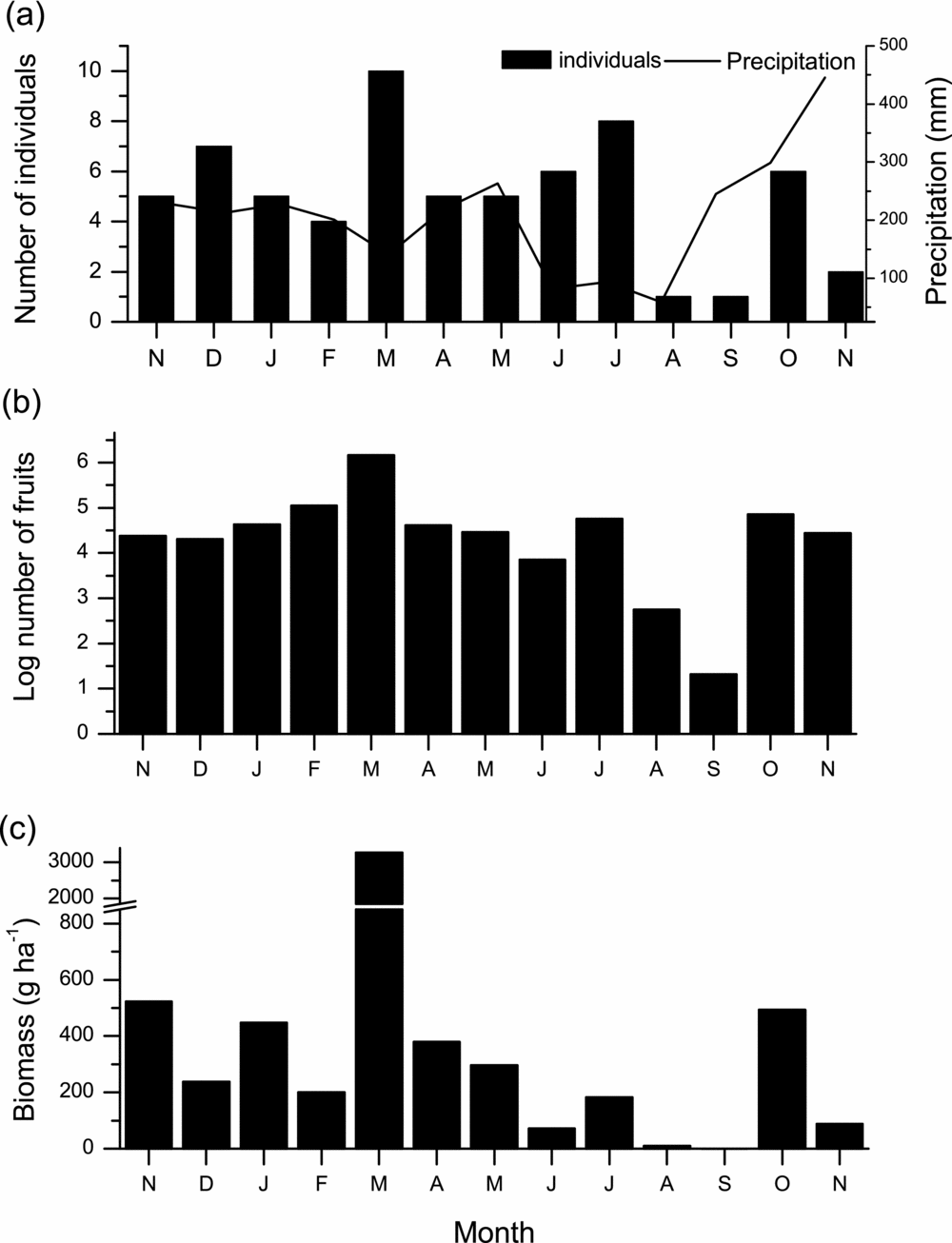
Fruit availability (ripe syconia) varied throughout the year. There was variation in the monthly number of trees presenting ripe fruits (χ211 = 3.9, P = 0.04), with a low of one individual in August and September and a high of 10 individuals in March (Figure 2).
Fig availability at a cloud-forest site in the Andes of Colombia, between November 2003 and November 2004. Graphs show the number of individual fruiting trees per month for five species of Ficus, with precipitation for the year of study (a), the total number of figs (log-transformed) (b), and total dry biomass for trees fruiting in 14 transects (c).
There was significant variation among months in the number of fruits (χ211 = 31.6, P < 0.001). Mean fruit availability was 145,000 ± 396,000 fruits mo−1 (range = 20–1.5 million; Figure 2). There also was significant monthly variation in fruit biomass (χ211 = 19.3, P < 0.001; Figure 2). The median of monthly biomass was 238 g ha−1 and varied between 0.2 and 3300 g ha−1. The low number of individuals in fruit in August and September was reflected in very low biomass availability in those months. Biomass in March was very high because of the massive fruiting of three large trees (two F. mutisii and one F. killipii).
The evenness index showed a high degree of asynchrony among all individuals in the five species in flowering/fruiting periods. Indices varied between 0.68 in November 2004 and 0.99 in July. For the most abundant species in our sample of fruiting trees, F. andicola, asynchrony was also high (index values between 0.63 and 0.99). Within trees, in contrast, synchrony in fruit production was very high (LV pers. obs.). Densities of the five tree species varied between 1 and 5 trees ha−1 (Table 1).
We observed 36 species of bird feeding on figs of three species (F. andicola, F. killipii and F. mutisii). A subgroup of 14 bird species were recorded in six or more months. These species included several tanagers (Tangara spp.), black-billed thrush (Turdus ignobilis), Swainson's thrush (Catharus ustulatus) and emerald toucanet (Aulacorhynchus prasinus). Two species of squirrel (Sciurus granatensis and Microsciurus sp.) and red howler monkey (Alouatta seniculus) also fed on figs, although the howler monkey did not feed on the small fruits of F. andicola. Between December 2004 and September 2005 we recorded between 12 and 19 consumer species every month in the 24 fig trees that we monitored.
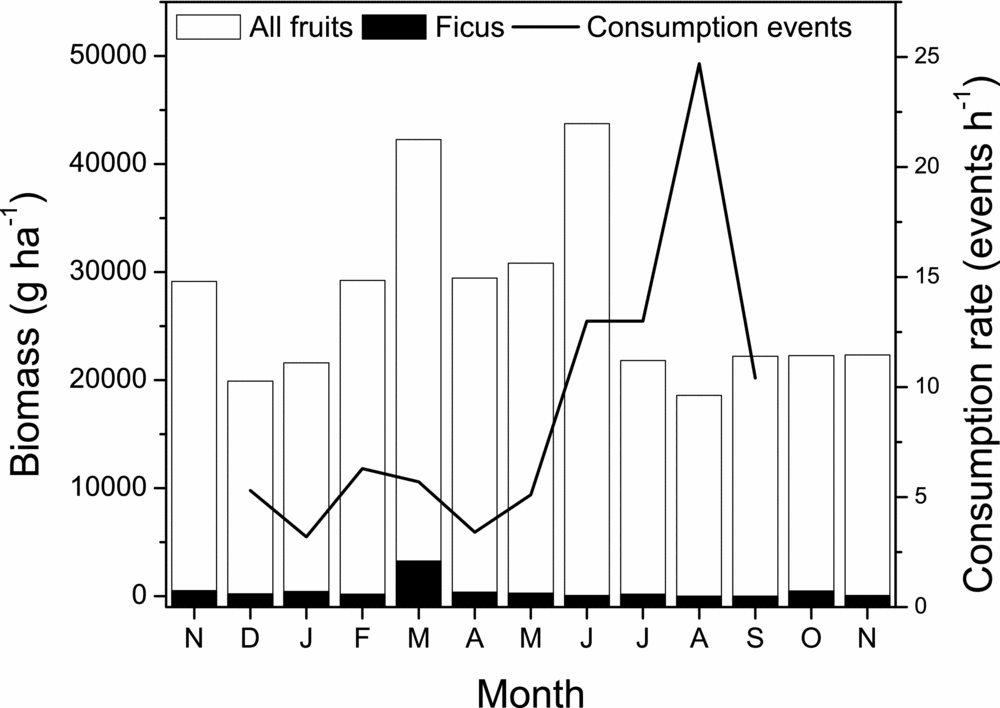
We recorded a total of 1521 consumption events, which varied monthly between 3.2 and 24.7 events h−1, with an increase between June and September (Figure 3). The most common consumers were different in the three fig species. In F. andicola the black-billed thrush represented 34% of consumption events, whereas in F. killipii the most common consumer was the Cauca guan (Penelope perspicax) with 29% of consumption events and in F. mutisii, the emerald toucanet with 32%.
Dry fruit biomass of five species of red-fruited Ficus compared with total fruit biomass in a cloud forest in the central range of the Colombian Andes, November 2003 to November 2004. The graph also shows consumption rates (events h−1) by birds and mammals in three Ficus spp.
Community-wide fruit production varied between 30 and 50 species and between 60 and 120 individuals in fruit every month (understorey and canopy combined). Fruit availability of Ficus, measured as dry biomass (g ha−1) represented a fraction of the total fruit biomass in the forest that varied between 0 and 8% (mean = 1.5%; Figure 3). The highest fraction occurred in March 2004, when three fig trees produced massive crops. There was no correlation between fig biomass and overall fruit biomass (r = 0.28, P = 0.35, N = 12).
DISCUSSION
In our study site in Andean cloud forest, fig-tree fruiting was inter- and intraspecifically asynchronous and the five species of fig produced fruit throughout the year. This corroborates previous findings that figs provide a permanent, although in this case highly variable, food supply for frugivorous birds and mammals.
We found only five species of fig (and an additional four species of green-fruited fig that are usually consumed by bats; Korine et al. Reference KORINE, KALKO and HERRE2000) but we sampled a relatively small area of the 411-ha reserve and only in late second-growth and mature forest, so we may have missed some species. Ficus is usually a very diverse genus in tropical forests. For example, 35 species are known for Cocha Cashu (1000 ha) in Peru and 16 for La Selva (1500 ha) in Costa Rica (Harrison Reference HARRISON2005). The small number of fig species found in our study may be an effect of area, altitude or habitat heterogeneity. We are not aware of any studies that have analysed altitudinal trends in Ficus species richness, but the genus is highly diverse ecologically and occupies a diversity of niches (Harrison Reference HARRISON2005). Therefore, expanding our study to include more area and other habitat types (e.g. valleys, forest edges, early second-growth) will probably reveal more species.
Fig tree densities, in contrast, are high in our study area, compared with lowland rain-forest sites. The five species had densities of >1 individual ha−1, whereas in localities throughout the tropics densities vary between 0.01 and 0.9 individuals ha−1 (Harrison Reference HARRISON2005). A study in southern India also reported relatively high densities of 11 trees ha−1 in an open trail and 5.6 trees ha−1 in primary forest (Athreya Reference ATHREYA1999). The high Ficus density at our site may reflect density compensation related to the lower species diversity of montane forest.
The 36 species of bird that we recorded consuming figs in this study represent 60% of the 60 species in the area that regularly or occasionally include fruits in their diets (GHK, unpubl. data). More extensive monitoring will likely add more species to the list of fig consumers. Consumption rates of figs were two to five times higher than rates reported for several species of Melastomataceae, another food resource important for tropical frugivorous birds and consumed by the same bird species at our site (Kessler-Rios & Kattan Reference KESSLER-RIOS and KATTAN2012). Our observations suggest that some species such as tanagers and red howler monkey seem to rely heavily on figs. A previous study at the same site also identified figs as important components in the diet of the howler monkey (Giraldo et al. Reference GIRALDO, GÓMEZ-POSADA, MARTÍNEZ and KATTAN2007). In addition, figs may be important sources of specific nutrients such as calcium (O'Brien et al. Reference O’BRIEN, KINNAIRD, DIERENFELD, CONKLIN-BRITTAIN, WRANGHAM and SILVER1998). Therefore, figs indeed represent an important resource for the frugivore community in this cloud forest. However, there was no season of scarcity during our study and figs represented a small fraction of the total fruit available in the area.
The fruits of over 200 species of tree and shrub in this Andean forest are consumed by birds and diurnal mammals (Rios et al. Reference RIOS, GIRALDO and CORREA2004), and plants such as Cecropia telealba and Melastomataceae also provide abundant, year-round food sources that are eaten by a large proportion of the local frugivores, particularly tanagers (Kessler-Rios & Kattan Reference KESSLER-RIOS and KATTAN2012, Rios Reference RIOS2005). Some species of Melastomataceae, such as Miconia acuminifera, which is consumed by tanagers and the howler monkey, may reach densities of 220 trees ha−1 (Giraldo et al. Reference GIRALDO, GÓMEZ-POSADA, MARTÍNEZ and KATTAN2007, Kessler-Rios & Kattan Reference KESSLER-RIOS and KATTAN2012).
Fig availability was highly variable in time and space. Out of 206 trees that we monitored, 125 did not initiate syconium production during the year of observation. Although fig trees are abundant, at any given time only a small proportion of trees are in fruit and these are widely scattered. A keystone resource should be abundant enough to sustain the local community of frugivores (Stevenson Reference STEVENSON, Dew and Boubli2005). In addition to the criteria proposed by Peres (Reference PERES2000), determining whether a particular resource is a keystone, should also consider the spatial scale of its availability (location of fruiting trees at any particular time) in relation to the patterns of movement and habitat use of its consumers. Some frugivores move over large spatial scales, but scattered fruiting trees may be out of reach for many frugivores that move over small scales (Durán & Kattan Reference DURÁN and KATTAN2005, García & Ortiz-Pulido Reference GARCÍA and ORTIZ-PULIDO2004, Kinnaird et al. Reference KINNAIRD, O’BRIEN and SURYADI1996). The variance in fig availability was very high in our study, which is likely a result of the relatively small spatial scale of our observations. Variance in fruit availability could be expected to decrease with increasing spatial scale, but it remains to be determined whether the scale at which this variance is minimized coincides with the scale of movements of most frugivores.
Existing studies suggest that northern Andean wet forests do not usually exhibit seasons of generalized fruit scarcity as occurs in lowland rain forest, although localized scarcities and supra-annual cycles of fruit availability may occur (Ataroff Reference ATAROFF, Kapelle and Brown2001, Giraldo Reference GIRALDO1990, Giraldo et al. Reference GIRALDO, GÓMEZ-POSADA, MARTÍNEZ and KATTAN2007). In our study area, a drop in fruit availability usually occurs between September and December, but the magnitude of the drop is variable and a period of relative scarcity may occur in some years (Muñoz et al. Reference MUÑOZ, LONDOÑO, RIOS and KATTAN2007; M. Kessler-Rios & G. Kattan, unpubl. data). Therefore, if the Ficus fruiting pattern holds among years, then figs may be a fallback food for some species in some years, but during the year of our study fruit was abundant and figs did not constitute a keystone resource. We conclude that most of the time figs are part, albeit an important one, of a broad array of fruiting species (Rios et al. Reference RIOS, GIRALDO and CORREA2004) in this Andean forest.
ACKNOWLEDGEMENTS
We thank the National Parks Unit and the staff at the Otún Quimbaya Flora and Fauna Sanctuary for permits and logistical support. For help with field work we thank Y. Toro, W. Cardona and P. Giraldo. Thanks to M. Kessler-Rios for sharing phenology data. The study was funded by a grant from the John D. and Catherine T. MacArthur Foundation through the Wildlife Conservation Society. We thank Rhett Harrison and three anonymous reviewers for comments that improved the paper.