Introduction
Specialized interactions between insects and plants are often examined though the lens of co-evolution, a mechanism by which each group promotes the evolution of novel traits in the other (Ehrlich and Raven, Reference Ehrlich and Raven1964; Berenbaum and Feeny, Reference Berenbaum and Feeny1981). Specialization of insects on their host plants is a successful and recurring evolutionary theme across many lineages (Mitter et al., Reference Mitter, Farrell and Futuyma1991; Bernays, Reference Bernays1998; Ward et al., Reference Ward, Hackshaw and Clarke2003). One requirement of specialization is strong host fidelity on the part of the insect because a prolonged association of insect and host allows evolutionary processes to occur (Futuyma and Moreno, Reference Futuyma and Moreno1988; Berenbaum, Reference Berenbaum2001). Instances of specialized insect feeding have been reported in the fossil record, where fossilized plant tissues with herbivore damage are preserved and are similar to damage made on extant members of those plant groups (Labandeira et al., Reference Labandeira, Dilcher, Davis and Wagner1994; Wilf et al., Reference Wilf, Labandeira, Johnson and Cúneo2005; Krassilov, Reference Krassilov2008; Wappler, Reference Wappler2010). One of the clearest examples of specialized herbivore damage commonly preserved in the fossil record is that made by leaf-galling insects. Galls are caused by the induction of abnormal growth in plant tissues for the purpose of feeding and protecting developing larvae, and the fossil record of galls extends back to the Paleozoic (Larew, Reference Larew1992; Labandeira and Phillips, Reference Labandeira and Phillips2002).
Many modern insects are known to induce leaf gall formation on their host plants. Here, we focus on the galls of Cynipini (Hymenoptera: Cynipidae) gallwasps due to their tightly constrained host use (Ronquist and Liljeblad, Reference Ronquist and Liljeblad2001; Stone et al., Reference Stone, Hernandez–Lopez, Nicholls, Di Pierro, Pujade–Villar, Melika and Cook2009; Hardy and Cook, Reference Hardy and Cook2010), diversity of gall forms, and hypothesized long-lived host relationships (Stone et al., Reference Stone, Hernandez–Lopez, Nicholls, Di Pierro, Pujade–Villar, Melika and Cook2009). Cynipini have a fossil record that extends back to the Oligocene (Liu et al., Reference Liu, Engel and Grimaldi2007) and their galls are often distinct from those of other oak gallers, such as aphids or midges, in both their overall shape and in the internal structure of their galls (Stone and Schönrogge, Reference Stone and Schönrogge2003, Erwin and Schick, Reference Erwin and Schick2007). Gallwasps and their oak hosts also have been shown to be a useful system for examining the evolution of host-plant specificity (Cornell, Reference Cornell1985; Stone and Cook, Reference Stone and Cook1998; Stone and Schönrogge, Reference Stone and Schönrogge2003). The clade Cynipini (Cynipidae) is part of the Woody Rosid Gallers, a group that exclusively galls woody roses and oaks, although the Cynipini are primarily specialized on Quercus Linnaeus, Reference Linnaeus1758 (Liljeblad et al., Reference Liljeblad, Ronquist, Nieves–Aldrey, Fontal–Cazalla, Ros–Farre, Gaitros and Pujade–Villar2008; Stone et al., Reference Stone, Hernandez–Lopez, Nicholls, Di Pierro, Pujade–Villar, Melika and Cook2009). An extensive body of work on modern gall wasps and oaks has documented strong host fidelity that has been hypothesized to stretch back at least 20 million years (Ronquist and Liljeblad, Reference Ronquist and Liljeblad2001; Stone et al., Reference Stone, Hernandez–Lopez, Nicholls, Di Pierro, Pujade–Villar, Melika and Cook2009). This is supported by the presence of cynipid galls on oak leaves preserved in Miocene floras (Waggoner and Poteet, Reference Waggoner and Poteet1996; Waggoner, Reference Waggoner1999; Erwin and Schick, Reference Erwin and Schick2007). The shapes of these Miocene galls differ from extant galls primarily in the degree of elongation and tapering at the distal end (Erwin and Schick, Reference Erwin and Schick2007), and they all have been assigned to the form-genus Antronoides Waggoner and Poteet, Reference Waggoner and Poteet1996. Antronoides was originally aligned with the modern genus Antron Kinsey, Reference Kinsey1930, but later was found to be more similar morphologically to galls made by wasps of the genera Cynips Linneaus, Reference Linnaeus1758 and Xanthoteres Ashmead, Reference Ashmead1897 (Erwin and Schick, Reference Erwin and Schick2007).
For all the fossil and modern examples of specialization, little is known about what the relationship between specialized insect herbivores and their hosts looks like over geologic time. Specialists have been hypothesized to adopt new hosts when their ancestors are specialists on closely related hosts (Berenbaum, Reference Berenbaum2001). Once established, the relationship is thought to persist relatively unchanged for millions of years (Moran, Reference Moran1989) resulting in a tight phylogenetic congruence between the clades of herbivores and their hosts (Farrell and Mitter, Reference Farrell and Mitter1998; Ronquist and Liljeblad, Reference Ronquist and Liljeblad2001; Ward et al., Reference Ward, Hackshaw and Clarke2003; Ramamurthy, Reference Ramamurthy2007). We therefore expect that distribution of fossilized cynipid galls (specifically those of the tribe Cynipini) will be confined to closely related species throughout time within oaks and other members of the Fagaceae. Here, we study fagaceous leaves from fossil floras that span a broad geographic and temporal range across the western United States to examine host-use patterns in oak gallwasps. Specifically, we examine how galls are distributed among leaves of different members of the Fagaceae through time to test the assumption that oaks and oak gallwasps have had a long-lived, co-evolved association, with little host shifting.
Methods
Fossil leaves used in this study come from deposits that consist of fine-grained, lacustrine or floodplain shales and siltstones. The floras from which these leaves were recovered are found across most western states (California, Idaho, Nevada, Oregon, Washington), and span an age range from 5–45 Ma (Fig. 1). Tectonic and volcanic activity in western North America during the late Paleogene and Neogene led to the creation of basins that preserved the abundant fossil floras that are the basis of this study (Schorn et al., Reference Schorn, Meyers and Erwin2007). Floras were included in this study if they met the basic criteria of: (1) preservation in fine-grain fluvolacustrine sediments, (2) an age within the range of Oligocene to Pliocene, (3) a large sample of Fagaceae leaves (average N=120). In order to focus on the same species through time, the geographical focus was limited to floras from the western United States, where many oak species are common to multiple floras (Axelrod, Reference Axelrod1983). Several floras were considered for inclusion but were rejected for either poor preservation or too few leaves preserved, including: the Chula Vista and Gold Bluffs floras of California; the Haynes Creek flora of Idaho; the Aldrich Station, Eastgate, Middlegate, Purple Mountain and Verdi floras of Nevada; the Keasey, Pittsburg Bluffs, Sardine and Thomas Creek floras of Oregon; and the Grand Coulee and Keechelus floras of Washington. Precision of age determination varies widely for the included floras. For those interspersed with volcanics, 40Ar/39Ar or K/Ar dates are available. Many other floras have mammalian faunal elements preserved in close proximity for which an age can be estimated. Several of the floras, however, have not yet been well studied, and for these, a taxonomic comparison with geographically proximal floras provides the only age estimate (Retallack et al., Reference Retallack, Orr, Prothero, Duncan, Kester and Ambers2004; Schorn et al., Reference Schorn, Meyers and Erwin2007).
Map showing floras with preserved gall structures. Eocene/Oligocene floras (black circles): (1) Chalk Bluffs, CA (Eocene); (2) Grant, MT (Eocene); (3) Bridge Creek, OR (Oligocene); (4) Rujada and Willamette, OR (Oligocene); (5) Ramsey, NV (Oligocene): Miocene floras (grey circles): (6) Cascadia, OR; (7) Tipton, OR; (8) Gilliam Springs, NV; (9) Fingerrock, NV; (10) Buffalo Canyon, NV; (11) Temblor, CA; (12) Mascall, OR; (13) Succor Creek, ID; (14) "Latah" and Almaden, ID; (15) Webber Lake, CA; (16) Stewart Valley, NV; (17) Mint Canyon, CA; (18) Trapper Creek, ID; (19) Stinking Water, OR; (20) Hidden Lake, OR (Mapped with Rujada and Willamette floras); (21) Mt. Reba, CA: Pliocene floras (open circles): (22) Washoe, NV (Miocene/Pliocene); (23) Turlock Lake CA.

We used museum collections to obtain the largest possible sample of leaves from floras across western North America. We focused on the collections of the University of California Museum of Paleontology, the National Museum of Natural History and the University of Colorado Museum of Natural History, due to their large holdings of western floras. The number of leaves bearing either galls or gall scars was recorded for each flora as well as the taxa on which galls were found and other fagaceous taxa present.
The oaks (Quercus) and beeches (Fagus Linnaeus, Reference Linnaeus1753) along with Castanea Miller, Reference Miller1754 and ‘Lithocarpus’ are the most common and abundant fagaceous genera in these floras. Many Fagaceae have sclerophylous leaves, which aids in their preservation, although more delicate fagaceous leaves, such as Q. pseudolyrata (Condit, Reference Condit1944), also are well represented. Fossil leaves of Fagaceae were identified using shape, tooth morphology, and vein architecture. Oaks vary widely in their leaf morphologies, and species groupings made on the basis of leaf traits correlate poorly with those based on genetic traits (Manos et al., Reference Manos, Doyle and Nixon1999). Because leaves from the same species can have markedly different appearances, previous investigators have had a tendency to oversplit fagaceous taxa (Jones, Reference Jones1986). For this reason, we took an inclusive approach to identifying leaves, aiming to unite taxa with general overall similarity. Leaves of both Quercus pollardiana-type and Q. simulata-type showed variation in morphology in that they could be either toothed or untoothed and more or less elongate. Following the opinions of previous workers, Q. hannibali and Q. dayana are considered to be synonyms of Q. pollardiana (Axelrod, Reference Axelrod1983; Fields, Reference Fields1996), although other authors continue to use the name Q. hannibali (Buechler et al., Reference Buechler, Dunn and Rember2007). Additionally, we did not attempt to resolve the nomenclatural discrepancies surrounding Q. simulata, but rather accepted the identification of previous workers and the wide range of morphological variation for this species. We also follow Fields’ (Reference Fields1996) inclusion of Q. consimilis (Newberry, Reference Newberry1883) as part of the Q. simulata-type, in light of the difficulties in reliably separating these species (MacGinitie, Reference MacGinitie1933).
Identification of fossil galls rests on the overall morphology and the position of the galls on the leaf, as microscopic details are often difficult to distinguish (Scott et al., Reference Scott, Stephenson and Collinson1994). These galls, attributed to Antronoides schornii Waggoner and Poteet, Reference Waggoner and Poteet1996, are elongate and tapered at their distal ends in an obclavate shape. The galls observed share many characteristics, such as the overall shape, size, and disk-like basal expansion (Waggoner and Poteet, Reference Waggoner and Poteet1996; Waggoner, Reference Waggoner1999; Erwin and Schick, Reference Erwin and Schick2007) with those made by modern members of the tribe Cynipini (Fig. 2), and we find this designation to be the most parsimonious; however, the precise generic assignment is uncertain, and validity of assigning the genus Antronoides to a living taxon has been difficult (Erwin and Schick, Reference Erwin and Schick2007; Liljeblad et al., Reference Liljeblad, Ronquist, Nieves–Aldrey, Fontal–Cazalla, Ros–Farre, Gaitros and Pujade–Villar2008). Other potential gall-inducers, such as mites of the family Eriophyoidea or midges of the family Cecidomyidae, are unlikely to be the insects responsible for these galls based on modern patterns of association and morphology. For example, mite galls tend to be tiny relative to insect-induced galls (Westphal, Reference Westphal1992) and midge galls on oaks tend to be blister-type galls or leaf rolls (Gagné, Reference Gagné1989). Midges are less common on oaks than on other members of the Fagaceae today (Kampichler and Teschner, Reference Kampichler and Teschner2002), although some species gall live oaks in North America (Gagné and Riley, Reference Gagné and Riley1999).
Photographs of fossil and modern gall structures: (1) Galls on Q. pollardiana from the Gilliam Springs flora, Miocene, Nevada (UCMP #398561), previously described in Waggoner and Poteet (Reference Waggoner and Poteet1996), scale bar=5 mm; (2) Detachable gall of H. sp. on Q. chrysolepis (section Protobalanus) overall gall length approximately 13 mm; (3, 4) Detachable galls of X. clavuloides on valley oak, Q. lobata (section Quercus s.s.), overall gall lengths approximately 7 mm and 8.5 mm respectively; (5) Integral gall of H. flavens on huckleberry oak, Q. vaccinifolia (section Protobalanus), overall gall diameter approximately 6 mm. Fossil gall image courtesy of D. Erwin, modern gall images courtesy of J. DeMartini.
Results
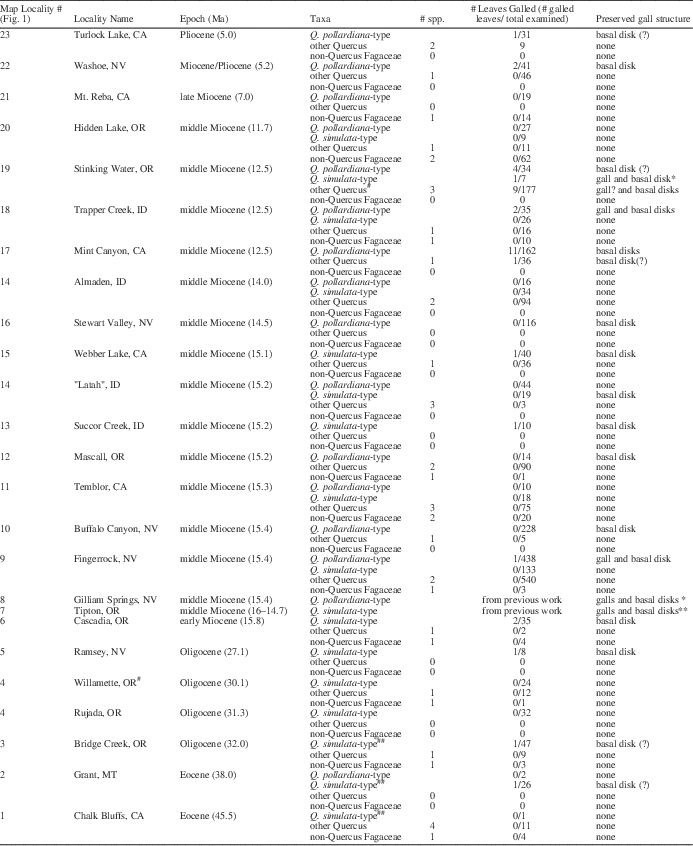
A total of 2,980 fossil leaves were examined for this study. The majority of these leaves were oaks, although other genera of Fagaceae were also examined if they were preserved (146 leaves total). Of these, only 39 galled oak leaves were recovered. Galls and gall scars examined in this study included both previously reported and new material (Table 1). New occurrences of galls from the Trapper Creek (OR) and the Fingerrock Wash floras (NV) may be made by the same insect as the previously reported galls from the Gilliam Springs flora (NV).
Comparison between geographic and temporal distribution of galls on Quercus pollardiana-type and Q. simulata-type leaves. The Clarkia flora, ID (Miocene), was also examined but contained neither host plant. Category "other Quercus" may include leaves of Q. pollardiana-type or Q. simulata-type that did not have the preservational quality to allow for positive identification. Category "# leaves galled" includes all potential gall structures, including those identified as cynipid galls.
Previously reported from: *Waggoner and Poteet Reference Waggoner and Poteet1996, Stinking Water flora was re-collected for this study; ** Erwin and Schick Reference Erwin and Schick2007; # Gall-bearing leaves are from Q. sp which are likely members of Q. pollardiana-type and Q. simulata-type that were too fragmentary or poorly preserved to allow for positive identification ## Host is Q. consimilis.
Galled leaves displayed either three-dimensional gall structures or gall scars (Fig. 3). The number of galls per leaf varied from one or two to up to 20. The galls were located on the leaf surface, often adjacent to major veins, as has been found by other authors (Waggoner and Poteet, Reference Waggoner and Poteet1996). Galls tended to be attached to the lower surface of the leaf and corresponded with a disk-like scar with a width of between 1–2 mm on the upper or lower surface. Examples of structures (<5) that are possibly galls with very different morphologies than those described were also found, but were not able to be attributed to a known gall maker. Gall scars, while not diagnostic on their own, are repeatedly found in association with preserved galls, and similar structures have been attributed to cynipids by other authors (Scott et al., Reference Scott, Stephenson and Collinson1994). Gall scars could be distinguished from hole-feeding damage because holes tended to be more irregular in size and shape and the reaction tissue around the gall scars is generally thicker. Additionally, the gall scar tissue was often impressed into the leaf surface, forming a slight indentation that was not seen around hole-feeding damage.
Photographs of gall structures and gall scars from the middle Miocene of western North America: (1,2) part and counterpart of Quercus simulata-type leaf from the Stinking Water Formation, Oregon (UCMP #168315), previously described in Waggoner (Reference Waggoner1999); (3) Quercus pollardiana-type leaf from the Trapper Creek Formation, Idaho (UCMP #8605); (4) Quercus pollardiana-type leaf from the Fingerrock Formation, Nevada (UCMP #191949). All scale bars=5 mm. Images courtesy of D. Erwin.
The two species of oaks on which cynipid galls were preserved, Quercus simulata-type and Q. pollardiana-type, were abundant in most of the floras examined (Q. simulata-type in 17 floras, Q. pollardiana-type in 16 floras, Table 1). Quercus simulata-type leaves are present in the oldest flora (Chalk Bluff, CA, Eocene), and the first Q. pollardiana-type leaves are present in the Grant flora (MT, Eocene), although the first unambiguous cynipid galls appeared later (mid-Oligocene for Q. simulata-type, mid-Miocene for Q. pollardiana-type), excluding the uncertain gall scars in the Bridge Creek and Grant floras. Galls were found on Q. simulata-type leaves in 8 of 17 floras in which this oak was recorded, and on Q. pollardiana-type leaves in 7 of 16 floras in which that oak was recorded. Although these two oak species co-occur in eight floras, galls were found on leaves of both species only in the Stinking Water flora. Seven floras were examined in which no galls were found: Chalk Bluffs (Eocene, CA); Rujada and Willamette (Oligocene, OR); Mt. Reba (Miocene, CA); Almaden and Clarkia (Miocene, ID); and Hidden Lake (Miocene, OR).
The stratigraphic distribution of galled floras (Fig. 4) shows that once galls were first seen on a host, they remain on that host throughout the rest of the host’s stratigraphic range. Gaps in the stratigraphic range reflect a lack of floras of that age, rather than the presence of floras without galls. The age of the flora was a significant predictor of whether or not galls were found (X 21,22=3.98, p=0.046) as floras with galls tended to be younger, having an average age of 14 million years compared to an average age of 25 million years for floras without galls. The number of fagaceous leaves examined did not significantly affect whether or not galls were found in a flora (X 21,22=1.68, p=0.195), nor did the number of oak species present (X 21,22=1.90, p=0.168).
Stratigraphic ranges of gall-bearing oak species. Circles indicate ages of floras with gall-bearing leaves of each species; lines indicate entire range of each species.
Discussion
Evidence for host fidelity
Throughout the sampled range of oaks in western North America and across 30 million years, we found no evidence for host shifting from Quercus simulata-type and Q. pollardiana-type to either other oaks or other members of the Fagaceae. Our evidence supports the hypothesis based on modern oak-gallwasp work that host fidelity is deeply rooted (Liljebad et al., Reference Liljeblad, Ronquist, Nieves–Aldrey, Fontal–Cazalla, Ros–Farre, Gaitros and Pujade–Villar2008; Stone et al., Reference Stone, Hernandez–Lopez, Nicholls, Di Pierro, Pujade–Villar, Melika and Cook2009) and that host shifts are exceedingly rare (Stone et al., Reference Stone, Van Der Ham and Brewer2008). Only two oak species were host to gallwasps across the floras examined that ranged in age from Eocene to Pliocene, and in the majority of floras where the oaks are found, leaf galls are also found. In both host species, the existence of the host predates the first galls by several million years. Once galls appear on leaves, however, they are found in almost all floras where their hosts are found throughout the rest of the sample, even when other potential hosts are present. This indicates that the gallwasps moved with and identified their hosts as the range of their hosts expanded across western North America.
Implications for models of specialization
Models for the development of specialized feeding relationships between herbivorous insects and plants based on examination of modern interactions tend to focus on the fitness benefits for an individual or community of insects (Jaenike, Reference Jaenike1990). At their most general, models based on maximizing fitness rewards predict that host plants that are the most abundant and that offer the best nutritional trade-offs are most likely to be targeted by specialists. Although the prediction of these models can be difficult to extrapolate over geologic time, the distribution of galls examined in this study provides a system in which models of specialization may be examined. Quercus simulata-type and Q. pollardiana-type oaks were the two most common and abundantly preserved fagaceous species, even when other species were also available. Both species are evergreen, a leaf trait that, in oaks, often correlates with higher levels of chemical protection than deciduous leaves (Estiatre, Reference Estiatre2007), and therefore lower levels of generalized insect herbivory (Pascual-Alvarado et al., Reference Pascual–Alvarado, Cuevas–Reyes, Quesada and Oyama2008; Pearse, Reference Pearse2011). Evergreen leaves are nevertheless correlated with higher incidence of cynipid galls (Karban, Reference Karban2007) as they are available to ovipositing insects when deciduous trees are bare and because gall-dwelling larvae are able to feed off of toxin-free leaf tissue within the gall (Kinsey, Reference Kinsey1930; Cornell, Reference Cornell1983).
Two common models for specialization in herbivorous insects are (1) evolution of generalist herbivores to specialization on a host that was already within the herbivores’ range (Futuyma and Moreno, Reference Futuyma and Moreno1988); and (2) transfer of already-specialized herbivores from one host to another (Bernays, Reference Bernays1998). Specialization in the Cynipini may follow this second path through a transfer of the gall-making habit from other, herbaceous plant families onto oaks (Ronquist and Liljeblad, Reference Ronquist and Liljeblad2001), or between species of oaks where hybrids are likely to exist. This “hybrid bridge” hypothesis (Floate and Whitham, 1993) has been proposed to explain the movement of herbivores between hosts using hybrid species, although host shifting in oak gallwasps may be considerably more complicated (Pearse and Baty, Reference Pearse and Baty2012). Other members of the Woody Rosid Galler group have non-oak hosts, including roses, but all show strong phylogenetic constraint between host groups and wasp groups (Liljeblad et al., Reference Liljeblad, Ronquist, Nieves–Aldrey, Fontal–Cazalla, Ros–Farre, Gaitros and Pujade–Villar2008). Although not specifically a part of this study, preliminary observations of rosids in two Miocene floras from western North America had possible cynipid gall scars, which is consistent with modern host use patterns. Further examination of rosid materials in future studies may be able to determine the relationship between these potential galls and those of oak galls. We also examined several floras that pre-date the first appearance of galls in this region, and found no evidence of Cynipini-style galls appearing on other fagaceous genera prior to their appearance on Q. simulata. It is not possible, therefore, to interpret based on these data what the history of Cynipini wasp may have been prior to their occurrence on oaks. A more precise identification of the gall-making wasps responsible for the damage we observed and an expanded examination of other taxa, such as the rosids, would be an important next step to answer these questions.
Implications for host identity
Another area in which galls might give information about their host’s identity is with the larger placement of Q. pollardiana and Q. simulata within the genus Quercus. Most authors (Axelrod, Reference Axelrod1995; Retallack, Reference Retallack2004; Buechler et al., Reference Buechler, Dunn and Rember2007) consider extant Q. chrysolepis Liebmann, Reference Liebmann1854 (canyon live oak) an oak in section Protobalanus, to be the nearest living relative of Q. pollardiana. The relationship of Q. simulata to extant oak species is more problematic. The most rigorous treatment of the systematic placement of Q. simulata is in Fields (Reference Fields1996), where a wide range of evidence, including acorn morphology, is considered to place the “Quercus simulata morphoplex” somewhere in section Lobatae (G. Don) Louden, Reference Louden1830. Work based solely on morphological characters in oaks, however, has been repeatedly undermined by convergence (Manos et al., Reference Manos, Doyle and Nixon1999), and Q. simulata leaves have been attributed to every section within the genus Quercus (Bortgard and Pigg, Reference Bortgard and Pigg1999), including section Protobalanus (Wolfe, Reference Wolfe1964). Therefore, insect herbivory may be able to be used to help identify different oak species as it has been used in other host plants (Floate and Whitham, Reference Floate and Whitham1995). The relationship between modern cynipids and their hosts is very tightly constrained, and we find no evidence to suggest that the relationship was different in the past. This suggests that whatever the affinities of Quercus simulata-type and Q. pollardiana-type might actually be, they are probably very closely related. Indeed, some authors have suggested that Q. pollardiana is an extinct version of Q. simulata (P. Fields personal comm., 2010). It may be the case that Q. simulata and Q. pollardiana hybridized, which may have facilitated the shift of Cynipini to the new host Q. pollardiana, the later appearing species.
Implications for gall-maker identity
The similarity in morphology among fossilized galls on western oaks provides a straightforward basis for inferring the close relationship between the gallmaking insects, although exact species identification and placement of those species within the Cynipini are difficult to determine. The affinities of some species within the form genus Antronoides are currently thought to belong with Cynips, while others belong to Xanthoteres Ashmead Reference Ashmead1897 (Erwin and Schick, Reference Erwin and Schick2007), modern wasp genera hosted by oaks in section Quercus sensu stricto (Erwin and Schick, Reference Erwin and Schick2007; Stone et al., Reference Stone, Hernandez–Lopez, Nicholls, Di Pierro, Pujade–Villar, Melika and Cook2009), contrary to its previously assumed alignment with the modern genus Antron (Waggoner and Poteet, Reference Waggoner and Poteet1996; Waggoner, Reference Waggoner1999). The strong host fidelity between gallwasps and their hosts makes it unlikely that a major host shift, such as would be necessary to move from a section Protobalanus (Trelease) A. Camus, 1938 species, to a section Quercus species, would occur. Shifts of this magnitude have not been found to occur in modern oak-Cynipini relationships (Stone et al., Reference Stone, Hernandez–Lopez, Nicholls, Di Pierro, Pujade–Villar, Melika and Cook2009), and there is no fossil evidence thus far that would support such a shift. Therefore, the assignment of gall species of the genus Antronoides to either Cynips or Xanthoteres may be in error.
We suggest that an alternative explanation to a major host shift is at work in the cynipids of western North America and that their affinity lies with modern gall-making genera of Q. chrysolepis of the tribe Cynipini, such as Andricus Hartig, Reference Hartig1840 or Heteroecus Kinsey, Reference Kinsey1922. Gall-inducing insects from closely related species can create galls of varying morphologies (Stone and Schönrogge, Reference Stone and Schönrogge2003), and modern genera create a wide range of gall types that encompass the range of morphologies seen in the fossil forms (Fig. 4). The galls we observe on Q. simulata-type and Q. pollardiana-type leaves are consistent with the modern pattern of host-conservatism seen in these wasps. Regardless of which genus these galling insects actually represent, these fossil galls were certainly created by a member of the Cynipini, those most closely tied with modern oaks in western North America (Liljeblad et al., Reference Liljeblad, Ronquist, Nieves–Aldrey, Fontal–Cazalla, Ros–Farre, Gaitros and Pujade–Villar2008).
Origins of gallwasps in western North America
The biogeographic complexities of the Cynipini make it difficult to infer the area of origin for this group, although they likely have roots in Asia (Abe et al., Reference Abe, Melika and Stone2007; Stone et al., Reference Stone, Hernandez–Lopez, Nicholls, Di Pierro, Pujade–Villar, Melika and Cook2009). The fossil record of galls has provided evidence for inferring the pattern of diversification of cynipines across western North America (Kinsey, Reference Kinsey1930; Kinsey, Reference Kinsey1936; Waggoner and Poteet, Reference Waggoner and Poteet1996; Ronquist, Reference Ronquist1999; Waggoner, Reference Waggoner1999; Erwin and Schick, Reference Erwin and Schick2007) and documenting their presence by the Miocene. Fossil gall evidence can therefore augment the scarce record of body fossils, such as the single cynipoid known from the Eocene of Colorado (Ronquist, Reference Ronquist1999). The pattern of gall distribution underscores the similarity in timing of diversification between the Cynipini and major groups of modern North American oaks, which likely happened more or less in place from the Eocene through the Miocene (Axelrod, Reference Axelrod1983; Manos et al. Reference Manos, Doyle and Nixon1999). While other authors also have suggested a concomitant radiation of oaks and oak gallwasps (Stone et al., Reference Stone, Atkinson, Rokas, Csóka and Nieves-Aldrey2001; Liu et al., Reference Liu, Engel and Grimaldi2007; Liljeblade et al., Reference Liljeblad, Ronquist, Nieves–Aldrey, Fontal–Cazalla, Ros–Farre, Gaitros and Pujade–Villar2008), we find several early floras in which Q. simulata or similar oaks (e.g. Q. consimilis Newberry, Reference Newberry1883) are preserved without galls. Although it is possible that there may have been some galls present but not preserved, especially for floras with low numbers of preserved leaves such as the Chalk Bluffs flora, it does leave open the possibility that the appearance of gallwasps into western North America was secondary to the appearance of their hosts, mirroring a lag in insect arrival seen in other specialized herbivore/host systems (Lopez-Vaamonde et al., Reference Lopez-Vaamonde, Wikström, Labandeira, Godfray, Goodman and Cook2006). The possible presence of galls in the Grant flora (38.0 Ma), the Bridge Creek flora (32.0 Ma), and the Ramsey flora from Nevada (27.1 Ma), followed by a profusion of galls of Miocene age from across the western United States, suggests that regardless of when gallwasps first appear in western North America, the radiation of this group occurred more or less simultaneously across a wide geographic area.
Conclusions
Gall structures on Q. simulata-type and Q. pollardiana-type oaks are abundant and widespread, and are not associated with other oak species. Although this finding might appear to be at odds with the presumed host shift of these gallwasps onto the oak species on which they are found on extant oaks, we believe that this pattern more likely reflects the difficulties in aligning fossil and modern gallwasps, rather than a host-shift.
We find early evidence of galls on floras from both Oregon and Nevada that are of similar age. While the circular gall-like scars on the leaf from the ~38 Ma Grant flora may represent the first occurrence of cynipid galls in the western US, the appearance of both galls and gall scars from many locations across the West in the middle Miocene suggests that the radiation of gallwasps occurred nearly simultaneous in many areas. The impressive fossil record of oak leaves from this region clearly demonstrates a relationship with gallwasps that was rapidly established over a broad geographic range, and that has been maintained over evolutionary time.
Acknowledgments
The authors wish to thank D. Erwin at the University of California Museum of Paleontology for assistance with specimens as well as many helpful comments and suggestions for improving this work and J. DeMartini for invaluable discussion about modern cynipids and for providing photographs of modern galls. We are grateful to S. Wing and J. Wingerath at the Smithsonian Institution for collections access and assistance, and to D. Leckey for assistance in data collection. We also wish to thank G. Stone and the suggestions of the anonymous reviewers for their input on an earlier version of this manuscript. We also thank the Geological Society of America, the Paleontological Society and the University of Colorado’s Beverly Sears Grant for support (to EHL) for this study.