





Introduction
In Australia, the number of people living permanently in residential aged care homes (RACHs) is increasing, with South Australia (SA) recording the highest per capita (44 per 1,000) (Australian Institute of Health and Welfare, 2025a). Older adults are entering RACHs with increasing cognitive, behavioural and functional care needs (Australian Institute of Health and Welfare, 2025b). While general practitioners (GPs) are well-placed to meet residents’ needs and reduce acute care demands (Moorin et al., Reference Moorin, Youens, Preen and Wright2020; Zhao et al., Reference Zhao, Thomas, Guthridge and Wakerman2014), the Royal Commission into Aged Care Quality and Safety reported challenges in GP access and the provision of proactive, continuous clinical care in RACHs (Royal Commission into Aged Care Quality and Safety, 2021).
GP services in RACHs are predominantly funded under Medicare, Australia’s universal health insurance scheme (Australian Government Department of Health, Disability and Ageing, 2022), with additional incentive payments (Royal Commission into Aged Care Quality and Safety, 2021). However, the fee-for-service funding is regarded as misaligned with proactive care, while overall remuneration is widely perceived by GPs as insufficient, contributing to reduced GP engagement (Royal Commission into Aged Care Quality and Safety, 2021; Burgess et al., Reference Burgess, Davis and Morgans2015; Gadzhanova and Reed, Reference Gadzhanova and Reed2007; Pearson et al., Reference Pearson, Mullan, Ujvary, Bonney and Dijkmans-Hadley2018).
In response to the Royal Commission, numerous reforms were introduced, including the replacement of the former General Practitioner Aged Care Access Incentive scheme with the General Practice in Aged Care Incentive (GPACI) in 2024 (Australian Government Office of The Inspector-General of Aged Care, 2024). However, the impact of these changes on GPs’ provision of services in RACHs remains unclear.
To gain a contemporary understanding of GP service provision in RACHs in Adelaide, a metropolitan city in SA, we conducted a qualitative study with GPs. We aimed to explore barriers, enablers, and suitable models of care (MoC), from the GPs’ perspectives. The integrated Promoting Action on Research Implementation in Health Services (i-PARIHS) framework (Harvey and Kitson, Reference Harvey and Kitson2016) was used to offer a structured lens for examining how innovation, recipients, and context shape GP service delivery in RACHs.
Methods
Study design and setting
This qualitative study involved interviews with Adelaide-based GPs, regardless of RACH experience, to explore their views and/or experiences of providing services in RACHs. Reporting followed COREQ guidelines (Tong et al., Reference Tong, Sainsbury and Craig2007).
Recruitment
Participants were recruited through convenience sampling via professional networks via emails, and social media posts. Interested GPs were contacted by the first author (a PhD student), who provided an information sheet and consent form and scheduled an interview at a convenient time. Participants received a $100 gift card.
Data collection
Semi-structured, one-on-one interviews were conducted by the first author from February to April 2025, who disclosed her role and research purpose, and had no prior relationship with participants. Interviews followed a guide (Supplementary Material, part 1) developed by the research team, with input from GPs, and underpinned by the i-PARIHS framework (Harvey and Kitson, Reference Harvey and Kitson2016). The i-PARIHS framework represents the dynamic and multifaceted nature of implementation in healthcare (Harvey and Kitson, Reference Harvey and Kitson2016). According to i-PARIHS, successful implementation results from the facilitation of an innovation with the recipients in their context (Harvey and Kitson, Reference Harvey and Kitson2016). In this study, the innovation was GP service delivery in RACHs, including different models and organizational approaches. The primary recipients were GPs providing care in RACHs, while the context encompassed general practices, RACHs, residents, families, and the broader health and aged care system within which care was delivered. Framing the interview questions and subsequent findings according to the i-PARIHS framework helps to contextualize the various factors involved in service delivery. This will inform future implementation strategies to test and introduce suitable GP MoC and organizational approaches in RACHs. Interviews were recorded and transcribed via Microsoft Teams and Word, and checked for accuracy. No participants requested transcript review.
Data analysis
Data was analysed via the reflexive thematic analysis approach outlined by Braun and Clarke (Braun and Clarke, Reference Braun and Clarke2022), informed by a critical realist perspective which posits that participants’ accounts are shaped by contextual factors and underlying mechanisms that may not be observable (Sayer, Reference Sayer2000). Codes and initial themes were inductively generated using NVivo 14 software and refined collaboratively by the research team (Supplementary Material, part 2).
Findings were subsequently mapped to the i-PARIHS constructs (innovation, recipients, context) and associated characteristics, including local, organizational, and external contextual influences (Harvey and Kitson, Reference Harvey and Kitson2016).
Ethical statement
Ethics approval was obtained from the Flinders University Human Research Ethics Committee (ID 7985). Informed consent was obtained from all participants prior to interview participation.
Results
Interview characteristics
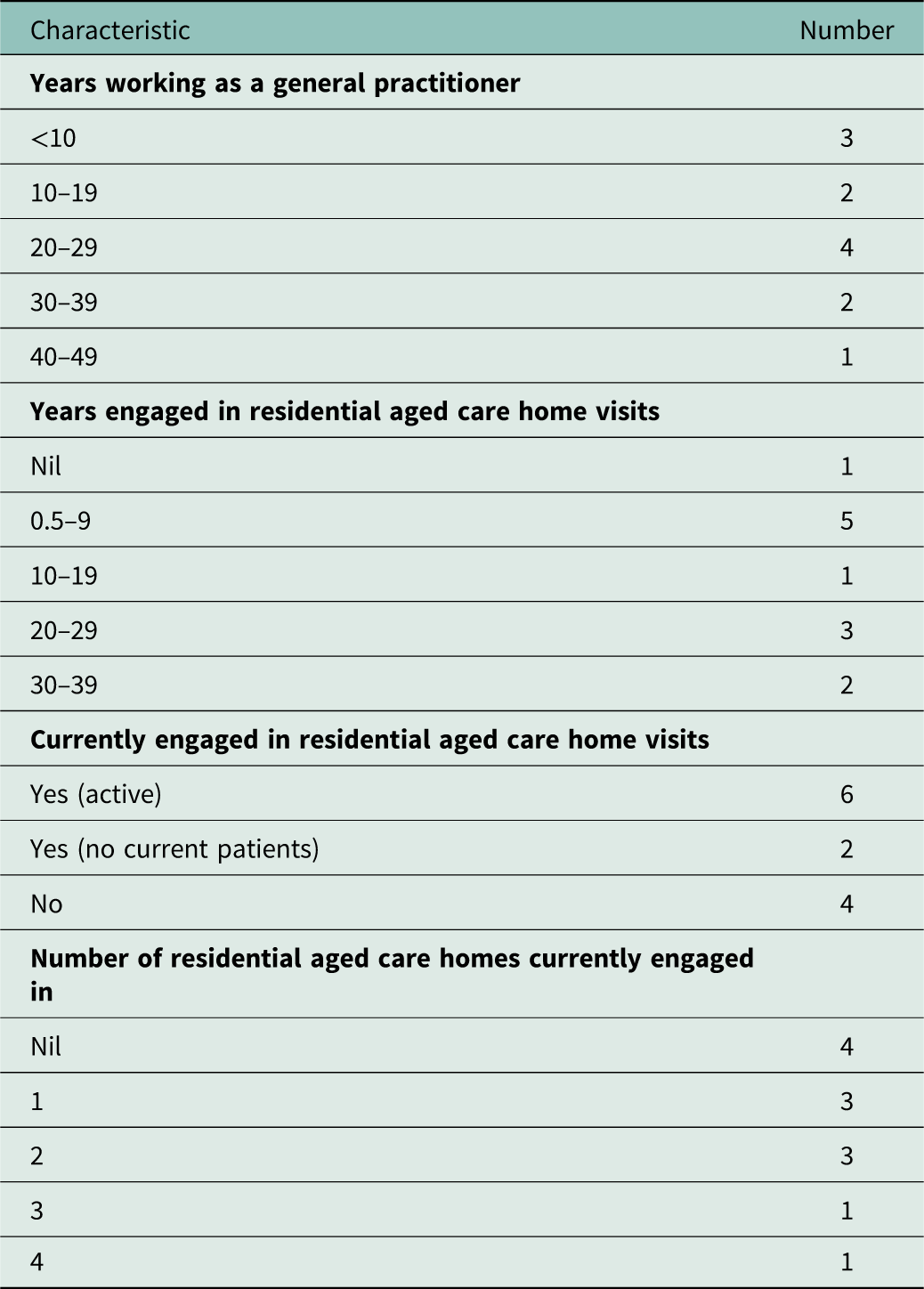
Twelve GPs participated in interviews (nine via video, two face-to-face, and one via phone). Median interview time was 24 minutes (range 18–49 minutes). GPs’ work characteristics are reported in Table 1.
Participant characteristics

Table 1. Long description
The table presents the characteristics of twelve general practitioners (GPs) based on their years of experience, engagement in residential aged care home visits, and current involvement in such visits. It has four main sections with row and column headers. The first section details the years working as a general practitioner with categories <10, 10-19, 20-29, 30-39, and 40-49 years, and the corresponding number of GPs in each category. The second section outlines the years engaged in residential aged care home visits with categories Nil, 0.5-9, 10-19, 20-29, and 30-39 years, and the number of GPs in each category. The third section indicates whether the GPs are currently engaged in residential aged care home visits, with categories Yes (active), Yes (no current patients), and No, and the number of GPs in each category. The fourth section shows the number of residential aged care homes currently engaged in, with categories Nil, 1, 2, 3, and 4, and the number of GPs in each category. Row 1: Years working as a general practitioner, <10, 3; 10-19, 2; 20-29, 4; 30-39, 2; 40-49, 1. Row 2: Years engaged in residential aged care home visits, Nil, 1; 0.5-9, 5; 10-19, 1; 20-29, 3; 30-39, 2. Row 3: Currently engaged in residential aged care home visits, Yes (active), 6; Yes (no current patients), 2; No, 4. Row 4: Number of residential aged care homes currently engaged in, Nil, 4; 1, 3; 2, 3; 3, 1; 4, 1.
GPs’ views and experiences of providing services in RACHs
Five themes were identified as influencing GP service provision in Adelaide RACHs. These themes, along with their corresponding elements, were mapped to the i-PARIHS framework (Harvey and Kitson, Reference Harvey and Kitson2016), highlighting innovation-, recipient-, and context-level factors that can inform future efforts to improve GP engagement and service delivery (Table 2).
Findings mapped to i-PARIHS constructs and characteristics

Table 2. Long description
A table mapping findings to i-PARIHS constructs and characteristics. The table has 11 rows and 4 columns. The columns are labeled Theme, Factor, Barrier, and Enabler. Each row describes a specific factor influencing GP service provision in Adelaide RACHs, categorized under themes such as Innovation, Recipients, Context (social), Context (organizational), and Context (internal health system). The table lists various factors, noting whether they act as barriers or enablers. For example, under the theme Innovation, factors like clarity, degree of fit with existing practice and values, and usability are listed, with some identified as barriers and others as enablers. The table provides a detailed breakdown of how different factors influence GP service provision.
# Theme 1: Poor remuneration and work–life balance; Theme 2: Growing demands, operational inefficiencies, and limited support; Theme 3: Regulatory and administrative burdens detracting from care; Theme 4: Small and diminishing cohort of GPs; Theme 5: Strengths and limitations across models of care.
Theme 1: Poor remuneration and work–life balance
GPs regarded remuneration for RACH visits as inadequate. Bulk billing, where GPs accept the Medicare rebate as full payment, was the prevailing norm. However, the rebates were considered insufficient: ‘Medicare rebates have way, way, way not kept pace with CPI [consumer price index]… we all struggle’ (GP6). This was ascribed to the wider lack of recognition of the value of primary care.
In RACHs, many tasks were ‘not paid at all, like the incessant phone calls’ (GP3). Consequently, GPs found RACH work less financially viable compared to practice work:
it’s a financially disadvantage to go and do work in the nursing homes. If I wanted to do best for my family, I would stay in my rooms and not go there (GP11)
Additionally, GPs were often expected to be on call: ‘after-hours work is part and parcel of nursing home work, unfortunately’ (GP2). This made it challenging for GPs to achieve a work–life balance: ‘I think it’s the on-call part which I found the most difficult… I don’t think it would actually really fit in with my life now with small children’ (GP1).
While alternative after-hours services (locums, SA Virtual Care Service, and extended care paramedics) were available, GPs expressed concerns regarding communication, care quality, and hospital transfer decisions associated with these services. Consequently, some GPs continued to provide after-hours care themselves despite the associated burdens: ‘I really don’t want to be called between 10 and 7… But I’d rather they call me than send someone to hospital or do something that is not particularly useful’ (GP8).
Telehealth was recognized as having a role in RACH work, particularly after hours: ‘quite a lot of things can be solved via telehealth… I definitely think there’s a role’ (GP1). Some GPs used telehealth pragmatically for ongoing or non-urgent issues, often via telephone: ‘Where something can be sorted out and it’s an ongoing issue, it can be sorted out on the phone… I do answer my phone so I will, of course, most weekends’ (GP8). For some, telehealth functioned as a first-line approach to after-hours care, particularly when supported by offsite access to clinical information: ‘if I don’t really have to go [to the RACHs], I will try not to go, try to work through the nurses. Because nowadays we can actually access the clinical notes from home’ (GP10). However, not all GPs had access to RACH notes while offsite, limiting their ability to manage residents remotely. In practice, telehealth was predominantly phone-based, with video rarely used. Barriers included video being ‘harder to organize’ (GP5) and limited facility infrastructure: ‘there was a talk about just starting some video conferences, but it never happened’ (GP7). Despite this, telehealth was considered underutilized: ‘telehealth should be used a lot more… it’s probably underutilized’ (GP1).
Theme 2: Growing demands, operational inefficiencies, and limited support
GPs widely perceived RACH visits as inefficient due to time spent travelling between sites, gaining access to facilities, and locating staff, residents, and records. Access delays were particularly evident after hours or when attending facilities infrequently. Recordkeeping was fragmented: ‘It’s like there is information but you don’t know whether it’s up to date. It’s like in all different places’ (GP12). While electronic records made ‘things very much easier’ (GP10), records were ‘not electronic still, in many places’ (GP5). Inconsistent electronic record systems across RACHs made access and navigation challenging, while poor integration between RACH and practice software necessitated duplication of notes. Some RACHs required GPs to document in multiple places. To enhance efficiency, GPs recommended improved interoperability between GP and RACH information systems and that RACH processes be ‘streamlined’ (GP9) and ‘standardized’ (GP12).
Beyond system inefficiencies, RACH work was described as highly demanding. This reflected the increasing clinical complexity of residents, alongside administrative requirements, and pressures from residents and families. GPs noted that residents often had ‘a little bit more incapacity’ (GP12) as ‘people are really sick usually when they get in there or unable to cope at home’ (GP6). At the same time, ‘patients are getting more complex. They’re living longer. So in terms of the time… [spent] with each patient, it also tends to be longer’ (GP10). Family involvement could further add to this workload, particularly when expectations differed from clinical recommendations. GPs described situations where families were perceived as ‘blocking good treatment’ (GP6), or where conflicting perspectives between residents and families required negotiation, which was described as taking up ‘much more time’ (GP2):
So their [residents’ families’] demands used to be unbelievable. So contending with that, those demands, was also challenging, that the mum, the parents, would be saying something, and the kids are saying something else. So you get stuck between the two, like, you know, should you treat or should you not treat? (GP2)
Gaps in support from RACH staff further compounded these operational and clinical challenges. These were attributed to sector-wide workforce issues, including staff shortages, high turnover, and variability in skills and knowledge. As one GP noted, ‘nursing staff are very busy… [with] a very high turnover’ (GP12). Limited staffing capacity restricted the provision of non-pharmacological care: ‘they just haven’t got the staff… to keep them [residents] calm and keep them distracted’ (GP11) which in turn influenced clinical decision-making. GPs noted that ‘there are lots of things that might be done better without medicines that you end up maybe doing with medicines because there aren’t enough staff’ (GP3).
Variability in staff skills and knowledge also affected the reliability of resident information provided to GPs:
there is not as much personal knowledge of the residents… there’s been a loss of long-term staff over time. And the agency staff and the new staff replacing them are variable quality… language barrier is an issue as well because it’s quite a few staff whose English is their second language (GP11)
In this context of fragmented systems and variable staffing, familiarity with residents and staff emerged as a key mechanism for navigating RACH work. GPs emphasized that ‘knowing the patients very well makes them easier to manage… [and] determining the key staff who know what’s going on’ (GP11). Such familiarity helped mitigate risks arising from information gaps, with one GP describing being contacted about incorrect cases: ‘a lot of the time, I got called for things and then it’s like the wrong patient or the wrong patient’s chart. And luckily, like, I knew my patients well enough’ (GP12). Strong relationships with RACH staff were therefore considered critical, with one suggesting that these relationships were more important than the specific MoC: ‘one or two staff that you always speak to… makes things a lot easier’ (GP10).
At a service delivery level, regular scheduled visits were seen to improve efficiency and support ‘continuity with staff’ (GP8). Predictable visit schedules enabled RACH staff to organize staffing and ensure relevant information was available, facilitating more efficient consultations. In addition, consistent visit days increased the likelihood of engaging with the same staff, supporting continuity with staff familiar with residents, who may only work on certain days. GPs emphasized the importance of scheduling visits during standard working hours, as after-hours visits were less efficient due to limited staff availability and difficulties accessing records. However, GPs also noted potential trade-offs, including a ‘risk of overservicing’ (GP3) for those with fewer residents, and the impracticality of this approach for GPs managing large numbers of residents across multiple facilities.
At a broader system level, GPs described limited external support, alongside pressures such as ambulance ramping and hospital bed shortages. Residents in RACHs were sometimes perceived as being prematurely categorized as palliative within acute care settings, resulting in reduced access to active treatment:
So there is a tendency to the hospitals to see nursing home patients as you know: ‘Old people dying, they’re going to clog up our waiting rooms, they’re going to clog up our hospitals. Get them back out into the nursing home. And if they’re old and sick, well, they’re palliative.’… They clearly weren’t palliative. They deserve active treatment, but they weren’t getting it. (GP11)
Theme 3: Regulatory and administrative burdens detracting from care
GPs expressed frustration that legislation and bureaucracy fostered a risk-averse culture and excessive paperwork, reducing the time and capacity for both GPs and RACH staff to focus on direct resident care, with little perceived benefit. As one GP explained, documentation requirements could become overly complex and compliance-driven:
now you’ve got the care facility sort of badgering the doctors to write ‘anxiety disorder’ as reason for medication rather than ‘anxiety’. Because if it’s ‘anxiety’, that’s not a medical diagnosis and it counts as chemical restraint. And then, ‘Can you fill out a chemical restraint form? Can you click through all these other…? And can you do it, you know, ASAP because, like, accreditors might come in any minute? (GP4)
Consent requirements for psychotropic prescribing were also identified as a significant barrier, particularly for residents with cognitive impairment:
It’s a very difficult task to start it because most of the patients [have] got dementia, they can’t decide, so you need to get the consent from the next of kin, which is very difficult because you can’t contact them. (GP7)
Medication review requirements were perceived as inflexible and not always aligned with clinical need. GPs described a ‘one size fits all’ approach, resulting in unnecessary reviews for stable residents while limiting flexibility for more complex cases:
you end up having to do things that are also unnecessary. So someone who’s been stable on medication that is going to be lifelong for them… you could review much less often, because there’s no reason to do it. And there might be other people’s medication that needs to be reviewed much more often. (GP8)
These constraints were seen as particularly problematic at end of life, where regulatory barriers could limit appropriate symptomatic management: ‘People with end-stage dementia do get agitated and it’s not pleasant… But because there are barriers to use medication, it’s not always used as much as necessary’. (GP8).
GPs also expressed concerns that policy instruments, including the recently introduced GPACI, did not adequately reflect the fluctuating needs of residents. While the previous incentive structure was primarily activity-based, GPACI requires at least two visits per quarter, each delivered in a separate calendar month. However, resident care often occurs in bursts of higher intensity:
I am frustrated by the fact that I’m going to see people at times unnecessarily so that I can be sure that I can get the incentive payment [GPACI]. And if I don’t get the incentive payment… it’s not financially viable… (GP8)
‘you might have seen them five times the week before, but if you don’t see them again, it falls away’ (GP8).
More broadly, GPs described the need to adapt care to fit funding structures rather than clinical need: ‘It’s the same with all Medicare things. You’ve got to work out how the system works and work into the system. Doesn’t necessarily provide better care’ (GP8).
Incentive structures were also seen to discourage shared care between GPs servicing the same facility. As payments were tied to patients registered under individual providers, this created disincentives for reviewing residents not formally linked to them:
And sometimes when I’m in there, the nursing staff will say, ‘Oh, do you mind reviewing Dr X’s patient…’ …But then I don’t get paid as much because he’s not on my list (GP6)
For many GPs, recent reforms were viewed as well-intentioned but constrained by their regulatory approach:
there is an essence that is good, but… can you legislate good care?… you can only do it by putting parameters in, but then those become onerous and sometimes restrictive in what you can do. (GP8)
Theme 4: Small and diminishing cohort of GPs
GPs highlighted RACHs’ reliance on a small, ageing GP workforce, raising concerns about workforce sustainability: ‘We’re all getting old and grey and there’s no one to replace us is the problem’ (GP11). Existing shortages were associated with episodic care delivery and challenges in arranging leave cover.
GPs attributed this in part to declining engagement among early-career GPs. Financial considerations were seen as a key factor, with early-career practitioners described as having ‘big mortgages paying off loans’, making them less inclined to engage in RACH work where they ‘make less money’ (GP11). Reduced exposure to RACH work during training was also highlighted: ‘they don’t get exposed to [RACHs] as much because there’s less GPs doing it… don’t get much of an opportunity to go into the nursing homes to see what the work’s like. And it just seems too difficult for them’ (GP11). In addition, early-career GPs may not yet have established long-term patient relationships that extend into aged care: ‘Maybe as I get older and throughout my career, I’ll be probably managing more older patients and then I’ll be possibly considered more looking after people in their homes or in aged care facilities’ (GP9).
As a result, the sector was perceived to depend on the goodwill of a small group of committed practitioners, motivated by professional values such as providing ‘cradle to grave care’ (GP3) and upholding the ‘tenets of family medicine’ (GP10). A sense of duty and passion for caring for older people often outweighed financial considerations. Nevertheless, GPs reported limiting the number of RACHs or residents they served to maintain care quality or manage the time demands associated with RACH work.
Theme 5: Strengths and limitations across models of care
Overall, GPs acknowledged that ‘there are pros and cons of everything’ (GP8) and ‘probably no one model that’s going to work best for everybody’ (GP5). They shared about the strengths and limitations of the various MoC, as follows.
5.1 Continuity model: where GPs continue caring for long-term clients who transition from community into RACHs, GPs valued the ability to maintain long-term relationships. It allows GPs to know residents ‘when they were much more well’ and what they ‘wanted before they lived in the aged care facility’ (GP3). Its adoption, however, is limited by distance, as ‘it’s just not feasible for GPs to be traipsing across town’ (GP8) for clients who move into RACHs located further away. Financial viability is another issue, as GPs may have only a small number of residents in each RACH: ‘there are no economies of scale which you would [otherwise] get if you had lots of people to go and see’ (GP3). As GPs would be working across various RACHs, ‘it can be really time-consuming to learn new systems and meet new staff’ (GP3).
5.2 Regular visiting GP model: Where GPs are aligned with specific RACHs, the ability to have ‘a whole session worth of patients to go and see’ (GP3) was seen as a key advantage. This facilitates regular scheduled RACH visits and ‘makes it financially a bit more viable’ (GP6). However, drawbacks include reduced familiarity with residents’ histories and potentially inadequate handover from community GPs.
5.3 In-house GP model: While no GP adopted the in-house GP model, whereby GPs are employed by RACHs, several believed that this ‘kind of system will work best’ (GP12). This could provide improved GP coverage and more timely care, as GPs ‘could be doing… a routine review, and then a[n] accident or incident happen[s], and then they can go’ (GP10). Being ‘committed to be there that day’ was seen to make roles and escalation pathways ‘really clear for everyone’ (GP12). Nevertheless, GPs acknowledged some GPs may dislike being ‘bound by the regulations of the nursing home… [as an] employee’ (GP10) and ‘want to be their own boss and go in their own time and decide how they want to run things’ (GP12).
5.4 Team-based model: Some GPs recognized the role for practice nurses: ‘having the nurses is really useful like just so that you can notate like – just as an extra helper, really’ (GP12). One also saw the value of interns: ‘They’d go see all my residents before I go in. So that saved me a lot of time, as they go see what the problems are, they do medication lists, they order pathology’. (GP11).
With nurse practitioners (NPs), GPs found it ‘tricky to know sort of what the GPs’ supervisory role is like’ (GP1). While GPs acknowledged that ‘good nurses can do a lot of good things’ (GP5), they felt ‘some complex things that perhaps are better managed by GP’ (GP1) and ‘it’s best if they [NPs] are working with or for the GPs or the general practice rather than doing it by themselves’ (GP5).
5.5 A rostering system: some GPs proposed a shared rostering system to ensure regular GP cover in RACHs, enabling timely identification and management of residents’ needs and reducing gaps in care between visits, where issues might otherwise ‘get missed’ (GP12) and only identified once acute.
And what you really need… a decent number of patients shared between a group of doctors so that you know someone goes into the nursing home every day. Five doctors, and everyone spends, you know, 1 1/2 day a week in the nursing home… and then you know they’re on call after hours if required – you get much better care of the residents. (GP11)
It would work if you had some sort of rostering system and buddy system where… maybe you had your own patients, but you knew that on the other days, if there was anything that came up like a small thing that someone was there to cover (GP12)
GPs emphasized that residents should retain a regular GP, with a rostered on-site GP providing cover, and highlighted the importance of effective communication and handover between GPs for the system to function well.
Discussion
The findings revealed that GPs reported significant barriers to the provision of services in RACHs, including poor remuneration and work–life balance, growing demands, operational inefficiencies, and limited support, reflecting national trends (Burgess et al., Reference Burgess, Davis and Morgans2015; Pearson et al., Reference Pearson, Mullan, Ujvary, Bonney and Dijkmans-Hadley2018). These challenges have reduced engagement among early-career GPs, leaving RACHs increasingly dependent on a small, ageing workforce. With only a small proportion (34%) of early-career GPs in Australia engaged in RACH visits (Turnock et al., Reference Turnock, Fielding, Moad, Blowes, Tapley, Davey, Holliday, Ball, Bentley, FitzGerald, Kirby, Spike, van Driel and Magin2024), and projected GP undersupply over coming decades (Australian Government Department of Health and Aged Care, 2024), there is an urgent need to address these barriers to sustain general practice capacity for an ageing population.
Central to this is improving remuneration for RACH work. Consistent with reports nationally (Burgess et al., Reference Burgess, Davis and Morgans2015; Wisbey, Reference Wisbey2024; Woodley, Reference Woodley2019), GPs reported that Medicare rebates inadequately reflect the complexity of resident care and volume of unremunerated RACH tasks. Streamlining and standardizing fragmented recordkeeping and documentation systems were also highlighted as key areas for improvement. Additionally, recent changes to financial incentive and prescribing requirements were seen to introduce substantial administrative and prescribing burdens and not always aligning with individual resident needs, underscoring opportunities for refinement to reduce unintended impacts.
Telehealth, while recognized as valuable, particularly for after-hours care, remains underutilized, especially for video consultations. Barriers such as infrastructure limitations and coordination challenges likely contribute to the gap between policy intent and practice. In this study, telehealth was predominantly telephone-based, used pragmatically for ongoing issues and, for some GPs, as a first-line approach after hours, enabled where clinical notes could be accessed offsite. However, this was not universal, limiting its safe and consistent use. Despite Medicare funding and broader policy support (Australian Government Department of Health, Disability and Ageing, 2025, 2026), these findings suggest telehealth in RACHs remains constrained by practical implementation challenges, with emerging research (e.g. GRACE video-telehealth project (Carrigan et al., Reference Carrigan, Baysari, Luscombe, McCormack, Von Huben, Tyagi, Taggart, Nash, Willcock, Wilkinson, Barnett, Bonney, Rhee, Pearce, Robinson, Chen, Vagholkar, Russell, Chua, Shaban, Soumya, Sengupta and Makeham2026)) likely to clarify its role.
Enablers of GP engagement in Adelaide RACHs included intrinsic motivation embedded in duty, passion, and long-term relationships with residents. At a service delivery level, regular scheduled visits – particularly during standard hours – were seen to improve efficiency, enable economies of scale, support continuity with RACH staff, and promote proactive care.
Support from team members such as practice nurses and interns was also viewed as valuable during RACH visits, highlighting opportunities to further explore and optimize these roles to better facilitate GPs’ service delivery. Additionally, knowing residents helped prevent errors, while strong relationships with RACH staff facilitated smoother navigation of facility processes. These findings align with evidence that MoC involving regular GP contact and collaboration with nursing staff are associated with improved provider satisfaction and care processes in RACHs (Marshall et al., Reference Marshall, Burns, Riddiford-Harland, Poulos, Poulos, Montague, Lewis, Pearson and Rhee2025).
Some GPs proposed a shared rostering arrangement in which GPs maintain responsibility for their own residents while an on-site GP provides interim cover between visits. This approach was seen to facilitate proactive and timely care. As this would support regular scheduled visits and on-site GP presence, this may facilitate collaboration and multidisciplinary practice (Johal et al., Reference Johal, Block, Dymmott, Dent, Exley and George2026). A shared rostering system may mitigate the earlier identified barriers by improving GP work–life balance through easing on-call burden, reducing inefficiencies through familiarity with specific RACHs, decreasing reliance on staff for information via more frequent on-site presence. Although this approach may involve a transition away from residents’ community GPs, long-term relationships can still form between residents and GPs responsible for ongoing care over time. Given its potential, trialling and evaluating this approach in future research is warranted.
Limitations
The use of convenience sampling limited the representativeness of the study, as not all MoC in RACHs or views of GPs without RACH experience were adequately captured. Additionally, the short interview duration limited the depth of discussion, although longer interviews with some participants allowed for more detailed exploration of issues.
Conclusion
GP engagement in the provision of services to residents in Adelaide RACHs is limited by poor remuneration and work–life balance, system inefficiencies, high demands, and inadequate support, mirroring national trends and raising concerns about workforce sustainability. Recent sector changes were perceived as contributing to administrative and prescribing hurdles and may not fully align with individual resident needs. Addressing these barriers requires improved remuneration that considers non-billable tasks and complexity of residents’ needs; streamlined and/or standardized RACH information management; and adjustments to recent prescribing and administrative requirements. With GPs acknowledging the support that team members, such as practice nurses and interns offer during RACH visits, it is worth exploring the optimization of their roles. At the service level, regular scheduled visits during standard hours, along with strong knowledge of and relationships with staff and residents were identified as key. A shared GP roster system, proposed by multiple GPs, may enhance access, continuity, and coordination while reducing on-call burden and inefficiencies associated with RACH work. This approach warrants further trial and evaluation in future implementation research.
Supplementary material
The supplementary material for this article can be found at https://doi.org/10.1017/S1463423626101844.
Data availability statement
The data for this study will not be shared, as we do not have permission from the participants or ethics approval to do so.
Acknowledgements
The authors would like to thank Adelaide PHN staff for supporting recruitment by sharing the study opportunity with their network. The authors are also grateful to Dr Chad Collins, Adelaide PHN, and Dr Joel Rhee, The University of New South Wales, for their time and expertise in reviewing and providing valuable input into the interview questions.
Author contributions (CRediT roles)
Jolyn Johal: Writing – review & editing, Writing – original draft, Project administration, Methodology, Investigation, Formal analysis, Data curation, Conceptualization. Heather Block: Writing – review & editing, Supervision, Methodology, Investigation, Formal analysis, Conceptualization. Alison Dymmott: Writing – review & editing, Supervision, Methodology, Investigation, Formal analysis, Conceptualization. Helen Exley: Writing – review & editing, Supervision, Methodology, Investigation, Formal analysis, Conceptualization. Stacey George: Writing – review & editing, Supervision, Methodology, Investigation, Formal analysis, Conceptualization.
Funding statement
This work was supported by funding from the Adelaide PHN, through the Australian Government’s PHN Program, and Flinders University of a co-funded Enterprise PhD Scholarship.
Competing interests
None.
Artificial intelligence (AI)
Microsoft Copilot was used to assist in re-phrasing and summarizing of text for clarity and succinctness, following the completion of the initial manuscript draft first without AI assistance. All content was reviewed and verified by the authors.


 Open access

